co
Software, Programming
,
and Future Developments
r
-PERIODICALS SEC 1263 56856
SAN
JOSE
PUBl LIBRARY
0104
MARKET
~
SAN
F~R
ANOO
*N1268
SA
J
OSE
CA
95113
.«
Perry Publications
is making headlines with this system
The system was designed so Perry's 26 daily
Florida newpapers could use one computer
cen-. ter in West Palm Beachcen-.
Every day the Perry papers send their display
advertising and editorial matter to the center to
be prepared for typesetting machines.
Since speed is essentia I, Perry set up 14 trans*
mitting-receiving centers where newspaper
copy is put on paper tape. The tapes are sent via
Type 2 Dataspeed*Service (at 1050 words per
minute) to West Palm Beach.
At the center, tapes are read into the
com-puters at 1000 characters per second, using
pho-toelectric readers. The computers
have
a 50,000
word dictionary programmed into them, so that
copy can be prepared in newspaper column
widths and words hyphenated, where necessary.
The output of the computer isa new tape
which is returned by Dataspeed service and fed
directly into typesetting machines.
If moving information in a hurry will help you
make more efficient use of your computer
instal-lation ,talk with Our Communications
Consul-I1ii\
tant. He'll help you plan a
~
At'?!!
::'~~::a:~o~t~~~~/~:t~:adline.
m
DataspeedE3
Service r7"IIIIf Bell System LJ.-.I Central OfficeAnyone can promise you time-sharing software.
We can demonstrate it.
Nearly every computer manufacturer has some sort of
time-sharing hardware ready to deliver.
Including us.
But when you ask a computer salesman about
software, he's likely to start talking about the
future. Because what most computer
manu-facturers have to offer is an operating
sys-tem, a primitive FORTRAN, and a
tape full of promises.
Not us.
When we sell you a 940
time-sharing system it comes
com-plete with an operating system,
plus BASIC (a programming
tool for beginners) plus a conversational
algebraic language, plus a conversational
FORTRAN IV, plus a FORTRAN II, plus
a powerful text editor, plus a two pass assembler, plus a
ma-chine language debugging package, plus a whole library of
programs and subroutines. All operating and ready to work.
Now.
The reason we have more is that we've been at it longer. We
started working on time-sharing in prehistoric times, almost
two years ago. Since then we've sold our 940's to companies,
to research institutes, and to time-sharing utility service
cen-ters. And they have used them for everything from character
recognition to locating a 4-door sedan with red upholstery in
a car dealer's inventory.
So when you ask an SDS salesman
5 C 5
about time-sharing software he won't
start talking about the future. He'll
plug in his teletype unit and put you in
direct contact with our 940 computer.
Scientific Data Systems,It
can speak for itself.
Santa Monica, California4
FEBRUARY, 1968, Vol. 17, No.2
41 Across the Editor's Desk
-Computing and Data Processing Newsletter
(For detailed contents, see page 5)
58 Advertising Index
57 Books and Other Publications
39 Calendar of Coming Events
57 C&A Problem Corner
6 Letters to the Editor
SPecial Feature:
Software, Programming, and Future Developments
14
THE PROGRAMMING PROFESSION, PROGRAMMING THEORY, AND
PRO-GRAMMING EDUCATION
by larry L. Constantine
A candid look at the complex of attitudes, formal practice, ethics, and social structure rele-vant to the lfuestion: Is programming a profession?
22
MULTIPROGRAMMING: WHAT IT IS . . . WHEN TO USE IT . . . WHAT TO
LOOK FOR
by Michael Mensh
Some guidelines to help computer users determine whether a multiprogramming system offers a reasonable solution to their programming problems.
26
AN INTERACTIVE PROGRAMMING SYSTEM FOR THE CASUAL USER
by Morton I. Bernstein and Thomas G. Williams
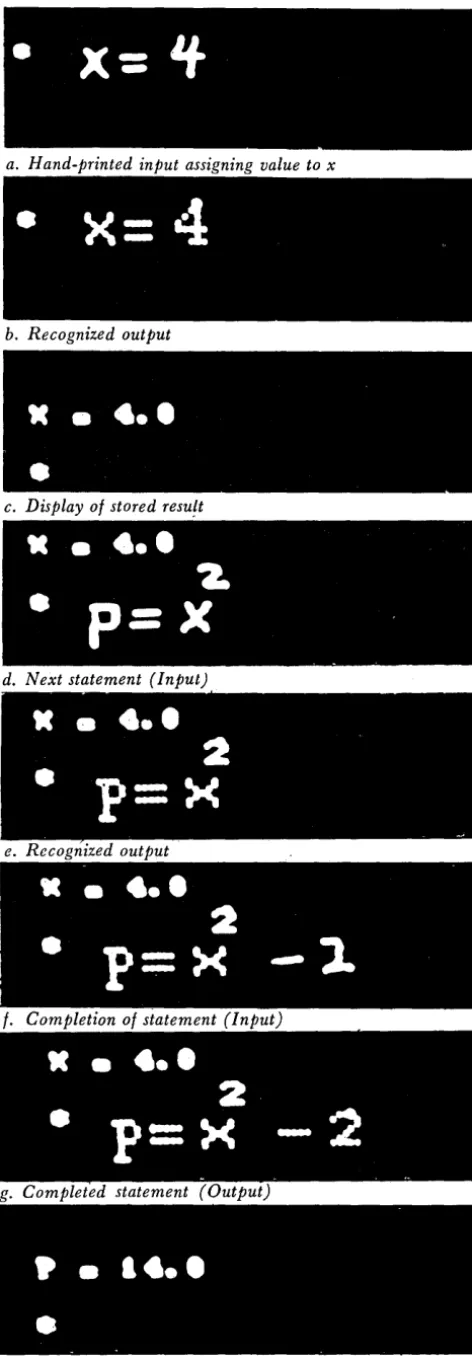
A prototype of a graphic programming system that is economical, simple to use and under-stand, and requires almost no notational change in the way problems are conceived and expressed.
32
PROPRIETARY PROTECTION OF COMPUTER PROGRAMS
by Sheldon J. Dansiger
An examination of four different methods for marketing software . • . with an evaluation of each method.
8
Editorial,
by Edmund C. BerkeleyThe Problem of Keeping Up With One's Reading
20
Market Report
Control Data Corporation Plays Increasingly Important Role in World Computer Market, by Ted Schoeters
36
World Report -
Great Britain,
by Ted Schoeters54 Monthly Computer Census Implications of the possible merger between International Computers and Tabulator Co. and
52 New Contracts
53 New Installations
58 New Patents
by Raymond R. Skolnick
English Electric.
37
World Report -
Australia,
by W. R. CooperHow the first recession to hit the computer industry in Australia has affected the major in-dustry suppliers; first Australian-designed computer is announced.
35
Jobs and Careers in Data Processing
Computers Open New Path to Rapid Promotions in Business, by Greg Zenner
29
Ideas: Spotlight
Mind StretchingMulti-Access Forum
10 1968 Prediction for the Computer Industry, by Isaac l. Auerbach
10 The General Services Administration V/.!:lnts More for the United States' Computer Dollars 11 Utah Computer Researchers Create "Idea Photographs"
11 Automation and the Proposed Minimum Annual Income: Subject for Debate
12 Contributions Welcome to "Who's Who in the Computer Field"
12 ACM Professional Development Seminars
13 Award to be Given for Outstanding Contribution in the Field of Automatic Control
APPLICATIONS
The Iront cover shows illustrations
01
a graphic programming system being developed at System Development Corp., Santa Monica, Calil. The "spokes"01
the wheel show "Some examples0/
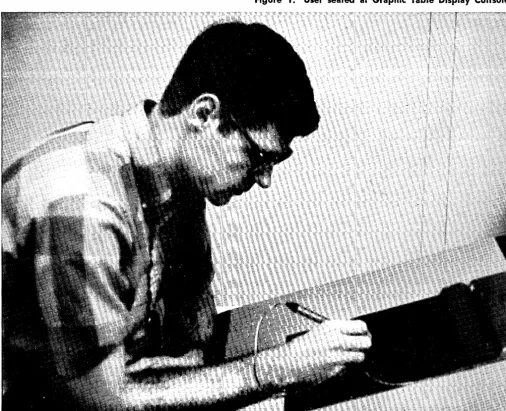
interactive character recognition and computational ability provided by the system,. the picture at the center shows a user seated at a graphic display console. For more in/ormation, see "An Interactive Programming System lor the Casual User," beginning on page 26.ACROSS THE EDITOR'S DESK
Computing and Data Processing Newsletter
41 Navajo Tribe Using Computer to Perform More than 125 Dis·
47 47
Indiana General Introduces New Molded Memory Plane Electronic M·emories Adds 900 Nanosecond System to
Nano-memory line
41 42
42 42
43 43
43
44
44
44 44
tinct Projects
Essex Wire Corp. Computer Tests Thermostats Automatically Documentary Evidence for Court Case Organized by Computer
at Information Engineering
Texas Instruments Uses Computer-Centered Circuit Calibrator National Bureau of Standards Institute for Materials Research
Applies Automation at the Crystal Data Center Computer is Operating Drilling Rig for Humble Oil
IBM Computer Helps Century-Old Machine Turn Out Heat Shields for Astronauts
Two Mile long Electron Beam Probes Atom with Aid of Com-puter
ORGANIZATION NEWS
Four Top Computer Management Officials Form Computer learn-ing Corp.
GE and Systems Capital Corp. Agreement Makes Some GE Computers Available for long-Term leasing
Paragon Systems Enters Digital Peripheral Field
NCR, Sanders Associates Announce Multi-Million-Dollar Agree-ment
47 48
48 48 48 48 48 48
49
49
Software
Audiodiagrammer - Software Resources Corp.
Automated Circuit Card Etching layout (ACCEl), MOD 1 -Sandia Corp.
COBOL-AID - Computer Results Corp. GENCO - Software Resources Corp. MIS/leasing - The Service Bureau Corp. Model 101 - Computer Corp. of America
Payroll Accounting System - Software Resources Corp. Teller-Register Unit Monitoring Program (TRUMP) - Honeywell
Electronic Data Processing
DatC!l Collection
Data Collection System from Electron Ohio Inc. for Industrial Plants
Peripheral Equipment
Motorola Reader Enters Data from Punched or Mark-Sensed Cards and Documents
44 Computer Applications Inc. Purchases Home Testing Institute/ 49 49 50 50 50
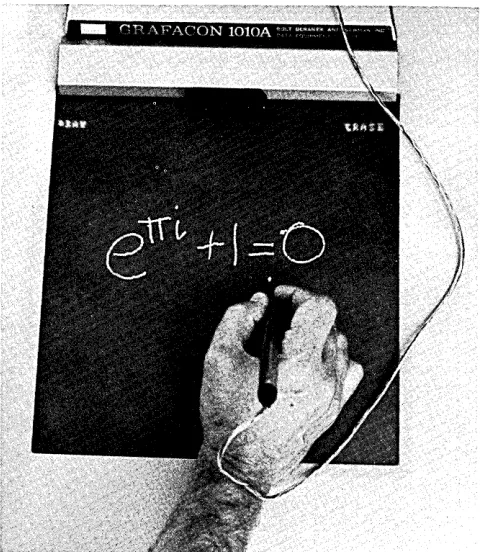
Remote Recording for IBM's Magnetic Tape Selectric Typewriter Analog-to-Digital Converter, DATRAC IV, from EPSCO, Inc. Grafacon 205-1 Magnetic Tape Digitizing System
TvQ, Inc.
45 Cook Electric Company and laboratory for Electronics Agree to Digitronlcs Model 2540, Perforated Tape Reader Merge
EDUCATION NEWS
50TEC Data-Screen Display Terminal Combines Fixed and Vari-able Message Display
45 Ohio State to Grant Degrees in Computer and Information
Interface System for Use with IBM 1130 Computer from Time Sharing Associates
Science
45 Arkay International Announces Desktop Teaching Machine
Data Processing Accessories
COMPUTER RELATED SERVICES
5151
Audio Devices New Audev K-68 Magnetic Tape
45 Computer Campaign Services, a New Counseling Service "Minireels" of Magnetic Computer Tape Available from Audio Devices
46
46 46
NEW PRODUCTS
Digital
IBM Adds Model 25 to System/360
Memories
Direct Access Storage System for Univac 9000 Series Memorex 630 Series Disc Drive
Editor and Publisher: Edmund C. Berkeley
51
51 51 51
BUSINESS NEWS
Computer Sciences Corp. Applies· for Withdrawal of Proposed Shares Offering
leasco Reports Income Rise for Fiscal 1967 Compudyne Reports Profit for Fiscal 1967
ADAPSO Suit to Bar Banks from Selling EDP Service is Rejected
Assistant Editors: Moses M. Berlin, Charlene J. Hofer, linda ladd lovett, Neil D. MacDonald
Contributing Editors: John Bennett, Andrew D. Booth, Dick H. Brandon, John W. Carr, III, Ned Chapin, Alston S. Householder, Peter Kugel, leslie Mezei, Rod E. Packer
Advisory Committee: T. E. Cheatham, Jr., James J. Cryan, Richard W. Hamming, Alston S. Householder, Victor Paschkis Art Director: Ray W. Hass
Fulfillment Manager: William J. McMillan, 815 Washington St., Newtonville, Mass. 02160 617-332-5453 Advertising Representatives: NEW YORK 10018, Bernard lane, 3Z West 39 St., 212-279-7281
CHICAGO 60611, Cole Mason Deming, 737 N. Michigan Ave., 312-787-6558 lOS ANGELES 90005, Wentworth F. Green, 300 S. Kenmore Ave., 213-387-8135 SAN FRANCISCO 94123, Richard C. Alcorn, 2152 Union St., 415-897-1620
ElSEWHERE, The Publisher, 815 Washington St., Newtonville, Mass. 02160, 617 -332-5453
:lrnr\A'B'~\ COMPUTERS AND AUTOMATION IS PUBLISHED MONTHLY AT 815 WASHINGTON ST., NEWTONVILLE, MASS. 02160, BY BERKELEY ENTERPRISES, INC. PRINTED IN U.S.A. SUBSCRIPTION RATES: UNITED
. '~~!il' STATES, $15.00 FOR 1 YEAR, $29.00 FOR 2 YEARS, INCLUDING THE JUNE DIRECTORY ISSUE; CANADA, ADD SOc A YEAR FOR POSTAGE; FOREIGN, ADD $3.50 A YEAR FOR POSTAGE. ADDRESS ALL •••• ".,. EDITORIAL AND SUBSCRIPTION MAIL TO BERKELEY ENTERPRISES, INC., 815 WASHINGTON ST., NEWTONVILLE, MASS., 02160. SECOND CLASS POSTAGE PAID AT BOSTON, MASS.
POSTMASTER: PLEASE SEND ALL FORMS 3579 TO BERKELEY ENTERPRISES, INC., 815 WASHINGTON ST., NEWTONVILLE, MASS. 02160. © COPYRIGHT, 1968, BY BERKELEY ENTERPRISES, INC. CHANGE OF ADDRESS: IF YOUR ADDRESS CHANGES, PLEASE SEND US BOTH YOUR NEW ADDRESS AND YOUR OLD ADDRESS (AS IT APPEARS ON THE MAGAZINE ADDRESS IMPRINT), AND ALLOW THREE WEEKS
FOR THE CHANGE TO BE MADE.
ELlS ...
.. 1:11:1
FOR PEOPLE WHO THOUGHT THEY COULDN'T AFFORD A DIGITAL COMPUTER
A
$ 4900
DIGITAL
COMPUTER
2 MICROSECOND CORE STORE.
'400 NANOSECOND READ ONLY STORE.
6 J.L SEC FULL WORD ADD TIME. MICROPROGRAM MABLE.
UP TO 256 I/O. DEVICES.
ALL DTL INTEGRATED CIRCUIT CONSTRUCTION.
~ELBIT
COMPUTERS LTD.
88, HAG I B 0 RIM S T R E E T
• P.O.B. 5390. HAIFA .ISRAEL.
Designate No. 21 on Reader Service Card
LETTERS
T 0
THE
Programmer/Correspondent Sought
I am a trainee programmer at a com-puter installation in Bulawayo, Rhodesia, and I feel that it would be helpful for me to correspond with a young pro-grammer in America. I am 22 years of age.
I would be extremely grateful if I could get in touch with anyone willing to correspond with me either by pen or by tape recordings. Can you help me? M. J. FROST
5, Rosal House 12th Ave./Rhodes St. Bulawayo, Rhodesia
(Ed. Note - This seems like a good op-portunity for some desirable exchange. If someone is interested, please write di-rect to Mr. Frost.)
FCC Inquiry and
Applications of Computers
The Univac Division of the Sperry Rand Corp. would like, in its response to the Notice of Inquiry of the Federal Communications Commission, 9 Novem-ber 1966, to reproduce the list of "Over 1200 Applications of Computers" from The Computer Directory and Buyers' Guide, 1967 (the June, 1967 issue of
Computers and Automation). Full cred-it will, of course, be accorded.
The Inquiry, as you probably know, is a far-reaching one consisting of ten major questions bearing upon data processing and communications, ad-dressed to participants in the data pro-cessing industry. Our purpose in quot-ing your list of applications is to show in item-by-item form, as you have done, how extensive these applications are. H.Y.GREENBERG
Director of Data Communications Univac Div. of Sperry Rand Philadelphia, Pa. 19101
(Ed. Note - Permission granted.)
Study in the U.S.
My company has awarded me an in-dustrial scholarship which I intend to use visiting the United States to study aspects of computer project manage-ment, planning and control.
From the events calendar published in your magazine, it is apparent that you
are closely in touch with the data pro-cessing training scene. Do you have a comprehensive list of EDP courses and seminars to be held in the spring of 1968?
I am particularly interested in any courses organized by the Departments of Continuing Education in American universities or colleges.
D. L. BOWLAND
Company Systems Officer Thomas Bolton & Sons, Ltd. Froghall, Stoke-on-Trent Staffordshire, England
(Ed. Note - We have no listing other than our HCalendar of Coming Events," but we suggest you contact the persons listed there. By now the courses or-ganized in A merican universities prob-ably number 50 to 100, and specific in-formation could be obtained by writing to various universities in the area which you plan to visit.)
Training Programmers
I read with extreme interest John J. Mason's article, "Business Systems Analysis - An Orderly Approach," in your August, 1967 issue.
I am an Assistant Methods Analyst with The Prudential Insurance Company of America and would like to use this article when training our young pro-grammers in systems development work.
It would be appreciated if you could send me a copy of this article or your permission to reprint it for my own use. L. F. HUBER
Jacksonville, Florida 32211
EDITOR
Battles By Computer - Final Results
May I call your attention to an editorial slip? Your article (Battles By Computer, November, '67, p. 12) stated that "Jack Dempsey became the cham-pion (boxer) when he knocked out Gen-tleman Jim Corbett in the seventh round." That fight was only a prelim-inary bout in the 13 week world's championship elimination tournament. The final round was broadcast here in Washington, D.C., by WTOP on December 18, 1967. Rocky Marciano became the greatest boxer that ever lived, according to the computer, by knocking out Jack Dempsey in the 13th round of an otherwise even match (4 rounds each and 4 draws). Inci-dentally, he wins $10,000 and a golden belt for this.
WENDELL WEATHERFORD
Silver Springs~ Md. 20901
Praise for Pictorial
Mr. Pierre F. Simon, head of our company, was very much impressed with your issue of December, 1967 (An-nual Pictorial Report on the Comput-er Field) . Please send six additional copies to him and bill us accordingly. MRS. SHIRLEY COHEN
Machine & Products Co. New York, N.Y. 10005
We are interested in the Fifth Edition of Who's Who in the Computer Field.
When will it be available for sale, and what will be its price?
LOUISE LA LONDE, Librarian Control Data Corp.
Minneapolis, Minn. 55440
(Ed. Note - See announcement in "Multi-Access Forum" in this issue.)
NUMBER1
IN NUMBERS
-9
The world's most versatile
PERSONAL CALCULATING
SYSTEM
thinks in logarithms ...
answers in decimals
THE MODEL
370 GIVES YOU
MOST OF THE ADVANTAGES
OF A BIG COMPUTER ... WITH NONE OF THE
• Expandable, random-access core memory
• Looping, branching, subroutines • Extraordinary power and versatility - handles statistical computations, simultaneous equations, problems with logs and exponentials, etc. • Time-sharing - fully compatible with standard 320 series for "in-field" expandability
• Extensive software library • Modular design - buy only the functions you ne.ed; add more capa-bilities at any time.
DISADVANTAGES
• No major investment required -price in upper "calculator" range • No waiting - always available at your fingertips
• No special language needed -programs in minutes in simple key-board format
• No space problems - compact keyboard! control console takes little more room than a phone on your desk; small electronics unit takes no more room than a desk drawer and may be located up to .50' away.
DEPARTMENT 0000, 836 NORTH STREET, TEWKSBURY, MASSACHUSETTS 01876 • TEL. (617) 851-7311
EDITORIAL
The Problem of Keeping Up With One's Reading
Item: Recently a renewal notice from a subscriber came into our office marked: "Can't renew - management thinks too much time is spent in reading - I don't agree, but . . . . "
Item: The pile of material most of us have to read ac-cumulates like snow in the ice age - it never melts, we never finish reading the pile. (I look forward to traveling on a plane or riding on the New York subway because I will have a chance to catch up on some reading.)
Item: The magazine Business Week helps the reader -because it has a page close to the beginning of the issue where everything in the issue is listed and briefly described so anybody can decide quickly what he wants to read and what he doesn't. Computers and Automation has adopted this system, going to a two-page table of contents.
How are we in the computer field to keep up with the reading we want to do and need to do? Is this possible?
For anybody who is ambitious and who is doing a lot of work, it probably is not possible. The quantity of ambition increases the amount to be read. The quantity of work to be done subtracts time away from reading.
If success is impossible, what solution should be adopted?
Scheme 1. Separate between what will bite you if you don't read it, and what will not bite you if you don't read it - and read only what will bite you if you don't read it.
Take for example a notice of a parking violation. Most people will read it - the penalty for not reading it is drastic. Furthermore, the notice of the parking violation notice is definitely short, to the point, and often very clear: "If no response in 21 days, fine of $5."
Unfortunately, this scheme is far from adequate. Much more reading can be done, and the scheme provides an insufficient guide for selection.
Scheme 2. Separate between what you can understand, and what you can't understand - and don't read what you can't understand.
Unfortunately, this scheme is also far from adequate. Most of us can understand a good deal of what we have no time or desire to read, including billboards and signs on buses; and this scheme also provides an insufficient guide for selection. Once in a while, also, curiosity gets the better of me, and I read what I can't understand. Across the editor's desk the other day came a notice of a meeting on LSI. What was that? I read through the entire notice, and I could not find out anywhere what LSI was. Finally, I wrote a letter to discover - and found out that LSI stood for Large Scale Integration (of circuits). But I should have saved myself the trouble; I paid a penalty for my curiosity.
Scheme 3. Get someone else to read for you and report to you.
This is the principle regularly used in producing book reviews. And a lot of people come to feel they have read
a
book because they have read a review of the book.Unfortunately, I have almost never found a summary, digest, or review to be at all equivalent to the impression that I myself receive from reading something for myself. So this scheme is not really adequate, though perhaps in special circumstances, with careful training of your assistant, it may
work. (As a computer person, I confess I keep hoping to program a computer to read for me - but I don't think it
will happen for some years to com~~)
In ComjJUters and Automation,? we try to publish for "book reviews" short reports saying what is in a book, and what its le~el is, so that a reader can decide for himself whether a book is likely to be worth examining.
Scheme 4. Separate between what you won't remember if you read it and what you will remember if you read it - and try not to read what you won't remember. For example, the daily newspaper is full of reports about events that will make almost no difference and will be for-gotten two months from now. Therefore, try to read the daily paper using the principle of not reading anything that won't make any difference two months from now.
This scheme really saves a lot of time. In fact, this principle, suitably applied, leads to almost never reading more than a small fragment of the Sunday newspaper!
Scheme 5. Make a treaty with the author, the publisher, or the reporter to save your time reading.
For example,. the treaty should provide: (1) The most important part of the story should be put down first. (2) Headings should be used so the reader can find his way about. Etc., etc., etc.
This is rather a good scheme. Not all ideas are equally im-portant.- An author and an editor can make an article inviting and helpful by putting important ideas in prominent positions, and wording them carefully.
Over and over again in putting together the issues of
Com-puters and Automation we try to save our readers' time in reading. We try to use helpful devices for this purpose. All suggestions from our readers. will be welcome. Suppose only one-tenth of an issue of Computers and Automation or less is read by a reader - yet if he finds half a dozen ideas that make a real difference to him, then the bargain is reasonable.
To conclude, let me quote Samuel T. Coleridge (1772-1834), poet, philosopher, author of "Kubla Khan" and "The Ancient Mariner":
There are only four kinds of readers:
The first is like the hour-glass; their reading being as the sand, it runs in and runs out, and leaves no vestige behind.
The second is like the sponge, which imbibes everything and returns it in nearly the same state, only a little dirtier.
A third is like a jelly-bag, allowing all that is pure to pass away, retaining only the refuse and dregs.
And the fourth is like the slaves in the diamond mines, who, casting aside all that is worthless, -retain only pure gems.
The UNIVAC@ 9400. High performance complement to the family of successful UNIVAC 9200 and 9300 computer systems.
A powerful medium-sized real-time system with capabilities previously found only in larger, more expensive systems.
Newest addition to the UNIVAC 9000 Series, the UNIVAC 9400 offers a wide choice of applications whether they be direct access, sequential batch processing, or communications-oriented processing.
Communications configurations provide for up to 64 duplex line terminals, with the number of possible remote devices almost unlimited. Utilizing an intermix of codes and speeds, the UNIVAC 9400 can communicate with a full range of peripheral terminals, the UNISCOPE@ 300 visual display unit and the DCT-2000 as well as many other processors such as
the UNIVAC 1108 and 494 Systems. Designed with a supervisor control program for multiprogramming, the UNIVAC 9400 will run up to five main-chain programs at the same time. For example: 1) responding to inquiries from remote terminals, 2) updating accounts receivables,3) updating "in process" inventory,4) sorting disc or tape files, 5) solving complex mathematical equations -all can be processed concurrently.
Peripherals include industry standard discs and tapes. Tape systems can be expanded from 4 to 16 drives, from 34 to 192 KB. Disc configurations provide from 2 to 8 UNIVAC 8411 Disc Drives. Each has a 7,250,000 byte capacity and 75 millisecond average access time.
The complement of software includes full COBOL and FORTRAN, RPG and BAL,
among others, in tape and disc-oriented systems plus other proven programming and testing packages. .
A basic UNIVAC 9400 tape or disc system is available at monthly costs beginning at about $6,000. Extend it, expand it, make it grow with you. Yet-no matter how big you make it-it can still be part of one large computer family-the UNIVAC 9000 Series.
If you're ready to move up, please call UNIVAC.
The voice that answers will he human.
UNIVAC
Univac is saving a lot of people a lot of time.
~>-- 5PE~Y
RAI\D
Designate No. 23 on Reader Service Card
The voice at the other end
of this telephone isrit human.
If you've never talked to
a
computer before, we'd like to introduce you.
MULTI-ACCESS FORUM
1968 PREDICTION FOR THE COMPUTER INDUSTRY
Isaac L. Auerbach, PresidentAuerbach Corp. 121 N. Broad St. Philadelphia, Pa. 19107
It is my belief that the computer industry will grow be-tween 12 and 15 percent during 1968. The main area of growth will be an increase in the economic yield, over-all efficiency, and productivity of present place computer in-stallations.
During 1968, informed business leaders will pay much greater attention to the computer as a device which affords the potential of significant profit - in production scheduling, man-loading, economic forecasting, marketing, and corporate planning. It is important to have the computer work where the action is, and this is on the operational side of business.
In spite of this growth, however, the year 1968 may be characterized by some measure of relative economic con-fusion and hesitation, resulting from a possible tightening of Federal expenditure due to concern over dollar devaluation.
It is conceivable that a resultant profit squeeze could curtail business expenditure for new plant construction and capital equipment. And this would affect the computer industry -now clearly a major capital equipment supplier.
Although some new technological developments in the field will be introduced in 1968, nothing revolutionary is expected to disrupt the operation of current in-place equipment. One area of major need is peripheral equipment (input and output equipment), where greater reliability is becoming more im-portant. The economic impact of laser and photo-optic tech-nological advances will probably be negligible. Developments in computer-assisted education and instruction should con-tinue at a brisk pace, with emphasis on new techniques to improve basic teaching programs, as well as the use of im-proved consoles in the student-machine relationship.
THE GENERAL SERVICES ADMINISTRATION WANTS MORE FOR
THE UNITED STATES' COMPUTER DOLLARS
Based on a report by Richard Wightman, Electronic News, December 18, 1967
The General Services Administration intends to take a more active part in the purchase of data processing equip-ment by the various agencies in the Federal governequip-ment. GSA was given the "sole responsibility" for buying such equipment for Federal use through legislation which was passed two years ago; but government departments have continued to be supplied indiyidually, meeting their own needs as required. Because of concern that it may, in fact, be illegal for individual departments to make such pur-chases, GSA recently sought the opinion of the Comptroller General of the United States, and was advised that the two-year-old law does provide "exclusive authority to GSA to
10
procure all general-purpose ADP and related supplies and equipment for use by other Federal agencies."
UTAH COMPUTER RESEARCHERS CREATE "IDEA PHOTOGRAPHS"
Dr. David C. Evans, Director Computer Service Department University of Utah
Salt Lake City, Utah 84112
Researchers at the University of Utah are using a com-puter to create three-dimensional, halftone "photographs" of a man's ideas. The research opens the door to a large area of creative visual electronics, with remarkable possibilities in nearly every field from entertainment and education to archi-tecture and medicine.
The group of scientists working on the project has made "photographs" of objects that exist only in the minds of those at the computer controls. The photograph-like repro-ductions were "materialized" by the computer, which had been previously programmed in the mathematics appropriate to light and shape.
This development opens up many future possibilities such as:
1. Motion pictures in three dimensions which give the illusion of live action;
2. Computerized architecture, which would allow the designer to spend ninety percent of his time on cre-ative work; this would include three-dimensional building design, eliminating the need for blueprints in the design process, and allowing the designer to show viewers (through a special set of "goggles") how the structure will look on the site; and
3. Realistic visual aids which will modify teaching meth-ods in education.
The scientists are working under a four-year, $5 million contract with the Advanced Research Prqjects Agency, De-partment of Defense, Washington, D.C., to increase munications and graphic techniques between man and com-puters.
In the halftone research, which is part of the project, the group is working initially with geometric shapes, like cubes, pyramids, and spheres. These building blocks, once they are programmed into the computer, are "stretchable" and can be manipulated into many different combinations of design forms and shapes.
One of the practical applications of halftone research may come in the field of architecture. The new computer graphics should allow an architect to design a building on :t large
cathode-ray tube instead of a drawing board. He will need to do so only once, and he will be able to do so in perspective, right down to the last detail. In the process, the com-puter can rotate the design for a view from any angle. The architect can magnify any section for close-up examination, and can remove walls to look inside any part of the struc-ture.
The University of Utah group is working closely with Dr. Ivan Sutherland of the Aiken Computation Laboratory, Har-vard University, Cambridge, Mass. Dr. Sutherland is experi-menting with a set of "goggles" which makes the computer graphics appear three dimensional; he has made a "hel-met" fitted with a pair of cathode-ray tube "lenses" that show computer images in a stereoscopic pair.
AUTOMATION AND THE PROPOSED MINIMUM ANNUAL INCOME:
SUBJECT FOR DEBATE
I. From Martin Haufmann 217 West 15th St.
Hays, Kansas 67601
lama debator at Ft. Hays State College, Hays, Kansas. This year's resolution is:
Be it resolved that the Federal Government guarantee a minimum annual cash income to all citizens.
We are developing an argument relating automation to the above resolution.' Our argument is based on the premise that a fear of automation exists among the general public, and that this fear is blocking or hindering the development
II. From the Editor
One of' the best references we know is the report of the National Commission on Technology, Automation, and Eco-nomic Progress, Technology and the American Economy, Vol.
1, 115 pp., published by the Superintendent of Documents, Washington, D.C., February, 1966. It is available for 75 COMPUTERS and AUTOMATION for February, 1968
of automation. Because automation offers a great many ad-vantages, we would advocate the annual income to remove this fear.
We need information on public fear of automation: that it exists, that it is widespread, that it is a major block to automation. We also need information supporting automa-tion.
We need to have quotable material, such as statements by authoritative persons. Any help you can give us will be appreciated.
cents. We suggest that you order a copy.
Also, we publish an annual index in each January issue of
Computers and Automation indexing all the material
pub-lished in the previous twelve months. The index should also be helpful to you.
CONTRIBUTIONS WELCOME TO
IIWHO/
S
WHO IN THE COMPUTER FIELDII
I. From
J.
G. Schofer Program Administrator Chrysler Corp.1100 South Tibbs Ave. Indianapolis, Ind. 46241
In regard to your "Who's Who in the Computer Field, Fifth Edition, 1968, we are enclosing six entries for your consideration.
Chrysler Corporation, Indianapolis Foundry, is the site of the first computer process control of cupola melting. We have used data processing in this plant for a number of years for payroll, accounts payable, quality analysis, down. time reporting, preventive maintenance program, inventory control, linear programming and the other normal D.P. ap-plications. In 1965 we contracted with Control Data Corpor-ation for a Model 63.6 computer for process control.
Enclosed are four articles written about our process con-trol computer installation. Our Plant Manager, Mr. P. F. Moore, was formerly a manager in the Corporate Systems Department. Mr. Moore addressed the National Convention of American Society for Quality Control in Chicago, June 2, 1967. The speech was about. our process control computer. Since J une,Mr. Moore and our Plant Comptroller, Mr. C. S. Orban, have talked to three regional groups of American So-·ciety for Quality Control in Indianapolis, Detroit and New
Brunswick, New Jersey.
We are very prqud of our installation and we would ap-preciate your consideration of the six people described on the attached sheets for inclusion in "Who's Who In The Computer Field" - Fifth Edition, 1968.
II. From the Who's Who Editor:
We thank you for your entries, and we are sure they will be worthwhile additions to the Who's Who. Thank you for your friendly cooperation in our assembling of information for it.
The Fifth Edition of Who's Who in the Computer Field
will be published by Computers and Automation during 1968. The Fourth Edition, 253 pages, with about 5000 capsule biographies, was published in 1963. The Third Edition, 199 pages, was published in 1957.
In this edition, we hope to include upwards of .10,000; capsule biographies, including as many persons as possible who have distinguished themselves in the field of computers
and data processing. If you know of people who should be included, please tell us their names and addresses.
If you wish to be considered for inclusion in this "Who's Who", pleasecbmplete the ·following form (which may be copied on any piece of paper) or' provide us with the equivalent information:
1. Name? (Please print) _ _ _ _ _ _ _ _ _ _ _ _ _ 2. Home Address? _ _ _ _ _ _ _ _ _ _ _ _ _ _ _ _ 3: Organization?
4. Its Address?
5. Your Title? _ _ _ _ _ _ _ _ _ _ _ _ _ _ _ _ _ 6. Your Main Interests?
Applications () Business ( ) Construction Design Logic Management
( ) ( ) ( ) ( )
Mathematics Programming Sales Systems Other
(Please specify)
( ) ( )
( ) ( ) ( )
7.
Year of Birth? _ _ _ _ _ _ _ _ _ _ _ _ _ _ _ _8. Education and degrees? _ _ _ _ _ _ _ _ _ _ _ _ _ 9. Year Entered Computer Field? _ _ _ _ _ _ _ _ _ _ 10. Occupation _ _ _ _ _ _ _ _ _ _ _ _ _ _ _ _ _ _ 11. Publications, Honors, Memberships, and Other
Information? - - - -_ _ _ _ _ _ _ _ _ _
(attach paper if needed)
12. Associates or friends who should be sent "Who's Who" entry fOMlls?
Name and Address
When completed, please send to:
Who's Who Editor, Computers and Automation, 815 Washington St., Newtonville. Mass. 02160
ACM PROFESSIONAL DEVELOPMENT SEMINARS
Association for Computing Machinery (ACM) National Headquarters
211 East 43rd St. New York, N.Y. 10017
~ A number of ACM Professional Development Seminars have been organized and scheduled. The titles of seminars include: "File Structures for On-Line Systems;" "Time Shar-ing Systems;" "The Selection and Evaluation of Computet Personnel;" "Decision Tables for Computer Systems Design and Programming;" "Information: Its Storage, Retrieval. and Management;" and "Computer Graphics."
Eight different seminars have been scheduled in 26 cities during January, February, and March.
Prices range from $15 to about $95, depending mainly on the length of the seminar.
AWARD TO BE GIVEN FOR
OUTSTANDING CONTRIBUTION IN
THE FIELD OF AUTOMATIC CONTROL
Donald P. Eckman Award Committee of the American
Automatic Control Council
c/o Systems Research Center
Case Western Reserve University
University Circle
Cleveland, Ohio 44106
A certificate and cash award of $300 will be granted for an outstanding contribution in the field of automatic con-trol at the 1968 Joint Automatic Concon-trol Conference.
Nominations are invited in support of outstanding indi-vidual young contributors subject to the following qualifica-tions:
• Contributions may take the form of technical or sci-entific publications, theses, patents, inventions, or com-binations of the above in the field of automatic con-trol.
• Applications will be accepted in support of candi-dates who are less than thirty years of age .
• The contribution for which the Award is sought must represent work performed prior to the age of 27 while a resident in the U.S.A.
• Supporting evidence must include a full professional
resume and letter of recommendation by at least one responsible supervisor.
• All supporting documents shall be in the English lan-guage.
Nominations for the award should be submitted to the above address prior to April 15, 1968.
AUTHORS' ADDRESSES INCLUDING
MAIL CODES
I.
From the Institute for Scientific Information
325 Chestnut Street
Philadelphia, Pa. 19106
Since many journals are read widely both inside and outside of the United States, international scientific communication will be greatly aided if addresses of authors including zip codes are given. Many foreign countries also have recently in-stituted new mail coding systems; therefore, we hope you can also include mail codes for foreign authors.
II. From the Editor
Commencing at once, Computers and Automation will seek to publish complete addresses for all authors.
1·::::~~~·r···E""l""E"··P"·A··"·T····~
CODE
TRANSLATOR puts your
Card Punch on-line with your Teletype equipment
IBM,....r:::=:::::
Punched Cards
L--.J-l
t
IBM CARD PUNCH SOLID STATE
TELEPATH TRANSLATOR
TRANSMISSION LINE
Versatile 2-way Code Translator gives you this flexible programming!
• CARD TO CARD
• CARD TO LINE
• LINE TO CARD
• CARD TO COMPUTER
All with or without page copy or tape. Compatible with EIA Standards and Bell System Data Sets
Write tor Literature
ONEIDA ELECTRONICS INC.
P. O. BOX 46 YORKVILLE, NEW YORK 13495A D I V I S I O N OF CAE INDUSTRIES LTD.
Designate No. 20 on Reader Service Card
THE PROGRAMMING PROFESSION, PROGRAMMING
THEORY, AND PROGRAMMING EDUCATION
Larry L. Constantine
Information & Systems Institute, Inc. 14 Concord Lane
Cambridge, Mass. 02138
"The classic challenge has been that programming lacks:
(1)
an ordered
body of knowledge,
(2)
active interaction between the field's
practition-ers and that body of knowledge, and
(3)
a systematic educational
pro-cess for imparting the knowledge to new entrants to the field. H ow are
we meeting this challenge?"
The question whether or not programming is a profession today remains unresolved. Perhaps ultimately, the issue will be settled not by definitions and debate, nor by social de-cisions, but by the conduct of the would-be professionals in the field. Much of what constitutes a profession is a matter of professionalism - a complex of attitudes, formal practice, ethics, and social structure.
Beyond this, however, are matters which are certainly important to the emergence of a programming profession, but also may be critical to the viability of programming as a legitimate, unique field of endeavor.
The classic challenge has been that programming lacks (1) an ordered body of knowledge, (2) active interaction between the field's practitioners and that body of knowledge, and (3) a systematic educational process for imparting the knowledge to new entrants to the field. [1] This challenge is nearly as valid today as when stated four years ago. It is in-cumbent on us in the field to examine the origins of the diffi-culty and the potential solutions to the dilemma. It is the
14
purpose of this article to consider one aspect of the problem: the relationship between current education in the programming field and that portion of an ordered body of knowledge about programming which does exist.
The relation between education and programming theory is very relevant not only to the professional future of pro-gramming but to the cost and quality of its practice, both to-day and tomorrow.
Programming Theory
Programming theory needs to be divided into two parts: the theory of programs and the theory of programming. Clearly, though the scope and treatment of the two theory bodies are distinct, they are interrelated, just as the theory of X's is interrelated with the theory of making X's, whatever X may be.
What is a theory?
In practice, a theory (or theory body) is a model, a model representing supposed underlying principles of operation or behavior. A theory explains, or accounts for, phenomena and observations; and it also enables t.he making of true predic-tions about the phenomena covered, including predicting the results of departing from norms of operation or behavior.
To have an acceptable theory, we require in addition to the model, a usable definition of the scope of phenomena covered by the model as a theory. That is, we must be able to say, independent of the application of the theory itself, for any given phenomenon whether or not it is an instance of those things included in the theory.
Finally, we judge a theory on its validity (correctness), relevance (appropriateness) and applicability (practical value), though only the first factor (validity) is a requirement of all theories.
It is crucial to note that the theories of programs and programming are distinct from either the theory of com-puters or the theory of computation.
The theory of computers is basically a theory that states what a computer is, its principles of operation, its behavior under prescribed conditions, and fundamentals of its con-struction. This theory is extensively covered, perhaps even well developed, but certainly not well integrated. Indeed, mo,;t of what would be a part of a theory of computers would probably not be considered as such by its authors.
The theory of computation deals with computing, indepen-dent of computers. The theory includes what a computation is, what can be computed and what cannot, and specific questions such as the equivalence of computations and their transformation. This theory is both well developed and well integrated, but it is usually not alluded to by this name; usually it is called recursive function theory.
Neither programs nor programming are covered by the theories of computers or computing (or, for that matter, by any number of computer-related theory bodies such as the theory of algorithms,- numerical analysis, or computational linguistics). The available university-recognized theory bod-ies are generally irrelevant, because they exclude or minimize the phenomena of most importance to the practicing profes-sional programmer, namely, programs and programming.
To be specific, a theory of programs must say what a program is (not what it should be or could' be or is similar to); what are its constituents and their interrelationships; what its characteristic modes of behavior are; and what happens when you do certain things to it. Moreover, we would want such a theory to have clear implications for the construction of programs with certain characteristic be-havior (such as reliable bebe-havior).
Similarly, a theory of programming would identify just what that phenomena is, what it means to program or create a program, what the characteristic behavior of the programmer is, what influence programming practice has on the cost and quality of the product (programs), and what can be done to change (ideally, improve) the practice and the product.
As practitioners, we do not require that either theory be mathematical, only useful. This may well be a factor sepa-rafng academicians from practitioners, the former placing a premium on mathematical formulation.
Existence of Programming Theory
Significant portions of both the theory of programs and the theory of programming do exist today.
The existence of programming theory is proved by the simple exhibition of at least one model constituting a theory of programs and one for a theory of programming. To do so in any depth is however outside the scope of this article;
COMPUTERS and AUTOMATION for February, 1968
nevertheless, to fail to outline examples would be to risk losing credibility. In each case premises are stated and then the basic model is presented. References to some of the back-ground and further explication are found in the references at the end of this article.
The presentation of a portion of each of these two theories is important to the central thesis of this article: that much more is known about programs and programming than is being recognized and taught. Even more important is the fact that both theoretical views are representative of what is going on in industry but not in the universities.
A Structural Theory of Programs
We call the theory of programs set forth here "a struc-tural theory of programs." This is deliberately chosen to contrast with the algorithmic theory of programs, which treats programs merely as algorithms, that is, orderly pro-cedures for the computation of results.
The algorithmic theory of programs revolves around problems of order, sequence, and efficiency. By definition in this theory, a program is merely a sequence of instructions constituting an algorithm for the computation of some value (s) . This characterization is correct; the algorithmic theory or view of programs is unquestionably valid. However, the algorithmic view is insufficient to account for the most important aspects of programs as they exist today.
The basic assumption of the structural theory of programs is that a program is a system, that is, a finite, structured collection of components which performs some task. Among the components may be other systems. Thus a program is composed of both statements (instructions, commands, etc.) and collections of statements. In fact, from the standpoint of significance to programming, the latter is enormously more important. Thus:
A program is an ordered set of statements and aggre-gates of statements defining, describing, or directing the performance of some task. A program is a system and is thus defined by its inputs, outputs, transformation function, its boundary, components, and their interrela-tionships. The aggregates of statements are called mod-ules, and a module is a program.
This definition leads to a model of a program based on constituents which are larger than the basic statements and to a concentration on the interrelationships among these components. To illustrate the nature of the theory and some of its conclusions, consider the crucial question of program cost, which must be strongly related to ultimate program complexity.
Structural Representation of A Program
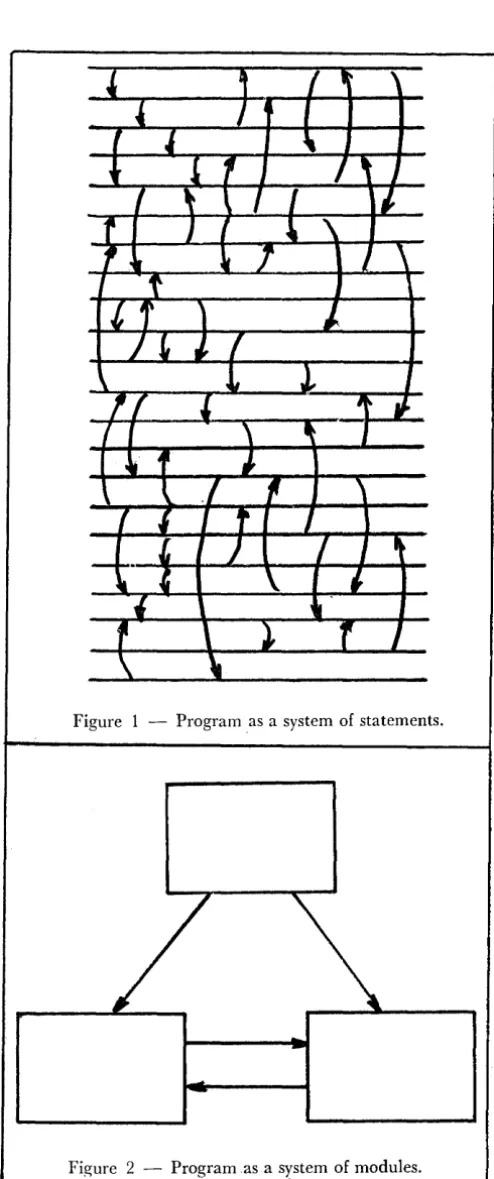
A structural representation of a program on a statement by statement basis is illustrated in Figure 1. Each of the arrows represents a direct reference within one stqtement to another statement, or to some part of another statement, or to something also referred to by another statement, or an arrow represents an implicit connection, such as related pro-cessing effects or sequential execution. The intent of Figure 1 is to represent the sum total of all interrelationships among elements of the program, that is, the complete
struc-ture. Any real program is a very complex structure when modeled in this manner.
Now in practice, no real program above a certain critical size is ever actually implemented as such a monolithic structure - as a single, linear, unbroken sequence of code. In the sense of containing phases, segments, procedures, blocks, subroutines, macros, or other externally defined ag-gregations, all programs are modular. [5, 8]
Figure 1 - Program as a system of statements.
Figure 2 - Program .asa system of modules.
The physical structure defined by such aggregates can be considered to be superimposed on the inherent structure of the statements. Externally, then, a program is really mor~ like Figure 2, that is, a number of "large" components, with (sometimes) fewer, more explicit interconnections. In a sense, one cannot eliminate the inherent structure. Figure 3a represents one aggregation superimposed on the program of Figure 1, resulting in the system structure of Figure 3b. Another aggregation scheme for the same program is shown in Figure 3c giving the structure of 3d. In a very definite sense, the latter structure is simpler. The com-ponents of the modules of Figure 3c and 3d are more co-hesive, more related, while the modules themselves are more independent, less related.
16
Numerous factors are influenced by the aggregation (or in practice, segmentation) scheme. The separability of the pro-gramming task and the success of such separation will de-pend on the number and kind of intermodular interconnec-tions. Ease of maintenance is largely a function of limiting the scope of changes. Structures with minimal intermodular connections and maximum functional cohesiveness of module content will tend to minimize the cost of correction and changes. In fact, a mathematical cost .model, based on the structural theory of programs and an understanding of hu-man information processing even indicates a strategy for minimum debugging costs. Both the components and inter-connections in programs a're heterogeneous sets. Modules can be classified by physical characteristics (subroutine, macro, etc.) and by constructive basis (coincidence, similarity of func-tion, etc.) connections may be differentiated on a functional bas:s (input-output coupling, common environment connec-. tions, etc.). On these bases, one can make successful predic-tions about implementation diffi(:ulties, maintainability, and generality of the components.
The structural theory of programs is most significant be-cause of its implications and impact on actual program development. This is intimately tied up with the theory of programming to be discussed below.
-1
f
1 { ~~
I ,
I
f I I \
r
T
7 J / 11 JI \
r
I
l-f , } ~ \
l'
£1'
J.
J
L
J,I
J,
,l.71
\ ~ Il. ~ J
\ I f
-r
,
Ir
I J~ )
,
I
I~ \ I
l-I ~
-,
\
.J.
T
J'\
"
I=---.J
a) Scheme 1 Aggregation b) Scheme 1 System Structure
c) Scheme 2 Aggregation d) SC:leme 2 System Structure
Recognition of computer-oriented problem
ANALYSIS Specify solution IMPLEMENTATION
Integrate solution
wJth environment MAINTENANCE
'Define problem
DESIGN Build Solution INST ALL ATI ON Keep solution going
t
Figure 4 - Phases of programming. Obsolescence of system
A Process Theory of Programming
Almost directly from the structural theory of programs, follows a theory of programming [3]:
Programming is a systems problem-solving process di-rected toward the cre~tion of a program whose function is the solution of some portion of a given problem. Programming is performed by people. It is an en-giIJeering function which seeks optimality.
From this definition it is clear that:
- programming is not an instantaneous event; - it is an error-prone pro~ess;
- it does not begin with writing the first line of code; it does not end with writing the last line of code; - it is a subset of problem solving in general.
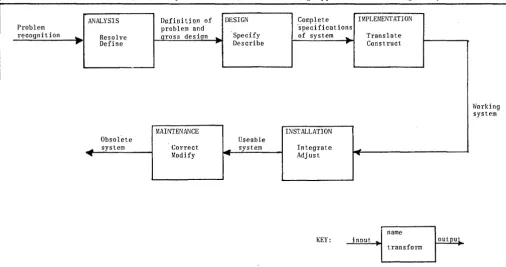
As a process, programming is divisible into phases on the basis of distinct characteristic actions and orientations. These phases are part of virtually all "inventive" problem solving, that is, human creation of a system. By definition, the oper-ations represented by the phases in Figure 4 are a part of all programming. In practice, some phases are accomplished by non-programmers, and the division of labor varies from or-ganization to oror-ganization. Often, explicit performance of certain functions is bypassed, resulting in the implicit (and poorer) realization of these functions in later phases, or worse,
ANALYSIS DefinitiQn of DESIGN
Problem problem and
recognition
•
Resolve aross desiqn..
SpecifyDefine ,. Describe
MAINTENANCE
expensive and repetitive return to the functions of earlier phases.
Figure 5 simply represents the programming process as a system. The pivotal role of the design function is most im-portant. By the definition of a program, design must specify not just the realization of the function (the algorithm or procedure) but the input-output morphology, the system boundary, the components, a)ld their interrelationships. Par-ticularly the last two system aspects are usually "designed" by the incidental side effects of the implementation process.
Since design must specify (describe, represent) 'the unim-plemented program, by definition, it employs models. Po-tentially, any system model or documentation technique is a design tool. Because system design involves very rapid eyolution, some tools may be less usable than others. Note also that tools for specifying the design of all system charac-teristics are needed. By definition, the flowchart and the decision ta.ble are not panaceas for program design. If we carry our analysis of the design function to its logical con-clusion, it follows readily that morphological (external form) and structural (internal form) characteristics have more pro-found and direct impact on major design objectives than algorithmic considerations do. System generality, durability, and utility are all largely determined by form rather than method.
If programming is a human problem-solving process, then clearly, psychology and particularly the psychology of prob-lem solving applies. Indeed, a large body of literature is
Complete 's'peel:l'i cat ions
IMPLEMENTATION
of system
.,.,
Translate., Construct
Working system
INSTALLATION
Obsolete Useable
...
system Correct-
system Integrate ~.,
Modify-
Adjust ,name
KEY: input ..
~
transform
[image:17.615.57.566.34.199.2] [image:17.615.61.568.475.742.2]