Studios in Software Engineering
Education
Christopher Neil Bull
, B.Sc, M.ResDecember 2015
HighWire CDT
memorize ‘problem solving strategies’ [. . . ] what good is it to teach just the mechanical manipulation of equations without achieving understanding?”
– Eric Mazur
“I hear and I forget. I see and I remember. I do and I understand.”
Computing has its roots in mathematics, where lectures are the dominant mode of education. Software engineering (SE) education, born from computer science, is also traditionally taught using lectures, but has grown beyond its mathematical roots; as the name implies, it is an engineering discipline. It is arguably necessary for SE to rethink its approach to education.
Studio education is one alternative being explored. Studios originated from ar-chitecture and design, and are complex spaces used by collocated students to col-laboratively and individually work on projects; they emphasise a physical “home” for students, problem-based and peer-based learning, and mentoring by academic staff rather than formal lectures. There are inherent similarities between SE and the original studio disciplines: e.g. we often use the architecture of buildings as metaphors when designing and describing software. This suggests that studios in SE should be further explored, despite its apparent lack of uptake across institu-tions worldwide.
Some of the work presented in this thesis has previously been published:
B Christopher N. Bull, Jon Whittle and Leon Cruickshank (2013). ‘Studios in Software Engineering Education: Towards an Evaluable Model’. In: Pro-ceedings of the 35th International Conference on Software Engineering (ICSE ’13). San Francisco, CA, USA: IEEE Press, pp. 1063–1072
B Christopher N. Bull and Jon Whittle (2014a). ‘Observations of a software engineering studio: Reflecting with the studio framework’. In: Proceed-ings of the 27th Conference on Software Engineering Education and Training (CSEE&T’14). Klagenfurt, Austria: IEEE, pp. 74–83. doi: 10.1109/CSEET. 2014.6816784. [Best Paper Award]
B Christopher N. Bull and Jon Whittle (2014b). ‘Supporting Reflective Practice in Software Engineering Education through a Studio-Based Approach’. In: IEEE Software 31.4, pp. 44–50. doi: 10.1109/MS.2014.52
B Jon Whittle, Christopher N. Bull, Jaejoon Lee and Gerald Kotonya (2014). ‘Teaching in a Software Design Studio: Implications for Modeling Education’. In: Proceedings of the 10th Educators’ Symposium (EduSymp ’14) at MOD-ELS 2014. Valencia, Spain: CEUR-WS
I would like to thank my supervisors, Prof. Jon Whittle and Prof. Leon Cruick-shank, for their assistance and dedicated involvement throughout this process. Thank you for your guidance, support, and understanding over the years, but also for showing me what it is to be an academic. Also, thanks to HighWire CDT and its Directors for providing me with the opportunity to do a PhD in the first place, especially Prof. Gordon Blair, who has been a support to us all throughout.
I would also like to show gratitude to all of the anonymous interview participants and Lancaster University’s software engineering students for participating in this research. Thank you for taking time out of your busy schedules to have conversa-tions with me – I intend to take this thread of research further, alongside others I have experienced along the way, because if nothing else, your passions for changing how students learn is infectious.
I would like to acknowledge all of the staff in the School of Computing and Com-munications, my fellow HighWire PhD students, and my family, for the countless discussions and critiques. This process of support and critique is something that I have seen embodied in studio education as well as the PhD process during this research, and I feel it is essential to our success as researchers. I particularly want to mention a few key people, though I can’t name you all, who have helped in pre-cisely this process: Stephen Forshaw, John Hardy, Graham Dean, Marcia Smith, Barney Craggs, Kiel Long, John Vidler, Carl Ellis, and Stephen Wattam.
Finally, and most importantly, I would like to thank my wife Jennifer for her love and constant support. I have found out that a PhD, on the contrary to what we were told at the start, is not a solo pursuit – indeed, by making the decision to take on a PhD, you have implicitly (whether you realise or not) decided to take those around you on that process as well.
Jen: You have shared in my ups and downs. Thank you for those times you had to listen to me ramble on, for proofreading after an all-nighter, at times nodding along even though I am filling the air with buzzwords, and frequently making me coffees. You don’t have to do these things, but you do. For that, I thank you, and I love you.
I declare that this thesis is my own work and that it has not been submitted in substantially the same form for the award of a higher degree elsewhere.
Abstract i
Publications ii
Acknowledgements iii
Declaration v
1 Introduction 1
1.1 Studio Education . . . 2
1.2 Background Summary . . . 5
1.3 Motivation . . . 6
1.4 The Research . . . 7
1.5 Summary of Results and Contributions . . . 9
2 Literature Review 10 2.1 Roots Of Studio Education . . . 10
2.1.1 Ecole des Beaux-Arts . . . .´ 11
2.1.2 Bauhaus . . . 12
2.2 Studios . . . 13
2.2.1 Lack of a definition . . . 14
2.2.2 Reflective Practice . . . 16
2.2.3 Critique . . . 18
2.2.4 Coaching . . . 22
2.2.5 Arguments Against Studios . . . 23
2.3 Software Studios . . . 25
2.3.1 Carnegie Mellon University (CMU) . . . 26
2.3.2 Massachusetts Institute of Technology (MIT) . . . 28
2.3.3 University of Queensland (UQ) . . . 29
2.3.4 Monash University . . . 30
2.3.5 Washington State University . . . 34
2.3.6 Auburn University . . . 37
2.3.7 University of Hawaii . . . 39
2.3.8 University of California – Irvine . . . 39
2.3.9 University of Victoria . . . 40
2.3.10 Poznan University of Technology . . . 42
2.3.11 Open University . . . 42
2.4 HCI Studios . . . 44
2.4.1 University of Oregon . . . 44
2.4.2 University of Calgary . . . 45
2.4.4 The University of British Columbia . . . 47
2.5 Similar or Alternative Learning Approaches . . . 47
2.5.1 War Room . . . 47
2.5.2 Project-Based Learning . . . 49
2.5.3 Peer Instruction . . . 50
2.5.4 Flipped Classroom . . . 51
2.6 Conclusions . . . 51
3 Understanding Studios: The Studio Framework 54 3.1 Methodology . . . 55
3.1.1 Interview Participants . . . 56
3.1.2 Interview Design . . . 58
3.1.3 Analysis . . . 59
3.2 The Studio Framework . . . 61
3.2.1 Physical environment . . . 64
3.2.2 Facilitation of studio . . . 65
3.2.3 Modes of education . . . 66
3.2.4 Awareness . . . 67
3.2.5 Critique . . . 68
3.2.6 Culture . . . 70
3.2.7 Individual’s characteristics . . . 72
3.2.8 Inspiration . . . 73
3.2.9 Collaboration . . . 74
3.3 Further Analysis . . . 75
3.3.1 Necessary and Desirable Framework Parameters . . . 75
3.3.2 Relationships Between Parameters . . . 77
3.3.3 Anomalous Categories . . . 80
3.3.4 Most Important Aspect of a Studio . . . 82
3.4 Discussion . . . 83
3.4.1 Towards an Evaluable Model . . . 84
3.4.2 Applicability of the Framework to a Software Studio . . . . 85
3.5 Conclusions . . . 86
4 State of Software Studios in Universities 87 4.1 Methodology . . . 89
4.1.1 Interview Participants . . . 90
4.1.2 Interview Design & Analysis . . . 93
4.2 The Software-Studio Framework . . . 94
4.2.1 Physical Environment . . . 98
4.2.2 Facilitation of Studio . . . 102
4.2.3 Modes of Education . . . 105
4.2.4 Awareness . . . 111
4.2.5 Critique . . . 113
4.2.6 Culture . . . 118
4.2.7 Individual’s characteristics . . . 121
4.2.8 Collaboration . . . 121
4.3 Further Analysis . . . 126
4.3.2 Relationships Between Parameters . . . 128
4.3.3 Comparing the Two Frameworks . . . 130
4.3.4 Most Important Aspect of a Studio . . . 136
4.4 Conclusions . . . 137
5 Lancaster University’s Software Engineering Studio 138 5.1 Motivation for Lancaster’s Studio . . . 139
5.2 Implementation . . . 140
5.2.1 Guiding Principles . . . 140
5.2.2 The Room . . . 141
5.3 The Course and Curriculum . . . 147
5.3.1 SCC.230 Core Studio . . . 149
5.3.2 SCC.330 Networked Studio . . . 151
5.3.3 SCC.331 Live Studio . . . 153
5.4 Summary . . . 154
6 Analysis of Lancaster University’s Studio 156 6.1 Methodology . . . 157
6.1.1 Participant Observation . . . 157
6.1.2 Focus Group . . . 158
6.1.3 Annotating Research Participants . . . 159
6.2 Analysis: Observation Themes . . . 161
6.2.1 Observation Themes . . . 161
6.2.2 General Observations . . . 166
6.3 Analysis: Reflecting on the Studio Framework . . . 167
6.3.1 Physical Environment . . . 168
6.3.2 Facilitation of Studio . . . 169
6.3.3 Modes of Education . . . 174
6.3.4 Flipped Classroom . . . 176
6.3.5 Project Courses . . . 177
6.3.6 Awareness . . . 181
6.3.7 Critique . . . 183
6.3.8 Culture . . . 189
6.3.9 Individual’s characteristics . . . 194
6.3.10 Inspiration . . . 195
6.3.11 Collaboration . . . 195
6.4 Conclusions . . . 201
7 Conclusions 204 7.1 Contributions . . . 204
7.1.1 Studio Framework . . . 204
7.1.2 Current State of Studios in Software Engineering . . . 206
7.1.3 Analysis of Lancaster University’s SE Studio . . . 206
7.1.4 Impact . . . 208
7.2 Future Work . . . 208
Bibliography 210
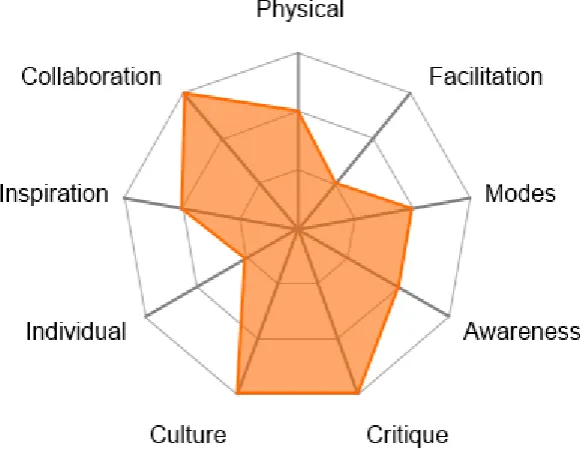
1.1 An example professional architecture studio – The ‘Studio Aalto’ . 3 1.2 An example architecture studio – A student’s workspace . . . 3 1.3 An example architecture studio – Yale School of Architecture . . . . 4 1.4 An example service design studio – Royal College of Art . . . 4 3.1 Example visualisation of the studio framework . . . 84
2.1 Existing software studios’ activities . . . 27
3.1 Interviews participant’s experience (design studios) . . . 57
3.2 The studio framework – A definition of studio education . . . 62
3.3 The studio framework – Participant matrix . . . 63
3.4 The studio framework – Dominant Parameters . . . 76
4.1 Interview participant’s experience (software studios) . . . 91
4.2 A representative set of interview participants . . . 92
4.3 The software studio framework – A variation based on software engineering educators’ perspective of studio education . . . 95
4.4 The software studio framework – Participant matrix . . . 96
4.5 Critique types used by participants . . . 115
4.6 The software studio framework – Dominant Parameters . . . 127
5.1 Summary of the differences between the studio modules at Lancaster University . . . 148
6.1 Legend describing quotation annotations – Descriptions of what the quotation mark-up means (Who said what) . . . 160
There are many approaches to learning that can be utilised in software engineering, ranging from traditional structured approaches (such as lectures and homework) to more agile ones (such as interactive seminars and project-based learning). A traditional lecture is an effective method for presenting information to numer-ous students at once (Bligh, 1998, p.3). However, in itself it does not necessarily promote understanding of the subject content, because it is argued that the “tradi-tional approach to teaching reduces education to a transfer of information” (Mazur, 2009, p.50). This follows a long held idea by some that lectures are not necessar-ily an optimal approach to education (Gibbs, 1981). Project-based courses are one alternative that focuses on “teaching by engaging students in investigation” (Blumenfeld et al., 1991, p.371); these courses increase motivation and can better support a learning-by-doing approach, especially by allowing students to “apply system-level thinking” (Jazayeri, 2004, p.xxv). Traditional lecture-based education is prominent in the computing discipline, and sometimes supported with project-based work, which is echoed by others, stating that “Instruction continues to be conducted in the traditions established when computer science emerged from math-ematics decades ago” (Hundhausen et al., 2008a, p.392).
efforts of large teams” and then posed the question “why then have not all in-dustrial programming teams been replaced by dedicated garage duos?” Here, two teams achieve different results, not too dissimilar to what could be expected of the differing learning approaches. What is it that this duo has, that a large company therefore does not? Students do not generally, if at all, work on large complex sys-tems during their education, so institutions could get away with using traditional teaching methods (if students did not find them boring). Software engineering is an inherently creative process (Brooks, 1995; Glass and DeMarco, 2006) and it is very beneficial to learn with other students (Falchikov, 2001). To support this, we should ask: are the environments that we learn in suited to promoting a collaborative culture that is sensitive to creative processes?
1.1 Studio Education
Looking towards the design disciplines (design, art and architecture etc.) that face similar challenges with learning and team-based work, there are aspects of their commonly used working environments which, from the outset, promote a range of advantages (Kuhn, 1998), some of which include collaboration and creativity (F¨allman, 2007). These environments are called studios, an alternative to lecture-oriented courses, studios are open or shared working environments where students do visually-centred work. Studios are a very prominent approach in design and arts education (Lynch et al., 2002). A more in-depth look at studios informs us that they promote several human-centric aspects of learning including: ‘reflective practice’ (Sch¨on, 1987) (a process of observing and refining practice in a continu-ous cycle); problem-based learning (Morkel, 2011); coaching, peer-learning, and mentoring by academic staff rather than formal lectures (Sch¨on, 1987; Hokanson, 2012); and an emphasis on a physical “home” for the students (Carlhian, 1979, p.8). Some examples of studios are shown in Figures 1.1-1.4.
Figure 1.1: An example professional architecture studio – Alvar Aalto’s studio: ‘Studio Aalto’ c Pepechibiryu, CC BY-SA 3.0
[image:15.595.108.526.117.399.2] [image:15.595.109.525.467.762.2]Figure 1.3: An example architecture studio: ‘Desks of architecture students in the Yale Art and Architecture Building’ c Ragesoss, CC BY-SA 3.0
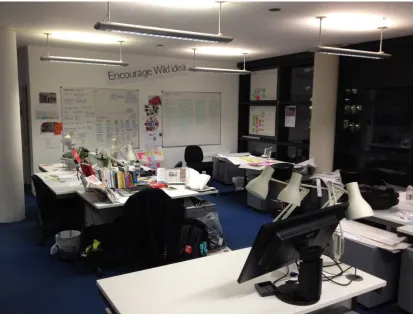
[image:16.595.107.524.105.392.2] [image:16.595.108.522.452.768.2]in implementation, with some studio courses being entirely studio based, whilst others may be a studio module within a course. Studios courses may even still utilise lectures, but they are not the primary approach to learning. They may even be shared across cohorts of students, or even dedicated to one group of students. Sometimes this may be forced through the institutions that provide the space for the courses.
Previous research has linked the type of activities and problems faced by ar-chitecture students (building, not software) with those of software engineering students (Hazzan, 2002). There have been some attempts to transfer studio-based teaching to software engineering education (software studios), with numerous re-porting successes; software studios are courses that utilise a studio approach to teaching software engineering and development – these include software engineer-ing, computer science, and information technology. In many ways, this is natural as software engineering has significant practical elements. However, attempts at software studios have usually ignored experiences and theory from arts and design studio teaching. There is therefore a lack of understanding of what “studio” really means, and how well the concepts transfer to software engineering. It is this gap in knowledge that this thesis will address.
Recent research continues to recognise the need to improve our learning environ-ments (Herrick, 2011) – regardless of whether new environenviron-ments are studio-based or not, the trend is shifting towards more flexible open spaces which promote group work. The evolving spaces that are required blend “instruction, course work and social interactions” (Herrick, 2011, p.65).
1.2 Background Summary
with a studio experience. Software studios are reviewed in detail in chapter 2, Literature Review.
Despite continued interest in studio-based learning (Carter and Hundhausen, 2011), there appears still to be very few implementations of software studios, yet potential benefits of studio education are numerous and understood (Hazzan, 2002; Hundhausen et al., 2008a).
If publications are taken as example implementations of studio-based education, then besides the limited number in existence, they also significantly vary in execu-tion and guiding principles; this in itself is not necessarily a negative point, as each will have their own successful elements. However, this makes it difficult to com-pare or benefit from shared implementation details. Despite the limited numbers of studios, there is still continued interest; for example Carter and Hundhausen (2011) recently presented a brief overview of five studios in computer science. The studios they analysed did not replace lectures, but were instead used to reinforce content taught in lectures – this is not necessarily the case in all studios in design or architecture, with some rarely using lectures. The success or failure of software studios are also“usually assessed through end-of-term questionnaires” (Carter and Hundhausen, 2011, p.110), which may provide limited information on their own.
1.3 Motivation
studio practice due to the inherently complex nature of studio education.
Some people argue that lectures are no longer the desired medium for education, with Mazur (2009, p.50) succinctly summarising this viewpoint: “The traditional approach to teaching reduces education to a transfer of information [. . . ] education is so much more than information transfer”. Carpenter et al. (2013) state that the fluency of an instructor in a lecture only increases perceptions of learning, and not the actual learning. There are other benefits to a fluent instructor, for example en-joyment level, but this study suggests that the perception of learning is decoupled to actual learning – suggesting that exploring different teaching approaches are a better avenue to follow.
Despite the lack of a concrete understanding of studio education, software studio implementations often report varying levels of success; it has been indicated that, in certain studios, the student’s content mastery is“as much or more than students in the same courses taught in the traditional way” and also that“students in studio courses have shown higher levels of motivation and engagement than students in traditional courses” (Narayanan et al., 2012, p.165).
Studio-based learning for software engineering is a well-received concept, despite its apparent lack of uptake across institutions worldwide. Apart from the benefits a studio may provide, one of the reasons to explore software studios further is because students enjoy them (Carter and Hundhausen, 2011).
1.4 The Research
Review chapter, section 2.2.1. This lack of understanding is the foundation for the following research questions explored throughout this thesis:
RQ1) What is a studio?
RQ2) What is the current state of studio education in software engineering? RQ3) Does studio education transfer to software engineering education?
Firstly an understanding of studio education is required to be formulated. This is explored by RQ1 in chapter 3 by interviewing studio educators from the disciplines where studio education originated from, and subsequently performing an analysis of the interview transcripts to discover what people native to studio education think it consists of. This culminated in the creation of the studio framework – providing an understanding of studio education.
To complement RQ1, RQ2 is explored in chapter 2 (Literature Review) and chapter 4 (State of Software Studios in Universities). This thread of research is conducted to get a sense of the software studios that are in existence, and then per-form interviews with software engineering educators using a similar methodology as chapter 3. By following a similar methodology, but with participants from soft-ware engineering as opposed to the design disciplines, allows for the results of the analyses to be comparable. This is discussed further in chapter 4’s ‘Methodology’ section (4.1).
1.5 Summary of Results and Contributions
Whilst exploring RQ1 in chapter 3, the ‘studio framework’ was created from the interview transcripts analysis. This framework provides a definition and under-standing of studio education.
Further to the studio framework, chapter 4 led to the creation of a studio frame-work variant, the ‘software studio frameframe-work’. As the interviews and analysis (with software engineering educators) in chapter 4 followed a similar methodology as chapter 3 (with design, architecture and art educators), the results were com-parable. The analysis of the software engineering educators interviews resulted in a framework with mostly the same set of categories, except for one, and the parameters within each category had variable overlap between the two studies; some were more strongly linked than others. This means that the software studio framework was somewhat similar to the original studio framework. The differences between the two frameworks is more nuanced, and exist inside the categories, e.g. the parameters.
The objective of this chapter is to provide an understanding of the current state of studio education, supplying an adequate foundation for the research questions in this thesis to be answered. The first aim is to collate information about the origins of studio education in design and art disciplines, followed by any prominent definitions or features that are widely expressed in studio literature. The second aim is to explore literature on current implementations of software studios, and to gather information on what is considered to form these studios. Software studios are courses that utilise a studio approach to teaching software engineering and de-velopment; these include software engineering, computer science, and information technology.
2.1 Roots Of Studio Education
The roots of the design studio can be traced back as far as Medieval Times where guilds would take on apprentices (Sch¨on, 1985). Most literature that discusses the origins of the design studio often describes two main schools of studio education: ´
2.1.1 ´
Ecole des Beaux-Arts
´
Ecole des Beaux-Arts (France, 1819-1914), or ‘School of Fine Arts’, was a French school of art which taught subjects such as drawing, painting, sculpture, engrav-ing and architecture. The environments used were known as ateliers, French for ‘workshop’, where students worked under the guidance of a patron (tutor) – these are widely regarded as the first knowns environments that resembled a studio, as more recent studios are said to“have inherited the historical tradition of the ´Ecole des Beaux-Arts and its atelier model” (Oh et al., 2013, p.303). The purpose of ´
Ecole des Beaux-Arts was to allow working and learning to occur simultaneously. Whilst working under their patron, the students would also be studying a theory of design; each atelier had a different“acquired reputation” that would lure differ-ent studdiffer-ents depending on their taste or intended direction (Carlhian, 1979, p.7). One of the most important factors of the atelier was that the “design problem and learning by doing superseded the lecture as the primary method of teaching” (Broadfoot and Bennett, 2003, p.1). Many traditions in studios today evolved from the ´Ecole which “provided the basis of a pedagogical method that is still the core of design and architectural education” (Broadfoot and Bennett, 2003, p.1). Some aspects include:
• Esquisse (initial sketch to a problem that would be further developed)
• Teaching of design by practising professionals
• The final evaluation of student work by a jury
2.1.2 Bauhaus
The Staatliches Bauhaus, or School of Building (Germany, 1919-1933), was foun-ded by Walter Gropius. Bauhaus is well known for its fusion of theory and practice, but more importantly, art and craft; it taught these new approaches in a workshop environment that formed the basis of today’s studios. Some of the topics taught at this school were art, architecture, graphic design, interior design, industrial design, and typography. An important way that Bauhaus differs from ´Ecole des Beaux-Arts is that Bauhaus’ founder, Walter Gropius, placed an emphasis on pro-duction and technology: “design was neither an intellectual nor a material affair but simply an integral part of modern concepts of mass production and modern technology” (Lackney, 1999, p.2).
Although this school was “a challenge to the Beaux Arts tradition of education, the basic form of studio-based learning model remained unchanged” (Lackney, 1999, p.3). Instruction was “of a practical nature, providing actual work with materials in the shops and on buildings under construction” (Lackney, 1999, p.2). One of the major aims was “the unification of art and modern technology to create archi-tecture and design for the modern free man and woman” (Ehn, 1998, p.208), with another aim being to reinstate control to the designer over architectural decisions (Salama, 1995). What made Bauhaus particularly unique was that “apprentices were to be instructed, not only by ‘masters’ of each particular craft, but also by fine artists” (Salama, 1995, p.50). One final, yet important, aspect was that the teaching program aimed to develop the personalities of the students (Broadfoot and Bennett, 2003), as this was considered key to the future design experiences.
2.2 Studios
A studio is an alternative to lecture-oriented courses, which are a dominant teach-ing method at universities. It is often a room that supports and promotes several human-centric aspects of learning, and is also sometimes called an ‘atelier’ (which is the term used at the ´Ecole des Beaux-Arts mentioned earlier). Studio-based edu-cation often includes a dedicated physical space for students where learning comes from tackling complex, partially specified problems, and teaching staff are seen more as mentors and coaches rather than disseminators of information. Learning can often be collaborative, is very practical, often project-based, employs coach-ing, formal and informal critique, and the studio is commonly said to act as the student’s second home: “Students do not so much attend these events as live in them” (Sch¨on, 1987, p.311). Conceptually, a studio “is a process of learning by doing” (Lawson, 2012, p.7). Students also frequently play roles to their peers (peer-learning or peer-coaching) in addition to what the staff would also normally perform, e.g. coaching and critiquing. A key difference to traditional lecture-based teaching is that lectures are rarely used, if at all, and when they are the students are in their studio before and after the lectures – which is similar in approach to the ´Ecole des Beaux-Arts (see section 2.1.1, above), which had some lectures, but were not the primary method of teaching.
Studios can be quite variable, as they could be a studio module within a larger degree, or the studio may be their studio space for everything in a degree. Studio spaces can sometimes be dedicated to cohorts of students, and others may share a studio space with everyone on a course. Indeed, some studios may share their space across courses. Due to this variability, this thesis takes an inclusive look at studio education. Sch¨on (1987, p.37) describes studios as a reflective practicum:
Sch¨on is a popular name in studio literature, with many referring to his work on reflective practice, particularly in studio settings. He also points out the similarities between the relationship between studio teachers (“masters”) and their students, which is akin to a master and apprentice’s relationship.
This section reviews studios from the perspectives of architecture, design and art, allowing for this thesis to position itself and its contributions with respect to studio-based literature. Two activities that are frequently described as occurring often within a studio setting are reflection and critique.
“Studios are typically organized around manageable projects of design, individually or collectively undertaken, more or less closely patterned on projects drawn from actual practice. They have evolved their own rituals, such as master demonstrations, design reviews, desk crits, and design juries, all attached to a core process of learning by doing. And because studio instructors must try to make their approaches to design understandable to their students, the studio offers privileged access to designers’ reflections on designing. It is at once a living and traditional example of a reflective practicum.” (Sch¨on, 1987, p. 43).
Koch et al. (2002, p.3) succinctly summarise experiences that those who have studied in an architectural studio may have experienced:
“Late nights, exciting projects, extreme dedication, lasting friend-ships, long hours, punishing critiques, unpredictable events, a sense of community, and personal sacrifice. [. . . ] Those aspects are not usually written into the curriculum or even the design assignments, but they are likely the most memorable and influential”.
2.2.1 Lack of a definition
agreed upon studio definition. By no means is it suggested that no understanding of studios exist, far from it; however, descriptions and definitions of studios appear vague, and it is clear that an understanding of their complex nature resides in tacit knowledge (L¨owgren and Stolterman, 2004) – literature cited in this section refers to studio education in arts and design. A studio could be the physical space, the teaching style or even the attitudes of the students. There are numerous under-standings and implementations of studio education, with many nuances that are not covered in a succinct definition of a studio, especially as each varies depending on its context, as “evidenced in the tremendous diversity of content and methods in studio teaching in different schools and even within one department” (Ledewitz, 1985, p.2). Not much is understood still about studio learning and what goes on within the studios (Kvan and Jia, 2005), as they are often “characterized by mul-tiple and sometimes contradictory goals, implicit theories and inherent conditions of ‘inexpressibility, vagueness, and ambiguity’ ” (Ledewitz, 1985, p.2). This prob-lem is addressed directly, later in chapter 3, through interviews with experienced studio educators in architecture, design and art.
that studios afford Design disciplines. However, if you cannot concretely define a studio, perhaps you can model it instead to assess its effective implementation?
Despite the fact that there appears to be no agreed definition, there are many thinkers that have provided important observations and definitions of elements within studio education. The most widely cited thinker, Donald Sch¨on, distils a core concept of studio education: ‘reflective practice’ (Sch¨on, 1983). This takes place in a‘reflective practicum’, and the students“learn by doing, with the help of coaching” (Sch¨on, 1987, p.xii); this is described in greater detail in section 2.2.2. Another important facet of studio education is the use of critiques (Sch¨on, 1987), and they are widely considered an“indispensable tool” (Uluoˇglu, 2000, p.54); cri-tiques come in various forms ranging from formal to informal, and individual or group – used as a mechanism to communicate ideas and evaluate designs. These are described in more detail in section 2.2.3. Several aspects of Sch¨on’s books (Sch¨on, 1983; Sch¨on, 1985; Sch¨on, 1987; Sch¨on, 1991) discuss elements of educa-tion and practice that can occur independently of studios, but they are discussed in the context of studio education as they are prominent in those spaces. Another observation made by Sch¨on is that studios work with real world projects. Real world projects often deal with complex issues that can be categorised as “wicked problems” (Buchanan, 1992). Wicked problems are difficult to frame and have no “right” answer. Despite these observations, there is still a lack of a concrete agreed upon definition. However, there are three main elements of studio edu-cation that appear in the literature frequently: Reflective practice, critique and coaching. These are covered in further detail below.
2.2.2 Reflective Practice
the studio concept (Sch¨on, 1983; Tomayko, 1991). Some examples of the activities that support reflective practice include critiques (section 2.2.3) or writing reflective reports. Furthermore, the first software studio, by Tomayko (1991), was primarily based on the notion of reflective practice (achieved through“constant questioning” (Tomayko, 1991, p.301), see section 2.3.1); this studio has been used and referred to as a foundation for other software studios since then.
Reflective practice comes in two main forms: reflection-in-action and reflection-on-action (Sch¨on, 1983), which are described in further detail below. McCall (2013, p.24) also partially describes reflective practice as “repeated alternation between knowing-in-action and reflection-in-action”; knowing-in-action is a form of embodied tacit knowledge. In many professions, these reflective activities are assumed to improve “the proficiency and performance” of practitioners (Hazzan, 2002, p.161); those professions that Hazzan refers to share several similarities with software engineering – indeed, one in particular, the architecture of buildings, is often used as a metaphor for software development (Kuhn, 1998).
Lecture-based delivery can suppress reflection due to its didactic style (Brock-bank and McGill, 2007). Project-based courses are better in this regard because they give students the opportunity to rework solutions over time. However, such courses do not guarantee that they will “build in” reflection, primarily because reflection is often only considered implicitly in learning goals. Reflective practice is important here because practicums attempt to help “students learn to become proficient at a kind of reflection-in-action” (Sch¨on, 1987, p.40).
Reflection-in-action
reflection-in-action as“the questioning and challenging associated with problematic situations in practice – a reflective dialogue with the designer’s own knowing in action”. Others also provide their own succinct description, describing it as students learning“not by assimilation but by trial-and-error practice” (Wang, 2010, p.175).
Reflection-on-action
After problem solving has occurred, a practitioner may consider what they could have done differently or would do differently next time. This is what Sch¨on calls reflection-on-action, or reflecting back on past experience. Sch¨on (1987, p.26) states that it can occur “after the fact, in tranquility, or we may pause in the midst of action”, but it“has no direct connection to present action”.
One approach to reflection-on-action is highlighted by Sch¨on: “We reflect on action, thinking back on what we have done in order to discover how our knowing-in-action may have contributed to an unexpected outcome” (Sch¨on, 1987, p.26).
2.2.3 Critique
Desk Critique
The desk critique is central to the studio experience (Sch¨on, 1983; Shaffer, 1997). This type of critique, more commonly referred to as ‘Desk Crit’, and sometimes simply just ‘Crit’, is usually a one-on-one activity between a coach and the student. The name is derived from the simple fact that these critiques generally happen with each student, during an on-going project, whilst they are sat at their desk. These activities are small, often informal, and cover elements such as the design and the thinking process.
A desk crit is supportive of spontaneous or scheduled interactions. A succinct description of the desk crit process is given by Shaffer (1997, p.201):
“a student describes his or her work to the professor, including areas of particular interest or concern in the design. The professor probes the design, asking for clarification where needed, and then isolating potential problem areas. As students present possible solutions, the professor explores the implications of various design choices, suggesting alternative possibilities, or offering ways for the student to proceed in his or her exploration of the problem”.
A desk crit can also take the form of peer critique (Hokanson, 2012). A peer crit is very similar to a desk critique, but with a peer rather than an instructor, and will likely be constructed around different social boundaries, for example, a desk crit may draw a small crowd of“incidental learners” that do not participate due to the ‘expert’ nature of the instructor (Hokanson, 2012, p.78). Peer crits on the other hand are less formal, and are in fact the “least formal of the critique formats” (Hokanson, 2012, p.79). Peer crits also provide the students with the opportunity to“extend their own skill in critique” (Hokanson, 2012, p.79).
Design Review
occur quite frequently – ideally multiple times during a project, to aid the learning-by-doing process. They can take the form of presentations, demonstrations or posters, and they have a flat audience hierarchy (that is to say, the non-presenting students taking equal place alongside members of staff in the audience, as a po-tential critic). These critiques are seen as“more generative and educational” than the final design jury counterpart, as they focus more on the “improvement and development of the design project” (Hokanson, 2012, p.77).
Design Jury
Sometimes referred to as a ‘jury critique’, ‘pin-up’ session, ‘design crit’, or often just as a ‘jury’. Juries are very similar to design reviews, though are more formal and usually only occur at the end of a project – forming part of the final assess-ment. This particular critique gets its name from the attendance of “a group of outside critics (the ‘jury’)” (Sch¨on, 1983, p.80), which is also a significant point that differentiates itself from design reviews, creating a very different social dy-namic and set of interactions. Although critiques are considered very important to design education, in a cruel twist of irony regarding its name, design juries can be“punishing” and difficult for the students (Koch et al., 2002, p.3).
In a study by Dannels and Martin (2008, p.143-147), they identified a topology of feedback given during design juries through looking at various levels of design studio that range from novice to expert. These studios were for different levels of students in their educational career and included freshmen, junior, senior and a graduate studio. The study identified nine types of feedback:
• Judgement(25.4%) – Judgemental feedback that occurred when the critics react and “rendered some assessment of its quality”.
• Process oriented (20.8%) – Statements or questions about a student’s design approach or process. Can be suggestive or observation-oriented.
possibilities”; often taking the form of ‘what if?’ questions. The tone of the questioning “clearly indicated that the questions were rhetorical”.
• Interpretation (12.4%) – Trying to make sense of the concept or product.
• Direct recommendation (9%) – When specific advice is given about a design. This feedback is “focused, purposeful, and usually specific”.
• Investigation (5.1%) – Feedback that is geared towards requesting inform-ation, typically by questioning. This feedback “necessitated a response”.
• Free association (3.7%) – When critics make reactive (spontaneous) and associative statements about a design. Statements are“often started with ‘It reminds me of’ or ‘This looks like’ ”.
• Comparison (2.8%) – When the feedback compares the design with some-thing else. This differs to ‘free-association’ which is “reactive (spontaneous) whereas comparison feedback was strategic (focused, intentional)”.
• Identity invoking(2.5%) – Questions and statements aimed at making the students“consider the larger picture of themselves as designers” and“within the larger context of the design profession”. The tone of the questioning “clearly indicated that the questions were rhetorical”.
Dannels and Martin (2008, p.151) summarises their study as follows:
categories (more frequent in the three upper-level studios) all indicate a more collaborative relationship between the critic and the student– with the student as a more active agent and independent thinker and designer.”
They did however end by suggesting that what they observed was feedback that was“more reflective of academic developmental stages or idealized workplace contexts than of actual professional settings” (Dannels and Martin, 2008, p.135).
2.2.4 Coaching
There is a significant difference between coaching and lecturing. Typical defini-tions of lecturing refer to the lecturer giving or reading to an audience by formal discourse. It is amusing that the term ‘lecturing’ is also a synonym for reprimand or used to describe someone giving a lengthy scolding to someone else.
Coaching on the other hand is about providing instruction or advice. In a studio, Sch¨on (1987, p. 38) states that teaching staff act as a coach, and their main functions in a practicum are:
• Demonstrating
• Advising
• Questioning
• Criticizing
Coaching can also come in the form of peer-coaching, whereby “fellow students may, in various ways, play the coach’s role” (Sch¨on, 1987, p.170). Sch¨on goes on further to emphasise the importance of this type of coaching from peers by stating “groups of students [. . . ] are often as important to one another as the coach” (Sch¨on, 1987, p.38).
supervision or in collaboration with others. He describes it as“the distance between the [student’s] actual development level as determined by independent problem solv-ing and the level of potential development as determined through problem solvsolv-ing under adult guidance or in collaboration with more capable peers”.
2.2.5 Arguments Against Studios
Although the design studio is currently widely used, and presents a solid argument for its continued use, there are also some arguments against it. The following are a couple of reasons why the studio is under threat, as outlined by Cruickshank (2006):
• Space is expensive – The first issue is that permanent space is an expensive premium. When an environment is to be used as a permanent home for the occupants, as well as their work, nobody else can use that space.
• Less contact time – Lecturers may have less contact time with their stu-dents. There is always a drive for increased participation and interaction, and studios provide this with coaching. However, without a corresponding increase in funding, lecturers are pushed to teach larger groups of students (or other non-teaching responsibilities), which also makes it more difficult to build trust with individual students. Whilst this argument depends on how an individual studio is run, it highlights the potential for contradictory objectives set by universities.
One other argument is the potential “punishing critiques” (Koch et al., 2002). This relates more specifically to the practice of critiquing than to the studio itself, and is described earlier in section 2.2.3.
A report by Koch et al. outlines numerous myths that studio education perpetu-ates. Koch et al. (2002, p.5) say that these “influence the mentality of students and promote certain behaviors and patterns”. Following is the list of myths:
• Architectural education should require personal and physical sacrifice
• The creation of architecture should be a solo, artistic struggle
• The best students are those who spend the most hours in studio
• Design studio courses are more important than other architecture or liberal arts courses
• Success in architecture school is only attained by investing all of your energy in studio
• It is impossible to be a successful architect unless you excel in the design studio
• Students should not have a life outside of architecture school
• The best design ideas only come in the middle of the night
• Creative energy only comes from the pressure of deadlines
• Students must devote themselves to studio in order to belong to the architec-ture community
• Collaboration with other students means giving up the best ideas
• It is more important to finish a few extra drawings than sleep or mentally prepare for the design review
• It is possible to learn about complex social and cultural issues while spending the majority of time sitting at a studio desk
• Students do not have the power to make changes within architecture programs or the design studio
2.3 Software Studios
There are several software studio implementations worldwide, where “students in studio courses have shown higher levels of motivation and engagement than stu-dents in traditional courses” (Narayanan et al., 2012, p.165). Although studio-based pedagogy is increasing in software disciplines, not many have been imple-mented (Hundhausen et al., 2008b). However, despite the apparent success of these few studios, it is also apparent that none of them follow a shared definition or understanding of studio education – making comparisons non-trivial. Because of this, previous studio attempts are collated below and detailed to provide the necessary context to this thesis.
The idea of software studios has been around for a couple of decades, with some of the first attempts at implementing one going as far back as 1991 (Tomayko, 1991). A software studio is an attempt to utilise similar environments to that of a design studio but for software related disciplines; many names have been given to these studios which include ‘software studio’, ‘software development studio’, ‘software design studio’ etc.
Although there are many instances where a variation of a design studio has been used to specifically teach design topics to computing students (Docherty et al., 2001; Greenberg, 2009), these are not the focus here. The focus in this literature review is not to explore teaching design through the medium of a design studio (e.g. visual thinking or interaction design outside of a software development context), but to see how aspects of a design studio could improve software design and development in disciplines such as computer science and software engineering. There have been several attempts to integrate a studio-based learning environ-ment into computing degrees to reasonable levels of success. There also appear to be studios that have been implemented with limited or no acknowledgement in the wider literature and just appear in course descriptions online (Wallingford, 2011; University of Nebraska-Lincoln, 2011).
software studios focused on utilising the design studio for the design aspects of software projects, but less so for the implementation, especially in HCI and other media-based courses. Implementation tasks at some institutions still followed tra-ditional approaches and were relatively unaffected by any studio processes.
In this section, documented software studios (those that appear in publications) are identified and summarised, with various descriptions of implementation, cur-riculum, and intended audience – features that are explicitly stated about the nature of these studios. Table 2.1 collates and summarises the list of studios and their explicitly stated studio features and activities; all have been mentioned in publications from each of their respective institutions, with each studio described in more detail below. The only drawback is that some activities or features may indeed exist in a particular studio, but if it is not mentioned in their respective publications it cannot be listed in the table; therefore Table 2.1 is a reflection on what they describe as core studio elements, not necessarily what they think a studio is. The following subsections, in chronological order (according to their re-spective publication dates), look at implementations of these design studios within software-based degree schemes. Summarising these efforts, all of the attempts did successfully utilise certain features found in typical design studios. However, in those that only implemented a subset of features from a studio, the software envir-onments effectively became another type of environment, but not a design studio – often these were environments that facilitated problem-based learning and had a minimal culture of critique.
2.3.1 Carnegie Mellon University (CMU)
CMU started offering a Master of Software Engineering with a significant studio experience in 1991 (Tomayko, 1991). This degree, including the crucial studio elements, is still being used today (Carnegie Mellon University, 2013).
as coaches (Tomayko, 1991). The studio is also integrated across the curriculum, allowing many courses to have aspects developed into the studio projects. The way that this studio implementation had open-ended and complex problems to solve was by having a pre-selected problem from a real company; in the first year the course was run, the problem came from Boeing.
The studio was only used for group work; there were no individual projects to work on. The groups in the studios often suffered from bad group dynamics (To-mayko, 1996), but this was eventually smoothed out by moving students amongst the groups. Furthermore, the studio environment was only used for one day a week during the first and second semester, essentially using the room as a place to meet as a group for project management or reflection. This is out of step with a normal design studio where the students would be in there most of the time. This was, however, followed by a summer of heavy studio use, but this time it was used as a base of operations during the implementation stage of the project. In this regard, the studio does not benefit the implementation of projects, instead just supporting the design – during the summer it would be akin to any other environment where a group is collocated and implementing a project solution.
CMU appears to have the main principles set out by Sch¨on (1987) as their guide: Reflection and coaching through the use of critiques and constant question-ing. Indeed, when encouraging reflective practice, the students are expected to “complete the real-world project, but also to reflect on the rationale, motivation, and consequences of their decisions and actions” (Garlan et al., 1997, p.62).
2.3.2 Massachusetts Institute of Technology (MIT)
in support roles.
The course set out, similarly to standard design studios, with intentions to begin with a complex open-ended question, which was followed by rapid iteration of design solutions. There was also an intent to facilitate a culture of critique, which occurred mainly by faculty except during the weekly meetings where both faculty and peers gave critique to the presentations given. The down-side is that these opportunities for critique were only really available during the weekly meetings as “students were not physically co-located as they worked on their projects” (Kuhn, 1998, p.66); this is at odds with many studio definitions (section 2.2). The meetings were usually only for three hours a week and often consisted of presentations and demonstrations, only allowing for jury critiques. Contact time between the students will have been significantly lower than that of a traditional design studio – thus continual informal discussion and critique would have been a rare occurrence.
2.3.3 University of Queensland (UQ)
In 1999, UQ started a studio-based course called ‘Bachelor of Information Envir-onments’. This course consists courses such as Interaction Design, Multimedia, the Web, Computer Supported Cooperative Work and Information Appliances (Docherty et al., 2001), but based on a computer science foundation.
One aspect that this course taught was design skills (or skills in a design context) to computing students, for example, generative thinking, observation, production and integration. The course had open-ended real-world design projects to work on, involved teamwork, collaborative learning, interactive problem solving, presenta-tions and peer review – so there was scope for reflective practice and critique.
The course integrated design skills and thinking into a computer science degree for the purposes of designing information environments. The studio was used as a place where skills learnt from other courses were applied.
was continuous integration practices, where a large student group all worked on a legacy code base. There is a focus on just-in-time teaching, where lecture content is“delivered just-in-time to address issues the class should be facing in their project at a given stage” (Billingsley and Steel, 2013, p.213).
In this course a monitoring tool is used to observe the code base (e.g. whether tests are failing and commits etc.). This same tool also allows“the teaching staff to monitor the class’s collective progress reducing the need to meet regularly with each small group” (Billingsley and Steel, 2013, p.213). This has a practical benefit for teaching staff that are stretched for time, but also reduces potential benefits that the students may receive through frequent contact with teaching staff. However, in a revision of their studio, the students benefit from increased peer-engagement because the teaching staff use the “marking criteria to promote inter-group co-operation and earlier development” (Billingsley and Steel, 2013, p.214).
This studio course also used to provide student-delivered content, which fol-lowed a “teach-to-learn pedagogy”, but it was removed from the course after a review. This type of content was reported by students in their course reviews as a distracting task (Billingsley and Steel, 2013, p.216).
In recent observations of this second studio at UQ they state that“allowing the students to choose their own project topics was a success” (Billingsley and Steel, 2013, p.218). Interestingly, they are also considering to attempt opening“parts of the course up to online delivery”, they expect that it“will also present a challenge” (Billingsley and Steel, 2013, p.218).
2.3.4 Monash University
Bachelor of Information Management and Systems (BIMS)
“In 2000, the School of Information Management and Systems, at Monash University, was awarded a Strategic Innovation Fund grant ($70,000) to institute an innovative teaching and learning model based on a studio approach in a core subject of the Bachelor of Informa-tion Management and Systems (BIMS).” (Carbone and Sheard, 2002, p.213)
BIMS has a“strong practical focus” (Lynch et al., 2002, p.75) and is based on the Bauhaus school of design. They state that this model is used for“the development of collaborative learning, integrated curriculum and problem-based learning”(Lynch et al., 2002, p.75). Central to the BIMS program is a compulsory“year long studio subject in each year of the program”, with other core and elective subjects running alongside (Lynch et al., 2002, p.75).
During their implementation of their studio, Lynch et al. (2002, p.75) identified that approaching a studio required a radical rethink of their:
• “layout and design of the physical teaching space”
• “teaching and learning approach used”
• “IT infrastructure”
The studio space is a transformed classroom space that was re-architected to include “the studios themselves, an Internet caf´e, a meeting room, and an area for technical support staff” (Lynch et al., 2002, p.75). The studios are where the main interactions and collaborations occur. The caf´e was hypothesized to improve student performance by allowing a break away space, to escape and get “relief from intensive studio activity” (Lynch et al., 2002, p.76).
The course identified the need to alter the assessment of the course, stating that “typically in IT courses students are required to submit specific solutions to a question” (Lynch et al., 2002, p.77), but opting to include portfolio assessments (similar to a design studio). To navigate the change in format, they combined assessment techniques of both traditional IT and design studio assessments: the main difference is the assessment of the student’s work through the “presentation of a portfolio of work or a product” (Lynch et al., 2002, p.77).
Lynch et al. (2002, p.78) performed a survey and found the responses generally positive, with the studio giving them “the opportunity to chat with peers in an informal, flexible and collaborative way, but also ‘forced’ them to communicate, collaborate and learn”, which also provided the students with the “opportunity to further develop their communication and analytical skills” (Lynch et al., 2002, p.79).
Most students felt “having a number of lecturers has been beneficial” (Lynch et al., 2002, p.78). However, “some students found having a number of lecturers a little confusing and they found it difficult to develop a rapport with any one of them” (Lynch et al., 2002, p.79).
MUSE Studio Lab
This studio is part of Monash’s Bachelor of Software Engineering program, and is only used by its final year students. In this course, the studio is used in their team-based Capstone SE project, where “teams have worked in groups of four on real client projects over two semesters” (Ramakrishnan, 2003, p.22), with the other units (modules) following a“more traditional teaching approach” (Ramakrishnan, 2003, p.21).
also acknowledge virtual environments play a role in studios, “Studio is often a physical/virtual environment” (Ramakrishnan, 2003, p.21), though it is not clear if they mean a mix of physical and virtual, or potentially just virtual – however, their implementation is a physical environment that is supported by a virtual one. Ramakrishnan (2003, p.21) goes on to describe how their studio implementation differs from other units in the degree program :
• “the physical layout” of the studio facility.
• “the hardware and software resources required”
• “the teaching approach used in terms of content and method”
• “the development of strategies for integrating the formal and pragmatic as-pects of SE, by getting students to reflect (muse over) and see links between the formal aspects of SE, critical thinking and research methods in the thesis component”
• “the Studio project and the software tools used to support the SE life cycle.”
Their studio is “aimed at supporting agile SE practices” (Ramakrishnan, 2003, p.21). However, to avoid the possible deterioration of light-weight agile methods into“adhoc development”, the MUSE studio used a“tailored middle-weight process which requires students to devote enough effort in requirements and design models and move more to the agile method during implementation” (Ramakrishnan, 2003, p.22) .
2.3.5 Washington State University
Hundhausen and Brown (2005, p.45) explored the pedagogical value of studio ex-periences by implementing and studying them within their“introductory CS1 unit on algorithmic problem-solving”. They state that the reason for their continued exploration of studios is because of the“increasing importance of communication, teamwork, and critical thinking skills” (Hundhausen et al., 2010, p.500). The studio course at Washington is supported by a series of lectures, but they only took place “during the regularly-scheduled two hour and fifty minute lab periods in the second and fourth weeks of each course” (Hundhausen and Brown, 2005, p.47). In this unit, the students were given algorithm design problems and tasked with “constructing algorithmic solutions and accompanying visualizations”, and “presenting their visualizations for feedback and discussion in a session modeled after an architectural ‘design crit’ ” (Hundhausen and Brown, 2005, p.45). The type of design crit that they refer to is not explicitly stated in their paper, although they do describe it: the students “presented their visualizations for feedback and discussion during presentation sessions scheduled after the assignment due date” (Hundhausen and Brown, 2005, p.46), which would imply that these were likely jury critiques (see section 2.2.3). For their studies, Hundhausen and Brown util-ised ‘participant observation’, ‘videotaping’, ‘artifact collection’, ‘interviewing’, and ‘questionnaires’.
A key observation from their studies was that“students benefited from construct-ing and presentconstruct-ing their own visualizations not only because this exercise increased their motivation and level of interest in algorithms, but also because it stimulated meaningful discussions about algorithms” (Hundhausen and Brown, 2005, p.46).
(Hundhausen and Brown, 2005, p.46). When the students used the “high tech” approach they “tended to spend inordinate amounts of time steeped in low-level implementation details” which was then followed by sharing “ ‘programming war stories’ when they ultimately discussed their visualizations with the class” (Hund-hausen and Brown, 2005, p.46). However, with the “low tech” approach the stu-dents “tended to focus their attention squarely on the algorithm itself both in the construction phase, and in the conversations” (Hundhausen and Brown, 2005, p.46). They later present data in a graph showing that the “low tech” art supply approach spent a greater percentage of time communicating, but in other data, the semantic error rates of the solutions were significantly higher in the students using the “low tech” approach – they postulated that this was most likely because of “the text editors they used for algorithm development made it difficult for them to determine if their coding efforts were on track” (Hundhausen and Brown, 2005, p.51).
Hundhausen and Brown (2005, p.55) conclude in their paper that “studio-based pedagogy is a step in the right direction, but will require more refinement”, and also provide a set of recommendations for educators interested in exploring studios:
• “Make sure that novice students have consistent access to knowledgeable ex-perts during the coding process”
• “Make sure to give students enough time to develop their algorithmic solu-tions”
• “Make sure to have skilled facilitators for the presentation sessions”
Hawaii at Manoa. Updates related to this venture are also posted online: stu-diobasedlearning.org.
This relationship has continued, and they now state that they have involved“26 computing courses at 15 institutions in seven states” with studio-based learning (Narayanan et al., 2012, p.165). However, information about these particular 26 courses has not been found. Based on how Narayanan et al. describe and define studio education, it can be concluded that their definition is limited. Their main focus is on a few set activities (e.g. the “design crit”), and the students have limited exposure to studio sessions compared to other studios described within the art and design disciplines. This reinforces the need to explore or provide more descriptive definitions and understandings of studio education.
Pedagogical Code Review
This activity developed at Washington State University is an “adaptation of the formal code inspection” (Hundhausen et al., 2009, p.291) employed within Wash-ington State’s studio-based course that adapts the studio approach for “lower-division computing courses, which traditionally revolve around a series of indi-vidual programming assignments” (Hundhausen et al., 2010, p.500). This tech-nique is essentially a process where “developers first review a piece of code indi-vidually, and then come together as a team to log issues[. . . ] that they encountered, and to identify additional issues as a team” (Hundhausen et al., 2009, p.291). The authors also stated that this process enabled students to“exercise a variety of skills that are increasingly important for computing careers, including (a) computer pro-gramming, (b) critical review of their own and others’ code, and (c) communication and teamwork” (Hundhausen et al., 2009, p.291).
2010, p.500):
• “self-efficacy decreased more in the traditional course than in the studio-based course; and”
• “peer learning decreased in the traditional course, but increased in the studio-based course.”
OSBLE
The ‘Online Studio-Based Learning Environment’1 is an online environment that
“supports both asynchronous and face-to-face [Pedagogical Code Reviews]” (Hund-hausen et al., 2013, p.14:6), developed at Washington State University. It is used for constructing and maintaining teaching and learning communities based on studio-based learning. The OSBLE website describes it as enabling course “in-structors to set up and maintain online presences for their courses”. One of the claimed unique points of OSBLE is “its powerful support for studio-based assign-ments”.
In a video preview of OSBLE 2.0, OSBLE is described as “a learning manage-ment system that enables studio-based learning activities to take place asynchron-ously and online” (Hundhausen, 2011, 1:06).
2.3.6 Auburn University
Hendrix et al. (2010, p.505) state that new approaches to teaching computing education are needed because it is “critically important to increase student en-joyment in problem solving and raise student motivation levels and their interest in computer science”. For this reason they explored studio-based learning, but acknowledge that studio education’s“implementation in computing education can vary widely” (Hendrix et al., 2010, p.505). Therefore they ground their under-standing of studios on two core features identified by Hundhausen et al. (2008b): Students construct their own artefacts and design critiques.
Hendrix et al. adapted studio-based learning to their CS2 ‘data structures’ course. One of the activities they employed was the use of anonymous peer-reviews, whereby work would be anonymously redistributed back to the students after a submission. The students were expected to read and review each other’s work and “make meaningful comments regarding its correctness, efficiency, cre-ativity, etc.” (Hendrix et al., 2010, p.506). This hit a hurdle when the teaching staff realised that “unless there were significant point values associated [with] the design, peer reviews, and oral response, students wouldn’t put as much effort into those components as we would like” (Hendrix et al., 2010, p.506). Later, Hendrix et al. (2010, p.507) had distilled the following five activities as being“fundamental to our implementation of the studio-based learning model”:
1) “Develop multiple solution strategies.”
2) “Justify the choice of one solution strategy.”
3) “Present work-in-progress to peers and respond to comments.”
4) “Submit final work to peers for review.” 5) “Review the work of others.”
Lastly, Hendrix et al. (2010, p.509) summarise the elements that they think the students gain experience in:
• “individually and collaboratively solving computational problems”
• “evaluating and selecting among competing solutions based on engineering design issues”
• “explaining their solutions to others in writing and through oral presenta-tions”
• “critically analyzing each other’s solutions in peer reviews”
• “reflecting on and learning from these studio sessions over the course of a semester”
2.3.7 University of Hawaii
Publications about this university’s studio implementations are limited. How-ever, it was working in conjunction with Washington State University and Auburn University as part of a “multi-institutional research project” (Hundhausen et al., 2008b, p.393). The University of Hawaii has claimed that it has studios imple-mented into its pre-CS1, CS1, CS2 courses (Hundhausen et al., 2008b, p.395), but no specific publications about them could be found.