Scale Up Event Extraction Learning via Automatic Training Data Generation
Abstract
The task of event extraction has long been investigated in a supervised learning paradigm, which is bound by the num-ber and the quality of the training instances. Existing training data must be manually generated through a combination of expert domain knowledge and extensive human involvement. However, due to drastic efforts required in annotating text, the resulted datasets are usually small, which severally affects the quality of the learned model, making it hard to general-ize. Our work develops an automatic approach for generating training data for event extraction. Our approach allows us to scale up event extraction training instances from thousands to hundreds of thousands, and it does this at a much lower cost than a manual approach. We achieve this by employ-ing distant supervision to automatically create event anno-tations from unlabelled text using existing structured knowl-edge bases or tables. We then develop a neural network model with post inference to transfer the knowledge extracted from structured knowledge bases to automatically annotate typed events with corresponding arguments in text. We evaluate our approach by using the knowledge extracted from Freebase to label texts from Wikipedia articles. Experimental results show that our approach can generate a large number of high-quality training instances. We show that this large volume of training data not only leads to a better event extractor, but also allows us to detect multiple typed events.
Introduction
Event extraction is a key enabling technique for many natu-ral language processing (NLP) tasks. The goal of event ex-traction is to detect, from the text, the occurrence of events with specific types, and to extract arguments (i.e. typed par-ticipants or attributes) that are associated with an event. Cur-rent event extractor systems are typically built through ap-plying supervised learning to learn over labelled datasets. This means that the performance of the learned model is bound by the quality and coverage of the training datasets.
To generate training data for event extraction, existing ap-proaches all require manually identifying – if an event oc-curs and of what type – by examining the event trigger1and
Copyright c2018, Association for the Advancement of Artificial Intelligence (www.aaai.org). All rights reserved.
1
A trigger is the word or phrase that clearly expresses the occur-rence of an event. E.g.,exinex-husbandtriggers adivorceevent.
arguments from each individual training instance. This pro-cess requires the involvement of linguists to design annota-tion templates and rules for a set of predefined event types, and the employment of annotators to manually label if an individual instance belongs to a predefined event type.
To determine an event type, existing approaches all re-quireexplicitlyidentifying event triggers from text and as-sign them with predefined types, thus relies on human to annotate training data. This makes the quality and the number of the generated instances dependent on the skill and available time of the annotators (Aguilar et al. 2014; Song et al. 2015). To scale up event extractor training, we therefore must take human annotators out from the loop of data labeling.
This work develops a novel approach to automatically la-bel training instances for event extraction. Our key insight was that while event triggers are useful, they do not always need to be explicitly captured. Structured knowledge bases (KBs) such as Freebase already provide rich information of event arguments, organizing as structured tables, to enable us to automatically infer the event type. For example, sen-tence “In 2002, WorldCom made its filing for Chapter 11 in New York.” describes abankruptcyevent; but this event does not have to be identified through abankrupttrigger (and in fact such a trigger is missing in this sentence) – in this case, several key arguments together also imply such an event.
If we can find ways to exploit structured tables or lists, a single entry can then be used to label many instances without human annotations. Such an approach is known as distant supervision (DS). Recent studies (Mintz et al. 2009; Zeng et al. 2015) have demonstrated its effectiveness in various NLP tasks. The central idea ofDSis to use the knowledge extracted from a knownKBtodistantly supervisethe process of training data generation.
We observe that the structured tables of Freebase and Wikipedia can be useful for inferring event types. We then design heuristics to identify what are the most important properties, or key arguments, of a table entry in determin-ing the occurrence of an event. We show that it is possible to completely forgo explicit trigger information and entirely rely on key arguments to determine event types. Using key arguments, we can now develop anautomaticapproach to generate training data for event extraction. Under this new
ar-S1: Remedy Corp was sold to BMC Software as the Service Management Business Unit in 2004.
company
acquired acquiring company divisions formed date
(a) An example sentence from Wikipedia
id company acquired acquiring company date divisions formed
m.07bh4j7 Remedy Corp BMC Software 2004 Service Management Business Unit
(b) Entry ofbusiness.acquisitionin Freebase
Figure 1: The event type of the sentence shown in (a) can be automatically inferred using the structured table given by Freebase in (b).
chitecture based on neural networks and linear integer pro-gramming. One of the key innovations of our approach is that the model does not rely on explicit triggers. Instead, it uses a set of key arguments to characterize an event type. As a result, it eliminates the need to explicitly identify event triggers, a process that requires heavy human involvement.
We evaluate our approach by applying it to sentence-level event extraction. We have conducted intensive experiments on multiple datasets generated using various knowledge re-sources. Our experimental results confirm that key argu-ments are often sufficient enough for infering event types. Using the structured tables from FreeBase and Wikipedia, we are able to automatically generate a large number of training instances – resulting in a training dataset that is 14x greater than the widely used ACE Challenge dataset(Dod-dington et al. 2004), and our dataset was automatically con-structed within hours instead of costing years of linguists and annotators’ time. We show that the quality of the auto-matically generated data is comparable to ones that would be manually constructed by human experts. Using the larger volume of training data, in combination of our novel event extractor architecture, we can not only learn a highly effec-tive event extraction system, but also unlock the potential of multiple typed event detection – a feature that few of the existing event extraction methods supports, but is much needed.
Motivation
As a motivation example, consider the sentence in Fig-ure 1(a). To detect the event, traditional approaches require first identifying the trigger word,sold, then assigning it with a type ofbusiness.acquisition.
For this particular sentence, we argue that identifying the trigger is not necessary for determining the event type. Figure 1 (b) shows a Compound Value Type (CVT) en-try from Freebase (FB) (Bollacker et al. 2008). Here, a
CVTorganizes complex structured data with multiple prop-erties in a table2. Using this CVT schema, one can eas-ily map the three arguments of sentence S1,Remedy Corp,
BMC Software, and 2004, respectively to their proper-ties, company acquired,acquiring company, and
date. Here each property essentially describes the role of
2
Therefore, we also use the term “argument” to refer to aCVT
property for the rest of paper.
an argument in the sentence; and in combination, they define
abusiness.acquisitionevent.
This example shows thatCVTinformation can be used to infer event type without explicit trigger information. If we can utilize such CVT information, we can then label sen-tences without needing to explicitly identifying any triggers. As a result, we can free annotators from the labour-intensive manual process. In this work, we develop a simple, yet ef-fective technique to automatically generate training data by exploiting the priorCVTknowledge.
Training Data Generation
Our approach exploits structural information like FB CVT
tables to automatically annotate event mentions3, and gen-erate training data to learn an event extractor. We use the arguments of aCVTtable entry to infer what event a sen-tence is likely to express. A CVT table entry can have multiple arguments, but not all of them are useful in de-termining the occurrence of an event. For instance, the
divisions formedargument in Figure 1(b) is not as
im-portant as the other three arguments when determining if a sentence expresses abusiness.acquisitionevent.
Our first step for training data generation is to identify the key arguments from aCVTtable entry. Akey argumentis an argument that plays an important role in one event, which helps to distinguish with other events. If a sentence contains all key arguments of an entry in an event table (e.g. aCVT
table), it is likely to express the event presented by the table entry. If a sentence is labelled as an event mention of aCVT
event, we also record the words or phrases that match the entry’s properties as the involved arguments, with the roles specified by their corresponding property names.
Determining Key Arguments
We use the following formula to calculate the importance score, Icvt,arg, of an argument arg(e.g., date) to its event typecvt(e.g.,business.acquisition):
Icvt,arg=log
count(cvt, arg)
count(cvt)×count(arg) (1)
where count(cvt) is the number of instances of typecvt
within a CVT table, count(arg) is the number of times
arg appearing in all CVT types within a CVT table, and
count(cvt, arg)is the number ofcvtinstances that contain
argacross allCVTtables.
Our strategy for selecting key arguments of a given event type is described as follows:
P1 For a CVT table with n arguments, we first calculate the importance score of each argument. We then consider the top halfn/2(rounding up) arguments that have the highest importance scores as key arguments.
P2 We find that time-related arguments are useful in deter-mining the event type, so we always include a time-related
3
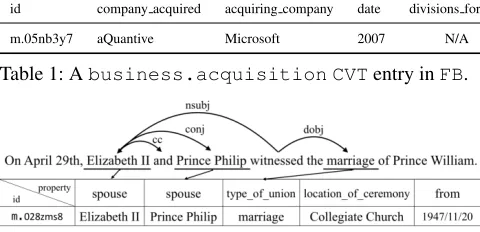
id company acquired acquiring company date divisions formed
[image:3.612.55.295.58.174.2]m.05nb3y7 aQuantive Microsoft 2007 N/A
Table 1: Abusiness.acquisition CVTentry inFB.
Figure 2: The dependency tree of S4, which partially matches aCVTentry ofpeople.marriageinFB.
argument4(such as date) in the key argument set.
P3 We also remove sentences from the generated dataset in which the dependency distances between any two key arguments are greater than 2. The distance between two arguments is the minimal number of hops it takes from one argument to the other on the dependency parse tree (see also Figure 2).
Using this strategy, the first three arguments of the CVT
entry are considered to be key arguments for event type
business.acquisition.
Selection Creteria: To determine how many arguments should be chosen in P1, we have conducted a series of evalu-ations on the quantity and quality of the datasets using differ-ent policies. We found that choosing the top half argumdiffer-ents gives the best accuracy for event labeling.
We use the following three example sentences from Wikipediato explain P2 and P3 described above.
S2:Microsoft spent $6.3 billion buying online display advertising companyaQuantivein2007.
S3: Microsoft hopes aQuantive’s Brian McAndrews can outfox Google.
S4: On April 29th, Elizabeth II and Prince Philip wit-nessed the marriage of Prince William.
Although time-related arguments are often missing in the currently imperfectKBs, they are crucial to identify the ac-tual occurrence of an event. As an example, suppose we want to use theCVTentry shown in Table 1 to determine whether sentences S2 and S3 arebusiness.acquistionevents. While this strategy works for S2, it gives a false prediction for S3. If we add the time-related argument (i.e., date: 2007), we can then correctly label both sentences. Therefore, we al-ways consider the most important time-related argument as key arguments (P2) when they are available.
Finally, P3 is based on our intuitions that two arguments involved in the same event mention are likely to be closer within the syntactic structure. As shown in Figure 2, al-though bothPrince Philipandmarriagecan be matched as key arguments in apeople.marriageentry, but with a
4
If there are multiple time-related arguments, we select the one with highest importance score.
distance of 3 (i.e., far from each other under our criterion) on the dependency tree, thus S4 will be labeled as negative.
Data Generation
To generate training data, we follow a number of steps. Our approach takes in existing structured tables or lists that are organized in a way similar to theFB CVTtables. The structured tables can be obtained from an existing knowl-edge base, created by experts, or generated through a com-bination of both approaches. For each event type, we de-termine the key arguments for each entry within that type used the key argument selection strategy described above. This step produces a set of rules to be used for data labeling, where each rule contains the event type, key arguments and non-key arguments given by a structured table entry. We also use alias information (such as Wikipedia redirect) to match two arguments that have different literal names but refer to the same entity (e.g. Microsoft and MS).
Next, we label each individual sentence from the target dataset. The labeling process is straightforward. We enumer-ate all rules from the generenumer-ate rule set, and check if the tar-get sentence contains all the key arguments specified by a rule. We regard a sentence as apositivesample if it contains all the key arguments of a rule, or negativeotherwise. For instances, S1 in Figure 1(a) and S2 (with its arguments in italics and underlined) are positive examples, while S3 and S4 are negative.
Because 68% of arguments in our dataset consist of more than one word, we formulate the training in a sequence la-beling paradigm rather than word-level classifications. We tag each word of the sentence using the standard begin-inside-outside (BIO) scheme, where each token is labeled
asB-roleif it is the beginning of an event argument with
its rolerole, orI-roleif it is inside arole, orO other-wise. We call this alabeling sequence.
Limitations
Our approach relies on structured tables or lists to automat-ically label text. The table can be obtained from an existing
KBor hand-crafted by experts. We stress that providing a ta-ble incurs much less overhead than manually tagging each training sentence, as a single table entry can be automati-cally applied to an unbounded number of sentences.
Our implementation may benefit from pronoun resolu-tion and entity coreference, which is complementary to our method, and may improve our recall. While this work tar-gets the sentence level, we believe it is generally applicable. There are methods like event coreference resolution(Liao and Grishman 2010; Berant et al. 2014), can be used to ex-tend our approach to document-level event extraction.
Event Extraction
Text
labeling seq.(s) w/ key arguments only Event & Key
Arg. Detection
Non-key Argument
Detection labeling seq.(s) w/ non-key arguments only
+
labeling seq.(s) w/ all arguments
event type(s) event type(s)
=
Final Output [image:4.612.54.305.55.110.2]1 2
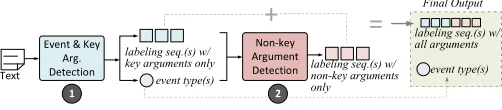
Figure 3: Our 2-stage event extraction pipeline.
The first stage identifies the key arguments in a sentence. If a sentence containsallkey argumentsof a specific event type, it will be considered to imply an event mention of this specified type. Since at this stage we do not concern non-key arguments, all non-non-key argument tokens are tagged asO. Furthermore, multiple labeling sequences may be produced by this stage, each corresponds to an event type. The second stage takes in the outputs of the first stage, and detects all the non-key arguments.
Stage 1: Key Argument and Event Detection
The model used in stage 1 consists of a Bidirectional Long Short-Term Memory (BLSTM) network with a conditional random field (Lafferty, McCallum, and Pereira 2001) (CRF) layer and an Integer Linear Programming (ILP) based post inference. The BLSTM-CRF layer finds the optimal label-ing sequence which will then be post-processed by an ILP solver. Using the labeling sequence, an event detector then checks if the sentence mentions a specific event.BLSTM At each timet, a forward LSTM layer takesxt as input and computes the output vector−→htof the past con-text, while a backward LSTM layer reads the same sentence in reverse and outputs←−htgiven the future context. We con-catenate these two vectors to form the output vector of a BLSTM, which is fed into a softmax layer to estimate a probability distribution over all possible labels.
CRF Choosing the best label for each word individually according to the BLSTM ignores the dependencies between labels, thus cannot guarantee the best sequence. Therefore, we introduce a CRF layer over the BLSTM output.
We considerPto be a matrix of confidence scores output by BLSTM, and the elementPi,j of the matrix denotes the probability of the labeljfor thei-th word in a sentence. The CRF layer takes a transition matrixAas parameter, where Ai,jrepresents the score of a transition from labelito label
j. The score of a sentence w along with a path of labels
y = {y1, y2, . . . , yn} is measured by the sum of BLSTM outputs and transition scores:
score(w,y) =
n X
i=0 Pi,yi+
n X
i=1
Ayi,yi+1, (2)
During test, given a sentencew, we adopt the Viterbi algo-rithm (Rabiner 1989) to find the optimal label sequence with the maximum score among all possible label sequences.
ILP-based Post Inference The output sequences of BLSTM-CRF do not necessarily satisfy the structural con-straints of event extraction. We thus propose to apply ILP
to further globally optimize the BLSTM-CRF output to pro-duce the best label sequence. Formally, letLbe the set of possible argument labels. For each wordwiin the sentence
wand a pair of labelshl, l0i ∈ L×L, we create a binary vari-ablevi,l,l0 ∈ {0,1}, denoting whether or not the i-th word wiis tagged as labelland its following wordwi+1is tagged as labell0at the same time. The objective of ILP is to maxi-mize the overall score of the variables as:
X
i,l,l0vi,l,l0∗(Pi,l+Al,l0).
where we consider the following four constraints:
C1: Each word should be and only be annotated with one label, i.e.:
X
l,l0vi,l,l0 = 1 (3)
C2: If the value ofvi,l,l0 is1, then there has to be a label l∗that will makevi+1,l0,l∗equal to1, i.e.:
vi,l,l0 =
X
l∗vi+1,l0,l∗ (4)
C3: If the current label isI-arg, then its previous label must beB-argorI-arg, i.e.:
vi,I-arg,l0 =vi−1,B-arg,I-arg+vi−1,I-arg,I-arg (5)
C4: For a specific event type, all its key arguments should co-occur in the sentence, or none of them appears in the re-sulting sequence. For any pair of key argumentsarg1 and
arg2 with respect to the same event type, the variables re-lated to them are subject to:
X
i,l0vi,B-arg1,l0 ≤n∗
X
j,l∗vj,B-arg2,l∗ (6)
wherenis the length of the sentence.
Event Detection This step simply if the input sentence contains all the key arguments of a specific event type by examining the labeling sequence.
Multiple Typed Events There are scenarios where one sentence expresses multiple events which share some key ar-guments, but most current event extractors only map a sen-tence to one event. For example, in S5, Youyou Tu is the
winerof twoaward honorevents triggered by the same
wordreceived.
S5:YouYou Tureceived theLasker Awardin2011, and
Nobel Prize in Physiology or Medicinein2015.
One of the advantages of our approach is that it can be eas-ily extended to support multiple typed events. To do so, we allow our ILP solver to output multiple optimal sequences. Specifically, after our model outputs the best sequencestat timet, we remove the previously best solutions{s1, . . . ,st} from the solution space, and re-run our solver to obtain the next optimal sequences st+1. We repeat the optimization procedure until the difference between the scores ofs1and
Stage 2: Non-key Argument Detection
[image:5.612.331.547.54.125.2]After event detection, a sentence will be classified into one or more event types, and labeled with the corresponding key arguments. We next adopt the same BLSTM-CRF architec-ture to detect the remaining non-key arguments, where we encode the key-argument label (from the first stage) of each word into a key-argument feature vector through a look-up table, and concatenate it with the original word embedding as the input to a new BLSTM-CRF. Note that we do not need post inference here, because there is no structural constraints between non-key arguments.
Experiments
Our experiments are designed to answer: 1) whether it is possible to automatically collect training data for event ex-traction, 2) whether extractors trained on such data can de-tect events of interest and identify their corresponding ar-guments, and 3) whether our solution can work with other knowledge resources for more types of event.
Dataset Evaluation
We start by comparing key argument selection strategies: (1)
ALL: uses all arguments as key arguments; (2)IMP: uses the top half arguments with highest importance scores as key arguments; (3) IMP&TIME: includes a time-related argu-ment together with the arguargu-ments selected byIMP; and (4)
DIS: eliminate sentences where the dependency distances between any two key arguments are greater than 2. We use the above methods to collect datasets using Freebase and the English Wikipedia dump of 2016-11-20, by randomly se-lecting 100 sentences from each dataset, and ask two anno-tators to decide if each sentence implies a given event type.
As shown in Table 2, it is not surprising that ALL, as the most strict, guarantees the quality of the collected data, but only contributes 203 sentences covering 9 event types, which is far from sufficient for further applications.IMP re-laxes ALLby allowing the absence of non-key arguments, which expands the resulting dataset, but introduces more noise. We can also see that the dependency constraint (DIS) improves the data quality (IMP+DIS). Compared withIMP, the significant quality improvement byIMP&TIMEproves that time-related arguments within CVT schemas are criti-cal to imply an event occurrence. Among all strategies, the dataset byIMP&TIME+DISachieves the best quality, while still accounting for 46735 sentences with 50109 events, al-most 10 times more than the ACE dataset, showing that it is feasible to automatically collect quality training data for event extraction without either human-designed event schemas orextrahuman annotations.
Our final dataset,FBWiki, usingIMP&TIME+DIS, con-tains 46,735 positive sentences and 79,536 negative ones5a random split of 101,019 for training and 25,252 for testing. There are on average 4.8 arguments per event, and in total, 5.5% instances labeled with more than two types of events.
5
Besides trivial negative samples that have no matched argu-ments, we randomly sample 34,837 negative instances that contain only part of key arguments, and 21,866 sentences whose key argu-ments violate the dependency constraint.
Strategy Sentences Type Positive Percentage (%)
ALL 203 9 98%
IMP 318K 24 22%
IMP+DIS 170K 24 37%
IMP&TIME 112K 24 83%
IMP&TIME+DIS 46K 24 91%
Table 2: Statistics of the datasets built with different strate-gies.Typethe number of different CVT types found.
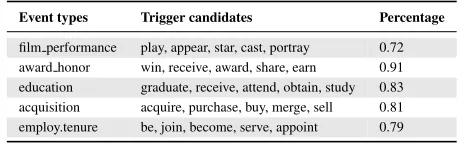
Event types Trigger candidates Percentage
film performance play, appear, star, cast, portray 0.72 award honor win, receive, award, share, earn 0.91 education graduate, receive, attend, obtain, study 0.83 acquisition acquire, purchase, buy, merge, sell 0.81 employ.tenure be, join, become, serve, appoint 0.79
Table 3: Top 5 most frequent trigger candidates and their proportions over all positive instances within each type.
Trigger Inference: To further explore the relationship be-tween key arguments and triggers, we regard the least com-mon ancestor of all key arguments in the dependency tree as a trigger candidate. As listed in Table 3, these candidates share similar meanings and are highly informative to the un-derlying event types, showing that our key arguments with necessary constraints can play the same role with explicit triggers in identifying an event.
On ACE: We also test our strategy on the ACE dataset. We first collect all annotated events, without triggers, as the knowledge base to compute the importance values for all arguments, and select the key arguments for each ACE event type accordingly. We followIMP&TIME+DISto ex-amine every sentence whether it can be selected as an an-notated instance within the ACE event types. Eventually, we correctly obtain 3,448 sentences as positive instances, cov-ering 64.7% of the original ACE dataset. We find that the main reason for the missing 35.3% is that many arguments in the ACE dataset are pronouns, where our strategy is cur-rently unable to treat pronouns as key arguments. However, if a high-precision coreference resolution tool is available to preprocess the document, our solution would be able to automatically label more instances.
Extraction Setup
Next, we evaluate our event extractor on FBWiki with pre-cision(P),recall(R), andF-measure(F) for each subtask. These metrics are computed according to the following stan-dards of correctness. Forevent classification, an event is cor-rectly classified if its reference sentence containsall key ar-gumentsof this event type. Forkey argument detection, an event is correctly detected if its type and all of its key argu-ments match a reference event within the same sentence. For
all argument detection, an event is correctly extracted if its type and all of its arguments match a reference event within the same sentence.
[image:5.612.322.552.154.226.2]100. In argument detection, we use the same size of word embedding, while the size of LSTM layer is 150, and the size of key argument embedding is 50. Word embeddings are pre-trained using skip-gram word2vec (Mikolov et al. 2013) on English Wikipedia and fine tuned during training. We apply dropout (0.5) on both input and output layers.
Baselines:We compare our proposed model with three base-lines. The first is a BLSTM model that takes word embed-dings as input, and outputs the label for each word with the maximum probability. For feature-based methods, we apply CRF (using the CRF++ toolkit (Kudo 2005) ) and Maximum Entropy (Berger, Pietra, and Pietra 1996) (Le Zhang’s Max-Ent toolkit) to explore a variety of elaborate features, ac-cording to the state-of-art feature-based ACE event extrac-tors (Li, Ji, and Huang 2013). Note that after key argument detection, we add the resulting label of each word as a sup-plementary feature to detect non-key arguments.
Compare with Automatic Annotations
Firstly, we compare the model output against the automat-ically obtained event annotations. As shown in Table 4, feature-based models perform worst in both event classifi-cation and argument detection. One of the main reasons is the absence of explicit trigger annotations in our dataset, which makes it impossible to include trigger-related fea-tures, e.g., trigger-related dependency and position features. Although traditional models can achieve higher precisions, they only identify a limited number of events, resulting in low recalls. Neural-network methods perform much better than feature-based models, especially in recall, since they can make better use of word semantic features. Specifically, BLSTM can capture longer dependencies and richer con-textual information, instead of neighbouring word features only. The CRF layer brings an averagely 2% improvement in all metrics, and by adding the ILP-based post inference, our full model, BLSTM-CRF-ILPmulti, achieves the best per-formance among all models.
It is not surprising that every model with a CRF layer over its BLSTM layer is superior to the one with a BLSTM layer only. Compared with vanilla BLSTM, BLSTM-CRF achieves higher precisions and recalls in all subtasks by significantly reducing the invalid labelling sequences (e.g.,
I-argappears right afterO). During prediction, instead of
tagging each token independently, BLSTM-CRF takes into account the constraints between neighbouring labels, and potentially increases the co-occurrences of key arguments regarding the same event type.
As shown in Table 4, the ILP-based post inference con-siderably improves the overall performance, especially in
event type classification. With the help of constraintC4, du-bious key arguments can be correctly inferred through other key arguments from their context. Compared with BLSTM-CRF, BLSTM-CRF-ILP1 produces an F1 gain of 3.2% in event type classification, 1.5% in key argument detection, and 1.2% in all argument detection.
Multiple Type Events:Among all methods, BLSTM-CRF-ILPmulti is the only model that can deal with multiple type event mentions. The proposed strategy ILPmulti helps
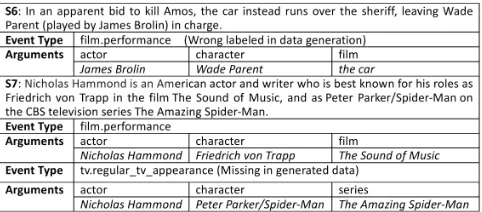
de-Figure 4: Example outputs of BLSTM-CRF-ILPmulti.
tect more event mentions for a sentence, contributing to the increase of recalls, and F1 scores with a little drop of pre-cisions. BLSTM-CRF-ILPmulti can correctly identify 132 sentences with multiple type events, with an accuracy of 95.6%, and for each involved event, our model maintains a high performance in identifying its arguments, achieving 45.5%, and 29.1% in F1 for key argument detection and all argument detection, respectively.
Manual Evaluation
To provide a deep investigation about our dataset and mod-els, we randomly sample 150 sentences from the test set. Two annotators are asked to annotate each sentence follow-ing two steps. First, determine if a given sentence is positive or negative, and assignall possibleevent types to positive ones. Next, label all related arguments and their roles ac-cording to the event types for all positive instances. Two an-notators will independently annotate each sentence, and dis-cuss to reach an agreement. The inter-annotator agreement is 87% for event types and 79% for arguments.
By comparing the automatic and manual annotations on the 150 sentences, we find that the main issue for the au-tomatic annotation is that some auau-tomatically labeled sen-tences do not imply any event while still matching all key properties of certain CVT entries in Freebase. We find 16 such instances that are mistakenly labeled as positive. For example in Figure 4, although the phrase the car in S6 matches a film name, it does not refer to a film. This is be-cause that we currently do not have a strong entity linker to verify those entities, which we leave for future work. How-ever, during manual investigation, BLSTM-CRF-ILPmulti can correctly identify these 6 instances as negative.
On this manually annotated dataset, we can observe simi-lar trends with Table 4, and BLSTM-CRF-ILPmultiremains the best performing model, achieving 80.7%, 56.4% and 36.3% in F1 scores for event type, key argument detection and all argument detection, respectively.
[image:6.612.321.562.53.159.2]Model Event Type Key Argument Detection All Argument Detection
P R F P R F P R F
CRF 88.9 11.0 19.6 36.1 4.47 7.96 19.9 3.06 5.30
MaxEnt 95.2 12.4 21.9 41.6 5.40 9.56 22.5 3.40 5.91
BLSTM 89.8 63.0 74.1 64.9 45.5 53.5 42.9 27.7 33.7
BLSTM-CRF 86.4 67.4 75.7 63.6 49.6 55.8 44.4 31.0 36.5
BLSTM-CRF-ILP1 84.4 74.1 78.9 62.3 53.8 57.3 42.7 33.8 37.7
[image:7.612.78.536.53.140.2]BLSTM-CRF-ILPmulti 85.3 79.9 82.5 60.4 55.3 57.7 41.9 34.6 37.9
Table 4: System performance when compared against automatic annotations (%).
Event type Entries Positive EC KAD AAD
Acquisition 690 414 87.0% 72.0% 69.6% Olympics 2503 1460 77.2% 64.5% 38.6% Awards 3039 2217 95.0% 82.8% 58.6%
Table 5: Statistics of the TBWiki dataset and the perfor-mance (in F1) of our model on TBWiki. EC, KAD and AAD denote event type classification, key argument detection and all key argument detection, respectively.
On BBC News: We further apply our event extractor, trained on FBWiki, to 397 BBC News articles (2017/04/18 – 2017/05/18 in Politics, Business and TV sections), and man-ually examine the extraction results. We find that our model is able to correctly identify 117 events, and 53 events, almost half of which are not covered in the currently used Freebase.
Tables as Indirect Supervision
To investigate the applicability of our approach to other structured knowledge/tables besides Freebase CVT tables, we automatically build a new dataset,TBWiki, with the su-pervision provided by Wikipedia tables, which characterize events about business acquisition, winning of the Olympics games, and awards winning in entertainment (Table 5).
We train our BLSTM-CRF-ILPmulti on this dataset and evaluate it on 100 manually annotated sentences. We can see that without extra human annotations, our model can learn to extract events from the training data weakly supervised by Wikipedia tables. Given a specific event type, as long as we can acquire tables implying events of such type, it is possible to automatically collect training data from such tables, and learn to extract structured event representations of that type.
Related Work
Most event extraction works are within the tasks defined by several evaluation frameworks (e.g., MUC (Grishman and Sundheim 1996), ACE (Doddington et al. 2004), ERE (Song et al. 2015) and TAC-KBP (Mitamura et al. 2015)), all of which can be considered as a template-filling-based extrac-tion task. These frameworks focus on limited number of event types, which are designed and annotated by human experts and hard to generalize to other domains. Further-more, existing extraction systems, which usually adopt a supervised learning paradigm, have to rely on those high-quality training data within those frameworks, thus hard to move to more domains in practice, regardless of feature-based (Gupta and Ji 2009; Hong et al. 2011; Li, Ji, and Huang 2013) or neural-network-based methods (Chen et al. 2015; Nguyen, Cho, and Grishman 2016).
Besides the works focusing on small human-labeled cor-pora, Huang et al. (2016) and Chen et al.(2017) leverage var-ious linguistic resources (e.g., FrameNet, VerbNet, etc.) to automatically collect trigger annotations with more training instances to improve existing event extractors. In contrast, we propose to exploit various structured knowledge bases to automatically discover types of events as well as their corre-sponding argument settings, without expert annotations, and further automatically construct training data, with the help ofDS.
Distant supervision (DS) has been widely used in binary relation extraction, where the key assumption is that sen-tences containing both the subject and object of a <subj,
rel,obj>triple can be seen as its support, and further used to train a classifier to identify the relation rel. However, this assumption does not fit to our event extraction scenario, where an event usually involves several arguments and it is hard to collect enough training sentences with all arguments appearing in, as indicated by the low coverage ofALL. We therefore investigate different generation strategies for event extraction within the DS paradigm and propose to utilize time and syntactic clues to refine theDSassumption for bet-ter data quality. We further relieve the reliance on explicit trigger annotations required by previous event extractors, and define a novel event extraction paradigm with key ar-guments to characterize an event type.
Conclusions
References
Aguilar, J.; Beller, C.; McNamee, P.; Van Durme, B.; Strassel, S.; Song, Z.; and Ellis, J. 2014. A comparison of the events and relations across ace, ere, tac-kbp, and framenet annotation standards. InProceedings of the Second Work-shop on EVENTS: Definition, Detection, Coreference, and Representation, 45–53.
Berant, J.; Srikumar, V.; Chen, P.-C.; Vander Linden, A.; Harding, B.; Huang, B.; Clark, P.; and Manning, C. D. 2014. Modeling biological processes for reading comprehension. InEMNLP.
Berger, A. L.; Pietra, V. J. D.; and Pietra, S. A. D. 1996. A maximum entropy approach to natural language processing.
Computational linguistics22(1):39–71.
Bollacker, K.; Evans, C.; Paritosh, P.; Sturge, T.; and Taylor, J. 2008. Freebase: a collaboratively created graph database for structuring human knowledge. InSIGMOD 2008, 1247– 1250. ACM.
Chen, Y.; Xu, L.; Liu, K.; Zeng, D.; and Zhao, J. 2015. Event extraction via dynamic multi-pooling convolutional neural networks. InACL 2015, volume 1, 167–176.
Chen, Y.; Liu, S.; Zhang, X.; Liu, K.; and Zhao, J. 2017. Automatically labeled data generation for large scale event extraction. InProceedings of the 55th Annual Meeting of the Association for Computational Linguistics (Volume 1: Long Papers), volume 1, 409–419.
Doddington, G. R.; Mitchell, A.; Przybocki, M. A.; Ramshaw, L. A.; Strassel, S.; and Weischedel, R. M. 2004. The automatic content extraction (ace) program-tasks, data, and evaluation. InLREC 2004, volume 2, 1.
Grishman, R., and Sundheim, B. 1996. Message under-standing conference-6: A brief history. InCOLING 1996, volume 96, 466–471.
Gupta, P., and Ji, H. 2009. Predicting unknown time argu-ments based on cross-event propagation. In ACL-IJCNLP 2009, 369–372. Association for Computational Linguistics.
Gurobi Optimization, I. 2016. Gurobi optimizer reference manual.
Hong, Y.; Zhang, J.; Ma, B.; Yao, J.; Zhou, G.; and Zhu, Q. 2011. Using cross-entity inference to improve event extrac-tion. InACL 2011, 1127–1136. Association for Computa-tional Linguistics.
Huang, L.; Cassidy, T.; Feng, X.; Ji, H.; Voss, C.; Han, J.; and Sil, A. 2016. Liberal event extraction and event schema induction. InACL 2016.
Kudo, T. 2005. Crf++: Yet another crf toolkit. Software available at http://crfpp. sourceforge. net.
Lafferty, J.; McCallum, A.; and Pereira, F. 2001. Condi-tional random fields: Probabilistic models for segmenting and labeling sequence data. InICML 2001, volume 1, 282– 289.
Li, Q.; Ji, H.; and Huang, L. 2013. Joint event extraction via structured prediction with global features. InACL 2013, 73–82.
Liao, S., and Grishman, R. 2010. Using document level cross-event inference to improve event extraction. In Pro-ceedings of the 48th Annual Meeting of the Association for Computational Linguistics, 789–797. Association for Com-putational Linguistics.
Mikolov, T.; Sutskever, I.; Chen, K.; Corrado, G. S.; and Dean, J. 2013. Distributed representations of words and phrases and their compositionality. In NIPS 2013, 3111– 3119.
Mintz, M.; Bills, S.; Snow, R.; and Jurafsky, D. 2009. Dis-tant supervision for relation extraction without labeled data. InACL-IJCNLP 2009, 1003–1011. Association for Compu-tational Linguistics.
Mitamura, T.; Yamakawa, Y.; Holm, S.; Song, Z.; Bies, A.; Kulick, S.; and Strassel, S. 2015. Event nugget annotation: Processes and issues. InProc. of the Workshop on EVENTS at the NAACL-HLT, 66–76.
Nguyen, T. H.; Cho, K.; and Grishman, R. 2016. Joint event extraction via recurrent neural networks. In NAACL-HLT 2016, 300–309.
Rabiner, L. R. 1989. A tutorial on hidden markov models and selected applications in speech recognition.Proc. of the IEEE77(2):257–286.
Song, Z.; Bies, A.; Strassel, S.; Riese, T.; Mott, J.; Ellis, J.; Wright, J.; Kulick, S.; Ryant, N.; and Ma, X. 2015. From light to rich ere: annotation of entities, relations, and events. In Proc. of the Workshop on EVENTS at the NAACL-HLT, 89–98.