warwick.ac.uk/lib-publications
Persistent WRAP URL:
http://wrap.warwick.ac.uk/112011
How to cite:
Please refer to published version for the most recent bibliographic citation information.
If a published version is known of, the repository item page linked to above, will contain
details on accessing it.
Copyright and reuse:
The Warwick Research Archive Portal (WRAP) makes this work by researchers of the
University of Warwick available open access under the following conditions.
© 2018 Elsevier. Licensed under the Creative Commons
Attribution-NonCommercial-NoDerivatives 4.0 International
http://creativecommons.org/licenses/by-nc-nd/4.0/.
Publisher’s statement:
Please refer to the repository item page, publisher’s statement section, for further
information.
Micro-Net: A unified model for segmentation of various objects in
microscopy images
Shan E Ahmed Raza, Linda Cheung, Muhammad Shaban,
Simon Graham, David Epstein, Stella Pelengaris, Michael Khan,
Nasir M. Rajpoot
PII:
S1361-8415(18)30062-8
DOI:
https://doi.org/10.1016/j.media.2018.12.003
Reference:
MEDIMA 1438
To appear in:
Medical Image Analysis
Received date:
6 March 2018
Revised date:
13 December 2018
Accepted date:
14 December 2018
Please cite this article as: Shan E Ahmed Raza, Linda Cheung, Muhammad Shaban, Simon Graham,
David Epstein, Stella Pelengaris, Michael Khan, Nasir M. Rajpoot, Micro-Net: A unified model for
segmentation of various objects in microscopy images,
Medical Image Analysis
(2018), doi:
https://doi.org/10.1016/j.media.2018.12.003
ACCEPTED MANUSCRIPT
Highlights• A unified deep learning framework for segmentation of objects (cell nuclei, cells, and multi-cellular objects such as glandular structures) in two main
types of microscopy images: fluorescence and histology.
• The proposed Micro-Net is aimed at better object localization in the face of varying intensities and is robust to noise.
• Detailed experimentation & comparative evaluation on publicly available data sets and a new image dataset that is made public with this paper.
ACCEPTED MANUSCRIPT
Micro-Net: A unified model for segmentation of various
objects in microscopy images
Shan E Ahmed Razaa,b,∗, Linda Cheungc, Muhammad Shabanb, Simon
Grahamb, David Epsteind, Stella Pelengarisc, Michael Khanc, Nasir M.
Rajpootb,e,f,∗
aDivision of Molecular Pathology, The Institute of Cancer Research, UK. bDepartment of Computer Science, University of Warwick, UK.
cSchool of Life Sciences, University of Warwick, UK. dDepartment of Mathematics, University of Warwick, UK.
eDepartment of Pathology, University Hospitals Coventry and Warwickshire, UK. fThe Alan Turing Institute, London, UK.
Abstract
Object segmentation and structure localization are important steps in
auto-mated image analysis pipelines for microscopy images. We present a
convolu-tion neural network (CNN) based deep learning architecture for segmentaconvolu-tion
of objects in microscopy images. The proposed network can be used to segment
cells, nuclei and glands in fluorescence microscopy and histology images after
slight tuning of input parameters. The network trains at multiple resolutions
of the input image, connects the intermediate layers for better localization and
context and generates the output using multi-resolution deconvolution filters.
The extra convolutional layers which bypass the max-pooling operation allow
the network to train for variable input intensities and object size and make it
robust to noisy data. We compare our results on publicly available data sets and
show that the proposed network outperforms recent deep learning algorithms.
Keywords: Cell segmentation, nuclear segmentation, gland segmentation,
convolution neural networks, microscopy image analysis, digital pathology
∗Corresponding author
Email addresses: [email protected](Shan E Ahmed Raza),
ACCEPTED MANUSCRIPT
1. IntroductionIn automated microscopic image analysis pipelines, segmentation of key
structures such as tumours, glands and cells is an important step (Awan et al.
(2017); Yuan et al. (2012); Qaiser et al. (2017)). Recent advances in deep
learn-ing have helped to achieve accurate segmentation of these structures. A major
5
strength of deep learning is that the same network architecture can be used to
segment various structures across different modalities by retraining and slight
tuning of the input parameters (Shelhamer et al. (2017); Ronneberger et al.
(2015)).
In this paper, we propose a CNN with additional layers in the downsampling
10
path, bypassing the max-pooling operation in order to learn the parameters for
segmentation ignored during the max-pooling operation. By doing so, we retain
contextual information, make the network interpret the output at multiple
res-olutions and train the model at multiple input image resres-olutions in the
down-sampling path to learn the model parameters for variable cell/nucleus/gland
15
sizes and shapes in the presence of variable intensities and texture. There are
two main features of the proposed architecture: (a) it learns image features at
multiple input resolutions for better understanding of tissue components and
(b) it bypasses the max-pooling operation through extra layers to retain
infor-mation from weak features may be missed during max-pooling. This makes the
20
network robust to noise and helps to learn the context at multiple resolutions.
Figure 1 & 2 demonstrate the impact of these design changes. In Figure 1, solid
lines represent training accuracy/loss for Micro-Net and Micro-Net–, whereas
dashed lines representvalidation accuracy/loss for Micro-Net and Micro-Net–
during training. Accuracy is defined in terms of pixel-wise agreement with the
25
ground truth and loss is defined in Section 3.6. In Micro-Net–, we removed
the multi-resolution input and the bypass layers while keeping the rest of the
architecture the same. The improved accuracy and loss values demonstrate the
importance of the proposed design changes. To emphasise this further, Figure
2(a) shows an H & E image where nuclei are outlined with green boundaries by
ACCEPTED MANUSCRIPT
an expert, Figure 2(b) outlines the result of U-Net (Ronneberger et al. (2015))and Figure 2(c) the result of the proposed approach. It can be observed that
U-Net failed to learn the features due to the presence of a dark cytoplasmic
region and segmented most of the cellular region instead of just the nucleus,
whereas the proposed approach learned the context at multiple resolutions and
35
successfully located the nuclei despite high levels of noise. We discuss this in
detail in Section 4.
0 5 10 15 20
Epoch
0.68 0.7 0.72 0.74 0.76 0.78 0.8 0.82
0.84 Accuracy
Micro-Net: Training Accuracy Micro-Net: Validation Accuracy Micro-Net : Training Accuracy Micro-Net : Validation Accuracy
0 5 10 15 20
Epoch
1 1.5 2 2.5 3 3.5
4 106 Loss
Micro-Net: Training Loss Micro-Net: Validation Loss Micro-Net : Training Loss Micro-Net : Validation Loss
Figure 1: Solid lines represent training accuracy/loss for Micro-Net and Micro-Net– while
the dashed lines represent validation accuracy/loss calculated for 25 epochs on fluorescence imaging data for cell segmentation. Micro-Net– was obtained by removing multi-resolution
input and the bypass layers from Micro-Net architecture. The accuracy and loss curves clearly
show the importance of the multi-resolution input and bypass layers.
This paper is an extension of our previous work on cell (Raza et al. (2017a))1
and gland segmentation (Raza et al. (2017b)) with the following novel
contri-butions:
40
1We will publish our fluorescence cell segmentation data set along with ground truth
ACCEPTED MANUSCRIPT
Figure 2: Nuclear segmentation on a sample H & E image from lung outlined in green (a)
ground truth, (b) U-Net (Ronneberger et al. (2015)) (c) proposed. U-Net clearly misses the boundary and is inclined towards strong contrast whereas the proposed method segments
nuclei instead ofstrongcontrast with the background. This is because the proposed approach learns the features at multiple input resolutions and learns for weaker boundaries.
1. A unified framework for segmentation of various types of objects (nuclei,
cells, glands) in two different types of image modalities (histology and
fluorescence microscopy).
2. We discuss in detail the challenges faced for training a CNN for
segmen-tation and present a solution to overcome those challenges.
45
3. Detailed results to show the robustness of the method to high levels of
noise and comparative evaluation with the state-of-the-art.
4. We propose how the proposed network architecture can be modified/extended
for different applications.
5. In order to justify and clearly demonstrate the effect of additional layers,
50
we present results for Micro-Net–after removing the multi-resolution input
and the bypass layers while keeping the rest of the architecture the same
as Micro-Net.
6. Addition of another data set to our analysis where we compare our results
with those in the MICCAI 2017 computational precision medicine (CPM)
55
ACCEPTED MANUSCRIPT
1.1. Related WorkThe existing literature on segmentation methods can be broadly classified
into two main categories: handcrafted feature based approaches and deep
learn-ing based methods. Most of the existlearn-ing handcrafted feature based approaches
60
to cell/nuclear segmentation employ a combination of thresholding, filtering,
morphological operations, region accumulation, marker controlled watershed
(Yang et al. (2006); Veta et al. (2013)), deformable model fitting (Bergeest and
Rohr (2012)), graph cut (Dimopoulos et al. (2014)) and feature classification
(Li et al. (2015)). A detailed review of cell/nuclear segmentation methods was
65
presented by Meijering (2012) for images from various modalities. For gland
segmentation, most of the early attempts used handcrafted features. Wu et al.
(2005) identified initial seed regions based on large vacant lumen regions and
expanded the seed to a surrounding chain of epithelial nuclei. Farjam et al.
(2007) proposed segmentation by clustering texture features calculated using a
70
variance filter. However, robust segmentation requires more domain knowledge
and texture features calculated using just a variance filter might not provide
enough information for the local structure of the tissue. Naik et al. (2008)
em-ployed a Bayesian classifier to detect lumen regions and then refined using a
level set to stop the curve, based on the likelihood of a nucleus. While this
75
approach is reported to work well in benign cases, it can fail in malignant cases
where the morphology of glands is quite complex. Nguyen et al. (2012) grouped
the nuclei, cytoplasm and lumen using colour space analysis and grew the lumen
region with constraints to achieve segmentation. Gunduz-Demir et al. (2010)
represented each tissue component as a circular disc and constructed a graph
80
with nearby discs joined by an edge. They performed region growing on
lu-men discs that were constrained by lines joining the nuclear discs. Nosrati and
Hamarneh (2014) and Cohen et al. (2015) first classify tissue regions into
differ-ent constitudiffer-ents and then employ a constrained level set algorithm to segmdiffer-ent
the glands. Sirinukunwattana et al. (2015) identified epithelial superpixels and
85
used epithelial regions as vertices of a polygon approximating the boundary of a
ACCEPTED MANUSCRIPT
then employ region growing or level sets to segment glandular regions. Recently,Li et al. (2017) proposed a slightly different approach where they first
deter-mine potential epithelial regions using lumen/background information and then
90
identify connected epithelial cells to segment the glands using a multi-resolution
cell orientation descriptor.
In this paper, we focus on deep learning based approaches using
convolu-tional neural networks (CNNs). These have recently received a wealth of
at-tention, due to state-of-the-art performance in recent computer vision tasks,
95
including segmentation (Shelhamer et al. (2017); Ronneberger et al. (2015);
Chen et al. (2017); Song et al. (2017)). The fully convolutional network (FCN)
for segmentation is considered to be a benchmark for segmentation tasks
us-ing deep learnus-ing (Shelhamer et al. (2017)). The network performs pixel-wise
classification to obtain the segmentation mask for a given input and consists of
100
downsampling and upsampling paths. The downsampling path consists of
con-volution and max-pooling and the upsampling path consists of concon-volution and
deconvolution (convolution transpose) layers. U-Net (Ronneberger et al. (2015))
is inspired by FCN but connects intermediate downsampling and upsampling
paths to conserve the context information. Recently, Sadanandan et al. (2017)
105
used the CellProfiler pipeline (Carpenter et al. (2006)) as an automatic way of
generating ground truth to train the network and employed a variation of fully
convolutional network inspired by the improvements in U-Net (Ronneberger
et al. (2015)) and residual network architecture (He et al. (2016)) for cell
seg-mentation. Kraus et al. (2016) use multiple instance learning (MIL) to
simul-110
taneously segment and classify cells in microscopy images. The binary instance
classifier generates the predictions which are combined through an aggregate
function in the MIL layer of the proposed network. However, this approach can
be computationally expensive for solving a segmentation problem as multiple
feature maps need to be aggregated using the global pooling function. DCAN
115
(Chen et al. (2017)) employs a modified FCN that simultaneously segments both
the objects and contours to assist separating clustered object instance. Another
ACCEPTED MANUSCRIPT
trains the network at different scales of the Laplacian pyramid and merges thenetwork in the upsampling path to perform segmentation. Xu et al. (2016,
120
2017) proposed a network that performs side supervision of boundary maps in
addition to the foreground. Manivannan et al. (2018) combined handcrafted
features with deep learning for segmentation, but this approach is
computa-tionally expensive as it not only requires calculation of features using classical
approaches but also a support vector machine (SVM) classifier to predict local
125
label patches.
2. Data Sets and Challenges
The data sets that we use in this paper come from two different sources. The
first data set contains images acquired using a multiplexed fluorescence
micro-scope, capable of acquiring images of multiple tags in a cyclic manner (Schubert
130
et al. (2006)), where our task was cell segmentation. The other two data sets are
Haematoxylin and Eosin (H&E) stained microscopic images collected as part of
open challenge contests. We use one of the data sets to evaluate nuclear
seg-mentation in four different tumour types (CPM) and the other one for gland
segmentation in colon cancer histology images (Sirinukunwattana et al. (2017)).
135
In this way, we demonstrate that the proposed network is capable of dealing
with diverse datasets and segmentation tasks.
2.1. Multiplexed Fluorescence Imaging Data
We first focus on segmentation of individual cells in multiplexed fluorescence
images using nuclear and membrane markers. In the fluorescence microscopy
140
images, this task is challenging for various reasons, for example relatively large
variation in intensity of captured signal and difficulty with separating
neigh-bouring cells. It requires careful tuning of the algorithm to make it robust to
intensity, shape, size and fusion of individual cellular regions. That process can
require experimentation with a variety of features and can be time consuming.
145
individ-ACCEPTED MANUSCRIPT
ual cells, but the intensity of the membrane markers varies depending on typeand orientation of each cell which makes segmentation difficult.
A multi-channel fluorescence microscope known as the Toponome Imaging
System (TIS) (Schubert et al. (2006)), acquired images of tissue samples from
150
mouse pancreata. The TIS microscope is capable of capturing signals from
multiple biomarkers, but for cell segmentation we employ only two channels
corresponding to Ecad (membrane marker using FITC channel) and DAPI
(nu-clear marker). After segmentation work is completed, the other channels are
available to study individual cells, and to group similar cells together for
statis-155
tical purposes. We performed alignment and normalization of the multi-channel
images using protocols designed for pre-processing of the TIS data (Raza et al.
(2012, 2016)). Next, ground truth for image segmentation, marked by an expert
biologist, was used for training.
Sample images of mouse pancreatic exocrine cells and endocrine cells are
160
shown in Figure 3 as RGB composite images (enhanced for display), where
membrane marker is shown in green, nuclear marker in blue and ground truth
is overlaid in red with black boundaries. One can observe the variation in
intensities of cell boundaries and that the nuclei are not always present and, if
present, are not always positioned at the centre of the cell. This is because a
165
tissue is a three-dimensional structure which is finely cut into multiple sections
to obtain a two-dimensional image, which may or may not contain part of the
cell containing the nucleus. Pancreatic cells are either endocrine cells, seen in
the islets, or exocrine cells. Endocrine cells are more tightly packed and are
smaller than exocrine cells. In addition, images with varying levels of
signal-170
to-noise ratio (SNR) are expected in fluorescence microscopy images where not
only the imaging apparatus but also antibody concentration, temperature and
incubation times contribute to noise. These variations make segmentation a
ACCEPTED MANUSCRIPT
Figure 3: Top row: Membrane marker (Ecad-FITC) is shown in green and nuclear marker (DAPI) in blue. Bottom row: ground truth is overlaid in red with black boundaries. Left:
Exocrine Cells. Right: Endocrine Cells.
2.2. The Computational Precision Medicine (CPM) Data Set for nuclear
seg-175
mentation
Nuclear segmentation can help understand the tumour microenvironment
by studying features such as nuclear pleomorphism and nuclear morphology.
Segmentation of nuclei in histology images is difficult, especially within tumour
cells due to their heterogeneous nature with high variation in shape, size and
180
chromatin pattern. The data set we use in this paper was published as part
of a challenge contest at Medical Image Computing and Computer Assisted
Interventions (MICCAI) 2017. The data set contains 32 training and 32 testing
image tiles along with ground truth marking for nuclear segmentation, extracted
from multi-tissue H&E stained histology slides. There is an equal representation
ACCEPTED MANUSCRIPT
of glioblastoma multiforme (GBM), lower grade glioma (LGG), head and necksquamous cell carcinoma (HNSCC) and non-small cell lung cancer (NSCLC). A
couple of example images (left) with corresponding ground truth outlined with
green boundary (right) are shown in Figure 4.
Figure 4: Left: Sample Images from the CPM data set. Right: Ground truth marking outlined
in green colour on the sample images. Top row: head and neck squamous cell carcinoma. Bottom row: lower grade glioma.
2.3. Gland Segmentation (GLaS) Challenge Data Set
190
Histological assessment of glands is one of the key factors in colon cancer
grading (Sirinukunwattana et al. (2017)). This requires a highly trained
pathol-ogist, is labour intensive, suffers from inter and intra-observer variability and
has limited reproducibility. Due to complex nature of the problem,
sophisti-cated algorithms are needed for successful automatic segmentation. Automatic
ACCEPTED MANUSCRIPT
segmentation of glands is challenging due to high variation in texture, size andstructure of glands especially in malignant tissue. The third data set we use
in this paper is the publicly available Warwick-QU data set published as part
of the GLand Segmentation (GLaS) challenge (Sirinukunwattana et al. (2017)).
The data set consists of 165 images with the associated ground truth marked
200
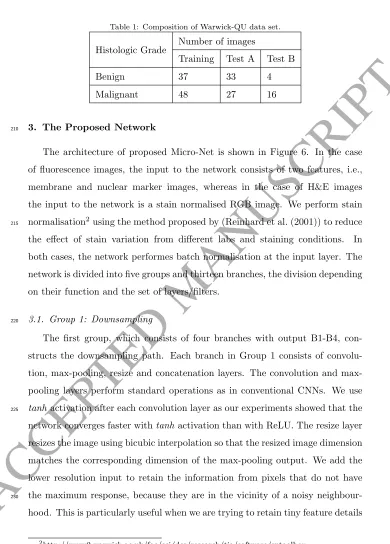
by expert pathologists. The composition of the data set is detailed in Table 1,
whereas a few sample images from the data set are shown in Figure 5. In Figure
5, the top row shows sample images from benign cases, and the bottom row
shows sample images from malignant cases. Figure 5 (c) has been taken from
a moderately differentiated colon cancer tissue and (d) has been taken from a
205
poorly differentiated colon cancer tissue section. It is evident from these images
that there is a large variation in the size, texture and structure of glands in
both malignant and benign cases although the variation is greater in malignant
cases.
Figure 5: Sample images from the GLaS data set (Sirinukunwattana et al. (2017)). The images are shown in pairs, where the sample image on the left is overlaid on the right with
the ground truth. The top row shows sample images from benign cases and the bottom row
shows sample images from malignant cases. (a) & (b) show variation in size and structure of glands in benign cases, whereas (c) & (d) show variation in malignant colon cancer, where (c)
is taken from a moderately differentiated sample and (d) is taken from a poorly differentiated
ACCEPTED MANUSCRIPT
Table 1: Composition of Warwick-QU data set.
Histologic Grade Number of images
Training Test A Test B
Benign 37 33 4
Malignant 48 27 16
3. The Proposed Network
210
The architecture of proposed Micro-Net is shown in Figure 6. In the case
of fluorescence images, the input to the network consists of two features, i.e.,
membrane and nuclear marker images, whereas in the case of H&E images
the input to the network is a stain normalised RGB image. We perform stain
normalisation2using the method proposed by (Reinhard et al. (2001)) to reduce 215
the effect of stain variation from different labs and staining conditions. In
both cases, the network performes batch normalisation at the input layer. The
network is divided into five groups and thirteen branches, the division depending
on their function and the set of layers/filters.
3.1. Group 1: Downsampling
220
The first group, which consists of four branches with output B1-B4,
con-structs the downsampling path. Each branch in Group 1 consists of
convolu-tion, pooling, resize and concatenation layers. The convolution and
max-pooling layers perform standard operations as in conventional CNNs. We use
tanhactivation after each convolution layer as our experiments showed that the
225
network converges faster withtanh activation than with ReLU. The resize layer
resizes the image using bicubic interpolation so that the resized image dimension
matches the corresponding dimension of the max-pooling output. We add the
lower resolution input to retain the information from pixels that do not have
the maximum response, because they are in the vicinity of a noisy
neighbour-230
hood. This is particularly useful when we are trying to retain tiny feature details
ACCEPTED MANUSCRIPT
(a)
(b)
Figure 6: The proposed Micro-Net architecture. (a) Micro-Net-252 & (b) Micro-Net-508.
ignored during the max-pooling operation, for example, when trying to detect
cells with boundary markers having extreme intensities, even for individual cells
as shown in Figure 3. Another aspect of the resizing operation is to train the
network on different sized cells/nuclei and glands as explained in Section 2. The
235
ACCEPTED MANUSCRIPT
of the features are the result of the max-pooling operation and the next half(64) are obtained by performing convolutions only on the resized image. The
following branches in Group 1 double the feature depth of the previous branch
but follow the same protocol in generating the branch output. The only
differ-240
ence is that B1 performs batch normalisation at the input and the resize layer
whereas B2-B4 perform batch normalisation at the resize layer only.
3.2. Group 2: Bridge
Group 2, consisting of B5, bridges the connection between the downsampling
and upsampling paths, whose architecture is very similar to conventional CNN
245
architectures.
3.3. Group 3: Upsampling
Group 3 forms the upsampling path and consists of branches B6, B7, B8 &
B9. Each of these branches take two inputs, one from the previous branch and
one from the branch with the closest feature dimension in the downsampling
250
path. The output of each branch is double in height and width and half the depth
of the previous branch. The second input is added from the downsampling path
for better localization and to capture context information as in (Ronneberger
et al. (2015)). It also passes the convolution only features to the upsampling
path, which helps to learn from features which do not have maximum response
255
in the downsampling path. Compared to U-Net (Ronneberger et al. (2015)),
we add additional deconvolution layers instead of cropping the feature from the
downsampling path. This allows us to produce a segmentation map of the same
size as the input image and an overlap-tile strategy is not required. It also
reduces the number of patches required to produce the desired segmentation
260
output thus removing computational steps.
3.4. Group 4 & 5: Auxiliary and Main Output
Group 4 & 5 generate the auxiliary and main output and calculate the
ACCEPTED MANUSCRIPT
output from one of B7-B9 and generates three auxiliary feature masks, which265
are fed into the main output branch. The output branch concatenates feature
masks and performs convolution followed by softmax classification to get the
segmentation output mappo(x) wherexrepresents a pixel location. The output
of branches B7-B9 are of different resolutions and so the deconvolution layer in
each of the auxiliary branches is set to generate the output of the same size
270
(Chen et al. (2017)). The deconvolution is followed by a convolution layer
which produces the auxiliary feature mask. Each of the auxiliary feature masks
is followed by a dropout layer (set to 50%) and the convolution layer followed
by softmax classification to get the auxiliary outputs (pa1(x),pa2(x),pa3(x)).
3.5. Modifications for Gland Segmentation
275
For gland segmentation we slightly modified the network to train on a bigger
patch size as shown in Figure 6(b). We doubled the input size to incorporate
larger context to take account of the larger size of glands as compared individual
cells. This modified architecture consists of five groups and fourteen branches
where all five groups and the corresponding branches perform the same tasks
280
as in Figure 6(a). However, the architecture of group 2 was slightly modified to
learn deep features by adding an additional branch that performs deconvolution
followed by convolution. The additional branch in group 2 was added so that the
smallest feature patch size is (8×8) in line with the Micro-Net 252 architecture.
The rest of the architecture remains the same except for the size of input/output
285
for each branch.
3.6. Loss Function
For training, we calculate weighted cross entropy loss for the main output
(lo) and the auxiliary outputs (la1,la2,la3) as
lk=
X
x∈Ω
w(x) log(pk(x)(x)) (1)
ACCEPTED MANUSCRIPT
to pixels that are at the merging cell boundaries, leading to a higher penalty290
(Ronneberger et al. (2015)). The total loss (l) is calculated by combining
aux-iliary and main loss by usingl =lo+ (la1+la2+la3)/epoch whereepoch >0
represents the number of training passes already made through the data. This
strategy reduces exponentially the contribution of auxiliary losses for a higher
epoch, avoiding reduction of the contribution by large steps (Chen et al. (2017)).
295
3.7. Data Augmentation
As deep learning algorithms require large amounts of data for training, we
augment the data using barrel, pincushion and moustache distortion. While
adjusting parameters we made sure by visual examination that the distortions
created by these parameters were realistic and not too strong. For cell
segmen-300
tation on fluorescence imaging data, we augmented the data by adding white
Gaussian noise with mean 0 and variance in the range 0.0007 to 0.001, where
for each patch the value of variance was randomly selected. For nuclear and
gland segmentation we introduced Gaussian blur with a Gaussian filter of size
12×12, with σ ranging from 0.2 to 2. The value σ was randomly selected
305
for each patch. In addition we rotate, and flip the images left, right, up and
down. To train the network for cell/nuclear (gland) segmentation, we first
ex-tract 300×300 (600×600) patches from the training data. If the size of image is smaller than 300 (600) in height or width, we symmetrically pad the image to
increase its size. During training the network picks these patches in a random
310
order for eachepoch, choosing centres for the patches at random locations, and
then cropping them to a size of 252×252 (508×508) patch before inputting. The proposed network was implemented using TensorFlow v0.12 (Abadi et al.
(2015)). We start with a learning rate (lr = 0.001) and reduce it according to
lr = 0.001/(10(epoch/5)), which reduces the learning rate by a factor of 10 for
315
ACCEPTED MANUSCRIPT
Figure 7: Segmentation results, ground truth in red, output of the algorithm in green and overlap between ground truth and output of algorithm in yellow. Top row: Exocrine region.
Bottom row: Endocrine region. Columns (left to right) are output from FCN8, U-Net, DCAN
and Micro-Net architectures.
4. Results and Discussion
4.1. Multiplexed Fluorescence Imaging Data
Our image data consists of 10 images of size 2048×2048 pixels (11,163 cells) of which 6 images (with approximately 60% i.e., 6,641 cells) are used for
train-320
ing and 4 images (with the remaining 40% i.e., 4,522 cells) for testing. During
training, we used 20% of the data for validation. We compare our results with
the state-of-the-art FCN8 (Shelhamer et al. (2017)), DCAN (Chen et al. (2017))
and U-Net (Ronneberger et al. (2015)) networks. To remove the bias we trained
all the networks on the same training data obtained after augmentation. We
325
used the authors’ implementation of FCN8 and trained it for our data, whereas
DCAN and U-Net were implemented in TensorFlow. The weights for the
pro-posed network were initialised with truncated Gaussian and the network was
trained for 25 epochs. The checkpoint was chosen based on the minimum
vali-dation loss. For U-Net and DCAN, we ran the network for 30 epochs but the
330
criteria for choosing the trained checkpoint file was thesame (i.e., best
ACCEPTED MANUSCRIPT
FCN8 identified cellular regions but was not able to segment individual cells.DCAN is designed to learn the contour features and performed better
segmen-tation of the cells in the exocrine region but performed poorly with smaller
335
sized cells in the endocrine region. U-Net performed better than both FCN and
DCAN but missed the cells with weaker boundaries. The proposed Micro-Net
method, performed better in the presence of variable intensities and variable
size/shape of the cells. The output in Figure 7 was post-processed for all the
algorithms using area opening (100 pixels) and hole filling operations to get
340
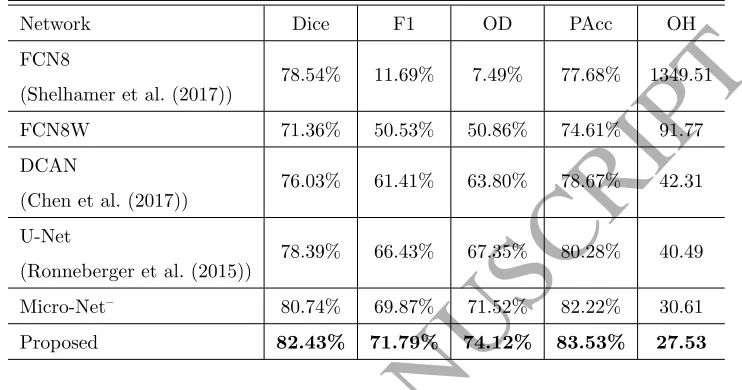
the final output score in Table 2. For quantitative analysis, we used measures
which include Dice coefficient, F1 score, object Dice, pixel accuracy and object
Hausdorff (Sirinukunwattana et al. (2017)). Better results correspond to smaller
Hausdorff distance and all other measures larger. The quantitative results are
shown in Table 2 which show that the proposed Micro-Net method outperforms
345
the state-of-the-art deep learning approaches with at least 3-4% margin in terms
of average Dice, F1 score, object Dice, pixel accuracy and object Hausdorff. We
modified the FCN8 algorithm (FCN8W) by introducing weighted loss
(Ron-neberger et al. (2015)) to improve segmentation of individual cells. FCN8W
improved F1, object Dice, pixel accuracy and object Hausdorff but failed to
350
increase the Dice coefficient. In addition, we add results for Micro-Net–where
we removed the multi-resolution input and the bypass layers. The results are
slightly better compared to U-Net but not better than Micro-Net supporting
the suggested changes in the design.
In addition to the above experiments we tested all the network architectures
355
for their robustness to various levels of white Gaussian noise by controlling the
SNR and generating the output for various network architectures. For this
purpose we did not retrain the networks but used the already trained models as
above. The values for Dice, F1, object Dice, pixel accuracy and object Hausdorff
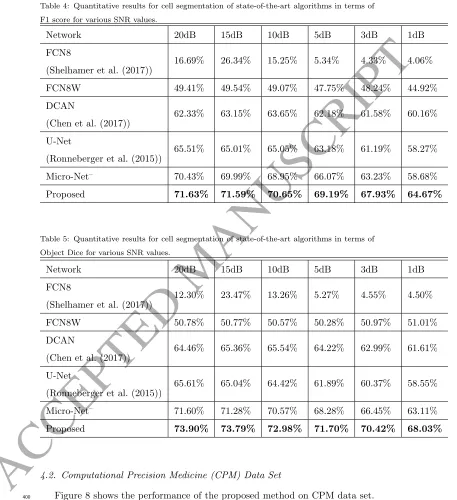
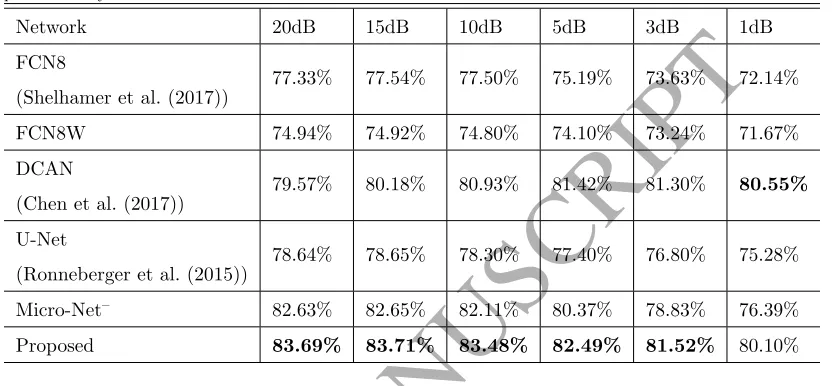
for various SNR values are given in Table 3, 4, 5, 6 and 7 respectively. For Dice
360
coefficient, FCN8 and U-Net drop to 73% whereas the proposed method drops
to 78%. However, DCAN shows a different behaviour and increases the Dice
ACCEPTED MANUSCRIPT
Table 2: Quantitative results for cell segmentation in terms of Dice coefficient, F1 score, Object Dice (OD), Pixel Accuracy (Acc) & Object Hausdorff (OH).
Network Dice F1 OD PAcc OH
FCN8
(Shelhamer et al. (2017)) 78.54% 11.69% 7.49% 77.68% 1349.51
FCN8W 71.36% 50.53% 50.86% 74.61% 91.77
DCAN
(Chen et al. (2017)) 76.03% 61.41% 63.80% 78.67% 42.31
U-Net
(Ronneberger et al. (2015)) 78.39% 66.43% 67.35% 80.28% 40.49
Micro-Net– 80.74% 69.87% 71.52% 82.22% 30.61
Proposed 82.43% 71.79% 74.12% 83.53% 27.53
networks drop to below 65% at 1dB where the proposed network retains the
top position. The trend was similar with object Dice as well where the first
365
position was retained by the proposed network. In terms of pixel accuracy,
the proposed method dropped roughly 4% from 20dB to 1dB. DCAN however
showed similar trend to Dice values i.e., increased pixel accuracy with increasing
noise content. This is an interesting result, but if we carefully observe Dice and
pixel accuracy both depend only on the pixels that are in agreement, whereas
370
object Dice only takes into account the pixels which belong to the ground truth.
Similarly, the F1 score takes into account not only true positives but also false
positives. With increasing noise content, DCAN lost some of the false positives
causing more pixels not belonging to the cellular region to agree. This increased
pixel accuracy and Dice while simultaneously decreasing object Dice and the F1
375
score. Object Hausdorff is a measure of similarity of the shape of cell boundaries
and is lower for better performance. Here the author’s implementation of FCN
produced very high values, whereas with weighted loss (FCN8W) the values were
in a comparable range. Additionally FCN8W values improved with increasing
noise due to the resulting loss of many cell segmentations. U-Net increased 55
ACCEPTED MANUSCRIPT
points from 20dB to 1dB noise which shows it’s sensitivity to noise. DCANperformed better as it is designed to match the contours and only increased
12 points with increased noise content. However, the proposed network only
increased 6 points showing the stability of the network and it’s robustness to
the noise. It is important to note here that Micro-Net– shows the steepest 385
decline in performance (in terms of Dice, F1, object Dice and pixel accuracy)
with increasing noise content compared to U-Net, DCAN and Micro-Net. The
decline is not much in the case of object Hausdorff as Micro-Net–uses the
multi-resolution output, and therefore shows robust shape similarity (on segmented
cells) as shown by DCAN (which also utilises multi-resolution output). This
390
further emphasises the role of multi-resolution input and the bypass layers.
Overall, the proposed network outperformed the recent deep learning models
for various levels of noise in terms of Dice, the F1 score, object Dice, pixel
accuracy and object Hausdorff. In terms of computation time, on average the
network takes 2.50 sec/batch for training and 0.39 sec/batch for testing a batch
395
of 5 images on a Windows10 machine with Intel Xeon E5-2670 v2 CPU, TitanX
Maxwell GPU and 96 GB RAM. For 25 epochs, it took around 4.5 days to train
the network.
Table 3: Quantitative results for cell segmentation of state-of-the-art algorithms in terms of Dice coefficient for various SNR values.
Network 20dB 15dB 10dB 5dB 3dB 1dB
FCN8
(Shelhamer et al. (2017)) 77.55% 76.24% 76.97% 76.47% 75.26% 73.66%
FCN8W 71.56% 71.53% 71.39% 70.56% 69.36% 66.88%
DCAN
(Chen et al. (2017)) 77.18% 77.95% 78.92% 79.82% 79.91% 79.40%
U-Net
(Ronneberger et al. (2015)) 76.58% 76.61% 76.29% 75.59% 74.99% 73.45%
Micro-Net– 81.35% 81.42% 80.72% 78.30% 76.04% 72.33%
ACCEPTED MANUSCRIPT
Table 4: Quantitative results for cell segmentation of state-of-the-art algorithms in terms of F1 score for various SNR values.
Network 20dB 15dB 10dB 5dB 3dB 1dB
FCN8
(Shelhamer et al. (2017)) 16.69% 26.34% 15.25% 5.34% 4.33% 4.06%
FCN8W 49.41% 49.54% 49.07% 47.75% 48.24% 44.92%
DCAN
(Chen et al. (2017)) 62.33% 63.15% 63.65% 62.18% 61.58% 60.16%
U-Net
(Ronneberger et al. (2015)) 65.51% 65.01% 65.05% 63.18% 61.19% 58.27%
Micro-Net– 70.43% 69.99% 68.95% 66.07% 63.23% 58.68%
Proposed 71.63% 71.59% 70.65% 69.19% 67.93% 64.67%
Table 5: Quantitative results for cell segmentation of state-of-the-art algorithms in terms of
Object Dice for various SNR values.
Network 20dB 15dB 10dB 5dB 3dB 1dB
FCN8
(Shelhamer et al. (2017)) 12.30% 23.47% 13.26% 5.27% 4.55% 4.50%
FCN8W 50.78% 50.77% 50.57% 50.28% 50.97% 51.01%
DCAN
(Chen et al. (2017)) 64.46% 65.36% 65.54% 64.22% 62.99% 61.61%
U-Net
(Ronneberger et al. (2015)) 65.61% 65.04% 64.42% 61.89% 60.37% 58.55%
Micro-Net– 71.60% 71.28% 70.57% 68.28% 66.45% 63.11%
Proposed 73.90% 73.79% 72.98% 71.70% 70.42% 68.03%
4.2. Computational Precision Medicine (CPM) Data Set
Figure 8 shows the performance of the proposed method on CPM data set.
400
ACCEPTED MANUSCRIPT
Table 6: Quantitative results for cell segmentation of state-of-the-art algorithms in terms of pixel accuracy for various SNR values.
Network 20dB 15dB 10dB 5dB 3dB 1dB
FCN8
(Shelhamer et al. (2017)) 77.33% 77.54% 77.50% 75.19% 73.63% 72.14%
FCN8W 74.94% 74.92% 74.80% 74.10% 73.24% 71.67%
DCAN
(Chen et al. (2017)) 79.57% 80.18% 80.93% 81.42% 81.30% 80.55%
U-Net
(Ronneberger et al. (2015)) 78.64% 78.65% 78.30% 77.40% 76.80% 75.28%
Micro-Net– 82.63% 82.65% 82.11% 80.37% 78.83% 76.39%
Proposed 83.69% 83.71% 83.48% 82.49% 81.52% 80.10%
Table 7: Quantitative results for cell segmentation of state-of-the-art algorithms in terms of
object Hausdorff for various SNR values.
Network 20dB 15dB 10dB 5dB 3dB 1dB
FCN8
(Shelhamer et al. (2017)) 1171.08 604.18 1176.88 1618.90 1700.83 1589.12
FCN8W 88.55 90.42 86.99 84.24 81.03 66.30
DCAN
(Chen et al. (2017)) 42.20 41.16 42.32 47.72 50.92 54.21
U-Net
(Ronneberger et al. (2015)) 55.53 63.53 62.50 85.48 97.49 100.15
Micro-Net– 31.42 32.13 32.85 33.62 33.91 35.13
Proposed 27.98 28.35 29.64 30.73 31.69 33.84
(HNSCC), lower grade glioma (LGG), non-small cell lung cancer (NSCLC) &
glioblastoma multiforme (GBM) respectively. Column 1 shows H & E image
with ground truth outlined for nuclear segmentation. Column 2 shows an RGB
composite image with ground truth in green and output of U-Net in red and
405
com-ACCEPTED MANUSCRIPT
posite image with ground truth in green, the output of the proposed algorithmin red and the overlap in yellow. In HNSCC, on the lower left corner we can
observe red cells, that are segmented by the proposed algorithm, but not picked
during ground truth marking. On the other hand, on the top right, the
algo-410
rithm undersegments, due to the relatively weak signal of the nuclei. In LGG,
the proposed algorithm seems to oversegment where the ground truth might
have been mistakenly marked on the nucleolus rather than on the nucleus of
the cell. The algorithm seems to be struggling in these kinds of regions in
NSCLC as well, where it missed segmenting the nuclei under darker shades.
415
In GBM, the proposed algorithm misses a few cells with fainter nuclei.
Over-all the performance of the algorithm seems good; however it seems to struggle
with nuclei under multiple shades. U-Net on the other hand shows more red
in all cases demonstrating oversegmentation. This is particularly noticeable in
NSCLC where there seems to be a strong cytoplasmic shade. Micro-Net
strug-420
gles in these circumstances but performs much better than U-Net due to its
robustness. We quantitatively measure the performance of segmentation using
two evaluation metrics as selected by the contest organisers (CPM), namely
Tra-ditional Dice (Dice 1) and Ensemble Dice (Dice 2). Dice 1 measures the overlap
between the ground truth and the prediction, whereas Dice 2 also penalises the
425
prediction if there is a mismatch in the way segmentation regions are split. The
overall score is then computed as the average of the two Dice coefficients. We
compare our results with FCN8 (Shelhamer et al. (2017)), U-Net (Ronneberger
et al. (2015)), SAMS-Net (Graham and Rajpoot (2018)) and the submissions
in the competition. The results in Table 8 show that our method not only
out-430
performs the results of contest winners but also recent deep learning methods
such as SAMS-Net (Graham and Rajpoot (2018)).
4.3. Gland Segmentation Challenge (GLaS) Data Set
We used 85 images for training and 80 for testing, where 60 of the test images
correspond to Test set A and the remaining 20 to Test set B. For quantitative
435
ACCEPTED MANUSCRIPT
Figure 8: Top to Down: (1) HNSCC, (2) LGG, (3) NSCLC, (4) GBM. Left to Right: (1) H & E image with ground truth outlined for nuclear segmentation, (2) RGB composite image with
ground truth in green and output of U-Net in red, (3) RGB composite image with ground
ACCEPTED MANUSCRIPT
Table 8: Cell segmentation results on CPM contest data set using evaluation metrics Dice 1 and Dice 2 as selected by the organisers.
Method Dice 1 Dice 2 Score Rank
Proposed 0.857 0.796 0.827 1
SAMS-Net (Graham and Rajpoot (2018)) 0.855 0.769 0.812 2
U-Net (Ronneberger et al. (2015)) 0.837 0.741 0.789 3
vuquocdang - - 0.783 4
brisker - - 0.773 5
FCN8 (Shelhamer et al. (2017)) 0.829 0.697 0.763 6
Schwarz - - 0.703 7
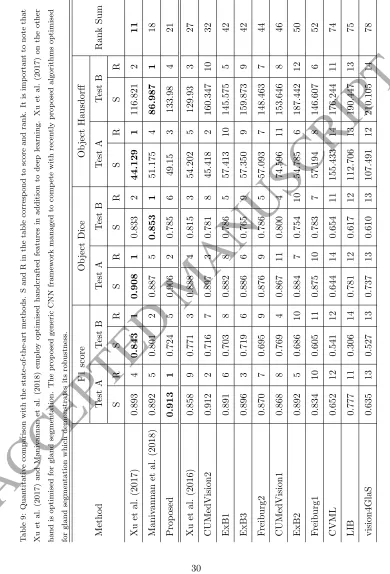
object Hausdorff (Sirinukunwattana et al. (2017)). In the case of Hausdorff
distance lower values are better; for other measures higher are better. The
quantitative results are given in Table 9 which shows that our method produces
competitive results compared to the state-of-the-art algorithms from the contest
440
and ranks third after the recently proposed (Xu et al. (2017); Manivannan et al.
(2018)) according the rank sum criteria set by the organisers. Xu et al. (2017)
and Manivannan et al. (2018) employ optimised handcrafted features in addition
to deep learning. Xu et al. (2017) on the other hand is heavily optimised for
gland segmentation. Our algorithm employs only deep learning and is being
445
proposed as a generic approach for cell, nuclear and gland segmentation, easily
implemented using existing libraries optimised for GPU usage, which reduces the
computational cost. Nevertheless, the proposed method performs competitively
against recently proposed approaches and beats the conference version of Xu
et al. (2016). Compared to the results of the contest on test A, the proposed
450
algorithm performed best in terms of F1 and object Dice but ranked third and
fifth on test B. In terms of object Hausdorff, which measures the shape similarity,
it ranked second after CUMedVision2 (Chen et al. (2017)) on test A and Xu et al.
(2016) on test B. Lower F1 and object Dice on test B suggests that our method
missed more glands in malignant cases, whereas lower Hausdorff suggests higher
ACCEPTED MANUSCRIPT
shape similarity to the ground truth extracted by our method. Qualitativeresults of the algorithm for sample images in Figure 5 are shown in Figure 9,
where for each pair the image on first and second column show ground truth
in green, output of DCAN (contest winner, the results were obtained from the
contest organisers) and the proposed algorithm respectively in red and overlap of
460
ground truth and output of algorithm in yellow. The image on the right shows
the output of the proposed algorithm overlaid on the sample image. These
results show that our algorithm clearly misses a few glands on the boundary of
the image for which there is insufficient information. In the second row, it merges
the glands at the bottom of the image and misses one gland. In malignant cases
465
the algorithm seems to be rather ‘conservative’ in its approach when marking
the boundary of glands. It can be observed in the third row for the two large
glands at the bottom and in the fourth row for the smaller gland in the middle.
All these glands show significant green inside the ground truth boundary, which
at first suggests that the algorithm segmented the gland well inside the ground
470
truth marking for the gland. However, when carefully observed in the overlay
with the sample images the algorithm is faithfully following the boundary with
tumor cells. For the large gland on the top right in third row the algorithm
‘oversegments’ the gland compared to the ground truth but again, looking at
the overlay with the sample image, the algorithm has included tumor cells in
475
the segmentation. Overall the algorithm performs a good job in segmenting the
glands but needs to improve on the glands at the boundary of a patch. This
limitation could be overcome by using overlapping patches from the whole slide
and then merging the results. Compared to DCAN (first column), the proposed
algorithm shows better overlap with the ground truth. It can be observed that
480
DCAN is sensitive to white spaces and certain architecture in benign cases
where it segments false regions. This can be clearly observed in cases from row
2, 3 & 4 and column 1. In the fourth row, it joins two glands together and
under segments the smaller gland in the middle. It can also be observed that
similar to the proposed algorithm, DCAN misses the glands at the boundary
485
ACCEPTED MANUSCRIPT
Figure 9: Results of the proposed network for sample images in Figure 5. First and second column show RGB composite images with output of the DCAN (Chen et al. (2017)) and the
proposed algorithm respectively in red, ground truth in green and overlap of ground truth
and output in yellow. The image in the third column shows the output of the proposed method overlaid on the sample image. The results for DCAN were obtained from the contest
organisers.
in terms of qualitative and quantitative results.
5. Conclusions
In multi-channel fluorescence microscopy, cell segmentation can help to build
molecular profiles of individual cells. However, images captured using
fluores-490
cence microscopy contain very weak and variable intensities that make it difficult
ACCEPTED MANUSCRIPT
it even more challenging for image processing algorithms to perform cellseg-mentation. In tumour histology slides, the morphology of nuclei and nuclear
pleomorphism can help in making a diagnosis and in studying the tumour
mi-495
croenvironment but nuclear segmentation is difficult due to varying shape, size,
chromatin structure and clumped nuclei. Similarly morphology of glands can
help the pathologist to grade the cancer but it is also very challenging due
to texture, size and structure of the glands. All these tasks require
sophisti-cated segmentation algorithms. We have presented a deep learning architecture
500
named Micro-Net that can be used to segment cells/nuclei and glands in
fluores-cence and H&E stained images with slight tuning of theinputparameters. The
proposed architecture allows the network to visualise input and output at
mul-tiple resolutions. The extra convolutional layers bypass the max-pooling layer,
thus allowing the network to better train its parameters for weak features in
505
addition to the strongly observed feature sets. This has been demonstrated by
the robustness of algorithm to varying level of noise in fluorescence image data.
Intermediate connections between the layers allow context and localization to
be retained. The qualitative and quantitative results show that the Micro-Net
architecture outperforms recently published deep learning approaches. We will
510
make the fluorescence image data set publicly available subject to publication of
this manuscript. The other two data sets we used in this paper are already
pub-licly available. We showed that the proposed algorithm produces competitive
results compared to the state-of-the-art. The results produced by the algorithm
can be extended to build molecular profile in multiplexed fluorescence images,
515
grade cancer or study tumour microenvironment.
6. Acknowledgements
We are grateful to the BBSRC UK for supporting this study through project
ACCEPTED MANUSCRIPT
References520
Computational precision medicine nuclei segmentation challenge website.http:
//miccai.cloudapp.net/competitions/57.
Abadi M, Agarwal A, Barham P, Brevdo E, Chen Z, Citro C, Corrado GS, Davis
A, Dean J, Devin M, Ghemawat S, Goodfellow I, Harp A, Irving G, Isard M,
Jia Y, Jozefowicz R, Kaiser L, Kudlur M, Levenberg J, Man´e D, Monga R,
525
Moore S, Murray D, Olah C, Schuster M, Shlens J, Steiner B, Sutskever
I, Talwar K, Tucker P, Vanhoucke V, Vasudevan V, Vi´egas F, Vinyals O,
Warden P, Wattenberg M, Wicke M, Yu Y, Zheng X. TensorFlow:
Large-scale machine learning on heterogeneous systems. 2015. URL:https://www.
tensorflow.org/; software available from tensorflow.org.
530
Awan R, Sirinukunwattana K, Epstein D, Jefferyes S, Qidwai U, Aftab Z,
Mujeeb I, Snead D, Rajpoot N. Glandular morphometrics for objective
grading of colorectal adenocarcinoma histology images. Scientific reports
2017;7(1):16852. doi:10.1038/s41598-017-16516-w.
Bergeest J, Rohr K. Efficient globally optimal segmentation of cells in
fluores-535
cence microscopy images using level sets and convex energy functionals.
Med-ical image analysis 2012;16(7):1436–44. doi:10.1016/j.media.2012.05.012.
Carpenter AE, Jones TR, Lamprecht MR, Clarke C, Kang IH, Friman O,
Guertin DA, Chang JH, Lindquist RA, Moffat J, et al. Cellprofiler: image
analysis software for identifying and quantifying cell phenotypes. Genome
540
biology 2006;7(10):R100. doi:10.1186/gb-2006-7-10-r100.
Chen H, Qi X, Yu L, Dou Q, Qin J, Heng PA. Dcan: Deep contour-aware
net-works for object instance segmentation from histology images. Medical Image
Analysis 2017;36(Supplement C):135 –46. doi:10.1016/j.media.2016.11.
004.
545
Cohen A, Rivlin E, Shimshoni I, Sabo E. Memory based active contour
Com-ACCEPTED MANUSCRIPT
puterized Medical Imaging and Graphics 2015;43:150–64. doi:10.1016/j.compmedimag.2014.12.006.
Dimopoulos S, Mayer CE, Rudolf F, Stelling J. Accurate cell segmentation in
mi-550
croscopy images using membrane patterns. Bioinformatics 2014;30(18):2644–
51. doi:10.1093/bioinformatics/btu302.
Farjam R, Soltanian-Zadeh H, Jafari-Khouzani K, Zoroofi RA. An image
anal-ysis approach for automatic malignancy determination of prostate
patho-logical images. Cytometry Part B: Clinical Cytometry 2007;72B(4):227–40.
555
doi:10.1002/cyto.b.20162.
Graham S, Rajpoot NM. Sams-net: Stain-aware multi-scale network for
instance-based nuclei segmentation in histology images. In: 2018 IEEE 15th
International Symposium on Biomedical Imaging (ISBI 2018). 2018. p. 590–4.
doi:10.1109/ISBI.2018.8363645.
560
Gunduz-Demir C, Kandemir M, Tosun AB, Sokmensuer C. Automatic
seg-mentation of colon glands using object-graphs. Medical image analysis
2010;14(1):1–12. doi:10.1016/j.media.2009.09.001.
He K, Zhang X, Ren S, Sun J. Deep residual learning for image recognition. In:
Proceedings of the IEEE conference on computer vision and pattern
recogni-565
tion. 2016. p. 770–8. doi:10.1109/CVPR.2016.90.
Kraus OZ, Ba JL, Frey BJ. Classifying and segmenting microscopy images with
deep multiple instance learning. Bioinformatics 2016;32(12):i52–9. doi:10.
1093/bioinformatics/btw252.
Li G, Raza SEA, Rajpoot NM. Multi-resolution cell orientation congruence
de-570
scriptors for epithelium segmentation in endometrial histology images.
Med-ical Image Analysis 2017;37:91 – 100. doi:10.1016/j.media.2017.01.006.
Li G, Sanchez V, Nagaraj P, Khan S, Rajpoot N. A novel multitarget
track-ing algorithm for myosin vi protein molecules on actin filaments in tirfm
se-quences. Journal of Microscopy 2015;260(3):312–25. doi:10.1111/jmi.12299.
ACCEPTED MANUSCRIPT
Manivannan S, Li W, Zhang J, Trucco E, McKenna SJ. Structure prediction forgland segmentation with hand-crafted and deep convolutional features. IEEE
Transactions on Medical Imaging 2018;37(1):210–21. doi:10.1109/TMI.2017.
2750210.
Meijering E. Cell segmentation: 50 years down the road. Signal Processing
580
Magazine, IEEE 2012;29(5):140–5. doi:10.1109/MSP.2012.2204190.
Naik S, Doyle S, Agner S, Madabhushi A, Feldman M, Tomaszewski J.
Au-tomated gland and nuclei segmentation for grading of prostate and breast
cancer histopathology. In: Biomedical Imaging: From Nano to Macro, 2008.
ISBI 2008. 5th IEEE International Symposium on. IEEE; 2008. p. 284–7.
585
doi:10.1109/ISBI.2008.4540988.
Nguyen K, Sarkar A, Jain AK. Structure and context in prostatic gland
seg-mentation and classification. In: Medical Image Computing and
Computer-Assisted Intervention–MICCAI 2012. Springer; 2012. p. 115–23. doi:10.1007/
978-3-642-33415-3_15.
590
Nosrati MS, Hamarneh G. Local optimization based segmentation of
spatially-recurring, multi-region objects with part configuration constraints. IEEE
transactions on medical imaging 2014;33(9):1845–59. doi:10.1109/TMI.2014.
2323074.
Qaiser T, Tsang YW, Epstein D, Rajpoot N. Tumor segmentation in whole
595
slide images using persistent homology and deep convolutional features. In:
Annual Conference on Medical Image Understanding and Analysis. Springer;
2017. p. 320–9. doi:10.1007/978-3-319-60964-5_28.
Raza SEA, Cheung L, Epstein D, Pelengaris S, Khan M, Rajpoot NM.
Mimo-net: A multi-input multi-output convolutional neural network for cell
seg-600
mentation in fluorescence microscopy images. In: 2017 IEEE 14th
Inter-national Symposium on Biomedical Imaging (ISBI 2017). 2017a. p. 337–40.
ACCEPTED MANUSCRIPT
Raza SEA, Cheung L, Epstein D, Pelengaris S, Khan M, Rajpoot NM.MI-MONet: Gland Segmentation Using Multi-Input-Multi-Output Convolutional
605
Neural Network; Cham: Springer International Publishing. p. 698–706.
doi:10.1007/978-3-319-60964-5_61.
Raza SEA, Humayun A, Abouna S, Nattkemper TW, Epstein DB, Khan M,
Rajpoot NM, et al. RAMTaB: robust alignment of multi-tag bioimages. PLoS
ONE 2012;7(2):e30894. doi:10.1371/journal.pone.0030894.
610
Raza SEA, Langenk¨amper D, Sirinukunwattana K, Epstein D, Nattkemper
TW, Rajpoot NM. Robust normalization protocols for multiplexed
fluo-rescence bioimage analysis. BioData Mining 2016;9(1):11. doi:10.1186/
s13040-016-0088-2.
Reinhard E, Adhikhmin M, Gooch B, Shirley P. Color transfer between images.
615
IEEE Computer graphics and applications 2001;21(5):34–41.
Ronneberger O, Fischer P, Brox T. U-net: Convolutional networks for
biomedical image segmentation. In: International Conference on
Medi-cal Image Computing and Computer-Assisted Intervention. 2015. p. 234–41.
doi:10.1007/978-3-319-24574-4_28.
620
Sadanandan SK, Ranefall P, Le Guyader S, W¨ahlby C. Automated training of
deep convolutional neural networks for cell segmentation. Scientific reports
2017;7(1):7860. doi:10.1038/s41598-017-07599-6.
Schubert W, Bonnekoh B, Pommer AJ, Philipsen L, B¨ockelmann R, Malykh Y,
Gollnick H, Friedenberger M, Bode M, Dress AW. Analyzing proteome
topol-625
ogy and function by automated multidimensional fluorescence microscopy.
Nature biotechnology 2006;24(10):1270. doi:10.1038/nbt1250.
Shelhamer E, Long J, Darrell T. Fully convolutional networks for semantic
seg-mentation. IEEE Transactions on Pattern Analysis and Machine Intelligence
2017;39(4):640–51. doi:10.1109/TPAMI.2016.2572683.
ACCEPTED MANUSCRIPT
Sirinukunwattana K, Pluim JP, Chen H, Qi X, Heng PA, Guo YB, WangLY, Matuszewski BJ, Bruni E, Sanchez U, et al. Gland segmentation in
colon histology images: The glas challenge contest. Medical image analysis
2017;35:489–502. doi:10.1016/j.media.2016.08.008.
Sirinukunwattana K, Snead DR, Rajpoot NM. A stochastic polygons model for
635
glandular structures in colon histology images. IEEE transactions on medical
imaging 2015;34(11):2366–78. doi:10.1109/TMI.2015.2433900.
Song Y, Tan EL, Jiang X, Cheng JZ, Ni D, Chen S, Lei B, Wang T.
Accu-rate cervical cell segmentation from overlapping clumps in pap smear images.
IEEE Transactions on Medical Imaging 2017;36(1):288–300. doi:10.1109/
640
TMI.2016.2606380.
Veta M, Van Diest PJ, Kornegoor R, Huisman A, Viergever MA, Pluim JP.
Au-tomatic Nuclei Segmentation in H&E Stained Breast Cancer Histopathology
Images. PLoS ONE 2013;8(7):e70221. doi:10.1371/journal.pone.0070221.
Wu HS, Xu R, Harpaz N, Burstein D, Gil J. Segmentation of intestinal gland
645
images with iterative region growing. Journal of Microscopy 2005;220(3):190–
204. doi:10.1111/j.1365-2818.2005.01531.x.
Xu Y, Li Y, Liu M, Wang Y, Lai M, Eric I, Chang C. Gland instance
segmen-tation by deep multichannel side supervision. In: International Conference
on Medical Image Computing and Computer-Assisted Intervention. Springer;
650
2016. p. 496–504. doi:10.1007/978-3-319-46723-8_57.
Xu Y, Li Y, Wang Y, Liu M, Fan Y, Lai M, Chang EIC. Gland instance
segmentation using deep multichannel neural networks. IEEE Transactions
on Biomedical Engineering 2017;64(12):2901–12. doi:10.1109/TBME.2017.
2686418.
655
Yang X, Li H, Zhou X. Nuclei segmentation using marker-controlled watershed,
ACCEPTED MANUSCRIPT
Transactions on Circuits and Systems I: Regular Papers 2006;53(11):2405–14.doi:10.1109/TCSI.2006.884469.
Yuan Y, Failmezger H, Rueda OM, Ali HR, Gr¨af S, Chin SF, Schwarz RF,
660
Curtis C, Dunning MJ, Bardwell H, et al. Quantitative image analysis of
cel-lular heterogeneity in breast tumors complements genomic profiling. Science
translational medicine 2012;4(157):157ra143–. doi:10.1126/scitranslmed.