Page 1 of 15
Group work and the change of obstacles over time: The influence of learning style and group composition
Danny Soetanto and Matthew MacDonald
Biographical/contact details of authors
Danny Soetanto, Department of Entrepreneurship, Strategy and Innovation, Lancaster University Management School, Lancaster, LA1 4YX, United Kingdom. Email: [email protected].
Danny Soetanto is a Lecturer at Lancaster University, UK. His research focuses on the field of entrepreneurship and management, including the role of social networks in shaping business, management, practices and consequences on the growth of firms. He is currently working on several studies focusing on the dynamics of group work activities in class and in the business context. He has published several articles in journal related to innovation, entrepreneurship and management.
Matthew MacDonald, Department of Entrepreneurship, Strategy and Innovation, Lancaster University Management School, Lancaster, LA1 4YX, United Kingdom. Email:[email protected].
Matthew MacDonald is a Senior Research Associate at Lancaster University, UK. His research focuses on the field of social entrepreneurship and social innovation. He has a background in youth work, group work and community development practice.
Abstract
It is through working in groups that students develop cooperative learning skills and experience. However, group work activity often leads students into a difficult experience, especially for first-year students who are not familiar with group work activities at university. This study explores obstacles faced by first year students during their group work activities. This study investigates whether a group of students with a similar learning style (homogeneous group) experience different obstacles compared to a group of students with a diverse learning style (heterogeneous group). In addition, to identify the difference, if any, between a group formed by a tutor and one where the students form the group themselves, tutor and self-allocated group allocations are explored. This study focuses on obstacles experienced by these students during group work activities. Using a sample of more than 200 students over a period of three years, the types and the changes of obstacles in different stages of group life are explored. The findings show that students experience obstacles which can be classified into personal and social, leadership and management, and task-related obstacles. Those obstacles were not static but increased over time. The study also investigates the impact of different method of forming groups and whether this impacted on obstacles experienced. Overall, different interventions prompted different patterns of obstacles development.
Keywords: group work, obstacles, method of forming group
Group work: do obstacles change over time?
Page 2 of 15
1991). This approach focuses on students as being at the centre of activities and empowers them through the use of cooperative learning (Sharan, 2010; Johnson and Johnson, 1999). Ideally, group work can help students to develop a sense of ‘team’ by encouraging them to support each other’s learning (Peterson and Miller, 2004; Slavin, 1995). As they learn to share, communicate ideas and listen to others’ ideas, working in a group will help students in their learning and to experience new constructs for understanding (French and Kottke, 2013; Hillyard et al, 2010; Hilyard et al., 2010; Johnson and Johnson, 2002; Webb et al., 1995).
A number of factors make group work an attractive method for teaching and learning in higher education (Gregory and Thorley, 2013; Barth et al., 2007; Collier, 1980). As teaching pedagogies have shifted from teacher-centred learning to student-centred learning, this shift is characterised by the change from traditional rote-learning methods to styles in which students are more able to play an active role (Brockbank and McGill, 2007; Braxton et al., 2000) and engage in cooperative learning (Onwuegbuzie et al., 2009; Yazici, 2005; Johnson and Johnson, 1999). Johnson and Johnson (1986) and Sobral (1997) found evidence that students working in a group achieve higher levels of learning and retain information longer than students who work individually. By engaging in a cooperative learning environment, students are encouraged to take responsibility for their own learning and thus become critical thinkers (Sharan, 2010; Totten et al., 1991; Slavin, 1990).
Group work may, however, pose some potential problems (Hall and Buzwell, 2012; Wang, 2012; Micari and Drane, 2011; Stott-Ladd and Chan, 2008; Aggarwal and O’Brien, 2008; Hillyard et al., 2010’ McCorkle et al., 1999). Group work can be an unpleasant experience due to a dysfunctional groups (Aggarwal and O’Brien, 2008; Dommeyer, 2007). Groups may experience communication problems if group members are diverse and come from different backgrounds. Several obstacles have been highlighted, such as ‘free-ride’ members (Hall and Buzwell, 2012; Aggarwal and O’Brien, 2008), social-comparison dilemmas (Micari and Pazos, 2014), management conflict (Stott-Ladd and Chan, 2008) and members’ low participation (Li and Campbell, 2008). Burdett and Hastie (2009) found that individuals were more satisfied with group work when they perceived greater workload equality. Another problem is related with social comparison where students feel intimidated as they are less talented or less able to perform well than other (Dijkstra et al., 2008; Micari and Drane, 2011). Demographic differences also appear to have an impact on group work. Wilkinson and Fung (2002) found in a mixed-ethnicity group, some students tend to dominate discussion and activities. A similar pattern has been found with regard to gender, where males are more active than females (Lockheed et al., 1983). Overall, it can be concluded that groups that are able to overcome obstacles and function at the higher stages of development are more productive (Wheelan and Lisk, 2000).
While studies have discussed obstacles that hinder learning in group work, those obstacles are often seen as static and do not change over time. In fact, the obstacles may disappear or escalate while new obstacles appear as groups progress from one stage of group development to another. Without understanding how students work as a group and how they use resources on solving and negotiating obstacles at the expense of learning, their learning process may perhaps be impaired in some way. For that reason, there is a need to better understand the development pattern of different types of obstacles during group work.
Group works: the impact of the different method of forming groups on obstacles
While working in groups may facilitate and reinforce learning activities, the challenge of employing group work is in part about the way that those groups are formed. There are several ways of forming groups, but the most popular ones are these two. One, allowing students to choose their own group (self-selected group). Two, that the tutor allocates students to groups, randomly, that is, without taking into account any factors such as gender balance, background, age or whatever (Huxham and Land, 2010).
Page 3 of 15
nature of obstacles experienced by students during group work. In addition, there have been few studies examining the relationship between how groups are formed and the obstacles faced within each (Huxham and Land, 2010, Yazici, 2005).
It is argued here that students that have been tasked to work in a group that the tutor has formed, one which does not take into account any factors such as gender balance, background, age or whatever, (that is the group comprises students who have been randomly allocated), may find it difficult to perform in that group, especially in the early stages in introducing themselves to each other compared to self-selected groups. In self-selected groups, problems such as communication can be reduced, as members are more likely to be known to each other. The group often selects members based on their skills and capability that they believe will bring benefit to the group. Consequently, the self-selected group may experience fewer obstacles and a lower degree of difficulty than the group that has been formed by the tutor and which comprises students who have been randomly allocated.
Another common method that has been used to form groups is by attempting to ‘engineer’ groups according to certain characteristics (Yazici, 2005; Huxham and Land, 2010). Students process and learn new information in different ways, which may impact on their approach to group work activities. According to the concept of cooperative learning, having a variety of learning styles in a heterogeneous group has a positive impact on group work (for example, Slavin, 1987; 1995; Johnson and Johnson, 1989). The argument is that in a heterogeneous learning group, students may complement their skills and capability (Cheng et al., 2008; Slavin, 1991; Stevens and Slavin, 1995; Webb, 1982) which result in a better performance than that the homogeneous learning group. However, students in heterogeneous learning groups may potentially experience more, or different, obstacles than those in homogeneous learning groups (for example Monteil and Huguet, 1993, Dweck, 1986; Steel, 1997). Students may be confronted with others who have different learning approaches and styles. The differences may hinder engagement, resulting in a reduced ability to learn effectively. Students in heterogeneous learning groups may potentially experience social-comparison problems where they feel inferior as they view others as more competent (Mugny et al., 2001).
There is, therefore, a gap in the literature regarding the method of assigning students to groups and its impact on the obstacles that they face along the way. Therefore, there is a need to address the following research questions. One, do the obstacles change over time? Two, to what extent do the different methods of forming groups impact on the obstacles experienced? Three, does this vary when their learning style is taken into account? The following hypotheses are proposed.
H1a. Students in groups formed by the tutor on a random basis experience more obstacles than those in self-selected groups.
H1b. Students in groups formed by the tutor on a random basis experience greater difficulty than self-selected groups.
H2a. Students in groups comprising those with heterogeneous learning styles experience more obstacles than those in groups comprising those with homogeneous learning styles.
H2b. Students in groups comprising those with heterogeneous learning styles experience greater difficulty than those in groups comprising those with homogeneous learning styles.
Research method
Page 4 of 15
The first stage of the research was undertaken by conducting interviews with a cohort of students in 2010. In total, there were 80 students who participated in the course. 30 students were selected using a random sampling method. The journey of these students was followed and interviews were conducted every two weeks for 10 weeks. During the interviews, we asked students the following questions such as ‘how is it going with your group?’ ‘is everything going according to plan?’ ‘do you experience any problems?’ ‘have you been in trouble with the group?’ If the students did not report any difficulties or obstacles, more detail questions were posed in relation with their perception on group performance, leadership, and the process during group work activity. Those questions aimed to explore any potential conflict that emerged during the activity. In total, 40 hours of data from the interviews were collected. The result of the analysis produced three categories of obstacles. Table 1 shows the mapping of the interview raw data to the obstacle categories.
--- TABLE 1 HERE
---
As a summary, the obstacles can be succinctly conceptualised by three formative constructs, (1) personal and social obstacles, (2) leadership and management obstacles, and (3) task-related obstacles. Personal and social obstacles refer to obstacles related to personality and interaction among students, such as lack of motivation, personality clash and difficulties in accepting others’ opinions. Leadership and management obstacles refer to obstacles experience by students during the process of group work activities. This obstacle includes some technical issues related to managing the process such as leadership, communication and approaches to problem solving. The task-related obstacle relates to the content of the assignment. This is associated with limited knowledge and skills possessed by students as well as possible misunderstandings of the task objectives and mistakes during the process. From the interviews and the observation on the group work process, we found that the students spent the first two weeks in the forming stage. The meetings took a long time as the group started to understand the nature of assignments and different capabilities that are available in the group. The storming stage was normally started at week 3 and last until week 6 where the groups need to deliver their intermediate report. We defined the rest of the week as norming stage where the group reach consensus and start to work effectively toward the objective. Based on this construction of three categories of obstacles, a questionnaire was developed. We conducted surveys with a sample of 170 respondents over 2 years (85 students joining the module in 2011 and 85 students joining the module in 2012). The timing of the survey was in weeks 2, 5 and 8 during the 10 weeks module. In the survey, we used dichotomous variable (yes/no) to represent whether the students experience the obstacles. Using a five-point likert scale, we also asked them to indicate the degree of difficulty caused by each obstacle.
Page 5 of 15
FindingsDo the obstacles changes over time?
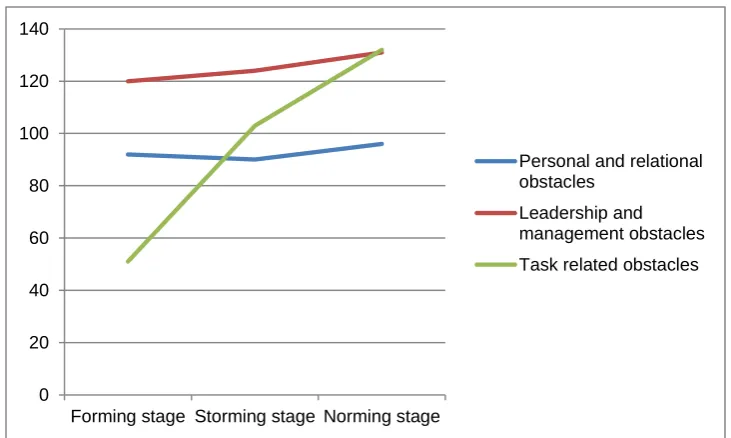
Based on the 2011 and 2012 data, the analysis found a similar pattern of obstacle development where most of the obstacles increased in the final stages. In the forming stage, the number of obstacles was relatively low compared to that in other stages. The students were relatively new to each other and may have encountered different personal characteristics and backgrounds. During this stage, the students adjusted their behaviour accordingly, to adapt to the differences as well as to build their leadership capacity. Comparing the number of obstacles across different types of obstacles, the students suffered most from the leadership and management obstacles. Personal and social obstacles shows a similar development pattern with leadership and management obstacles where in the first two stages the number of obstacles were relatively stagnant but increased in the final stage. Task related obstacles were relatively low at the beginning but increased drastically in the second and the final stages.
--- FIGURE 1 and 2 HERE ---
To what extent do the different methods of forming groups have an impact on the obstacles experienced?
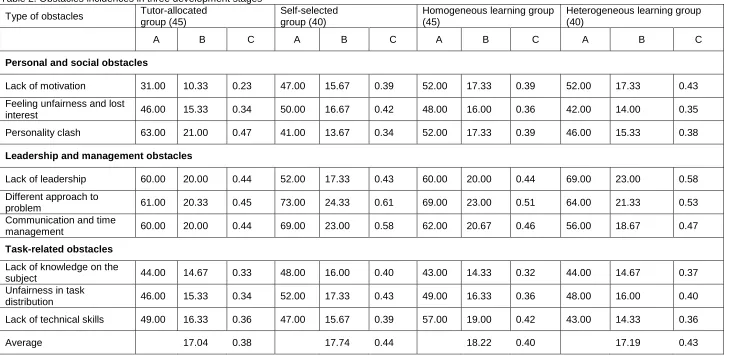
Table 2 shows the average number of incidences of obstacles experienced by the groups and by each student. On average, the students in groups formed by the tutor on a random basis experienced 17.04 obstacles in each stage compared to 17.74 obstacles experienced by the students in the self-selected groups in each stage. However, if we calculate the average number of obstacles experienced by the students, students in the groups formed by the tutor on a random basis experienced significantly fewer obstacles (0.38 incidences of obstacles per student) than students in the self-selected groups (0.44 incidences of obstacles per student). In the groups formed by the tutor on a random basis, the most frequent obstacle was personality clash (0.47 incidences of obstacles per student) while the most frequent problem in the self-selected groups was different approaches to problem solving (0.61 incidences of obstacles per student) and communication and time management (0.58 incidences of obstacles per student).
With regards to the role of learning style in terms of the make-up of the students in the group, students in groups comprising those with homogeneous learning styles experienced more obstacles compared to the students in groups comprising those with heterogeneous learning styles. On average, the homogeneous groups experienced 18.22 obstacles compared to 17.19 obstacles experienced by the heterogeneous groups. The number of obstacles experienced by students is relatively similar with the students in groups comprising those with homogeneous learning styles experiencing 0.40 incidences of obstacles per student and the students in groups comprising those with heterogeneous learning styles experiencing 0.43 incidences of obstacles per student. The obstacles experienced by the students in groups comprising those with homogeneous learning styles were relatively spread across the categories, with the highest incidences of obstacles being different approaches to problem solving (0.51 incidences of obstacles per student). For the students in groups comprising those with heterogeneous learning styles, two obstacles, namely lack of leadership and different approaches to problem solving were the most common obstacles witnessing 0.58 and 0.53 incidences of obstacles per student.
Page 6 of 15
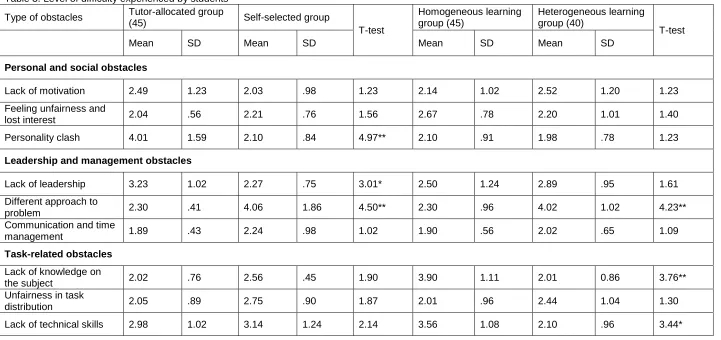
students in groups comprising those with heterogeneous learning styles suffered from different approaches to problem solving.
--- TABLE 2 and 3 HERE ---
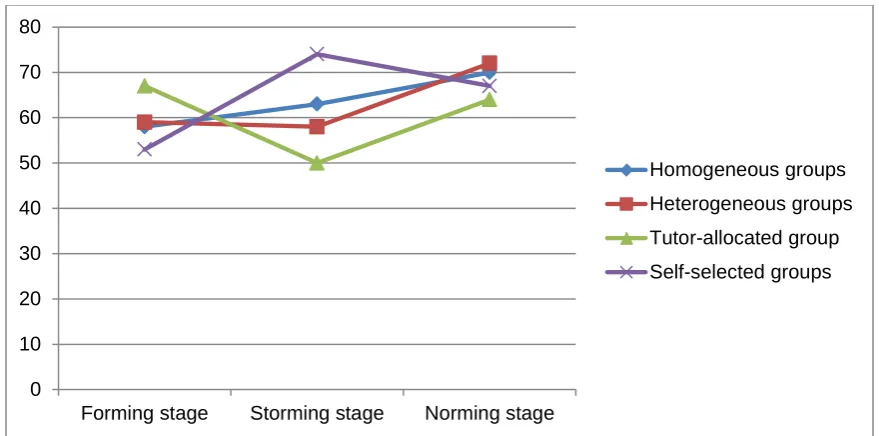
In this section, the findings on the trend of obstacles experienced by the group over time are presented. For each figure, the obstacles experienced by the students within the category are added. Figure 3 shows that in forming stage, the personal and social obstacles where the students in groups comprising those with homogeneous learning styles and the self-selected groups experienced fewer obstacles compared to the students in groups comprising those with heterogeneous learning styles and those in groups formed by the tutor on a random basis. This finding is in contrast to obstacles experienced by the students in groups comprising those with heterogeneous learning styles and groups formed by the tutor on a random basis where the number of obstacles is significantly higher. However, the obstacles experienced by the students in groups comprising those with homogeneous learning styles and those in a self-selected group escalated in the later stages while students in groups comprising those with heterogeneous learning styles and those in groups formed by the tutor on a random basis experienced a decline in the number of obstacles. In the final stage, the students in groups comprising those with homogeneous learning styles and self-selected groups experienced more obstacles than the students in groups comprising those with heterogeneous learning styles and the groups formed by the tutor on a random basis.
--- FIGURE 3 HERE ---
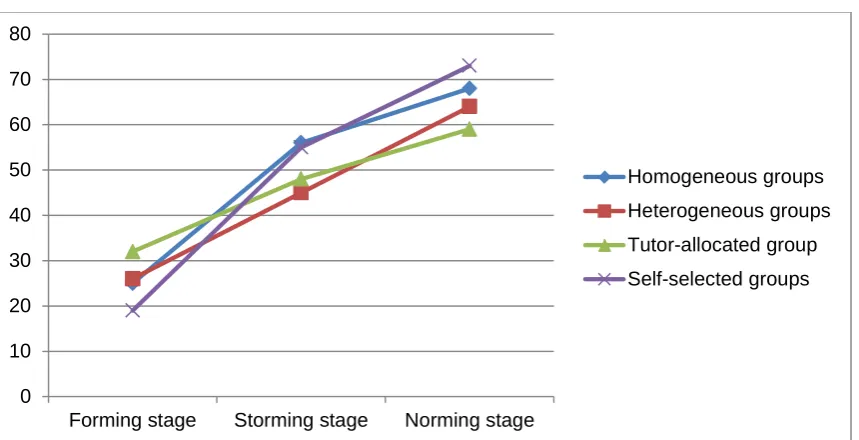
Examination of the leadership and management obstacles shows a mixed trend was apparent (Figure 4). With regards to the differences in learning style, both the students in groups comprising those with either a homogeneous or a heterogeneous learning style showed a similar trend where obstacles increased as the groups developed to the final stage. Comparing the groups formed by the tutor on a random basis and the self-selected groups, there are some interesting findings. At the beginning, the groups formed by the tutor on a random basis experienced more obstacles than the self-selected groups but as the groups progressed to the storming stage, the obstacles reduced drastically in the groups formed by the tutor on a random basis while the self-selected groups suffered from a significant increase in the number of obstacles.
--- FIGURE 4 HERE ---
The last figure (Figure 5) shows the development of task related obstacles where the number of obstacles increased drastically in the final stage. The pattern can be understood as the students must focus on accomplishing the task. Overall, the self-selected and students in groups comprising those with homogeneous learning styles experienced a higher number of obstacles compared to other groups.
--- FIGURE 5 HERE ---
Page 7 of 15
showed a significant dynamic change from the first to the stage stages. While for self-selected groups the number of obstacles increased dramatically, the students in the groups formed by the tutor on a random basis experienced the opposite, where the obstacles declined. This finding indicates that the way that the group is formed has an effect on the process. With regards to the task obstacles, the obstacles escalated in the final stage. While most of the groups experienced similar patterns, those students in the self-selected groups fared the worst compared to others.
Conclusion
This study explored the obstacles that appeared in each stage of group development. Using trend analysis, the study found that the obstacles experienced by the students increased as the groups progressed. Each stage had its own major obstacles, as the challenges and the context of each stage are different. The study found that most obstacles increase in the final stage with the leadership and management obstacles being among the most in terms of obstacles experienced. Two hypotheses regarding the impact that different methods in the forming groups may have had on the number and type of incidences of obstacles faced, namely, whether or not students in groups formed by the tutor on a random basis experience would experience more obstacles than those in groups that students themselves selected, that is, self-selected groups, and whether students in groups formed by the tutor on a random basis would experience greater difficulty than self-selected groups. It was hypothesised that students in groups formed by the tutor on a random basis would experience more obstacles than those in the self-selected groups. In fact, students in groups formed by the tutor on a random basis experienced fewer obstacles than those in self-selected groups. In addition, students in groups formed by the tutor on a random basis experienced more problematic obstacles than those in self-selected groups with regards to personality clashes and lack of leadership.
With regards to the second hypothesis, that is, whether students in groups comprising those with heterogeneous learning styles would experience more obstacles and face greater difficulty than those in groups comprising those with homogeneous learning styles, the results did not confirm that students in groups comprising those with heterogeneous learning styles experienced more obstacles than those in groups comprising homogeneous learning styles. Rather, those in groups comprising those with heterogeneous learning styles experienced fewer problematic task-related obstacles than those in groups comprising students with homogeneous learning styles. Students in groups comprising those with homogeneous learning styles suffered from obstacles such as lack of knowledge on the subject and technical skills. Based on this finding, it can be argued that the method of assigning students into groups determines the type and the development of obstacles experienced by students.
Limitations include that the study is based on the relatively small sample in a very specific context, namely, undergraduate students in their first year and within the field of business and management. Therefore, future work needs to look at more samples, such as those from later on during their undergraduate studies and also those at postgraduate level and also in different contexts, such as different disciplines and different cultural contexts, in order to support any generalisation of the findings. By further testing the findings in several different contexts, this can enrich our understanding about the factors that may influence the emergence and development of obstacles. There are also different ways of forming groups, and so future work needs to look at how different formations may or may not impact how students work in groups. It may also be fruitful to explore the role of intervention in supporting the learning process and in developing students’ understanding of the group processes they are experiencing during group activities (Hillyard et al., 2010). Future studies could therefore usefully incorporate both the assessment of learning outcomes and the impact of students’ prior understanding of group processes and obstacles in group activities.
Page 8 of 15
group development (Jehn and Mannix, 2001). This work builds on and develops the literature on cooperative learning within groups (Slavin, 1990; Sharan, 1994; Johnson et al., 2010) by addressing not only outcomes but also by shedding light on the nature and type of those obstacles as they develop over time. Secondly, it helps us as lecturers/faculty when it comes to our decision making in terms of the choices open to us when it comes to the formation of groups in our classrooms. In addition to this, the study highlights potential obstacles to successful group processes and task completion at different stages of group life, which might perhaps be addressed by timely tutor, or institutional (Hillyard et al 2010), support and intervention.
References
Aggarwal, P., and O'Brien, C. L. (2008). Social loafing on group projects: Structural antecedents and effect on student satisfaction.Journal of Marketing Education. 30(3), 255-264
Barth, M., Godemann, J., Rieckmann, M., and Stoltenberg, U. (2007). Developing key competencies for sustainable development in higher education.International Journal of Sustainability in Higher Education,8(4), 416-430.
Bonwell, C. C., and Eison, J. A. (1991).Active Learning: Creating Excitement in the Classroom. 1991 ASHE-ERIC Higher Education Reports. ERIC Clearinghouse on Higher Education, The George Washington University, One Dupont Circle, Suite 630, Washington, DC 20036-1183.
Braxton, J. M., Milem, J. F., and Sullivan, A. S. (2000). The influence of active learning on the college student departure process: Toward a revision of Tinto's theory. Journal of Higher Education, 71(5).569-590.
Brockbank, A., and McGill, I. (2007). Facilitating reflective learning in higher education. McGraw-Hill Education (UK).
Cohen, E. G. (1994). Restructuring the classroom: Conditions for productive small groups.Review of Educational Research,64(1), 1-35.
Collier, K. G. (1980). Peer-group learning in higher education: the development of higher order skills.
Studies in Higher Education,5(1), 55-62.
Colbeck, C. L., Campbell, S. E., and Bjorklund, S. A. (2000). Grouping in the dark: What college students learn from group projects.Journal of Higher Education, 71(1), 60-83.
Cheng, W. Y., Lam, S. F., and Chan, C. Y. (2008). When high achievers and low achievers work in the same group: The roles of group heterogeneity and processes in project‐based learning. British Journal of Educational Psychology,78(2), 205-221.
Dommeyer, C. J. (2007). Using the diary method to deal with social loafers on the group project: Its effects on peer evaluations, group behavior, and attitudes.Journal of Marketing Education,29(2), 175-188.
Dijkstra, P., Kuyper, H., van der Werf, G., Buunk, A. P., and van der Zee, Y. G. (2008). Social comparison in the classroom: A review.Review of Educational Research,78(4), 828-879.
French, K. A., and Kottke, J. L. (2013). Teamwork satisfaction: Exploring the multilevel interaction of teamwork interest and group extraversion.Active Learning in Higher Education, 46(5), 536–575. Hansen, R. S. (2006). Benefits and problems with student teams: Suggestions for improving team projects.Journal of Education for Business,82(1), 11-19.
Hall, D., and Buzwell, S. (2012). The problem of free-riding in group projects: Looking beyond social loafing as reason for non-contribution.Active Learning in Higher Education, 14(1), 37-49
Huxham, M., and Land, R. (2000). Assigning students in group work projects. Can we do better than random?.Innovations in Education and Teaching International,37(1), 17-22.
Hendry, G. D., Heinrich, P., Lyon, P. M., Barratt, A. L., Simpson, J. M., Hyde, S. J. and Mgaieth, S. (2005). Helping students understand their learning styles: Effects on study self‐efficacy, preference for group work, and group climate.Educational Psychology,25(4), 395-407.
Hillyard, C., Gillespie, D., and Littig, P. (2010). University students’ attitudes about learning in small groups after frequent participation.Active Learning in Higher Education,11(1), 9-20.
Jehn, K. A., and Mannix, E. A. (2001). The dynamic nature of conflict: A longitudinal study of intragroup conflict and group performance.Academy of management journal,44(2), 238-251.
Johnson, D. W., and Johnson, R. T. (1999). Making cooperative learning work.Theory into practice,
38(2), 67-73.
Lockheed, M. E., and Harris, A. M. (1984). Cross-sex collaborative learning in elementary classrooms.
American Educational Research Journal,21(2), 275-294.
Page 9 of 15
McCorkle, D. E., Reardon, J., Alexander, J. F., Kling, N. D., Harris, R. C., and Iyer, R. V. (1999). Undergraduate marketing students, group projects, and teamwork: The good, the bad, and the ugly?.
Journal of Marketing Education,21(2), 106-117.
Micari, M., and Drane, D. (2011). Intimidation in small learning groups: The roles of social-comparison concern, comfort, and individual characteristics in student academic outcomes. Active Learning in Higher Education,12(3), 175-187.
Micari, M., and Pazos, P. (2014). Worrying about what others think: A social-comparison concern intervention in small learning groups.Active Learning in Higher Education, 15(3), 249-262
Onwuegbuzie, A. J., Collins, K. M., and Jiao, Q. G. (2009). Performance of cooperative learning groups in a postgraduate education research methodology course The role of social interdependence.Active Learning in Higher Education,10(3), 265-277.
Peterson, S. E., and Miller, J. A. (2004). Comparing the quality of students' experiences during cooperative learning and large-group instruction.The Journal of Educational Research, 97(3), 123-134.
Gregory, R., and Thorley, L. (Eds.). (2013). Using group-based learning in higher education. Routledge.
Slavin, R. E. (1983). When does cooperative learning increase student achievement?.Psychological Bulletin,94(3), 429.
Scott-Ladd, B., and Chan, C. C. (2008). Using action research to teach students to manage team learning and improve teamwork satisfaction.Active Learning in Higher Education,9(3), 231-248. Sharan, Y. (2010). Cooperative learning for academic and social gains: Valued pedagogy, problematic practice.European Journal of Education,45(2), 300-313.
Sobral, D. T. (1997). Improving learning skills: a self-help group approach. Higher Education, 33(1), 39-50.
Slavin, R. E. (1990).Cooperative Learning: Theory, research, and practice (Vol. 14). Boston: Allyn and Bacon.
Julie Yazici, H. (2005). A study of collaborative learning style and team learning performance.
Education+ Training,47(3), 216-229.
Totten, S., Sills, T., Digby, A., & Russ, P. (1991). Cooperative Learning: A guide to research. New York: Garland.
Wang, Y. (2012). Mainland Chinese students' group work adaptation in a UK business school.
Teaching in Higher Education,17(5), 523-535.
Wheelan, S. A., and Lisk, A. R. (2000). Cohort group effectiveness and the educational achievement of adult undergraduate students.Small Group Research,31(6), 724-738.
Page 10 of 15
Table 1 shows the mapping of the interview raw data. Respondents’ response(illustrative evidence that were found across the stages)
First-order categories Obstacles categories
‘Our problem was ‘X’. He did not show contribution. He never response our email, missed most of the group meetings .. he basically do not really care.’
Lack of motivation and commitment
Personal and social obstacles ‘I found it was difficult to understand ‘X’. He pretended to
be clever, but actually his ideas were meaningless.
Difficulty in accepting other ideas
‘I had a feeling that ‘X’ did not like me. I had no problem with her, yes .. she was a bit annoying.’
Personality clash
‘We are not moving and we always found it difficult to make a decision.’
Lack of leadership and direction
Leadership and
management obstacles ‘I was not sure that our approach was a right way. I didn’t
like it .. but, everybody agreed.’
Disagreement in approaching problem ‘If we sit together, we usually very quiet and did not act to
accomplish the assignment. Group meeting is useless.’
Communication problem
‘I hate statistics. In our group, most of us do not understand the concept.’
Lack of knowledge on the subject
Task-related obstacles ‘I felt unfair … most of us worked hard for the project
except him.’
Unfairness in task distribution ‘Our group have worked very hard but we still found it
difficult to move forward. We don’t know how to work with the SPSS.’
Page 11 of 15
Table 2. Obstacles incidences in three development stagesType of obstacles Tutor-allocated
group (45)
Self-selected
group (40)
Homogeneous learning group (45)
Heterogeneous learning group (40)
A B C A B C A B C A B C
Personal and social obstacles
Lack of motivation 31.00 10.33 0.23 47.00 15.67 0.39 52.00 17.33 0.39 52.00 17.33 0.43
Feeling unfairness and lost
interest 46.00 15.33 0.34 50.00 16.67 0.42 48.00 16.00 0.36 42.00 14.00 0.35
Personality clash 63.00 21.00 0.47 41.00 13.67 0.34 52.00 17.33 0.39 46.00 15.33 0.38
Leadership and management obstacles
Lack of leadership 60.00 20.00 0.44 52.00 17.33 0.43 60.00 20.00 0.44 69.00 23.00 0.58
Different approach to
problem 61.00 20.33 0.45 73.00 24.33 0.61 69.00 23.00 0.51 64.00 21.33 0.53
Communication and time
management 60.00 20.00 0.44 69.00 23.00 0.58 62.00 20.67 0.46 56.00 18.67 0.47
Task-related obstacles
Lack of knowledge on the
subject 44.00 14.67 0.33 48.00 16.00 0.40 43.00 14.33 0.32 44.00 14.67 0.37
Unfairness in task
distribution 46.00 15.33 0.34 52.00 17.33 0.43 49.00 16.33 0.36 48.00 16.00 0.40
Lack of technical skills 49.00 16.33 0.36 47.00 15.67 0.39 57.00 19.00 0.42 43.00 14.33 0.36
Average 17.04 0.38 17.74 0.44
18.22 0.40 17.19 0.43
Page 12 of 15
Table 3. Level of difficulty experienced by studentsType of obstacles Tutor-allocated group
(45) Self-selected group
T-test
Homogeneous learning group (45)
Heterogeneous learning group (40)
T-test
Mean SD Mean SD Mean SD Mean SD
Personal and social obstacles
Lack of motivation 2.49 1.23 2.03 .98 1.23 2.14 1.02 2.52 1.20 1.23
Feeling unfairness and
lost interest 2.04 .56 2.21 .76 1.56 2.67 .78 2.20 1.01 1.40
Personality clash 4.01 1.59 2.10 .84 4.97** 2.10 .91 1.98 .78 1.23
Leadership and management obstacles
Lack of leadership 3.23 1.02 2.27 .75 3.01* 2.50 1.24 2.89 .95 1.61
Different approach to
problem 2.30 .41 4.06 1.86 4.50** 2.30 .96 4.02 1.02 4.23**
Communication and time
management 1.89 .43 2.24 .98 1.02 1.90 .56 2.02 .65 1.09
Task-related obstacles
Lack of knowledge on
the subject 2.02 .76 2.56 .45 1.90 3.90 1.11 2.01 0.86 3.76**
Unfairness in task
distribution 2.05 .89 2.75 .90 1.87 2.01 .96 2.44 1.04 1.30
Page 13 of 15
Figure 1. Trend of obstacles in 2011 studyFigure 2. Trend of obstacles in 2012 study
0 20 40 60 80 100 120 140 160
Forming stage Storming stage Norming stage
Personal and relational obstacles
Leadership and management obstacles
Task related obstacles
0 20 40 60 80 100 120 140
Forming stage Storming stage Norming stage
Personal and relational obstacles
Leadership and management obstacles
[image:13.595.69.435.355.574.2]Page 14 of 15
Figure 3. Trend of personal and social obstacles across three stages
Figure 4. Trend of leadership and management obstacles across three stages 0
10 20 30 40 50 60 70
Forming stage Storming stage Norming stage
Homogeneous groups
Heterogeneous groups
Tutor-allocated group
Self-selected groups
0 10 20 30 40 50 60 70 80
Forming stage Storming stage Norming stage
Homogeneous groups
Heterogeneous groups
Tutor-allocated group
[image:14.595.69.509.345.563.2]Page 15 of 15
Figure 5. Trend of task-related obstacles across three stages0 10 20 30 40 50 60 70 80
Forming stage Storming stage Norming stage
Homogeneous groups
Heterogeneous groups
Tutor-allocated group