Manuscript version: Author’s Accepted Manuscript
The version presented in WRAP is the author’s accepted manuscript and may differ from the
published version or Version of Record.
Persistent WRAP URL:
http://wrap.warwick.ac.uk/108287
How to cite:
Please refer to published version for the most recent bibliographic citation information.
If a published version is known of, the repository item page linked to above, will contain
details on accessing it.
Copyright and reuse:
The Warwick Research Archive Portal (WRAP) makes this work by researchers of the
University of Warwick available open access under the following conditions.
© 2018 Elsevier. Licensed under the Creative Commons
Attribution-NonCommercial-NoDerivatives 4.0 International
http://creativecommons.org/licenses/by-nc-nd/4.0/.
Publisher’s statement:
Please refer to the repository item page, publisher’s statement section, for further
information.
The generalised word problem in hyperbolic and
relatively hyperbolic groups
Laura Ciobanu, Derek Holt, and Sarah Rees
September 11, 2018
Abstract
We prove that, for a finitely generated group hyperbolic relative to virtually abelian subgroups, the generalised word problem for a parabolic subgroup is the language of a real-time Turing machine. Then, for a hyperbolic group, we show that the generalised word problem for a qua-siconvex subgroup is a real-time language under either of two additional hypotheses on the subgroup.
By extending the Muller-Schupp theorem we show that the generalised word problem for a finitely generated subgroup of a finitely generated virtually free group is context-free. Conversely, we prove that a hyperbolic group must be virtually free if it has a torsion-free quasiconvex subgroup of infinite index with context-free generalised word problem.
2010 Mathematics Subject Classification: 20F10, 20F67, 68Q45
Key words: generalised word problem, relatively hyperbolic group, context-free language, real-time Turing machine
1
Introduction
Let G = hXi with |X| < ∞ be a group and H ≤ G. The word problem WP(G, X) andgeneralised word problem GWP(G, H, X) are defined to be the preimagesφ−1({1
G}) andφ−1(H) respectively, whereφis the natural map from
the set of words overX toG. We are interested in the relationship between the algebraic properties of G (and H) and the formal language classes containing
WP(G, X) andGWP(G, H, X). These questions have already been well studied for the word problem, but relatively little for the generalised word problem. Since, as is well known forWP(G, X), the question of membership ofWP(G, X) andGWP(G, H, X) in a formal language familyFis typically independent of the choice of the finite generating setX, we shall usually use the simpler notations
WP(G) andGWP(G, H). It will be convenient to assume throughout the paper that all generating setsX of groupsGare closed under inversion; i.e. x∈X ⇒ x−1∈X.
It is well-known that WP(G) is context-free if and only if G is virtually free [14], and it is shown in [10, 11] that WP(G) is a real-time language (that is, the language of a real-time Turing machine) for several interesting classes of groups, including hyperbolic and geometrically finite hyperbolic groups. The solvability ofGWP(G, H) has been established for numerous classes of groups, most recently for all (compact and connected) 3-manifold groups [7].
In this paper, we study the conditions under whichGWP(G, H) is a real-time or a context-free language for subgroupsH of hyperbolic and relatively hyperbolic groups. There are several definitions of relatively hyperbolic groups, and the one that we are using here is that of [15]; so in particular the Bounded Coset Penetration Property holds. Our first result is the following.
Theorem 1.1. Suppose that the finitely generated groupGis hyperbolic relative to a set{Hi:i∈I}of virtually abelian (parabolic) subgroups ofG, and thatH is a selected parabolic subgroup. ThenGWP(G, H)is a real-time language.
The proof uses a combination of results for relatively hyperbolic groups that were developed by Antol´ın and Ciobanu in [3] and theextended Dehn algorithmsthat were introduced by Goodman and Shapiro in [9]. By choosing H = H0 to be
the trivial subgroup ofG, we obtain a generalisation of the result proved (also using extended Dehn algorithms) in [11] that WP(G) is a real-time language whenGis a geometrically finite hyperbolic group.
Since Goodman and Shapiro’s techniques, such as the N-tight Cannon’s algo-rithm and related results (Theorem 37 in [9]), only apply to virtually abelian groups and not, for example, to all virtually nilpotent groups, our proof cannot be extended to parabolics beyond those that are virtually abelian. Furthermore, even with a different approach to the proof there must be some limitations on the choice of parabolics, since examples exist of relatively hyperbolic groups with generalised word problems that are not real-time. If one considers, for example, the free product G = H ∗K of two groups H and K, where H is hyperbolic and K has unsolvable word problem, then G is hyperbolic relative to K, but it is easy to see that the subgroup membership problem forK in G
is unsolvable, so it cannot be real-time.
Recall that a subgroupH≤Gis calledquasiconvexinGif geodesic words over
X that represent elements ofHlie within a bounded distance ofH in the Cayley graph Γ(G, X). AndHis calledalmost malnormalinGif|H∩Hg|is finite for all g∈G\H. We conjecture that, for a hyperbolic groupG, the setGWP(G, H) is a real-time language for any quasiconvex subgroupH ofG, but we are currently only able to prove this under either of two additional hypotheses:
Theorem 1.2. Let Gbe a hyperbolic group, and H a quasiconvex subgroup of G. Suppose that either
(i) H is almost malnormal inG; or
(ii) |CG(h) :CH(h)| is finite for all16=h∈H.
Our proofs of the result in the two cases are quite distinct, and so we write them separately. Under assumption (i), Gis hyperbolic relative to{H} [15, Section 1, Example (III)], and the proof is similar to that of Theorem 1.1 (although
H is not usually virtually abelian, so we cannot apply that result directly). Under assumption (ii), we make use of some results of Foord [6] about the Schreier graph ofGwith respect toH. Note that, since centralisers of elements of infinite order in hyperbolic groups are virtually cyclic, |CG(h) : CH(h)| is
always finite for such elements h and so, in particular, assumption (ii) holds wheneverGis torsion-free.
Our next result, which concerns context-free generalised word problems, is straightforward to prove and may be known already, but it does not appear to be in the literature.
Theorem 1.3. Let G be finitely generated and virtually free, and let H be a finitely generated subgroup ofG. ThenGWP(G, H)is deterministic context-free.
The conclusion of Theorem 1.3 may or may not hold if we drop the condition thatH is finitely generated. Suppose thatGis the free group on two generators
a, b. ForH1= [G, G], the setGWP(G, H1) consists of all words whose exponent
sums in bothaandbare zero, and is not context-free, but for the subgroupH2
of words whose exponent sum in ais zero, the setGWP(G, H2) is context-free.
We would like to know to what extent Theorem 1.3 is best possible whenH is finitely generated. We observe that, whereHG :=∩g∈GHg is thecore ofH in G, the setGWP(G, H, X) is the same set of words asGWP(G/HG, H/HG, X).
We know of no examples for whichH is finitely generated with trivial core and
GWP(G, H) is context-free, butGis not virtually free. The following result is an attempt at a converse to Theorem 1.3.
Theorem 1.4. LetGbe a hyperbolic group, and letH be a quasiconvex subgroup of infinite index in Gsuch that |CG(h) :CH(h)| is finite for all 16=h∈H. If GWP(G, H)is context-free thenGis virtually free.
Note that we make the same assumption on centralisers of elementsh∈H as in Theorem 1.2 (ii), and again we conjecture that this is not necessary for the con-clusion of the theorem. However the necessity of quasiconvexity is demonstrated by a construction found in [16], as follows. LetQbe any finitely presented group, and choose λ > 0. We can define a finitely presented group Gand a normal 2-generated subgroup H of G, such that G/H ∼=Q, and Gsatisfies the small cancellation conditionC0(λ); in particular we can chooseQwith insoluble word problem, and choose λ≤1/6 to ensure that Gis hyperbolic, and in that case
GWP(G, H) is not even recursive.
The closure properties of context-free languages [12, Chapter 11] and of real-time languages [17] ensure that all of the above results are independent of the choice of the finite generating setX ofG, so we are free to chooseX to suit our own purposes in the proofs. (More generally, for membership of WP(G, X) or
GWP(G, H, X) in a formal language classF to be independent of the choice of
deterministic free, real-time, sensitive, deterministic context-sensitive, and recursive languages.)
This article is structured as follows. In Section 2, we summarise the basic properties of relatively hyperbolic groups that we shall need, and we recall some of their properties that are proved in [3]. In Section 3, we introduce the concept ofextended Dehn algorithmsfor solving the word and generalised word problems in groups and we recall some results pertaining to relatively hyperbolic groups that are proved in [9]. Sections 4, 5, 6, 7 and 8 contain the proofs of Theorems 1.1, 1.2 (i), 1.2 (ii), 1.3 and 1.4, respectively. Finally, in Section 9, we sketch a proof of a result of Foord [6, Theorem 4.3.1.1] that we shall need, since the original source might not be readily available to readers.
2
Relatively hyperbolic groups
We follow [15] for notation and the definition of relatively hyperbolic groups. This definition is equivalent to what Farb calls “strong relative hyperbolicity” in [5].
Suppose thatGis a group,X a finite generating set, and{Hi:i∈I}a collection
of subgroups ofG, which we callparabolicsubgroups. We defineXi :=X∩Hito
be the set of generators inXthat lie within the subgroupHi, andXI :=∪i∈IXi.
Then we defineHandXb as the sets
H:=[
i∈I
(Hi\ {1}), Xb =X∪ H.
Much of our argument involves the comparison of lengths of various words that represent an element g ∈ G written over different sets, namely X, Xb, a set Z ⊇X that is introduced during the extended Dehn algorithm (which, when
Z ⊃X, is not actually a generating set forG, since only some of the words over
Z correspond to elements ofG), and certain subsets of these sets.
So we shall consider the Cayley graphs Γ andΓ forb Gover the generating sets X andXb, and view words overX andXb also as paths in Γ andΓ. We denoteb
bydΓ the graph distance in Γ and bydΓb the graph distance in bΓ. For a word w written over a setY (that is, an element ofY∗), we write|w| to denote the length ofwand, for a group elementg, we write|g|Y to denote the length of a
shortest word overY that represents the group elementg (assuming that such a word exists). We call|g|Y theY-lengthofg, and a shortest word overY that
represents ga Y-geodesicforg.
Most words will be written over either X or Xb and, in order to make a clear
distinction between those two types of words we will normally use Roman letters as names for words overXand paths in Γ, and Greek letters as names for words over Xb and paths in bΓ, with the exception that we will writewb for the word
overXb that is derived from a wordwoverX by a process called compression,
We refer to [15] for a precise definition of relative hyperbolicity ofGwith respect to {Hi : i ∈ I}. Under that definition, relative hyperbolicity is known to be
equivalent to the fact that the Cayley graphΓ isb δ-hyperbolic for someδtogether
with the Bounded Coset Penetration Property, stated below as Property 2.1.
From now on we shall assume that G is relatively hyperbolic in this sense. It is proved in [15] that, under our assumption that G is finitely generated, the subgroups Hi are finitely generated, the set I is finite, and any two distinct
parabolic subgroups have finite intersection. We assume that the generating set
X is chosen such thatHi=hXiifor alli∈I.
We need some terminology relating to paths inΓ.b
1. We call a subpath of a path πanHi-component, or simply acomponent, ofπif it is written as a word overHi for somei∈I, and is not contained
in any longer such subpath ofπ.
2. Two components of (possibly distinct) paths are said to be connected if both areHi-components for somei ∈I, and both start within the same
left coset ofHi.
3. A path is said to backtrack if it has a pair of connected components. A path is said tovertex-backtrackif it has a subpath of length greater than 1 that is labelled by a word representing an element of someHi.
Note that if a path does not vertex-backtrack, then it does not backtrack and all of its components are edges.
4. Forκ≥0 we say that two paths areκ-similarif theX-distances between their two initial vertices and between their two terminal vertices are both at mostκ.
Property 2.1 (Bounded Coset Penetration Property [15, Theorem 3.23]). For any λ≥1, c≥0, κ≥0, there exists a constant =(λ, c, κ)such that, for any two κ-similar (λ, c)-quasi-geodesic paths π and π0 in
b
Γ that do not backtrack, the following conditions hold:
(1) The sets of vertices ofπandπ0are contained in the closed-neighbourhoods (with respect to the metricdΓ) of each other.
(2) For anyHi-component σ of π for which the X-distance between its end-points is greater than, someHi-component σ0 of π0 is connected to σ.
(3) Wheneverσandσ0 are connectedHi-components ofπandπ0respectively, the pathsσandσ0 are-similar.
We shall need to use two more properties of relatively hyperbolic groups that are proved in [3].
every 2-local geodesic word overY ∪ H not containing any element of Ψ as a subword labels a (λ, c)-quasi-geodesic path in Γb without vertex-backtracking.
Now suppose thatv is any word inX∗. Then following [3, Construction 4.1] we define bv to be the word over Xb that is obtained fromv by replacing (working
from the left) each subworduthat is maximal as a subword over someXi(i∈I)
by the elementhuofHthat the subword represents. We call theseXi-subwords uofvitsparabolic segments, and use the termcompressionfor the process that convertsv tobv. A wordv is said to haveno parabolic shortenings if each of its parabolic segments is anXi-geodesic.
In order to avoid confusion we comment that a parabolic segment (which is a maximum subword over someXi of a word overX) is not quite the same as a
component (which is a maximal subpath/subword over someHiof a path/word
overXb); but clearly the two concepts are close.
The other required property is proved in [3, Lemma 5.3]; the precise description of Φ is taken from the proof of that lemma, rather than from its statement.
Property 2.3. Let Y be a finite generating set for G. Then for someλ≥1, c≥0, some finite subsetH0 of H, and any finite generating set X of Gwith
Y ∪ H0⊆X ⊆Y ∪ H,
there is a finite subsetΦof non-geodesic words overX such that:
if a wordw∈X∗ has no parabolic shortenings and no subwords in
Φ, then the word wb ∈ Xb∗ is a 2-local geodesic and labels a (λ, c) -quasi-geodesic path inΓb without vertex-backtracking.
Furthermore, for everyi∈I andh∈Hi, we have|h|X =|h|Xi.
In fact Φ = Φ1∪Φ2, whereΦ1is the set of non-geodesic words in X∗ of length
2, and Φ2 is the set of all words u∈ X∗ with no parabolic shortening and for
whichub∈Ψ, whereΨ(together withλandc) is given by Property 2.2.
3
Extended Dehn algorithms
Our definition of an extended Dehn algorithm (which is defined with respect to a specific finite generating set X of G) is modelled on the definition of [9] (where it is called aCannon’s algorithm), with the difference that we are using our algorithm to solve a generalised word problemGWP(G, H, X) rather than a word problem WP(G, X). Elsewhere in the literature [11] the same concept is called ageneralised Dehn algorithm; our decision to introduce a new name is based on both our recognition that there are many various different algorithms attributed to (more than one) Cannon, and our desire to avoid overuse of the term ‘generalised’.
For a (Noetherian) rewriting systemR with alphabetZ andw∈Z∗, we write
R(w) for the reduction of the wordw using the rules of R. In general, R(w) may depend on the order in which the rules are applied, and we shall specify that order shortly. A word w is called (R-)reduced ifR(w) =w; that is, if w
does not contain the left hand side of any rule as a subword.
We define an eda for a finitely generated group G = hXi with respect to a subgroup H ≤ Gto be a finite rewriting system S consisting of rules u→ v, where
(i) u, v∈Z∗ for some finite alphabetZ⊇X∪ {H}; (ii) |u|>|v|; and
(iii) eitheru, v∈(Z\ {H})∗ oru=Hu
1, v=Hv1, withu1, v1∈(Z\ {H})∗.
We say that the eda S solves the generalised word problem GWP(G, H, X) if, for every word wover X, we haveS(Hw) =H if and only if w represents an element of H. If H = {1} (in which case we may assume only that Z ⊇X), then we call S anedaforG.
As observed earlier, for S(w) to be well-defined, we need to specify the order in which the reduction rules are applied to words w. In the terminology of [9, Section 1.2],S with the order we specify below is an incremental rewriting algorithmand, since we shall only apply it to words of the formHwwithw∈X∗, the rules Hu1 →Hv1 are effectively anchored rules. We assume that no two
distinct rules have the same left hand sides. Then we require that when a word
Hw contains several left hand sides of S, the rule which is applied is one that ends closest to the start ofHw; if there are several such rules, the one with the longest left hand side is selected.
In our applications, the rules of the form u → v with u, v ∈ (Z \ {H})∗ will form an edaR forG, of a type that is considered in [9], and which solves the word problem WP(G, X); i.e. R(w) is the empty word if and only if w=G 1.
The properties of the eda R that we shall use are described in more detail in Proposition 3.1 below. Many of the technical results of [9] apply without modification toedas that solve aGWPrather thanWP.
shortly that our rewrite rules Hu → Hv will all be of the form Hz →H for words z ∈ (Z \ {H})∗ that represent elements ofH, and so words derived by applying rules of theedatoHwwithw∈X∗unambiguously represent the coset ofH inGdefined byHw.
Following [9, Corollary 27], for a positive integerD, we say that anedaS that solves the word problem for a groupK=hYiisD-geodesicif a wordwthat is
S-reduced and represents an elementg of Y-length at mostD must in fact be written over Y, and be aY-geodesic forg.
In this section so far, we have not made any assumptions onG, H, X, beyond the finiteness of the generating setX. Suppose now that the parabolic subgroupsHi
are all virtually abelian, and thatR is anedaforGthat solvesWP(G, X). For integersD≥E≥0, we say thatR satisfiesP(D, E) if the following conditions hold.
(1) For eachi,Xi:=X∩HigeneratesHi, and the alphabetZ ofRhas the
form Z=∪i∈IZi∪X withXi⊆Zi.
(2) For each rule u→v ofR, we either have u, v∈X∗, oru, v ∈Zi∗ for a uniquei∈I.
(3) For each i∈I, the rules u→v with u, v ∈Zi∗ form a D-geodesiceda Ri that solvesWP(Hi, Xi).
(4) AllR-reduced wordsw∈X∗that have length at mostEareX-geodesic.
The following result is proved under slightly more general conditions on the parabolic subgroups in [9], and is stated here in the form in which we need it:
Proposition 3.1([9, Theorem 37]). Suppose thatG=hYiis hyperbolic relative to the virtually abelian parabolic subgroupsHi. Then, there is a finite generating set X of G, consisting of the generators in Y together with some additional elements from theHi(that include all non-trivial elements from the intersections Hi∩Hj withi6=j) with the following property: for all sufficiently large integers D, E withD≥E ≥0, there is anedaforGthat solvesWP(G, X)and satisfies P(D, E).
We need to extend our definition of the propertyP(D, E) to our wider definition of an edafor a group with respect to a subgroup. For Gsatisfying the above hypotheses, and given any subgroup H ≤G, we shall say that anedaS forG
with respect toH, with alphabetZ∪ {H}, satisfiesP(D, E) if the rules inS of the formu→v withu, v∈Z∗ form anedaRsatisfyingP(D, E).
In the proofs of each of Theorems 1.1, 1.2 (i), 1.2 (ii), we shall apply the following result, which is essentially (part of) [11, Theorem 4.1].
Proposition 3.2. LetGbe a group, finitely generated overX,H a subgroup of G, and let S be an extended Dehn algorithm for Gwith respect to H. Suppose that there exists a constantk such that, for any word woverX, we have
|w1| ≤kmin{|g|X:g∈G, g∈Hw},
where w1 is the word over Z defined by Hw1 = S(Hw). Then S solves the
Proof. Since, for any w ∈ GWP(G, H) the minimal length representative of
Hw is the identity element, it is immediate from the inequality thatS solves
GWP(G, H). That anedasatisfying that condition can be programmed in real-time is then an immediate consequence of [11, Theorem 4.1]; in fact as stated that theorem applies only toedas to solve the word problem, but it is clear from the proof that it applies also toGWP(G, H).
4
The proof of Theorem 1.1
In this section we prove Theorem 1.1, namely, that if a finitely generated group
G is hyperbolic relative to a set {Hi : i ∈ I} of virtually abelian (parabolic)
subgroups, and H is a selected parabolic subgroup, thenGWP(G, H) is a real-time language.
Suppose that G = hXi and thatH = H0 is the selected parabolic subgroup,
generated byX0⊂X. We start with some adjustments toX that are necessary
to ensure that it satisfies the conditions we need for our arguments. These adjustments all consist of appending generators that lie in one of the parabolic subgroups. Firstly, we extendX to contain the finite subsetH0 ofHdefined in
Property 2.3. Secondly, we adjoin toX the elements of theHithat are required
by Proposition 3.1. (As stated in Proposition 3.1, these include all elements in the finite intersectionsHi∩Hj (fori6=j) of pairs of parabolic subgroups.)
Associated with this choice of X, Properties 2.2 and 2.3 specify sets Ψ and Φ of non-geodesic words over Xb and X respectively, and associated parameters λ, c. We then define = (λ, c+ 1,0) to be the constant in the conclusion of Property 2.1.
We now apply Proposition 3.1 to find anedaRforGthat solvesW P(G, X) and that satisfiesP(D, E) for parametersD, E withD≥E, whereE >max{,2}, and E is also greater than the length of any word in Φ, and greater than the
X-length of any component of any word in Ψ. (The reasons for these conditions will become clear during the proof.)
We can use all properties ofR that are proved in [9, Section 5] and we observe in particular that, by [9, Lemma 48], for a word w ∈ X∗, if R(w) = u1vu2
where v is a maximal Zi-subword for some i ∈ I, then there exists v0 ∈ Xi∗
with Ri(v0) = v, whereRi is the associated eda for Hi. So v unambiguously
represents the element v0 ∈Hi.
We create anedaSforGwith respect toH by adding toRall rules of the form
Hz→H with z∈Z0. Since none of these new rules actually applies to words
over X, it is clear that theeda S also satisfiesP(D, E). We shall verify that
S solvesGWP(G, H, X), and that it can be programmed on a real-time Turing machine.
Now suppose that w ∈ X∗ and that S(Hw) = Hw1. In order to verify that
kthat is independent of the choice of w, such that
|w1| ≤kmin{|g|X:g∈Hw}. (†)
So the aim of the rest of the proof is to prove the inequality (†).
Observe that a maximal subword pi of w1 that is written over Zi∗ for some i
may contain symbols fromZi\Xi, but any such symbols must have arisen from
application of the rules in theedaRito words overXi∗, and sopiunambiguously
represents an element ofHi. Following [9], we decomposew1as a concatenation w1=v0p1v1· · ·pmvm, (∗)
where p1 is defined to be the first subword ofw1 (working from the left) that
is written over Zi1 for some i1 ∈ I, has maximal length as such a subword,
and represents an element of Hi1 of Xi1-length greater than E. (Note that
the words vi are denoted by gi in [9].) The subwords pi for i >1 are defined
correspondingly with respect to the suffix remaining after removing the prefix
v0p1v1· · ·pi−1 fromw1.
Then any (maximal) subword of any vj that is written over any Zi represents
an element ofHi ofXi-length at mostE≤D, and soP(D, E) (3) ensures that
the subword is written overXi and is anXi-geodesic. Hencevj is a word over X with no parabolic shortenings. Then (since E > 2) property P(D, E) (4) ensures thatvj is also a 2-local geodesic. Also, since Φ is a set of non-geodesic
words over X of length at most E, vj cannot contain any subword in Φ. It
follows by Property 2.3 that eachvbj is a 2-local geodesic.
Now, for each j, choose qj to be a geodesic word over Xij that represents the
same element hj of Hij as pj (so, by Property 2.3, qj is also an X-geodesic).
Define
w2=v0q1v1· · ·qmvm.
We already observed that each vj is written over X, and hence so isw2. Now
according to [9, Lemma 23], the X-lengths of non-identity elements of Hi are
bounded below by an exponential function on the lengths of words overZithat
are their reductions by the edaforHi. So there is certainly a positive constant k1such that|qj| ≥k1|pij|for allj, and hence|w2| ≥k1|w1|. Hence it is sufficient
to prove the inequality (†) above for the wordw2 rather thanw1, that is, for
some k0, show that
|w2| ≤k0min{|g|X:g∈Hw}. (††)
With this in mind, our next step is to construct a wordwf2overXb, representing
the same element ofGasw2, and for which we can use Property 2.2. We define
f
w2=vb0h1vb1· · ·hmvcm.
Note that we would havewf2=wc2if the subwordsqj were parabolic segments of w2, but this might not be true if the first generator in someqj were in more than
one parabolic subgroup, and then we could not be sure that wc2 would satisfy
compression and we call the subwords qj of w2 together with the parabolic
segments of the subwords vj the modified parabolic segments of w2. Observe
that these modified parabolic segments are allX-geodesics.
We want to apply Property 2.2 towf2, so we must show first thatwf2 is a 2-local
geodesic over Xb. If not, then wf2 has a non-geodesic subword ζ of length 2,
equal inGto anXb-geodesic wordηof length at most 1. We saw earlier that the
subwordsvbjare 2-local geodesics, soζmust contain somehj; that is,ζ=yhjor ζ=hjy, wherey ∈Xb. Then the definition of thepj as maximalZij-subwords
ofw1 ensures thaty6∈Hij, so|η|= 1. So, sinceλ, c+ 1≥1,ζ andη are both
(λ, c+ 1)-quasigeodesics. But now, since hj is a component in ζ of X-length
greater thanE > =(λ, c+ 1,0), we can apply Property 2.1 to the paths inΓb
labelled byζ andη, and deduce thatη contains a component connected to the component hj, and so η represents an element of Hij; henceζ ∈ Hij, and we
have a contradiction. (Alternatively, we could apply [3, Lemma 4.2] to deduce that |ζ|= 2, a contradiction.)
To verify the second requirement of Property 2.2, we need to check that wf2
contains no subword in Ψ. So suppose that ξis such a subword in Ψ. Then ξ
cannot contain any of the generatorshj, sincehj would then be a component in ξofX-length greater thanE, by the conditions imposed on the decomposition (∗) of w1; but this contradicts the choice ofEearlier in this proof to be greater
than theX-length of any component of any word in Ψ. Soξmust be a subword of some vbj; but in that case, ξ=ubfor some subword uof vj. We saw earlier
that vj has no parabolic shortenings, and hence neither does u. So from the
definition of Φ2 we haveu∈Φ2 ⊆Φ. But we also observed earlier thatvj has
no subword in Φ, so we have a contradiction.
It now follows using Property 2.2 thatwf2is a (λ, c)-quasigeodesic overXbwithout
vertex-backtracking.
Let w3 be a geodesic overX that represents an element of Hw2 =Hw; since
it is geodesic, w3 cannot contain any subwords in Φ, and it cannot have any
parabolic shortenings. So we can apply Property 2.3 to deduce that wc3 is a
2-local geodesic overXb and a (λ, c)-quasigeodesic without vertex-backtracking.
Nowwf2=G hwc3 for someh∈H and so, since wf2 is a (λ, c)-quasigeodesic, |wf2| ≤λ|hwc3|+c.
We note that wf2 and hwc3 are both (λ, c+ 1)-quasigeodesics over Xb without
vertex-backtracking, and the initial and terminal vertices of the paths in Γb
that they label coincide. So we have Properties 2.1 (2) and (3) concerning the components of the two paths. (This is why we chose =(λ, c+ 1,0) at the beginning of the proof.)
We choose a geodesic word wh over X0 that represents h, and consider the
wordsw2andwhw3. We want to compare the lengths ofw2andwhw3, and we
do this by examining the processes of (modified) compression of w2 and whw3
to wf2 and \whw3 =hwc3. The wordw2 can be decomposed as a concatenation
f
w2 (quasi-geodesic)
t 1
b
Γ
hwc3(quasi-geodesic)
component ˆu,|u|X >4
b u0 P P P P P P @ @ @ Q Q Q Q Q Q
[image:13.595.131.464.117.250.2]≤ε ≤ε
Figure 1: The pathswf2 andhwc3 inΓ: bounded coset penetrationb
modified parabolic segments and its maximal subwords overX\XI; we define a
modified parabolic segment to belongif its length is greater than 4andshort
otherwise.
Now modified compression reduces the total length of subwords of the second type, which are replaced by single elements of Xb, by a factor of at most 4,
while the subwords of the third type are unchanged. So the total length of the subwords ofw2 of the second and third types is bounded by
4|wf2| ≤4(λ|hwc3|+c)≤4(λ|whw3|+c),
where the second equality follows from the fact thathwc3=w\hw3.
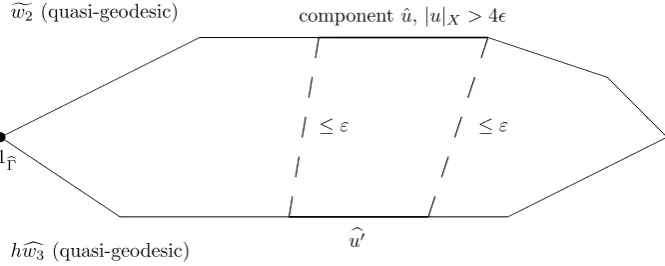
Now let u be a long modified parabolic segment of w2. Then Property 2.1
applied towf2 andhwc3ensures that there is a corresponding parabolic segment u0 of whw3 such that ub and ub0 are connected components of length 1 of wf2
and hwc3 Then since uband ub
0 must be -similar, it follows that the initial and
terminal points of u0 must be within X-distance of the initial and terminal points (respectively) ofu. Then 4 <|u| ≤2+|u0|, and so|u| ≤2|u0|(see Fig.
1).
Since wf2 does not backtrack, distinct components of wf2 must correspond to
distinct components of hwc3, and we deduce that the total length of the long
parabolic segments in w2 is bounded above by 2|whw3|. So |w2| ≤(4λ+ 2)|whw3|+ 4c.
Now we consider wh, which is a parabolic segment of whw3. If |wh| > then
Property 2.1 applied to (the paths labelled by)hwc3andwf2ensures the existence
of a corresponding parabolic segment u2 in w2, whose initial vertex is within X-distance of the basepoint 1
b
Γ of the Cayley graph Γ, and whose terminalb
vertex must be inH. Let w2 factorise as a concatenation of subwords u1u2u3.
Since u1u2 is a prefix ofw2 that represents an element of H, the fact that wf2
does not vertex-backtrack ensures that its subword cu1cu2 must have length at
most 1, and hence u1 is empty. But now the prefixu2 ofw2 is written over the
generators of H, and w2 cannot have a non-trivial such prefix, since w1 (from
So now|wh| ≤, and we can deduce from the inequality above that |w2| ≤A|w3|+B
for some constantsA, B. Provided that|w3| 6= 0, it follows that |w2| ≤(A+B)|w3|.
But if|w3|= 0, thenw2 must represent an element of H and so, sincewf2 has
already been proved not to vertex-backtrack,wf2must be a word written overH
of length at most 1. It follows thatw2is a word overX0, and so, just as above,
we deduce that|w2|= 0, and so the same inequality holds. This completes our
verification of the condition of (††) (and hence (†)), and the theorem is proved.
5
The proof of Theorem 1.2 (i)
In this section we show that ifGis a hyperbolic group, and H a quasiconvex, almost malnormal subgroup ofG, thenGWP(G, H) is a real-time language.
LetH be a quasiconvex and almost malnormal subgroup of a hyperbolic group
G=hXi. It is observed in [15, Section 1, Example (III)] thatGis hyperbolic relative to{H}so we can apply the results of Section 2. The proof of Theorem 1.2 (i) is very similar to that of Theorem 1.1 (although we are no longer assum-ing that H is virtually abelian) but is more straightforward, so we shall only summarise it here. In particular, we have Z =X so the complications arising from the elements ofZ\X that do not necessarily represent group elements do not arise.
We start by extendingX as before to include the finite subsetH0 of Hdefined
in Property 2.3. Since we are not applying Proposition 3.1 in this proof, the other adjustment toX is not necessary. We define Ψ,Φ, λ, c, , E as before and put D=E.
The standard Dehn algorithm for solving WP(G, X) consists of all rulesu→v
with u, v ∈X∗ such thatu=G v and 4δ≥ |u|>|v|, whereδ is the ‘thinness’
constant of G with respect to X (i.e. all geodesic triangles in Γ are δ-thin); see [1, Theorem 2.12]. Wordswthat are reduced by this algorithm are 4δ-local geodesics, and it is proved in [10, Proposition 2.1] that, ifwrepresents the group elementg, then|w| ≤2|g|.
We define our Dehn algorithm R for WP(G, X) to consist of all rules u → v
as above, with k ≥ |u|>|v|, where k = max(2D,4δ). ThenR-reduced words have the property that subwords representing group elements of X-length at mostD areX-geodesics. SinceD=E, it is also true thatR-reduced words of length at mostE are geodesic, soR has the required propertyP(D, E). As in the previous proof, we defineSto be theedaforGWP(G, H, X) consisting ofR
together with rulesHx→H for allx∈X0:=X∩H.
As before, we suppose thatSreduces the input wordHwtoHw1and define the
group elements ofX-length greater thanE. Again we letqi be geodesic words
over X0 (and hence also over X) with qi =G pi. By [10, Proposition 2.1], we
have|qi| ≥k1|pi|withk1= 1/2, so again we have|w2| ≥k1|w1|. The remainder
of the proof is identical to that of Theorem 1.1.
6
Proof of Theorem 1.2 (ii)
Here we prove the second part of Theorem 1.2 by showing that ifGis a hyper-bolic group and H a quasiconvex subgroup such that|CG(h) :CH(h)|is finite
for all 16=h∈H, thenGWP(G, H) is a real-time language.
As we did for Part (i) of this theorem, we prove Theorem 1.2 (ii) by constructing anedaover the alphabetX∪ {H}, whereG=hXi. As in the two earlier proofs, we verify that the conditions of Proposition 3.2 hold, to complete the proof.
For a finite (inverse-closed) generating setX of an arbitrary groupG, we define an X-graph to be a graph with directed edges labelled by elements of X, in which, for each vertex p and each x ∈ X, there is a single edge labelled x
with source pand, if this edge has target q, then there is an edge labelledx−1
from q to p. So the Cayley graph Γ(G, X) and, for a subgroup H ≤ G, the
Schreier graph Σ(G, H, X) ofG with respect toH are examples of X-graphs. We shall denote the base points of the Cayley and Schreier graphs by 1Γ and
1Σrespectively.
Following [6, Chapter 4], for k ∈ N, we define the condition GIB(k) (which
stands forgroup isomorphic balls) for Σ := Σ(G, H, X) as follows.
GIB(k): there exists K ∈ Nsuch that, for any vertex p of Σ with
d(1Σ, p)≥K, the closedk-ballBk(p) of Σ isX-graph isomorphic to
thek-ballBk(1Γ) of Γ(G, X).
We say that Σ satisfies GIB(∞) if it satisfies GIB(k) for allk≥0. The following result is proved in [6, Theorem 4.3.1.1]. Since its proof may not be readily available, we shall sketch it in Section 9.
Proposition 6.1. Let H be a quasiconvex subgroup of the hyperbolic groupG. ThenΣ(G, H, X) satisfiesGIB(∞)if and only if, for all 16=h∈H, the index |CG(h) :CH(h)| is finite.
Suppose thatG, Hsatisfy the hypotheses of Theorem 1.2 (ii). So Σ := Σ(G, H, X) satisfies GIB(∞) and, by [6, Theorem 4.1.3.3] or [13], Σ isδ-hyperbolic for some
δ >0 (that is, geodesic triangles in Σ are δ-thin).
Let k be an integer with k ≥4δ. Let K be an integer that satisfies the con-dition in the definition of GIB(k), and let R = 2K. We can assume that
K ≥max(k,2). We define our edato consist of all rules of the following two forms:
wherev1, v2, u1, u2∈X∗, v1v2−1∈H, u1=Gu2.
In order to apply Proposition 3.2 we need to verify that, wheneverw∈X∗ and
Hw is reduced according to the aboveeda, the length of the shortest stringv
overX withHv=Hw is bounded below by a linear function of|w|.
We shall use [10, Proposition 2.1]: ifu(of length>1) is ak-local geodesic in a
δ-hyperbolic graph, with k≥4δ, then the distance between the endpoints ofu
is at least|u|/2 + 1.
So suppose that Hw is reduced according to the eda. Ifw has length at most
R, then sinceHw is reduced by rules of type (1),Hw is geodesic in Σ, and the inequality in Proposition 3.2 holds with k= 1.
So suppose that|w|> R, and letw1 be the prefix of lengthRofw. We aim to
show that every vertex of Σ that comes afterw1 on the path from 1Σ labelled wlies outside ofBK(1Σ). Choosew2 so thatw1w2is maximal as a prefix of w
subject to all vertices ofw2lying outside ofBK(1Σ). Then, sincew1is geodesic
of length R = 2K, we have |w2| ≥ K−1, and so |w1w2| ≥ 3K−1. Since w1 is geodesic in Σ, and that part of the path labelled w1w2 that lies outside
of the K-ball is a k-local geodesic in Σ (because, by GIB(k), it is isometric to the corresponding word in the Cayley graph, and our inclusion of the rules of type (2) in the eda ensures that the reduced words over X of length ≤ k are geodesics), we see that the whole of the path labelledw1w2is ak-local geodesic
in Σ. So we can apply [10, Proposition 2.1] to deduce from theδ-hyperbolicity of Σ that
dΣ(1Σ, Hw1w2)≥ |w1w2|/2 + 1≥(3K+ 1)/2> K+ 1.
It follows that, if w1w2 were not already equal to w, then it would be
ex-tendible to a longer prefix of w subject to all vertices of w2 lying outside of BK(1Σ). So w1w2 = w, and the above inequality gives us the linear lower
bound dΣ(1Σ, Hw) ≥ |w|/2 + 1≥ |w|/2 on dΣ(1Σ, Hw). So the inequality in
Proposition 3.2 holds with k = 2 and hence, by the preceding paragraph, it holds withk= 2 for all wordswsuch thatHw is reduced according to theeda. The result now follows from Proposition 3.2, and this completes the proof of Theorem 1.2 (ii).
7
Proof of Theorem 1.3
We show that if Gis a finitely generated virtually free group, andH a finitely generated subgroup ofG, thenGWP(G, H) is deterministic context-free.
LetF be a free subgroup ofG=hXiwith|G:F|finite, and letY be the inverse closure of a free generating set forF; that is the union of a free generating set with its inverses. LetK=F∩H. The subgroupKhas finite index inH, and so must (likeH) be finitely generated. It easy to see that the elements in any right transversal ofKinH lie in different cosets ofF inG, so we can extend a right transversalT0 ={t1, . . . , tm} ofK in H to a right transversalT ={t1, . . . , tn}
where U is the set{u(i, x) : 1≤i≤n, x∈X} of Schreier generators forF in
Gdefined by the equationstix=u(i, x)tj. (Note thatX inverse-closed implies
that U is inverse-closed.) Then, by substituting the reduced word in Y∗ for each u(i, x), the wordw can be written as a word vt in Y∗T (where v is not necessarily freely reduced).
The first step to recognise whether w ∈ H is to rewrite it to the form vt, as above, using a transducer. Then w ∈ H if and only if t ∈ T0 and v ∈ K. It remains for us to describe the operation of a deterministic pushdown automaton (pda) N to recognise those words v in Y∗ that lie in the subgroup K of the free group F. Note that this machine operates simultaneously, rather than sequentially, with the transducer, and it follows from the fact that context-free languages are closed under inverse gsms [12, Example 11.1, Theorem 11.2] that the combination of the two machines is apda.
By [2] or [8, Proposition 4.1], any finitely generated subgroupK of a free group is L-rational, where Lis the set of freely reduced words over a free generating set; that is, the setK∩Lis a regular language. In our case, we chooseLto ber the freely reduced words overY.
We shall build our pda N out of a finite state automaton (fsa) M for which
L(M)∩L = K∩L (where L(M) is the set of words accepted by M). The construction is (in effect) described in the proof of [8, Theorem 2.2] thatK is
L-quasiconvex. The L-quasiconvexity condition is equivalent to the property that all prefixes of freely reduced words that represent elements ofK lie within a bounded distance ofKin the Schreier graph Σ := Σ(F, K, Y). Equivalently, a freely reduced wordv overY represents an element ofK precisely if it labels a loop in Σ from 1Σto 1Σthat does not leave a particular bounded neighbourhood B=Bd(1Σ) of 1Σ.
Suppose that g1 = 1 and that K = Kg1, Kg2, . . . , Kgr are the right cosets
corresponding to the bounded neighbourhoodBof 1Σwithin Σ that is identified
above. Thefsa M is defined as follows.
(i) The states ofM are denoted byσ1, . . . , σr,σˆ.
(ii) The states σ1, . . . , σr correspond to the right cosets Kgi of K in F,
where each gi is in the finite subsetB identified above; indeed we may
identify σi with the coset Kgi, and then use the name B both for the
set {Kg1, . . . , Kgr} of cosets and for the set {σ1, σ2, . . . , σr} of states.
The stateσ1 (which corresponds to the subgroupK) is the start state
and the single accepting state.
(iii) For 1 ≤i, j≤rand y∈Y, there is a transitionσiy =σj if and only if Kgiy=Kgj. It follows from this thatσ
y
i =σj if and only ifσ y−1
j =σi.
(iv) σˆis a failure state, and is the target of all transitions that are not defined in (iii), including those from ˆσ.
We see that, as a word is read by M, the automaton keeps track of the coset of Σ that containsKw, wherewis the prefix that has been read so far, so long as that coset is within the finite neighbourhoodB of 1Σ, and in addition so are
that a word inLis accepted byM if and only if it represents an element ofK. In fact any word overY that is accepted byM must represent an element ofK.
However words over Y that are not freely-reduced (that is, not in L) and do not stay inside of B will be rejected byM, even when they represent elements of K. In order to construct a machine that accepts all wordsv over Y within
K, and not simply those that are also freely-reduced, we need to combine the operation of the fsa M above with a stack, which we use to compute the free reduction.
We construct ourpdaN to have the same state set B∪ {σ}ˆ as M, again with
σ1=Kg1=Kas the start state and sole accepting state. The transitions from
the states σi =Kgi are as in M. We need however to describe the operation
of the stack, and transitions from the state ˆσ, which is non-accepting, but no longer a failure state.
The stack alphabet is the setY∪(Y×B). The second component of an element of Y ×B is used to record the state M is in immediately before it enters the state ˆσ. In addition, we use the stack to store the free reduction of the prefix ofv that has been read so far.
The operations of thepdaNthat correspond to the various transitions ofM are described in the following table. The absence of an entry in the ‘push’ column indicates that nothing is pushed.
Transition Input Input Pop Push Output
ofM state symbol state
σiy=σj σi y y−1 σj
σi y y06=y−1 y0y σj
σiy= ˆσ σi y y0 y0(y, σi) σˆ
ˆ
σy= ˆσ σˆ y (y−1, σi) σi
ˆ
σ y (y0, σi), y0 =6 y−1 (y0, σi)y σˆ
ˆ
σ y y−1 σˆ
ˆ
σ y y06=y−1 y0y σˆ
Note that we have not specified thaty0 6=y−1in line 3, but in fact the condition y0=y−1 does not arise in this situation. Since there can be a symbol inY ×B
on the stack only whenN is in state ˆσ, it is not possible to pop such a symbol whenN is in stateσi, so there are no such entries in the table.
The fact thatN recognisesGWP(F, K, Y) follows from the fact thatN accepts
wif and only ifM acceptsw, wherewis the free reduction (inL) ofw. We prove this by induction on the numberkof reductions of the formw1yy−1w2→w1w2
withy∈Y that we need to apply to reduce wtow.
The case k= 0 of our induction follows from the fact thatL(M)∩L=K∩L, combined with the observation that, ifwis freely reduced, thenwleads to the same state of M as it does ofN. For in that case the only possible transitions as we readware of the types described in lines 2,3,5,7 of the table.
(∗): if wy ∈L, then the configuration ofN after reading wyy−1 is
identical to the configuration after readingw.
It follows from (∗) that a wordw1yy−1w2in whichyy−1is the leftmost cancelling
pair is accepted byN if and only ifw1w2 is accepted byN, and hence we have
the inductive step we need.
We can check the statement (∗) with reference to the table. There are up to seven possibilities for the type of transition ofN as the final symboly ofwy is read.
For the first two of these,N is in stateσi after readingw, and moves to a state σj. Sincewyis inL, the top stack symbol after readingwis noty−1. Hence the
transition must be of the type described in line 2 of the table, and not as in line 1, that is,y0 6=y−1 is popped, and then y0y is pushed. Recalling that σy
i =σj
in M if and only ifσjy−1 =σi, we see that the next transition ofN, from wy
on y−1, is of the type described in line 1. Then the symbol y is popped, the
symboly0 is again on the top of the stack, and N returns to the stateσi
We consider similarly the remaining five possibilities for the transition from w
on y0, and the subsequent transitions on y0−1, and verify (∗) for each of those
configurations. This completes the proof of Theorem 1.3.
8
Proof of Theorem 1.4
Recall the statement of Theorem 1.4: letG be a hyperbolic group, and letH
be a quasiconvex subgroup of infinite index in Gsuch that |CG(h) :CH(h)| is
finite for all 16=h∈H. IfGWP(G, H) is context-free thenGis virtually free.
Our proof of Theorem 1.4 has the same structure as the proof in [14] that groups withWP(G) context-free are virtually free, and it would be helpful for the reader to be familiar with that proof.
We shall prove that G has more than one end. Assuming that to be true, we use Stalling’s theorem [18] to conclude that G has a decomposition as an amalgamated free productG=G1∗KG2, or as an HNN-extensionG=G1∗K,t,
over a finite subgroupK. SinceG1 (andG2) are easily seen to be quasiconvex
subgroups of G, it is not hard to show that the hypotheses of the theorem are inherited by the subgroupH∩G1 ofG1 (andH∩G2 of G2), and so they too
have more than one end, and we can apply the Dunwoody accessibility result to conclude thatGis virtually free.
gram-matical rule we writew⇒w0, and when a sequence of such rules is needed we writew⇒∗w0.
Letz1, . . . , zn be the variables of the grammar other thanS and, for eachzilet ui be a shortest word in X∗ with zi ⇒∗ ui. Let L be the maximum length of
the wordsui.
Letw∈GWP(G, H, X) with|w|>3, and fix a derivation ofwin the grammar. We shall define a planarX-graph ∆ with an associatedX-graph homomorphism
φ: ∆→Σ := Σ(G, H, X). We start with a simple plane polygon with a base point, and edges labelled by the letters ofw, and withφmapping the base-point of ∆ to 1Σ. Note thatφis not necessarily injective.
Ifzioccurs in the chosen derivation ofw, then we havew=vviv0withzi⇒∗vi;
two such words vi and vj are either disjoint as subwords of w or related by
containment. Since zi ⇒∗ ui, we also have vuiv0 ∈ GWP(G, H, X). So we
can draw a chord labelledui in the interior of ∆ between the two ends of the
subpath labelled vi, and φ extends to this extension of ∆. If we do this for
each suchzi for which 1<|vi|<|w| −1 then, as in [14, Theorem 1], we get a
‘diagonal triangulation’ of ∆, in which the sides are either boundary edges of ∆ or internal chords of length at mostL. (But note that, for the first derivation
S→z1z2, say, if|v1|>1 and|v2|>1 then, to avoid an internal bigon, we omit
the chord labelledu2.)
Suppose, for a contradiction, that G has just one end; that is, for anyR, the complement in Γ(G, X) of any ball of radiusR is connected. Then, for anyR, we can find a word w1w2w3 overX with w1w2w3 =G 1 which, starting at 1Γ,
labels a simple closed path in Γ(G, X), where|w1|=|w3|=R,w3w1is geodesic,
and no vertex in the path labelled w2 is at distance less thanRfrom 1Γ.
Choose such a path withR= 3L+ 1. Choosek0 such that the whole path lies in the ballBk0(1Γ) of Γ(G, X), and letk=k0+L. Then, since by Proposition
6.1 Σ(G, H, X) satisfies GIB(k), there exists K such that, for any vertex p
of Σ(G, H, X) with d(1Σ, p) ≥ K, the ball Bk(p) of Σ(G, H, X) is X-graph
isomorphic to the ballBk(1Γ) of Γ(G, X). Choose such a vertexp, and consider
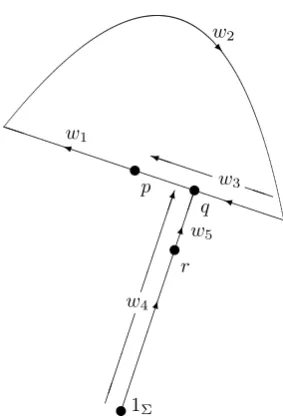
the path labelledw1w2w3of Σ(G, H, X) that is based atp, as in Fig. 2.
Choose a vertex qon the path labelledw1w2w3 withd(1Σ, q) minimal, and let w4 be the label of a geodesic path in Σ(G, H, X) from 1Σtoq. Then, for some
cyclic permutation w0 of w1w2w3, we have a closed path in Σ(G, H, X) based
at 1Σand labelledw4w0w−41.
We apply the above triangulation process to a planarX-graph ∆ forw4w0w4−1.
Sinceqis the closest vertex to 1Σon the loop labelled byw0, and the path from
1Σ to q in the Cayley graph labelled by w4 is geodesic, every vertex on that
path is as close toq as to any other vertex ofw0, and so any vertex ofw4that
can be connected by the image of a chord of ∆0 to a vertex ofw0must be within distance at mostLofq. Letrbe the first such vertex onw4 (as we move from
1Σtoq), and letw5 be the suffix ofw4 that labels the path alongw4fromrto q. Then|w5| ≤L.
t1Σ w4 t q w5 t r P P P P i i w3 PP t p i w1 P P P P P P P P P P P P P P P R w2
Figure 2: Triangulation in Σ(G, H, X)
∆0 for the word w5w0w5−1, and there is an associatedX-graph homomorphism φ0 that maps this to the corresponding subpath in Σ(G, H, X). (Note that the
images ofw5andw5−1underφ0are equal, but thatφ0is injective when restricted
to w0.) By our choice ofk=k0+L, the image ofφ0 lies entirely withinBk(p),
which isX-graph isomorphic toBk(1Γ). So the distances in Σ(G, H, X) between
vertices in this image are the same as in any path with the same label in Γ(G, X).
As in [14], we colour, using three colours, the vertices of the boundary paths of ∆0 that are labelledw1, w2, w3 (where vertices on two of these subwords get
both associated colours), and we colour the vertices on w5 and w−51 with the
same colour (or colours) asq. As in [14, Lemma 5], we conclude that there is a triangle in the triangulation whose vertices use all three colours between them. One (or even two) of these vertices could be on the subpath labelled w5, and
two 2-coloured vertices in the triangle might coincide, but, since any vertex on
w5is within distance Lofq, replacing vertices onw5 byqas necessary, we end
up with a triangle of three (not necessarily distinct) verticesp1, p2, p3withpion wi, and withd(pi, pj)≤2L for eachi, j. At least one ofp1, p3 must be within
distance Lofp. But thend(p, p2)≤3L, contradicting our assumption thatw2
is outsideB3L(p). This completes the proof of Theorem 1.4.
9
Sketch of proof of Proposition 6.1
tA= 1Γ
t
B
u
6
v
6
v
t
C tD
[image:22.595.227.382.140.310.2]
-w
Figure 3: The geodesic quadrilateral ABCD
Suppose first that |CG(h) : CH(h)| is infinite for some 1 6=h ∈H, and let w
be a word representing h. Then, for any K >0, there exists a wordv∈CG(h)
labelling a path in Σ := Σ(G, H, X) from 1Σ to a vertexpwith d(1Σ, p)> K,
and there is a loop labelledwbased atpin Σ, but no such loop based at 1Γ in
Γ := Γ(G, X). So GIB(|w|) fails in Σ.
Suppose conversely that GIB(k) fails in Σ for somek. Then there are vertices
p of Σ at arbitrarily large distance from 1Σ such that the ball Bk(p) in Σ is
notX-graph isomorphic to the ballBk(1Γ) in Γ. So the natural labelled graph
morphismBk(1Γ)→Bk(p) with 1Γ7→pis not injective, and hence two distinct
vertices of Bk(1Γ) map to the same vertex of Bk(p). So, for any such vertex p, there is at least one labelled loop based at p, within Bk(p), such that the
corresponding labelled path based at in Bk(1Γ) in Bk(1Γ) is not a loop in Γ.
Since the number of words that can label loops in a ball of radius k in Σ is finite, some wordwwithw6=G 1 must label loops based atpfor infinitely many
verticespof Σ, and we can choosewto be geodesic overX. Now for any integer
N, there is a wordv of length greater thatN, labelling a geodesic in Σ from 1Σ
to a vertexp, from which there is a loop in Σ labelled byw.
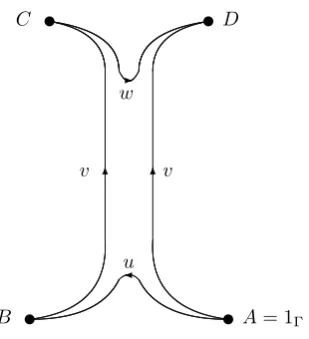
For such a wordv, we havehvw=v for someh∈H. Letube a geodesic word labellingh. Then we have a geodesic quadrilateral with verticesA= 1Γ, B, C, D
in Γ(G, X) with sides AB, BC, CD, AD labelled u, v, w, v, respectively, as shown in Fig. 3.
By the hyperbolicity ofG, each vertex of ABlies within a distance 2δof some vertex onBC,CDorDA, whereδis the constant of hyperbolicity. Furthermore, sinceH is quasiconvex inG, there is a constantλ, such that each vertex ofAB
is within a distanceλof a vertex of Γ representing an element ofH. Since each vertex of wlies at distance at least|v| −k from any vertex inH, by choosing
DA. But, since v labels a geodesic path from 1Σin Σ, at most 2δ+λvertices
onBCor onDAcan be within 2δ+λof a vertex inH. So each vertex ofABis at distance at most 2δfrom one of at most 4δ+ 2λvertices and, since the total number of vertices in Γ with that property is bounded, we see that |AB|=|u|
is bounded by some expression in|X|,δandλ.
By hyperbolicity ofG, the two pathsBCandADlabelledvmust synchronously
L-fellow travel for someL(which depends on the upper bounds on|w|and|u|). Let m > 0. Then, by choosing v sufficiently long, we can ensure that some word u0 appears as a word-difference between BC and AD at least m times; that is,vhas consecutive subwordsv0, . . . , vm, v0, such thatv=v0v1v2· · ·vmv0,
andhv0v1v2· · ·viu0 =G v0v1v2· · ·vi for eachiwith 0≤i≤m. The casei= 0
gives u0 = v−1
0 h−1v0, and it follows from this that gi := v0(v1v2· · ·vi)v−01 ∈ CG(h) for 1 ≤ i ≤ m. Also, since v labels a geodesic in Σ, the elements v0v1, v0v1v2, . . . v0v1v2· · ·vm lie in distinct cosets of H and hence so do the gi. Since we can choose m arbitrarily large, this contradicts the finiteness of |CG(h) :CH(h)|.
Acknowledgements
The first author was supported by the Swiss National Science Foundation grant Professorship FN PP00P2-144681/1, and would like to thank the mathematics departments of the Universities of Newcastle and Warwick for their support and hospitality.
References
[1] J. Alonso, T. Brady, D. Cooper, V. Ferlini, M. Lustig, M. Mihalik, M. Shapiro and H. Short, “Notes on word-hyperbolic groups”, in E. Ghys, A. Haefliger and A. Verjovsky, eds., “Proceedings of the Conference “Group Theory from a Geometric Viewpoint” held in I.C.T.P., Trieste, March 1990, World Scientific, Singapore, 1991.
[2] A.V. Anisimov and F.D. Seifert. Zur algebraischen Charakteristik der durch kontext-freie Sprachen definierten Gruppen.Elektron. Informationsverarb. Kybernet., 11:695–702, 1975.
[3] Y. Antol´ın and L. Ciobanu, Finite generating sets for relatively hyperbolic groups and applications to conjugacy languages,Trans. Amer. Math. Soc., Volume 368, Number 11 (2016), 7965–8010.
[4] M.J. Dunwoody. The accessibility of finitely presented groups. Invent. Math., 81:449–457, 1985.
[5] B. Farb, Relatively hyperbolic groups. Geom. Funct. Anal. 8 (1998) no. 5, 810–840.
[7] S. Friedl and H. Wilton. The membership problem for 3-manifold groups is solvable.Alg. & Geom. Topology, 16 (2016) 1827–1850.
[8] S.M. Gersten and H.B. Short. Rational subgroups of biautomatic groups.
Ann. of Math., 134(1):125–158, 1991.
[9] O. Goodman and M. Shapiro, On a generalization of Dehn’s algorithm.
Internat. J. Algebra Comput., 18 (2008) 1137–1177.
[10] D.F. Holt, Word-hyperbolic groups have real-time word problem.Internat. J. Algebra Comput.10 (2000) 221–227.
[11] D.F. Holt and S. Rees, Solving the word problem in real time, J. London Math Soc.63 (2001) 623–639.
[12] John E. Hopcroft and Jeffrey D. Ullman,Introduction to automata theory, languages and computation, Addison-Wesley, 1979.
[13] I. Kapovich. The geometry of relative Cayley graphs for subgroups of hy-perbolic groups,http://arxiv.org/abs/math/0201045v2.
[14] D.E. Muller and P.E. Schupp. Groups, the theory of ends, and context-free languages.J. Comp. System Sci., 26:295–310, 1983.
[15] D. Osin, Relatively hyperbolic groups: intrinsic geometry, algebraic prop-erties and algorithmic problems. Mem. Amer. Math. Soc. 179 (2006) no. 843, vi+100pp.
[16] E. Rips. Subgroups of small cancellation groups, Bulletin London Math. Soc., 14(1):45–47, 1982.
[17] Arnold L. Rosenberg, Real-time definable languages, J. Assoc. Comput. Mach. 14 (1967) 645–662.
[18] J. Stallings.Group Theory and Three-Dimensional Manifolds, volume 4 of
Yale Mathematical Monographs. Yale University Press, 1971.
Laura Ciobanu, Mathematical and Computer Sciences, Colin McLau-rin Building, Heriot-Watt University, Edinburgh EH14 4AS, UK
E-mail address: [email protected]
Derek Holt, Mathematics Institute, Zeeman Building, University of Warwick, Coventry CV4 7AL, UK
E-mail address: [email protected]
Sarah Rees, School of Mathematics and Statistics, University of Newcastle, Newcastle NE1 7RU, UK