© 2019, IRJET | Impact Factor value: 7.211 | ISO 9001:2008 Certified Journal
| Page 5243
DESIGN SIMULATION AND CONTROL OF UTILITY GRID CONNECTED
SOLAR PHOTOVOLTAIC ARRAY
PAYAL GANVIR
1, RADHARAMAN SHAHA
21
(PG Student, Dept of Electrical Engineering)
2(Asst. Professor Dept of Electrical Engineering)
---***---ABSTRACT :- The consumption of electricity generation by
photovoltaic system has increase in daily purpose. The generation of photovoltaic system plant focus on the maximum profit of collect solar energy. In this paper we are control the renewable energy based solar photovoltaic system using MATLAB. The grid connected MATLAB model is studied under solar radiation and changing weather condition. In this we generate excess amount of electricity and send to the utility grid. Here we used MPPT technique which is implemented in DC-DC step up converter to permit P-V module to give power at maximum power point. The output of this converter is given to the 3-level inverter and it synchronized the utility grid.
KEYWORDS :- Solar Energy; Solar Photovoltaic Array System; Maximum Power Point Tracking Technique; Voltage Source Converter; DC-DC boost converter ;Grid
1) INTRODUCTION
Tracking is the maximum power point of a photo-voltaic array is usually an essential part of the PV system[7]. Due to the growing demand on electricity the limited stock and rising prices of conventional sources (such as coal and petroleum etc) photovoltaic (PV) energy becomes a alternative it is omnipresent freely available environment friendly, less operational and maintenance cost. Thus the demand of PV generation system has to be increased for standalone and grid connected modes of PV system. Therefore an efficient maximum power point tracking technique is expected to track the MPP at all environmental condition and then force the PV system to operate at the MPP point. MPPT is an essential component of a PV system. Solar photovoltaic system are one of the fastest growing renewable energy generation system. The energy generated from PV system is depend on environmental factors such as solar irradiation, cloud coverage, wavelength, reflection and ambient temperature.
These factors can negatively affect the PV cell conversion
efficiency[3]. PV energy system has some advantage such as pollution free, abundant availability, less maintenance. In solar photovoltaic system the optimum efficiency (which is 7-16%) second inverter efficiency (90-97%) and the efficiency of MPPT algorithm (over 98%). In photovoltaic system integrated to grid, the grid inverter is three inverter in this paper it is an important component which invert dc power which is obtain from P-V system array alternating power to synchronized voltage and frequency of connected utility grid. In this paper the major component are photovoltaic plant, consist of P-V array, MPPT unit, three level inverter, step-up converter and utility grid.
The function of PV array is to convert the solar irradiation which is comes from solar energy into dc power. The MPPT algorithm is also connected to the PV array which allow PV array P-V array to produce maximum power. The unidirectional power is obtained and then changed into ac power with the help of three level inverter and then this ac power is filter through LC filter and fed to utility grid .A boost converter is also to provide link between MPPT and inverter for boost purpose. In order to match inverter output current with the grid voltage and reduce the total harmonic distortion. The voltage source converter is used in this paper.
2)
PROBLEM REVIEW
© 2019, IRJET | Impact Factor value: 7.211 | ISO 9001:2008 Certified Journal
| Page 5244
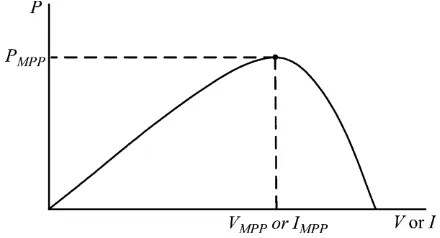
Figure1. Characteristic PV array power curve.3) MPPT TECHNIQUE
The following techniques are some of the widely used MPPT techniques applied on various PV application such as space satellite, solar vehicles, and solar water pumping, etc.
A)LOOK-UP TABLE TECHNIQUE
In this technique, MPP of a PV system is calculated before hand for each probable environmental condition and stored in the memory device of MPPT’s control system. During the operation, the corresponding MPP for a particular condition is selected from that memory and implemented.
B) FRACTIONAL OPEN-CIRCUIT VOLTAGE TECHNIQUE
In this technique, Vmpp can be calculated from the following relationship as follows.
Vmpp= Koc Voc
It is found that the value of Koc varies between0.78and 0.92. Koc can be calculated by analyzing the PV system ay wide range of solar radiation and temperature. In this method, the PV system is open circuited at load end for a fraction of second and Voc is measured, then Vmpp is calculated. Repeating this process Voc is sampled repeatedly in every few seconds and value of Vmpp is updated.
A) FEEDBACK VOLTAGE OR CURRENT TECHNIQUE
This technique is used in the system which has no battery. Without a battery, a simple controller is needed to fix the bus voltage at a constant level. In this method, the feedback of panel voltage is taken and compared with a pre-calculated reference voltage the duty ratio of dc/dc
converter is continuously adjusted so that it operates close to that of MPP.
B) LOAD CURRENT/LOAD VOLTAGE
MAXIMIZATION TECHNIQUE
If directly connected to the load, operation of the PV array at the MPP cannot be ensured even for constant loads. Thus operation at the MPP cannot be achieved using a tunable matching network that interfaces the load to the PV array. The main components of the MPPT circuit are its power stage and the controller. As the power stage is realized by means of a switched mode power converter, the control input is the duty cycle.
4) MODEL OF P-V CELL
[image:2.612.35.255.87.206.2]A simple ideal equivalent circuit model for cell obtain by the parallel combination of an ideal current source and real diode is shown in below
Figure 2:Fundamental circuit representation of solar cell
Where:
I: Current of solar cell (A)
Isc: Short circuit current (with assuming no series/ shunt resistance)
ID : Saturation current of diode (A) q : Electron charge (1.6*10-19C) k : Boltzmann constant (1.38064*10-23J/Kelvin)
T : Temperature in Kelvin (K)
V : Output voltage of solar cell (V)
Rs : Series resistance of solar cell(Ω)
© 2019, IRJET | Impact Factor value: 7.211 | ISO 9001:2008 Certified Journal
| Page 5245
5) BOOST/STEP-UP CONVERTER (DC TO DC)
Drawback of step-down/buck dc-dc converter is that when converter switch is on it transfer power from input to output but when converter switch is off zero output value across p-v module is obtain which gives the point of operation stay near the open circuit voltage which provide losses. Boost converter gives a dc output voltage which is more than the applied dc input voltage, filter which consisting of inductor and capacitor, is utilized to decrease ripple in dc output voltage and dc output current respectively and is connected at output terminal of the converter. The operating principle step-up/boost converter consist two different states of operation. When switch is on that is switch is close, result an increase in current. When switch is off that is open, result in reducing in inductor current.
6) CONTROLLER
It is consisting of two controller which is power controller and current controller. Power controller senses the grid voltage and current and provides the corresponding grid active and reactive power as per requirement of the circuit. Power controller also sense three level inverter output voltages and current and provide the active and reactive power respectively. The main purpose of current controller is to provide triggering pulse according to reference values.
7)
PV CHARACTERISTIC
[image:3.612.349.557.89.178.2]PV1 is a subsystem when double click on it subsystem mask will open. In this we can change the value of short circuit current, open circuit voltage current at Pmax voltage at Pmax. In the first PV module (1) block actual P-V, I-V characteristic system is constructed. This output Vpv and Ppv is given at output.
FIGURE 3 :- PV CHARACTERISTIC
To view circuit inside in this block right click on the block select mask and look under mask. Now circuit inside the block will be displayed.
When double click on the PV module(1) block inside the circuit will display.
Where,
© 2019, IRJET | Impact Factor value: 7.211 | ISO 9001:2008 Certified Journal
| Page 5246
8) PV Array
Implement PV array modules
The PV Array block is a five parameter model using a current source IL (light-generated current), diode (I0 and nI parameters), series resistance Rs, and shunt resistance Rsh to represent the irradiance- and temperature-dependent I-V characteristics of the modules.
Here we take Insolation = 200, 400, 600, 800, 1000 W/m2.
Insolation 1000 W/m2
Temperature =25 deg
9) CONCLUSION
The PV module characteristic of a P-V system is shown in the above section. The P-V, I-V characteristic is shown above. The model explains solar P-V cell is the effect of physical environmental condition based on solar radiation and cell temperature. The voltage source controller is used to synchronize P-V cell plant, step-up converter and inverter with utility grid. The model is used a tool to forecast the nature of grid connected P-V plant under solar radiation and temperature change.
REFERENCES
[1] Prakash K . Ray1, Senior Member IEEE, Soumya Ranjan Das2, and Asit Mohanty1, Member IEEE, “Fuzzy Controller Designed PV based Custom Power Device for Power Quality Enhancement,”2018.
[2] Mashood Nasir, Student Member IEEE, Hassan Abbas Khan, Member IEEE, Arif Hussain, Laeeq Mateen and
Nauman Ahmad Zaffar, Member IEEE, “Solar PV-based
Scalable DC Microgrid for Rural Electrification in Developing Regions,”2017.
[3] Morcos Metry Student Member, IEEE Renewable Energy & Advanced Power Electronics Research Laboratory Texas A&M University College Station, TX 77843, USA [email protected], “MPPT of Photovoltaic Systems Using Sensorless Current-Based Model Predictive Control,”2016.
© 2019, IRJET | Impact Factor value: 7.211 | ISO 9001:2008 Certified Journal
| Page 5247
[5] Mohammad B. Shadmand, Student Member, IEEE,Robert S. Balog, Senior Member, IEEE, and Haitham Abu-Rub, Senior Member, IEEE, “Model Predictive Control of PV Sources in a Smart DC Distribution System: Maximum Power Point Tracking and Droop Control,”2014.
[6] Bidyadhar Subudhi, Senior Member, IEEE, and
Raseswari Pradhan, “A Comparative Study on Maximum Power Point Tracking Techniques for Photovoltaic Power Systems,”2013.