Abstract— Bone tissue engineering is a new treatment technique for bone grafting. This procedure can regenerate damaged bone by implanting scaffolding to provide mechanical support in gap areas. The scaffold acts as a temporary matrix for cell proliferation until new bone tissue is completely regenerated. This research developed bone scaffold using freeze-drying method. A mixture design technique was used to investigate the effect of chitosan, gelatin, and hydroxyapatite on the scaffold properties. The results showed that the degradability and porosity of the scaffold increased with decreasing chitosan-gelatin and hydroxyapatite concentrations, while swelling increased with increasing chitosan-gelatin but decreasing hydroxyapatite concentrations. An optimal condition was obtained from the scaffold with a chitosan-gelatin:hydroxyapatite:1% acetic acid ratio of 2.62:2.17:95.21. The SEM image also showed the scaffold fabricated from this ratio has an open pore structure, which could benefit bone regeneration.
Index Terms— Chitosan, Gelatin, Hydroxyapatite, Porous scaffold, Bone grafting
I. INTRODUCTION
ONES are rigid organs that support and protect various organs of the body. Repair techniques for bones with defects or loss due to disease, trauma or tumor resections [1] are the subject of intensive research. Bone grafts – a well-recognized and standard treatment method for reconstructive orthopedic surgery [2] – employ three types of bone or tissue substitution: allograft, autograft and xenograft. Allografts transplant bone or soft tissue from one individual to another in the same species. Allografts have many advantages, including osteoinduction and strong mechanical properties, but carry the risk of disease transmission from the donor, such as HIV, hepatitis or cancer. Autografts, or autologous bone transplants, transplant bone tissue from one site to another in the same individual. This graft offers excellent biocompatibility and does not stimulate host inflammatory response. However, the procedure may cause long lasting pain and discomfort for the patient. Furthermore, there is additional risk of wound infection at the surgery sites [3]. Xenografts remove cells or sections of tissue from one species and graft them on or into a different species. Bovine bone [4] and mollusk shell [5] are common
Manuscript received Dec 5, 2013; revised Dec 21, 2013.
W. Wattanutchariya is an Associate Professor at the Design and Development of Advanced Manufacturing Research Unit, Department of Industrial Engineering, Faculty of Engineering, Chiang Mai University, 239 Huaykeaw Road, T. Suthep, A. Muang, Chiang Mai, Thailand phone: 66-53-944125; fax: 66-53-944185; e-mail: [email protected].
W. Changkowchai is a Graduate Student in Biomedical Engineering Center, Faculty of Engineering, Chiang Mai University, 239 Huaykeaw Road, T.Suthep, A. Muang, Chiang Mai, Thailand e-mail: [email protected].
materials used in xenografts. However, the bioactive properties of xenografts are weaker than allografts and autografts. To improve xenografts, a new treatment technique has been introduced for bone or tissue repair called bone tissue engineering – a procedure to regenerate damaged bone by implanting cells, proteins and scaffold to provide mechanical support for gap areas [6]. Bone substitute morphology has many forms, such as a compact and porous structure. As bone replacements, a compact structure provides good mechanical strength while a porous structure is suitable for cell attachment and blood supply [7]. Bone tissue engineering creates a biological material that provides the option for implantation and/or prosthesis. Bone tissue engineering has three main requirements: osteoconductive biomaterial scaffolds, osteogenic cells and osteoinductive molecules [8]. Materials widely used in bone tissue engineering include chitosan, gelatin and HA. Chitosan is a polysaccharide that can be synthesized from crustacean shell and squid pen. Chitosan’s structure is similar to glycosaminoglycans, the major component of the extracellular matrix of bone and cartilage [9, 10]. Gelatin can be obtained by thermal denaturation and chemical degradation of collagen [11], and is known to benefit cell viability [12]. In the meantime, HA has a chemical composition similar to human mineral tissue and can be synthesized from many natural sources with calcium-based structures, such as bovine bone, mollusk shell and coral [13-14].
Sintering, salt leaching and freeze-drying have been used for fabricating porous scaffold in bone tissue engineering. Sintering uses high temperatures to bond substances together as well as burn out organic material to form a porous structure [15]. Salt leaching is also feasible, but is limited by the prolonged contact of particles with water and the requirement for salt removal [16]. This study has chosen freeze-drying because it can form highly a porous structure and offer stability and ease of handling [17-18].
This study focuses on preparing and characterizing composite scaffold synthesized from three natural-based materials – chitosan, gelatin and HA. In combination, these three biomaterials offer potential synergies between physical properties and bioactivity for use as bone substitutes in bone grafts, benefiting a range of surgical applications.
II. MATERIALSANDMETHODS
A. Materials Preparation
HA in this study was synthesized from mollusk shell using a wet chemical precipitation method. Mollusk shells were calcined at 850 °C for 5 hours and then ground for 12
Characterization of Porous Scaffold from
Chitosan-Gelatin/Hydroxyapatite
for Bone Grafting
Wassanai Wattanutchariya and Whattanapong Changkowchai
hours to obtain CaCO3 powder. CaCO3 was dissolved in ammonium di-hydrogen phosphate (NH4H2PO4) solution and the pH was adjusted by phosphoric acid (H3PO4) before precipitating the solution at room temperature for 12 hours to achieve HA with the appropriate Ca/P ratio of 1.0/0.5. Finally, the slurry was calcined at 800 °C for 12 hours to obtain HA powder. Chitosan derived from squid pen extraction was purchased from Taming Enterprises Co., Ltd, Thailand. Gelatin, ammonium di-hydrogen phosphate, sodium hydroxide (NaOH) and phosphoric acid were purchased from Sigma Aldrich Co., Ltd.
B. Preparation of Chotosan-Gelatin Solution
Chitosan solution was prepared by mixing 97.88% deacetylation chitosan with 1% acetic acid solution. Then, gelatin was added to the chitosan solution in a 1:1 ratio and the solution was agitated at 37 °C for 12 hours to form a chitosan-gelatin solution.
C. Fabrication of Chitosan-Gelatin/Hydroxyapatite Porous Scaffold
To develop a porous bone scaffold for this study, HA was added to the chitosan-gelatin solution and stirred for 24 hours to disperse thoroughly. The resultant solution was transferred to well culture plates and pre-frozen at -20 °C for 12 hours, followed by freeze-drying in lyophillizer at -40 °C for 48 hours to obtain porous scaffolds. Then the scaffolds were neutralized by 2% sodium hydroxide and washed with deionized water before repeating the freeze-drying process. A mixture design technique was used to investigate the effect of chitosan-gelatin/HA compositions on scaffold properties. The mixtures were varied based on previous research [18], with a chitosan-gelatin range of 0.50 to 4.00 (%w/w), an HA range of 1.00 to 3.00 (%w/w) and a 1% acetic acid solution range of 93.00 to 98.50 (%w/w).
D. Scaffold Characterizations
The prepared materials and resultant structures of the porous bone scaffolds were characterized for their composition, biodegradability, morphology, porosity, swelling and biocompatibility.
X-ray diffraction analysis (XRD)
X-ray diffraction analysis (XRD) was used to identify the phase of the synthesized HA. The data was collected from a Bruker D8 Advance, using Cu Kα radiation. Voltage and current were set at 40 kV and 40 mA, respectively.
Biodegradability
Biodegradability of the scaffolds was characterized by in vitro study. The scaffolds were immersed in PBS medium containing lysozyme (10,000 U/ml) at 37 °C for 7 days. The initial scaffold weight was denoted as W0. After 7 days, the scaffolds were washed in deionized water to remove ions adsorbed on the surface and then freeze-dried. The dry weight of the scaffold was denoted as Wt. The degradation of the scaffold was calculated using equation (1).
(1)
Pore Morphology
Pore structure morphology was examined by scanning electron microscope analysis (SEM). The scaffolds were
sputter coated with gold before examining with a JBM-410LV SEM.
Porosity
The porosity of the chitosan-gelatin/HA scaffolds at different concentrations can be determined by Archimedes’ principle. Ethanol was selected as the displacement liquid as it permeates the scaffolds without swelling or shrinking the matrix. The dry weight of scaffolds was denoted as Wd, while Wldenoted the weight of the scaffold after immersed in the ethanol for 5 min. Then, the scaffolds were removed and the liquid on the surface removed by filter paper. The weight of the wet scaffold was denoted as Ww. The porosity of the chitosan-gelatin/HA scaffold was calculated using equation (2).
(2)
Swelling Ability
Swelling ability was determined by the percentage of water absorption. Dry weight of the scaffold was denoted as
W0. Then, porous scaffolds were immersed in PBS buffer solution with pH 7.4 at 37°C for 24 hours. Afterward, the scaffolds were taken out from PBS buffer solution and its wet weight was measured, denoted as Ww. The ratio of swelling was calculated using equation (3)
- (3)
III. RESULTSANDDISCUSSION
A. Materials Characterization
The HA powder synthesized from mollusk shell was characterized using X-Ray diffraction. Figure 1 shows the diffractogram of the synthesized HA, which resembles the naturally occurring bone apatite with respect to degree of crystallinity and structural morphology.
B. Fabrication of Chitosan-Gelatin/Hydroxyapatite Porous Scaffold
The ratio of chitosan-gelatin/hydroxyapatite was varied by the mixture design technique. Physical properties of the developing scaffold from each condition were characterized and recorded, as shown in Table 1.
C. Scaffold Characterizations Biodegradability, Porosity and Swelling
To investigate the degradability of the structure, the porous scaffold was soaked in PBS solution with lysozyme for 7 days before calculating this property using equation 1. The results showed that when the chitosan-gelatin concentration increased, the scaffold porosity decreased and when the HA concentration increased, both the degradability and porosity of the scaffold decreased. On the other hand, swelling was proportional to the chitosan-gelatin concentration, but inversely proportional to the HA concentration in the mixture. For bone grafting, a porous scaffold should have low biodegradability to allow bone regeneration, while the ideal porosity should be 90.5% to provide the optimal balance between a better surface area for cell attachment and its structural strength [20]. Furthermore, the expansion rate, or swelling ability, of the
ISBN: 978-988-19253-3-6
scaffold is important when employed in a large area; the faster the better. Based on statistical evaluation, the chitosan-gelatin:HA:1% acetic acid ratio of 2.62:2.17:95.21 achieved optimal biodegradability, porosity and swelling properties of 25.6%, 90.5% and 95.5%, respectively.
Pore Morphology
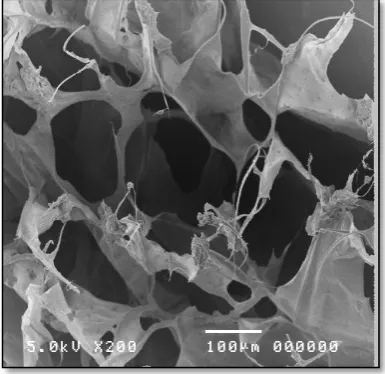
Figure 2 and 3 illustrate the morphology of the fabricated porous scaffold. The morphology of this specimen significantly displays open pore structure with both micropores and macropores. An open pore structure is good for blood supply and cell attachment [12]. The pore size of
[image:3.595.45.545.50.698.2]Fig 1. XRD pattern of HA synthesized from mollusk shell
Fig. 1. Magnetization as a function of applied field. Note that “Fig.” is abbreviated. There is a period after the figure number, followed by two spaces. It is good practice to explain the significance of the figure in the caption.
TABLE I
EXPERIMENTAL DESIGN AND RESULTS OF CHITOSAN-GELATIN/HA POROUS SCAFFOLD
Chitosan-Gelatin concentration (%w/w)
HA (%w/w)
1% Acetic acid Solution (%w/w)
Biodegradability (%)
Porosity (%)
Swelling (%)
1.37 1.50 97.13 44.23 91.46 93.24
3.13 2.50 94.37 20.87 89.37 94.32
2.30 2.00 95.70 23.94 92.59 93.10
0.50 1.00 98.50 56.32 94.65 90.76
4.00 3.00 93.00 18.12 88.56 94.15
1.37 1.50 97.13 43.52 91.42 92.45
0.50 3.00 96.50 31.22 90.15 80.45
4.00 1.00 95.00 35.50 92.84 96.88
4.00 3.00 93.00 17.65 88.76 94.23
3.13 1.50 95.37 38.45 91.95 95.66
1.37 2.50 96.13 28.78 89.88 89.66
0.50 3.00 96.50 30.84 90.15 81.89
1.37 2.50 96.13 28.64 89.84 88.35
3.13 2.50 94.37 21.06 89.59 94.48
0.50 1.00 98.50 55.96 94.55 89.74
3.13 1.50 95.37 38.45 91.74 95.45
2.30 2.00 95.70 24.82 91.86 92.95
[image:3.595.43.552.51.315.2] [image:3.595.55.534.361.695.2]the chitosan-gelatin/HA composite scaffold varied from 50 to 350 µm, as measured by SEM. With increasing concentration of chitosan-gelatin, the pore size decreased, which is in accordance with a previous report [21] and ASTM F2450-10.
Fig 2. Porous scaffold specimen
Fig 3. Porous scaffold composite with an open pore structure
IV. CONCLUSION
This study sought to identify a proper mixing ratio between chitosan, gelatin and HA for developing porous bone scaffold that could yield appropriate biodegradability, porosity and swelling properties for bone grafting based on bone tissue engineering technique. The results showed that degradability of scaffold was decreased with increasing chitosan-gelatin and HA concentrations. Porosity increased with decreasing chitosan-gelatin and HA concentrations. Swelling increased with increasing chitosan-gelatin and decreasing HA concentrations. The optimal condition was obtained from the scaffold with a chitosan-gelatin:HA:1% acetic acid ratio of 2.62:2.17:95.21. Furthermore, SEM technique showed an open pore structure of scaffolds – appropriate for blood supply and cell attachment. The porous bone scaffold mix developed here could be a promising bone substitute for bone grafting in the near future.
ACKNOWLEDGMENT
The authors are grateful to the Design and Development of Advance Manufacturing Research Unit, Department of Industrial Engineering as well as the Biomedical Engineering Center, Faculty of Engineering, Chiang Mai University for their facilities and financial support.
REFERENCES
[1] O. Gauthier, R. Müller, D.V. Stechow, B. Lamy, P. Weiss, J.M. Bouler, E. Aguado and G. Daculsi, “In vivo bone regeneration with injectable calcium phosphate biomaterial: A three-dimensional micro-computed tomographic, biomechanical and SEM study,” Biomaterials, vol. 26, no. 27, 2005, pp. 5444-5453.
[2] M. Mehta, K. Schmidt-Bleek, G.N. Duda, and D.J. Mooney, “Biomaterial delivery of morphogens to mimic the natural healing cascade in bone,” Advanced Drug Delivery Reviews, vol. 64, Dec. 2012, pp. 1257-1276.
[3] J. Venkatesan, Z.J. Qian, B. Ryu, K.N. Ashok, S.K. Kim, “Preparation and characterization of carbon nanotube-grafted-chitosan-Natural hydroxyapatite composite for bone tissue engineering,” Carbohydrate Polymers, vol. 83, no. 2, 2011, pp. 569-77.
[4] N.A.M. Barakat, M.S. Khil, A.M. Omran, F.A. Sheikh, H.Y. Kim, “Extraction of pure natural hydroxyapatite from the bovine bones bio waste by three different methods,” Journal of Materials Processing Technology, vol. 209, no. 7, 2009, pp. 3408-15.
[5] K.S. Vecchio, X. Zhang, J.B. Massie, M. Wang, C.W. Kim, “Conversion of bulk seashells to biocompatible hydroxyapatite for bone implants,” Acta Biomaterialia, vol. 3, no. 6, 2007, pp. 910-8. [6] X. Wang, J.S. Nyman, X. Dong, H. Leng, M. Reyes, Fundamental
Biomechanics in Bone Tissue Engineering. Morgan & Claypool,
2010.
[7] X. Cai, H. Tong, X. Shen, W. Chen, J. Yan, J. Hu, “Preparation and characterization of homogeneous chitosan-polylactic acid/ hydroxyapatite nanocomposite for bone tissue engineering and evaluation of its mechanical properties,” Acta Biomaterialia, vo. 5, no. 7, 2009, pp. 2693-703.
[8] N. Vachiraroj, J. Ratanavaraporn, S. Damrongsakkul, R. Pichyangkura, T. Banaprasert, S. Kanokpanont, “A comparison of Thai silk fibroin-based and chitosan-based materials on in vitro biocompatibility for bone substitutes,” International Journal of Biological Macromolecules, vol. 45, no. 5, 2009, pp. 470-7. [9] W.W. Thein-Han, R.D.K. Misra, “Biomimetic
chitosan-nanohydroxyapatite composite scaffolds for bone tissue engineering,” Acta Biomaterialia, vol. 5, no. 4, 2009, pp. 1182-97.
[10] Z. Li, H.R. Ramay, K.D. Hauch, D. Xiao, M. Zhang, “Chitosan-alginate hybrid scaffolds for bone tissue engineering,” Biomaterials vol. 26, no.18, 2005, pp. 3919-28.
[11] S. Panzavolta, M. Fini, A. Nicoletti, B. Bracci, K. Rubini, R. Giardino, et al., “Porous composite scaffolds based on gelatin and partially hydrolyzed α-tricalcium phosphate,” Acta Biomaterialia, vol. 5, no. 2, 2009, pp. 636-43.
[12] H.W. Kim, H.E. Kim, V. Salih, “Stimulation of osteoblast responses to biomimetic nanocomposites of gelatin-hydroxyapatite for tissue engineering scaffolds,” Biomaterials, vol. 26, no. 25, 2005, pp. 5221-30.
[13] K.S. Vecchio, X. Zhang, J.B. Massie, M. Wang, C.W. Kim, “Conversion of bulk seashell to biocompatible hydroxyapatite for bone implants,” Acta Biomaterialia, vol. 3, 2007, pp. 910-8. [14] N.A.M. Barakat, K.A., Khalil, F.A. Sheikh, A.M. Omran, B. Gaihre,
S.M. Khil, H.Y. Kim, “Physiochemical characterization of hydroxyapatite extracted from bovine bones by three different methods: Extraction of biologically desirable Hap,” Materials Science and Engineering C, vol. 28, 2008, pp. 1381-7.
[15] F. Baino, E. Verné, C. Vitale-Brovarone, “3-D high-strength glass ceramic scaffolds containing fluoroapatite for load-bearing bone portions replacement,” Materials Science and Engineering, vol. 29, no. 6, 2009, pp. 2055-62.
[16] V. Cannillo, F. Chiellini, P. Fabbri, A. Sola, “Production of Bioglass® 45S5-Polycaprolactone composite scaffolds via salt-leaching,” Composite Structures, vol. 92, no. 8, 2010, pp. 1823-32. [17] F. Zhao, W.L. Grayson, T. Ma, B. Bunnell, W.W. Lu, “Effects of
hydroxyapatite in 3-D chitosan-gelatin polymer network on human mesenchymal stem cell construct development,” Biomaterials, vol. 27, no. 9, 2006, pp. 1859-67.
ISBN: 978-988-19253-3-6
[image:4.595.71.264.306.493.2][18] T. Sukhachiradet and W. Wattanutchariya, “Preparation and Characterization of Fibroin/Chitosan/Hydroxyapatite Porous Scaffold,” Advanced Materials Research, vol. 849, 2 4, pp. 5 -156. [19] M. Peter, N. Ganesh, N. Selvamurugan, S.V. Nair, T. Furuike, H. Tamura, R. Jayakumar, “Preparation and characterization of chitosan-gelatin/nanohydroxyapatite composite scaffolds for tissue engineering applications,” Carbohydrate Polymers, vol. 8, no. 3, 2010, pp. 687-94. [20] H. Shahoon , Z. Yadegari , N. Valaie , S. Farhadi and R. Hamedi, “Evaluation of Hydroxyapatite Nanoparticles, Biocompatibility at Different Concentrations on the Human Peripheral Blood Mononuclear Cells: An in vitro Study,” Research Journal of Biological Sciences, vol. 5, no. 12, 2010, pp. 764-8.