Abstract—Nowadays environmental sustainability is a major concern to companies that operates in a global scale as it contributes to companies’ reputation, stakeholder value and avoiding the risk of being to illustrate a rational function on sustainability pushing manufacturing industries to extend their focus beyond conventional financial goals to the triple bottom line technique that concurrently embraces the environmental, social and economic domains. Work on recycling mostly indirectly has been done in South Africa as compared to sustainable supply chain and reverse logistics. The author reviewed literature mostly on the drivers and enablers of SSCM. The author used explanatory research to find the drivers and enablers. 50 research articles mainly from Taylor and Francis are reviewed to get the selected 10 drivers of the enterprise development. The study used the Total Interpretive Structural Method (TISM) to develop the integrated framework using the elements of reverse logistics, sustainable supply chain and enterprise development. Data was analyzed and recommendations and conclusions were drawn.
Index Terms— MIMAC analysis, Reverse logistic, SSCM, and TISM
I. INTRODUCTION
90% of Walmart’s total emissions related to its supply chain operations and 2500 largest global companies makes about 20% of greenhouse gases emissions were their supply chains are responsible for a major proportion of emissions resulting from corporate operations due to globalization and complexity of goods and services distribution channels, [1]. nowadays with increasing concern about environmental sustainability is a major concern to companies that operates in a global scale as it contributes to companies’ reputation, stakeholder value and avoiding the risk of being to illustrate a rational function on sustainability pushing manufacturing industries to extend their focus beyond conventional financial goals to the triple bottom line technique that concurrently embraces the environmental, social and
Manuscript received March 03, 2017; revised April, 05, 2017.
Sebonkile C Thaba is with the University of Johannesburg; (email, [email protected]. phone: 0027115591536).
economic domains, [2]. Solid waste and gas emission are generated through different activities which then results in social challenges and environmental problems pushing the firms to engage in social responsible practices, [3].
Many companies in South Africa have done progressive work on recycling mostly indirectly as compared to sustainable supply chain and reverse logistics. Big companies like Nampak are supporting recovery action group (RAG) which is the body of different recycling companies. For this big companies especially the once in packaging working with paper, glass and plastic, through rag they are able to use the resources such as CSR and CSI to ensure they are playing a role is making the environment clean. This is very necessary for the bigger companies which have contacts with the end customers to play a role. The focal companies should take superior roles and responsibility in environmental and social criteria for final goods and services and production of process set and implemented as at most time the focal companies engages with the suppliers and assists in improving their business model, [4]. With South Africa such relationships exist due to government
Mandates on enterprise and enterprise development (ESD [5] but is still a challenges because such relationship still need strong business model and the fact is that a lot of waste is still deposited to the landfill due to the current method of collecting waste, while SSCM and reverse logistic can plan a role in saving the landfill spaces. The true of the matter is that with effective and efficient reverse logistics and sustainable supply chain which also covers part of recycling South African companies can reap the benefits of utilizing the two. Many organizations are starting to realize that reverse logistics is very crucial and can be very cost effective while delivering significantly added value for the organization brand’s customers when implemented correctly resulting in return on investment (ROI) and differentiating organizations from rivals while winning customer loyalty, [6]. There is a need for organizations to know the drivers that enable SSCM. As the enablers will be a starting point for organizations to work towards insuring the implementation of SSCM enablers. This study is based on identifying the enablers of SSCM within organizations.
Drivers of Sustainable Supply Chain
Management in South Africa a Total Interpretive
Structural Method (TISM) Based Review
II. SUSTAINABLESUPPLYCHAINMANAGEMENT “The strategic, transparent integration and achievement of an organization’s social, environmental and economic goals in the systemic coordination of key inter-organizational business processes for improving the long-term economic performance of the individual company and its suppliers [and customers]”. Adoption of SSCM recently have started with the manufacturing companies within the emerging economies with the aim of taking responsibility in sustainable development bearing in mind that achieving sustainable production will be a major challenge to such companies operating in developing countries as it might have serious financial complication [8].
III. DRIVERS OF SUSTAINABLE SUPPLY CHAINS.
A. Regulatory Measures
The sustainable supply chain changes from wanting to go green as a burden to a going green as a competitive advantage due to exchange of burden, [9]. In china industries remanufacturing is still emerging remanufacturing, experiencing of profit and the introduction of such policies from the Policy orientation and developed countries urge some firms to take part, [10]. In most developing countries the solid waste management is a primary function of the local municipality then there is a need for an indicator to measure the success and effectiveness of proper handling and disposal within the local authority system is functioning, [11]. Municipal solid waste (MSW) in developing countries is the type of waste that is generated by domestic, business, and production activities by natural individuals and it is managed and handled through local municipalities [12], [13], [14]. B. Collaborative Driver
One of the reflected goals of the organization needs to be increasing cooperation within supply chain management, in order to reach sustainable goals, [15]. Multi-disciplinary collaborations can be achieved in an innovative manner within supply chain players, by managing the collaborations and relationships, through firms’ defined operative governing mechanisms [16]. The firm’s settings ensures strong relationships and collaboration with their suppliers helping with development and adoption of technologies that are environmentally friendly, [7]. The green buying ensures the environmental friendly collaboration were supplier’s logistic activities and technologies incorporates the improvement of new merchandise and the advent of greater new environmental friendly manufacturing traces, [17]. The aims of sustainable supply chain management are to facilitate the flow of materials through integration and collaboration developments among supply chain parties, [16]. Despite the networks of complex global supply chain, achieving the goals of SSCM needs the decision making of the team involved in interrelationships and cooperation in the supply chain entities. In particular, effective and efficient supply chain relationships and sustainable collaborations can enhance the overall sustainable performance. In collaboration with suppliers in procuring
materials and services, this is happening in most large manufacturing firms ensuring a sustainable environment [7].
C. Corporate Strategy and Commitment
Authorities and policies of the ruling party affect sustainability practices, [7]. The can reduce or increase opportunism and reduce direct clashes and completion, thus improving sustainability performance. As such organizations need to have a good and clear picture of government strategy and policy.
D. Environmental Performance
The environmental overall performance relates the corporations’ capability to condense air emissions, liquid waste or sewage discharged, and solid wastes to lower intake of dangerous and poisonous materials, [7].
E. Sustainable Design
Through facilitation of recycling, reuse and recovery of component parts and material, manufacturing firms needs to design technologies that reduce the consumption of energy and materials that are non-renewable and hazardous products in their manufacturing processes.
F. Cost Performance
Manufacturing plants need to be in a position where costs related to purchased materials, energy usage, liquid waste or sewage discharged, and fines for environmental accident are effectively and efficiently managed [7]
G. Stakeholders
For organisations to achieve the sustainable developments, supply chain needs to be viewed as a complex system, that needs to be effectively and efficiently managed through collaborating stakeholders such as other firms, communities and government as the group addresses the life-cycle perspectives together, [27].
IV. REVERSELOGISTICS
The logistic management exercises cannot be constrained by just direct stream additionally need to consider exercises which includes reverse logistics stream, [21].
SSCM is concerned with material, capital flows, information and data management, is also the collaboration and integration among different supply chain firms working towards achieving the three drivers of sustainable transport namely economic, environmental and social factors for ensuring that both customer and stakeholder requirements are met, [1]. The goal does not differ from the reverse logistics as is the process of planning, organizing, executing, and monitoring the efficient and cost effective of unprocessed, and in-processed materials also the finished products from their last mile to the point of origin, while also ensuring proper disposal and value recapturing, [20]. Reverse logistics is the process of retrieve used product from a customer and for disposal, reuse and recycle of products, [18]. The purpose of reverse logistics is the recovery value or proper disposal, [19].
The main challenges faced by organisation with RL is management of customer expectations in terms of return policy, educating customers and establish new points of contact with customers, outsourcing and partnering with other organisations, [19],[20] . Added process costs and RL needs to be more improved investigated by companies, [21] further states that the challenge is lack of relevant research studies and company discussions within the RL area and this results in obstacles mastering and implementing RL advantages. Companies such as such as Kodak, Fuji Film, Hewlett-Packard, IBM Europe, Xerox and Dell has voluntarily partaken in the recovery of their products from the end user. Organizations such as General Motors, Canon, Dell, and Hewlett-Packard and Kodak benefited from reverse logistic activities, [23].
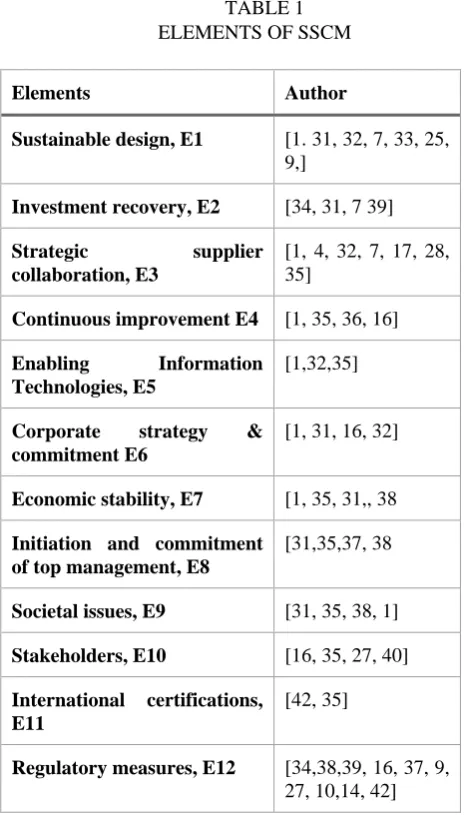
Reverse logistics is a process whereby firms can become more environmentally responsible through recycling, reusing and reducing the amount of materials used in the forward system, [23]. Elements in Table 1 are the drivers or the enablers of
To improve brand image, sustainable competitive advantage, and effective and efficient resources usage, increased customer satisfaction and profitability organization works towards a common goal through SSCM. Various business strategies are employed within organizations to implement SSCM and RL. Companies implementing RL and SSCM initiatives adopt the programs with the aim of getting the economic benefits that are related to the returned products, [24].
V. LINKINGTHEDRIVERS(THEORETICALLY) Globally a large wide variety of industries are working towards remanufacturing, [25]. As stated by the Centre for Remanufacturing and Reuse (CRR), in Volkswagen each 12 months 15,000 engines are reconditioned, reusing 70% of the fabric at 1/2 the fee as compared to the brand new. Hence, remanufacturing is not only a financial possible solution, but also positively contributing to the environment
via maintaining resources. The importance of RL and SSCM within focal enterprises is that businesses in nowadays enterprise environment are increasingly under strain to minimize the variety of incidents with reference to the social dimension on the supply chain level that can damage their popularity, [26]. Companies operating in South Africa have several legislation and policies that are binding them to ensure successful focal enterprises. Supporting in a form of doing business locally with the SMEs. Sustainability projects, are no longer pressured by way of future guidelines to change their supply chain structure, leading to competitive benefits for local organizations, [26]
VI. RESEARCHMETHODOLOGY
The explanatory research was used to find them. Research articles, government documents, books and conference papers are reviewed to get the total of 10 drivers The study is using the Total Interpretive Structural Method (TISM) to develop the integrated framework using the elements of reverse logistics, sustainable supply chain and enterprise development. Emphasizes that the TISM model process can be scaled-up to cover complicated and complex different modelling situations requirements and complex structures with multiple elements types and with one or multiple types of contextual relationship.
The study is conducted using the total interpretive structural method (TISM). To analysis the elements of sustainable supply chain management, is to first identify the drivers or enablers of SSCM. TISM approach is used to develop integrated relationship of the enablers of SSCM TISM applied in forming structural model which represent the interpretation of connections between involving factors, [8],
VII. DATA ANALYSIS
This study makes use of the TISM methodology. The TISM is an interactive learning process which assists with improving the order and direction relationships within a very complex system of variables [29]. With selected variables, the sets are different and related variables that affect the system under consideration are structured into a comprehensive systemic model. With TISM model is formed to represent the issues complexity of the structure, the system’s field of study and employing designed graphic patterns and words, [24], [30].
The TISM technique follows a systematic methodology. The various steps involved in Interpretive Structural Model (ISM) technique were 12 identified drivers are applied to from SSCM (or variables) and are explained as follows
I. The 12 variables are numbered and listed and are numbered as drivers 1-12 in Table I. These variables were identified through the literature review and discussions with the experts in the relevant area.
V-Enabler I will help to achieve enabler j A-Enabler j will help to achieve enabler i
[image:4.595.302.551.80.245.2]X-Enabler i and j will help to achieve each other, and O-Enabler i and j are unrelated
TABLE 1 ELEMENTS OF SSCM
Elements Author
Sustainable design, E1 [1. 31, 32, 7, 33, 25, 9,]
Investment recovery, E2 [34, 31, 7 39] Strategic supplier
collaboration, E3
[1, 4, 32, 7, 17, 28, 35]
Continuous improvement E4 [1, 35, 36, 16] Enabling Information
Technologies, E5
[1,32,35]
Corporate strategy & commitment E6
[1, 31, 16, 32]
Economic stability, E7 [1, 35, 31,, 38 Initiation and commitment
of top management, E8
[31,35,37, 38
Societal issues, E9 [31, 35, 38, 1] Stakeholders, E10 [16, 35, 27, 40] International certifications,
E11
[42, 35]
[image:4.595.41.276.159.567.2]Regulatory measures, E12 [34,38,39, 16, 37, 9, 27, 10,14, 42]
TABLE 2. STRUCTURAL SELF-INTERACTION MATRIX (SSIM)
E12 E11 E10 E9 E8 E7 E6 E5 E4 E3 E2
E1 X X A V A V A X A X V
E2 A 0 0 V A X A A X A
E3 A X V A V A A A X
E4 A V X V A X A A
E5 X O V V A O A
E6 V V V V X V
E7 A A A V A
E8 V V X V
E9 A A A
E10 X X
E11 X
TABLE 3. INITIAL REACHABILITY MATRIX
Reachability matrix is a pair relationship were drivers of the system obtained in step 2, through structural self-interaction matrix of the drivers was developed in Table 3
[image:4.595.303.550.392.528.2]On the basis of a pair-wise relationship between the drivers of the system as obtained from step-2, a structural self-interaction matrix (SSIM) is developed for the drivers as shown in Table 3.
TABLE 4 FINAL REACHABILITY MATRIX
Reachability matrix is obtained after the completion the requirements of transitivity, and this is based on relationships obtained in Table 4 as is for level partitioning. Through comparisons of reachability and antecedent variable sets.
TABLE 5 ITERATION I
TABLE 6 ITERATION II
TABLE 7 ITERATION III
TABLE 8 ITERATION IV
TABLE 9 ITERATION V
TABLE 10 ITERATION VI
TABLE 11 ITERATION VII
TABLE 12 ITERATION VIII
TABLE 13 ITERATION X
MICMAC Analysis: enablers or variables are sorted according to their dependence and driving power. There is a clusters for the enabler’s namely linkage, autonomous, dependent, and independent. Table 14 which is a summary for the levels of enablers form Table 5 to 13. Figure three is a MICMAC graph that shows the driving powers of the enablers vertically and the dependence horizontally.
Autonomous Variable: it indicates a weak driving and dependence enabler. Such an enabler can be isolated from the process or be able to implement without it
Linkage Variable: it indicates a strong driving and dependence enabler
Dependent Variable: it indicates a weak driving and strong dependence enabler. Such enabler have little guidance in terms of power. The implementation of the process depend strongly on dependent enablers
Independent Variable: it indicates a strong driving power and a weak dependence. Such enablers with have little integration with other enablers and the process of implementing the enables
[image:6.595.48.557.333.791.2]Fig. 1 Graph of MICMAC Analysis
Table 15: Independent and dependent variables
Cluster IV : Independent Enablers
E10 E12 E11
E9 E8
Cluster III: Linkage Enablers
E6 E7 E5 E1
E3 E4 E2
Cluster I: Autonomous Enablers
Cluster II: Dependent Enablers
In this study the enablers are scattered between Cluster IV which is independent variable and Cluster I which is Autonomous variable. Cluster IV consist of the following elements: Initiation and commitment of top management, E8, Societal issues, E9, Stakeholders, E10 International certifications, E11 and Regulatory measures, E12. This elements has a strong driving power on the implementation of SSCM within organisations. But each of the enabler has a very weak dependence which means they depend on each other. While enablers which are autonomous: Sustainable
design, E1, Investment recovery, E2, Strategic supplier collaboration, E3, Continuous improvement E4, Enabling Information Technologies, E5. Corporate strategy & commitment E6 and Economic stability, E7. It means they are very weak in dependence and also very weak in enabling, lastly the enablers or this elements are disconnected
VIII. CONCLUSION
The enabler/drivers of SSCM are those element an organisation can implement individually to work towards the SSCM. None of the drivers’ depend on the other if they are to be implemented, which gives an organisation an opportunity to can implement each element whenever the organisation can without having to wait for the completion of the other element. As this elements are taken from literature then all are every essential if the organisation is to be successful with the SSCM. THE future study can be based on reviewing more literature and selecting elements specifically to a certain organisation. This will help each organisation to know elements that are more appropriate in implementing SSCM within an organisation.
REFERENCES
[1] Dubey, R., Gunasekaran, A., Papadopoulos, T., Childe, S. J., Shibin,
K. T., & Wamba, S. F. (2016). Sustainable supply chain management: framework and further research directions. Journal of Cleaner Production.
[2] Erdoğan, S. and Miller-Hooks, E., 2012. A green vehicle routing
problem. Transportation Research Part E: Logistics and
Transportation Review, 48(1), pp.100-114.
[3] Luthra, S. Garg, D., and Haleem, A. (2016), The impacts of critical success factors for implementing green supply chain management towards sustainability: an empirical investigation of Indian automobile industry, Journal of Cleaner Production 121 (2016) 142e158
[4] Seuring, S. (2012), A review of modeling approaches for sustainable
supply chain management, 54 (2013) 1513–1520
[5] The DTI (2012), Amemded Broad Based Black Economic
Empowerment Codes of Good Practice, the Department of Trade and
Industry (DTI), Available via;
https://www.thedti.gov.za/economic_empowerment/docs/bee_launch. pdf
[6] Badenhorst, A., & Nel, J. D. (2012). Identifying potential solutions for specific reverse logistics problems. Journal of Transport and Supply Chain Management, 6(1), 73-90.
[7] Esfahbodi, A., Zhang, Y., & Watson, G. (2016). Sustainable supply
chain management in emerging economies: Trade-offs between environmental and cost performance. International Journal of Production Economics.
[8] Mangla, S.K., Kumar, P. and Barua, M.K., 2014. Flexible decision
approach for analysing performance of sustainable supply chains under risks/uncertainty. Global Journal of Flexible Systems Management, 15(2), pp.113-130.
[9] eskvastava, S.K., 2007. Green supply‐chain management: a
state‐of‐the‐art literature review. International journal of management reviews, 9(1), pp.53-80.
[10] Zhang, J.H., Yang, B. and Chen, M., 2016. Challenges of the
development for automotive parts remanufacturing in China. Journal of Cleaner Production.
[11] Mohee, R. and Bundhoo, M.A.Z., 2015. A Comparative Analysis of
Future Directions of Municipal Solid Waste Management in Africa, p.6.
[12] Karak, T., Bhagat, R.M. and Bhattacharyya, P., 2013. Municipal Solid
Waste Generation, Composition, and Management: The World Scenario. Critical Reviews in Environmental Science and Technology, 43(2), pp.215-215.
[13] Ngadiman, I.N., Moeinaddini, M., Ghazali, J.B. and Binti Roslan,
N.F., 2016. Reverse Logistics in Food Industries: A Case Study in Malaysia. International Journal of Supply Chain Management, 5(3), pp.91-95.
[14] Mohee, R. and Simelane, T. eds., 2015. Future directions of municipal
solid waste management in Africa. Africa Institute of South Africa.pp1.
[15] Seuring, S. (2011). Supply chain management for sustainable
products–insights from research applying mixed methodologies. Business Strategy and the Environment, 20(7), 471-484.
[16] Govindan K, Embedding Sustainability Dynamics in Supply Chain
Relationship Management and Governance Structures: Introduction, Review and opportunities, Journal of Cleaner Production (2016), doi: 10.1016/j.jclepro.2015.11.036
[17] Leigh, M. and Li, X., 2015. Industrial ecology, industrial symbiosis and supplychain environmental sustainability: a case study of a large UK distributor. Journal of Cleaner Production, 106, pp.632-643.
[18] Guide, Jr. V.D.R., and Wassenhove, L.N. Van Wassenhove, (2002).
The Reverse Supply Chain, Sustainability, Harvard Business Review.
[19] Cognizant, (2011), Reverse Supply Chain: Completing the Supply
Chain Loop, Cognizant, Available via:
[20] Hawks, K., (2006), What is Reverse Logistics, Reverse Logistics
Magazine, VP Supply Chain Practice, Navesink, available via:
http://www.rlmagazine.com/edition01p12.php, Last accessed
08/04/2016
[21] Gonçalves, M.F. and Silva, Â.E., 2016. REVERSE LOGISTICS: THE
PORTUGUESE COMPANIES'PERSPECTIVE. Brazilian Journal of Operations & Production Management, 13(3), pp.330-337.
[22] Yuan, K.F., Ma, S.H., He, B. and Gao, Y., 2015. Inventory
decision-making models for a closed-loop supply chain system with different decision-making structures. International Journal of Production Research, 53(1), pp.183-219.
[23] Agrawal, S., Singh, R.K. and Murtaza, Q., 2015. A literature review and perspectives in reverse logistics. Resources, Conservation and Recycling, 97, pp.76-92.
[24] Ravi, V. and Shankar, R., 2015. Survey of reverse logistics practices
in manufacturing industries: an Indian context. Benchmarking: An International Journal, 22(5), pp.874-899.
[25] Sharma, V., Garg, S.K. and Sharma, P.B., 2016. Identification of
major drivers and roadblocks for remanufacturing in India. Journal of Cleaner Production, 112, pp.1882-1892.
[26] Veiga, M.M., 2013. Analysis of efficiency of waste reverse logistics for recycling. Waste Management & Research, 31(10 suppl), pp.26-34.
[27] Eskandarpour, M., Dejax, P., Miemczyk, J. and Péton, O., 2015.
Sustainable supply chain network design: an optimization-oriented review. Omega, 54, pp.11-32.
[28] Govindan, K., Soleimani, H. and Kannan, D., 2015. Reverse logistics
and closed-loop supply chain: A comprehensive review to explore the future. European Journal of Operational Research, 240(3), pp.603-626.
[29] Seuring, S., and Müller, M. (2008). From a literature review to a conceptualframework for sustainable supply chain management. Journal of cleaner production, 16(15), 1699-1710.
[30] Kedia, P.K., 2013, July. Total interpretive structural modelling of strategic technology management in automobile industry. In 2013 Proceedings of PICMET'13: Technology Management in the IT-Driven Services (PICMET) (pp. 62-71). IEEE.
[31] Luthra, S. Garg, D., and Haleem, A. (2015), An analysis of
interactions among critical success factors to implement green supply chain management towards sustainability: An Indian perspective, Journal of Resource Policy, 46(2015)37–50
[32] Malviya, R.K. and Kant, R., 2016. Hybrid decision making approach
to predict and measure the success possibility of green supply chain management implementation. Journal of Cleaner Production, 135, pp.387-409.
[33] Varsei, M., 2016. Sustainable supply chain management: A brief
literature review. The Journal of Developing Areas, 50(6), pp.411-419.
[34] Luthra, S. and Haleem, A., 2015. Hurdles in implementing sustainable
supply chain management: An analysis of Indian automobile sector. Procedia-Social and Behavioral Sciences, 189, pp.175-183.
[35] Hussain, M., Awasthi, A. and Tiwari, M.K., 2016. Interpretive
structural modeling-analytic network process integrated framework for evaluating sustainable supply chain management alternatives. Applied Mathematical Modelling, 40(5), pp.3671-3687.
[36] Tramarico, C.L., Salomon, V.A.P. and Marins, F.A.S., 2016.
Multi-criteria assessment of the benefits of a supply chain management training considering green issues. Journal of Cleaner Production.
[37] Nishat Faisal, M., 2010. Sustainable supply chains: a study of
interaction among the enablers. Business Process Management Journal, 16(3), pp.508-529.
[38] Luthra, S. Garg, D., and Haleem, A. (2016), The impacts of critical success factors for implementing green supply chain management towards sustainability: an empirical investigation of Indian automobile industry, Journal of Cleaner Production 121 (2016) 142e158
[39] 1Luthra, S. Garg, D., and Haleem, A. (2015), An analysis of
interactions among critical success factors to implement green supply chain management towards sustainability: An Indian perspective, Journal of Resource Policy, 46(2015)37–50
[40] Beske, P., Land, A. and Seuring, S., 2014. Sustainable supply chain management practices and dynamic capabilities in the food industry: A critical analysis of the literature. International Journal of Production Economics, 152, pp.131-143.
[41] Mani, V., Agrawal, R. and Sharma, V., 2015. Social sustainability in
the supplychain: Analysis of enablers. Management Research Review, 38(9), pp.1016-1042.
[42] Kumar, N.R. and Kumar, R.M., 2013. Closed Loop Supply Chain
Management and Reverse Logistics-A Literature Review.