warwick.ac.uk/lib-publications
A Thesis Submitted for the Degree of PhD at the University of Warwick
Permanent WRAP URL:
http://wrap.warwick.ac.uk/78677
Copyright and reuse:
This thesis is made available online and is protected by original copyright.
Please scroll down to view the document itself.
Please refer to the repository record for this item for information to help you to cite it.
Our policy information is available from the repository home page.
M A E
G NS
I
T A T
MOLEM
U N
IVER
SITAS WARWICEN
SIS
Performance Modelling and Optimisation of
Inertial Confinement Fusion Simulation Codes
by
Robert Francis Bird
A thesis submitted to The University of Warwick
in partial fulfillment of the requirements
for admission to the degree of
Doctor of Philosophy
Department of Computer Science
The University of Warwick
Abstract
Legacy code performance has failed to keep up with that of modern hardware.
Many new hardware features remain under-utilised, with the majority of code
bases still unable to make use of accelerated or heterogeneous architectures.
Code maintainers now accept that they can no longer rely solely on hardware
improvements to drive code performance, and that changes at the software
en-gineering level need to be made.
The principal focus of the work presented in this thesis is an analysis of the
changes legacy Inertial Confinement Fusion (ICF) codes need to make in order to
efficiently use current and future parallel architectures. We discuss the process of
developing a performance model, and demonstrate the ability of such a model to
make accurate predictions about code performance for code variants on a range
of architectures. We build on the knowledge gained from such a process, and
examine how Particle-in-Cell (PIC) codes must change in order to move towards
the required levels of portable and future-proof performance needed to leverage
the capabilities of modern hardware. As part of this investigation, we present
an OpenCL port of the legacy code EPOCH, as well as a fully featured mini-app
representing EPOCH. Finally, as a direct consequence of these investigations,
we directly apply these performance optimisations to the production version
Acknowledgments
First and foremost, I would like to thank my supervisor, Professor Stephen
Jarvis, for all of his help and hard work over the past four years and for allowing
me the opportunity to undertake a Ph. D. as well as the opportunities a↵orded
as a consequence.
It is also my pleasure to acknowledge my colleagues, past and present, in
the High Performance and Scientific Computing group: Richard Bunt, Adam
Chester, Peter Coetzee, James Davis, Simon Hammond, Andrew Mallinson,
John Pennycook, Oliver Perks, and Steven Wright. I reserve special thanks for
David Beckingsale, there from the start and still there at the end of all things
(with hopefully many more to come!). I have also enjoyed the support of many
individuals within the Department of Computer Science, including Jane Clarke,
Richard Cunningham, Christine Leigh, Roger Packwood, Catherine Pillet, Gill
Reeves-Brown, and Paul Williamson. Thank you for all the help and support.
Finally, I would like to thank all those from my personal life who have
supported me over the past few years, especially my family: Mom, Dad, Gran,
Declarations
This thesis is submitted to the University of Warwick in support of the author’s
application for the degree of Doctor of Philosophy. It has been composed by the
author and has not been submitted in any previous application for any degree.
The work described in this thesis has been undertaken by the author, unless
otherwise stated.
Much of the work presented in this thesis has been published in peer reviewed
conferences, workshops and journals. Publication highlights include the
follow-ing works:
• [8] R. F. Bird, S. A. Wright, D. A. Beckingsale, and S. A. Jarvis.
Perfor-mance Modelling of Magnetohydrodynamics Codes. In: Lecture Notes in
Computer Science (LNCS), 7587:197-209, July 2013.
• [9] R. F. Bird, S. J. Pennycook, S. A. Wright, and S. A. Jarvis. Towards a
Portable and Future-proof Particle-in-Cell PlasmaPhysics Code. In: 1st
International Workshop on OpenCL (IWOCL 13), May 2013.
• [33] P. Gillies, N. J. Sircombe, R. F. Bird, S. J. Pennycook and S. A.
Jarvis. The challenges of porting the Particle-in-cell code EPOCH to new
architectures. In: JOWOG 34, Sandia National Laboratory, August 2013.
• [34] P. Gillies, N. J. Sircombe, and R. F. Bird. Particle in Cell Simulations
at AWE. In:JOWOG 34, Lawrence Livermore National Laboratory, April
2014.
• [10] R. F. Bird, P. Gillies, M. R. Bareford, and S. A. Jarvis. Mini-app
Driven Optimisation of Inertial Confinement Fusion Codes. In: IEEE
Cluster Workshop on Representative Applications (WRAp 2015),
In addition, research conducted during the period of registration has also led
to the following publications which, while not directly focused on Inertial
Con-finement Fusion simulation, have nevertheless shaped the research presented in
this thesis:
• [115] S. A. Wright, S. D. Hammond, S. J. Pennycook, R. F. Bird, J.
Herdman, I. Miller, A. Vadgama, A. Bhalerao, and S. A. Jarvis, Parallel
File System Analysis Through Application I/O Tracing. The Computer
Journal, 56 (2). pp. 141-155. ISSN 0010-4620, 2013
• [94] O. Perks, R. F. Bird, D. A. Beckingsale, and S. A. Jarvis, Exploiting
Spatiotemporal Locality for Fast Call Stack Traversal. In: Workshop on
High-performance Infrastructure for Scalable Tools, WHIST, Venice, 2012
• [19] E. Carrier, A. Reisner, K. Czuprynski, R. Pavel, P. Grosset, and
R. Bird, Evaluating Distributed Runtimes in the Context of Adaptive
Mesh Refinement. In: LANL Student Symposium, Los Alamos National
Laboratory, United States of America. LA-UR-14-25562, 2014.
• [86] R. Pavel, R. Bird, P. Grosset, K. Czuprynski, A. Reisner, E. Carrier,
C. Junghans, B. Bergen, and A. McPherson, Adaptive Mesh Refinement
under the Concurrent Collections Programming Model, In: The Sixth
Sponsorship and Grants
The research presented in this thesis was made possible by the support of the
following benefactors and sources:
• The EPSRC grant “A Radiation Hydrodynamic ALE Code for Laser
Fu-sion Energy” (EP/I029117/1)
• The UK Royal Society through their Industry Fellowship Scheme
(IF090020/AM).
• The AWE/Warwick Centre for Computational Plasma Physics
Additionally, I would like to thank all of the people who made the experimental
aspects of this research possible, including but not limited to: those at EPCC
who maintain ARCHER; those at the Open Compute Facility at Lawrence
Liv-ermore National Laboratory which provides access to Sierra; and those at the
Abbreviations
ALE Arbitrary Lagrangian-Eulerian
AoS Array-of-Structs
AoSoA Array-of-Structs-of-Arrays
ATAM Architecture Tradeo↵Analysis Method
AVX Advanced Vector Extensions
CFL Courant-Friedrichs-Lewy
CnC Concurrent Collections
CPU Central Processing Unit
CUDA Compute Unified Device Architecture
FDTD Finite-Di↵erence Time-Domain
FLOP/s Floating-Point Operations per Second
FMA Fused Multiply-Add
GB/s Gigabytes per Second
GFLOP/s Giga-Floating-Point Operations per Second
GHz Gigahertz
GPU Graphics Processing Unit
HPC High Performance Computing
ICF Inertial Confinement Fusion
LLNL Lawrence Livermore National Laboratory
LPI Laser-Plasma Interaction
MHD Magnetohydrodynamics
MIMD Multiple Instruction, Multiple Data
MISD Multiple Instruction, Single Data
MPI Message Passing Interface
NIF National Ignition Facility
NUMA Non-Uniform Memory Access
OpenCL Open Computing Language
PIC Particle-in-Cell
PFLOP/s Peta-Floating-Point Operations per Second
PPC Particle-Per-Cell
QED Quantum Electrodynamics
SDK Software Development Kit
SIMD Single Instruction, Multiple Data
SIMT Single Instruction, Multiple Thread
SISD Single Instruction, Single Data
SMT Simultaneous Multi-Threading
SoA Struct-of-Arrays
SPMD Single Program, Multiple Data
SSE Streaming SIMD extensions
TDP Thermal Design Power
VLIW Very Long Instruction Word
Contents
Abstract ii
Acknowledgments iii
Declarations iv
Sponsorship and Grants vi
Abbreviations vii
List of Figures xvi
List of Tables xviii
1 Introduction 1
1.1 Motivations . . . 4
1.2 Thesis Contributions . . . 5
1.3 Thesis Overview . . . 6
2 Performance Analysis and Modelling 9 2.1 The Laws of Parallel Computing . . . 9
2.1.1 Speedup . . . 9
2.1.2 Parallel Efficiency . . . 10
2.1.3 Amdahl’s Law . . . 10
2.1.4 Gustafson’s Law . . . 11
2.2 Benchmarking . . . 12
2.3 Profiling . . . 13
2.4 Representative Applications . . . 14
2.5 Performance Modelling . . . 16
Contents
2.5.2 Simulation . . . 19
2.5.3 Modelling Languages and Queuing Theory . . . 20
2.6 Summary . . . 21
3 Parallel Hardware and Programming Models 22 3.1 Flynn’s Taxonomy . . . 22
3.2 Moore’s Law . . . 24
3.3 Hardware Parallelism . . . 25
3.3.1 Instruction-Level Parallelism . . . 26
3.3.2 Vectorisation . . . 27
3.3.3 Multi-Threading . . . 28
3.3.4 Message Passing . . . 30
3.4 Performance Portability . . . 31
3.5 Benchmarking Platforms . . . 32
3.5.1 Single Nodes . . . 32
3.5.2 Supercomputers . . . 33
3.6 Summary . . . 34
4 Inertial Confinement Fusion Simulations 36 4.1 Motivation . . . 36
4.2 Background . . . 37
4.3 Lare . . . 40
4.3.1 Computational Overview . . . 41
4.4 EPOCH: Extendable PIC Open Collaboration . . . 43
4.4.1 Computational Overview . . . 44
4.5 Summary . . . 47
5 Performance Modelling of Magnetohydrodynamics Simulations 48 5.1 Development of a Performance Model . . . 49
5.1.1 Serial Model . . . 50
Contents
5.2 Validation . . . 53
5.2.1 Weak Scaled Problem . . . 53
5.2.2 Strong Scaled Problem . . . 54
5.3 Evaluation of Future Optimisations . . . 55
5.4 Summary . . . 57
6 Performance-Portable Plasma Physics Simulations 59 6.1 Background . . . 60
6.2 OpenCL Implementation . . . 62
6.2.1 Particle Move . . . 63
6.2.2 Field Calculation . . . 63
6.2.3 Current Accumulation . . . 65
6.3 Results . . . 66
6.3.1 E↵ects and Portability of Optimisations . . . 68
6.3.2 Hardware Comparison . . . 71
6.4 Summary . . . 72
7 Optimisation of Particle-in-Cell Simulations 74 7.1 Implementation and Optimisation . . . 76
7.1.1 Experimental Setup . . . 80
7.2 Results . . . 80
7.2.1 Vectorisation . . . 83
7.2.2 Memory Layout . . . 85
7.2.3 Parent Code Optimisation . . . 87
7.2.4 Particle-Per-Cell Scaling . . . 88
7.3 Summary . . . 91
8 Discussion and Conclusions 93 8.1 Limitations . . . 94
8.2 Implications . . . 95
Contents
8.3.1 Many-Core Investigation . . . 97
8.3.2 Single-Precision EPOCH Code Variant . . . 99
8.4 Final Remarks . . . 100
Bibliography 101
Appendices 116
A Performance-Portable Plasma Physics Simulations 117
B Optimisation of Inertial Confinement Fusion Simulations 119
List of Figures
1.1 Accelerated Supercomputing architecture from the perspective of
(a) Hardware; and (b) Data Movement. . . 2
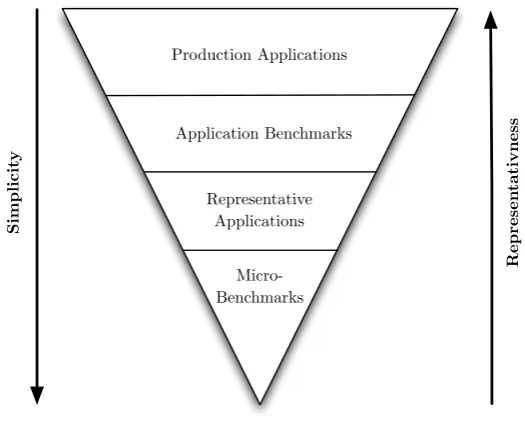
2.1 Representativeness and Simplicity of Application Scale. . . 15
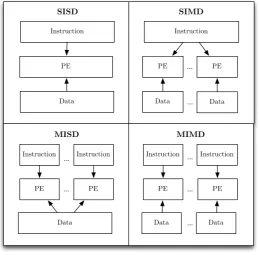
3.1 Flyyn’s Taxonomy, showing the application of parallel processing elements (PEs) to instructions and data. . . 23
3.2 Levels of parallelism in theory, hardware, and software. . . 25
3.3 Fork-Join Model for Thread-Level Parallelism. . . 29
3.4 OpenMP Pragma Example to Distribute Work. . . 29
4.1 A comparison of of-Structs, Struct-of-Arrays, and Array-of-Structs-of-Arrays data layouts. . . 38
4.2 The main compute loop of Lare, operated over for a fixed number of iterations. . . 41
4.3 Pseudocode depiction of EPOCH’s core PIC algorithm. . . 45
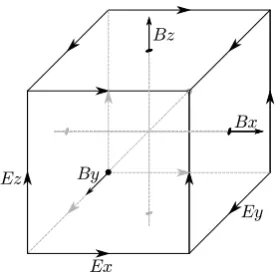
4.4 An example of a Yee staggered grid. . . 45
5.1 Code examples comparing original source code with its represen-tation in the model, including a wg based compute call and a SST/macro MPI call. . . 52
6.1 OpenCL Kernel code example. . . 64
6.2 Overhead introduced by atomic operations. . . 69
6.3 Impact of sorting schemes on kernel runtimes. . . 70
List of Figures
7.1 The duration of each time step in EPOCH as a simulation
pro-gresses. Each simulation window, of which there are 100 in total,
contains 100 steps. . . 76
7.2 A diagram depicting the particle sort implementation in the
con-text of the Yee grid rounding. . . 78
7.3 Pseudocode depiction of EPOCH’s modified PIC algorithm. . . . 79
7.4 Cache misses during a simulation consisting of 100 simulation
windows (each window containing 100 steps). . . 81
7.5 Normalised cache misses during a simulation consisting of 100
simulation windows (each window containing 100 steps). . . 81
7.6 Time-step duration for a simulation consisting of 100 simulation
windows (each window containing 100 steps). . . 82
7.7 SIMD scaling of miniEPOCH AoS kernels for 256-bit AVX,
128-bit AVX and for the code operating without vectorisation. . . 84
7.8 SIMD scaling of miniEPOCH SoA kernels for 256-bit AVX,
128-bit AVX and for the code operating without vectorisation. . . 84
7.9 Normalised instruction counts per kernel for di↵erent SIMD widths
for the SoA memory layout. . . 86
7.10 Kernel runtime for di↵erent data layouts. . . 87
7.11 Overall runtime for the original and optimised versions of EPOCH
for a 10,000 step run. The additionalsortcost is highlighted for
clarity. . . 88
7.12 The PPC time scaling of the original EPOCH code base and the
optimised mini-app. . . 90
7.13 The PPC instruction count scaling of the original EPOCH code
base, and the optimised mini-app. . . 90
8.1 A comparison of Intel Xeon Phi and CPU kernel performance
List of Figures
8.2 Push time comparison for the optimised versions of miniEPOCH
List of Tables
3.1 Hardware specifications of the CPUs used in this thesis. . . 33
3.2 Hardware specifications of the GPUs used in this thesis. . . 34
3.3 Hardware specifications ofSierra andMinerva. . . 34
3.4 Hardware specifications ofARCHER. . . 34
4.1 A profile of Lare runtime composition. . . 42
4.2 A profile of EPOCH runtime composition. . . 47
5.1 The grind times used in modeling Lare, including their relative location in the source code. . . 50
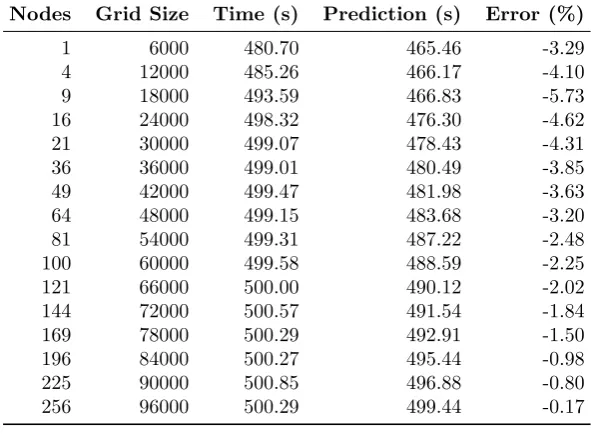
5.2 A comparison of the runtimes and simulation times of Lare on (a) Minerva and (b) Sierra for a weak scaled problem. . . 54
5.3 A comparison of the runtimes and simulation times for Lare on (a) Minerva and (b) Sierra for a strong scaled problem. . . 55
5.4 Percent decrease in runtime for di↵erent values ofFrandCremap new for a 8,192 square problem on 36 processors performing 100 iter-ations. . . 57
6.1 Comparison of execution times (in seconds) for di↵erent mutual exclusion approaches. . . 67
A.1 Overhead introduced by atomic operations. . . 117
A.2 Impact of st orting schemes on the Field Calculation kernel run-times. . . 117
A.3 Impact of sorting schemes on the Current Accumulation kernel runtimes. . . 117
List of Tables
B.1 Normalised Data for Original EPOCH timestep scaling. . . 119
B.2 Cache Miss Counts for Array based EPOCH. . . 121
B.3 Normalised Cache Miss Counts for Array based EPOCH. . . 123
B.4 Cache Miss Counts for Linked List based EPOCH. . . 126
B.5 Normalised Cache Miss Counts for Linked List based EPOCH. . 128
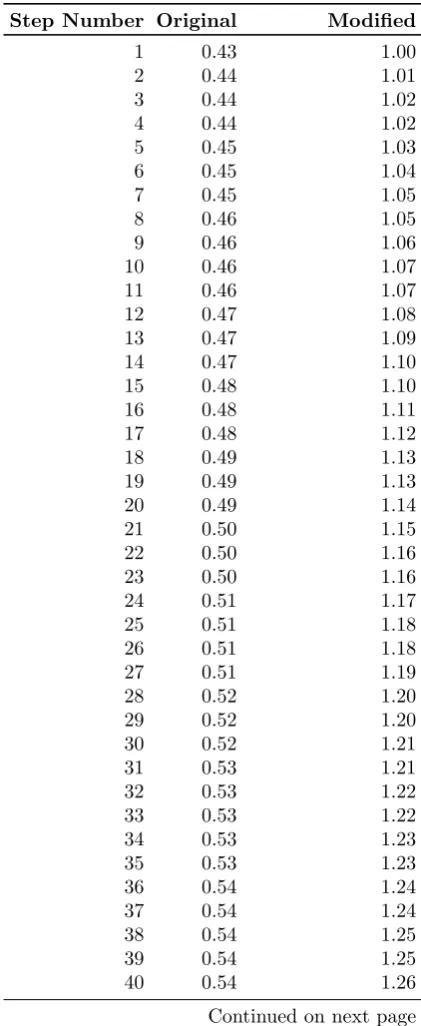
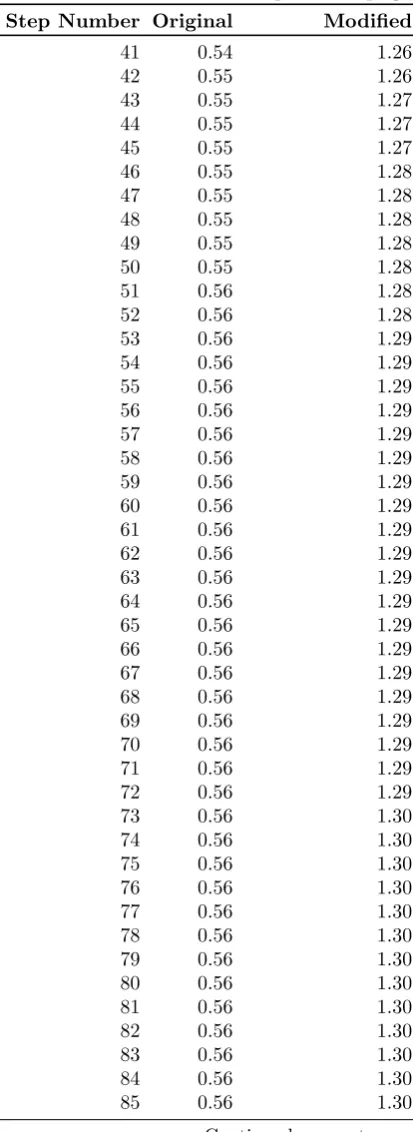
B.6 Data for Original and Modified EPOCH timestep scaling. . . 130
B.7 SIMD scaling of miniEPOCH AoS kernels for 256-bit AVX, 128-bit AVX and for the code operating without vectorisation. . . 133
B.8 SIMD scaling of miniEPOCH SoA kernels for 256-bit AVX, 128-bit AVX and for the code operating without vectorisation. . . 133
B.9 Normalised instruction counts per kernel for di↵erent SIMD widths for the SoA memory layout. . . 133
B.10 Kernel runtime for di↵erent data layouts. . . 134
B.11 Overall runtime for the original and optimised versions of EPOCH for a 10,000 step run. . . 134
B.12 Particle Per Cell Scaling of EPOCH and miniEPOCH. . . 134
B.13 Counts for the number of instructions executed during particle per cell scaling. . . 134
C.1 Kernel Performance of Intel Xeon Phi and Comparable CPU. . . 135
CHAPTER
1
Introduction
Computational experimentation is a vital tool of modern scientific investigation.
It allows for full-resolution reproduction of real world phenomena, including
events which cannot be investigated closely enough through observation alone.
The computational simulation of such events o↵ers a safe and practical method
to perform initial scientific investigation, even into areas in which
experimenta-tion could be extremely dangerous or prohibitively expensive. Such simulaexperimenta-tions
are often so complex in nature that they cannot be completed on desktop
com-puters alone, and researchers have to rely on the computational power o↵ered
by supercomputing facilities. Supercomputers are large machines, maintained
specifically to facilitate such complex calculations and are typically many orders
of magnitude more powerful than desktop computers. An entire research field
has been formed around the efficient use and development of powerful
super-computers and the algorithms to support them; today, this field is commonly
referred to as High Performance Computing (HPC).
Supercomputing was first realised in the early 1960s, and has continued to
develop ever since. The delivery of machines such as the Atlas Computer in
1962, and the CDC 6600 in 1964 were amongst the first landmark events in
su-percomputing’s long history [65, 108]. Despite the lack of similarities between
such machines and current supercomputers, they undeniably played a strong
role in the development of computational simulation, and shaped what we know
today as HPC. Modern supercomputers are able to perform around 10 orders of
magnitude (1010) more Floating-Point Operations per Second (FLOP/s) than
their historic counterparts, and have increasingly been able to incorporate o↵
1. Introduction
Offload
CPU
Accelerator
(a) Hardware
CPU Accelerator
CPU Control Flow
Data T
ransfer
(b) Data Movement
Figure 1.1: Accelerated Supercomputing architecture from the perspective of (a) Hardware; and (b) Data Movement.
typically feature vast numbers of compute nodes, interconnected with a
high-speed network specifically designed for inter-process communication.
Histori-cally, such compute nodes have typically featured traditional Central
Process-ing Units (CPUs), with any inter-process communication handled explicitly by
the programmer via message-passing. This, however, will likely change with
the increased adoption of heterogeneous computing. Hardware manufacturers
have started to pair traditional CPU architectures, with specialised
accelera-tor (orco-processor) architectures to which the CPU can o✏oad computation.
These accelerators can either be in the form of commodity Graphics Processing
Units (GPUs), or more specialised hardware such as the Intel Xeon Phi product
range. Figure 1.1 highlights this paradigm, with work being o✏oaded (typically
over a PCIe bus) to the accelerator from the host CPU.
As of June 2015, 90 of the TOP500 supercomputers utilised heterogeneous
accelerators to increase their computational performance – including four of the
top ten [110]. Figure 1.2 provides a summary of the increase in accelerator
use amongst the worlds fastest supercomputers over the last ten years. Since
2006, the use of heterogeneous accelerators has increased steadily; a trend which
1. Introduction
2006 2007 2008 2009 2010 2011 2012 2013 2014 2015 0
20 40 60 80 100
Year
Ac
ce
le
rat
or
C
ou
n
t
Figure 1.2: Accelerator count in the TOP500 Rankings from 2006 to 20151.
performance and power efficiency o↵ered by heterogeneous computing [58].
The demand for more accurate and complex simulation is one of the major
driving forces behind the evolution of supercomputers. Given sufficient compute
resources, current scientific simulations are often accurate enough to simulate
physical reactions at the atomic level, and can include direct particle interaction.
As the need for more detailed simulations continues, hardware designers are
being faced with the increasingly difficult task of delivering supercomputer
per-formance which can match this. As we move into the so-called ‘exascale era’ [27],
compute hardware is more complex than it has ever been and the hardware
im-provements delivered by increasing transistor counts are less impactful than ever
before. This forces developers to invest more heavily in software-level
improve-ments to achieve increased code performance. Application engineers strive for
maximum performance through code optimisation and algorithmic research, but
achieving peak performance is made increasingly more difficult by the diverse
range of hardware available in modern HPC platforms and by the large scale of
the codes which need to be changed in order to leverage it.
This thesis presents an investigation into developing an understanding of how
to overcome these issues in the context of Inertial Confinement Fusion (ICF)
simulations. It aims to o↵er techniques to enable such codes to run well on both
1The decrease in accelerator count in Figure 1.2 can be accounted for by the aging and
1. Introduction
current and future generations of hardware, ensuring that as supercomputers
move forward, so too do the codes which they need to support.
1.1
Motivations
Recent decades have seen vast improvements to compute hardware;
improve-ments which have historically been very challenging for code developers to fully
utilise. Large bodies of work have been formed over decades focusing solely
on performance optimisation [9, 10, 16, 102]. Such optimisation procedures are
often highly complex, requiring extensive domain knowledge and an in-depth
understanding of the code. As CPU complexity grows, so too does the gap
between current code performance and that which is attainable. Often,
sim-ulations which use such CPUs were developed in such a way that they were,
perhaps unintentionally, closely related to the hardware available at their
in-ception. In order to exploit the increase in CPU performance and functionality
a↵orded by modern CPU design, it is first essential to understand existing code
performance; a task most typically done through profiling, benchmarking, and
modelling.
The work in this thesis focuses on the major challenges facing legacy ICF
codes to deliver performance on both modern and future hardware.
Specifi-cally this includes the changes required to multiple legacy plasma physic
sim-ulation codes, including those in the areas of Particle-in-Cell (PIC) simsim-ulation
and Magnetohydrodynamics (MHD) simulation. ICF is an important area of
computational research, driving real-world scientific discovery and o↵ering the
possibility of solving the world’s energy crisis. ICF experiments are typically
high-power in nature, with select sites being able to deliver petawatt focused
beams with approximately 10,000 times more power than the UK National Grid
(during pico-second pulses). Any e↵ort to better understand and improve the
performance of such simulations not only stands to save computational time
1. Introduction
optimisations are key to this thesis, in which the ability of performance
mod-els to provide important insights into code performance is demonstrated. The
development of a mini-app is presented, which represents their ability to guide
code optimisation and to be a powerful research tool. Throughout, the
funda-mental problems with classical techniques are highlighted, motivating the need
for either a change in the core algorithm or an alternative way of expressing
parallelism to be developed.
1.2
Thesis Contributions
This thesis makes the following specific contributions to ICF code performance
engineering and optimisation:
• A novel performance model for the MHD code Lare is presented. It is
the first known predictive performance model for Lare, and allows for the
prediction of runtime across a range of current and future architectures
based on minimal parameter inputs. It is validated on two HPC systems
with an accuracy of greater than 90% for both weak and strong scaled
problems on over three thousand cores. This model is then extended to
investigate the e↵ects of modifying the Lare code-base to include aspects
of Arbitrary Lagrangian-Eulerian (ALE) methods, a change which would
further extend the range and depth of the physical phenomena simulated
by Lare, to better facilitate ICF research. The techniques used for this
modelling processes are applicable to other ICF codes, including those
codes discussed later in this thesis, such as the PIC code EPOCH;
• The development of the first documented port of the EPOCH code-base
to accelerator architectures is shown. An Open Computing Language
(OpenCL) mini-benchmark which represents the key compute kernel of
the PIC algorithm used in EPOCH is developed. The use of accelerator
specific optimisations to EPOCH is explored, including the efficient use
1. Introduction
shared memory. A benchmarking comparison is then performed across
a variety of hardware, including a range of CPUs, and three generations
of NVIDIA GPUs (Tesla, Fermi and Kepler). This work culminates in
a discussion about the code changes needed for EPOCH and other ICF
codes to successfully utilise accelerated heterogeneous hardware;
• A fully featured mini-application which represents the PIC code EPOCH
is developed. It is the first publicly recorded mini-app explicitly targeting
a Finite-Di↵erence Time-Domain (FDTD) PIC plasma physics code. The
mini-app is then validated and verified as being able to fully recreate a
range of physical simulations available within EPOCH, with a
particu-lar focus on Laser-Plasma Interaction (LPI). The mini-app is then used
to investigate known performance issues within EPOCH, including poor
time-step scaling of long runs, and high levels of cache misses due to
par-ticle store fragmentation;
• Finally, as a direct impact of the knowledge gained through all previous
work, the previously discovered optimisations for PIC codes are mapped
back to the legacy EPOCH code base. This allows EPOCH to scale
lin-early in a time-step basis, exhibit improved particle per cell scaling, and
demonstrate vastly improved cache hit rates and memory locality. Overall
this culminates in a speedup of over 2⇥for the production EPOCH
algo-rithm, an improvement which will decrease the time to solution for novel
scientific discovery.
1.3
Thesis Overview
Chapter 2 presents an account of the basic underlying computational
the-ory that underpins all of the work contained within this thesis. It details the
governing laws and equations of parallel computing, provides a background to
benchmarking and profiling, and introduces the concepts required for
1. Introduction
Chapter 3discusses the theoretical and practical aspects of parallel computing.
It highlights the di↵erent types of parallelism available in modern hardware, and
discusses the mapping between theory and implementation, as well as outlining
some of the challenges that arise when trying to fully exploit the available
par-allelism o↵ered by modern hardware. Much of the work in this thesis focuses on
overcoming such challenges which arise as a direct consequence of the complex
interactions between levels of parallelism.
Chapter 4 presents a background to ICF codes and the typical structure of
such scientific simulations. It describes the operation of two codes: EPOCH, a
PIC plasma physics code; and Lare, an MHD code – both of which represent key
components of typical ICF research workflows. Further, Chapter 4 highlights
key areas of the codes which dominate their performance profile; and provides
intuition into how the codes operate.
Chapter 5presents a performance model of the MHD code, Lare. The model
can accurately predict runtimes for both current and future generations of
com-pute hardware. It details the processes of producing such a model, and
vali-dates it on two HPC systems. The model is then used to make performance
predictions about an optimised version of Lare which includes aspects of ALE
methods. The processes presented can be applied to all similar codes, with the
most applicable being other codes relating to ICF research.
Chapter 6documents the initial investigation into the use of accelerators to
en-hance PIC simulations. Specifically, it presents a case study of porting EPOCH
to OpenCL in the form of a mini-benchmark, and o↵ers conclusions about how
such a process applies to other plasma physics codes. It highlights key problems
in the legacy PIC algorithm which limit its suitability for accelerator hardware,
1. Introduction
Chapter 7presents the development of the first known FDTD PIC mini-app,
known as miniEPOCH. It builds on the understanding gained in Chapter 6 to
show how such an investigation can culminate in improved code performance of
the parent application. The mini-app is used to investigate a variety of novel
optimisations, at each step showing how they map back to the original code,
ultimately culminating in improved application performance.
Chapter 8 concludes this thesis with a discussion of the implications of the
work presented. The limitations of the research presented are outlined, with
final remarks about possible opportunities for future work being outlined, as
CHAPTER
2
Performance Analysis and Modelling
Increased computational performance has always been at the forefront of
sci-entific development [72]. For centuries, theorists have sought algorithmic
im-provements to reduce computational complexity, with the terms algorithm and
algebra having been established over 1200 years ago. The pursuit of increased
computational performance is most commonly motivated by the desire for
in-creasingly complex and accurate scientific simulation. As the prominence of
High Performance Computing (HPC) and scientific computing increases, so too
does the importance of developing new algorithms and methodologies for
achiev-ing efficient computation. In this Chapter an overview of the current state of
HPC is provided, as well as introducing the fundamental concepts that underpin
both the work in this thesis and computational simulation as a whole.
2.1
The Laws of Parallel Computing
While parallel computing is often perceived to be a very practical domain, it is
underpinned by a rich background of theory. The following equations govern the
behaviour and limits of all computation, and most importantly can be applied
to give an accurate insight to application performance.
2.1.1
Speedup
Speedup o↵ers a measure of scalability for an application; it demonstrates how
well an application makes use of increasing numbers of processing elements
2. Performance Analysis and Modelling
(Ts) to parallel runtime (Tp). This can formally be expressed as:
Sp= Ts Tp
(2.1)
This is a useful metric, most commonly used to quickly assess how a code will
scale with increasing compute resource and has gained popularity because of
the ease in collecting the required numbers. A code which exhibits a near linear
speedup is said to scale well.
2.1.2
Parallel E
ffi
ciency
Parallel efficiency leverages the concept of speedup, and uses it to measure the
proportion of the available parallel improvement a code is able to obtain when
running on N parallel processors.
Ep= Sp
N (2.2)
Typically the measure of parallel efficiency has a value between 0 and 1, with
1 representing ideal parallel efficiency. Any number smaller than one shows a
loss in parallel efficiency. It is important to note, however, a value of greater
than one is possible to obtain, and is referred to as a super-linear speedup. Such
speedups are not typical for complex algorithms, and are often a side e↵ect of a
change exploiting machine-specific architecture, causing a discrepancy with the
theoretical improvement.
2.1.3
Amdahl’s Law
In 1967, Gene Amdahl proposedAmdahl’s law [2]. An equation which governs
how parallelism can a↵ect overall code performance and describes the
maxi-mum speedup achievable through increasing parallelism. The theory states that
for a parallel code with serial fraction Fs and parallel fractionFp (equivalent
2. Performance Analysis and Modelling
increasingly large values ofn. This can be more formally expressed as:
SN 6
1
Fs+FNp
(2.3)
For many years the HPC industry has benefited from increasing numbers
of processors (N), whilst the time to complete the serial code portion (Fs)
has simultaneously benefited from increasing single core performance and more
complex Central Processing Units (CPUs). The trend of increasing single core
performance has diminished, meaning that further improvements to serial code
runtime must come from algorithmic changes. Parallels are often drawn
be-tween Amdahl’s law and the practice ofstrong scaling, during which additional
processors are added in an attempt to decrease the time to solution for a given
scientific simulation.
2.1.4
Gustafson’s Law
Gustafson’s law [39] states that despite the bounds provided by Amdahl’s law,
increasingly large data sets can be efficiently parallelised, as the parallel work
fraction increases. This can be most easily conceptualised by considering a
fixed time window, and observing how the amount of work solvable in that time
changes with the increased availability of parallel hardware. As more processors
(N) are made available, larger problem sizes can be solved within the fixed time
window despite the presence of a serial code portion (Fs). This can formally be
expressed as:
SN =N Fs⇥(N 1) (2.4)
Gustafson’s law is often compared to the practice ofweak scaling, where more
processors are added to the system to solve a proportionally larger problem in
the same time frame. This provides a direct counterpoint to Amdahl’s law and
2. Performance Analysis and Modelling
2.2
Benchmarking
The performance of compute hardware has historically been measured in
Floating-Point Operations per Second (FLOP/s); a metric which is intended to represent
the bottleneck in scientific computation. The theoretical peak FLOP/s figures
quoted by hardware manufacturers provide an upper bound on application
per-formance. These figures, however, are not representative of how well real-world
applications can exploit the power of compute hardware; as many applications
only achieve a fraction of this quoted rate.
In order to achieve maximum FLOP/s performance, all functional units of
the CPU must be consistently used. Typically this means that at any point
in time, the CPU must make full use of the Single Instruction, Multiple Data
(SIMD) width, whilst simultaneously dispatching a Fused Multiply-Add (FMA)
every clock cycle, per core. Any operation which deviates from this represents
a reduction in performance, including any stalls caused by operations such as
reading from memory. It is widely understood that although theoretical FLOP/s
rates serve as a good single metric indicating potential performance, it is a
poor measure of real-world application performance [25, 36, 109]. The process
commonly known as benchmarking seeks to address this issue.
Benchmarks are specialised applications designed to measure some aspect or
property of a computational system. Benchmarks are often designed to collect
performance data which is representative of real world applications, and to
provide metrics which can then be compared and used to evaluate the suitability
of the hardware. A variety of benchmarks exist to try and categories the absolute
performance of a supercomputer, each targeting very specific hardware features.
These results can then be collated and used to rank supercomputers, as seen in
schemes such as the TOP500 [109] and the Graph500 [36]. Such benchmarks
include: LINPACK [26], a linear algebra benchmark used to rank supercomputer
performance in the TOP500 list; STREAM [71], a memory benchmark used to
2. Performance Analysis and Modelling
benchmark used to evaluate the performance of the Message Passing Interface
(MPI) library and the machine interconnect.
Despite the availability of these component-specific benchmarks, it is diffi
-cult to combine the metrics in order to make conclusions about more complex
algorithms which rely on their combined behaviour. One possible solution is
the development of domain or application specific benchmarks, which exhibit
analogous computational behaviour to production applications. These
bench-marks can be more light weight and portable, and even represent commercially
sensitive code. It is common to see benchmark suites which represent the most
prominent areas of scientific investigation, examples include the NAS parallel
benchmark suite [6]; the Rodinia benchmark suite [20]; the SPEC benchmark
suite [111]; and the NESRC benchmark suite [3, 77]. Such benchmarks suites
can play an important role in procurement procedures, as they can capture a
set of metrics which represent the workload of the relevant supercomputing
cen-tre. The NERSC benchmarks are designed specifically for this purpose, whilst
many of the other suites are intended for more general use in the classification
of machine performance.
2.3
Profiling
Whilst benchmarking provides powerful insights into how codes may perform
on di↵erent machine configurations, their use only goes part way into explaining
code performance for specific applications. Benchmarks often fail to capture
suf-ficiently low-level detail to identify the root cause of application improvement,
instead only showing how runtimes vary. Profilers are tools which address this
issue by monitoring an application as it runs, and collecting a range of
per-formance metrics during its execution. These metrics can then be analysed,
to gain an insight and understanding into the program’s behaviour. Common
metrics include multi-level execution time tracking [35], memory behaviour
oper-2. Performance Analysis and Modelling
ation tracing [18, 115].
It is important to understand code performance for a given application, and
profilers are a powerful way to achieve this. Throughout this thesis, the
inves-tigations rely heavily on the profiling of codes, and predominantly on the hand
instrumentation of source code after an initial investigation has been carried
out using traditional profiling tools such as those previously described. The
information gained from these profiling e↵orts provides great insight into code
performance, and allows future endeavors to be better directed. The concept of
performance modelling discussed in Section 2.5, and used throughout Chapter 5,
relies heavily on the concept of profiling.
2.4
Representative Applications
Representative applications are a set of small, self-contained, programs which
directly correspond to a parent application, whilst having reduced complexity.
They act as highly specialised benchmarking tools, targeted specifically at a
sub-component of the parent application. Broadly, representative applications
can be divided into two major subgroups: mini-applications (mini-apps); and
proxy applications (proxy-apps). Mini-apps represent their parent application
by performing the same algorithmic computation as the parent application
(per-haps with di↵erent input), whilst proxy-apps represent their parent application
by performing analogous computation that is expected to replicate the same
stress the parent application would put on the machine. There are many
fac-tors which may motivate the development of a representative application, the
most prominent being benchmarking, optimisation, and architecture evaluation.
Additionally, proxy-apps can represent closed source or classified codes without
giving away any intellectual property.
Figure 2.1 shows how representative applications relate to both production
applications and traditional benchmarks (micro-benchmarks). The closer a
2. Performance Analysis and Modelling
Production Applications
Application Benchmarks
Representative Applications
Micro-Benchmarks
Simplicit
y
Represen
[image:34.595.162.425.133.348.2]tativness
Figure 2.1: Representativeness and Simplicity of Application Scale.
it is, but this comes at the cost of increased complexity. Mini-apps are
impor-tant as they occupy a good balance of representativeness, without being overly
complex. They allow ideas to be tested in a more manageable environment
than a production code, but still allow the findings to be sufficiently meaningful
that they can then be transferred back into the parent application. Given their
significantly smaller size, mini-apps are ideally suited for testing new techniques
or programming models, which would otherwise be intractable if attempted in
the parent code.
Despite the benefits of mini-apps being identified as early as 1991 [6], the
re-emergence and use of mini-apps has gained greater traction in recent years [44].
There are now examples of mini-app use in co-design, code optimisation and
porting, and in the exploration of new programming languages and paradigms.
The use of mini-apps for code optimisation is exemplified in the work by
Karlin et al., in which the authors use the mini-app LULESH (Livermore
Un-structured Lagrangian Explicit Shock Hydrodynamics) to demonstrate the
2. Performance Analysis and Modelling
to better focus optimisation e↵orts, they increase LULESH’s vector instruction
utilisation by a factor of 8, reduce the number of memory reads by 62%, and
reduce the overall application memory footprint by 19%. These improvements
were then mapped back to ALE3D to achieve a 20% reduction in overall
appli-cation runtime [53, 54, 66, 80], performance gains that had remained undetected
until the mini-app investigation.
Further studies demonstrate the use of mini-apps to rapidly investigate both
hardware platforms and programming paradigms. Lavall´ee et al. demonstrate
how the mini-app HYDRO was used to investigate multiple hardware platforms
available through the PRACE Tier-0 Research Infrastructure [64]; similarly, the
size of the mini-app greatly aided their development of several code variants of
HYDRO, including those employing MPI, OpenMP, CUDA, OpenCL, HMPP
and UPC – a task that would have been infeasible using the full production
application. The availability of such a diverse range of code implementations
allowed the authors to evaluate a variety of heterogeneous hardware and assess
its viability as a future platform for the parent application RAMSES [107], an
EU-funded computational astrophysics package used for the study of large-scale
structure and galaxy formation. Such studies demonstrate the importance of
mini-apps as a tool to enable studies in code portability, scaling and
perfor-mance.
Mini-apps are increasingly being developed within open source frameworks,
thus allowing the HPC community to benefit from their development. Projects
such as Mantevo [7, 44] and the UK Mini-App Consortium (UKMAC) [92] exist
to provide centralised repositories where collections of mini-applications can
exist, selected to represent key scientific areas supported by HPC simulation.
2.5
Performance Modelling
Performance modelling refers to a set of techniques which allow computer
2. Performance Analysis and Modelling
Typically this involves the development of a conceptual model to represent the
code, with the aim of o↵ering highly accurate runtime predictions. Such
mod-els can only be developed once a good understanding of the code is formed, a
task which relies heavily on the previously outlined techniques of profiling and
benchmarking.
Once a model has been established, it can be used to make predictions about
how algorithmic changes might a↵ect the performance of an application, and
also to predict how architectural di↵erences may impact code runtime. The use
of modelling has been demonstrated to identify performance bottlenecks [46],
evaluate algorithmic changes [8], predict application performance when ported
to new architectures [24], and to quantify the e↵ect of improved communication
behaviour on code performance [45]. The concept of performance modelling is
key to this thesis, and is discussed further in Chapter 5. Broadly, the
tech-niques for developing a performance model used in this thesis can be split into
two categories: (i) analytical models which capture application performance as
a set of equations; and (ii)simulation, where a code model is run on simulated
hardware. A third category of performance models exists, which capture
math-ematical modelling languages such as Petri nets [76], and Markov chains [12].
2.5.1
Analytical Model
The general runtime of a parallel application can be described by Equation 2.5,
which states that the total runtime is a combination of the compute time,
communication time, synchronisation time, and any time lost during overhead
operations. Each term can be constructed from a series of observations and
models which capture the aggregate contributions of each application
sub-component which, when combined, represent the overall application runtime.
Ttotal= (Tcompute+Tcomms Toverlap)
+Tsynchronisation+Toverhead
2. Performance Analysis and Modelling
Compute costs are typically obtained during empirical investigation using
bench-marks, along with custom timers. Message costs are typically captured by a
communication model parameterised for a given network, combined with
mes-sage counts and sizes. Equation 2.5 is often simplified to assume negligible
communication overlap and application overhead, as described in Equation 2.6.
Ttotal=Tcompute+Tcomms (2.6)
When developing a performance model it is usual to start with the simplistic case
of a serial run, as it contains no communications. In doing this, Equation 2.6 can
be further simplified to only include terms relating to the cost of computation.
This can then be expanded as shown in Equation 2.7 to present the per work
unit function costs, known asgrind times (wg).
Tcompute= X
wg (2.7)
To obtain these grind times, timing data must be gathered. This can either
be done using a profiler such as gprof [35] or scalasca [31], or alternatively
the code can be instrumented manually. Once these grind times have been
calculated, they can be put back into Equation 2.7 to obtain the total compute
time. A per platform communication model must then be generated based on
empirical machine latency and bandwidth, for varying message sizes to account
for protocol changes. The communication and computation terms can then
be combined to satisfy Equation 2.6. Finally, where possible, any additional
synchronisation and overhead costs must be established. In practice however,
these costs are often represented in the compute and communication costs. The
purely mathematical nature of analytical models brings both clear advantages
and disadvantages. Their simplicity means that they can be evaluated near
instantaneously, where new configurations can be re-evaluated by substituting
di↵erent parameters into the model equations. This, however, comes at the cost
2. Performance Analysis and Modelling
A great deal of literature exists showcasing the success of performance
mod-elling e↵orts for assessing both current and future architectures [1, 23].
Ham-mond et al. show how performance modelling can be used to provide a
compar-ison between two di↵erent systems, and use this comparison to aid procurement
decisions [42]. They show that the ability to make predictions at scale can
be more valuable than the information obtained from small scale benchmarks.
Herdman et al. use a performance model of an industry strength hydrodynamics
benchmark to provide guidance for the procurement of future systems [43]. The
authors use their performance model to generate a range of predicted values
for comparison, spanning multiple architectures and compiler configurations.
In addition to allowing the assessment of current architectures, performance
modelling also plays a vital role in enabling us to look at the performance of
applications on future architectures at scale. Pennycook et al. show how
per-formance modelling can be used to provide an insight into how applications will
perform on a variety on architectures, highlighting the potential benefits of using
many-core architectures [90]. Finally, Mudalige et al. show that performance
modelling can be applied to emerging distributed memory heterogeneous
sys-tems to provide an analysis of the performance characteristics and to accurately
predict runtimes for an application [32, 75].
2.5.2
Simulation
Simulators aim to further improve on the prediction accuracy of analytical
mod-els by simulating hardware interactions to capture additional system-behaviour
details. The concept of simulation covers a broad range of possible
scenar-ios, from a full featured hardware simulation, to combining simulating network
events with an analytical compute model. The most common form of
per-formance model simulation is a ‘macro’ level simulation, in which computation
times are collected empirically and communication costs are derived from a fully
simulated topology primed with an empirical baseline. This approach tends to
2. Performance Analysis and Modelling
but o↵ers improved communication accuracy. If desired, the network
infrastruc-ture used in the simulation can be changed to investigate how di↵erent networks
may a↵ect the runtime, perhaps even simulating theoretical network topologies
and contention. Such improvements do not come without a cost, as
simula-tions tend to take significantly more time to return their predicsimula-tions as they
run through the control flow code of the simulation. By having this closeness
between software and hardware it allows for greater performance optimisation
of both, as seen in the co-design approach that is being used to move towards
exascale [41, 48, 98].
The simulation work presented in this thesis makes use of Structural
Simula-tion Toolkit (SST)/macro [48]. This is just an example of one such toolkit, with
others such as the Warwick Performance Prediction (WARPP) [40, 41] toolkit
o↵ering similar functionality. SST was chosen because it is well established in
the field, and has been shown to o↵er a range of accurate and useful features. In
addition to this a tool to generate un-primed SST/macro models from Fortran
source code was also developed in order to facilitate the development of multiple
models.
2.5.3
Modelling Languages and Queuing Theory
The aforementioned techniques only represent a small portion of those
avail-able in the HPC literature. Other common techniques include the use of Petri
nets [76] and Markov chains [76]. A Petri net is a bipartite graph in which
the nodes represent transitions or places. Directed arcs connect these nodes,
describing pre and post conditions for the transitions. Distributed systems can
be modeled as transitions and places, connected with weighted arcs. Their
op-eration is not dissimilar to that of Markov chains, in which a statistical model
is built from interconnected state spaces to represent a distributed system. A
2. Performance Analysis and Modelling
2.6
Summary
This Chapter presents a description of the governing equations that have
pro-vided a theoretical basis for evaluating application performance for over 50
years. These equations can be combined with the techniques of profiling and
benchmarking in order to aid in real world performance evaluation and code
un-derstanding. These techniques can also be combined to develop powerful tools
for understanding code performance, such as performance models.
In this thesis we use the described techniques as the foundation for our
op-timisation e↵orts and show the importance of understanding code performance
through the development of a performance model. This high level of code
under-standing is crucial for Inertial Confinement Fusion (ICF) simulations to make
CHAPTER
3
Parallel Hardware and Programming Models
Modern hardware is highly parallel, and seeks to employ parallelism at every
level of its design. This can range from very low-level parallelism, such as
Instruction Level Parallelism (ILP), to higher levels of parallelism, such as
task-based threaded execution. In order for good code performance to be achieved,
each level of parallelism must be utilised to its maximum potential. Not only
does this require high levels of understanding, it often represents great e↵ort
re-quired by code specialists. In this Chapter we discuss modern hardware features
and programming models, and describe how these practical areas correspond to
the theory. We also detail the benchmarking platforms used to gather the data
presented in this thesis.
3.1
Flynn’s Taxonomy
In 1966 Michael Flynn introduced a classification for computer architectures
with the goal of allowing a distinction to be made between di↵erent theoretical
models for parallel hardware, and the ways in which they consume data [30].
The taxonomy is centered around the idea that under di↵erent schemes of
op-eration, it is possible for both data and instructions to be executed in parallel.
By considering these as either serial (single) or parallel (multiple), a four-way
classification arises commonly known as Flynn’s taxonomy. Figure 3.1 shows
Flynn’s taxonomy, and highlights the possible combinations of single and
paral-lel execution of both data and instructions. In the context of Flynn’s taxonomy,
an instruction can be thought of as a basic data operation such as an add or a
multiply, and data can be visualized as one or more floating point numbers to
3. Parallel Hardware and Programming Models
PE Instruction
Data
SISD
Instruction
Data
SIMD
Data
Data
MISD
Instruction
MIMD
Data Data
PE PE
PE PE
Instruction
PE PE
Instruction Instruction
...
...
...
... ...
...
[image:42.595.166.426.134.389.2]...
Figure 3.1: Flyyn’s Taxonomy, showing the application of parallel processing elements (PEs) to instructions and data.
Single Instruction, Single Data (SISD) represents the most basic form of
computation, in which at most a single instruction operates on a single piece of
data. This is typical of the very first computers that emulated the behaviour
of a person performing arithmetic. It was not until the demand for increased
computational speed outstripped the performance o↵ered by SISD processors
that parallelism became commonplace.
Single Instruction, Multiple Data (SIMD) describes a mode of parallel
operation whereby a single operation, such as an addition, can be applied to
multiple values or items of data at once. This can most commonly be seen in
vector calculus, which represents many of the core algorithmic operations
im-3. Parallel Hardware and Programming Models
plementation of SIMD computation in current hardware is the Advanced Vector
Extensions (AVX) instruction set. It includes the support for instructions such
asVADDPD, in which a single instruction (add) is applied to multiple data points
simultaneously to achieve n-way data parallelism. Under the SISD paradigm,
these instructions would be processed sequentially, one data element at a time.
Multiple Instruction, Single Data (MISD)is the least frequently seen type
of parallel computer architecture. Whilst it is theoretically possible to perform
multiple instructions on a single data item, it is realistically challenging for
hardware to manipulate a single data value in parallel. These difficulties mean
MISD computers are used to fulfill special use cases only, and are not typically
found within the scope of High Performance Computing (HPC).
Multiple Instruction, Multiple Data (MIMD)is the most ubiquitous form
of parallelism seen today, and it is the category into which most distributed
supercomputers fall. The MIMD paradigm represents a grouping of
process-ing elements each of which can process di↵erent instructions on multiple data
elements concurrently. The MIMD paradigm also includes an important
sub-category known as Single Program, Multiple Data (SPMD); in which the tasks
that form a single program are explicitly subdivided and run simultaneously on
multiple processors.
3.2
Moore’s Law
In 1965 Gordon Moore put forth the observation that the number of transistors
in dense integrated circuits doubles approximately every two years, a projection
we commonly know today asMoore’s Law [74]. This observation has held true
for decades, and has been one of the driving reasons behind increased Central
on-3. Parallel Hardware and Programming Models
Compiler Optimisation
Vector Code Threading Message Passing
Multi-Core
SIMD
Superscalar Instruction-Level
Data-Level Task-Level
Theoritcal Parallelism
Hardware Implementation
Software Implementation
Figure 3.2: Levels of parallelism in theory, hardware, and software.
chip complexity to be added, giving rise to increased ILP, improved cache sizes,
and additional arithmetic units.
Despite the continued trend for increasing transistor counts, concerns are
growing that this rate of improvement may begin to slow, as transistor size
begins to approach the physical limits of current techniques. The increasing
consideration for power efficiency means that clock frequencies have also begun
to stagnate, with hardware manufactures and consumers alike unwilling to pay
the power cost required to drive clock rates further. Now that application
developers can no longer rely on this increasing performance driven by Moore’s
law, a new era of algorithmic research has started. Algorithmic changes are now
being recognised as the most important way to drive forward code performance
and to get increased utilisation of machine features [29, 63].
3.3
Hardware Parallelism
Figure 3.2 provides an overview of how di↵erent types of theoretical parallelism
3. Parallel Hardware and Programming Models
available, each level of which needs to be exploited to its fullest in order to
achieve optimal performance for a given code.
3.3.1
Instruction-Level Parallelism
ILP is a measure of how many of the operations in a computer program the
compute-hardware can perform simultaneously. Historically, ILP has been closely
associated with instruction pipelining, however advances in processor design
have begun to expose alternative ways to introduce parallelism at the
instruc-tion level. This includes techniques such as: super scalar dispatch, speculative
execution, and out-of-order execution. Super-scalar dispatch allows multiple
instructions to be dispatched to di↵erent functional units on a processor
con-currently. This is exemplified by processors which employ instruction
pipelin-ing, where by multiple instructions are partially overlapped to hide instruction
throughput latency. Out-of-order execution is a technique which allows the
pro-cessor to perform operations in any order that does not violate dependencies,
often reducing the e↵ect of stalls caused by unfulfilled data dependencies.
Spec-ulative execution allows for the issuing of instructions from di↵erent code paths
which the processor predicts may be required. This allows the processor to
per-form computation when it may otherwise be idle. This does, however, come at
the risk of the work being wasted should the result of the instruction not being
needed.
The introduction of hardware level ILP often comes at the cost of increased
CPU design complexity. Techniques such as super-scalar dispatch can often be
determined in software by dependency analysis at compile time. This removes
the need for dedicated CPU silicon, at the expense of increased compilation
and software complexity. This is the approach used by Very Long Instruction
Word (VLIW), to introduce increased levels of ILP and to facilitate increased
CPU performance without increasing hardware complexity. Doing this allows
3. Parallel Hardware and Programming Models
3.3.2
Vectorisation
Vectorisation is the theoretical concept represented by SIMD processing in
Flynn’s taxonomy (Section 3.1). A vector processor can be thought of as a
CPU which supports an instruction set allowing for the operation of
instruc-tions directly on vectors of data (one dimensional arrays).
The idea of vector processing was introduced in the 1970s and was a staple
of the supercomputing landscape until the 1990s, after which commodity
com-ponents, that lacked vector processing capabilities, were widely adopted for use
in HPC machines. Current implementations of vectorisation include Streaming
SIMD extensions (SSE), and AVX, the utilisation of which is key to achieving
high Floating-Point Operations per Second (FLOP/s) performance on the
ma-jority of commodity CPU components today. When first introduced, SSE
sup-ported the operation of a single instruction on two 64-bit floating point values.
AVX has since expanded this to four 64-bit floating point values, with
acceler-ated hardware such as the Intel Xeon Phi supporting 512-bit AVX. As SIMD
width increases, so too does the importance of fully utilising it; if a code does
not, each time the vector width doubles, 50 percent of the potential performance
is lost. In order to achieve maximum performance, programmers often rely on
intrinsic instructions. These instructions give programmers explicit control over
how the hardware’s vector registers are used, and which assembly instructions
are generated. However, this increased control does not come without cost, as
the code generated by programmers in this way is often complex, platform
spe-cific, and may not run well on alternative hardware. The code is typically harder
to read, and therefore less maintainable than traditional scalar code. For this
reason auto-vectorisation is often preferred, whereby the compiler takes scalar
code and automatically generates comparable vector code, respecting any data
dependencies.
Many of the most important scientific simulations in use today were written
with little consideration for vector processing, and subsequently exhibit poor
3. Parallel Hardware and Programming Models
Inertial Confinement Fusion (ICF) codes, and is one of the issues the work in
this thesis seeks to address.
3.3.3
Multi-Threading
As hardware manufactures and consumers alike are no longer willing to pay
the increasing power costs associated with rising clock frequencies, they are
instead opting to favour increasing numbers of cores per processor as a means
to achieve greater computational performance. Many-core architectures have
decreased per-processor clock-speeds, whilst o↵ering greater performance per
Watt. However, this assumption only holds true if programs are able to make
e↵ective use of the additional processor cores, which can be accomplished by
programming in a multi-threaded capable language. In so doing, a program can
use many threads (typically one per processing element) to distribute application
workloads, with each thread responsible for some sub-task working towards the
global application goal. Many modern architectures also support Simultaneous
Multi-Threading (SMT), often referred to as ‘hyper-threading’. This allows
multiple threads to share the resources of a single physical core, with 2-way SMT
being typical on CPUs. SMT is also commonly found on Graphics Processing
Unit (GPU) architectures, where the degree of SMT is typically much greater
than that of CPU architectures. Historically, such threading was achieved using
pthreads, a library which provides a standard way of writing threaded POSIX
software [81].
Despite the low level explicit control o↵ered by pthreads, the most prominent
way of programming multi-threaded scientific applications, is through the use
of OpenMP – a library which abstracts the use and programming of threads.
It employs the fork-join model (Figure 3.3), where the master thread creates
(forks) additional threads which are used to complete parallel code sections,
once each thread completes its task, it joins the master thread again before
execution is continued. OpenMP is programmed through the use of pragmas,
3. Parallel Hardware and Programming Models
Serial Work Parallel Work
...
F
o
rk
Jo
in Serial Work
Parallel Work Parallel Work
...
Figure 3.3: Fork-Join Model for Thread-Level Parallelism.
1 #pragma omp p a r a l l e l f o r s c h e d u l e ( dynamic ) 2 f o r (i n t i = 0 ; i < n u m p a r t i c l e s ; i ++)
3 {
4 x [ i ] += ux [ i ] ⇤ w e i g h t ; 5 y [ i ] += uy [ i ] ⇤ w e i g h t ;
6 }
Figure 3.4: OpenMP Pragma Example to Distribute Work.
about valid ways to run the program in parallel. An example of such pragma
based programming is shown in Figure 3.4. At the start of the loop threads are
forked; the loop iterations can then be distributed between the threads, until
finally the work has concluded and the threads can join again.
CPUs which feature multiple cores of slower clock speeds come with a variety
of advantages, but are not without complication. Typically the CPU chips
which exploit the highest degree of multi-threading feature multiple sockets,
each with an individual processor containing many cores. These may appear
to the operating system as a single processor with many cores, but such
multi-socket designs feature regions of Non-Uniform Memory Access (NUMA). This
means that any cross-socket (or cross memory-controller) memory accesses pay
an increased latency and bandwidth cost, which represents a major performance
penalty. Typically programs need to be written and executed in a NUMA aware
way to get the best performance from modern hardware and to avoid cache