RESEARCH ARTICLE
Visual approach computation in feeding hoverflies
Malin Thyselius1, Paloma T. Gonzalez-Bellido2, Trevor J. Wardill2and Karin Nordström1,3,*ABSTRACT
On warm sunny days, female hoverflies are often observed feeding from a wide range of wild and cultivated flowers. In doing so, hoverflies serve a vital role as alternative pollinators, and are suggested to be the most important pollinators after bees and bumblebees. Unless the flower hoverflies are feeding from is large, they do not readily share the space with other insects, but instead opt to leave if another insect approaches. We used high-speed videography followed by 3D reconstruction of flight trajectories to quantify how femaleEristalishoverflies respond to approaching bees, wasps and two different hoverfly species. We found that, in 94% of the interactions, the occupant female left the flower when approached by another insect. We found that compared with spontaneous take-offs, the occupant hoverfly’s escape response was performed at∼3 times higher speed (spontaneous take-off at 0.2±0.05 m s−1 compared
with 0.55±0.08 m s−1 when approached by anotherEristalis). The
hoverflies tended to take off upward and forward, while taking the incomer’s approach angle into account. Intriguingly, we found that, when approached by wasps, the occupantEristalistook off at a higher speed and when the wasp was further away. This suggests that feeding hoverflies may be able to distinguish these predators, demanding impressive visual capabilities. Our results, including quantification of the visual information available before occupant take-off, provide important insight into how freely behaving hoverflies perform escape responses from competitors and predators (e.g. wasps) in the wild.
KEY WORDS: Retinal size, Approach, Foraging behavior, Looming stimuli, Motion vision, Target detection
INTRODUCTION
Many insects visit flowering plants, serving an important ecological role as pollinators while feeding on pollen and nectar (Gilbert, 1985; Gladis, 1997; Jauker et al., 2012; Kikuchi, 1965; Ssymank
et al., 2008). The hoverfly genusEristalis, for example, feeds from
flowers during the daylight hours of spring and summer (Howarth
and Edmunds, 2000; Ottenheim, 2000). Eristalis are Batesian
honeybee mimics (Brower and Brower, 1965), probably as a defense against predatory birds, with a similar foraging pattern to that of bees in terms of flight velocity, distance and flight time between
visited flowers (Golding and Edmunds, 2000; Golding et al., 2001).
The Eristalis genus is found across the world, including the
Himalayas (Shah et al., 2014), Australia (Hull, 1937) and Europe (Francuski et al., 2013).
FemaleEristalishoverflies are often found close to the flowers
from which they feed (Gilbert, 1981, 1985), often in the presence of other insects (Golding and Edmunds, 2000; Rashed and Sherratt, 2007). When feeding from large flowers, such as sunflowers, hoverflies may feed together with other insects (Kikuchi, 1962a, 1963). However, if feeding from smaller flowers, such as daisies, the occupant hoverfly often evades approaching insects (Kikuchi, 1962b), in many cases leading to neither of the two insects staying on the flower. Whereas some insects approaching the flower may compete for food, others, such as wasps, pose a survival risk (Akre, 1982). Indeed, wasps have been shown to actively predate on different insects, including hoverflies (Harris and Oliver, 1993; Rashed and Sherratt, 2007; Richter, 2000). For the occupant hoverfly, there is thus a trade-off between staying, which poses a risk of getting eaten or injured, and leaving the flower, which leads to lost feeding time and energy intake (Cooper and Frederick, 2007). When animals flee from a potential threat, the flight direction
is most often directed 90–180 deg away from the threatening
stimulus, although it also depends on factors such as morphological constraints and the potential presence of a refuge (Domenici et al., 2011; Ilany and Eilam, 2008; Kaiser et al., 1992). Such escape responses may be triggered by a range of visual factors. For example, in houseflies, escape responses appear to be triggered by the increasing contrast of an expanding stimulus (Holmqvist and Srinivasan, 1991), whereas fruit flies and locusts initiate escape responses to looming stimuli 50 ms after the angular size reaches a
threshold 50–60 deg (Fotowat et al., 2009; Fotowat and Gabbiani,
2007). In laboratory experiments, the escape response in the crab
Neohelice granulateis based on the angular increment of the looming
stimulus, i.e. how fast its angular size grows on the retina (Oliva and Tomsic, 2012), whereas fiddler crabs observed in the field use a mixture of elevation, size and angular speed (Hemmi, 2005).
The visual optics of both male and female Eristalis have
dorsofrontal interommatidial angles around 1 deg and a region of
binocular overlap (Straw et al., 2006). Eristalis photoreceptors
(Horridge et al., 1975) show sensitivity across a broad part of the wavelength spectrum. Higher-order interneurons in the third optic ganglion provide sensitivity to optic flow motion (Nordström et al., 2008), similar to what has been found in many other insects (Borst,
2014). Recent work on the hoverflyEpisyrphus balteatus(Goulard
et al., 2015, 2016) showed that they have exquisite optomotor behaviors, likely supported by these neurons (Borst, 2014;
Nordström et al., 2008). Furthermore, Eristalis hoverflies have
neurons specifically tuned to the motion of objects that move relative
to the remaining surround–such is the type of motion that would be
generated by another insect flying in the vicinity (Nordström, 2012). However, with the exception of the classic studies in the 1970s (Collett and King, 1975; Collett and Land, 1975, 1978), hoverfly target tracking behaviors have been relatively poorly described.
Received 10 January 2018; Accepted 2 April 2018 1
Department of Neuroscience, Uppsala University, 75124 Uppsala, Sweden.
2Department of Physiology, Development and Neuroscience, University of
Cambridge, Cambridge CB3 2EG, UK.3Centre for Neuroscience, Flinders
University, GPO Box 2100, Adelaide, SA 5001, Australia.
*Author for correspondence ([email protected])
P.T.G., 0000-0003-2201-991X; T.J.W., 2049-113X; K.N., 0000-0002-6020-6348
This is an Open Access article distributed under the terms of the Creative Commons Attribution License (http://creativecommons.org/licenses/by/3.0), which permits unrestricted use, distribution and reproduction in any medium provided that the original work is properly attributed.
Journal
of
Experimental
Thus, although the hoverfly visual system is relatively well studied, their natural behaviors remain more poorly understood.
To increase our understanding about the natural visually guided behavior in hoverflies, we quantified the escape response of female
Eristalisfeeding from flowers in the field. We found that 94% of
occupant females left the flower from which they were feeding when approached by another insect. Even if the incomer did not appear to perform an active attack, the occupant appeared to perform
an active escape response, leaving the flower at ∼3 times higher
speed when approached by another insect, compared with spontaneous take-offs. We found that the hoverflies took-off upward and forward, and that the direction of take-off depended
on the incomer’s approach angle. We also found that the angular
velocity or the angular increment of the incomer (often referred to as tau) may trigger occupant take-off, as these were similar for approaches by different species. In addition, female hoverflies left the flower from which they were feeding sooner, and at a higher speed, if the incomer was a wasp, suggesting the hoverflies distinguish these predators, at least at the behavioral level.
MATERIALS AND METHODS Recordings and definitions
The natural behavior of hoverflies of the genusEristalis,Episyrphus
balteatushoverflies,Vespulawasps andApis melliferahoneybees
was recorded in Uppsala, Sweden (59°51′N/17°37′E), during July–
September 2015 on sunny, calm days, between 10:00 h and 17:00 h. Hoverfly sex was identified visually, using the sexually dimorphic eyes (Collett and Land, 1975), behavior (Heal, 1987; Wijngaard,
2013) or abdominal coloration (Heal, 1979, 1981). All Eristalis
incomers were female, except for 6 shown in Fig. 1A, and 5 shown
in Fig. 2B; all E. balteatus incomers were male, except 4 in
Fig. 1A. The sex of bees and wasps was undetermined.
For videography, two high-speed cameras (120 frames s−1with a
resolution of 640×480 pixels; EXFH25, Casio, Tokyo, Japan) were placed on tripods (Dörr cybrit medi 4-BA, Dörr GmbH, Neu-Ulm, Germany; SIRUI T-2005X, SIRUI, Verona, NJ, USA). The cameras were synchronized with a 1 frame resolution using the
flashlight of a mobile phone (iPhone 4S, Apple Inc., Cupertino, CA, USA). During recordings, we took audio notes (Voice memos, Apple Inc.) of sex and genus. Care was taken to avoid the experimenter casting shadows on the insects.
The‘occupant’was characterized as the insect on the flower at the
start of the interaction and the‘incomer’as the approaching insect
(using the terminology of Kikuchi, 1962b).‘Take-off’was defined
as the occupant flying away from the flower, with timet=0 as the last
frame before take-off.‘Leave’was defined as the insect leaving the
flower.‘Return’was defined as the occupant landing on the flower
after take-off. ‘Stay’ was defined as those occasions when the
occupant did not leave the flower despite an incomer either landing
on the flower or on the occupant itself.‘Land’was defined as the
incomer landing on the flower after occupant take-off. Each interaction was followed for as long as the two individuals were in camera view, or until they had moved on to other interactions or behaviors (e.g. landing on another flower).
Tracking and 3D reconstruction
3D reconstructions were carried out using custom-written Matlab (MathWorks, Natick, MA, USA) scripts (modified from Wardill et al., 2017). For calibration, we used a 7×7 square checker pattern printed on white paper and glued to a piece of cardboard (as in Wardill et al., 2017). Four sizes of squares were used, with sides of 8.5, 16.6, 21 and 35 mm, respectively. A new calibration was made each time the cameras were moved. The checker pattern was moved horizontally and
vertically, for long enough to attain at least 600–1200 frames with the
entire pattern clearly visible from both cameras. These frames were then converted to a calibration file using custom-written Matlab scripts (modified from Wardill et al., 2017). For the generation of the calibration file, we used a minimum of 50 frames of the smallest resolved pattern size. For synchronization of the two cameras, we used the synchronization flash to align their frames manually. On a few occasions when the synchronization flash was not visible in both cameras, another distinguishable feature in the videos, such as a rapid flick of a flower petal, was used for synchronization. Synchronizations were then manually verified for at least 10 consecutive frames.
Occupant
Return Land Return Leave
Stay Leave
Leave Leave
Leave Land
0.10 0.25 0.50 0.75 1.00 1.50 2.00
0 50 100
Time since take-off (s)
Percent of outcome
N
=129
N
=124
N
=1
16
N
=89
N
=80
N
=59
N
=47
B
A
0.35 0.30 0.25 0.20 0.15 0.10 0.05 0
0 0.05
0.10 0.15
0.20 0
0.05 0.10
Occupant Incomer
Ho rizontal plane (m)
Horizontal plane (m )
V
e
rtical plane (m)
[image:2.612.99.503.486.672.2]Incomer
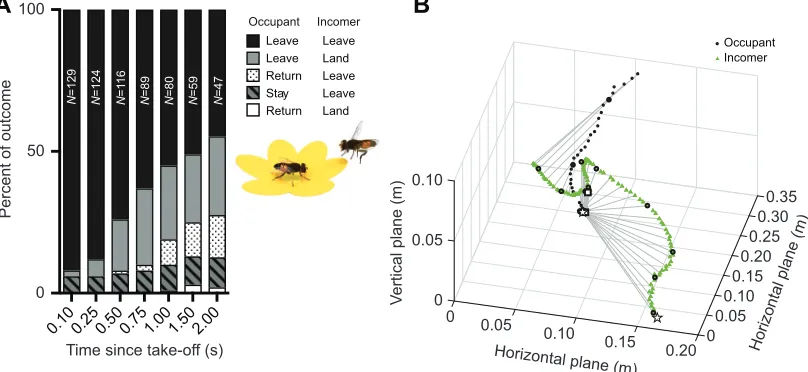
Fig. 1. Interaction outcome.(A) The bar graph shows the outcome of interactions between a feeding femaleEristalis(occupant) and an approaching insect (incomer). We defined behaviors as‘leave’, when an insect left the flower,‘return’, when the occupant returned to the flower after take-off,‘stay’, when the occupant remained on the flower, or‘land’, when the incomer landed on the flower (see color coding and inset). We followed each interaction for as long as possible, whereNshows the number of interactions analyzed for each time point. (B) Example interaction between two femaleEristalis, occupant and incomer, where both left the flower. The gray lines connect the path of the occupant and incomer every 25 ms. A black circle marks every 100 ms. White squares indicate time of take-off. White stars indicate the start position of the occupant and incomer. The interaction can be viewed in 3D in Movie 1.
Journal
of
Experimental
We tracked the position of each insect to get itsx–ycoordinates as seen by each camera, i.e. its 2D position. Often, tracking of insect positions had to be done manually, as the contrast against the cluttered background was too low for the process to be reliably automated. In all cases, the center of mass of each insect was used as its position in each frame of each camera. We next calculated the 3D position of each insect in each frame using the calibration file and the 2D location of each insect from each camera (Wardill et al., 2017).
Quantification of parameters
The 3D distance between the incomer and occupant was calculated using the formula for Euclidian distance (Eqn 1):
dðtÞ ¼
ffiffiffiffiffiffiffiffiffiffiffiffiffiffiffiffiffiffiffiffiffiffiffiffiffiffiffiffiffiffiffiffiffiffiffiffiffiffiffiffiffiffiffiffiffiffiffiffiffiffiffiffiffiffiffiffiffiffiffiffiffiffiffiffiffiffiffiffiffiffiffiffiffiffiffiffiffiffiffiffiffiffiffiffiffiffiffiffiffiffiffiffiffiffiffiffiffiffiffiffiffiffiffiffi
ðOðtÞxIðtÞxÞ2þ ðOðtÞyIðtÞyÞ2þ ðOðtÞzIðtÞzÞ2
q
;
ð1Þ
wheredis distance,tis time,Iis the 3D coordinates of the incomer,
Ois the 3D coordinates of the occupant, andx,yandzare the 3D
elements of the 3D coordinates.
The instantaneous speed for the occupant (Fig. 3A) or incomer (Fig. 2A) was calculated using the Euclidian 3D distance between two consecutive frames (Eqn 2):
vðtþ0:5Þ¼
ffiffiffiffiffiffiffiffiffiffiffiffiffiffiffiffiffiffiffiffiffiffiffiffiffiffiffiffiffiffiffiffiffiffiffiffiffiffiffiffiffiffiffiffiffiffiffiffiffiffiffiffiffiffiffiffiffiffiffiffiffiffiffiffiffiffiffiffiffiffiffiffiffiffiffiffiffiffiffiffiffiffiffiffiffiffiffiffiffiffiffiffiffiffiffiffiffiffiffiffiffiffiffiffiffiffiffiffiffiffiffiffiffiffiffiffiffiffiffiffiffiffi
ðXðtþ1ÞxXðtÞxÞ2þðXðtþ1ÞyXðtÞyÞ2þðXðtþ1ÞzXðtÞzÞ2
q
f rame rate2;
ð2Þ
wherev(t) is the speed relative to the ground,tis time,Xis the 3D
coordinates of the insect, andx,yandzare the 3D elements of the
3D coordinates. To correct for slight imperfections in the automated
tracking, a speed of 2 cm s−1 was removed based on tracking a
stationary object. The mean incomer speed was calculated by averaging across 10 frames, 100 ms before occupant take-off.
When calculating the retinal size, θ, of the incomer, we used
either its width or its length (bothw) to provide the range of possible
angular sizes:
uðtÞ ¼2arctan w
2=dðtÞ
; ð3Þ
where the width is 0.2 cm forE.balteatusand 0.4 cm for the other
incomers, and the length is 1.0 cm forE.balteatusand 1.2 cm for
the other incomers.
The angular velocity, w, of the incomer as projected on the
occupant’s retina was calculated using the law of cosine followed by
multiplication by the camera frame rate:
wðtþ0:5Þ ¼arccos dðtÞ
2þ
dðtþ1Þ2 DdI
2dðtÞdðtþ1Þ
!
f rame rate, ð4Þ
whereΔdIis the distance the incomer travelled between timetandt+1.
Angular increment,τ, was calculated from the retinal size (Eqn 3):
tðtþ0:5Þ ¼ ðuðtþ1Þ uðtÞÞ f rame rate: ð5Þ
The take-off angle was calculated by identifying the top of the head and the tip of the abdomen of the occupant at the time of take-off, the position of the incomer 100 ms before take-take-off, and the position of the occupant 100 ms after take-off. We used the body orientation of the occupant just before take-off to normalize the data from the different animals and interactions. For this, we translated
the four positions so that the tip of the occupant’s abdomen was
located at the origin (0,0,0). Next, we rotated the matrix so that the
occupant’s body was positioned along the positivex-axis at take-off.
Statistics
Prism (Prism 7, GraphPad Software Inc., La Jolla, CA, USA) was used for statistical analysis. We removed statistical outliers, which were classified after Tukey (1993). For analysis of significance, we
***
**
2.0*
–0.2 –0.1 0 0.1
0 0.5 1.0 1.5 2.0
Time (s)
Incomer speed (m s
–1
)
B
A
Incomer
E E Epi A V
N=31
N=6
N=7
N=9
Apis Eristalis Episyrphus
Incomer
Vespula
1.5
1.0
0.5
0
Incomer speed (m s
–1
)
[image:3.612.113.503.61.256.2]N=31 N=4 N=6 N=7 N=9
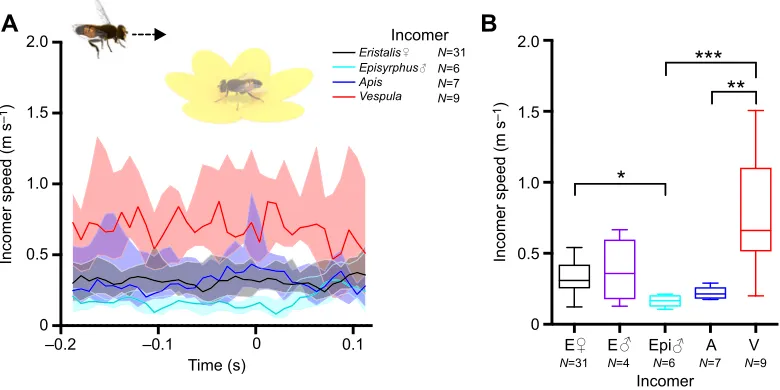
Fig. 2. Incomer speed does not increase as it approaches the flower.(A) Incomer speed as a function of the time of occupant take-off. The color coding indicates incomer identity; timet=0 is the last frame before the occupant took off from the flower. Thick lines show median, shadowing shows the interquartile range. The data have been smoothed with a third-order Butterworth filter with a cut-off frequency of 0.5. We checked for outliers (Tukey) every 50 ms and excluded any insect that was classified as an outlier for a minimum of 4 time points. (B) Box plot of mean incomer speed as measured over 83 ms (10 frames), 100 ms before occupant take-off. E,Eristalis; Epi,Episyrphus balteatus; A,Apis mellifera; V,Vespula. The midline is the median and error bars are after Tukey. Statistical significance was tested using one-way ANOVA: *P<0.05, **P<0.01, ***P<0.001.
Journal
of
Experimental
first performed a D’Agostino and Pearson omnibus normality test,
followed by a Kruskal–Wallis test with Dunn’spost hoctest for
non-parametric data, and two-way ANOVA for non-parametric data. Three
levels of significance were used, withP<0.05,P<0.01 andP<0.001
denoted with 1, 2 or 3 asterisks, respectively. Where we show changes over time, we indicate median and interquartile ranges. The whiskers in the boxplots use the Tukey setting in Prism.
RESULTS
FemaleEristalisleave their food flowers when approached by another insect
To quantify the reaction of female Eristalis feeding from
flowers when approached by incoming insects, we filmed natural interactions during calm sunny days. In this study, none of the
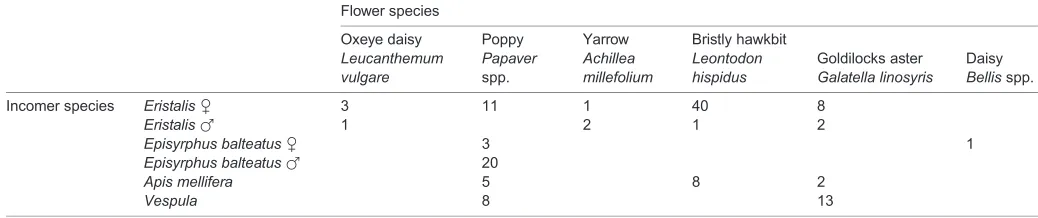
flower species (Table 1) from which the female Eristalis were
feeding had large corollas, and therefore we hypothesized that when approached by other insects, the occupant hoverfly would perform an evasive maneuver (Kikuchi, 1962b, 1963). Indeed, when approached by other hoverflies, bees or wasps (Table 1), the
occupant femaleEristalisleft the flower in 94% of the interactions
(black and gray data, Fig. 1A).
Time of take-off was defined as the last frame before the occupant left the flower. Our data show that 100 ms after occupant take-off, only 3 incomers (2.3%; Fig. 1A, gray) had landed on the flower. The incomer return rate increased over time and stabilized at ca. 26% after 750 ms (Fig. 1A, gray). The occupants that left the flower and subsequently returned started doing so only after 500 ms (Fig. 1A, dotted), with the return rate increasing over time and stabilizing at ca. 12% after 1.5 s (Fig. 1A, white and dotted). In the majority of the interactions (55%, Fig. 1A, black), the flower was still vacant 1 s
–0.2 –0.1 0 0.1
0 0.5 1.0 1.5 2.0
Time (s)
Occupant speed (m s
–1
)
–0.2 –0.1 0 0.1
0 0.5 1.0 1.5 2.0
Time (s)
Apis
***
*
**
**
***
A V S
0 0.5 1.0 1.5 2.0
Incomer
Occupant speed (m s
–1
)
N=31 N=6 N=7 N=9 N=15 Incomer
Spont. take-off Vespula
Elevation (m)
0.04 0.04
0
–0.04
Anterio-posterior axis (m)
Medio-lateral axis (m)
–0.04
0 0.04 0.08
N=14
0
–0.04
–0.04 0 0.04
Medio-lateral axis (m)
04 04
N=16
N=10
N=7
N=6
N=32
N=14
Eristalis Episyrphus
E Epi
A
B
C
D
Fig. 3. The occupant performs an escape response.(A) Occupant speed, color coded according to incomer identity (see key), as a function of the time of occupant take-off (att=0). The dashed line shows the take-off speed when the occupant left the flower spontaneously. Thick lines show median, shadowing shows the interquartile range. The data have been smoothed using a third-order Butterworth filter with a cut-off frequency of 0.5.t=0 is the last frame before the occupant took off from the flower. We checked for outliers (Tukey) every 50 ms and excluded any insect that was classified as an outlier for a minimum of 4 time points. A two-way ANOVA with Tukey’s multiple comparisons test fromt=0 to 100 ms showed a time effect (P<0.001), species effect (P<0.001) and subject effect (P<0.001). (B) Box plot of occupant speed 50 ms after occupant take-off. E,Eristalis; Epi,Episyrphus balteatus; A,Apis mellifera; V,Vespula; S, spontaneous take-off. The midline is the median and error bars are after Tukey. Statistical significance was tested using one-way ANOVA followed by Tukey’s multiple comparisons test: *P<0.05, **P<0.01, ***P<0.001. (C) The arrows show the positions of 14 occupants (femaleEristalis) 100 ms after take-off, aligned to the position of the occupant att=0, when viewed dorsally (as illustrated in the pictogram). The arrows are color coded to indicate the incomer approach angle (see color coding above graph). The inset shows occupant take-off angle (black dots) as a function of incomer position (red dot), where the red arrow indicates the mean (±s.e.m.) take-off angle. (D) The arrows show the positions of the same 14 occupants (femaleEristalis) 100 ms after take-off, aligned to the position of the occupant att=0, when viewed anteriorly (as illustrated in the pictogram). The arrows are color coded to indicate the incomer approach angle (see color coding above graph). The inset shows occupant take-off angle (black dots) as a function of incomer position (red dot), where the red arrow indicates the mean (±s.e.m.) take-off angle.
Journal
of
Experimental
after occupant take-off. Fig. 1B shows a 3D reconstruction of such
an interaction, where a feeding occupant female Eristalis (black
circles) was approached by another female Eristalis (green
triangles), resulting in both leaving the flower (Movie 1 provides an animation of the same data).
The incoming insect does not increase its speed on approach
When an insect approaches a flower, it is possible that it is unaware of the occupant hoverfly, perceives it as irrelevant or, alternatively, that it actively attacks the occupant to gain residency of the flower. As several species have been shown to accelerate while approaching a target (Boeddeker et al., 2003; Collett and Land, 1975, 1978), we hypothesized that a directed attack could be associated with an increase in speed as the incomer approached the occupant. To investigate this, we quantified the speed of hoverflies,
bees and wasps approaching an occupant female Eristalis, from
200 ms before to 100 ms after occupant take-off (Fig. 2A). This analysis showed that the incomer speed was constant over time
(species effect:P<0.001, subject effect:P<0.001, time effect: not
significant, two-way ANOVA with Tukey’s multiple comparisons
test; Fig. 2A), indicating that the incomer was unlikely to be actively attacking the occupant. However, note that wasps flew significantly faster than the other insects during the entire interaction (Fig. 2A, red), which was confirmed by quantifying the mean speed over 10 frames, 100 ms before occupant take-off (one-way ANOVA;
Fig. 2B). Note also that Eristalis females flew faster than E.
balteatusmales (one-way ANOVA; Fig. 2B).
The occupant hoverfly performs a directed take-off
We next investigated how female Eristalis left the flower when
approached by an incoming insect, and compared this with spontaneous take-offs, i.e. those that were not induced by an
incomer. We found that femaleEristalisflew away from the flower
at a higher speed when approached by an incoming insect (Fig. 3A, colored lines) than when they left the flower spontaneously (Fig. 3A, dashed line). At 50 ms after take-off, the speed was
0.15±0.02 m s−1 (mean±s.e.m.) when spontaneously leaving
the flower (Fig. 3B, gray), compared with 0.76±0.14 m s−1if the
incomer was a wasp (Fig. 3B, red) or 0.52±0.04 m s−1 if the
incomer was another Eristalis female (Fig. 3B, black). In
comparison, femaleEristalisflying between flowers traveled at a
speed of 0.34±0.02 m s−1(Fig. 2A, black).
The finding that the occupant left the flower at a higher speed when approached by another insect than when the take-off was spontaneous (Fig. 3A,B) suggests that the occupant could be performing an escape response. If so, we would expect the take-off angle to be consistently directed away from the incomer (Domenici
et al., 2011). To investigate this, we determined the occupant’s
location 100 ms after take-off and aligned the data to the body orientation and position of the occupant in the frame before take-off
(att=0, Fig. 3C; Fig. S1A). We plotted the occupant’s position as a
vector, which was color coded according to the approach angle of the
incomer. The data from 14 interactions between two femaleEristalis
show that the take-off angles were directed forward (11 out of 14 take-offs; Fig. 3C) and upward (14 out of 14 take-offs; Fig. 3D; Fig. S1B), suggesting biomechanical limitations or flight direction preferences. In addition, the data indicate that if the incomer came from the right, the occupant tended to fly to the left (Fig. 3C, pink and blue vectors; Fig. 3D, purple and blue vectors), suggesting that the occupant could determine the approach angle of the incomer.
To determine whether occupant take-off was indeed directed
away from the incomer, we measured the occupant’s take-off angle
relative to the approach angle of the incomer. The red dot in the inset in Fig. 3C illustrates the approach angle of the incomer 100 ms before occupant off, and the black dots show the resulting take-off angle of the occupant, measured 100 ms after take-take-off. We found that in azimuth, the average take-off angle was directed 215±15 deg away from the incomer, suggesting that the occupant could
determine the incomer’s approach angle. The take-offs showed a
larger variation in elevation, directed 110±30 deg away from the
incomer (Fig. 3D, inset). Considering that femaleEristaliscould not
fly below the flower (Fig. 3D), and that they tended to fly forward (Fig. 3C), these take-offs were likely efficient for the occupant hoverfly (Fig. 3C,D, insets), supporting our hypothesis that the take-off was an active escape response away from the intruder (Domenici et al., 2011).
What visual information is available before take-off?
What cues might the occupant Eristalis hoverfly use for
determining when to leave the flower from which it was feeding? Take-off could be triggered by a visual threshold, such as the distance to the incomer, the retinal size or angular velocity of the incomer and its angular increment (e.g. Fotowat et al., 2009; Fotowat and Gabbiani, 2007; Hemmi, 2005; Nityananda et al., 2016; Olberg et al., 2005; Oliva and Tomsic, 2012), or it could be initiated by internal factors that we did not measure here. If a fixed visual variable determines occupant take-off, it should show low variation across interactions (Fotowat and Gabbiani, 2007; Holmqvist and Srinivasan, 1991). To investigate this, we first
calculated the distance,d, between the occupant and the incomer as
a function of time, and found that the distance varied significantly and substantially between the approaches (Fig. 4A). Indeed, whereas the distance to approaching bees (Fig. 4A, dark blue) and
other femaleEristalis(Fig. 4A, black) at take-off was quite similar,
the occupant left the flower when wasps were further away (Fig. 4A,
red) and whenE.balteatusmales were closer (Fig. 4A, turquoise).
[image:5.612.45.564.71.180.2]The differences in distance associated with approaches by particular
Table 1. Flower and incomer species in the 129 interactions shown in Fig. 1A
Flower species
Oxeye daisy Leucanthemum vulgare
Poppy Papaver spp.
Yarrow Achillea millefolium
Bristly hawkbit Leontodon hispidus
Goldilocks aster Galatella linosyris
Daisy Bellisspp.
Incomer species EristalisC 3 11 1 40 8
EristalisF 1 2 1 2
Episyrphus balteatusC 3 1
Episyrphus balteatusF 20
Apis mellifera 5 8 2
Vespula 8 13
Journal
of
Experimental
insects (effect of time, species, subject and interaction, P<0.001,
two-way ANOVA fromt=−200 ms tot=0) therefore argues against
physical distance being a reliable trigger for occupant take-off.
We next quantified the angular size,θ, of the incomer as seen
by the occupant, and used the width of the approaching insect as a conservative estimate of its size (see Fig. S2 for corresponding data for incomer length). We found that, compared with the other
incomers, the approaching wasps projected a smaller angular size,θ,
on the occupant’s retina, but the difference was not significant
(effect of time:P<0.001, effect of subject: P<0.001, no effect of
species or interaction, two-way ANOVA fromt=−200 ms tot=0;
Fig. 4B). Nevertheless, as there was a large variation in the
incomer’s angular size between approaches (Fig. 4B, shaded areas)
over the time leading up to occupant take-off, we found it unlikely that angular size could be the sole determinant of the time of take-off
of the feeding femaleEristalis.
We next quantified the angular velocity, w, of the incomer as
seen by the occupant, and found that the median trajectories of the different approaching species overlaid each other (effect of time:
P<0.001, effect of subject: P<0.001, no effect of species or
interaction, two-way ANOVA fromt=−200 ms tot=0; Fig. 4C). We
additionally quantified the angular increment,τ, i.e. how fast the
image of the incomer grew on the occupant’s retina, and found that
the median trajectories of the different approaching species overlaid
each other (effect of time:P<0.001, effect of subject:P<0.05, no
effect of species or interaction, two-way ANOVA fromt=−200 ms
tot=0; Fig. 4D). However, for both these variables, the variation
across trials was larger (Fig. 4C,D, shaded areas) than would be expected if the parameter served a role as a threshold trigger. Taken
together, the data in Fig. 4 suggest that female Eristalis could
potentially use a decision filter based on the incomer’s angular
velocity (w) or angular increment (τ) for deciding when to take off
from the flower on which they were feeding, but that other internal factors such as perceived risk, hunger or attention (Cooper and Frederick, 2007; Dukas, 2001; Ydenberg and Dill, 1986) likely influenced the decision, as the variation across interactions was large (Fig. 4C,D).
DISCUSSION
In the summer time, hoverflies are often seen interacting among flowers in gardens and fields. Importantly, as they do not readily share small flowers with other insects (Kikuchi, 1962b), when approached by another insect they need to determine whether and
when to leave. We showed here that 94% of feeding femaleEristalis
left the flowers on which they were feeding when approached by other insects (Fig. 1). The approaching insect did not appear to perform an active attack against the occupant (Fig. 2), but nonetheless, the occupant left the flower with a fast escape response away from the incomer (Fig. 3). Finally, we also showed that a fixed visual threshold does not explain the timing of the
femaleEristalistake-off, but that the incomer’s angular velocity (w)
or angular increment (τ) could play a role in the decision (Fig. 4).
Interactions on flowers
Eristalishoverflies are Batesian bee mimics, probably as a defense
against predators (Brower and Brower, 1965). Indeed, frogs that have
been stung by honey bees eat fewerEristalisthan frogs that have not
experienced a bee sting (Brower and Brower, 1962), and naive human
subjects frequently confuse Eristalis hoverflies with honeybees
(Golding et al., 2005a). Hoverflies show similar flight patterns to bees
N=6
N=10
Apis Eristalis Episyrphus
Incomer
Vespula
N=30
N=5
–0.2 –0.1 0.0 0.1
0 5 10
Time (s)
Angular width,
(deg)
d
–0.2 –0.1 0 0.1
0 0.05 0.10 0.15 0.20
Time (s)
Distance,
d
(m)
C
N=32N=6
N=7
N=10
Episyrphus
Incomer
A
B
D
N=29
N=5
N=6
N=10
Eristalis Episyrphus
Incomer
N=30
N=6
N=7
N=9
Eristalis Episyrphus
Incomer
–0.2 –0.1 0 0.1
0 200 400 600 800 1000
Time (s)
Angular velocity,
(deg s
−
1)
–0.1 0 0.1
-50 0 50
1 1 1
1 00000000
Time (s)
Angular increment,
(deg s
−
1)
Eristalis
Apis Vespula
Apis Vespula Apis
[image:6.612.50.437.56.390.2]Vespula
Fig. 4. Visual parameters available to the occupant.(A) The distance,d, between the occupant and the incomer. (B) The angular width,θ, of the incomer as seen by the occupant. (C) The angular velocity,w, of the incomer as seen by the occupant. The data have been smoothed using a third-order Butterworth filter with a cut-off frequency of 0.25. (D) The angular increment,τ, of the incomer as seen by the occupant. The data have been smoothed using a third-order Butterworth filter with a cut-off frequency of 0.25. In all panels, the color coding indicates incomer identity, t=0 is the last frame before the occupant took off from the flower, thick lines show median and shadowing shows the interquartile range. In all panels, we checked for outliers (Tukey) every 50 ms and excluded any insect that was classified as an outlier for a minimum of 4 time points.
Journal
of
Experimental
when foraging around flowers, where they both fly in small loops around the flowers when foraging, as opposed to muscid flies that tend to fly in straight lines between the flowers (Golding and Edmunds, 2000; Golding et al., 2001). The cruising speeds of
foraging Eristalis tenaxand bees (Apis mellifera) are also similar
(approximately 0.2 m s−1; Fig. 2B; see Golding et al., 2005b;
Golding et al., 2001).Vespula vulgariswasps have previously been
described to fly between flowers at speeds of ca. 0.15 m s−1(Golding
et al., 2005b, 2001), or at 0.2 m s−1in a wind tunnel (Brown et al.,
2013), which is slower than our data (Fig. 2B, red), but this could depend on factors such as local temperature and time of day.
Hoverflies have previously been shown to not share the flowers from which they are feeding (Kikuchi, 1962a), unless these are large (Kikuchi, 1963), which was confirmed in our study (Fig. 1A). Male hoverflies are highly territorial and similarly avoid sharing their hovering territory with other hoverflies (Fitzpatrick, 1981). However,
whereas male Eristalis hoverflies readily pursue other insects,
including bees, butterflies and even wasps or hornets, sometimes with a lethal outcome for the hoverfly (Fitzpatrick, 1981; Fitzpatrick
and Wellington, 1983), femaleEristalisdo not perform such
high-speed pursuits (Collett and Land, 1975; Fitzpatrick, 1981).
Furthermore, as the flight velocity of the male Eristalis and E.
balteatuswas low (Fig. 2), the interactions that we filmed here are
quite different from high-speed territorial pursuits. Taken together, we find it unlikely that the female behaviors that we described here are territorial; rather, they illustrate a trade-off between exploiting a food source (Cooper and Frederick, 2007), which guarantees food and poses a risk of getting injured, and leaving, which is a safer option that results in immediate energy expenditure and a loss of food intake.
Such trade-offs are important as the approaching insect could be a predator, e.g. a wasp, whose prey range includes hoverflies (Harris and Oliver, 1993; Richter, 2000). Even if wasps are of similar size to
bees and otherEristalishoverflies, they fly faster (Fig. 2), and this
information could potentially be used by the occupantEristalis(but
note that there was no difference in the resulting angular velocity as perceived by the occupant; Fig. 4C). We found that when the
incomer was a wasp, the occupantEristalishoverfly left the flower
significantly sooner (i.e. when the wasp was further away, at 0.11±
0.014 m compared with 0.026–0.057 m for the other incomer
species; Fig. 4A) and its take-off speed was higher (0.62±
0.085 m s−1compared with that when approached by other insect
species of 0.26–0.40 m s−1; Fig. 3A). As the occupant speed 50 ms
after take-off was significantly higher in response to wasps than in response to other insects (Fig. 3A), this suggests that the feeding hoverfly might perceive the level of threat posed by a wasp, maybe by using the combined information provided by its higher speed (Fig. 2A) and other visual cues. Indeed, at the time of occupant take-off, the width of the wasp subtends a few degrees on the retina (Fig. 4B), which is larger than the optical resolution of the female hoverfly eye (Straw et al., 2006), and might thus be enough for its unique features to be identified, especially taking into account that dipteran hyperacuity may be 4 times better than predicted by the optics alone (Juusola et al., 2017). Wasps are so different from bees and hoverflies that pigeons can be trained to separate them based on antenna length, contrast of abdominal patterns and number of stripes (Bain et al., 2007; Dittrich et al., 1993). However, not all species are deterred by the markings, as recent work suggests that dragonflies are not discouraged by the classic black/yellow warning signals, such as those of wasps, when pursuing artificial prey (Duong et al., 2017). This could obviously depend on other factors, such as a much thicker cuticle, and the large size difference between dragonflies and their prey.
Escapes and attacks
We found that the approach by the incoming insect was unlikely to be an active attack, as we saw no difference in flight speed leading up to the interaction (Fig. 2A). Instead, it was more likely that the approaching insects were focused on foraging. Indeed, even if flowers of the same species look quite similar to the human observer, a combination of scent, color and shape make some much more attractive than others (Nordström et al., 2017), which could make a potential food source more salient than the presence of an occupant. It has been suggested that hoverflies might partially base their flower preference on the morphology of their mouth parts (Gilbert, 1980, 1981), whereas others argue that hoverflies rarely display a strong flower preference, but instead visit the most abundant flower in their surroundings (Branquart and Hemptinne, 2000). Nevertheless, both hoverflies and bees readily feed on nectar and pollen from a large variety of flowers (Gilbert, 1985; Nordström et al., 2017; Wallace et al., 2002).
We found that the approaching insect was unlikely to perform a directed attack. In contrast, we found it likely that the occupant performed an escape response as the occupants left the flower at higher speed if they were approached by another insect than if they left the flower apparently spontaneously (Fig. 3A,B). In addition, when approached by other insects, the occupants left the flower faster (Fig. 3A,B) than they approached it (Fig. 2B, black). Previous work, which did not separate spontaneous take-offs from those triggered by an incoming insect, also found that the take-off speed was faster than the approach speed. Such studies interpreted the faster take-off as a general strategy to avoid predators (Golding et al., 2001). By separating spontaneous take-offs from those triggered by an incomer, we found that the fastest take-offs were indeed triggered by the most dangerous incomer, the predatory wasp (Fig. 3A,B, red). We also showed that the escape response was directed 215 deg away from the incomer in azimuth (Fig. 3C, inset) and 110 deg away from the incomer in elevation (Fig. 3D, inset).
Mice flee from flying predators at an angle of 45–135 deg away
from the incoming threat (Ilany and Eilam, 2008), and mysid crustaceans flee from their predators at a 90 deg angle (Kaiser et al.,
1992). InDrosophila, the take-off angle is roughly 180 deg if an
artificial looming stimulus comes directly from the back or the front, but approximately 90 deg when the stimulus comes from the side (Card and Dickinson, 2008).
Our results (Fig. 3C,D) thus suggest that the hoverflies were able to take the approach angle of the incomer into account, even if they preferred flying forward and upward. Female hoverflies have neurons
tuned to the motion of small targets (Nordström and O’Carroll, 2006),
which would be suitable for detecting passing insects. These neurons tend to have very large receptive fields, covering a large portion of the
ipsilateral or contralateral visual field (Nordström and O’Carroll,
2006). Such neurons would thus alert the hoverfly to the presence of a small target moving across the visual field, but not provide more detailed position or direction information. Furthermore, as the incomer gets closer to the occupant, it would become a looming stimulus. The neural network of looming-sensitive neurons, underlying fly escape responses, have been described in amazing
detail inDrosophila(von Reyn et al., 2017).
Variables triggering take-off
If a certain visual parameter serves as a threshold trigger of take-off, it should have small variance at a fixed time before take-off (Fotowat et al., 2009; Fotowat and Gabbiani, 2007). As fruit flies and locusts use the angular size of the incoming stimulus, and crabs the angular
increment, as a trigger for the decision to take off and initiate an
Journal
of
Experimental
escape from a looming stimulus (Fotowat et al., 2009; Fotowat and Gabbiani, 2007), it seems reasonable that hoverflies could use one
of these parameters too. Eristalis hoverflies have the neural
machinery in place to process the type of stimuli that the incoming insects generate. For example, 50 ms before take-off,
the width of the incomer subtended a few degrees on the occupant’s
eye (Fig. 4B). Female target neurons can track moving targets even
smaller than this (Nordström and O’Carroll, 2006). The incomer’s
angular velocity, 50 ms before take-off, was a few hundred degrees per second (Fig. 4C), which is also within the response range of
female target neurons (Nordström and O’Carroll, 2006). However,
for all of the four potential visual triggers investigated here, we found a large variation between individual trials (Fig. 4). This
suggests that feeding femaleEristalismight not detect the incomer
until late in the interaction because of its attention to feeding, or alternatively that its position was not optimal for detection. Indeed, factors that we did not measure here, such as the energy benefit of the different flowers, the fitness and attention of each individual hoverfly, and the perceived level of threat the incomers posed (Cooper and Frederick, 2007; Ydenberg and Dill, 1986) could explain the large variation across trials (Fig. 4), and also why we observed interactions where the occupant did not leave the flower despite the incoming insect landing on it (Fig. 1A, striped). As an artificial visual stimulus will also induce an escape response in many flies (Card and Dickinson, 2008; Holmqvist and Srinivasan, 1991), visual parameters (Fig. 4) could be manipulated under more controlled conditions in future work using, for example, beads controlled with a rotor (Wardill et al., 2017).
Acknowledgements
We thank Ruddammsdalens Odlarförening, the Uppsala Botanical Garden and the Carlsson family for access to hoverflies, with special thanks to Eva Carlsson for on-site hoverfly spotting, Dr Mikael Vejdemo-Johansson, Cuny College of Staten Island, for 3D calculation discussions, Dr Francis Gilbert, University of Nottingham, for reference assistance, Prof. Fabrizio Gabbiani, Baylor College of Medicine, for advice regarding visual correlations, and Dr Olga Dyakova for constructive feedback.
Competing interests
The authors declare no competing or financial interests.
Author contributions
Conceptualization: M.T., K.N.; Methodology: M.T., P.T.G.-B, T.J.W., K.N.; Software: M.T., P.T.G.-B, T.J.W.; Validation: M.T.; Formal analysis: M.T., K.N.; Investigation: M.T.; Resources: K.N.; Data curation: M.T.; Writing - original draft: M.T., K.N.; Writing - review & editing: M.T., P.T.G.-B., T.J.W., K.N.; Visualization: M.T., T.J.W., K.N.; Supervision: K.N.; Project administration: M.T., P.T.G.-B, K.N.; Funding acquisition: P.T.G.-B, K.N.
Funding
This work was funded by the Air Force Office of Scientific Research (FA9550-15-1-0188 to P.T.G.-B. and K.N.), the Biotechnology and Biological Sciences Research Council (BB/L024667/1 David Phillips Fellowship to T.J.W.), Australian Research Council (DP170100008 to K.N.), Stiftelsen Olle Engkvist Byggmästare (2016/348 to K.N.) and Stiftelsen Längmanska Kulturfonden (BA17-0812 to K.N.). Deposited in PMC for immediate release.
Data availability
Data have been deposited in the Dryad Digital Repository (Thyselius et al., 2018): doi:10.5061/dryad.29j22tt.
Supplementary information
Supplementary information available online at
http://jeb.biologists.org/lookup/doi/10.1242/jeb.177162.supplemental
References
Akre, R. D.(1982). Social wasps.Social Insects4, 1-105.
Bain, R. S., Rashed, A., Cowper, V. J., Gilbert, F. S. and Sherratt, T. N.(2007).
The key mimetic features of hoverflies through avian eyes.Proc. R. Soc. B274, 1949-1954.
Boeddeker, N., Kern, R. and Egelhaaf, M.(2003). Chasing a dummy target:
smooth pursuit and velocity control in male blowflies.Proc. R. Soc. B Biol. Sci. USA270, 393-399.
Borst, A.(2014). Fly visual course control: behaviour, algorithms and circuits.Nat.
Rev. Neurosci.15, 590-599.
Branquart, E. and Hemptinne, J.-L.(2000). Selectivity in the exploitation of floral
resources by hoverflies (Diptera: Syrphinae).Ecography23, 732-742.
Brower, J. V. Z. and Brower, L. P.(1962). Experimental studies of mimicry. 6. The
reaction of toads (Bufo terrestris) to honeybees (Apis mellifera) and their dronefly mimics (Eristalis vinetorum).Am. Nat.96, 297-307.
Brower, J. V. Z. and Brower, L. P. (1965). Experimental studies of
mimicry. 8. Further investigations of honeybees (Apis mellifera) and their dronefly mimics (Eristalis spp.).Am. Nat.99, 173-187.
Brown, R. L., El-Sayed, A. M., Suckling, D. M., Stringer, L. D. and Beggs, J. R.
(2013). Vespula vulgaris (Hymenoptera: Vespidae) gynes use a sex pheromone to attract males.Can. Entomol.145, 389-397.
Card, G. and Dickinson, M. H. D.(2008). Visually mediated motor planning in the
escape response of Drosophila.Curr. Biol.18, 1300-1307.
Collett, T. S. and King, A. J.(1975). Vision during flight. InThe Compound Eye and
Vision of Insects(ed. G. A. Horridge), pp. 437-466. Oxford: Clarendon Press.
Collett, T. S. and Land, M. F.(1975). Visual control of flight behavior in hoverfly,
Syritta-Pipiens L.J. Comp. Physiol.99, 1-66.
Collett, T. S. and Land, M. F.(1978). How hoverflies compute interception courses.
J. Comp. Physiol.125, 191-204.
Cooper, W. E. and Frederick, W. G.(2007). Optimal flight initiation distance.
J. Theor. Biol.244, 59-67.
Dittrich, W., Gilbert, F., Green, P., Mcgregor, P. and Grewcock, D.(1993).
Imperfect mimicry: a pigeon’s perspective.Proc. R. Soc. B251, 195-200.
Domenici, P., Blagburn, J. M. and Bacon, J. P.(2011). Animal escapology II:
escape trajectory case studies.J. Exp. Biol.214, 2474-2494.
Dukas, R.(2001). Effects of perceived danger on flower choice by bees.Ecol. Lett.
4, 327-333.
Duong, T. M., Gomez, A. B. and Sherratt, T. N.(2017). Response of adult
dragonflies to artificial prey of different size and colour.PLoS ONE12, e0179483.
Fitzpatrick, S. M.(1981). Territorial aggression among males of three syrphid
species.MSc thesis, Department of Plant Science, University of British Columbia, Vancouver.
Fitzpatrick, S. M. Wellington, W. G.(1983). Insect territoriality.Can. J. Zool.61,
471-486.
Fotowat, H. and Gabbiani, F.(2007). Relationship between the phases of sensory
and motor activity during a looming-evoked multistage escape behavior.
J. Neurosci.27, 10047-10059.
Fotowat, H., Fayyazuddin, A., Bellen, H. J. and Gabbiani, F.(2009). A novel
neuronal pathway for visually guided escape in Drosophila melanogaster.
J. Neurophysiol.102, 875-885.
Francuski, L., Djurakic, M., Ludoški, J. and Milankov, V.(2013). Landscape
genetics and spatial pattern of phenotypic variation of Eristalis tenax across Europe.J. Zool. Syst. Evol. Res.51, 227-238.
Gilbert, F. S.(1980). Flower visiting by hoverflies (Syrphidae).J. Biol. Educ.14,
70-74.
Gilbert, F. S.(1981). Foraging ecology of hoverflies: morphology of the mouthparts
in relation to feeding on nectar and pollen in some common urban species.Ecol.
Entomol.6, 245-262.
Gilbert, F. S.(1985). Diurnal activity patterns in hoverflies (Diptera, Syrphidae).
Ecol. Entomol.10, 385-392.
Gladis, T. (1997). Bees versus flies? Rearing methods and effectiveness of
pollinators in crop germplasm regeneration.Acta Hortic.437, 235-238.
Golding, Y. C. and Edmunds, M.(2000). Behavioural mimicry of honeybees (Apis
mellifera) by droneflies (Diptera: Syrphidae: Eristalis spp.).Proc. Biol. Sci.267, 903-909.
Golding, Y. C., Ennos, A. R. and Edmunds, M.(2001). Similarity in flight behaviour
between the honeybeeApis mellifera(Hymenoptera: apidae) and its presumed mimic, the droneflyEristalis tenax(Diptera: syrphidae).J. Exp. Biol.204, 139-145.
Golding, Y., Ennos, R., Sullivan, M. and Edmunds, M.(2005a). Hoverfly mimicry
deceives humans.J. Zool.266, 395-399.
Golding, Y. C., Edmunds, M. and Ennos, A. R.(2005b). Flight behaviour during
foraging of the social wasp Vespula vulgaris (Hymenoptera: Vespidae) and four mimetic hoverflies (Diptera: Syrphidae) Sericomyia silentis, Myathropa florea, Helophilus sp. and Syrphus sp.J. Exp. Biol.208, 4523-4527.
Goulard, R., Julien-Laferriere, A., Fleuriet, J., Vercher, J.-L. and Viollet, S.
(2015). Behavioural evidence for a visual and proprioceptive control of head roll in hoverflies (Episyrphus balteatus).J. Exp. Biol.218, 3777-3787.
Goulard, R., Vercher, J.-L. and Viollet, S.(2016). To crash or not to crash: how do
hoverflies cope with free-fall situations and weightlessness?J. Exp. Biol.219, 2497-2503.
Harris, R. J. and Oliver, E. H.(1993). Prey diets and population densities of the
WaspsVespula vulgarisandV. germanicain Scrublandpasture.N. Z. J. Ecol.17, 5-12.
Heal, J.(1979). Colour patterns of Syrphidae: I. Genetic Variation in the Dronefly
Eristalis tenax.Heredity42, 223-236.
Journal
of
Experimental
Heal, J.(1981). Colour patterns of Syrphidae. III. Sexual Dimorphism inEristalis
arbustorum.Heredity6, 119-127.
Heal, J. (1987). Observations on Eristaline behaviour. InHoverfly Newsletter,
Dipterists Forum, Vol. 5, pp. 3-4. Reading: British Entomological and Natural History Society.
Hemmi, J. M.(2005). Predator avoidance in fiddler crabs: 2. The visual cues.Anim.
Behav.69, 615-625.
Holmqvist, M. H. and Srinivasan, M. V.(1991). A visually evoked escape response
of the housefly.J. Comp. Physiol. A169, 451-459.
Horridge, G. A., Mimura, K. and Tsukahara, Y.(1975). Fly photoreceptors. II.
Spectral and polarized light sensitivity in the drone flyEristalis.Proc. R. Soc. Lond.
B Biol. Sci.190, 225-237.
Howarth, B. and Edmunds, M.(2000). The phenology of Syrphidae (Diptera): are
they Batesian mimics of Hymenoptera?Biol. J. Linn. Soc.71, 437-457.
Hull, F. M.(1937).A Check List of the Syrphidae of Oceania. Honolulu, HI: Bernice
P. Bishop Museum.
Ilany, A. and Eilam, D.(2008). Wait before running for your life: defensive tactics of
spiny mice (Acomys cahirinus) in evading barn owl (Tyto alba) attack.Behav.
Ecol. Sociobiol.62, 923-933.
Jauker, F., Bondarenko, B., Becker, H. C. and Steffan-Dewenter, I.(2012).
Pollination efficiency of wild bees and hoverflies provided to oilseed rape.Agric.
Forest Entomol.14, 81-87.
Juusola, M., Dau, A., Song, Z., Solanki, N., Rien, D., Jaciuch, D., Dongre, S. A.,
Blanchard, F., de Polavieja, G. G. and Hardie, R. C.(2017). Microsaccadic
sampling of moving image information provides Drosophila hyperacute vision.
Elife6, e26117.
Kaiser, M. J., Gibson, R. N. and Hughes, R. N.(1992). The effect of prey type on
the predatory behaviour of the fifteen-spined stickleback, Spinachia spinachia (L.).
Anim. Behav.43, 147-156.
Kikuchi, T.(1962a). Studies on the coaction among insects visiting flowers I. Ecological
groups in insects visiting the Chrysanthemum flower, Chrysanthemum
leucanthemum.Sci. Rep. Tôhoku Univ. Ser. IV28, 17-22.
Kikuchi, T.(1962b). Studies on the coaction among insects visiting flowers II.
Dominance relationship in the so-called drone fly group.Sci. Rep. Tôhoku Univ.
Series IV28, 47-51.
Kikuchi, T.(1963). Studies on the coaction among insects visiting flowers III.
Dominance relationship among flower visiting flies, bees and butterflies.Sci. Rep.
Tôhoku Univ. Series IV4, 1-8.
Kikuchi, T.(1965). Role of interspecific dominance-subordination relationship on
the appearance of flowervisiting insects.Sci. Rep. Tôhoku Univ. Series IV31, 275-296.
Nityananda, V., Tarawneh, G., Rosner, R., Nicolas, J., Crichton, S. and Read, J.
(2016). Insect stereopsis demonstrated using a 3D insect cinema.Sci. Rep.6, 18718.
Nordström, K.(2012). Neural specializations for small target detection in insects.
Curr. Opin. Neurobiol.22, 272-278.
Nordström, K. and O’Carroll, D. C.(2006). Small object detection neurons in
female hoverflies.Proc. Biol. Sci.273, 1211-1216.
Nordström, K., Barnett, P. D., Moyer de Miguel, I. M., Brinkworth, R. S. A. and
O’Carroll, D. C.(2008). Sexual dimorphism in the hoverfly motion vision pathway.
Curr. Biol.18, 661-667.
Nordström, K., Dahlbom, J., Pragadheesh, V., Ghosh, S., Olsson, A., Dyakova,
O., Suresh, S. K. and Olsson, S. B.(2017). In situ modeling of multimodal floral
cues attracting wild pollinators across environments.Proc. Natl Acad. Sci. USA
114, 13218-13223.
Olberg, R., Worthington, A., Fox, J., Bessette, C. and Loosemore, M.(2005).
Prey size selection and distance estimation in foraging adult dragonflies.J. Comp.
Physiol. A191, 791-797.
Oliva, D. and Tomsic, D.(2012). Visuo-motor transformations involved in the
escape response to looming stimuli in the crab Neohelice (=Chasmagnathus) granulata.J. Exp. Biol.215, 3488-3500.
Ottenheim, M. M.(2000). Annual and diurnal rhythms ofEristalisspecies (Diptera:
Syrphidae).Proc. Sec. Exp. Appl. Entomol. Netherlands Entomol. Soc.11, 169-174.
Rashed, A. and Sherratt, T. N.(2007). Mimicry in hoverflies (Diptera: Syrphidae): a
field test of the competitive mimicry hypothesis.Behav. Ecol.18, 337-344.
Richter, M. R.(2000). Social wasp (Hymenoptera: Vespidae) foraging behavior.
Annu. Rev. Entomol.45, 121-150.
Shah, G. M., Jan, U. and Wachkoo, A. A.(2014). A checklist of hoverflies (Diptera:
Syrphidae) in the western Himalaya, India.Acta Zool. Hung.60, 283-305.
Ssymank, A., Kearns, C. A., Pape, T. and Thompson, F. C.(2008). Pollinating flies
(Diptera): a major contribution to plant diversity and agricultural production.
Biodiversity9, 86-89.
Straw, A. D., Warrant, E. J. and O’Carroll, D. C.(2006). A“bright zone”in male
hoverfly (Eristalis tenax) eyes and associated faster motion detection and increased contrast sensitivity.J. Exp. Biol.209, 4339-4354.
Thyselius, M., Gonzalez-Bellido, P., Wardill, T. and Nordström, K.(2018). Data
from: Visual approach computation in feeding hoverflies. Dryad Digital Repository. https://doi.org/10.5061/dryad.29j22tt
Tukey, J. W.(1993). Exploratory data analysis: Past, present and future: DTIC
Document.
von Reyn, C. R., Nern, A., Williamson, W. R., Breads, P., Wu, M., Namiki, S. and
Card, G. M.(2017). Feature integration drives probabilistic behavior in the
drosophila escape response.Neuron94, 1190-1204.e6.
Wallace, H. M., Maynard, G. V. and Trueman, S. J.(2002). Insect flower visitors,
foraging behaviour and their effectiveness as pollinators of Persoonia virgata R. Br. (Proteaceae).Aust. J. Entomol.41, 55-59.
Wardill, T. J., Fabian, S. T., Pettigrew, A. C., Stavenga, D. G., Nordström, K. and
Gonzalez-Bellido, P. T.(2017). A novel interception strategy in a miniature robber
fly with extreme visual acuity.Curr. Biol.27, 854-859.
Wijngaard, W.(2013).Eristalis nemorummale aerobatics.Proc. Neth. Entomol.
Soc. Meet.24, 17-23.
Ydenberg, R. C. and Dill, L. M.(1986). The economics of fleeing from predators.
Adv. Study Behav.16, 229-249.