The impact of website features on
customer satisfaction in the
e-commerce context in Indonesia
UNIVERSITY OF TWENTE.
Faculty of Behavioral, Management and Social Sciences
Master Thesis
Author
: Helena Wisda Inandika
(S2031868)
Program
: Msc Business Administration
Track
: Strategic Marketing
Management
First supervisor
: Dr. Agata Leszkiewicz
Second supervisor : Dr. R.P.A. Loohuis
Date
: 15-08-2019
Table of Contents
1. Introduction ... 6
2. Theoretical background and hypotheses development ... 8
2.1 E-CRM features and website service quality ... 8
2.2 Examination of website features from perspectives of e-CRM and website service quality ... 15
2.3 Online purchasing cycle ... 16
2.4 Conceptual framework ... 17
2.5 Pre-purchase cycle and customer satisfaction ... 18
2.5.1 Website design ... 18
2.5.2 Informativeness of the product ... 18
2.5.3 Ease of use ... 18
2.5.4 Customization ... 19
2.6 At-purchase cycle and customer satisfaction ... 19
2.6.1 Security/privacy assurance ... 19
2.6.2 Payment system ... 19
2.7 Post-purchase cycle and customer satisfaction ... 20
2.7.1 Order fulfillment ... 20
2.7.2 Responsiveness of customer service ... 20
2.8 Outcomes of customer satisfaction: Repurchase intention and positive word-of-mount (WOM) ... 21
3. Methodology ... 22
3.1 Data collection ... 22
3.2 Survey instrument ... 22
3.3 Measurements ... 23
3.4 Data Analysis ... 26
3.4.1 Multiple regression analysis ... 26
3.4.2 Linear regression analysis ... 26
4. Results ... 27
4.1 Sample ... 27
4.2 Measurement model ... 28
4.3 Hypothesis testing ... 31
4.3.1 Regression analysis ... 31
5. Discussion and conclusion ... 33
5.1 Discussion of findings ... 33
5.2 Practical Implications ... 35
6. Limitations and suggestion for future research ... 37
Appendices ... 38
Appendix 1. Questionnaire in English version ... 38
Appendix 2. Questionnaire in Indonesian version ... 42
Appendix 3. Scatter diagrams: Relationship of customer satisfaction on repurchase intention ... 47
Appendix 4. Scatter diagrams: Relationship of customer satisfaction on positive word-of-mouth ... 47
Acknowledgment
Abstract
This study aims to construct general website features on the e-commerce website in Indonesia by integrating the perspectives from Information system and marketing studies. Furthermore, this study examines the impact of website features on customer satisfaction and investigate the correlation of customer satisfaction on repurchase intention and positive word-of-mouth. The general website features were generated based on the website features that have been consistently cited from prior literature in both studies. The website features were conceptualized in the model comprising website design, informativeness of the products, ease of use, customization/personalization, security/privacy, payment system, order fulfillment, and responsiveness of customer service. A total of 228 respondents were collected. The respondents of this study were the people who had shopping experienced in e-commerce website in Indonesia. Based on the data collected, the researcher found evidence that pre-purchase experience including experiences with website design, and personalization/customization are the main driver of customer satisfaction. On the contrary, the informativeness of products is significantly has a negative relationship toward customer satisfaction. Moreover, the effect of ease of use on customer satisfaction is not significant. In at-purchase cycle, the researcher did not find evidence for the effect of security/privacy on customer satisfaction as evidenced in previous studies. The positive relationship toward customer satisfaction is only can be found in the payment system. In the post-purchase stage, the features of order fulfillment and responsiveness of customer service have a significant impact on customer satisfaction. Furthermore, this study validated that customer satisfaction leads to repurchase intention and positive word-of-mouth.
Keywords:
6
1. Introduction
The internet users in Indonesia growing rapidly each year. The survey conducted by Indonesian Internet Service Providers (APJII), shows that in 2017, with the population of 250 million people, the internet users reach 143 million people with the increase of 7.9 percent compared to 2016 (Yuniarni , 2018). At the same time, the number of online shoppers in Indonesia also increases. McKinsey predicted that Indonesia had 30 million of online shoppers (Das, Tamhane, Vatterott, Wibowo, & Wintels, 2018). Moreover, with the shift in consumers’ shopping behavior towards online shopping, the e-commerce market in Indonesia is expected to grow to US$ 130 billion in 2020, according to the data from Indonesia’s Ministry of Information and Communications Technology (Rastogi, 2019). In Indonesia, there are numerous of commerce companies. Based on their monthly traffic, there are big 5 of e-commerce companies, namely, Tokopedia, Shopee, Bukalapak, Lazada, and Blibli (Asean Up, 2019). To maintain themselves in the competition, several fundamental factors should be taken into consideration. Shin et al. (2013) suggested the e-commerce business build a website that meets customers’ needs according to the customers perspective. Likewise, Liu and Arnett (2000) suggested that the e-commerce business has to improve the quality of the website to enhance customer satisfaction. Thus, by referring to the literature, it becomes clear that website features become the important drivers of customer satisfaction. This research has three primary aims. Firstly, to identify and construct general features on the e-commerce website by incorporating the theories from the perspectives of Information system on e-CRM and marketing studies. Secondly, to examine the impact of e-commerce website features on customer satisfaction in different stages of the purchasing cycle. Thirdly, to investigate the correlation of customer satisfaction on customer repurchase intention and positive word-of-mouth.
A wide variety of studies, for instance, information system and marketing studies have investigated, and proposed factors affect customers’ satisfaction in the context of e-commerce. In the perspective of the information system, several studies (eg. Feinberg and Kadam, 2002; Khalifa and Shen, 2005; Sigala, 2006a; Alhaiou et al., 2009; Ismail and Hussin, 2013) proposed frameworks which contain a group of website features by using the terminology of e-CRM features. In contrast, the marketing studies (eg, Szymanski and Hise, 2000; Yoo and Donthu, 2001); Loiacono et al, 2002; Wolfinbarger and Gilly, 2003; Parasuraman et al., 2005; Chen, 2010; Pham and Ahammad, 2017) proposed frameworks which contain a group of website quality factors by using the terminology of website service quality. Since the information system and marketing studies employs different terminology, it induces confusion in defining and interpreting the meaning of website features (Yang, Cai, Zhou Z., & Zhou, 2005). Also, it is resulting in multifaceted dimensions of website features (Lee and Kozar, 2012).
7 relationship among website features, customer satisfaction, and repurchase intention. The result of those studies shows that website features and customer satisfaction are significantly related to repurchase intention.
Hence, this study strengthens the literature of information system and marketing studies by analyzing and integrating different features on the website from the view of IS and marketing from the previous studies which resulting general features of the website. Hereafter, this study will investigate the association between the features on the website and customer satisfaction in different stages of the purchasing cycle. Thus, the first research question is formulated:
“Do the website features in the different stages of the purchasing cycle (Pre-purchasing, at-purchasing, and post-purchasing) affect customer satisfaction in online shopping? Customer satisfaction has acknowledged predicting behavioral intention (Ravald & Grönroos, 1996). Anderson and Srinivasan (2003) defined satisfaction as the fulfillment of the customers purchasing experiences with a certain e-commerce website. Zeithaml et al. (2002) believe that customer satisfaction leads to advantageous results, for instance, improved customer retention and positive WOM (Word-of-mouth). Moreover, Lee (2005) found that customer satisfaction leads to repurchase intention and likely to make positive recommendations to others. However, the result of satisfaction on e-CRM features lead to repurchase intention and positive WOM is remain limited. This leads to the second research questions:
“Do the customer satisfaction on website features lead to the repurchase intention and positive WOM?
Additionally, this study will contribute to add the literature by focusing the study in a developing country, such as Indonesia. In this case, the researcher will identify the features of e-commerce websites in Indonesia. E-commerce in Indonesia is interested to be studied as E-commerce is one of the fast-growing sectors in Indonesia, which has mentioned above that the number of e-commerce businesses in Indonesia increased rapidly.
8
2. Theoretical background and hypotheses development
2.1 E-CRM features and website service quality
E-CRM features are the common terminology used by information system studies. In the context of e-commerce, e-CRM is mainly about supporting business process with strategies with purposes to create customer value and that are supported with ICT (Rigby, Reichheld, & Schefter, 2002). As the transactions for purchasing a product are conducted in online mode, the implementation of e-CRM is through numerous website features providing e-CRM functionality (Sigala, 2006a). Therefore, the e-commerce company must construct the website in such a way that it increases the traffic while ensuring customer satisfaction and retention at the same time. The previous studies, Feinberg and Kadam (2002) have examined 42 website features providing e-CRM functionality and identified the most common e-CRM features that provided in the retailers’ websites, for instance, product information, product highlight, preview product, site map, email, about company, local search, complaining ability, privacy policy, cross-sell, online purchasing and check out. Furthermore, their study reveals that there is a correlation between those features and customer satisfaction.
Only Khalifa and Shen (2005) considered and proposed a framework to capture the impact of e-CRM features on customer satisfaction in different stages of the purchasing process, which is, pre-purchase, at- purchase, and post-purchase. The result shows that there are some specific e-CRM features on the website are recognized as satisfaction drivers for the customers, for instance, search capabilities, website customization, product customization, comparative shopping, dynamic pricing, problem-solving, and order tracking.
Meanwhile, in marketing studies, the website quality is defined as the extent to which a website facilitates efficient and effective shopping, purchasing, and delivery (Zeithaml et al., 2000). In the same way, Chang and Chen (2009) defined website quality as a multifaceted conception that measures overall customers’ purchasing experiences from pre-purchase to post-purchase. Additionally, there are various of literature have emphasized the importance of customer perceptions on online service quality (eg. Janda et al., 2002; Yoo and Donthu, 2001) and the impact of service quality on customers’ behaviors, for instance, customer retention (Ranganathan and Ganapathy, 2002; Chen, 2010), repurchase intention (Shin et al., 2013; Pham and Ahammad, 2017; Tandon et al., 2017), satisfaction (Kim et al., 2009; Lin, 2007; Szymanski and Hise, 2000), loyalty (Kim et al., 2009; Wolfinbarger and Gilly, 2003), word-of-mouth (Yang, 2015; Blut, 2016), and perceived value (Bauer, 2006; Zehir et al., 2014).
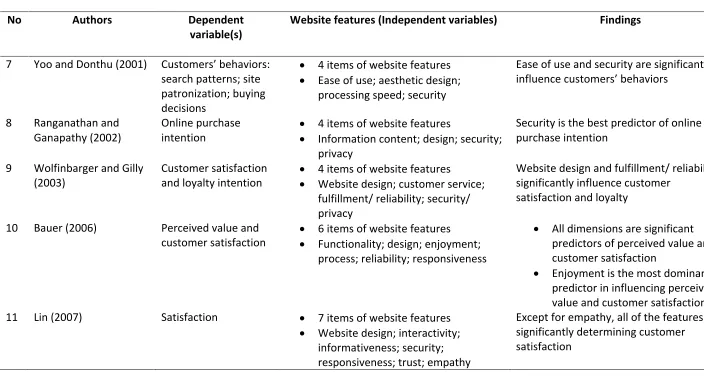
9 Table 2.1 Summary of website features according to information system and marketing studies
No. Authors Dependent
variable(s) Website features (Independent variables) Findings
1 Feinberg and Kadam
(2002) Customer satisfaction 42 items of website features • Product information, product highlight, preview product, site map, email, about company, local search, complaining ability, privacy policy, cross sell, online purchasing and check out are significantly has impacts on customer satisfaction 2 Khalifa and Shen (2005) Satisfaction • 13 items of website features
• Pre purchase (search capabilities; site customization; loyalty program; alerts)
• At purchase (Product customization; comparative shopping; dynamic pricing; payment methods; purchase conditions)
• Post purchase (problem solving; order tracking; web center; online
community)
• Search capabilities is the most important features determining satisfaction
• Product customization is the most important driver of satisfaction
• Problem solving is the strongest satisfaction factor in post purchase cycle
3 Sigala (2006a) Cultural dimensions: Power distance; individual; masculinity; uncertainty
avoidance; long-term orientation
• 6 items of website features
• Website contact interactivity; shopping convenience/care, service and quality; personalization of information/service/product; cultivation; community; website character
• Website contact interactivity and shopping convenience/care, service and quality are the most important e-CRM features
10 Table 2.1 (Continued)
No Authors Dependent
variable(s) Website features (Independent variables) Findings
4 Alhaiou et al. (2009) E-trust, E-satisfaction
and E-loyalty •• 8 items of website features Pre purchase (Site design; search capabilities; loyalty programs)
• At purchase (Security/privacy; payment methods)
• Post purchase (Order tracking; on-time delivery; customer service)
A conceptual framework
5 Ismail and Hussin
(2013) E-trust, E-satisfaction and E-loyalty •• 11 items of website features Pre purchase (website design; search capabilities; loyalty programs,
promotions)
• At purchase (information service; booking process; payment options; privacy/ security)
• Post purchase (problem solving; manage my booking; after sales service)
A conceptual framework
6 Szymanski and Hise
(2000) E-satisfaction •• 4 items of website features Convenience; merchandising (product offerings and product information); site design; financial security
11 Table 2.1 (Continued)
No Authors Dependent
variable(s) Website features (Independent variables) Findings
7 Yoo and Donthu (2001) Customers’ behaviors: search patterns; site patronization; buying decisions
• 4 items of website features
• Ease of use; aesthetic design; processing speed; security
Ease of use and security are significantly influence customers’ behaviors
8 Ranganathan and
Ganapathy (2002) Online purchase intention •• 4 items of website features Information content; design; security; privacy
Security is the best predictor of online purchase intention
9 Wolfinbarger and Gilly
(2003) Customer satisfaction and loyalty intention •• 4 items of website features Website design; customer service; fulfillment/ reliability; security/ privacy
Website design and fulfillment/ reliability significantly influence customer
satisfaction and loyalty
10 Bauer (2006) Perceived value and
customer satisfaction •• 6 items of website features Functionality; design; enjoyment; process; reliability; responsiveness
• All dimensions are significant predictors of perceived value and customer satisfaction
• Enjoyment is the most dominant predictor in influencing perceived value and customer satisfaction 11 Lin (2007) Satisfaction • 7 items of website features
• Website design; interactivity; informativeness; security; responsiveness; trust; empathy
Except for empathy, all of the features are significantly determining customer
[image:11.842.56.760.90.475.2]12 Table 2.1 (Continued)
No Authors Dependent
variable(s) Website features (Independent variables) Findings
12 Kim et al. (2009) E-trust, E-satisfaction
and E-loyalty •• 5 items of website features Fulfillment/ reliability; responsiveness; website design; security and privacy
• Fulfillment is the strongest predictor for both E-satisfaction and E-trust
• E-trust and e-satisfaction have a positive direct impact on e-loyalty 13 Chen (2010) Purchase intention • 8 items of website features
• Technology factors (security; privacy; usability)
• Shopping factors (convenience; trust; delivery)
• Product factors (product value; merchandising)
Usability, delivery, security, trust and convenience are significantly impacting on purchase intention
14 Shin et al. (2013) Customer satisfaction, trust, commitment, and repurchase intention
• 6 items of website features
• Shopping convenience; site design; informativeness, security; payment system; communication
• Customer communication is the most important factor and the lowest factor is transaction security to overall site quality
• Shopping convenience is the most important factors in satisfaction
• Website quality is positively associated with customer
13 Table 2.1 (Continued)
No Authors Dependent
variable(s) Website features (Independent variables) Findings
15 Bresolles (2014) Customer satisfaction • 7 items of website features
• Quality and quantity of information; ease of use; aesthetics; reliability and respect of commitments; security and privacy
The ease of use is the most important factors in predicting customer satisfaction
16 Yang (2015) Consumer
participation, positive eWOM and
co-shopping
• 5 items of website features
• Visual aesthetics; user friendliness; privacy/security; entertainment; community driveness
• Entertainment and community driveness have significant impacts on consumer participation
• The finding reveals that consumer participation has relationship with positive e-WOM and co-shopping 17 Blut (2016) Customer satisfaction,
repurchase intention and word of mouth
• 5 items of website features
• Website design; fulfillment; customer service; security and privacy
Website design has very strong
relationship with customer satisfaction, repurchase intention and positive word of mouth
18 Tandon et al. (2017) Customer satisfaction and repurchase intention
• 9 items of website features
• Ease of understanding; ease of use, ease of ordering, information
usefulness, security/privacy, website design, navigation, customization and consistency
• Navigation is the most important variables in influencing customer satisfaction and repurchase
intention, then followed by ease of understanding and information usefulness
14 Table 2.1 (Continued)
No Authors Dependent
variable(s) Website features (Independent variables) Findings
19 Pham and Ahammad
(2017) Customer satisfaction, repurchase intention and willing to pay more
• 9 items of website features
• Pre purchase (Product information; ease of use; website appearance; customization)
• At purchase (Ease of check out; security assurance)
• Post purchase (Order fulfillment; responsiveness of customer service; ease of return)
• Product information, ease of use, customization, ease of check out, and security assurance have significant impact on customer satisfaction
[image:14.842.40.808.95.284.2]15
2.2 Examination of website features from perspectives of e-CRM and website
service quality
Table 2.1 is provided to compare the website features that studied in the perspective of e-CRM and service quality. The study from the perspective of e-CRM is presented in Table 2.1 from number 1 to 6. Meanwhile, the study from the point of view of service quality is showed from number 7 to 19. From Table 2.1, we can find several similarities and differences of website features that have identified by previous researchers. Lee and Kozar (2002) explain that the differences in website features identified by the prior studies occur because of two potential reasons.
First, each of the studies defined the website features in different terminology. In the perspective of e-CRM, Ismail and Hussin (2013) emphasize e-CRM features as the functionality and essential tools provided by the website. Hosseini et al. (2016) further explained that these features constitute the concrete website of internet-based tools that facilitate the interaction between the customers and the e-commerce business. Feinberg and Kadam (2002) have investigated 42 website features providing e-CRM functionality. In contrast to Feinberg and Kadam (2002), the study conducted by Khalifa and Shen (2005), Alhaiou et al. (2009), and Ismail and Hussin (2013) analyzed the website features according to the online purchasing cycle. While, from another approach, Sigala (2006) investigate the correlation of cultural dimensions on e-CRM implementation. Hence, in total, the number of website features identified by researchers ranges from 6 (Sigala, 2006) to 42 dimensions (Feinberg and Kadam, 2002).
In the perspective of marketing, the aforementioned studies consider e-commerce website features similar to overall e-commerce website service quality. Those researches treat website service quality as the customer’s judgment of overall quality of a website according to the customer’ viewpoint and treat is as the extent to which a website facilitates efficient and effective shopping, purchasing, and delivery which cover customer purchasing experience from the pre-purchase until post-purchase (Shin et al., 2013 and Blut, 2016). The number of website features identified by researchers ranges from 4 to 9 dimensions.
Secondly, the researchers from different disciplines define the website features differently depending on the objectives to accomplish (enhance customer satisfaction, customer retention, and customer loyalty). Consequently, those varieties of terminology resulted in lack of consensus and confusion in describing and interpreting the general website attributes or features (Lee & Kozar, 2012).
16
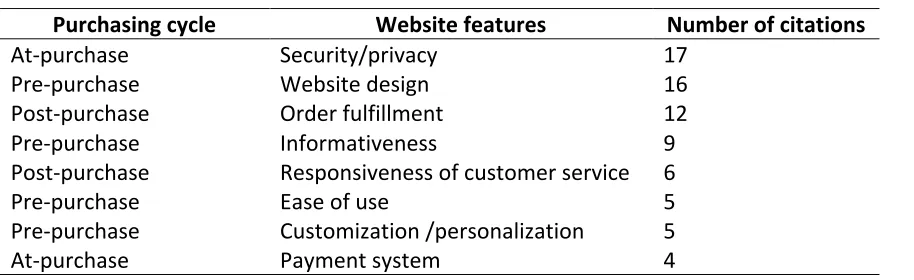
Table 2.2 The website features that are mostly cited from Table 2.1
Purchasing cycle Website features Number of citations
At-purchase Security/privacy 17
Pre-purchase Website design 16
Post-purchase Order fulfillment 12
Pre-purchase Informativeness 9
Post-purchase Responsiveness of customer service 6
Pre-purchase Ease of use 5
Pre-purchase Customization /personalization 5
At-purchase Payment system 4
2.3 Online purchasing cycle
In 1969, Howard and Sheth (Howard & Sheth, 1969) have introduced the framework of the purchasing process. According to them, the process can be categorized into five stages: problem recognition, information search, evaluation of alternative, purchase decision, and post-purchase activities. From another approach, Chircu and Mahajan (2006) conceptualized the online retail purchasing process as a sequence steps, including store access, search, evaluation and selection, ordering, payment, order fulfillment, and post-sale service. In one hand, the idea proposed by Chircu and Mahajan (2006) is helpful for keeping track of specific activities in the online shopping process. In the other hand, in the reality, the concept that proposed by Chircu and Mahajan (2006) sometimes does not represent the concrete steps of purchasing process described by Chircu and Mahajan (2006).
17
2.4 Conceptual framework
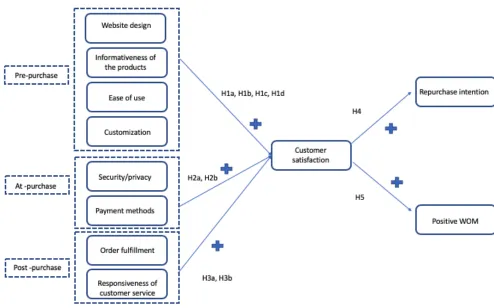
[image:17.595.51.545.280.588.2]The concept of this study is to construct general features of the website by incorporating the features on the website from the perspective of e-CRM and website service quality as the previous studies are lack of consensus in determining the features on a website. The variables of the website features were chosen according to the website features that have been persistently cited by the previous research (See Table 2.2). By identifying the general features on the website, the researcher will be able to verify the association of website features in different stages of purchasing cycle on customer satisfaction. Subsequently, the outcomes of customer satisfaction, which are repurchase intention and positive word-of-mouth will be further investigated. The figure 1 shows the conceptual framework in this study.
18
2.5 Pre-purchase cycle and customer satisfaction
In this cycle, the activities that conducted by the customers include searching product information, comparing various of alternatives, and checking the reviews from the other customers in order to make the best buying decision (Klaus, 2013). Based on the prior studies, four variables were chosen in the pre-purchase cycle: website design, informativeness, ease of use, and customization/personalization.
2.5.1 Website design
The website design refers to all elements on the website which includes navigation, information search, order processing, and appropriate personalization and product selection experienced by the customers (Kalia, 2017). From other perspectives, the website design is characterized based on the graphics, aesthetics, store layout, and proper display of products (Tandon, Kiran, & Sah, 2017). Tandon et al. (2017) argue that Website design is one of the important factors that influence customer perceptions as it is the first determinant observed by the online customers. In the study conducted by Wolfinbarger and Gilly (2003) reveal that website design significantly influence customer satisfaction. The result is consistent with Lin (2003) who describe that website design is the strongest determinant of customer satisfaction. Therefore, the researcher proposes that:
Hypothesis 1a: Well-designed web has a positive impact on customer satisfaction
2.5.2 Informativeness of the product
In the context of e-commerce, before makes a purchase, customers try to seek for the information of the products. The customers heavily depend on the information provided by the online retailers as it facilitates them to predict the quality and utility of the product. Wolfinberger and Gilly (2003) argue that it is important to provide comprehensive and in-dept information to the customers as it influences the purchasing decision of customers. Aside from that, up-to-date, relevant, sufficient, and easy to understand information helps the customers to make a purchase decision (Pham & Ahammad, 2017). Therefore, in order to enhance customer satisfaction, retailers have to provide accurate and up-to-date information about the products to the customers (Tandon, Kiran, & Sah, 2017). The more extensive product information provided by the retailers on the website, the more customers’ perceived satisfaction (Jiang & Rosenbloom, 2005). The result is consistent with Pham and Ahammad (2017) where informativeness of the product positively influence customer satisfaction. Hence, the following hypothesis is proposed:
Hypothesis 1b: High informativeness of the product will have a significant positive effect on customer satisfaction
2.5.3 Ease of use
19
Hypothesis 1c: Ease-of-use of the website has a positive impact on customer satisfaction
2.5.4 Customization
Site customization refers to the ability of the e-commerce website to identify the customers’ specific needs, interest, and preferences and then tailor the choice of products (Thirumalai & Sinha, 2011). The prior researchers have emphasized the importance of providing product information relevant to customers (Srinivasan et al., 2002, Rose et al., 2012). Srinivasan et al., (2002) concluded that by customizing the website, it can help the customers to reduce their frustration. In the same vein, Häubl and Trifts (2000) demonstrate that customization will reduce the time consumption of customers spent when seeking something that they wish. This resulting to the increase of overall quality of their purchase decision (Häubl & Trifts, 2000). Besides, it enables the customers to complete their transactions more efficiently (Srinivasan et al., 2002). In line with the previous arguments, the researcher proposes that customization on the website will increase customer satisfaction.
Hypothesis 1d: Customization significantly influence customer satisfaction
2.6 At-purchase cycle and customer satisfaction
In this stage of the online purchasing process, usually, customer already makes a decision and selection of the product that they would like to purchase. Moreover, in this stage, the customers will execute the purchase action and fulfill the transaction by placing the order and paying for the product (Khalifa & Shen, 2005).
2.6.1 Security/privacy assurance
At the purchase stage, the customers have to reveal the details of their personal information and payment. The dimension of security/privacy assurance is crucial for the customers because it is related to the ability of the website to protect the personal information of customers and makes the customers believe that paying online is secure (Turban, King, Lee, & Viehland, 2006). The previous literature has proposed a mechanism to safeguard the online transaction. Ranganathan and Ganapathy (2002) suggested that creating a personal account with an ID and password can reduce customer fears and anxiety. Pham and Ahammd (2017) confirm that there is a positive effect of security/privacy assurance on customer satisfaction. Therefore, Tandon et al. (2017) suggest that since security and privacy still a main concern for online customers, therefore, the e-commerce business has to provide best security as it is the fundamental matter. Thus, the researcher proposes:
Hypothesis 2a: Security and privacy assurance has a positive impact on customer satisfaction
2.6.2 Payment system
20 make a repurchase. Thus, the following hypothesis is provided to investigation the association between payment system/ method on e-commerce website and customer satisfaction.
Hypothesis 2b: Payment system on a website has a positive relationship with customer satisfaction
2.7 Post-purchase cycle and customer satisfaction
The post-purchase is the final stage for customers after purchasing a product. In this stage, the customers will have a customer service interaction and evaluate their online purchasing experience, for instance, services provided by retailers as product delivery, customer service, and product return. According to Kotler (1997), the post-purchase cycle is an essential part of customer experience because, in this cycle, the customers are finally able to examine the product, as a consequence, it will give impact on the customers’ future behavior.
2.7.1 Order fulfillment
In the context of e-commerce, the customers are not only evaluating the products that offered through the website, but also how their need is fulfilled (Wolfinbarger and Gilly, 2003). Order fulfillment refers to the ability of the retailers to provide the promised products dependably and accurately (Stank, Goldsby, Vickery, & Savitskie, 2003). More precisely, the retailers’ ability to deliver the right amount of the right product at the right place at the right time in the right condition at the right price with the right information (Stock & Lambert, 2001). Some research has found evidence that customer satisfaction is increased when they receive the product in the expected time, get the exact product that ordered, and receive the product in a promised condition (Collier & Biestock, 2006). Study result of Wolfinbarger and Gilly (2003) indicated that order fulfillment is the most crucial factor in determining customer satisfaction. The result is constant with Blut (2016). He suggested that it is important for the retailers to take account and ensure timeliness of delivery, the accuracy of orders, and condition of delivered products. Hence, the following hypothesis is proposed:
Hypothesis 3a: Order fulfillment directly contribute to customer satisfaction
2.7.2 Responsiveness of customer service
Responsiveness refers to the extent to which the retailer’s response quickly and helpful to customer request, complaints, returns during or after the purchasing process. Some previous studies have implied that there is a strong relationship between customer satisfaction and service quality of which responsiveness is perceived as an important dimension in e-commerce context (Gounaris, Dimitriadis, & Stathakopoulos, 2010). The study conducted by Holloway and Beatty (2008) validated that reliable customer service and well-communicated return/exchange policies are important dimensions to enhance customer satisfaction. Blut (2016) indicated that excellent customer service drives customers to pay more to receive the service. Based on the above arguments, the researcher proposes:
21
2.8 Outcomes of customer satisfaction: Repurchase intention and positive
word-of-mount (WOM)
Customer satisfaction has been widely acknowledged used to predict behavioral intention (Wang & Head , 2007). In the context of e-commerce, Lin (2007) reveals that customer satisfaction often leads to favorable outcomes such as repurchase intention and positive word-of-mouth. The result of a study conducted by Abdul-Muhmin (2010) is consistent with Lin (2007). In their study, they confirmed that overall satisfaction with the entire process of online purchasing experience significantly influencing the repurchase intention of customers in the future. Several studies have found evidence of a positive association between repurchase intention and customer satisfaction (Pham and Ahammad, 2017; Rose et al., 2012; Sriinivasan et al., 2002). Given these evidences, the researcher proposes that:
Hypothesis 4: Customer satisfaction will positively influence the repurchase intention
In the context of e-commerce, repurchase intention is not the only outcomes of customer satisfaction, but also positive word-of-mouth. When the customers are satisfied, they are more likely to provide positive comments (Srinivasan et al., 2002). In contrast, when the customers are not satisfied, they are more likely provide negative comments and shift to other platforms of e-commerce website and become more resistant to revisit that website (Kim, Jin, & Swinney, 2009). A study by Pham and Ahammad (2017) verified that satisfied customers are likely to spread positive word-of-mouth. In the same line, Blut (2016) indicate the overall website quality has a significant influence on positive word-of-mouth. Hence, the researcher proposes:
22
3. Methodology
3.1 Data collection
To validate the correlation of website features in the different purchasing cycle on customer satisfaction and association of customer satisfaction on repurchase intention and positive word-of-mouth, the researcher distributed the questionnaire. To make it easy and convenient, the questionnaire was distributed online. The following parameters guided the sample selection. First, based on shopping behavior, the researcher wanted customers who had an online purchase experience in certain e-commerce platforms in Indonesia, since the researcher is interested in the entire online purchasing experience. Second, according to customer demographics, the researcher wanted to make sure that the respondents between the age of 17 years old and 50 years old because those age groups are mostly the active users of the internet and having a buying power.
The respondents were selected using a convenience sampling method. The convenience sampling method primarily used because it is considered easy to collect the sampling frame since they are reachable and accessible. Besides that, it is considered inexpensive and least time-consuming. Since the focus of the study was in Indonesia and the respondents are Indonesian, accordingly, the questions of the survey will be translated from English to Indonesia. Both of English and Indonesian version of the survey will be provided in Appendix 1 and 2.
Before data collection, the researcher distributed preliminary questionnaires to a pilot group which consists of 20 persons. The purpose of the pre-test is to make sure that the respondents get the questions correctly and to make sure that the questions have proper translations. The pilot group was asked to answer the questionnaires, evaluate, and suggest some changes in the language and arrangement of the questionnaires. After obtaining feedback from a pilot group, the wording and arrangement of the questionnaires were modified and then distributed to the respondents. Qualtrics was used to construct the questionnaire and the link of the form was sent to the respondents via social media, such as WhatsApp, LINE, Facebook, and Instagram.
3.2 Survey instrument
23 to rate their degree of agreement of the e-commerce website they visited most frequently on various aspects of website features, for instance, website design, informativeness of the product, ease of use, customization, security/ privacy, payment system, order fulfillment, and responsiveness of customer service. Each item of the website features was measured on a 5-point Likert scales from 1 (strongly disagree) to 5 (strongly agree). A Likert scale is suitable for measuring attitude and the most common format of Likert scales is a 5-point scale and 7-point scale where the middle position indicating neutrality (Bryman, 2012). However, in this case, a 5-point scale is more favorable compared to 7-point scale as Revilla, Saris, and Krosnick (2014) shows that the quality of coefficients decreases as the number of categories increases. Hence, they suggested using 5-point rather than a 7-point Likert scale. The final part included the demographic information, such as gender, age, and education level. All of the questions were marked as ‘required’ thus the questionnaire has a high completion rate. This technique was used to make sure that the respondents filled and completed the whole questionnaire.
3.3 Measurements
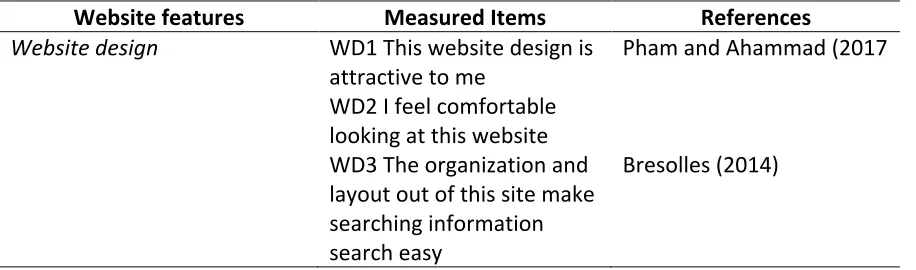
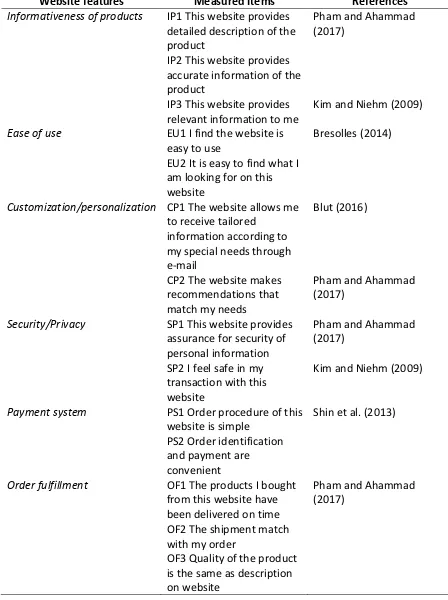
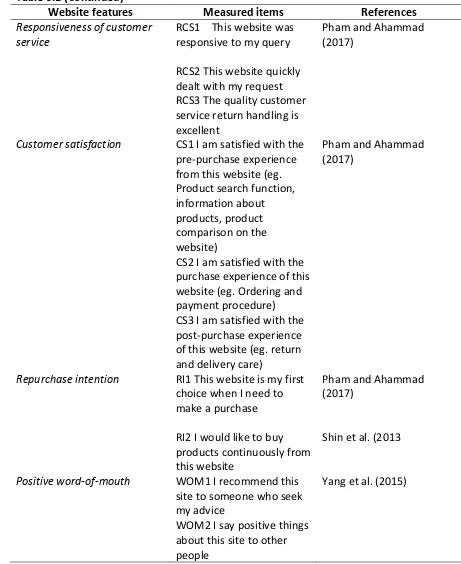
[image:23.595.73.531.619.754.2]The measures of the items for this research were adapted from existing scales used in previous studies. The items of each website features were chosen according to its reliabilities reported by previous studies. All the items showed the Cronbach’s reliability coefficient higher than the minimum threshold value of 0,65 proposed by Lee and Kim (1999) or 0,72 suggested by Nunnally (1978) were chosen. The measurement items are provided with references are shown in Table 3.1 below. Three items were used to measure the variable of website design (Pham and Ahammad, 2017; Bresolles, 2014). Informativeness of products was measured using the items from Pham Ahammad (2017) and Kim and Niehm (2009). Ease of use was measured using items from Bresolles (2014). Two items were adapted from Blut (2016) and Pham and Ahammad (2017) to measure customization/personalization. Two items measuring security/privacy were adapted from Pham and Ahammad (2017) and Kim and Niehm (2009). The payment system was measured by using two items proposed by Shin et al. (2013). Order fulfillment was measured by using three items adapted from Pham and Ahammad (2017). Responsiveness of customer service was measured with three items proposed by Pham and Ahammad (2017) and Blut (2016). Three items were used to measure the variable of customer satisfaction (Pham and Ahammad, 2017). Repurchase intention was measured using two items from Pham and Ahammad (2017) and Shin et al. (2013). Lastly, positive word-of-mouth was measured by using two items adopted from Yang et al. (2015). All items were measured with a 5-point Likert scale.
Table 3.1 Measurement scales
Website features Measured Items References
Website design WD1 This website design is
attractive to me Pham and Ahammad (2017
WD2 I feel comfortable looking at this website WD3 The organization and layout out of this site make searching information search easy
24
Table 3.1 (Continued)
Website features Measured Items References
Informativeness of products IP1 This website provides detailed description of the product
Pham and Ahammad (2017)
IP2 This website provides accurate information of the product
IP3 This website provides
relevant information to me Kim and Niehm (2009)
Ease of use EU1 I find the website is
easy to use Bresolles (2014)
EU2 It is easy to find what I am looking for on this website
Customization/personalization CP1 The website allows me to receive tailored
information according to my special needs through e-mail
Blut (2016)
CP2 The website makes recommendations that match my needs
Pham and Ahammad (2017)
Security/Privacy SP1 This website provides assurance for security of personal information
Pham and Ahammad (2017)
SP2 I feel safe in my transaction with this website
Kim and Niehm (2009)
Payment system PS1 Order procedure of this
website is simple Shin et al. (2013)
PS2 Order identification and payment are convenient
Order fulfillment OF1 The products I bought from this website have been delivered on time
Pham and Ahammad (2017)
OF2 The shipment match with my order
[image:24.595.71.519.94.694.2]25
Table 3.1 (Continued)
Website features Measured items References
Responsiveness of customer
service RCS1 This website was responsive to my query Pham and Ahammad (2017)
RCS2 This website quickly dealt with my request RCS3 The quality customer service return handling is excellent
Customer satisfaction CS1 I am satisfied with the pre-purchase experience from this website (eg. Product search function, information about products, product comparison on the website)
Pham and Ahammad (2017)
CS2 I am satisfied with the purchase experience of this website (eg. Ordering and payment procedure) CS3 I am satisfied with the post-purchase experience of this website (eg. return and delivery care)
Repurchase intention RI1 This website is my first choice when I need to make a purchase
Pham and Ahammad (2017)
RI2 I would like to buy products continuously from this website
Shin et al. (2013
Positive word-of-mouth WOM1 I recommend this site to someone who seek my advice
Yang et al. (2015)
[image:25.595.62.523.83.647.2]26
3.4 Data Analysis
3.4.1 Multiple regression analysis
Multiple regression analysis is suitable to examine the correlation between two or more metric predictor (Independent) variables and one metric dependent (criterion) variable (McDaniel & Gates , 2015). In this case, firstly, the researcher has to measure the correlation of website features on customer satisfaction, to ensure that there is no multicollinearity problem. When multicollinearity problem is not found, then the multiple regression analysis can be used. The website features which consist of website design; informativeness of products; ease of use; customization/personalization; security/privacy; payment system; order fulfillment and responsiveness of customer service will be treated as independent variables. While customer satisfaction was treated as a dependent variable. To measure the correlation between website features and customer satisfaction, the researcher used the general equation for multiple regression as follows:
Equation 1:
!"# = α + '()*() + '+,*+,+ '-. *-.+ '0, *0,+ '1, *1,+ ',1 *,1 + '23 *23
+ '401*401 + 5
3.4.2 Linear regression analysis
One way to study the relationship of customer satisfaction on repurchase intention and positive word-of-mouth is to plot the data in a scatter diagram. By examining the scatter diagram, one can determine whether the relationship between the two variable is linear. In Appendix 3 and Appendix 4, it shows that the relationship of customer satisfaction on repurchase intention and positive word-of-mouth appears to be linear. Therefore, linear regression is appropriate to be used in this study. In this case, the simple linear regression was conducted twice, as we would like to know to what degree of association between customer satisfaction (independent variable) on repurchase intention (dependent variable) and customer satisfaction (independent variable) on positive word of mouth (dependent variable). Therefore, the equations presented as follows:
Equation 2:
67# = 8 + '01*01 +5
Equation 3:
27
4. Results
4.1 Sample
[image:27.595.92.503.361.721.2]A total of 285 respondents were collected and 228 usable data were obtained after discarding 57 questionnaires due to the incompleteness of the response. The respondents of this study were people who had shopping experienced in e-commerce website in Indonesia. The survey was conducted from 8th July until 18th July 20019. The table below shows the shopping behavior and demographic characteristics of the respondents. Based on the demographic characteristics, the result shows that 75% of the respondents were females. The largest age group was 23-28 years old (68.4%), followed by 29-34 years old (10.1%), 17-22 years old (8.3%), 41-46 years old and over 47 years old (4.8%), lastly, the remaining 3.5% were between 35-40 years of age. The academic attainment of the respondents was relatively high. The majority of respondents (63.6%) had a bachelor’s degree, moreover, 9.6% of respondents had a master’s degree. According to the shopping behavior, the e-commerce websites that mostly visited by the respondents is Tokopedia (43.9%) and followed by Shopee (32.9%). Approximately, 52.2% of respondents have visited the e-commerce website at least 1-5 times in a month, subsequently 18.9% of respondents who had visited the website in 6-10 times in a month.
Table 4.1 Shopping behavior of the sample and demographic characteristics, n=228
Frequency %
E-commerce platforms mostly
visited Bukalapak 9 3.9
Tokopedia 100 43.9
Lazada Indonesia 14 6.1
Shopee 75 32.9
Blibli 4 1.8
JD.ID 10 4.4
Bhineka 1 0.4
Other 15 6.6
Number of visits in a month 1 Less than 1 time 24 10.5
2 1-5 times 119 52.2
3 6-10 times 43 18.9
4 11-20 times 25 11
5 21-30 times 6 2.6
6 More than 30 times 11 4.8
Gender Male 57 25
Female 171 75
28
Table 4.1 (Continued)
Frequency %
Age 17-22 years old 19 8.3
23-28 years old 156 68.4
29-34 years old 23 10.1
35-40 years old 8 3.5
41-46 years old 11 4.8
Over 47 years old 11 4.8
Education High school 19 8.3
Diploma's degree 42 18.4
Bachelor's degree 145 63.6
Master's degree 22 9.6
4.2 Measurement model
There were two ways to assess multicollinearity. The obvious way to identify multicollinearity is by examining the correlation matrix on the independent variables. The first indication of the presence of multicollinearity is the presence of high correlations (0.9 and higher) among independent variables (Hair, Black, Babin, & Anderson, 2014). The next step was using collinearity statistics (Variance Inflation Factor/ VIF). A value of VIF below 10 indicates no multicollinearity problem (Besley, Kuh, & Welsch, 1980). Table 4.2 list the descriptive statistic and the correlation matrix. Based on the correlation matrix, the multicollinearity problem was not found in this study. Besides, the VIF value ranged from 1.29 to 1.00 and the tolerance values ranged from 0.55 to 1.00. This would suggest that multicollinearity did not appear to be an issue in this study.
All data presented on table 4.2 was collected from 228 respondents. The first notable information from the table is the high correlation between the responsiveness of customer service and customer satisfaction (r= .559**), followed by payment system (r= .535**), and order fulfillment respectively (r=.520**). When the customers perceive that the e-commerce platforms responsive to the customers’ request, problems, and handling the product return quickly, the customers are satisfied. This indicates that the responsiveness of customer service becomes the most important factor in the post-purchase stage.
[image:28.595.91.506.93.312.2]29 satisfaction as well. The research by Rao, Griffis, and Goldsby (2011) found an indication that customer satisfaction has been associated with order fulfillment as well. This suggesting that when the e-commerce provides the promised service by delivering the right products on the right amount at the right place at the right time in the right condition at the right price with the right information, is more likely that the customers will be satisfied.
Furthermore, it can be indicated that the other website features, namely website design (r= .408**), informativeness of products (r= .369**), ease of use (r= .472**), customization/personalization (r= .356**), and security/ privacy (r= .460**) have a positive association with customer satisfaction. Even though the value of those aforementioned website features is below responsiveness of customer service (r= .559**). Which suggesting that the aforementioned website features have weaker association compared to responsiveness of customer service.
30 4.2 Descriptive statistics and Correlation matrix
(1) (2) (3) (4) (5) (6) (7) (8) (9) (10) (11) Mean S.D.
(1) Customer satisfaction 1 11.745 1.406
(2) Repurchase intention .456** 1 7.469 1.505
(3) Positive WOM .448** .476** 1 7.644 1.259
(4) Website design .408** .325** .379** 1 11.324 1.766
(5) Informativeness of products .369** .278** .294** .496** 1 11.399 1.656
(6) Ease of use .472** .425** .362** .510** .370** 1 8.245 1.002
(7) Customization
/personalization .356** .190** .282** .248** .433** .176** 1 7.122 1.277
(8) Security privacy .460** .291** .310** .298** .389** .343** .338** 1 7.649 1.223
(9) Payment system .535** .399** .421** .273** .371** .534** .144* .478** 1 8.364 1.025
(10) Order fulfillment .520** .437** .379** .273** .440** .421** .188** .375** .497** 1 11.679 1.742
(11) Responsiveness customer
service .559** .374** .411** .320** .430** .310** .358** .333** .321** .473** 1 10.662 1.970
Notes:
**Correlation is significant at the 0.01 level (2-tailed)
31
4.3 Hypothesis testing
4.3.1 Regression analysis
Multiple regressions are a statistical tool to systematically analyze the relationship between one dependent variable with two or more independent variables. To be classified as significant, the relationship of the dependent variable and independent variables needs the result of p-value to be < 0.05. Firstly, multi regression analysis was used to examine the relationship of customer satisfaction and website features which consist of website design, informativeness of products, ease of use, customization/personalization, security/privacy, payment system, order fulfillment, and responsiveness of customer service. This study was using causal studies to analyze whether a change in one variable will affect another variable(s).
The table 4.3.1 shows the summary of multi regression analysis between customer satisfaction and website features. Within the model, the positive impacts of website features in the pre-purchase stage namely website design (p= 0.008) and personalization/customization (p= 0.004) on customer satisfaction have been confirmed. In contrast, the informativeness of products (p= 0.022, B= -0.121) and ease of use (p= 0.156, B= 0.122) are not accepted as the informativeness of products is significantly has a negative relationship toward customers satisfaction. Additionally, the finding shows that website feature of ease of use is not statistically significant. In the at-purchase stage, the positive relationship toward customer satisfaction is only can be found in the payment system (p= 0.000). Meanwhile, security/privacy (p= 0.057) has to be rejected since the result is not significant. In the post-purchase stage, all of the website features specifically order fulfillment (p= 0.003) and responsiveness of customer service (p=0.000) are significantly has a positive impact on customer satisfaction. Therefore, hypothesis H1a, H1d, H2b, H3a, and H3b are accepted.
After the multiple regression was conducted. The researcher examined the linear regression of customer satisfaction on repurchase intention and positive WOM. The empirical results also confirm for positives outcomes of customer satisfaction on repurchase intention (p= 0.000) and positive word-of-mouth (p= 0.000). Hence, it can be concluded that customer satisfaction is significantly has a positive impact on repurchase intention and positive word-of-mouth. Hypothesis H4 and H5 are accepted.
4.3.1 Summary of multi regression analysis- Customer satisfaction
Variables Parameter Result
Intercept 1.879(.679)**
Website design (H1a) .124(.046)** Supported
Informativeness of products (H1b) -.121(.052)* Not supported
Ease of use (H1c) .122(.086) Not supported
Customization/Personalization (H1d) .171(.059)** Supported
Security/privacy (H2a) .123(.064) Not supported
Payment system (H2b) Order fulfillment (H3a)
Responsiveness of customer service (H3b)
.335(.084)** .141(.048)** .207(.040)** Supported Supported Supported
R squared .524
32 By using the multi regression equation, the prediction of customer satisfaction is estimated as follows:
!"# = 1.879 + .124-. − .12101 + .12223 + .171!1 + .123"1 + .3351" + .14167 + .2079!"
4.3.2 Summary of linear regression analysis- Repurchase intention
Variables Parameter Result
Intercept 1.738(.750)*
Customer satisfaction .488(.063)** Supported
R squared .204
Notes:**Significant at the 0.01 level. *significant at the 0.05 level.
The mathematical equation for the relationship of customer satisfaction on repurchase intention wrote as follows:
90# = 1.738 + .488!"
This indicates that the repurchase intention is predicted to increase by .488 when customer satisfaction variable goes up by one and is predicted to be 1.738 when customer satisfaction is zero.
4.3.3 Summary of linear regression analysis- Positive WOM
Variables Parameter
Intercept 2.928(.630)**
Customer satisfaction .402(.053)** Supported
R squared .198
Notes:**Significant at the 0.01 level. *significant at the 0.05 level.
The model of positive word-of-mouth is estimated as follows:
-6:; = 2.928 + .402!"
33
5. Discussion and conclusion
5.1 Discussion of findings
[image:33.595.75.515.335.598.2]This study represents an attempt to explore the impact of website features in different stages of purchasing cycle on customer satisfaction by incorporating the IS and marketing perspectives. Aside from that, how customer satisfaction influence repurchase intention and positive WOM (word-of-mouth) is also investigated. The purpose of incorporating the website features between IS and marketing perspective is to construct a general website features and to avoid multifaceted dimensions of website features which resulting in a confusion. Lee and Kozar (2012) explained that the confusion arises due to the different terminology used by the information system and marketing studies. Therefore, the researcher examined the website features that have been consistently cited from both studies. The result shows that the most cited website features are website design, informativeness of the products, ease of use, customization/personalization, security/privacy, payment system, order fulfillment, and responsiveness of customer service. In this case, the researcher categorized the website features according to the purchasing cycle which consists of pre-purchase, at-purchase, and post-purchase. The main results of this study are discussed below.
Figure 2 Hypotheses testing result
34 needs and preferences without having to spend time on searching from thousands of products on the website. As the website design becomes the first determinant observed by online customers, hence, it drives customer satisfaction as well. The research by Rose et al. (2012) also highlight the website design is important to impress the customers when they visit the website for the first time.
On the contrary, the researcher found that informativeness of products has a negative impact on customer satisfaction. The researcher failed to prove the effect of informativeness of products as evidenced in Wolfinberger and Gilly (2003), Jiang and Rosenbloom (2005), Lin (2007), Tandon et al. (2017) and Pham and Ahammad (2017). The possible explanation for this negative result may be due to inadequate information about the products on the website which provided by the seller. The researcher figured out that in one of Indonesia e-commerce, namely, Tokopedia, the sellers are not required by the company to describe the products. It is optional for the sellers to provide information. As a result, the customers have to contact the seller via chat to get in-depth information. This suggesting that e-commerce company has to require the seller to provide accurate and relevant information. Furthermore, ease of use was found least significant of all variables in the pre-purchase stage. This finding was not consistent with Bresolles (2014) study which found that ease of use is the most important factor in predicting customer satisfaction. The possible reason behind it because his study is focused in French where the people are more technology-savvy despite the age group of respondents in his study 34% were above 45 years of age. This indicates that the online customers in Indonesia, especially whose over 40 years old still find difficulties to order the products on the website as they find that the interface for the transaction is complicated and hard to be understood.
On one hand, the study identified that online security/privacy dimension was least significant to enhance customer satisfaction. There might be fear from the online customers in Indonesia to share their personal information. The finding implying that the e-commerce company should improve its security by utilizing secure modes for online transaction in order to protect the confidential information of online customers. As a result, it helps to increase the levels of customer satisfaction towards online security/privacy in the future. On the other hand, the effect of payment method on customer satisfaction is stronger in the at-purchase stage compared to security/privacy dimension. This is because the customer perceived that the identification of order and payment system is simple, fast, and convenient which enhance customer satisfaction.
35 well-communicated and return and exchange policies is an important factor driving customer satisfaction.
In this study, the researcher hypothesized that customer satisfaction has both direct effects on repurchase intention and positive word-of-mouth. Customer satisfaction is positively associated with repurchase intention. This is consistent with findings in previous studies (Tandon et al., 2017; Pham and Ahammad, 2017; Abdul-Muhmin, 2010; Lin, 2007; Rose et al., 2012; Sriinivasan et al., 2002). This suggests that when online customers are satisfied with the overall purchasing experience, they tend to make a repeat purchase in the future. Further, positive word-of-mouth emerged as an important outcome of customer satisfaction as well. The similar result also can be found in the previous studies (Pham and Ahamma, 2017; Blut, 2016) which emphasize that when customers are satisfied with their purchasing experience, they likely to spread and provide their positive experience.
5.2 Practical Implications
36
5.3 Theoretical implications
37
6. Limitations and suggestion for future research
There are several limitations in conducting this study. First, this study was conducted with a limited sample size, which is only 228 respondents. Aside from that, the imbalance of between the number of male and female participating in this study was found as the majority of participants were female. Thus, this may not represent the number of populations who had online purchasing experiences. Moreover, since the researcher used a convenience sampling method, the research sample was chosen based on friends, families, and the social network contact trusting their willingness to participate in this study. To overcome the aforementioned limitations, the future researcher may benefit from employing online social forums, such as Reddit, to increase the representativeness of the sample. The current study focuses on the outcomes of customer satisfaction, namely, repurchase intention and positive word-of-mouth. The future researcher can also examine the other predictor, for instance, customer trust, customer loyalty, and customer commitment.
38
Appendices
Appendix 1. Questionnaire in English version
Thank you for participating in this study! This study has a purpose to examine the
correlation of customer satisfaction on repurchase intention and positive word-of-mouth in online purchasing experiences. If you had online purchasing experiences on Indonesia e-commerce platforms, please answer the questions below. You will be asked to rate the degree of agreement of the Indonesia e-commerce website you visited most frequently on various aspects of website features. Your identity and your answers will be treated
confidentially. The data and results of this study are solely used for the purpose of my graduation assignment. If you still have any questions left, you can write an e-mail to: [email protected]
1. Have you ever shopped at online shopping website? A. Yes B. No
2. Please choose one of the e-commerce website you mostly visited in the past month A. Bukalapak
B. Tokopedia C. Lazada Indonesia D. Shopee
E. Blibli F. Elevenia G. JD.ID
H. Matahari Mall I. Bhineka
J. Other (….)*Fill in your own answer*
3. How often you visit the website in a month? A. < 1 time
39 Instruction: The questions below relate to your evaluation or judgment of the aspects of website features on the website you mostly visited above. Please choose one out of five available answers that suits you the best
1 Strongly disagree 2 disagree
3 Neutral 4 agree
40 Response
Website features Questions 1.
Strongly disagree
2.
Disagree 3.Neutral Agree4. 5Strongly . agree
Website design This website design is attractive to me
I feel comfortable looking at this website
The organization and layout out of this site make searching
information search easy
Informativeness
of products This website provides detailed description of the product This website provides accurate information of the product This website provides relevant information to me
Ease of use I find the website is easy to use
It is easy to find what I am looking for on this website
Customization
/personalization The website allows me to receive tailored information according to my special needs through e-mail The website makes
recommendations that match my needs
Security/privacy This website provides assurance for security of personal information I feel safe in my transaction with this website
Payment system Order procedure of this website is
simple
Order identification and payment are convenient
Order fulfillment The products I bought from this website have been delivered on time
The shipment match with my order Quality of the product is the same as description on website
Responsiveness of
41 Please fill in your personal information
5. Gender: A. Male B. Female
6. Age: A. 17-22 B. 23-28 C. 29-34 D. 35-40 E. 41-46 F. Over 47
The quality customer service return handling is excellent
Customer
satisfaction I am satisfied with the pre-purchase experience from this website (eg. Product search function,
information about products, product comparison on the website)
I am satisfied with the purchase experience of this website (eg. Ordering and payment procedure)
I am satisfied with the
post-purchase experience of this website (eg. return and delivery care)
Repurchase
intention This website is my first choice when I need to make a purchase I would like to buy products
continuously from this website
Positive
42 7. Education level:
A. High school diploma B. In university
C. University graduate D. In graduate school E. Master’s
D. Other(….)*Fill in your own answer*
Appendix 2. Questionnaire in Indonesian version
Terima kasih atas partisipasinya dalam penelitian ini. Pada saat ini saya sedang mengadakan penelitian mengenai “Website features on e-commerce website in Indonesia: The effect of customer satisfaction on repurchase intention and positive word-of -mouth.” Jika Anda pernah memiliki pengalaman dalam berbelanja Online, silahkan mengisi kuesioner dibawah ini. Data kuesioner ini murni digunakan untuk kepentingan studi saya. Saya menjamin identitas dan kerahasiaan identitas dan jawaban Anda. Jika Anda memiliki pertanyaan mengenai kuesioner ini, silahkan menghubungi melalui e-mail di
1. Apakah Anda pernah berbelanja di situs online shopping? A. Pernah B. Tidak pernah
2. Silahkan pilih satu e-commerce website yang paling sering Anda kunjungi dalam satu bulan terakhir
A. Bukalapak B. Tokopedia C. Lazada Indonesia D. Shopee
E. Blibli F. Elevenia G. JD.ID
43 J. Lainnya (….)
3. Seberapa sering Anda mengunjungi website tersebut dalam satu bulan? A. < 1 kali
B. 1-5 kali C. 6-10 kali D. 11-20 kali E. 21-30 kali F. > 30 kali
Instruksi:Pertanyaan-pertanyaan dibawah ini berkaitan dengan penilaian Anda mengenai berbagai macam aspek dalam fitur situs web terhadap situs web yang paling sering Anda kunjungi di atas. Silahkan tandai salah satu dari kelima pilihan jawaban yang diberikan. 1. Sangat tidak setuju
2. Tidak setuju 3. Netral 4. Setuju
44 Respon
Response
Website features Pertanyaan
Questions Sangat tidak
setuju
Strongly disagree
Tidak setuju
Disagree
Netral
Neutral Setuju Agree
Website design Desain situs web tersebut menarik bagi
saya
Saya merasa nyaman melihat situs web tersebut
Organisasi dan tata letak dari situs ini memudahkan pencarian informasi
Informativeness of
products Situs web tersebut menyediakan deskripsi yang rinci mengenai produk yang ditawarkan
Situs web tersebut meneyediakan informasi produk yang akurat
Situs web tersebut memberikan informasi yang relevan kepada saya
Ease of use Menurut saya situs web tersebut
mudah digunakan
Sangat mudah untuk menemukan apa yang saya cari di situs web tersebut
Customization
/personalization Situs web tersebut memungkinkan saya untuk menerima informasi khusus yang sesuai dengan kebutuhan khusus saya melalui e-mail
Website tersebut membuat rekomendasi yang sesuai dengan kebutuhan saya
Security/privacy Website tersebut memberikan jaminan
untuk keamanan informasi pribadi