ISSN: 1815-9346
© Medwell Journals, 2014
Corresponding Author: M.Z. Shamsudin, Faculty of Biomedical and Health Sciences, Universiti Selangor, Shah Alam Selangor, Malaysia
Development and Validation of Work Movement Task Analysis: Part 1
M.Z. Shamsudin and M.Y. Daud
1 2
Faculty of Biomedical and Health Sciences, Universiti Selangor, Shah Alam Selangor, Malaysia 1
Razak School of Engineering and Advanced Technology, Universiti Teknologi Malaysia, 2
Kuala Lumpur, Malaysia
Abstract: Work-related Musculoskeletal Disorder (WMSDs) is an occupational health problems encountered
by workers over the world. In Malaysia, there is increasing in trend over the years, particularly in the manufacturing sectors. Current method to observe workplace WMSDs is self-report questionnaire, observation and direct measurement. Observational method is most frequently used by the researcher and practitioner because of the simplified, quick and versatile when it applies to the worksite. However, there are some limitations identified, e.g., some approach does not cover a wide spectrum of biomechanics activity and not sufficiently sensitive to assess the actual risks. This study elucidates the development of Work Movement Task Analysis (WMTA) which is an observational tool for industrial practitioners’, especially untrained personnel to assess WMSDs risk factors and provide a basis for suitable intervention. First stage of the development protocol involved literature reviews, practitioner survey, tool validation and reliability. A total of six themes/comments were received in face validity stage. New revision of WMTA consisted of four sections of postural (neck, back, shoulder and arms and legs) and associated risk factors; movement, load, coupling and basic environmental factors (lighting, noise, odorless, heat and slippery floor). For inter-rater reliability study shows substantial agreement among rater with K = 0.70. Meanwhile, WMTA validation shows significant association between WMTA score and self-reported pain or discomfort for the back, shoulder and arms and knee and legs with p<0.05. This tool is expected to provide new workplace ergonomic observational tool to assess WMSDs for the next stage of the case study.
Key words: Biomechanics, musculoskeletal disorders, assessment, validation, odorless
INTRODUCTION e.g., approach does not cover a wide spectrum of
Work-related Musculoskeletal Disorder (WMSDs) is assess the actual risks. This research focuses on the one of the occupational health problems encountered by development of Work Movement Task Analysis workers over the world. In Malaysia, there is increasing in (WMTA) and explain about development and validation trend over the years, particularly in the manufacturing process. WMTA is designed for industrial practitioner sectors. As an Industrial Developing Country (IDC), especially untrained personnel to investigate WMSDs Malaysian reliance most of the man powers in the job risk factors with employee engagement.
process to support civilization development. Main
WMSDs risk factors in the workplace are awkward MATERIALS AND METHODS
postures, repetitive movement and task duration mostly
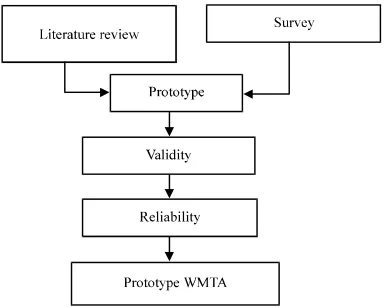
involved in manual material handling activity. Individual Development and evaluation of WMTA risk factors include age, gender, anthropometry, muscle encompassed two stages (phase I and II). This study only strength and physical fitness (David et al., 2008). discusses the development of WMTA phase I. Figure 1 Current technique to observe workplace WMSDs is shows the stages in the development process in self-report questionnaire, observation and direct sequently order.
Fig. 1: Development process phase I
Corlett, 1993; Kilbom, 1994; Karhu et al., 1977; Aaras, 1994; Paquet et al., 2001; Punnett et al., 1991; Zunjic et al., 2012; Hignett and McAtamney, 2000; Gallagher et al., 2011; Chung et al., 2003) conducted comprises current observational tools, physical and psychosocial risk factors and epidemiological evidence with regard WMSDs.
Initial survey conducted among 16 OSH practitioners to find out the features of a suitable observational tool and their requirements for a new assessment tool. Based on their feedbacks, the first prototype is designed covered workspace environment risk factors, musculoskeletal risk factors and psychosocial risk factors.
Prototype WMTA extended to several reviewers appointed to examine face and content validity. The reviewers consists of occupational safety and health practitioners, university lecturers with occupational safety and health background and undergraduate student taking bachelor of occupational safety and health program. Some reviewers have extensive experience (between 10-20 years) in the field of occupational safety and health. Comments from those highlighted to improve the prototype.
Pilot study was important to ensure the appropriateness of the prototype. Some sets of concerns are to identify the clarity of the items contained and get an initial overview of the ability of the instrument when used in actual field conditions. Inter-observer reliability test is applied to examine the degree of the agreement among rater. The value of k in scale 0:00-1:00 which in ascending order, the higher the reliability.
Development of WMTA: Based on a survey conducted to
industrial practitioners, observational tools should fit the
short, quick and easy to use can be applied in various types of work, completed within 10-20 min, comprehensive, reliable and having instruction how to use the tool. Prototype WMTA is developed with justification of the items based on previous epidemiological and laboratory studies, text books and standards related to WMSDs comprised of neck, back, shoulder and arm and legs.
Neck posture: There is strong evidence indicates
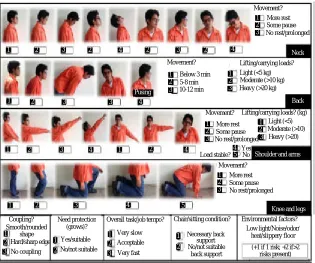
awkward posture of the neck increases risk factor of the neck disorder/shoulder (Bernard, 1997; Chaffin, 1973). There is evidence that sustained neck flexion increase load on the neck nerve compression and creep response in tissue. Chaffin distinguished that neck flexion with 15° affected neck muscle after 6 h working period. Ariens et al. (2001) confirmed the neck flexion >20° in most of the time work increases the risk of neck pain. Meanwhile, Ng proved the maximum neck flexion resulted in significant muscle activity. Ohlsson et al. (1995) justify critical posture of the neck at 15 and 30° flexion. Other studies (McAtamney and Corlett, 1993) details neck posture more closely based on the risk rating; low-risk 0-10°, 10-20° medium risk and high risk of >20°. Prototype WMTA postures category was defined using nine real pictures of head posture nominate the risks associated with the real task observed (Fig. 2).
Back posture: Natural back posture within 20° bend
forward (Aaras, 1994). Any stooped posture beyond the natural range of either bend forward, sideways or backwards at risk for back disorder. There is evidence indicates the relationship between back disorders with awkward postures (Bernard, 1997). Punnett et al. (1991) proposed back disorder to four categories; neutral (<20°), mild (21-45°), severe (>45°) and lateral bending and twisting (>20°). Keyserling et al. (1988) proved that Manual Material Handling (MMH) involves many side bending and twisting increased risk of low back pain. The other study (Paquet et al., 2001) detailed the risk factors; <20° = low risk, >20-45° = moderate risk and =45° = high risk. Meanwhile, McAtamney and Corlett (1993) classified trunk posture to three categories; (0-20°) = low risk, (21-60°) = moderate risk and (>60°) = high risk. Prototype WMTA postures category was defined using five real pictures of back posture nominate the risks associated with the real task observed (Fig. 2).
Back movement and weight handling: Repetitive forward
Fig. 2: Prototype Works Movement Task Analysis (WMTA) tool
and tightened erector spinae. This phenomenon increases lifting more than 10 kg dayG generate risk to the spine. the symptom of back discomfort. Meanwhile, heavy lifting Dolan and Adams (1998) discovered >100 lifts decreased and excessive exertion/forceful movem ent are the main muscle performance especially at L3 region by 5.5% risk factor to increase LBP (Bernard, 1997). Forceful confirming erector spinae was fatigued. Meanwhile, 23 kg movement occurs when workers trying to lift or move is a threshold given by NIOSH to define maximum heavy load. This phenomenon generates high acceptable weight for lifting under optimal conditions. compressive force to the lumbar disk and stressed out However, maximum acceptable weight given by NIOSH erector spinae. The risk is highly increased when lateral limited to Eropean population with difference bending or twisting are performed simultaneously. antropometric and physiological features compared to the Combination of these attributes indicates to be risk factor Asian population. Therefore, due to obscurity exists, this for low back pain (Punnett et al., 1991). In summary, standard not suitable for Malaysian population. Currently repetitive movement is the main risk factor contributes to there is limitation study focuses on Asian people. Thus, low back disorder. However, there is a limitation on prototype WMTA using subjective category of loads; how frequent is frequent affect the back. David et al. below 5 kg = low risk, >10 kg = mild risk and >20 kg = (2008) detailed lifting frequency to three levels; severe risk. Nevertheless, it does not conflict from other infrequently = around 3 times/min or less. Frequently = ranges have been proposed by some researchers around 8 times/min or less, very frequently = around 12 (McAtamney and Corlett, 1993; Kilbom, 1994).
times/min or more. While the other study (McAtamney
and Corlett, 1993) classified it to three subjective Shoulder and arm posture: Working with elevated indicators; static, repeated and shocks movement with shoulder will cause shoulder disorder. Some studies combination with load handled. Due to uncertainty exists (Chaffin and Park, 1973; Wiker et al., 1990) suggested about load classification, prototype WMTA was followed posturing hands above shoulder level significantly and simplified QEC (David et al., 2008) categories; increased the risk of localized muscle fatigue even in light below 3, 5-8, 10-12 times/min to gain more sensitivity of weight. While Punnett et al. (2000) classified shoulder the scoring (Fig. 2). natural movement at <45°, moderate risk at 46-90° and Punnett et al. (1991) suggested lifting 5 kg load severe risk at >90°. Arm flexion above 60° is associated associated to LBP while Ohlsson et al. (1995) classified
1
with shoulder disorders (Bernard, 1997). Ng point out that
1 2 3 2 4 2 3 2 4
1 2 3 4
Pusing
4 2
1
1 2 3
3
4
1 2 3 4 5
Neck
Back
Shoulder and arms
Knee and legs 1 1 2 3 1 2 3 1 2 1 2 Coupling? No coupling Smooth/rounded shape Hard/sharp edge No/not suitable Yes/suitable Very slow Acceptable Very fast
Overall task/job tempo? Chair/sitting condition?
Necessary back support No/not suitable
back support
(+1 if 1 risk; +2 if>2 risks present) Environmental factors? Low light/Noise/odor/ heat/slippery floor Need protection (grows)? 2 3 1 2 3 1 2 3 1 2 3 1 2 3 1 2 3 4 5 Movement? More rest Some pause No rest/prolonged Load stable? Yes No Movement? More rest Some pause No rest/prolonged Movement? More rest Some pause No rest/prolonged Lifting/carrying loads? Light (<5 kg) Moderate (>10 kg) Heavy (>20 kg)
Lifting/carrying loads? (kg) Light (<5)
Heavy (>20) Moderate (>10) Below 3 min
side and forward arm lifting at 90° and shoulder shrugging [RNT] for the back [PB]×[MB] = [RB], then [RB]×[L] = yielded substantial muscle activity. Meanwhile, positive
association between prevalence of shoulder disorders and the frequency of upper arm movement past 60° flexion and abduction (Ohlsson et al., 1995). Prototype WMTA postures category was defined using seven real pictures of shoulder and arm posture nominate the risks associated with the real task observed (Fig. 2).
Shoulder and arm movement: Highly repetitive
shoulder/arm movement is associated with shoulder WWMSDs (Bernard, 1997). The other study (Ohlsson et al., 1995) study showed there is significant positive association between the prevalence of shoulder disorder and frequency of upper arm movement greater than 60° of flexion or abduction. Shoulder movement frequencies >2.5 minG1 were associated with WMSDs (Kilbom, 1994). However, there is limited reference to determine “safe” level of frequency that affected shoulder WMSDs. Thus, prototype WMTA proposed a three categories of shoulder and arm movement; more rest, some pause and no rest (continous or static).
Leg posture: Not many studies have investigated
WMSDs symptoms that focused on lower limbs. However, working in a squatting and kneeling affected directly to the leg and indirectly to the lower back. Basically, leg postures can be classified as knee-flexed and kneeling. Chung et al. (2001) reported that severely knee-flexed posture with knee flexion of 60° while mildly knee-flexed posture with knee flexion of 30°. In the other study (Chung et al., 2003; Gallagher et al., 2011) focused on kneeling posture. Kneeling with full flexion (0°) or deep flexed-leg yielded very discomfort condition while kneeling flexion with 90° is discomfort. Hignett and McAtamney (2000) proposed mild risk at 30-60° flexion and >60° is severe risk. In the prototype WMTA, kneeling posture with 90° is more focused. There were two conditions; kneeling with one leg or both legs. WMTA postures category was defined using five real pictures of leg posture nominate the risks associated with the real task observed (Fig. 2).
Scoring chart: Scoring chart is extensively used in
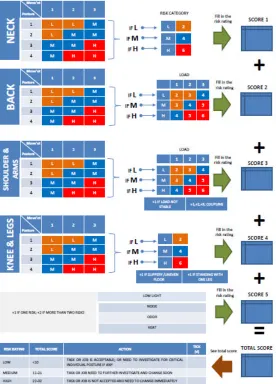
observational tools (Bernard, 1997; McAtamney and Corlett, 1993, Karhu et al., 1977; Zunjic et al., 2012; Hignett and McAtamney, 2000). Prototype WMTA proposed scoring chart to estimate and prioritize the risk outcomes. Previous studies suggests that the risk factors should considered in combination with each other (Adams and Dolan, 1991; Wiker et al., 1990). For the combination of the neck posture risk [PN]×[MN] =
[RBT] for the shoulder and arms [PS]×[MS] = [RS], then [RS]×[L] = RS1, then RS1+[1LS] AND/OR+[1C] = [RST] for the knee and legs [PL]×[ML] = [RL], then [RL]+[1FC] AND/OR+[1OL] = [RLT]. For the environmental factor [+1] if one risk exist; [+2] if more than two risks exist = [EF]. Sum of overall risk rating; [RNT]+ [RBT]+[RST]+[RLT]+[EF] = RTGS. This can be simplified as shown in Fig. 3.
The [PN] = Neck Posture, [MN] = Neck Movement, [RNT] = Total Risk score for Neck, [PB] = Back Posture, [MB] = Back Movement, [RB] = Risk score for Back, [L] = Load, [RBT] = Total Risk score for Back, [PS] = Shoulder and arms Postures, [MS] = Shoulder and arms Movement, [RS] = Initial Risk score for Shoulder and arms, RS1 = Second risk score for shoulder and arms, [1LS] = Load Stability, [1C] = Coupling, [RST] = Total Risk score for Shoulder and arms, [PL] = Legs Posture, [ML] = Legs Movement, [1FC] = Floor Condition, [1OL] = Standing one leg, [RLT] = Total risk score for legs, [EF] = Environmental factors, RTGS = Total grand score.
Combination of overall impact is greater than the sum of the separate effect (David et al., 2008). Thus, sum of the score then refers to the main scoring chart with three risk categories; low (<10), medium (11-21) and high (22-32). Each risk category accompanied with general action required to reduce the risk; low: task or job is acceptable or need to investigate for critical individual posture if any medium: task or job need to further investigate and change soon, high: task or job is not accepted and need to change immediately.
Face validity: In order to check initial stage of validity,
assessment of face validity was performed. First draft was distributed to 11 reviewers with different backgrounds ranging from OSH practitioners, lecturers and OSH students. It is important to obtain feedback on how a draft seems in the eyes of various parties inclusive for those without strong ergonomics background. A total of six main issues are identified and taking into account to improve the draft.
Inter-rater reliability: The aims of reliability study was to
Fig. 3: Scoring chart with process
effectiveness without using aids such as camera. Each discomfort in relevant body region. A total 40 task is labeled as; Task 1 ‘Packing 1’, Task 2 ‘Packing 2’, manufacturing workers involved in this study. Each job Task 3 ‘Packing 3’, Task 4 ‘Packing 4’, Task 5 ‘Packing 5’, was observed using WMTA. During the resting time, Task 6 ‘Packing 6’, Task 7 ‘Packing 7’. Most of the structured interview was conducted to gather body research on the premise involves packing a books and discomfort experienced by the workers. Body discomfort magazines. Percentage of agreement calculates for neck, chart (Corlett and Bishop, 1976) was used for this purpose back, shoulders and arms and legs. Intraclass Correlation with some modification to fit the research setting. The (ICC) calculates agreements between 3 or more rankers as chart consists of survey of body region which contains they rank a number of subjects according to a particular upper and lower extrimities. The workers need to circle or characteristics. ICC with two-way fixed analysis of mark the area of body that experience discomfort or pain. consistent agreement for each observer and average value Chi square (P) is used to measure the association of body
were reported. discomfort/pain and WMTA scores.
WMTA validation: The aims of validity study was to RESULTS
establish wherether WMTA is provided good
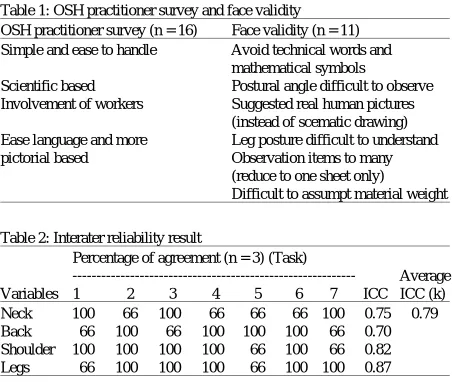
indication of WMSDs. This step involved assessment of Face validity: A total of 4 themes were collected to association between postural and musculoskeletal develop an initial prototype WMTA. Response from OSH
Table 1: OSH practitioner survey and face validity Table 3: Chi square statistical analysis for WMTA scores and reported pain OSH practitioner survey (n = 16) Face validity (n = 11)
Simple and ease to handle Avoid technical words and mathematical symbols
Scientific based Postural angle difficult to observe
Involvement of workers Suggested real human pictures Neck No 10 13 5.56 0.06 (instead of scematic drawing) Yes 2 15
Ease language and more Leg posture difficult to understand Back No 4 0 28.89 0.00*
pictorial based Observation items to many Yes 2 34
[image:6.612.315.541.116.219.2](reduce to one sheet only) Shoulder and arms No 2 5 8.06 0.04* Difficult to assumpt material weight Yes 2 31
Table 2: Interater reliability result
Percentage of agreement (n = 3) (Task)
--- Average Variables 1 2 3 4 5 6 7 ICC ICC (k) Neck 100 66 100 66 66 66 100 0.75 0.79 Back 66 100 66 100 100 100 66 0.70 Shoulder 100 100 100 100 66 100 66 0.82 Legs 66 100 100 100 66 100 100 0.87
practitioners (n = 16) were stated in Table 1. OSH practitioners argued that observational tools used on site should be user friendly, especially for industrial workers but still retain its scientific based. Employees participation was more important than just the individual observations. They also expressed theirs view that involvement of workers together in the process of hazard identification and risk analysis in accordance the concept of self-regulation and safety culture. In addition, the use of simple language without engaging technical terms is better as well as with appropriate diagrams. As mention previous, it is important to obtain feedback on how a draft seems in the eyes of various parties inclusive for those without strong ergonomics background. Output from the reviewers (n = 11) summarized in Table 1. The responses from various reviewers were used for improvements made by taking into account the factors mentioned. Then, second draft of WMTA was proposed consists of four sections of postural analysis (neck, back, shoulder and arms and legs) and associated risk factors; movement, load, vibration, workspace and basic environmental factors (lighting, noise, odourless, heat and slippery floor).
Inter-rater reliability: The result of phase 1 trials for
inter-rater reliability are shown in Table 2. According to Landis and Koch (1977), range between 1.0-0.81 were considered ‘almost perfect’, 0.80-061 ‘substantial’, 0.60-0.41 ‘moderate’, 0.40-0.21 ‘fair’ and 0<0.20 ‘slight’. Thus, ETA demonstrate substantial agreement among rater with k = 0.79.
WMTA validation: The relationship of the individual
WMTA body part scores to the pain or discomfort is statistically significant for the back, shoulder and arms and legs regions. The back score for WMTA body part
or discomfort
WMTA score
---Body parts Pain 1-3 >4 P2 p<0.05
Knee and legs No 7 8 4.42 0.04*
Yes 4 21
*0.05; **0.01; ***0.001
was >4 in 85% of workers while back pain or discomfort was 90% showing a significant association between WMTA and self-reported pain or discomfort (P2 = 28.89, p<0.00). The shoulder and arms score for WMTA body part was >4 in 90% of workers while shoulder and arms pain or discomfort was 83% showing a significant association between WMTA and self-reported pain or discomfort (P2 = 8.06, p<0.04). The knee and legs score for WMTA body part was >4 in 53% of workers while knee and legs pain or discomfort was 63% showing a significant association between WMTA and self-reported pain or discomfort (P2 = 4.42, p<0.04). However, the neck score >4 in 70% of workers while neck pain or discomfort was 43% did not demonstrate significant relationship between WMTA and self-reported pain and discomfort (P2 = 5:56, p<0.06). Table 3 summarizes chi square statistical analysis for WMTA scores and reported pain or discomfort.
DISCUSSION
WMTA development aims for the use of industrial practitioners with the involvement of workers. It is simple, precise and rapid to use are suitable for application, especially on the field. The practitioner should observe WMSDs risk against workers by completing WMTA observational tool. Employee role comes when dedicated observer requesting their feedback on body parts and basic work environment condition and suggestion to encounter the problem. WMTA development comprises survey among OSH practitioners regarding specific features observational tool, extensive literature reviews to justify specific items, draft development and validation process. WMTA emphasizes on the concept of participatory ergonomics which required workers together which OSH practitioner in the hazard identification and risk control activities.
WMTA, it is employs real pictures postures which ACKNOWLEDGEMENT
enables user to make a comparison of subject observed
with WMTA items. In addition, technical terms and Researchers would like to thank all subjects who mathematical symbols be avoided to minimize disruption volunteered to participate in this study. The researchers among users who less or are not proficient in the technical declare that there is no conflict of interest.
and mathematical knowledge. It is important in order to
attract interest of people to participate in the hazard REFERENCES
identification and risk control activities. While this,
interaction between observer (OSH practitioner) and Aaras, A., 1994. The impact of ergonomic intervention on worker occurred. Interview among the subject will clarify
any issues being overlooked in the observational tool. WMTA provided more sensitive assessment involving some combination of risks. It is not rigid and limited for certain static activity but could be implemented for more dynamic activity. WMTA advantage of not using the camera could prevent hawthorne effect among workers. In the reliability and validity point of views, WMTA demonstrate almost perfect agreement among raters’ shows that this tool that can be used as a measurement technique on the field. All tasks were consistently obtained substantial agreement between assessors which is legs shows the highest followed by shoulder and arms, neck and back. While there is significant correlation between WMTA score and self-reported pain or discomfort in the back, shoulder and arms and legs with p<0.05. However, only the neck alone did not show a significant relationship between the two variables. This occurs because there were constraints on field observations, particularly for the neck posture. In addition, movement of the neck inconsistently complicate the situation.
CONCLUSION
Designed WMTA observational tool in comparison to other observational tools has the following advantages: a main advantage it embraces the concept of participatory ergonomics and self-regulations (as mentioned in OSHA 1994) that is suitable for Industrial Developing Country (IDC) particularly Malaysia in this context. WMTA can be applied for dynamic work tasks instead of static. In term of sensitivity, WMTA promotes combination of risks potentially which causes WMSDs. In addition, it applies the real postural photos to facilitate the less experienced individuals and demonstrate versatile condition for dynamic activity. WMTA is clear, precise and simple that hopefully will help untrained individual cultivate good safety culture and behavior. This tool is expected to provide new workplace ergonomic observational tool to assess WMSDs for the next stage of the validation period (phase II) which is consisted of experimental validation phase involving direct measurement of muscles activities.
individual health and corporate prosperity in a telecommunications environment. Ergonomics, 37: 1679-1696.
Adams, M.A. and P. Dolan, 1991. A technique for quantifying the bending moment acting on the lumbar spine in vivo. J. Biomech., 24: 117-126. Ariens, G., P. Bongers, M. Douwes, M. Miedema and
W. Hoogendoorn et al., 2001. Are neck flexion, neck rotation, and sitting at work risk factors for neck pain? Results of a prospective cohort study. Occup. Environ. Med., 58: 200-207.
Bernard, B.P., 1997. Musculoskeletal Disorders and Workplace Factors: A Critical Review of Epidemiologic Evidence for Work-Related Musculoskeletal Disorders of the Neck, Upper Extremity and Low Back. 1st Edn., US Government Printing Office, Washington, DC., USA.
Braun, B.L. and L.R. Amundson, 1989. Quantitative assessment of head and shoulder posture. Arch. Phys. Med. Rehabil., 70: 322-329.
Chaffin, D.B. and K.S. Park, 1973. A longitudinal study of low-back pain as associated with occupational weight lifting factors. Am. Ind. Hyg. Assoc. J., 34: 513-525. Chaffin, D.B., 1973. Localized muscle fatigue-definiton and
measurement. J. Occup. Med., 15: 346-354.
Chung, M.K., I. Lee and D. Kee, 2003. Assessment of postural load for lower limb postures based on perceived discomfort. Int. J. Ind. Ergon., 31: 17-32. Chung, M.K., I. Lee and Y.S. Yeo, 2001. Physiological
workload evaluation of screw driving tasks in automobile assembly jobs. Int. J. Ind. Ergon., 28: 181-188.
Corlett, E.N. and R.P. Bishop, 1976. A technique for assessing postural discomfort. Ergonomics, 19: 175-182.
Dolan, P. and M.A. Adams, 1998. Repetitive lifting tasks McAtamney, L. and E.N. Corlett, 1993. RULA: A survey fatigue the back muscles and increase the bending
moment acting on the lumbar spine. J. Biomech., 31: 713-721.
Gallagher, S., J. Pollard and W.L. Porter, 2011. Electromyography of the thigh muscles during lifting tasks in kneeling and squatting postures. Ergonomics, 54: 91-102.
Hanten, W.P., R.M. Lucio, J.L. Russell and D. Brunt, 1991. Assessment of total head excursion and resting head posture. Arch. Phys. Med. Rehabil., 72: 877-880. Hignett, S. and L. McAtamney, 2000. Rapid Entire Body
Assessment (REBA). Applied Ergon., 31: 201-205. Karhu, O., P. Kansi and I. Kourinka, 1977. Correcting
working postures in industry: A practical method for analysis. Applied Ergon., 8: 199-201.
Keyserling, W.M., L. Punnett and L.J. Fine, 1988. Trunk posture and back pain: Identification and control of occupational risk factors. Applied Ind. Hyg., 3: 87-92. Keyserling, W.M., M.L. Brouwer and B.A. Silverstein, 1992. A checklist for evaluating ergonomic risk factors resulting from awkward postures of the legs, trunk and neck. Int. J. Ind. Ergonom., 9: 283-301. Kilbom, A., 1994. Repetitive work of the upper extremity:
Part I-Guidelines for the practitioner. Int. J. Ind. Ergon., 14: 51-57.
Landis, R.J. and G.G. Koch, 1977. The measurement of observer agreement for categorical data. Biometrics, 33: 159-174.
method for the investigation of work-related upper limb disorders. Applied Ergon., 24: 91-99.
Ohlsson, K., R.G. Attewell, B. Palsson, B. Karlsson and I. Balogh et al., 1995. Repetitive industrial work and neck and upper limb disorders in females. Am. J. Ind. Med., 27: 731-747.
Paquet, V.L., L. Punnett and B. Buchholz, 2001. Validity of fixed-interval observations for postural assessment in construction work. Applied Ergon., 32: 215-224. Punnett, L., L.J. Fine, W.M. Keyserling, G.D. Herrin and
D.B. Chaffin, 1991. Back disorders and nonneutral trunk postures of automobile assembly workers. Scand. J. Work Environ. Health, 17: 337-346. Punnett, L., L.J. Fine, W.M. Keyserling, G.D. Herrin and
D.B. Chaffin, 2000. Shoulder disorders and postural stress in automobile assembly work. Scand. J. Work Environ. Health, 26: 283-291.
Szeto, G.P., L. Straker and S. Raine, 2002. A field comparison of neck and shoulder postures in symptomatic and asymptomatic office workers. Applied Ergon., 33: 75-84.
Wiker, S.F., D.B. Chaffin and G.D. Langolf, 1990. Shoulder postural fatigue and discomfort: A preliminary finding of no relationship with isometric strength capability in a light-weight manual assembly task. Int. J. Ind. Ergon., 5: 133-146.