Munich Personal RePEc Archive
Financial deepening and economic
growth: A System GMM Panel Analysis
with application to 7 SSA countries
Alimi, R. Santos
Economics Department, Adekunle Ajasin University
Akungba-Akoko,Ondo State, Nigeria
July 2015
Online at
https://mpra.ub.uni-muenchen.de/65789/
1 | P a g e
Financial Deepening and Economic Growth:
A System GMM Panel Analysis with application to 7 SSA
Countries
R. Santos Alimi
Economics Department, Adekunle Ajasin University
Akungba-Akoko,Ondo State, Nigeria
Email:
[email protected]
,
[email protected]
ABSTRACT.
The relationship between financial development and economic growth has been a key study in economics field for a long time. This paper examines the link between financial development and economic growth in 7 Sub-Saharan African countries - Nigeria, South Africa, Lesotho, Malawi, Sierra Leone, Botswana and Kenya, over the period of 1981-2013. The study applied both static and dynamic panel data approach, to investigate the relation between financial development and economic growth. The results show that financial development has not led to economic growth in the panel of the selected countries when domestic credit provided by the banking sector is used as a proxy for financial development. The results thus lend support for the independent hypothesis postulates that financial development and economic growth are causally independent. Our study also considered foreign direct investment and interest rate as determinant of growth, but only interest rate suggested positive effect on economic growth. The implication of the results is that there is ardent need to develop the financial sector in order to stimulate real growth in the economies of these countries. Development of microfinance institutions as a complement to the conventional commercial banks will play a great role mobilising savings and providing ease access to fund, thus engendering growth process in the Sub-Saharan Africa.
2 | P a g e
1. INTRODUCTION
In recent years, the relationship between financial development and economic growth has been given a lot of attention by many researchers (Miller, 1998). However, there are mixed findings and opinion on the role that financial system plays in economic growth. For instance Levine (1997) opines that financial intermediaries enhance economic efficiency, and ultimately growth, by helping allocate capital for optimal use, whereas Lucas (1988) believes that the role of the financial sector in economic growth process is “over-stressed.” Notwithstanding the controversy, modern theoretical literature on the finance–growth nexus combines the endogenous growth theory and microeconomics of financial systems (Grossman & Helpman, 1991; Khan, 2001; Lucas, 1988; Romer, 1986; among others). The Early research works on financial development and economic growth were based on cross-country analysis. For instance, King and Levine (1993a, 1993b), and Levine and Zervos (1998) used cross-country analysis to study the relationship between financial development and economic growth. While their findings suggest that finance helps to predict growth, these studies do not deal formally with the issue of causality, nor do they exploit the time-series properties of the data. Moreso, conclusions drawn such cross-country analysis are sensitive to the sample countries, estimation methods, data frequency, functional form of the relationship, and proxy measures chosen in the study, all of which raise doubts about the reliability of cross-country regression analysis (see Al-Awad & Harb, 2005; Chuah & Thai, 2004; Hassan & Bashir, 2003; Khan & Senhadji, 2003).
Panel time-series analysis, on the other hand, exploits time series and cross-sectional variations in data and avoids biases associated with cross-sectional regressions by taking the country specific fixed effect into account (Hassan, M.K., Sanchez, B. & Jung-Suk Yu, J.(2011)). In order to mitigate the shortcomings of cross-sectional analysis, this paper examines the dynamic relationship between economic growth and financial development in 7 Sub-saharan African countries (Nigeria, South Africa, Lesotho, Malawi, Sierra Leone, Botswana and Kenya) in this study.
In static panel data models, Pooled OLS, fixed effects (FE) and random effects (RE) are used. The RE estimator was excluded because Hausman test rejects the null hypothesis RE versus FE. Therefore, the regression coefficients are estimated using fixed effects. We also decided to introduce a dynamic panel data. This methodology is most frequently used in the growth literature – System Generalized Method of Moments). The estimator used system GMM, permits the researchers to solve the problems of serial correlation, heteroskedasticity and endogeneity of some explanatory variables (Leitao, 2010). These econometric problems were resolved by Arellano and Bond (1991), and Blundell and Bond (1998, 2000). To estimate the dynamic model, we applied the methodology of Blundell and Bond (1998, 2000). The rest of this paper is structured as follows. Section 2 presents theoretical framework and empirical review while Section 3 provides a description of the data and methodology. Section 4 reports and discusses the empirical results. Concluding remarks and policy implications of findings are reported in Section 5.
2. Financial Development and Growth: Theoretical Framework and Empirical Review
3 | P a g e
without frictions caused by transaction, information and monitoring costs, no financial intermediaries are needed. If those costs are sufficiently high, no exchanges among economic agents will take place. The need to reduce those costs for exchanges to take place has led to the emergence of financial institutions and markets constituting the financial sector. A well-developed financial sector provides critical services to reduce those costs and thus to increase the efficiency of intermediation. It mobilises savings, identifies and funds good business projects, monitors the performance of managers, facilitates trading and the diversification of risks, and fosters exchange of goods and services. These services result in a more efficient allocation of resources, a more rapid accumulation of physical and human capital, and faster technological innovation, thus inducing faster long-term economic growth.
Second, the demand-following hypothesis postulates that economic growth leads to financial development. The development of the real economy induces increased demand for financial services, which in turn, generate the introduction of new financial institutions and markets to satisfy that increased demand for financial services (Demetriades & Hussein, 1996).
Third, the bi-directional causality hypothesis is a combination of the supply-leading and demand following hypotheses. It postulates that financial deepening and economic growth are mutually or bi-directionally causal (Greenwood & Jovanovic, 1990; Berthelemy & Varoudakis, 1996; Blackburn & Hung, 1998; and Harrison, Sussman & Zeira, 1999). Financial deepening gradually induces economic growth and this, in turn, causes feedback and induces further financial deepening.
Fourth, the independent hypothesis postulates that financial deepening and economic growth are causally independent. Lucas (1988) argues that, at best, financial deepening plays a very minor role in economic growth; Stern (1989) ignores the role of financial development in the growth process. (see Acaravci, S.K., Ozturk, I & Acaravci, A. (2009) for more detailed literature review on Growth-Finance link in Sub-Saharan African Countries)
3. ECONOMETRIC MODEL METHODOLOGY AND DATA
3.1 Econometric Model
In the empirical estimations on the relationship between financial development and economic growth, real gross domestic product (RGDP) will be employed as the dependent variable. In order to measure the level of financial development, we used the ratio of domestic credit provided by the banking sector to private sector to GDP. We included two macroeconomic control variables: real interest rate and foreign direct investment proxied by ratio of foreign direct investment inflow to GDP to avoid simultaneous bias in our regressions.
3.2 Methodology of GMM Estimators for Panel Models
We use the generalized method of moments (GMM) estimators developed for dynamic models of panel data introduced by Holtz-Eakin et al. (1990), Arellano and Bond (1991) and Arellano and Bover (1995). Consider the following regression equation:
Yit− Yit−1= (α − 1)Yit−1+ β0Xit + μi + εi,t (1)
4 | P a g e
Yit= αYit−1+ β0Xit + μi + εi,t (2) To eliminate country-specific effects, we take first differences of (2):
Yit− Yit−1 = a(Yit−1− Yit−2) + β0(Xit− Xit−1) + εit−εit−1 (3)
Levine et al. (2000) suggest the use of instruments for two reasons: to deal with the likely endogeneity of the financial development and economic growth and because by construction the new error term (εit −εit−1) in (3) is correlated with the lagged dependent variable, (Yit−1− Yit−2).The GMM panel estimator uses the following moment conditions:
E[Yit − s(εit−εit−1)] = 0 for s ≥ 2; t = 3, ..., T E[Xit− s(εit−εit−1)] = 0 for s ≥ 2; t = 3, ..., T
under the assumptions that the error term, ε, is not serially correlated and that the explanatory variables, X, are weakly exogenous. The authors refer to this as the difference estimator.
There are, though, statistical shortcomings with this estimator. Alonso-Borrego and Arellano (1996) and Blundell and Bond (1998) show that when the explanatory variables are persistent over time, lagged levels of these variables are weak instruments for the regression equation in differences. To reduce the potential biases associated with the difference estimator, the authors use a new estimator that combines in a system the regression in differences with the regression in levels The authors use a GMM estimator that uses lagged differences of Yit as instruments for the equation in levels in addition to lagged levels of Yit as instruments for equations in first differences. Blundell and Bond (1998) suggest that Monte Carlo simulations and asymptotic variance calculations show that this extended GMM estimator offers efficiency gains where the first-difference GMM estimator performs poorly. The instruments mentioned are appropriate under the following assumption: although there may be correlation between the levels of the right hand side variables and the country specific effect in the level equation, there is no correlation between the differences of these variables and the country specific effect. The additional moment conditions for the second part of the system which is the regression in levels are:
E[(yit − s− yit−s−1)( μi + εi,t)] = 0 for s = 1 E[(Xit − s− Xit−s−1)( μi + εi,t)] = 0 for s = 1
Given that the lagged levels are used as instruments in the differences specification, only the most recent difference is used as instrument in the levels specification. Using other lagged differences will result in redundant moment conditions [see Arellano and Bover (1995)]. The authors use the moment conditions above and employ a GMM procedure to generate consistent and efficient parameter estimates.
3.3 Data
5 | P a g e
4. EMPIRICAL RESULTS
This section provides both OLS and GMM regressions results of empirical estimations on the relationship between financial development and economic growth. Four techniques of estimations were used to revisit the various econometric approaches which studied the link between the financial development and the economic growth as described before. These methods are Pooled OLS, OLS -Fixed effect, the generalized method of moments in difference (GMM-Difference, Arellano and Bond, 1991) and in system (GMM-System, Blundell and Bond, 1995). Our results will be based on the last one which was the object of recent applications concerning the theme. In the first place, we made estimations by the Least Squared method. This last one allows checking the problem of heterogeneity of countries. Hausman Test, which allows choosing specific fixed effect or random effect, is applied. As shown table1, the relevance of fixed effects is established in the majority of regressions.
The GMM estimations in first difference and in system allow taking into account the problem of endogeniety of variables. This problem emerges especially when study concerns relation between financial development and economic growth regarding the existence of causality with double meaning between financial development and growth. The GMM-System estimator treats combination of both difference and level equations. Instruments used for the difference equation are the delayed values of variables in levels. Moreover, variables are instrumented by their first differences in level equation. This system of equations is estimated simultaneously by GMM. The simulations of Monte Carlo made by Blundell and Bond (1998) showed that system estimator is the most efficient. The tests used for over-identification are Hansen test and test of second serial correlation of Arellano and Bond. Statistics of Hansen test allowed acceptance of validity of instruments. For serial correlation test, results validate the hypothesis of absence of second serial correlation of residuals. In all regressions, standard deviations of coefficients are corrected by White method in order to check heteroscedasticity problem.
Analysis of the Static Panel Data Estimations
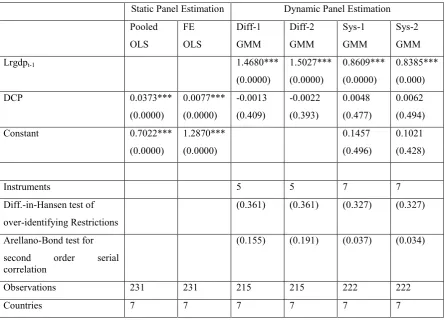
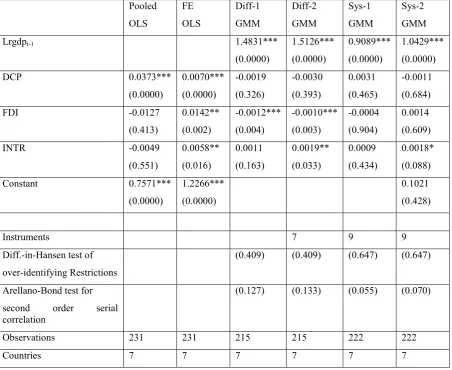
Using the log of real GDP as dependent variable, the results of the pooled OLS and fixed effects (LSDV) Estimator in table 1 are positive and highly statistically significant. The coefficient of the financial development variable does not show any systematic changes when we introduce control variables to the model as reported in Table 2. They are still positive and highly statistically significant, confirming a long-run positive relationship between financial development and growth as predicted in the majority of theoretical models. This is also consistent with the argument that well-developed domestic financial sectors in countries contribute significantly to an increase economic growth. For example, a 10% increase in the ratio of credit to private sector implies an increase in growth for 0.2% as predicted by pooled OLS (and about 0.08% under LSDV estimator). The results are consistent with previous studies, which find a positive relationship between measures of financial development and growth (see Levine, 2005).
Analysis of the Dynamic Panel Data Estimations
6 | P a g e
significant second order autocorrelation except for GMM-System in estimated model without the control variables. To sum up, our test statistics hint at a proper specification. The result of GMM-Difference shows a consistent but insignificant negative relationship between measures of financial development (ratio of credit to private sector) and economic growth. For instance, a 10% increase in the ratio of credit to private sector will lead to a fall in growth by about 0.02%. This finding in consistent with Dabos and Gantman (2010) who examined the link between financial developments and economic growth for 98 countries using dynamic panel’s method and concluded that there is no statistical significant relationship between financial development and economic growth.
As for the control variables, a positive and statistically significant impact of interest rate (INTR) on growth is reported in Table 2, which indicates that the increase in interest rate has marginally led to growth in the economy. One plausible reason might be through portfolio investment. However, the coefficient of foreign direct investment (FDI) is negative and significant, thus suggesting a marginal fall in growth as FDI increases. This is consistent with the findings of K. Lyroudi, J. Papanastasiou & A. Vamvakidis (2004).
Table 1: Financial Development and economic Growth: Static and Dynamic Panel Estimation, over the period 1980 to 2012 (Growth Model)
Static Panel Estimation Dynamic Panel Estimation
Pooled
OLS
FE
OLS
Diff-1
GMM
Diff-2
GMM
Sys-1
GMM
Sys-2
GMM
Lrgdpt-1 1.4680***
(0.0000)
1.5027***
(0.0000)
0.8609***
(0.0000)
0.8385***
(0.000)
DCP 0.0373***
(0.0000)
0.0077***
(0.0000)
-0.0013
(0.409)
-0.0022
(0.393)
0.0048
(0.477)
0.0062
(0.494)
Constant 0.7022***
(0.0000)
1.2870***
(0.0000)
0.1457
(0.496)
0.1021
(0.428)
Instruments 5 5 7 7
Diff.-in-Hansen test of
over-identifying Restrictions
(0.361) (0.361) (0.327) (0.327)
Arellano-Bond test for
second order serial
correlation
(0.155) (0.191) (0.037) (0.034)
Observations 231 231 215 215 222 222
[image:7.595.74.520.342.664.2]7 | P a g e
Table 2: Financial Development and economic Growth: Static and Dynamic Panel Estimation, over the period 1980 to 2012 (Growth Model, plus control variables)
Pooled OLS FE OLS Diff-1 GMM Diff-2 GMM Sys-1 GMM Sys-2 GMM
Lrgdpt-1 1.4831***
(0.0000) 1.5126*** (0.0000) 0.9089*** (0.0000) 1.0429*** (0.0000)
DCP 0.0373***
(0.0000) 0.0070*** (0.0000) -0.0019 (0.326) -0.0030 (0.393) 0.0031 (0.465) -0.0011 (0.684)
FDI -0.0127
(0.413) 0.0142** (0.002) -0.0012*** (0.004) -0.0010*** (0.003) -0.0004 (0.904) 0.0014 (0.609)
INTR -0.0049
(0.551) 0.0058** (0.016) 0.0011 (0.163) 0.0019** (0.033) 0.0009 (0.434) 0.0018* (0.088)
Constant 0.7571***
(0.0000)
1.2266***
(0.0000)
0.1021
(0.428)
Instruments 7 9 9
Diff.-in-Hansen test of
over-identifying Restrictions
(0.409) (0.409) (0.647) (0.647)
Arellano-Bond test for
second order serial
correlation
(0.127) (0.133) (0.055) (0.070)
Observations 231 231 215 215 222 222
Countries 7 7 7 7 7 7
8 | P a g e
Table 3: Financial Development and economic Growth: Static and Dynamic Panel Estimation, over the period 1980 to 2012 (Finance Model)
Static Panel Estimation Dynamic Panel Estimation
Pooled OLS FE OLS Diff-1 GMM Diff-2 GMM Sys-1 GMM Sys-2 GMM
Dcpt-1 1.0559
(0.000) 1.0756 (0.000) 0.9678 (0.000) 0.9814*** (0.000)
Lnrgdp 13.0701***
(0.000) 8.4290*** (0.000) -1.7539 (0.603) -0.5225 (0.827) 0.8000 (0.246) 0.3467 (0.7000)
Constant 5.4208**
(0.020) 3.0593 (0.416) 0.1435 (0.673) 0.1627 (0.732)
Instruments 5 5 7 7
Diff.-in-Hansen test of
over-identifying Restrictions
(0.765) (0.650) (0.765) (0.765)
Arellano-Bond test for
second order serial correlation
(0.553) (0.601) (0.553) (0.567)
Observations 215 215 222
[image:9.595.78.516.104.412.2]Countries 7 7 7
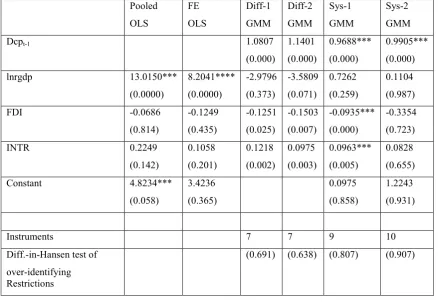
Table 4: Financial Development and economic Growth: Static and Dynamic Panel Estimation, over the period 1980 to 2012 (Finance Model, plus control variables)
Pooled OLS FE OLS Diff-1 GMM Diff-2 GMM Sys-1 GMM Sys-2 GMM
Dcpt-1 1.0807
(0.000) 1.1401 (0.000) 0.9688*** (0.000) 0.9905*** (0.000)
lnrgdp 13.0150***
(0.0000) 8.2041**** (0.0000) -2.9796 (0.373) -3.5809 (0.071) 0.7262 (0.259) 0.1104 (0.987)
FDI -0.0686
(0.814) -0.1249 (0.435) -0.1251 (0.025) -0.1503 (0.007) -0.0935*** (0.000) -0.3354 (0.723)
INTR 0.2249
(0.142) 0.1058 (0.201) 0.1218 (0.002) 0.0975 (0.003) 0.0963*** (0.005) 0.0828 (0.655)
Constant 4.8234***
(0.058) 3.4236 (0.365) 0.0975 (0.858) 1.2243 (0.931)
Instruments 7 7 9 10
Diff.-in-Hansen test of
over-identifying Restrictions
[image:9.595.80.519.463.771.2]9 | P a g e
Arellano-Bond test for
second order serial
correlation
(0.541) (0.541) (0.632) (0.451)
Observations 215 215 222 222
Countries 7 7
5. SUMMARY, CONCLUSION AND POLICY IMPLICATIONS
This study examined the relationship between financial development and economic growth in sub-Saharan Africa over the period 1980-2012. Pooled OLS, Fixed Effect Model and Generalized Method of Moment Panel Model were employed as estimation techniques. The estimations of the dynamic panel-data results concluded that there is no statistical significant relationship between financial development and economic growth in the selected sub-Saharan African countries. The results show that financial development has not led to economic growth in the panel of the selected countries when domestic credit provided by the banking sector is used as a proxy for financial development. The results thus lend support for the independent hypothesis postulates that financial development and economic growth are causally independent. Our study also considered foreign direct investment and interest rate as determinant of growth, but only interest rate suggested positive effect on economic growth. The implication of the results is that there is ardent need to develop the financial sector in order to stimulate real growth in the economies of these countries. Development of microfinance institutions as a complement to the conventional commercial banks will play a great role mobilising savings and providing ease access to fund, thus engendering growth process in the Sub-Saharan Africa.
REFERENCES
Acaravci, S.K., Ozturk, I & Acaravci, A. (2009). Financial development and economic growth: literature survey and empirical evidence from sub-Saharan African countries.
SAJEMS NS, 12(1).
Akinlo, A.E. & Egbetunde, T. (2010). Financial Development and Economic Growth: The Experience of 10 Sub-Saharan African Countries Revisited. The Review of Finance and Banking, 2(1)
Al-Awad, M., & Harb, N. (2005). Financial development and economic growth in the Middle East. Applied Financial Economics, 15, 1041–1051.
Alonso-Borrego, C., & Arellano, M. (1999). Symmetrically normalized instrumental variable estimation using panel data. Journal of Business & economic Statistics, 17, 36–49. http://dx.doi.org/10.2307/1392237
Arellano, M and O. Bover. (1995). Another look at the instrumental variable estimation of error component models. Journal of Econometrics, 68, 29-52.
Arellano, M. and S. Bond. (1991). Some tests of specification for panel data: Monte Carlo evidence and an application to employment equations. Review of Economics and Statistics, 58, 277-97.
10 | P a g e
Blackburn, K. & Hung, V.T.Y (1998). A theory of growth, financial development and trade,
Economica, 65, 107-124.
Blundell, R., & Bond, S. (1998). Initial conditions and moment restrictions in dynamic panel data models. Journal of Econometrics, 87, 115–143. http://dx.doi.org/10.1016/S0304-4076(98)00009-8.
Blundell, R., Bond, S., (2000). GMM Estimation with persistent panel data: an application to production functions”, Econometric Reviews, Taylor and Francis Journals, 19(3): pp. 321-340
Chuah, H., & Thai, W. (2004). Financial development and economic growth: Evidence from causality tests for the GCC countries. IMF Working Paper.
Dabos, M. P., & Gantmann, E. R. (2010). The Fading Link? A New Empirical Analysis of the Relationship Between Financial Development and Economic Growth. MFI Working Paper Series, No. 2010-013, 1-20.
Demetriades, P.O & Hussein, K.A (1996). Does financial development cause economic growth? Time series evidence from 16 countries, Journal of Development Economics, 51, 387-411.
Fosu, S. B. (2013). Financial Development and Economic Growth in Africa: A Dynamic Causal Relationship. Unpublished Thesis. Retrieved from www.econ-jobs/public/Samuel-Fosu-47391
Greenwood, J. & Jovanovic, B. (1990). Financial development, growth, and the distribution of income, Journal of Political Economy, 98, 1076-1107.
Grossman, G., & Helpman, E. (1991). Quality ladders in the theory of growth. Review of Economic Studies, 58, 43–61.
Hassan, M. K., & Bashir, A. (2003). Financial development and economic growth in the Middle East. Working Paper, The 6th International Conference in Islamic Economics, Manama, Bahrain.
Hassan, M.K., Sanchez, B. & Jung-Suk Yu, J. (2011). Financial development and economic growth: New evidence from panel data. The Quarterly Review of Economics and Finance 51, 88–104
Holtz-Eakin, D., Newey, W., & Rosen, H. (1990). Estimating vector autoregressions with panel data. Econometrica, 56, 1371–1395. http://dx.doi.org/10.2307/1913103
Khan, A. (2001). Financial development and economic growth. Macroeconomics Dynamics, 5, 413–433
Khan, M., & Senhadji, A. (2003). Financial development and economic growth: A review and new evidence. Journal of African Economies, 12(2), ii89–ii110.
King, R., & Levine, R. (1993a). Finance and growth: Schumpeter might be right. Quarterly Journal of Economics, 108, 717–738.
King, R., & Levine, R. (1993b). Finance, entrepreneurship, and growth: Theory and evidence. Journal of Monetary Economics, 32, 513–542
Leitao, N. C. (2010). Financial Development and Economic Growth: A Panel Data Approach.
Theoretical and Applied Economics Volume XVII, 10(551), 15-24
11 | P a g e
Levine, R., & Zervos, S. (1998). Stock markets, banks, and economic growth. American Economic Review, 88, 537–558.
Levine, R., Loayza, N., & Beck, T. (2000). Financial intermediation and growth: Causality and causes. Journal of Monetary Economics, 46, 31–77. http://dx.doi.org/10.1016/S0304-3932(00)00017-9
Lucas, R. E. (1988). On the mechanics of economic development. Journal of Monetary Economics, 22, 3–42.
Lyroudi, K., Papanastasiou, J. & Vamvakidis, A. (2004). Foreign Direct Investment And Economic Growth In Transition Economies. South Eastern Europe Journal of Economics 1, 97-110
Miller, M.H. (1998). Financial markets and economic growth. Journal of Applied Corporate Finance, 11, 8-14
Oluitan, R. (2012). Financial Development and Economic Growth in Africa: Lessons and Prospects. Business and Economic Research,2(2).
Romer, P. M. (1986). Increasing returns and long-run growth. Journal of Political Economy, 94, 1002–1037