AFM Observation of Microstructural Changes
in Fe-Mn-Si-Al Shape Memory Alloy
*1Motomichi Koyama
1;*2, Masato Murakami
1, Kazuyuki Ogawa
2,
Takehiko Kikuchi
2and Takahiro Sawaguchi
21Shibaura Institute of Technology, Tokyo 135-8548, Japan
2National Institute for Materials Science, Tsukuba 305-0047, Japan
We analyzed the surface relief caused by stress-induced hcp martensitic transformation in Fe-30Mn-5Si-1Al shape memory alloy by atomic force microscopy. The alloy exhibits a good shape memory effect and an improved ductility due to a small addition of Al to a conventional Fe-30Mn-6Si shape memory alloy. The orientation of an austenite matrix was determined with surface traces of fourf111gfplanes, which enabled us to determine the surface tilt angles for all twelve variants of hcp martensites and deformation twins. On the basis of these values, stress-induced martensite and deformation twin coexisting in the same grain were identified by studying the surface tilt angles. The surface relieves caused by the stress-induced martensite recovered after heating above the reversed transformation temperature, however some relieves originating from the deformation twin remained. [doi:10.2320/matertrans.MRA2007321]
(Received December 13, 2007; Accepted January 21, 2008; Published March 25, 2008)
Keywords: shape memory alloy, twinning induced plasticity, iron-manganese-silicon, aluminum addition, ductility, martensite, twin, atomic force microscopy
1. Introduction
Fe-Mn-Si shape memory alloys1,2) are attractive for engineering applications due to good workability and reasonable cost. Optimization of the alloy composition for practical applications have been studied in addition to the search for various application fields.3–5) It is generally accepted that the composition near Fe-30Mn-6Si is otpi-mum.6)The shape memory effect (SME) of Fe-Mn-Si alloy is
due to a reversed transformation of stress-induced " (hcp) martensite to the
(fcc) austenite on heating.
In contrast, Fe-30Mn-3Si-3Al alloy shows no shape memory effect but a high ductility that stems from deforma-tion twins, which is called twinning induced plasticity (TWIP) effect.7)Some of the TWIP steels have a high R
m
-A value (the product of tensile strength and ductility) exceeding 50,000 MPa%,8)and for this reason they are noted
as structural materials that have a good combination of high tensile strength and ductility.
Koyamaet al.9)noticed similar chemical compositions for two aforementioned alloy systems and then investigated the effect of Al-substitution on mechanical and shape memory properties using alloys with the compositions of Fe-30Mn-(1x)Si-xAl (x¼0;1;2;3).
It was found that Fe-30Mn-5Si-1Al alloy has similar SME and higher ductility compared with Fe-30Mn-6Si alloys. Stress-induced"-martensite and deformation twin are simul-taneously formed during the deformation process of Fe-30Mn-5Si-1Al alloy.
Bergeon et al.10) reported the method for determining
crystal orientation by measuring the angle of the banded surface relieves caused by the formation of the stress-induced
"-martensite and the deformation twin. Liuet al.11)succeeded
in analyzing the variants of martensites by application of the surface relief analyses to Fe-Mn-Si alloys with an atomic force microscope (AFM).
In this study, we employed a metallographic analytical method to reveal the deformation mode of Fe-30Mn-5Si-1Al alloys. The microstructural changes by deformation and heating were studied using the quantitative analysis of the surface relieves with AFM observation. Detailed orientation analyses made it possible to discriminate stress induced " -martensite from deformation twins.
2. Experimental
2.1 Sample preparation
The alloys with chemical compositions of Fe-30Mn-6Si and Fe-30Mn-5Si-1Al were prepared by vacuum induction melting. In this paper, the alloys were referred to as Al-0 and Al-1 using the mass% of Al. It is known that the sample Al-0 exhibits SME,6)and the sample Al-1 exhibits both good SME and high ductility.9)The specimens were solution-treated at 1000C for 3 h followed by water quenching after hot rolling and forging at 1000C. The specimens for AFM observation were prepared with electric spark machining.
2.2 AFM observation
Two kinds of the samples with dimensions of 1:0 0:713:2mm3and4:03:020:0mm3 with grip section
on both ends are used for AFM observations. Quantitative analyses of the surface relieves of Al-1 were performed. The specimens for AFM observations were electro-polished to obtain clean surfaces after mechanical polishing. The observations were made for the samples at the tensile strain of 1, 2, and 3% deformed at a strain rate of 0.1 mm/min, and for those subsequently heated to 200C and 300C. Some
specimens were deformed by 10% for the determination of the crystal orientation of the parent phase.
*1This Paper was Originally Published in Japanese in J. Japan Inst. Metals
71(2007) 672–677.
3. Results and Discussion
3.1 Fe-30Mn-6Si alloy
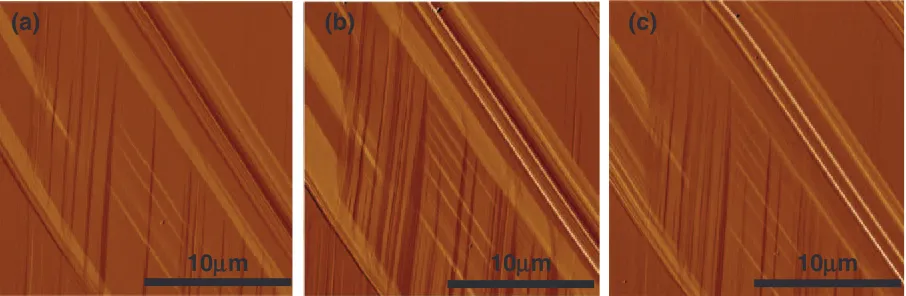
Figures 1(a)–(c) show AFM images of Al-0 samples deformed by 1%, 3% and that heated to 300C, respectively.
The observations were made at the same location. Here the horizontal direction is the tensile axis. A different contrast in color corresponds to the difference in the surface tilt angle.
As shown in Fig. 1(a), the surface relieves formed by 1% deformation are composed of the banded structures stretched in two directions. Although the surface relieves formed in Fe-Mn-Si shape memory alloys are mainly due to the stress-induced"-martensite,10)deformation twins ofparent phase
may also cause the surface relieves.11) For the
character-ization of the surface relieves, it should be born in mind the fact thatf111gh112ishear planes are shared by both stress-induced "-martensites and deformation twins. Hereafter, all of Miller’s indices and the direction indices are those for fcc parent phase.
One of the effective method to distinguish the martensite from the twin is the direct observation to check whether the martensite transforms reversely to austenite on heating.
In Fig. 1(a) one can see diagonal banded contrast running from top left to bottom right, that are products on the same habit plane. There are two kinds of contrasted regions: dark brown; and light brown, that originates from the difference in
h112idirections.
In addition, the products on another {111} plane are observed as banded contrast in a vertical direction. The width of banded products was extended with increasing the strain to 3%, and white contrasted regions were newly formed as falling diagonals. The banded structures decreased its width or disappeared after heating to 300C as shown in Fig. 1(c).
Such a change corresponds to "! reversed transforma-tion, which implies that the banded products are"-martensite. In contrast, white contrasted regions newly formed with a tensile strain of 3% did not disappear on heating, and thus the regions will be the deformation twin.
In these AFM images for Al-0, it is found that products form on multiple variants and multiple shear directions based on the fact that banded contrasts are running in two directions and have different colors. Kajiwaraet al.12)have reported that
martensite that contributed to the improvement in SME through training treatment or addition of fine precipitates was composed of highly fine plates of a single variant. Although the alignment of martensite variants are affected by the orientation of crystal grain, multiple variants were observed in most grains of the Al-0 samples.
3.2 Fe-30Mn-5Si-1Al alloy
Figures 2(a)–(c) show AFM images of Al-1 samples deformed by 1%, 3% and that heated to 200C, respectively.
10
µ
m
(a)
10
µ
m
(b)
10
µ
m
(c)
Fig. 1 Atomic force micrographs of Fe-30Mn-6Si alloy: The images were taken after (a) tensile deformation at 1%; (b) further deformation at 3%; and (c) subsequent heating to 300C.
10
µ
m
10
µ
m
(b)
(a)
10
µ
m
(c)
[image:2.595.72.525.73.221.2] [image:2.595.71.528.273.422.2]As reported in the previous report9) Al-1 sample has more annealing twins, and therefore the parent phases are more finely segmented than A1-0.
In Fig. 2, the top of the figure is the parent phase and the right down part is annealing twin that has the width of about 3mm. In the lower part, the parent phase and the annealing twin appear alternately. In addition, the formation of multiple narrow dark brown banded contrasts formed by 1% elonga-tion is shown in Fig. 2(a). These are banded products that have {111} habit plane like Al-0, and are either stress-induced "-martensite or deformation twin. We believe that some of banded products were "-martensite, which has already been corroborated by TEM observation.9)As shown in Figs. 2(a)–(c), the microstructural change with tensile elongation and heating exhibits the same tendency as Al-0. The area of banded region and its width increased with increasing the strain to 3%. Some banded regions disappear with subsequent heating to 200C. Such a recovering process
proceeded by further heating to 300C, though not presented
here. We noticed that the change between 200 and 300C
for Al-1 alloy was small compared to that of Al-0, which is presumably due to the fact that Al addition led to a reduction of Af.
Al-1 showed similar SME to A1-0 despite the fact that ductility was improved from 30% to 50% with Al substitu-tion.9) Such high ductility of Al-1 alloy is ascribed to the formation of deformation twins. The deformation twins are responsible for the residual surface relieves after heating above Af.
It should be born in mind however that the surface relieves may remain even after heating when"-martensite transforms to austenite along different crystallographic paths from that of stress-induced !" transformation.11) Therefore the
surface relieves cannot be identified as deformation twins only by the presence of surface relieves after heating.
In the present study, therefore, the identification of banded products and variants were performed by comparing meas-urement values of the surface tilt angles with theoretical values corresponding to stress-induced "-martensite and deformation twin. For this, the crystal orientation of the parent phase must be first determined. According to Takeuchi et al.,13) the crystal orientation of the parent phase can be determined when all the four traces off111gf plane appear on
the surface.
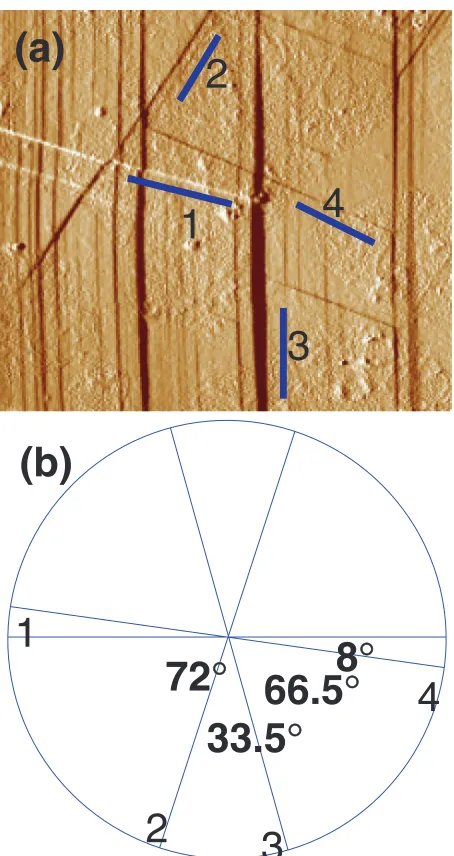
However, the deformation of 3% was not sufficient to observe all the four traces, and hence Al-1 sample was further deformed until four traces of {111} planes appear. We then noticed that deformation by 10% was enough to have all the four {111} traces appear on the surface.
Figure 3(a) shows AFM image of the sample deformed by 10%. One can clearly see four traces of {111} plane in this photo. The image was for the position moved to upper left from the area presented in Fig. 2 and within the same grain. Figure 3(b) shows the angle between each trace of four {111} plane labeled by numbers of 1–4 in Fig. 3(a). Longitudinal angle and latitude angle in stereographs for surface of specimen can be calculated by using the chart for the relationship with the angle between each trace andor.13) The results were¼21:5 and¼ 14:2. The respective traces of 1–4 are identified as (11111), (11111), (11111), (111).
In addition, one can determinethat is the angle between each {111} plane and surface of specimen and that is the angle between eachh112idirection and each surface trace of {111}. Usingand, one can obtain the surface tilt angle for
"-martensite (ð"Þ) and deformation twin(ðTÞ) with the
following equations:9)
tanð"Þ ¼ ðsinsin2Þ=ð2pffiffiffi2þsincossinÞ
tanðTÞ ¼ ðsinsin2Þ=ð
ffiffiffi 2 p
þsincossinÞ
With measuring these angles, the banded products in Fig. 2 can be classified as"-martensite or deformation twin. The analysis for surface tilt angles was performed to the banded products on the parent phase.
Figures 4(a) and (b) are AFM images for A1-1 deformed by 3% elongation and after heating, that are subject to the angle analyses. The locations with numbers are banded products analyzed.
Table 1 shows measurement values of surface tilt angles for the banded products in dark brown contrast marked with white numbers 1–5, which are the products on (11111) habit plane.
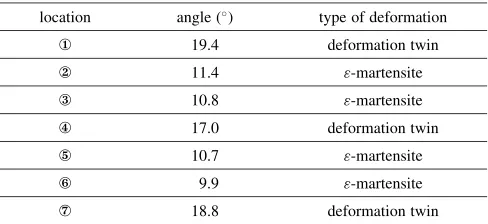
Table 2 presents measurement values of surface tilt angles for the banded products in white contrast marked with black numbers 1–7, which are the products on (11111) habit plane.
The angle between (11111) plane and the surface of specimen is¼ 57. Since the shear orientation which arises from
tensile deformation is [11122]. The angle between [11122] direction and the trace of (11111) plane is ¼ 122. As a
result, the theoretical surface tilt angles for stress-induced" -martensite and deformation twin are calculated to be
ð"Þ ¼ 10:5 and ð
TÞ ¼ 18:3, respectively. In the
[image:3.595.304.549.94.180.2]event that or has a negative value, the relief tilts downward assuming that it moves from left to right along the tensile axis. The measurement values in Table 1 are all close Table 1 Surface tilt angles of plate-like products exhibiting dark-brown
contrast in Fig. 4.
location angle () type of deformation
‹ 8.7 "-martensite
› 8.0 "-martensite
fi 8.6 "-martensite
fl 8.1 "-martensite
[image:3.595.305.549.231.343.2]9.0 "-martensite
Table 2 Surface tilt angles of plate-like products exhibiting white contrast in Fig. 4.
location angle () type of deformation
‹ 19.4 deformation twin
› 11.4 "-martensite
fi 10.8 "-martensite
fl 17.0 deformation twin
10.7 "-martensite
– 9.9 "-martensite
toð"Þ, and therefore all dark brown banded products running in a vertical direction will be"-martensite.
The angle between (11111) plane and the surface of the specimen is ¼63:5 and the direction formed by tensile
deformation is [121] or [22111]. Here, [121] direction is conformable with the measurement value. The angle between [121] direction and the trace of (11111) plane is ¼119:5,
and the theoretical values for "-martensite and twin are calculated to beð"Þ ¼12:4,ð
TÞ ¼21:6, respectively.
As the result, diagonally right up white contrast were identified deformation twin or "-martensite as shown in Table 2. In above-mentioned analytical results, the measure-ment values were all smaller than the theoretical value. Probably it originates from the fact that the banded products are composed of finer lamellar structure for both stress-induced"-martensite and deformation twin.11)
By comparing Figs. 4(a) with (b), the banded regions identified as the deformation twin (numbers surrounded black circle 1, 4, 7) did not disappear on heating, while the region identified as"-martensite disappeared. In addition, it was found that the deformation twins of 1, 4, and 7 had already existed at the stage of 1% elongation as shown in Fig. 2(a), suggesting that the deformation twin formed on the same habit plane along with stress-induced "-martensite during the initial deformation process of Al-1. This result suggests that the high ductility of Al-1 is attributable to TWIP effect.
Figures 5(a)–(c) show three dimensional AFM images for Al-1 deformed by 3% and 10%, and that after heating to
8
°
66.5
°
33.5
°
72
°
1
2
3
4
1
2
3
4
(a)
(b)
Fig. 3 (a) Atomic force micrographs of Fe-30Mn-5Si-1Al alloy deformed by 10%. The traces on four {111} planes are observed on the surface: (b) angles between different traces.
5
µ
m
(a)
(b)
5
µ
m
Fig. 4 Magnified images of upper parts of Figs. 2(b) and (c), which show the change in color of the plate-like products before and after heating.
(a)
(b)
(c)
[image:4.595.56.283.69.497.2] [image:4.595.314.541.72.196.2]400C, respectively. Here, annealing was performed at 400C to ensure full recovery. One can see that the surface
relieves are sharp and almost straight for the specimen deformed by 3%. In contrast, the surface relieves are rounded for the sample deformed by 10%, suggesting that slip dislocations are introduced in a high strain region. After heating, a part of surface relieves recovered as shown in Fig. 5(c). It is also notable in three dimensional micro-structural change from Figs. 5(a) to (c) that"-martensite was also induced along annealing twin boundaries by deformation and partly recovered by subsequent heating.
Stress-induced"-martensite observed along annealing twin boundary in Fig. 5(c) has a different shear component from the primary variant. This is due to the presence ofh112ishear on {111} plane associated with annealing twins in a high strain region.
4. Summary
With the aim of clarifying the source of a good combination of ductility and shape memory effect for Fe-30Mn-5Si-1Al alloys, we analyzed its microstructure with an atomic force microscope. When the alloy was deformed, the surface relieves were formed on the surface. It was found that such relieves are due to"-martensites and deformation twins. The relief due to"-martenstite disappeared when the sample was heated. In order to quantitatively analyze the surface relieves, we measured tilt angles relative to four traces of f111gf plane system. We calculated the theoretical values of
the surface tilt angles for"-martensite and deformation twin, and then compared with the measurement values obtained by AFM observation, which enabled us to distinguish " -martensite from deformation twins. It was found that
deformation twins along with stress-induced "-martensite are formed at the early stage of deformation in Fe-30Mn-5Si-1Al alloys, which is responsible for good ductility.
Acknowledgements
A part of the present work was funded by Japan Society for the Promotion of Science (JSPS), Grant-in-Aid for Scientific Research (C) and New Energy and Industrial Technology Development Organization (NEDO).
REFERENCES
1) A. Sato, E. Chishima, K. Soma and T. Mori: Acta Metall.30(1982) 1177–1183.
2) H. Otsuka, H. Yamada, T. Maruyama, H. Tanahashi, S. Matsuda and M. Murakami: ISIJ Int.30(1990) 674–679.
3) T. Maruyama and T. Kurita: Kinzoku74(2004) 160–163. 4) A. Sato: Materia Japan44(2005) 4–9.
5) T. Sawaguchi, P. Sahu, T. Kikuchi, K. Ogawa, S. Kajiwara A. Kushibe, M. Higashino and T. Ogawa: Scr. Mater.54(2006) 1885–1890. 6) M. Murakami, H. Otsuka, G. Suzuki and S. Matsuda:Proc. Int. Conf.
on Martensitic Transformation(The Japan Inst. Metals, 1986) pp. 985– 990.
7) O. Grassel and G. Frommeyer: Mater. Sci. Technol.14(1998) 1213– 1217.
8) S. Vercammen, B. C. De Cooman, N. Akdut, B. Blanplain, and P. Wollants: Steel Res.74(2003) 370–375.
9) M. Koyama, M. Murakami, K. Ogawa, T. Kikuchi and T. Sawaguchi: J. Japan Inst. Metals (2007) in press.
10) N. Bergeon, S. Kajiwara and T. Kikuchi: Acta mater.48(2000) 4053– 4064.
11) D. Z. Liu, S. Kajiwara, T. Kikuchi and N. Shinya: Philos. Mag.83 (2003) 2875–2897.
12) S. Kajiwara and K. Ogawa: Mater. Trans JIM34(1993) 1169–1176. 13) S. Takeuchi, T. Homma and S. Ikeda: J. Japan Inst. Metals22(1958)