Tree-Based Deterministic Dependency Parsing
— An Application to Nivre’s Method —
Kotaro Kitagawa Kumiko Tanaka-Ishii
Graduate School of Information Science and Technology, The University of Tokyo
[email protected] [email protected]
Abstract
Nivre’s method was improved by en-hancing deterministic dependency parsing through application of a tree-based model. The model considers all words necessary for selection of parsing actions by includ-ing words in the form of trees. It chooses the most probable head candidate from among the trees and uses this candidate to select a parsing action.
In an evaluation experiment using the Penn Treebank (WSJ section), the pro-posed model achieved higher accuracy than did previous deterministic models. Although the proposed model’s worst-case time complexity isO(n2), the experimen-tal results demonstrated an average pars-ing time not much slower thanO(n).
1 Introduction
Deterministic parsing methods achieve both effec-tive time complexity and accuracy not far from those of the most accurate methods. One such deterministic method is Nivre’s method, an incre-mental parsing method whose time complexity is linear in the number of words (Nivre, 2003). Still, deterministic methods can be improved. As a spe-cific example, Nivre’s model greedily decides the parsing action only from two words and their lo-cally relational words, which can lead to errors.
In the field of Japanese dependency parsing, Iwatate et al. (2008) proposed a tournament model that takes all head candidates into account in judg-ing dependency relations. This method assumes backward parsing because the Japanese depen-dency structure has a head-final constraint, so that any word’s head is located to its right.
Here, we propose a tree-based model, applica-ble to any projective language, which can be con-sidered as a kind of generalization of Iwatate’s
idea. Instead of selecting a parsing action for
two words, as in Nivre’s model, our tree-based model first chooses the most probable head can-didate from among the trees through a tournament and then decides the parsing action between two trees.
Global-optimization parsing methods are an-other common approach (Eisner, 1996;
McDon-ald et al., 2005). Koo et al. (2008) studied
semi-supervised learning with this approach. Hy-brid systems have improved parsing by integrat-ing outputs obtained from different parsintegrat-ing mod-els (Zhang and Clark, 2008).
Our proposal can be situated among global-optimization parsing methods as follows. The pro-posed tree-based model is deterministic but takes a step towards global optimization by widening the search space to include all necessary words con-nected by previously judged head-dependent rela-tions, thus achieving a higher accuracy yet largely retaining the speed of deterministic parsing.
2 Deterministic Dependency Parsing
2.1 Dependency Parsing
A dependency parser receives an input sentence x = w1, w2, . . . , wnand computes a dependency
graph G = (W, A). The set of nodes W =
{w0, w1, . . . , wn} corresponds to the words of a
sentence, and the nodew0 is the root ofG. A is the set of arcs(wi, wj), each of which represents a
dependency relation wherewi is the head andwj
is the dependent.
In this paper, we assume that the resulting de-pendency graph for a sentence is well-formed and projective (Nivre, 2008). Gis well-formed if and only if it satisfies the following three conditions of being single-headed, acyclic, and rooted.
2.2 Nivre’s Method
An incremental dependency parsing algorithm was first proposed by (Covington, 2001). After
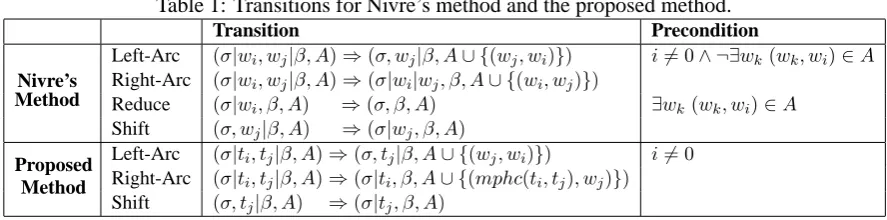
Table 1: Transitions for Nivre’s method and the proposed method.
Transition Precondition
Nivre’s Method
Left-Arc (σ|wi, wj|β, A)⇒(σ, wj|β, A∪ {(wj, wi)}) i̸= 0∧ ¬∃wk(wk, wi)∈A
Right-Arc (σ|wi, wj|β, A)⇒(σ|wi|wj, β, A∪ {(wi, wj)})
Reduce (σ|wi, β, A) ⇒(σ, β, A) ∃wk(wk, wi)∈A
Shift (σ, wj|β, A) ⇒(σ|wj, β, A) Proposed
Method
Left-Arc (σ|ti, tj|β, A)⇒(σ, tj|β, A∪ {(wj, wi)}) i̸= 0
Right-Arc (σ|ti, tj|β, A)⇒(σ|ti, β, A∪ {(mphc(ti, tj), wj)})
Shift (σ, tj|β, A) ⇒(σ|tj, β, A)
studies taking data-driven approaches, by (Kudo and Matsumoto, 2002), (Yamada and Matsumoto, 2003), and (Nivre, 2003), the deterministic incre-mental parser was generalized to a state transition system in (Nivre, 2008).
Nivre’s method applying an arc-eager algorithm works by using a stack of words denoted asσ, for a bufferβinitially containing the sentencex. Pars-ing is formulated as a quadruple(S, Ts, sinit, St),
where each component is defined as follows:
• S is a set of states, each of which is denoted as(σ, β, A)∈S.
• Tsis a set of transitions, and each element of
Tsis a functionts:S →S.
• sinit = ([w0],[w1, . . . , wn], ϕ) is the initial
state.
• Stis a set of terminal states.
Syntactic analysis generates a sequence of optimal transitions ts provided by an oracle o : S → Ts,
applied to a target consisting of the stack’s top ele-mentwiand the first elementwj in the buffer. The
oracle is constructed as a classifier trained on tree-bank data. Each transition is defined in the upper block of Table 1 and explained as follows:
Left-Arc Make wj the head of wi and pop wi,
wherewi is located at the stack top (denoted
asσ|wi), when the buffer head iswj(denoted
aswj|β).
Right-Arc Makewithe head ofwj, and pushwj.
Reduce Popwi, located at the stack top.
Shift Push the wordwj, located at the buffer head,
onto the stack top.
The method explained thus far has the following drawbacks.
Locality of Parsing Action Selection
The dependency relations are greedily determined, so when the transition Right-Arc adds a depen-dency arc (wi, wj), a more probable head of wj
located in the stack is disregarded as a candidate.
Features Used for Selecting Reduce
The features used in (Nivre and Scholz, 2004) to define a state transition are basically obtained from the two target wordswi andwj, and their related
words. These words are not sufficient to select Re-duce, because this action means thatwjhas no
de-pendency relation with any word in the stack.
Preconditions
When the classifier selects a transition, the result-ing graph satisfies well-formedness and projectiv-ity only under the preconditions listed in Table 1. Even though the parsing seems to be formulated as a four-class classifier problem, it is in fact formed of two types of three-class classifiers.
Solving these problems and selecting a more suitable dependency relation requires a parser that considers more global dependency relations.
3 Tree-Based Parsing Applied to Nivre’s Method
3.1 Overall Procedure
Tree-based parsing uses trees as the procedural el-ements instead of words. This allows enhance-ment of previously proposed deterministic mod-els such as (Covington, 2001; Yamada and Mat-sumoto, 2003). In this paper, we show the applica-tion of tree-based parsing to Nivre’s method. The parser is formulated as a state transition system
(S, Ts, sinit, St), similarly to Nivre’s parser, butσ
andβfor a states= (σ, β, A)∈Sdenote a stack of trees and a buffer of trees, respectively. A tree ti ∈Tis defined as the tree rooted by the wordwi,
and the initial state issinit= ([t0],[t1, . . . , tn], ϕ),
which is formed from the input sentencex. The state transitionsTsare decided through the
following two steps.
1. Select the most probable head candidate
(MPHC): For the treeti located at the stack
top, search for and select the MPHC forwj,
which is the root word of tj located at the
He
watched
most probable head candidate
birds He
the
with the head candidates
across
river the
birds
w
j [image:3.595.327.509.60.184.2]telescope
Figure 1: Example of a tournament.
functionmphc(ti, tj), and its details are
ex-plained in§3.2.
2. Select a transition: Choose a transition, by using an oracle, from among the follow-ing three possibilities (explained in detail in §3.3):
Left-Arc Make wj the head of wi and pop
ti, whereti is at the stack top (denoted
asσ|ti, with the tail beingσ), when the
buffer head istj (denoted astj|β).
Right-Arc Make the MPHC the head ofwj,
and pop the MPHC.
Shift Push the tree tj located at the buffer
head onto the stack top.
These transitions correspond to three possibilities for the relation betweentiandtj: (1) a word ofti
is a dependent of a word oftj; (2) a word oftj is a
dependent of a word ofti; or (3) the two trees are
not related.
The formulations of these transitions in the lower block of Table 1 correspond to Nivre’s sitions of the same name, except that here a tran-sition is applied to a tree. This enhancement from words to trees allows removal of both the Reduce transition and certain preconditions.
3.2 Selection of Most Probable Head Candidate
By usingmphc(ti, tj), a word located far fromwj
(the head of tj) can be selected as the head
can-didate in ti. This selection process decreases the
number of errors resulting from greedy decision considering only a few candidates.
Various procedures can be considered for im-plementingmphc(ti, tj). One way is to apply the
tournament procedure to the words inti. The
tour-nament procedure was originally introduced for parsing methods in Japanese by (Iwatate et al.,
The biped was
sold
separately by robot
his company
t
it
jmphc(ti,tj)
Right-Arc
The biped was
sold
separately by robot
his company
[image:3.595.88.295.63.187.2]t
it
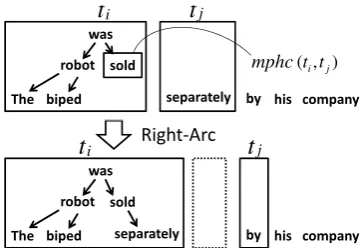
jFigure 2: Example of the transition Right.
2008). Since the Japanese language has the head-final property, the tournament model itself consti-tutes parsing, whereas for parsing a general pro-jective language, the tournament model can only be used as part of a parsing algorithm.
Figure 1 shows a tournament for the example of “with,” where the word “watched” finally wins. Although only the words on the left-hand side of tree tj are searched, this does not mean that the
tree-based method considers only one side of a de-pendency relation. For example, when we apply the tree-based parsing to Yamada’s method, the search problems on both sides are solved.
To implement mphc(ti, tj), a binary classifier
is built to judge which of two given words is more appropriate as the head for another input word. This classifier concerns three words, namely, the two words l (left) and r (right) in ti, whose
ap-propriateness as the head is compared for the de-pendent wj. All word pairs of l andr in ti are
compared repeatedly in a “tournament,” and the survivor is regarded as the MPHC ofwj.
The classifier is generated through learning of training examples for all ti and wj pairs, each
of which generates examples comparing the true head and other (inappropriate) heads in ti.
Ta-ble 2 lists the features used in the classifier. Here, lex(X) and pos(X) mean the surface form and part of speech of X, respectively. Xlef t means the dependents ofX located on the left-hand side of X, whileXright means those on the right. Also,
Xhead means the head ofX. The feature design
concerns three additional words occurring after wj, as well, denoted aswj+1, wj+2, wj+3.
3.3 Transition Selection
A transition is selected by a three-class classifier
after deciding the MPHC, as explained in §3.1.
precon-Table 2: Features used for a tournament.
pos(l), lex(l)
pos(lhead), pos(llef t), pos(lright)
pos(r), lex(r)
pos(rhead), pos(rlef t), pos(rright) pos(wj), lex(wj), pos(wlef tj )
pos(wj+1), lex(wj+1), pos(wj+2), lex(wj+2)
[image:4.595.68.537.67.156.2]pos(wj+3), lex(wj+3)
Table 3: Features used for a state transition. pos(wi), lex(wi)
pos(wilef t), pos(wrighti ), lex(wlef ti ), lex(wiright) pos(MPHC), lex(MPHC)
pos(MPHChead), pos(MPHClef t), pos(MPHCright)
lex(MPHChead), lex(MPHClef t), lex(MPHCright)
pos(wj), lex(wj), pos(wlef tj ), lex(wlef tj )
pos(wj+1), lex(wj+1), pos(wj+2), lex(wj+2), pos(wj+3), lex(wj+3)
dition. The transition Shift indicates that the tar-get trees ti andtj have no dependency relations.
The transition Right-Arc indicates generation of
the dependent-head relation between wj and the
result ofmphc(ti, tj), i.e., the MPHC forwj.
Fig-ure 2 shows an example of this transition. The transition Left-Arc indicates generation of the de-pendency relation in which wj is the head of wi.
While Right-Arc requires searching for the MPHC inti, this is not the case for Left-Arc1.
The key to obtaining an accurate tree-based parsing model is to extend the search space while at the same time providing ways to narrow down the space and find important information, such as the MPHC, for proper judgment of transitions.
The three-class classifier is constructed as fol-lows. The dependency relation between the target trees is represented by the three wordswi,MPHC,
andwj. Therefore, the features are designed to
in-corporate these words, their relational words, and the three words next towj. Table 3 lists the exact
set of features used in this work. Since this transi-tion selectransi-tion procedure presumes selectransi-tion of the MPHC, the result ofmphc(ti, tj)is also
incorpo-rated among the features.
4 Evaluation
4.1 Data and Experimental Setting
In our experimental evaluation, we used Yamada’s head rule to extract unlabeled dependencies from the Wall Street Journal section of a Penn Treebank. Sections 2-21 were used as the training data, and section 23 was used as the test data. This test data
1The head word ofw
ican only bewjwithout searching
withintj, because the relations between the other words intj
andwihave already been inferred from the decisions made
within previous transitions. Iftj has a childwk that could
become the head ofwi under projectivity, thiswk must be
located betweenwiandwj. The fact thatwk’s head iswj
means that there were two phases beforetiandtj (i.e.,wi
andwj) became the target:
• tiandtkbecame the target, and Shift was selected.
• tkandtjbecame the target, and Left-Arc was selected.
The first phase precisely indicates thatwiandwk are
unre-lated.
was used in several other previous works, enabling mutual comparison with the methods reported in those works.
The SVMlight package2 was used to build the
support vector machine classifiers. The binary
classifier for MPHC selection and the three-class classifier for transition selection were built using a cubic polynomial kernel. The parsing speed was evaluated on a Core2Duo (2.53 GHz) machine.
4.2 Parsing Accuracy
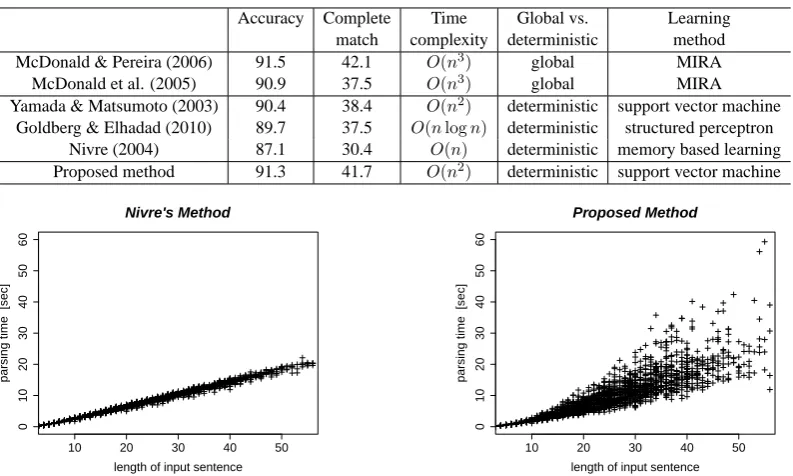
We measured the ratio of words assigned correct heads to all words (accuracy), and the ratio of sen-tences with completely correct dependency graphs to all sentences (complete match). In the evalua-tion, we consistently excluded punctuation marks. Table 4 compares our results for the proposed method with those reported in some previous works using equivalent training and test data. The first column lists the four previous methods and our method, while the second through fourth columns list the accuracy, complete match accu-racy, and time complexity, respectively, for each method. Here, we obtained the scores for the pre-vious works from the corresponding articles listed in the first column. Note that every method used different features, which depend on the method.
The proposed method achieved higher accuracy than did the previous deterministic models. Al-though the accuracy of our method did not reach that of (McDonald and Pereira, 2006), the scores were competitive even though our method is de-terministic. These results show the capability of the tree-based approach in effectively extending the search space.
4.3 Parsing Time
Such extension of the search space also concerns the speed of the method. Here, we compare its computational time with that of Nivre’s method. We re-implemented Nivre’s method to use SVMs with cubic polynomial kernel, similarly to our
Table 4: Dependency parsing performance.
Accuracy Complete Time Global vs. Learning
match complexity deterministic method
McDonald & Pereira (2006) 91.5 42.1 O(n3)
global MIRA
McDonald et al. (2005) 90.9 37.5 O(n3) global MIRA
Yamada & Matsumoto (2003) 90.4 38.4 O(n2)
deterministic support vector machine
Goldberg & Elhadad (2010) 89.7 37.5 O(nlogn) deterministic structured perceptron
Nivre (2004) 87.1 30.4 O(n) deterministic memory based learning
Proposed method 91.3 41.7 O(n2) deterministic support vector machine
10 20 30 40 50
0
10
20
30
40
50
60
Nivre’s Method
length of input sentence
parsing time [sec]
10 20 30 40 50
0
10
20
30
40
50
60
Proposed Method
length of input sentence
parsing time [sec]
Figure 3: Parsing time for sentences.
method. Figure 3 shows plots of the parsing times for all sentences in the test data. The average pars-ing time for our method was 8.9 sec, whereas that for Nivre’s method was 7.9 sec.
Although the worst-case time complexity for Nivre’s method isO(n)and that for our method is O(n2), worst-case situations (e.g., all words hav-ing heads on their left) did not appear frequently. This can be seen from the sparse appearance of the upper bound in the second figure.
5 Conclusion
We have proposed a tree-based model that decides head-dependency relations between trees instead of between words. This extends the search space to obtain the best head for a word within a deter-ministic model. The tree-based idea is potentially applicable to various previous parsing methods; in this paper, we have applied it to enhance Nivre’s method.
Our tree-based model outperformed various de-terministic parsing methods reported previously. Although the worst-case time complexity of our method isO(n2), the average parsing time is not much slower thanO(n).
References
Xavier Carreras. 2007. Experiments with a higher-order
projective dependency parse. Proceedings of the CoNLL Shared Task Session of EMNLP-CoNLL, pp. 957-961.
Michael A. Covington. 2001. A fundamental algorithm for dependency parsing. Proceedings of ACM, pp. 95-102.
Jason M. Eisner. 1996. Three new probabilistic models
for dependency parsing: An exploration. Proceedings of COLING, pp. 340-345.
Yoav Goldberg and Michael Elhadad. 2010. An Efficient Al-gorithm for Easy-First Non-Directional Dependency Pars-ing. Proceedings of NAACL.
Masakazu Iwatate, Masayuki Asahara, and Yuji Matsumoto. 2008. Japanese dependency parsing using a tournament model. Proceedings of COLING, pp. 361–368.
Terry Koo, Xavier Carreras, and Michael Collins. 2008.
Simple semi-supervised dependency parsing.
Proceed-ings of ACL, pp. 595–603.
Taku Kudo and Yuji Matsumoto. 2002. Japanese depen-dency analysis using cascaded chunking Proceedings of CoNLL, pp. 63–69.
Ryan McDonald, Koby Crammer, and Fernando Pereira.
2005. Online large-margin training of dependency
parsers. Proceedings of ACL, pp. 91–98.
Ryan McDonald and Fernando Pereira. 2006. Online learn-ing of approximate dependency parslearn-ing algorithms. Pro-ceedings of the EACL, pp. 81–88.
Joakim Nivre. 2003. An efficient algorithm for projective dependency parsing. Proceedings of IWPT, pp. 149–160.
Joakim Nivre. 2008. Algorithms for deterministic incremen-tal dependency parsing. Computational Linguistics, vol. 34, num. 4, pp. 513–553.
Joakim Nivre and Mario Scholz. 2004. Deterministic depen-dency parsing of English text. Proceedings of COLING, pp. 64–70.
Hiroyasu Yamada and Yuji Matsumoto. 2003. Statistical dependency analysis with support vector machines. Pro-ceedings of IWPT, pp. 195–206.