Correcting Errors in a Treebank Based on
Synchronous Tree Substitution Grammar
Yoshihide Kato1 and Shigeki Matsubara2 1Information Technology Center, Nagoya University 2Graduate School of Information Science, Nagoya University
Furo-cho, Chikusa-ku, Nagoya, 464-8601 Japan
Abstract
This paper proposes a method of correct-ing annotation errors in a treebank. By us-ing a synchronous grammar, the method transforms parse trees containing annota-tion errors into the ones whose errors are corrected. The synchronous grammar is automatically induced from the treebank. We report an experimental result of apply-ing our method to the Penn Treebank. The result demonstrates that our method cor-rects syntactic annotation errors with high precision.
1 Introduction
Annotated corpora play an important role in the fields such as theoretical linguistic researches or the development of NLP systems. However, they often contain annotation errors which are caused by a manual or semi-manual mark-up process. These errors are problematic for corpus-based re-searches.
To solve this problem, several error detection and correction methods have been proposed so far (Eskin, 2000; Nakagawa and Matsumoto, 2002; Dickinson and Meurers, 2003a; Dickinson and Meurers, 2003b; Ule and Simov, 2004; Murata et al., 2005; Dickinson and Meurers, 2005; Boyd et al., 2008). These methods detect corpus posi-tions which are marked up incorrectly, and find the correct labels (e.g. pos-tags) for those posi-tions. However, the methods cannot correct errors in structural annotation. This means that they are insufficient to correct annotation errors in a tree-bank.
This paper proposes a method of correcting er-rors in structural annotation. Our method is based on a synchronous grammar formalism, called syn-chronous tree substitution grammar(STSG) (Eis-ner, 2003), which defines a tree-to-tree
transfor-mation. By using an STSG, our method trans-forms parse trees containing errors into the ones whose errors are corrected. The grammar is au-tomatically induced from the treebank. To select STSG rules which are useful for error correction, we define a score function based on the occurrence frequencies of the rules. An experimental result shows that the selected rules archive high preci-sion.
This paper is organized as follows: Section 2 gives an overview of previous work. Section 3 ex-plains our method of correcting errors in a tree-bank. Section 4 reports an experimental result us-ing the Penn Treebank.
2 Previous Work
This section summarizes previous methods for correcting errors in corpus annotation and dis-cusses their problem.
Some research addresses the detection of er-rors in pos-annotation (Nakagawa and Matsumoto, 2002; Dickinson and Meurers, 2003a), syntactic annotation (Dickinson and Meurers, 2003b; Ule and Simov, 2004; Dickinson and Meurers, 2005), and dependency annotation (Boyd et al., 2008). These methods only detect corpus positions where errors occur. It is unclear how we can correct the errors.
Several methods can correct annotation errors (Eskin, 2000; Murata et al., 2005). These meth-ods are to correct tag-annotation errors, that is, they simply suggest a candidate tag for each po-sition where an error is detected. The methods cannot correct syntactic annotation errors, because syntactic annotation is structural. There is no ap-proach to correct structural annotation errors.
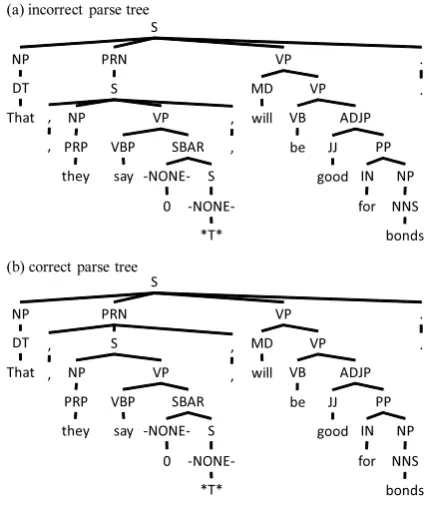
To clarify the problem, let us consider an exam-ple. Figure 1 depicts two parse trees annotated ac-cording to the Penn Treebank annotation 1. The
10and
*T*are null elements.
S
NP VP
. DT
That
PRN S
, NP VP
PRP they
VBP say
SBAR -NONE- S
-NONE-0
*T* ,
, ,
MD will
VP VB be
ADJP JJ good
PP IN for
NP NNS bonds
.
S
NP VP
. DT
That
PRN S ,
NP VP
PRP they
VBP say
SBAR -NONE- S
-NONE-0
*T* ,
, ,
MD will
VP VB be
ADJP JJ good
PP IN for
NP NNS bonds
.
(a) incorrect parse tree
(b) correct parse tree
Figure 1: An example of a treebank error
parse tree (a) contains errors and the parse tree (b) is the corrected version. In the parse tree (a), the positions of the two subtrees(, ,)are erro-neous. To correct the errors, we need to move the subtrees to the positions which are directly dom-inated by the node PRN. This example demon-strates that we need a framework of transforming tree structures to correct structural annotation er-rors.
3 Correcting Errors by Using Synchronous Grammar
To solve the problem described in Section 2, this section proposes a method of correcting structural annotation errors by using a synchronous tree sub-stitution grammar (STSG) (Eisner, 2003). An STSG defines a tree-to-tree transformation. Our method induces an STSG which transforms parse trees containing errors into the ones whose errors are corrected.
3.1 Synchronous Tree Substitution Grammar
First of all, we describe the STSG formalism. An STSG defines a set of tree pairs. An STSG can be treated as a tree transducer which takes a tree as input and produces a tree as output. Each grammar rule consists of the following elements:
• a pair of trees calledelementary trees
PRN S
,1 NP2 VP3 ,4
PRN S ,1
NP2 VP3 ,4
[image:2.595.74.289.67.320.2]source target
Figure 2: An example of an STSG rule
• a one-to-one alignment between nodes in the elementary trees
For a tree pair ⟨t, t′⟩, the tree t and t′ are called source and target, respectively. The non-terminal leaves of elementary trees are called fron-tier nodes. There exists a one-to-one alignment between the frontier nodes in t and t′. The rule means that the structure which matches the source elementary tree is transformed into the structure which is represented by the target elementary tree. Figure 2 shows an example of an STSG rule. The subscripts indicate the alignment. This rule can correct the errors in the parse tree (a) depicted in Figure 1.
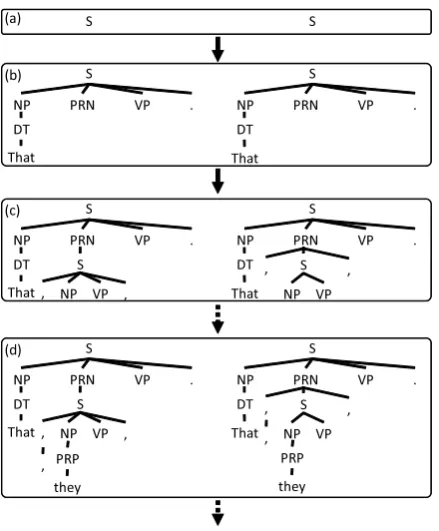
An STSG derives tree pairs. Any derivation process starts with the pair of nodes labeled with special symbols calledstart symbols. A derivation proceeds in the following steps:
1. Choose a pair of frontier nodes ⟨η, η′⟩ for which there exists an alignment.
2. Choose a rule⟨t, t′⟩s.t. label(η) = root(t)
and label(η′) = root(t′) where label(η) is the label ofηandroot(t)is the root label of
t.
3. Substitutetandt′intoηandη′, respectively.
Figure 3 shows a derivation process in an STSG. In the rest of the paper, we focus on the rules in which the source elementary tree is not identi-cal to its target, since such identiidenti-cal rules cannot contribute to error correction.
3.2 Inducing an STSG for Error Correction
This section describes a method of inducing an STSG for error correction. The basic idea of our method is similar to the method presented by Dickinson and Meurers (2003b). Their method de-tects errors by seeking word sequences satisfying the following conditions:
[image:2.595.314.522.68.130.2]S S
S
NP PRN VP .
S
NP PRN VP .
DT DT
That That
S
NP PRN VP .
S
NP PRN VP .
DT DT
That That
S , NP VP ,
S ,
NP VP ,
S
NP PRN VP .
S
NP PRN VP .
DT DT
That That
S , NP VP ,
S ,
NP VP ,
,
, PRP
they
PRP they
(a)
(b)
(c)
[image:3.595.75.295.62.328.2](d)
Figure 3: A derivation process of tree pairs in an STSG
• Different syntactic labels are assigned to the occurrences of the word sequence.
Unlike their method, our method seeks word se-quences whose occurrences have different partial parse trees. We call a collection of these word sequences with partial parse trees pseudo paral-lel corpus. Moreover, our method extracts STSG rules which transform the one partial tree into the other.
3.2.1 Constructing a Pseudo Parallel Corpus
Our method firstly constructs a pseudo parallel corpus which represents a correspondence be-tween parse trees containing errors and the ones whose errors are corrected. The procedure is as follows: Let T be the set of the parse trees oc-curring in the corpus. We write Sub(σ) for the set which consists of the partial parse trees in-cluded in the parse treeσ. A pseudo parallel cor-pusP ara(T)is constructed as follows:
P ara(T) = {⟨τ, τ′⟩ |τ, τ′ ∈ ∪
σ∈T
Sub(σ)
∧τ ̸=τ′
∧yield(τ) =yield(τ′)
∧root(τ) =root(τ′)}
PRN S ,1
NP2 VP4
PRP3 they
VBP5 say
SBAR6 -NONE-7 S8
-NONE-9 0
*T* ,
,10 , PRN
S
,1 NP2 VP4
PRP3 they
VBP5 say
SBAR6 -NONE-7 S8
-NONE-9 0
*T* ,
[image:3.595.312.522.63.160.2],10 ,
Figure 4: An example of a partial parse tree pair in a pseudo parallel corpus
S
NP VP
. DT
That
PRN S ,
NP VP
PRP they
VBP say
SBAR -NONE- S
-NONE-0
*T* ,
, ,
VBD will
ADJP PP IN of
NP PRP$
his NNS abilities
.
JJ proud
Figure 5: Another example of a parse tree contain-ing a word sequence “, they say ,”
where yield(τ) is the word sequence dominated byτ.
Let us consider an example. If the parse trees depicted in Figure 1 exist in the treebank T, the pair of partial parse trees depicted in Figure 4 is an element ofP ara(T). We also obtain this pair in the case where there exists not the parse tree (b) depicted in Figure 1 but the parse tree depicted in Figure 5, which contains the word sequence “, they say ,”.
3.2.2 Inducing a Grammar from a Pseudo Parallel Corpus
Our method induces an STSG from the pseudo parallel corpus according to the method proposed by Cohn and Lapata (2009). Cohn and Lapata’s method can induce an STSG which represents a correspondence in a parallel corpus. Their method firstly determine an alignment of nodes between pairs of trees in the parallel corpus and extracts STSG rules according to the alignments.
For partial parse treesτ andτ′, we define a node alignmentC(τ, τ′)as follows:
C(τ, τ′) = {⟨η, η′⟩ |η∈N ode(τ)
∧η′ ∈N ode(τ′)
[image:3.595.311.523.222.330.2]∧η′ is not the root ofτ′
∧label(η) =label(η′)
∧yield(η) =yield(η′)}
where N ode(τ) is the set of the nodes in τ, and
[image:4.595.312.528.67.188.2]yield(η) is the word sequence dominated by η. Figure 4 shows an example of a node alignment. The subscripts indicate the alignment.
An STSG rule is extracted by deleting nodes in a partial parse tree pair ⟨τ, τ′⟩ ∈ P ara(T). The procedure is as follows:
• For each ⟨η, η′⟩ ∈ C(τ, τ′), delete the de-scendants ofηandη′.
For example, the rule shown in Figure 2 is ex-tracted from the pair shown in Figure 4.
3.3 Rule Selection
Some rules extracted by the procedure in Section 3.2 are not useful for error correction, since the pseudo parallel corpus contains tree pairs whose source tree is correct or whose target tree is incor-rect. The rules which are extracted from such pairs can be harmful. To select rules which are use-ful for error correction, we define a score function which is based on the occurrence frequencies of elementary trees in the treebank. The score func-tion is defined as follows:
Score(⟨t, t′⟩) = f(t
′)
f(t) +f(t′)
wheref(·)is the occurrence frequency in the tree-bank. The score function ranges from 0 to 1. We assume that the occurrence frequency of an ele-mentary tree matching incorrect parse trees is very low. According to this assumption, the score func-tion Score(⟨t, t′⟩) is high when the source ele-mentary tree tmatches incorrect parse trees and the target elementary treet′ matches correct parse trees. Therefore, STSG rules with high scores are regarded to be useful for error correction.
4 An Experiment
To evaluate the effectiveness of our method, we conducted an experiment using the Penn Treebank (Marcus et al., 1993).
We used 49208 sentences in Wall Street Journal sections. We induced STSG rules by applying our method to the corpus. We obtained 8776 rules. We
PRN
, S
NP ,
PRN S
NP NP
VP
S
NP VP
NP
NP NP
IN NP
NP
NP PP
IN NP
(1) (2)
(4)
source target VP
, S ,
NP VP
(3) PP
IN DT NNS
PP
IN NP
DT NNS
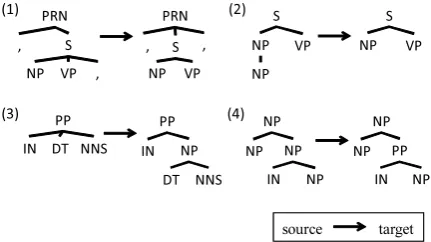
Figure 6: Examples of error correction rules in-duced from the Penn Treebank
measured the precision of the rules. The precision is defined as follows:
precision= # of the positions where an error is corrected # of the positions to which some rule is applied
We manually checked whether each rule appli-cation corrected an error, because the corrected treebank does not exist2. Furthermore, we only evaluated the first 100 rules which are ordered by the score function described in Section 3.3, since it is time-consuming and expensive to evaluate all of the rules. These 100 rules were applied at 331 positions. The precision of the rules is 71.9%. For each rule, we measured the precision of it. 70 rules achieved 100% precision. These results demon-strate that our method can correct syntactic anno-tation errors with high precision. Moreover, 30 rules of the 70 rules transformed bracketed struc-tures. This fact shows that the treebank contains structural errors which cannot be dealt with by the previous methods.
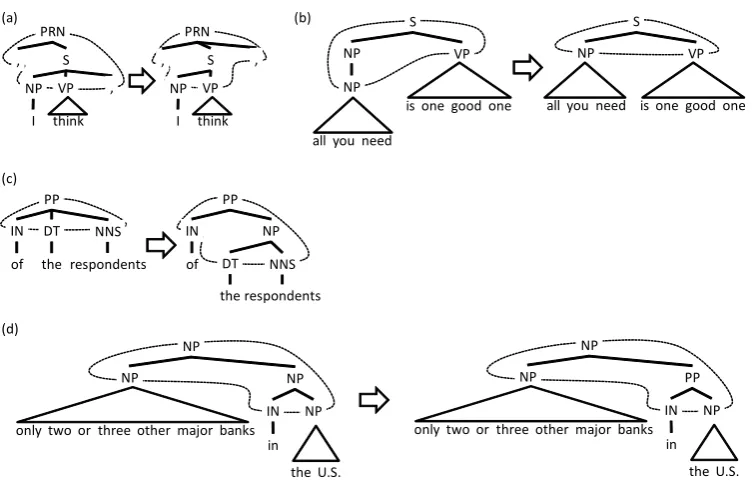
Figure 6 depicts examples of error correction rules which achieved 100% precision. Rule (1), (2) and (3) are rules which transform bracketed structures. Rule (4) simply replaces a node la-bel. Rule (1) corrects an erroneous position of a comma (see Figure 7 (a)). Rule (2) deletes a use-less node NPin a subject position (see Figure 7 (b)). Rule (3) inserts a nodeNP(see Figure 7 (c)). Rule (4) replaces a node label NP with the cor-rect labelPP(see Figure 7 (d)). These examples demonstrate that our method can correct syntactic annotation errors.
Figure 8 depicts an example where our method detected an annotation error but could not correct it. To correct the error, we need to attach the node
2This also means that we cannot measure the recall of the
PRN
, S
NP VP , I think
PRN
, S
NP
, VP I think
NP NP
S VP
is one good one all you need
NP S
VP
is one good one all you need
IN PP
NNS of
DT
the respondents IN
PP
NNS of DT
the respondents NP
NP NP
NP
the U.S. only two or three other major banks IN NP
in
NP NP
PP
the U.S. only two or three other major banks IN NP
in
(a) (b)
(c)
[image:5.595.112.490.61.305.2](d)
Figure 7: Examples of correcting syntactic annotation errors
S
PP , SBAR
IN At
NP NP CD 10:33
,
S
PP , SBAR
IN At
NP CD 10:33
,
[image:5.595.311.523.350.547.2]when ... when ...
Figure 8: An example where our method detected an annotation error but could not correct it
SBARunder the nodeNP. We found that 22 of the rule applications were of this type.
Figure 9 depicts a false positive example where our method mistakenly transformed a cor-rect syntactic structure. The score of the rule is very high, since the source elementary tree (TOP (NP NP VP .)) is less frequent. This example shows that our method has a risk of changing correct annotations of less frequent syn-tactic structures.
5 Conclusion
This paper proposes a method of correcting er-rors in a treebank by using a synchronous tree substitution grammar. Our method constructs a pseudo parallel corpus from the treebank and ex-tracts STSG rules from the parallel corpus. The experimental result demonstrates that we can ob-tain error correction rules with high precision.
TOP
NP VP .
based on quotations at five major banks The average of interbank offered rates
NP
TOP
NP VP .
based on quotations at five major banks The average of interbank offered rates
S
Figure 9: A false positive example where a correct syntactic structure was mistakenly transformed
In future work, we will explore a method of in-creasing the recall of error correction by construct-ing a wide-coverage STSG.
Acknowledgements
[image:5.595.81.285.353.435.2]References
Adriane Boyd, Markus Dickinson, and Detmar Meur-ers. 2008. On detecting errors in dependency tree-banks. Research on Language and Computation, 6(2):113–137.
Trevor Cohn and Mirella Lapata. 2009. Sentence com-pression as tree transduction. Journal of Artificial Intelligence Research, 34(1):637–674.
Markus Dickinson and Detmar Meurers. 2003a. De-tecting errors in part-of-speech annotation. In Pro-ceedings of the 10th Conference of the European Chapter of the Association for Computational Lin-guistics, pages 107–114.
Markus Dickinson and Detmar Meurers. 2003b. De-tecting inconsistencies in treebanks. InProceedings of the Second Workshop on Treebanks and Linguistic Theories.
Markus Dickinson and W. Detmar Meurers. 2005. Prune diseased branches to get healthy trees! how to find erroneous local trees in a treebank and why it matters. InProceedings of the 4th Workshop on Treebanks and Linguistic Theories.
Jason Eisner. 2003. Learning non-isomorphic tree mappings for machine translation. InProceedings of the 41st Annual Meeting of the Association for Com-putational Linguistics, Companion Volume, pages 205–208.
Eleazar Eskin. 2000. Detecting errors within a corpus using anomaly detection. InProceedings of the 1st North American chapter of the Association for Com-putational Linguistics Conference, pages 148–153.
Mitchell P. Marcus, Beatrice Santorini, and Mary Ann Marcinkiewicz. 1993. Building a large annotated corpus of English: the Penn Treebank. Computa-tional Linguistics, 19(2):310–330.
Masaki Murata, Masao Utiyama, Kiyotaka Uchimoto, Hitoshi Isahara, and Qing Ma. 2005. Correction of errors in a verb modality corpus for machine transla-tion with a machine-learning method. ACM Trans-actions on Asian Language Information Processing, 4(1):18–37.
Tetsuji Nakagawa and Yuji Matsumoto. 2002. Detect-ing errors in corpora usDetect-ing support vector machines. InProceedings of the 19th Internatinal Conference on Computatinal Linguistics, pages 709–715.