Methods for the Qualitative Evaluation of Lexical Association Measures
Stefan Evert
IMS, University of Stuttgart Azenbergstr. 12 D-70174 Stuttgart, Germany
Brigitte Krenn Austrian Research Institute for Artificial Intelligence (ÖFAI)
Schottengasse 3 A-1010 Vienna, Austria
Abstract
This paper presents methods for a qual-itative, unbiased comparison of lexical association measures and the results we have obtained for adjective-noun pairs and preposition-noun-verb triples ex-tracted from German corpora. In our approach, we compare the entire list of candidates, sorted according to the particular measures, to a reference set of manually identified “true positives”. We also show how estimates for the very large number of hapaxlegomena and double occurrences can be inferred from random samples.
1 Introduction
In computational linguistics, a variety of (statis-tical) measures have been proposed for identify-ing lexical associations between words in lexi-cal tuples extracted from text corpora. Methods used range from pure frequency counts to infor-mation theoretic measures and statistical signifi-cance tests. While the mathematical properties of those measures have been extensively discussed,1 the strategies employed for evaluating the iden-tification results are far from adequate. Another crucial but still unsolved issue in statistical col-location identification is the treatment of low-frequency data.
In this paper, we first specify requirements for a qualitative evaluation of lexical association
mea-1
See for instance (Manning and Schütze, 1999, chap-ter 5), (Kilgarriff, 1996), and (Pedersen, 1996).
sures (AMs). Based on these requirements, we introduce an experimentation procedure, and dis-cuss the evaluation results for a number of widely used AMs. Finally, methods and strategies for handling low-frequency data are suggested.
The measures2 – Mutual Information (
) (Church and Hanks, 1989), the log-likelihood ratio test (Dunning, 1993), two statistical tests: t-test and -test, and co-occurrence frequency –
are applied to two sets of data: adjective-noun (AdjN) pairs and preposition-noun-verb (PNV) triples, where the AMs are applied to (PN,V) pairs. See section 3 for a description of the base data. For evaluation of the association measures,
-best strategies (section 4.1) are supplemented with precision and recall graphs (section 4.2) over the complete data sets. Samples comprising par-ticular frequency strata (high versus low frequen-cies) are examined (section 4.3). In section 5, methods for the treatment of low-frequency data, single (hapaxlegomena) and double occurrences are discussed. The significance of differences be-tween the AMs is addressed in section 6.
2 The Qualitative Evaluation of Association Measures
2.1 State-of-the-art
A standard procedure for the evaluation of AMs is manual judgment of the
-best candidates identi-fied in a particular corpus by the measure in ques-tion. Typically, the number of true positives (TPs)
2
among the 50 or 100 (or slightly more) highest ranked word combinations is manually identified by a human evaluator, in most cases the author of the paper in which the evaluation is presented. This method leads to a very superficial judgment of AMs for the following reasons:
(1) The identification results are based on small subsets of the candidates extracted from the cor-pus. Consequently, results achieved by individ-ual measures may very well be due to chance (cf. sections 4.1 and 4.2), and evaluation with respect to frequency strata is not possible (cf. section 4.3). (2) For the same reason, it is impossible to determine recall values, which are important for many practical applications. (3) The introduc-tion of new measures or changes to the calculaintroduc-tion methods require additional manual evaluation, as new
-best lists are generated.
2.2 Requirements
To improve the reliability of the evaluation re-sults, a number of properties need to be con-trolled. We distinguish between two classes:
(1) Characteristics of the set of candidate data employed for collocation identification: (i) the syntactic homogeneity of the base data, i.e., whether the set of candidate data consists only of adjective-noun, noun-verb, etc. pairs or whether different types of word combinations are mixed; (ii) the grammatical status of the individual word combinations in the base set, i.e., whether they are part of or constitute a phrase or simply co-occur within a given text window; (iii) the per-centage of TPs in the base set, which is typically higher among high-frequency data than among low-frequency data.
(2) The evaluation strategies applied: Instead of examining only a small sample of
-best can-didates for each measure as it is common practice, we make use of recall and precision values for
-best samples of arbitrary size, which allows us to plot recall and precision curves for the whole set of candidate data. In addition, we compare preci-sion curves for different frequency strata.
3 The Base Data
The base data for our experiments are extracted from two corpora which differ with respect to size and text type. The base sets also differ with
re-spect to syntactic homogeneity and grammatical correctness. Both candidate sets have been man-ually inspected for TPs.
The first set comprises bigrams of adjacent, lemmatized AdjN pairs extracted from a small ( word) corpus of freely available Ger-man law texts.3 Due to the extraction strategy, the data are homogeneous and grammatically correct, i.e., there is (almost) always a grammatical de-pendency between adjacent adjectives and nouns in running text. Two human annotators indepen-dently marked candidate pairs perceived as “typ-ical” combinations, including idioms ((die) hohe See, ‘the high seas’), legal terms (üble Nachrede, ‘slander’), and proper names (Rotes Kreuz, ‘Red Cross’). Candidates accepted by either one of the annotators were considered TPs.
The second set consists of PNV triples ex-tracted from an 8 million word portion of the Frankfurter Rundschau Corpus4, in which part-of-speech tags and minimal PPs were identified.5 The PNV triples were selected automatically such that the preposition and the noun are constituents of the same PP, and the PP and the verb co-occur within a sentence. Only main verbs were con-sidered and full forms were reduced to bases.6 The PNV data are partially inhomogeneous and not fully grammatically correct, because they in-clude combinations with no grammatical relation between PN and V. PNV collocations were man-ually annotated. The criteria used for the dis-tinction between collocations and arbitrary word combinations are: There is a grammatical rela-tion between the verb and the PP, and the triple can be interpreted as support verb construction and/or a metaphoric or idiomatic reading is avail-able, e.g.: zur Verfügung stellen (at_the availabil-ity put, ‘make available’), am Herzen liegen (at the heart lie, ‘have at heart’).7
3See (Schmid, 1995) for a description of the part-of-speech tagger used to identify adjectives and nouns in the corpus.
4The Frankfurter Rundschau Corpus is part of the Euro-pean Corpus Initiative Multilingual Corpus I.
5
See (Skut and Brants, 1998) for a description of the tag-ger and chunker.
6
Mmorph – the MULTEXT morphology tool provided by ISSCO/SUISSETRA, Geneva, Switzerland – has been em-ployed for determining verb infinitives.
7
AdjN data PNV data
total 11 087 total 294 534
4 652
14 654
colloc. 15.84% colloc. 6.41%
= 737
[image:3.595.78.290.63.136.2]
= 939
Table 1: Base sets used for evaluation
General statistics for the AdjN and PNV base sets are given in Table 1. Manual annotation was performed for AdjN pairs with frequency
and PNV triples with
only (see section 5 for a discussion of the excluded low-frequency candidates).
4 Experimental Setup
After extraction of the base data and manual iden-tification of TPs, the AMs are applied, resulting in an ordered candidate list for each measure (hence-forth significance list, SL). The order indicates the degree of collocativity. Multiple candidates with identical scores are listed in random order. This is necessary, in particular, when co-occurrence fre-quency is used as an association measure.
4.1 -Best Lists
In this approach, the set of the
highest ranked word combinations is evaluated for each measure, and the proportion of TPs among this
-best list (the precision) is computed. Another measure of goodness is the proportion of TPs in the base data that are also contained in the
-best list (the re-call). While precision measures the quality of the
-best lists produced, recall measures their cov-erage, i.e., how many of all true collocations in the corpus were identified. The most problematic aspect here is that conclusions drawn from
-best lists for a single (and often small) value of
are only snapshots and likely to be misleading.
For instance, considering the set of AdjN base data with
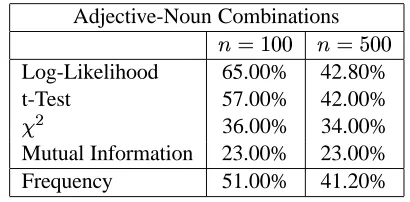
we might arrive at the following results (Table 2 gives the precision values of the
highest ranked word combinations with
): As expected from the results of other studies (e.g. Lezius (1999)), the precision of
is significantly lower than that of log-likelihood,8
8
This is to a large part due to the fact that systemati-cally overestimates the collocativity of low-frequency pairs, cf. section 4.3.
whereas the t-test competes with log-likelihood, especially for larger values of
. Frequency leads to clearly better results than
and , and, for
, comes close to the accuracy of t-test and log-likelihood.
Adjective-Noun Combinations
Log-Likelihood 65.00% 42.80%
t-Test 57.00% 42.00%
36.00% 34.00%
Mutual Information 23.00% 23.00%
Frequency 51.00% 41.20%
Table 2: Precision values for
-best AdjN pairs.
4.2 Precision and Recall Graphs
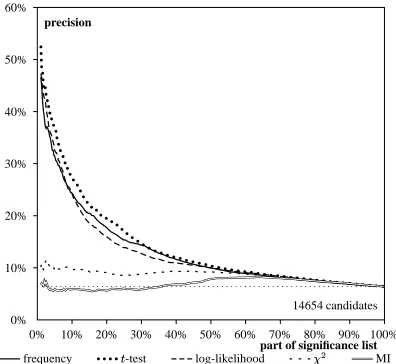
For a clearer picture, however, larger portions of the SLs need to be examined. A well suited means for comparing the goodness of different AMs are the precision and recall graphs obtained by step-wise processing of the complete SLs (Figures 1 to 10 below).9
The -axis represents the percentage of data
processed in the respective SL, while the
-axis represents the precision (or recall) values achieved. For instance, the precision values for
and
for the AdjN data can be read from the -axis in Figure 1 at positions where
and
(marked by verti-cal lines). The dotted horizontal line represents the percentage of true collocations in the base set. This value corresponds to the expected precision value for random selection, and provides a base-line for the interpretation of the precision curves.
General findings from the precision graphs are: (i) It is only useful to consider the first halves of the SLs, as the measures approximate after-wards. (ii) Precision of log-likelihood, , t-test
and frequency strongly decreases in the first part of the SLs, whereas precision of
remains al-most constant (cf. Figure 1) or even increases slightly (cf. Figure 2). (iii) The identification re-sults are instable for the first few percent of the data, with log-likelihood, t-test and frequency sta-bilizing earlier than
and , and the PNV data
9
[image:3.595.311.516.143.244.2]0% 10% 20% 30% 40% 50% 60% 70% 80% 90% 100% 0%
10% 20% 30% 40% 50% 60% 70%
part of significance list precision
4652 candidates
[image:4.595.82.279.62.235.2]frequency -test log-likelihood MI
Figure 1: Precision graphs for AdjN data.
0% 10% 20% 30% 40% 50% 60% 70% 80% 90% 100% 0%
10% 20% 30% 40% 50% 60%
part of significance list precision
14654 candidates
frequency -test log-likelihood MI
Figure 2: Precision graphs for PNV data.
stabilizing earlier than the AdjN data. This in-stability is caused by “random fluctuations”, i.e., whether a particular TP ends up on rank
(and thus increases the precision of the
-best list) or on rank
. The
-best lists for AMs with low precision values (
, ) contain a particularly
small number of TPs. Therefore, they are more susceptible to random variation, which illustrates that evaluation based on a small number of
-best candidate pairs cannot be reliable.
With respect to the recall curves (Figures 3 and 4), we find: (i) Examination of 50% of the data in the SLs leads to identification of between 75% (AdjN) and 80% (PNV) of the TPs. (ii) For the first 40% of the SLs,
and lead to the worst
results, with
outperforming
.
0% 10% 20% 30% 40% 50% 60% 70% 80% 90% 100% 0%
10% 20% 30% 40% 50% 60% 70% 80% 90% 100%
part of significance list recall
4652 candidates
[image:4.595.317.509.70.263.2]frequency -test log-likelihood MI
Figure 3: Recall graphs for AdjN data.
0% 10% 20% 30% 40% 50% 60% 70% 80% 90% 100% 0%
10% 20% 30% 40% 50% 60% 70% 80% 90% 100%
part of significance list recall
14654 candidates
frequency -test log-likelihood MI
Figure 4: Recall graphs for PNV data.
[image:4.595.81.279.280.462.2] [image:4.595.317.511.327.524.2]t-test leads to a recall of over 60% when approx. 20% of the SL has been considered.
In the Figures above, there are a number of po-sitions on the -axis where the precision and
re-call values of different measures are almost iden-tical. This shows that a simple
-best approach will often produce misleading results. For in-stance, if we just look at the first
of the SLs for the PNV data, we might conclude that the t-test and frequency measures are equally well suited for the extraction of PNV collocations. However, the full curves in Figures 2 and 4 show that t-test is consistently better than frequency.
4.3 Frequency Strata
While we have previously considered data from a broad frequency range (i.e., frequencies
for AdjN and
for PNV), we will now split up the candidate sets into high-frequency and low-frequency occurrences. This procedure al-lows us to assess the performance of AMs within different frequency strata. For instance, there is a widely held belief that
and are inferior
to other measures because they overestimate the collocativity of low-frequency candidates (cf. the remarks on the measure in (Dunning, 1993)).
One might thus expect
and to yield much
better results for higher frequencies.
We have divided the AdjN data into two sam-ples with
(high frequencies) and
(low frequencies), because the number of data in the base sample is quite small. As there are enough PNV data, we used a higher threshold and selected samples with
(high frequencies) and
(low frequencies).
High Frequencies
Considering our high-frequency AdjN data (Fig-ure 5), we find that all precision curves decline as more of the data in the SLs is examined. Espe-cially for
, this is markedly different from the results obtained before. As the full curves show, log-likelihood is obviously the best measure. It is followed by t-test, , frequency and
in this order. Frequency and
approximate when 50% of the data in the SLs are examined. In the remaining part of the lists,
yields better re-sults than frequency and is practically identical to the best-performing measures.
0% 10% 20% 30% 40% 50% 60% 70% 80% 90% 100% 0%
10% 20% 30% 40% 50% 60% 70%
part of significance list precision
1280 candidates
[image:5.595.313.510.62.235.2]frequency -test log-likelihood MI
Figure 5: AdjN data with
.
0% 10% 20% 30% 40% 50% 60% 70% 80% 90% 100% 0%
10% 20% 30% 40% 50% 60%
part of significance list precision
1249 candidates
frequency -test log-likelihood MI
Figure 6: PNV data with
.
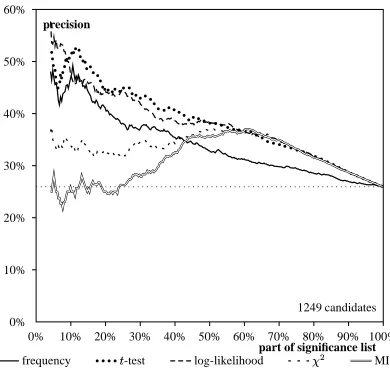
Surprisingly, the precision curves of and in
particular
increase over the first 60% of the SLs for high-frequency PNV data, whereas the curves for t-test, log-likelihood, and frequency have the usual downward slope (see Figure 6). Log-likelihood achieves precision values above 50% for the first 10% of the list, but is outper-formed by the t-test afterwards. Looking at the first 40% of the data, there is a big gap between the good measures (t-test, log-likelihood, and fre-quency) and the weak measures ( and
). In the second half of the data in the SLs, how-ever, there is virtually no difference between
,
, and the other measures, with the exception of
mere co-occurrence frequency.
[image:5.595.314.509.279.463.2]around the first 5% of the data in the SLs – leads to the overall best precision results for high-frequency PNV data. Log-likelihood is sec-ond best but achieves the best results for high-frequency AdjN data.
Low Frequencies
0% 10% 20% 30% 40% 50% 60% 70% 80% 90% 100% 0%
10% 20% 30% 40%
part of significance list precision
3372 candidates
[image:6.595.80.278.159.341.2]frequency -test log-likelihood MI
Figure 7: AdjN data with
.
0% 10% 20% 30% 40% 50% 60% 70% 80% 90% 100% 0%
10%
part of significance list precision
10165 candidates
[image:6.595.81.281.400.497.2]frequency -test log-likelihood MI
Figure 8: PNV data with
.
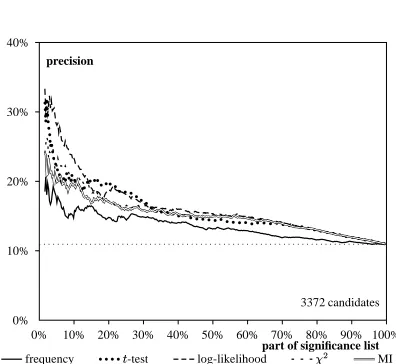
Figures 7 and 8 show that there is little differ-ence between the AMs for low-frequency data, except for co-occurrence frequency, which leads to worse results than all other measures.
For AdjN data, the AMs at best lead to an im-provement of factor 3 compared to random selec-tion (when up to
of the SL is examined, log-likelihood achieves precision values above 30%). Log-likelihood is the overall best measure for identifying AdjN collocations, except for
-coordinates between 15% and 20% where t-test outperforms log-likelihood.
For PNV data, the curves of all measures (ex-cept for frequency) are nearly identical. Their
precision values are not significantly10 different from the baseline obtained by random selection.
In contrast to our expectation stated at the be-ginning of this section, the performance of
and relative to the other AMs is not better for
high-frequency data than for low-frequency data. Instead, the poor performance observed in section 4.2 is explained by the considerably higher base-line precision of the high-frequency data (cf. Fig-ures 5 to 8): unlike the
-best lists for “frequency-sensitive” measures such as log-likelihood, those
of
and contain a large proportion of
low-frequency candidates.
5 Hapaxlegomena and Double
Occurrences
As the frequency distribution of word combina-tions in texts is characterised by a large number of rare events, low-frequency data are a serious challenge for AMs. One way to deal with low-frequency candidates is the introduction of cut-off thresholds. This is a widely used strategy, and it is motivated by the fact that it is in gen-eral highly problematic to draw conclusions from low-frequency data with statistical methods (cf. Weeber et al. (2000) and Figure 8). A practical reason for cutting off low-frequency data is the need to reduce the amount of manual work when the complete data set has to be evaluated, which is a precondition for the exact calculation of recall and for plotting precision curves.
The major drawback of an approach where all low-frequency candidates are excluded is that a large part of the data is lost for collocation extrac-tion. In our data, for instance, 80% of the full set of PNV data and 58% of the AdjN data are ha-paxes. Thus it is important to know how many (and which) true collocations there are among the excluded low-frequency candidates.
5.1 Statistical Estimation of TPs among Low-Frequency Data
In this section, we estimate the number of col-locations in the data excluded from our experi-ments (i.e., AdjN pairs with
and PNV triples with
). Because of the large num-ber of candidates in those sets (6 435 for AdjN,
10According to the
279 880 for PNV), manual inspection of the en-tire data is impractical. Therefore, we use ran-dom samples from the candidate sets to obtain es-timates for the proportion of true collocations among the low-frequency data. We randomly se-lected 965 items (15%) from the AdjN hapaxes, and 983 items ( 0.35%) from the low-frequency PNV triples. Manual examination of the samples yielded 31 TPs for AdjN (a proportion of 3.2%) and 6 TPs for PNV (0.6%).
Considering the low proportion of collocations in the samples, we must expect highly skewed frequency distributions (where is very small), which are problematic for standard statistical tests. In order to obtain reliable estimates, we have used an exact test based on the following model: Assuming a proportion of TPs in the full low-frequency data (AdjN or PNV), the number of TPs in a random sample of size is described
by a binomially distributed random variable
with parameter .11 Consequently, the proba-bility of finding or less TPs in the sample is
. We ap-ply a one-tailed statistical test based on the proba-bilities
to our samples in order to ob-tain an upper estimate for the actual proportion of collocations among the low-frequency data: the estimate
is accepted at a given signifi-cance level if
.
In the case of the AdjN data (
,
), we find that
at a confidence level of 99% (
). Thus, there should be at most 320 TPs among the AdjN candidates with
. Compared to the 737 TPs identified in the AdjN data with
, our decision to exclude the ha-paxlegomena was well justified. The proportion of TPs in the PNV sample (
,
) was much lower and we find that
at the same confidence level of 99%. However, due to the very large number of low-frequency candi-dates, there may be as many as 4200 collocations in the PNV data with
, more than 4 times the number identified in our experiment.
It is imaginable, then, that one of the AMs
11
To be precise, the binomial distribution is itself an ap-proximation of the exact hypergeometric probabilities (cf. Pedersen (1996)). This approximation is sufficiently accu-rate as long as the sample size is small compared to the size of the base set (i.e., the number of low-frequency candi-dates).
0% 10% 20% 30% 40% 50% 60% 70% 80% 90% 100% 0%
10%
part of significance list precision
10000 candidates
frequency -test log-likelihood "! MI
Figure 9: PNV data with
.
might succeed in extracting a substantial num-ber of collocations from the low-frequency PNV data. Figure 9 shows precision curves for the 10 000 highest ranked word combinations from each SL for PNV combinations with
(the vertical lines correspond to
-best lists for
).
In order to reduce the amount of manual work, the precision values for each AM are based on a 10% random sample from the 10 000 highest ranked candidates. We have applied the statisti-cal test described above to obtain confidence in-tervals for the true precision values of the best-performing AM (frequency), given our 10% sam-ple. The upper and lower bounds of the 95% con-fidence intervals are shown as thin lines. Even the highest precision estimates fall well below the 6.41% precision baseline of the PNV data with
. Again, we conclude that the exclusion of low-frequency candidates was well justified.
6 Significance Testing
We have assessed the significance of differences between AMs using the well-known test as
de-scribed in (Krenn, 2000).12 The thin lines in
Fig-ure 10 delimit 95% confidence intervals around the best-performing measure for the AdjN data with
(log-likelihood).
There is no significant difference between log-likelihood and t-test. And only for
-best lists with
, frequency performs marginally significantly worse than log-likelihood. For the PNV data (not shown), the t-test is signifi-cantly better than log-likelihood, but the differ-ence between frequency and the t-test is at best marginally significant.
12
0% 10% 20% 30% 40% 50% 60% 70% 80% 90% 100% 0%
10% 20% 30% 40% 50% 60% 70%
part of significance list precision
4652 candidates
[image:8.595.81.279.62.236.2]frequency -test log-likelihood MI
Figure 10: Significance of differences (AdjN)
7 Conclusion
We have shown that simple
-best approaches are not suitable for a qualitative evaluation of lexi-cal association measures, mainly for the follow-ing reasons: the instability of precision values ob-tained from the first few percent of the data in the SLs; the lack of significant differences between the AMs after approx. 50% of the data in the SLs have been examined; and the lack of significant differences between the measures except for cer-tain specific values of
. We have also shown that the evaluation results and the ranking of AMs dif-fer depending on the kind of collocations to be identified, and the proportion of hapaxes in the candidate sets. Finally, our results question the widely accepted argument that the strength of log-likelihood lies in handling low-frequency data. In our experiments, none of the AMs was able to ex-tract a substantial number of collocations from the set of hapaxlegomena.
Acknowledgement
The work of B. Krenn has been sponsored by the Fonds zur Förderung der wissenschaftlichen Forschung (FWF), Grant No. P12920. Financial support for ÖFAI is provided by the Austrian Fed-eral Ministry of Education, Science and Culture. The AdjN data is the result of joint research with Ulrich Heid and Wolfgang Lezius.
The authors would like to thank the anonymous reviewers for many helpful comments and inter-esting references.
References
Hadumod Bußmann. 1990. Lexikon der
Sprachwis-senschaft. Kröner, 2nd edition.
K.W. Church and P. Hanks. 1989. Word association norms, mutual information, and lexicography. In
Proceedings of the 27th Annual Meeting of the As-sociation for Computational Linguistics,
Vancou-ver, Canada, 76–83.
Ted Dunning. 1993. Accurate methods for the statis-tics of surprise and coincidence. Computational Linguistics, 19(1):61–74.
Stefan Evert, Ulrich Heid, and Wolfgang Lezius. 2000. Methoden zum Vergleich von Signifikanz-maßen zur Kollokationsidentifikation. In
Proceed-ings of KONVENS 2000, VDE-Verlag, Germany,
pages 215 – 220.
Adam Kilgarriff. 1996. Which words are particularly characteristic of a text? A survey of statistical ap-proaches. In Proceedings of the AISB Workshop on
Language Engineering for Document Analysis and Recognition, Sussex University, GB.
Brigitte Krenn. 2000. The Usual Suspects:
Data-Oriented Models for the Identification and Repre-sentation of Lexical Collocations. DFKI &
Univer-sität des Saarlandes, Saarbrücken.
Brigitte Krenn and Stefan Evert. 2001. Can we do better than frequency? A case study on extracting PP-verb collocations. In Proceedings of the ACL
Workshop on Collocations, Toulouse, France.
Wolfgang Lezius. 1999. Automatische Extrahierung idiomatischer Bigramme aus Textkorpora. In
Tagungsband des 34. Linguistischen Kolloquiums,
Germersheim.
Christopher D. Manning and Hinrich Schütze. 1999.
Foundations of Statistical Natural Language Pro-cessing. MIT Press, Cambridge, MA.
Ted Pedersen. 1996. Fishing for Exactness. In
Pro-ceedings of the South-Central SAS Users Group Conference, Austin, TX.
Helmut Schmid. 1995. Improvements in part-of-speech tagging with an application to german. In
Proceedings of the ACL SIGDAT-Workshop, 47–50.
Wojciech Skut and Thorsten Brants. 1998. Chunk Tagger. Stochastic Recognition of Noun Phrases. In
ESSLI Workshop on Automated Acquisition of Syn-tax and Parsing, Saarbrücken, Germany.