Evaluation Method of Metal Resource Recyclability Based
on Thermodynamic Analysis
Kenichi Nakajima
1, Osamu Takeda
2, Takahiro Miki
2and Tetsuya Nagasaka
31
Research Center for Material Cycles and Waste Management, National Institute for Environmental Studies, Tsukuba 305-8506, Japan 2Graduate School of Engineering, Tohoku University, Sendai 980-8578, Japan
3Graduate School of Environmental Studies, Tohoku University, Sendai 980-8578, Japan
Currently, several metals are commercially recycled from by-products and wastes by metallurgical processing. However, the metallurgical process has each characteristic, which causes limitation for resource recovery. The combinations of elements in secondary resources, such as by-products and wastes, are often different from those in natural resources. There are even combinations that are not present in natural resources. Conventional metallurgical processes have been optimized for economical and efficient extraction of desired elements only from large amount of ores under constant grade. Therefore, in order to extract metals from secondary resources by the conventional metallurgical process, it is necessary to estimate the recoverability of the constituent elements by taking into account their chemical properties well in advance. In particular, analysis for combination of elements is significantly important.
In this study, we developed the evaluation method of metal resources recyclability based on thermodynamic analysis, and made clear the element distribution among gas, slag and metal phases during metal recovery based on thermodynamic analysis. In an application of the method shows that Cu, and precious metals (Ag, Au, Pt, Pd) present in mobile phones can be recovered as metals in the pyrometallurgy process of Cu in a converter, while Pb and Zn can be recovered as vapor. Other elements distributed in the slag phase are difficult to recover. The result of our analysis reflects the trends observed in the distribution of metals in copper metallurgy, thereby indicating the validity of our proposed evaluation method. [doi:10.2320/matertrans.MBW200806]
(Received October 20, 2008; Accepted December 1, 2008; Published January 28, 2009)
Keywords: material flow analysis, substance flow analysis, thermodynamic analysis, recycle, metal
1. Introduction
Recently, there has been a significant change in the supply and demand environment of depleting natural resources, including rare metals, because of the economic growth of BRICs (Brazil, Russia, India and China) and resource monopolization by resource majors. High quality, high-functionality electric and electronic equipment and automotive manufacturing are the key industries of Japan. It is of critical importance to secure rare metals and other depleting natural resources in order to manufacture high-value added products such as electronic goods and iron and
steel components to support these industries. Baba showed1)
the importance of securing rare metal supplies for the future growth of Japan’s economy and noted the
vulner-ability2,3) of the resource supply structure. In Japan, a
country that imports most industrial raw materials, strategic resource and waste management are of utmost importance; hence, the promotion of recycling used materials is required as the medium- to long term strategy for securing depleting resources.
Under these circumstances, in recent years, the concept of
urban mines4–7) and recycling of waste electrical and
electronic equipment (WEEE or e-waste)6–10)have attracted
significant attention. There are differing views on who and
when the concept of urban mines was proposed. Nanjo4)
defined an urban mine as ‘‘a place on the earth’s surface where industrial products, which are considered as renewable
resources, are stored.’’ Tsunekawaet al.5)stated that an urban
mine is a place where secondary resources in urban areas are converted or recycled into usable materials and discussed the importance of technology to separate and refine secondary resources. Shiratori and Nakamura proposed the concept of ‘‘Reserve to Stock (R-to-S)’’ for the development of a metal
recycling system that focuses on urban mines.6,7) With
support from Akita Prefecture and the City of Odate, the R-to-S study group is currently conducting a project to test the collection of small domestic appliances (SDA). Currently, precious and rare metals from e-waste, including SDA, are the focus of the urban mine concept. In addition, e-waste management is gaining interest from an environmental point
of view at a global level. Jianjie Fuet al.8)showed that rice
cultivated in southeastern China, where e-waste recycling is carried out on large scale, contains a very high concentration of heavy metals.
Wong et al.9) pointed out that chemicals recycled from e-waste materials are indirectly exported. In light of these e-waste problems, an StEP (Solving the e-waste problem)
approach10) was founded with principal support from the
United Nations organization and additional support from several high-tech manufacturers in US and Europe. Thus, metals contained in e-waste are attracting attention as urban mine resources because they are valuable sources but potentially hazardous.
Material flow analysis (MFA) is considered to be a useful tool for quantifying the supply/demand structure of resour-ces, including recycled resourresour-ces, and global material
balance.11–13)In Japan, details of the economy-wide material
flow are published in the White Paper on the Environment14)
and the White Paper on Recycling.15) Of particular
signifi-cance is a study performed by Yamasue et al.16)From the
In this study, we propose a method based on thermody-namic analysis for evaluating the recyclability of secondary resources, such as by-products and end-of-life (EoL) prod-ucts, and evaluate the effectiveness of this method using end-of-life mobile phones as a typical example of a small high-performance SDA. We discuss recyclability evaluated by thermodynamic analysis as the ability to chemically extract metals from e-waste by a certain recovery process. However, we have not examined the economic rationality of this process in this study. We also need to evaluate the yield of individual processes separately.
2. Evaluation of Metal Resource Recyclability based on Thermodynamic Analysis
In both ferrous and nonferrous metallurgical processes, ores of natural resources are used as raw materials to produce metals; these processes also use secondary resources such as by-products and waste materials. In the case of using natural resources, the relationship between the desired elements and accessory elements is relatively clear. Using metal wheel
charts, Reuteret al.17)showed combinations of elements in
natural resources. Combinations of elements in secondary resources are often different from those in natural resources. There are even combinations that are not present in natural resources. Conventional metallurgical processes have been optimized for economical and efficient extraction of desired elements only from large amount of ores under constant grade. Elements not contained in natural resources have not been sufficiently evaluated. Therefore, in order to extract metals from secondary resources by the conventional non-ferrous metallurgical process, it is necessary to estimate the recoverability of the constituent elements by taking into
account their chemical properties well in advance. This study attempts to estimate the recoverability.
2.1 Thermodynamic analysis
The extraction conditions in both ferrous and nonferrous metallurgical processes have been suitably optimized for the efficient recovery of desired elements from natural resources, and the recovery of elements not contained in natural resources from secondary resources by using the metal-lurgical processes is limited because of the characteristics of the metallurgical processes and chemical properties of the elements. For example, the successful recovery of resources by pyrometallurgy depends mainly on the process atmo-sphere (e.g. partial pressures of oxygen and sulfur) and the equilibrium redox potential and vapor pressure of the target element. In this study, a thermodynamic analysis was performed to quantitatively discuss recyclability of elements, assuming resource recovery using a conventional metal-lurgical process. In particular, the relationship between (a) the vapor pressure ratio of elements dissolved in a solvent metal and the solvent metal itself and (b) the distribution ratio of elements between solvent metal and oxide slag is investigated to study the distribution of elements, slag, and gas phases, when Cu, Pb and Fe are used as solvents.
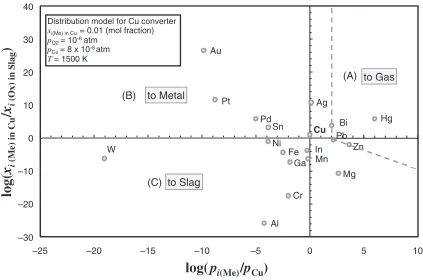
Figure 1 shows the distribution tendency of elements at 1500 K when a converter of copper metallurgy is used, where 1 mol% of each of the metals contained in the e-waste is dissolved in copper solvent. The horizontal axis is the logarithm of the vapor pressure ratio between elements and
Cu, pi=pcu, of each metal,18–20) and the vertical axis is
distribution ratio of elements between metal Cu and oxide
slag, xi(Me)inCu=xi(Ox)inSlag.18–20) The following relationships
were used to obtain the abovementioned parameters.
log(
x
i (Me) in Cu/
x
i(Ox) in Slag
)
log(
p
i(Me)/p
Cu)
–30 –20 –10 0 10 20 30 40
–25 –20 –15 –10 –5 0 5 10
Cu
Ag Au
Pd Pt
Pb Ni
W Fe
Ga
Zn
Cr Mn
Mg
Al
to Gas
to Metal
to Slag
Sn
In
Hg Bi
(A)
(B)
(C) Distribution model for Cu converter xi(Me) in Cu= 0.01 (mol fraction) pO2= 10-6atm
pCu= 8 x 10⁻⁶ atm
T = 1500 K
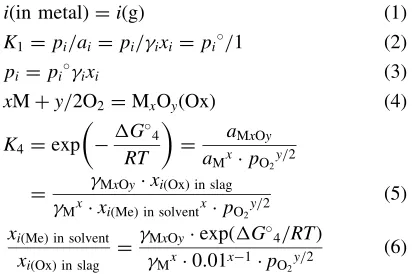
[image:2.595.87.510.72.352.2]i(in metal)¼i(g) ð1Þ K1¼pi=ai¼pi=ixi¼pi=1 ð2Þ
pi¼piixi ð3Þ
xMþy/2O2¼MxOy(Ox) ð4Þ
K4¼exp
G4
RT
¼ aMxOy aMxpO2
y=2
¼ MxOyxi(Ox) in slag
Mxxi(Me) in solventxpO2
y=2 ð5Þ
xi(Me) in solvent
xi(Ox) in slag
¼MxOyexpðG
4=RTÞ
Mx0:01x1pO2
y=2 ð6Þ
whereK,G,pi,pi,ai,iandxiare equilibrium constant,
the standard Gibbs free energy, vapor pressure of pure
element i, vapor pressure of element i, the activity in
Raoultian standard state, the activity coefficient and mole
fraction of each metal in copper, respectively. R is the gas
constant; T, the absolute temperature. The equilibrium
constant for eq. (1) is shown in eq. (2). The activity of pure element is unity hence eq. (3) can be derived by rearranging
eq. (2). In eq. (4), Oxis an oxide of metal M. When multiple
oxides are stable, the oxide in equilibrium with M is selected as Ox. Equilibrium constant for eq. (4) can be expressed as
eq. (5). The activity coefficient of MxOywas assumed to be
unity as a first approximation. It is needless to say that the
activity coefficient of MxOydepends on the slag composition.
However, unit activity coefficient is assumed in this study to show criteria and observe the tendency of element distribu-tion among metal, slag and gas phases. The mole fracdistribu-tion of elements in copper was set at 0.01. Value of vertical axis,
logðxi(Me)inCu=xi(Ox)inSlagÞ, cannot have a value lower than2,
because xi(Ox)inSlag will not exceed unity. However,
hypo-thetically calculated value was utilized to observe the tendency of oxide formation. Because of non-availability of the abovementioned data at specific temperatures, data pertaining to Au, Ag, Pd, Sn, and Hg are approximated by extrapolation.
iis calculated for infinite dilution, assuming the existence
of a regular solution. When the partial molar excess Gibbs
energy of mixing of i (GXSi ), partial molar heat of solution
ofi(HMi ), oriis known, the constantcan be calculated
using eq. (7) and converted toiat a specified temperature.
HMi ¼GXSi ¼RTlni¼ð1xiÞ2 ð7Þ
Because of the non-availability of the abovementioned data
for Pt, W, and Hg,iis assumed to be 1. For calculatingpO2,
measurements21) recorded in the copper-making stage in a
converter are used.
Element distribution tendency between metal and
slag can be clearly separated by the boundary at
logðxi(Me)inCu=xi(Ox)inSlagÞ ¼0. Boundary between metal and gas was assumed to be the condition that satisfies both
logðpi=pCuÞ ¼1 and logðpiÞ ¼ 3. Element that tends to
distribute to slag phase than metal phase may distribute to gas phase if it has high vapor pressure. Hence, boundary between
slag and gas was assumed to have a slope of1in the figure.
Cu, precious metals such as Ag, Au, Pt, and Pd and Bi are found to be distributed in the metal phase, while Hg in the gas phase. Our analysis also shows that elements such as Fe, Cr, and Al are distributed in the slag phase. The behavior of In is
[image:3.595.87.296.72.209.2]distributed in the slag phase (the reason for this will be discussed later). Currently, precious metals are recovered by pyrometallurgy of copper smelting. This is because direct recovery is difficult for by-products and wastes containing precious metals by using hydrometallurgy, and hence, they can be recycled by utilizing their strong chemical affinity with copper. With consideration for current recycling system, recovery of elements distributed in the metal and gas phases is easy, but that of the elements distributed in the slag phase is difficult.
Figure 2 represents a chart of the relationship at 1873 K when 1 mol% of each of the elements is dissolved in Fe. As in the case of Cu, the chart is designed using eqs. (1)–(6). The
values provided in references22–25) are used for calculating
the activity coefficient of each element in Fe, and the oxygen
partial pressure of the system is estimated to be1:91010
(atm)23,26)under the assumption that the partial pressure can
be controlled by the equilibrium between the metal and the slag. However, Ag, Pb, and Ca do not dissolve in Fe when their concentration is 1 mol %; hence, the metal melt is saturated with these elements. Therefore, the vapor pressures of pure Ag, Pb, and Ca are used for our calculations.
An analysis shows that Fe, Cu, Sn, Ni, Co, Mo and W are distributed in the metal phase, Zn, Ag and Pb in the gas phase, and the other elements in the slag phase. In the existing recycling system, elements distributed in the gas phase are easier to recover than those distributed in the metal and slag phases.
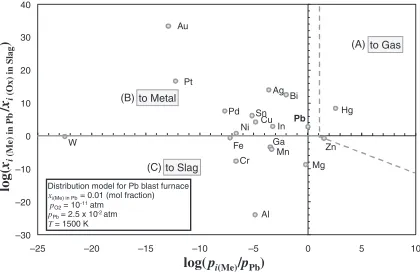
Figure 3 shows the results of the analysis carried out for a
lead blast furnace with Pb as the solvent.18–20,27–29) In the
analysis,i(M)inPbis assumed to be equal to 1 when Fe, Cr,
Mn, Pt, and W are dissolved in Pb. This figure indicates that in addition to the precious metals, Cu, Sn, and Bi can also be recovered from the metal phase. On the other hand, Fe is shown to be distributed in the slag phase. In the current process, though Zn has a high vapor pressure, it cannot be separated as a gas from the blast furnace due to the structure of the furnace.
Figure 4 demonstrates the analysis carried out for the imperial smelting process (ISP), a pyrometallurgical process
of zinc.18–20,27,28,30)
The ISP, in which Pb is made as the solvent, is used to produce Zn and Pb simultaneously. Therefore, the results of this analysis are almost consistent with those with of the analysis involving the Pb blast furnace; however, Zn can be removed as a gas from the furnace. This is because Pb as a Zn absorber is placed outside the furnace so that it forms an alloy with Zn, thus removing it from the furnace.
2.2 Distribution of elements among gas, slag, and metal phases during metal recovery
In ferrous metallurgy, values of the vertical axis for Cr and Mn were found to be lower than zero. From the calculation results, it can be concluded that Cr and Mn are mainly distributed in the slag phase. In this study, the activity
coefficient of MxOywas assumed to be unity due to lack of
thermodynamic information. However, value of the vertical
axis will depend on the activity coefficient of MxOyin slag
phase. Hence, these elements will also be distributed some extents to the metal phase.
Recovery of precious metals from secondary resources such as by-products and wastes by pyrometallurgy (conven-tional nonferrous metallurgy) involves their extraction into the metal phase using Cu or Pb as the absorber. In ferrous metallurgy, Zn, which is distributed in the gas phase and
log(
x
i (Me) in Pb/
x
i(Ox) in Slag
)
log(
p
i(Me)/p
Pb)
–30 –20 –10 0 10 20 30 40
–25 –20 –15 –10 –5 0 5 10
Cu Ag Au
Pd Pt
Pb
Ni
W Fe Ga
Zn
Cr Mn Mg
Al
to Gas
to Metal
to Slag
Sn In
Hg Bi
(A)
(B)
(C)
Distribution model for Pb blast furnace xi(Me) in Pb= 0.01 (mol fraction)
pO2= 10-11atm
pPb= 2.5 x 10⁻² atm
T = 1500 K
Fig. 3 Distribution chart of elements among gas, slag, and metal phases for the metal recovery under the simulated atmosphere of the blast furnace of lead smelting.
log(
x
i (Me) in Fe
/
x
i (Ox) in Slag)
log(
p
i(Me)/p
Fe)
–30 –20 –10 0 10 20 30 40
–25 –20 –15 –10 –5 0 5 10
Cu Ag
CaMg Zn Pb
Mn
Fe
Sn
Cr
Al Ni Co
La Ce V Ti Si
U B Mo
Zr Nb W
Ta
to Gas to Metal
to Slag (C)
(B) (A)
Distribution model for Fe converter
xi(Me) in Fe= 0.01 (mol fraction)
pO2= 1.9 x 10⁻¹⁰(atm)
pFe= 8.5 x 10⁻⁵ (atm)
T = 1873 K
[image:4.595.90.510.72.344.2] [image:4.595.89.509.391.664.2]collected as crude ZnO, is recovered by an intermediate process such as the Waelz process and used as a raw material
for zinc metallurgy.31) However, in ferrous metallurgy,
recovering elements distributed in the metal phase is not economically feasible, and hence, this is not presently in
practice. Therefore, for the beneficial use of elements, it is important to develop a pre-sorting system and accurately define scrap specifications by taking into account the elements contained in the e-waste.
log(
x
i(Me) in Pb
/
x
i(Ox) in Slag
)
log(
p
i(Me)/p
Pb)
–30 –20 –10 0 10 20 30 40
–25 –20 –15 –10 –5 0 5 10
Cu
Ag Au
Pd Pt
Pb Ni
W
Fe Ga
Zn
Cr
Mn
Mg
Al
to Gas to Metal
to Slag
Sn
In Hg
Bi
(A) (B)
(C)
Distribution model for ISP xi(Me) in Pb= 0.01 (mol fraction) pO2= 10-11atm
pPb= 6 x 10⁻² atm
T = 1600 K
Fig. 4 Distribution chart of elements among gas, slag, and metal phases for the metal recovery under the simulated atmosphere of the imperial smelting furnace of zinc smelting.
to Metal phase
to Slag phase
to Gas phase
Elements that have distributed among the metal phase as a solid or liquid metal
Elements that have distributed among the slag phase as oxide
Elements that have evaporated and distributed among the gas phase .
Zn Pb
Cr
Cu Mg
Mn
Sn
Mo La
W
Co
Fe
Ag
Ni
B V
Si
Zr
Ta Ti
Ce
U
Al Ca
Steel (BOF,EAF)
Nb
Ag
Cu
Ni Pb In
Cr Bi
Sn
Pd
Pt
Au Ga
Mn
Fe
Al Mg Zn Hg
Copper (Converter)
Cu
Mg Mn
Bi Sn
Pd Ni Au
Al Cr
Fe Ga In
Zn
Hg
W
Zinc·Lead (ISP)
Pt Ag
Pb
W
Lead
(blast furnace)
Zn
Hg Ga
Cr
Mn
Mg
Al In
Bi Ni
Pd
Pt Au W
Fe
Cu Ag
Sn
Pb
[image:5.595.89.509.73.347.2] [image:5.595.88.513.390.697.2]3. Applications and Results
A method based on thermodynamic analysis is proposed for evaluating the potential recyclability of important metals, using end-of-life cell phones as an example of the e-waste. Mobile phones are typical small high-performance SDAs, for which a recycling process has been established, mainly in the copper metallurgy industry; hence, they can be used to evaluate the usefulness of our proposed evaluation method.
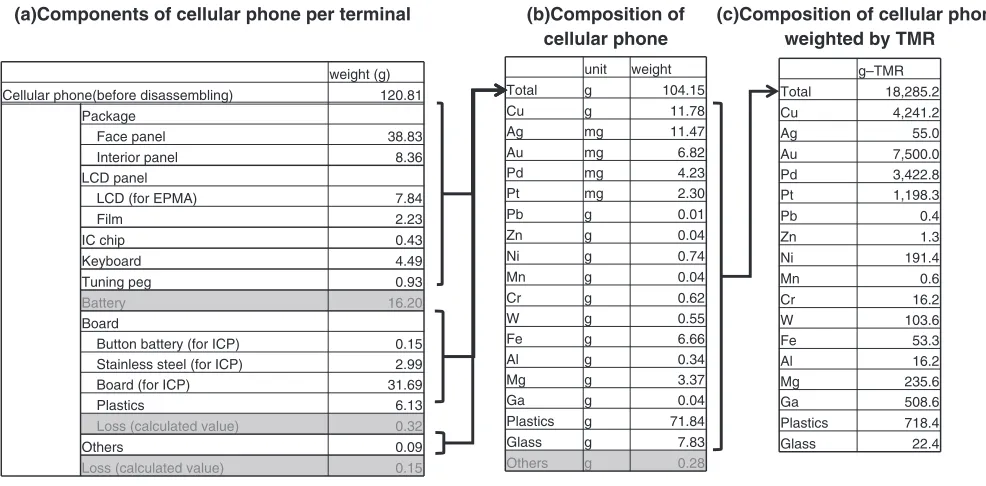
In this study, a thermodynamic analysis is performed on elements contained in mobile phones to evaluate resource recyclability by copper metallurgy. The evaluation, which is performed in terms of weight and TMR (total material
requirement),32,33) focused on 17 items, such as plastics,
glass, and Fe, which account for a large proportion of the weight of a mobile phone, in addition to Au and Ag, which have a high total material requirement per unit weight. TMR is an indicator of the quantity of material, including direct and indirect material inputs by human economic activities and non-economic hidden material flows. TMR that repre-sents material intensity is one of the important resource-potential indicators that are attracting attention globally. Information on the material composition of mobile phones is
obtained from a previous report.34)Table 1 shows the weight
composition and TMR33)-weighted material composition of
mobile phones.
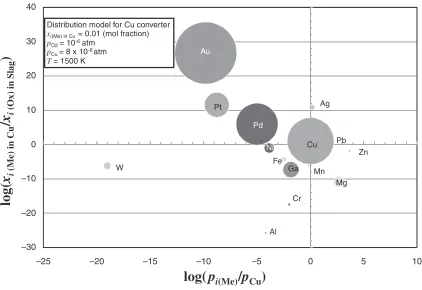
Figure 6 shows a chart of the relationship between the vapor pressure ratio between elements and solvent and the distribution ratio of elements between solvent and slag when Cu is used as a solvent, along with the content of various elements in a mobile phones. In this figure, the elemental composition of a mobile phone is explicitly represented in the form of a pie chart. An analysis shows that Cu and precious metals (Ag, Au, Pt, Pd) are distributed in the metal phase, while Pb and Zn are distributed in the gas phase. These elements can be recovered by the current copper metal-lurgical process. The analysis also shows that other elements
distributed in the slag phase are difficult to recover. Recoverable elements account for approximately 11% (11.8 g/unit) of the total weight (104.2 g/unit) of the 17 constituents of a mobile phone.
Figure 7 shows an analysis of the weighted material composition using TMR as an indicator of the resource potential. TMR is an indicator of the quantity of material, including direct and indirect material inputs by human economic activities and non-economic hidden material flows. The analysis shows that the above seven items (Cu, Ag, Au, Pt, Pd, Pb, Zn) account for only 11% of the total composition of a mobile phone on a weight basis but approximately 90% on a TMR basis.
4. Discussion
This section examines the validity of the results of our thermodynamic analysis, which provides a basis for the proposed evaluation method and also discusses the evalua-tion results when this method is applied to recycling of mobile phones.
[image:6.595.47.540.86.329.2]Since the analysis performed in this study uses simple assumptions, the conditions are not exactly reflective of the actual industrial process. For example, the sulfur partial pressure must be considered in the actual copper metallurgy process carried out in a Cu converter. However, even if this partial pressure is considered, there is no notable difference between the results of our analysis and those obtained in the study performed on the actual metallurgical process, sug-gesting that this analysis is a useful indicator for primary screening during the recovery of resources. Since this analysis is based on equilibrium, the kinetics of the process must also be considered for the actual resource recovery process. For example, as mentioned previously in this paper, Zn and Pb are recovered as dust in Cu converters. This is because they gradually evaporate even at vapor pressures less than 1 atm. If the vapor pressure is close to 1 atm, they can Table 1 Components and composition of cellular phone per terminal.
(a)Components of cellular phone per terminal (b)Composition of cellular phone
(c)Composition of cellular phone weighted by TMR
weight (g) Cellular phone(before disassembling) 120.81
Package
Face panel 38.83
Interior panel 8.36
LCD panel
LCD (for EPMA) 7.84
Film 2.23
IC chip 0.43
Keyboard 4.49
Tuning peg 0.93
Battery 16.20
Board
Button battery (for ICP) 0.15 Stainless steel (for ICP) 2.99
Board (for ICP) 31.69
Plastics 6.13
Loss (calculated value) 0.32
Others 0.09
Loss (calculated value) 0.15
unit weight
Total g 104.15
Cu g 11.78
Ag mg 11.47
Au mg 6.82
Pd mg 4.23
Pt mg 2.30
Pb g 0.01
Zn g 0.04
Ni g 0.74
Mn g 0.04
Cr g 0.62
W g 0.55
Fe g 6.66
Al g 0.34
Mg g 3.37
Ga g 0.04
Plastics g 71.84
Glass g 7.83
Others g 0.28
g–TMR Total 18,285.2
Cu 4,241.2
Ag 55.0
Au 7,500.0
Pd 3,422.8
Pt 1,198.3
Pb 0.4
Zn 1.3
Ni 191.4
Mn 0.6
Cr 16.2
W 103.6
Fe 53.3
Al 16.2
Mg 235.6
Ga 508.6
Plastics 718.4
possibly be recovered in vapor form. Furthermore, in addition to the vapor pressures of the metals, those of their oxides dissolved in the slag must also be considered in some cases. Most of oxides, such as Al2O3, have a low vapor pressure. However, some suboxides have a high vapor
pressure. For instance, In2O3 has a low vapor pressure and
does not vaporize easily; on the other hand, In2O, a suboxide
of indium, has a boiling point of 527C which means that it
has high vapor pressure, hence it easily evaporates.35)If In2O
is formed, In can be recovered as vapor from the slag.
log(
x
i (Me) in Cu/
x
i(Ox) in Slag
)
log(
p
i(Me)/p
Cu)
–30 –20 –10 10
0 20 30 40
–25 –20 –15 –10 –5 0 5 10
Au
Pt Ag
Mg W
Cr Mn
Zn Fe
Pb Ni
Cu Pd
Al Distribution model for Cu converter
xi(Me) in Cu= 0.01 (mol fraction) pO2= 10-6atm
pCu= 8 x 10⁻⁶ atm
T = 1500 K
Fig. 6 Distribution chart of elements contained in mobile phone under the simulated atmosphere of the converter of copper smelting.
log(
x
i (Me) in Cu/
x
i(Ox) in Slag
)
log(
p
i(Me)/p
Cu)
–30 –20 –10 0 10 20 30 40
–25 –20 –15 –10 –5 0 5 10
Au
Pt Ag
W
Cr
Mg Mn Ga Fe
Pb
Ni Cu
Pd
Al
Zn Distribution model for Cu converter
xi(Me) in Cu= 0.01 (mol fraction)
pO2= 10-6atm
pCu= 8 x 10⁻⁶ atm
T = 1500 K
[image:7.595.88.508.73.360.2] [image:7.595.88.510.399.689.2]However, thermodynamic data on suboxides are inadequate in both quantity and quality, while the accuracy of the available data is still questionable. Hence, more reliable data must be collected and examined for our future studies.
The potential resource recyclability of mobile phones recycled by copper metallurgy is only 12% on a weight basis. The precious metal recovery process is useful in recovering precious metals that have a strong chemical affinity for Cu, but it is not suitable for recovering materials that are distributed in the slag phase, such as Fe and Mg. Therefore, it necessary to separate stainless steel lead frames, electro-magnetic shields made of AZ91-alloy, and plastic casings before collection. The potential resource recyclability of mobile phones on a TMR basis is 91%. This suggests that recycling of mobile phones by copper metallurgy is benefi-cial in terms of TMR.
5. Conclusions
This study proposes a method based on thermodynamic analysis for evaluating the potential resource recyclability of important metals and evaluates the usefulness of the method by applying it to study the recycling of end-of-life mobile phones. The following are the main conclusions of this study: (1) In the pyrometallurgy of Cu in a converter, where Cu is used as a target metal for purification, Cu, precious metals (Ag, Au, Pt, Pd), and Bi are distributed in the metal phase, while Hg is distributed in the gas phase. Elements such as Fe, Cr, and Al are distributed in the slag phase.
(2) In ferrous metallurgy, where Fe is used as a target metal for purification, Fe, Cu, Sn, Ni, Co, Mo and W are distributed in the metal phase, while Zn, Pb and Ag are distributed in the gas phase. Other elements are distributed in the slag phase.
(3) In lead metallurgy in a blast furnace, lead and zinc metallurgy in the ISP, precious metals as well as Cu, Sn, and Bi can be recovered as the metal phase. (4) A thermodynamic analysis shows that Cu and precious
metals (Ag, Au, Pt, Pd) present in mobile phones can be recovered as metals, while Pb and Zn can be recovered as vapor. Other elements distributed in the slag phase are difficult to recover. The result of our analysis reflects the trends observed in the distribution of metals in copper metallurgy, thereby indicating the validity of our proposed evaluation method.
Acknowledgments
This study was conducted as a part of the research supported by the Grant-in-Aid for Waste Treatment Research from the Ministry of the Environment, and Grant-in-Aid for Scientific Research for Young Scientists (B), No. 19760588.
REFERENCES
1) Y. Baba: Metal Resource Report3(2006) 1076–1019. (in Japanese) 2) Y. Baba: Metal Resource Report11(2005) 619–628. (in Japanese)
3) Y. Baba: Metal Resource Report1(2006) 802–807. (in Japanese) 4) M. Nanjyo: Bull. Res. Inst. Min. Dress. Metall. Tohoku University43
(1987) 239–251.
5) M. Tsunekawa, K. Yoo, N. Hiroyoshi and M. Ito: Resource Proc.52 (2005) 32–38.
6) T. Shiratori and T. Nakamura: J. MMIJ122(2006) 325–329. 7) T. Nakamura and T. Shiratori: Indust.23(2008) 2–12.
8) J. Fu, Q. Zhou, J. Liu, W. Liu, T. Wang, Q. Zhang and G. Jiang: Chemosphere71(2008) 1269–1275.
9) M. H. Wong, S. C. Wu, W. J. Deng, X. Z. Yu, Q. Luo, A. O. W. Leung, C. S. C. Wong, W. J. Luksemburg and A. S. Wong: Environ. Pollut.149 (2007) 131–140.
10) Solving the E-waste Problem:<http://www.step-initiative.org/index. php>(2008/05/15)
11) A. Adriaanse, S. Bringezu, A. Hammond, Y. Moriguchi, E. Rodenburg, D. Rogich and H. Schutz: Resource flows the material basis of industrial economies, (World Resource Institute, Washington, D.C., 1997).
12) E. Matthews, C. Amann, S. Bringezu, M. Fischer-Kowalski, W. Huttler, R. Kleijn, Y. Moriguchi, C. Ottke, E. Rodenburg, D. Rogich, H. Schandl, H. Schutz, E. van der Voet and H. Weisz:The weight of nations: material outflows from industrial economies, (World Resource Institute, Washington, D.C., 2000).
13) P. H. Brunner and H. Rechberger:Practical Handbook of Material Flow Analysis, (Lewis Publishers, Boca Raton, 2004).
14) Ministry of environmental Japan: Annual Report on the Environment in Japan 2006, (2006).
15) Ministry of environment Japan: Sweeping policy reform towards a ‘‘sound material-cycle society’’ starting from Japan and spreading over the entire globe—the ‘‘3R’’ loop connecting Japan with other countries, 2006.
16) E. Yamasue, H. Okumura and K. N. Ishihara: IEEJ Trans. EIS128 (2008) 6–10.
17) M. A. Reuter and E. V. Verhoef: J. Electron. Mater.33(2004) 1567– 1580.
18) I. Barin: Therm. Data Pure Substa., (VCH Verlagsgesellschaft mbH, Weinheim, Germany, 1989).
19) R. Hultgren:Selected thermodynamic values and phase diagrams for copper and some of its binary alloys, (International Copper Research Association, New York, 1971).
20) Y. Kawai and Y. Shiraishi:Handbook of physico-chemical properties at high temperatures, (The Iron and Steel Institute of Japan, Tokyo, 1988).
21) H. Kurokawa and N. Kemori: J. Min. Mater. Proc. Inst. Jpn.119(2003) 55–60.
22) E. T. Turkdogan: Phys. Chem. High Temp. Technol., New York: Academic Press, 1980.
23) The Japan Society for Promotion of Science The 19th Committee in Steelmaking: Steelmaking Data Sourcebook, (Gordon and Breach Science Publishers, New York, NY, 1988).
24) X. Zhang, Q. Han and D. Chen: Metall. Trans. B22B(1991) 918–921. 25) X. Su, N. Tang and J. M. Toguri: J. Alloy. Compds.325(2001) 129–
136.
26) S. Ban-ya and M. Hino: Testu-to-Hagane73(1987) 476–483. 27) S. Ueno and Y. Waseda: J. Jpn. Inst. Metals52(1988) 204–210. 28) T. Pomianek: Z. Metallkde.77(1986) 388–392.
29) K. Agatsuma: Hitetsu Seiren, (Asakura Syoten, Tokyo, 1963). (in Japanese)
30) F. Tanno, K. Matsuzaki and A. Fuwa: J. Min. Mater. Proc. Inst. Jpn. 119(2003) 17–22.
31) K. Nakajima, K. Matsubae-Yokoyama, S. Nakamura, S. Itoh and T. Nagasaka: ISIJ Int.48(2008) 1478–1483.
32) A. Adriaanse, S. Bringezu, A. Hammond, Y. Moriguchi, E. Rodenburg, D. RoGich and H. Schu¨tz: Resource Flows:The Material Basis of Industrial Economics, (World Resources Institute, Washington D.C., 1-9, 1997).
33) K. Halada: Materia Japan46(2007) 543–547. (in Japanese) 34) K. Nakajima, K. Yamamoto, K. Nakano, K. Kuroda, K. Halada and T.
Nagasaka: J. Life Cycle Assess. Japan2(2006) 341–346.