Using Machine Learning to Explore Human Multimodal Clarification
Strategies
Verena Rieser
Department of Computational Linguistics Saarland University
Saarbr¨ucken, D-66041 [email protected]
Oliver Lemon School of Informatics University of Edinburgh Edinburgh, EH8 9LW, GB [email protected]
Abstract
We investigate the use of machine learn-ing in combination with feature engineer-ing techniques to explore human multi-modal clarification strategies and the use of those strategies for dialogue systems. We learn from data collected in a Wizard-of-Oz study where different wizards could decide whether to ask a clarification re-quest in a multimodal manner or else use speech alone. We show that there is a uniform strategy across wizards which is based on multiple features in the context. These are generic runtime features which can be implemented in dialogue systems. Our prediction models achieve a weighted f-score of 85.3% (which is a 25.5% im-provement over a one-rule baseline). To assess the effects of models, feature dis-cretisation, and selection, we also conduct a regression analysis. We then interpret and discuss the use of the learnt strategy for dialogue systems. Throughout the in-vestigation we discuss the issues arising from using small initial Wizard-of-Oz data sets, and we show that feature engineer-ing is an essential step when learnengineer-ing from such limited data.
1 Introduction
Good clarification strategies in dialogue systems help to ensure and maintain mutual understand-ing and thus play a crucial role in robust conversa-tional interaction. In dialogue application domains with high interpretation uncertainty, for example caused by acoustic uncertainties from a speech recogniser, multimodal generation and input leads to more robust interaction (Oviatt, 2002) and
re-duced cognitive load (Oviatt et al., 2004). In this paper we investigate the use of machine learning (ML) to explore human multimodal clarification strategies and the use of those strategies to decide, based on the current dialogue context, when a di-alogue system’s clarification request (CR) should be generated in a multimodal manner.
[image:1.595.298.536.598.697.2]In previous work (Rieser and Moore, 2005) we showed that for spoken CRs in human-human communication people follow a context-dependent clarification strategy which systemati-cally varies across domains (and even across Ger-manic languages). In this paper we investigate whether there exists a context-dependent “intu-itive” human strategy for multimodal CRs as well. To test this hypothesis we gathered data in a Wizard-of-Oz (WOZ) study, where different wiz-ards could decide when to show a screen output. From this data we build prediction models, using supervised learning techniques together with fea-ture engineering methods, that may explain the un-derlying process which generated the data. If we can build a model which predicts the data quite re-liably, we can show that there is a uniform strategy that the majority of our wizards followed in certain contexts.
Figure 1: Methodology and structure
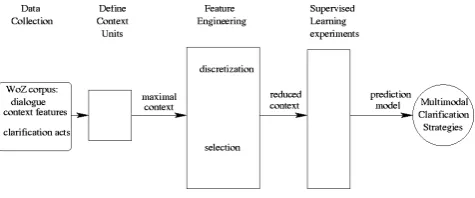
The overall method and corresponding structure of the paper is as shown in figure 1. We proceed
as follows. In section 2 we present the WOZ cor-pus from which we extract a potential context us-ing “Information State Update” (ISU)-based fea-tures (Lemon et al., 2005), listed in section 3. We also address the question how to define a suit-able “local” context definition for the wizard ac-tions. We apply the feature engineering methods described in section 4 to address the questions of unique thresholds and feature subsets across wiz-ards. These techniques also help to reduce the context representation and thus the feature space used for learning. In section 5 we test different classifiers upon this reduced context and separate out the independent contribution of learning al-gorithms and feature engineering techniques. In section 6 we discuss and interpret the learnt strat-egy. Finally we argue for the use of reinforcement learning to optimise the multimodal clarification strategy.
2 The WOZ Corpus
The corpus we are using for learning was col-lected in a multimodal WOZ study of German task-oriented dialogues for an in-car music player application, (Kruijff-Korbayov´a et al., 2005) . Us-ing data from a WOZ study, rather than from real system interactions, allows us to investigate how humans clarify. In this study six people played the role of an intelligent interface to an MP3 player and were given access to a database of informa-tion. 24 subjects were given a set of predefined tasks to perform using an MP3 player with a mul-timodal interface. In one part of the session the users also performed a primary driving task, us-ing a drivus-ing simulator. The wizards were able to speak freely and display the search results or the playlist on the screen by clicking on vari-ous pre-computed templates. The users were also able to speak, as well as make selections on the screen. The user’s utterances were immediately transcribed by a typist. The transcribed user’s speech was then corrupted by deleting a varying number of words, simulating understanding prob-lems at the acoustic level. This (sometimes) cor-rupted transcription was then presented to the hu-man wizard. Note that this environment introduces uncertainty on several levels, for example multiple matches in the database, lexical ambiguities, and errors on the acoustic level, as described in (Rieser et al., 2005). Whenever the wizard produced a CR, the experiment leader invoked a questionnaire window on a GUI, where the wizard classified
their CR according to the primary source of the understanding problem, mapping to the categories defined by (Traum and Dillenbourg, 1996).
2.1 The Data
The corpus gathered with this setup comprises 70 dialogues, 1772 turns and 17076 words. Ex-ample 1 shows a typical multimodal clarification sub-dialogue,1concerning an uncertain reference
(note that “Venus” is an album name, song title, and an artist name), where the wizard selects a screen output while asking a CR.
(1) User: Please play “Venus”.
Wizard: Does this list contain the song?
[shows list with 20 DB matches]
User: Yes. It’s number 4. [clicks on item 4]
For each session we gathered logging informa-tion which consists of e.g., the transcripinforma-tions of the spoken utterances, the wizard’s database query and the number of results, the screen option cho-sen by the wizard, classification of CRs, etc. We transformed the log-files into an XML structure, consisting of sessions per user, dialogues per task, and turns.2
2.2 Data analysis:
Of the 774 wizard turns 19.6% were annotated as CRs, resulting in 152 instances for learning, where our six wizards contributed about equal proportions. A χ2 test on multimodal strategy (i.e. showing a screen output or not with a CR) showed significant differences between wizards (χ2(1) = 34.21, p < .000). On the other hand, a Kruskal-Wallis test comparing user preference for the multimodal output showed no significant dif-ference across wizards (H(5)=10.94, p>.05). 3 Mean performance ratings for the wizards’ multi-modal behaviour ranged from 1.67 to 3.5 on a five-point Likert scale. Observing significantly differ-ent strategies which are not significantly differdiffer-ent in terms of user satisfaction, we conjecture that the wizards converged on strategies which were ap-propriate in certain contexts. To strengthen this
1
Translated from German. 2
Where a new “turn” begins at the start of each new user utterance after a wizard utterance, taking the user utterance as a most basic unit of dialogue progression as defined in (Paek and Chickering, 2005).
3
hypothesis we split the data by wizard and and per-formed a Kruskal-Wallis test on multimodal be-haviour per session. Only the two wizards with the lowest performance score showed no significant variation across session, whereas the wizards with the highest scores showed the most varying be-haviour. These results again indicate a context de-pendent strategy. In the following we test this hy-pothesis (that good multimodal clarification strate-gies are context-dependent) by building a predic-tion model of the strategy an average wizard took dependent on certain context features.
3 Context/Information-State Features
A state or context in our system is a dialogue in-formation state as defined in (Lemon et al., 2005). We divide the types of information represented in the dialogue information state into local
fea-tures (comprising low level and dialogue feafea-tures), dialogue history features, and user model fea-tures. We also defined features reflecting the
ap-plication environment (e.g. driving). All fea-tures are automatically extracted from the XML log-files (and are available at runtime in ISU-based dialogue systems). From these features we want to learn whether to generate a screen out-put (graphic-yes), or whether to clarify using speech only (graphic-no). The case that the wizard only used screen output for clarification did not occur.
3.1 Local Features
First, we extracted features present in the “lo-cal” context of a CR, such as the number of matches returned from the data base query (DBmatches), how many words were deleted by the corruption algorithm4 (deletion), what problem source the wizard indicated in the pop-up questionnaire (source), the previous user speech act (userSpeechAct), and the delay be-tween the last wizard utterance and the user’s reply (delay).5
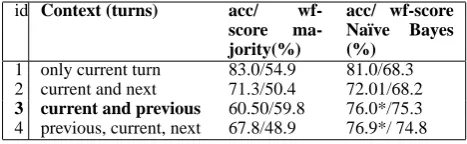
One decision to take for extracting these local features was how to define the “local” context of a CR. As shown in table 1, we experimented with a number of different context definitions. Context 1 defined the local context to be the current turn only, i.e. the turn containing the CR. Context 2
4Note that this feature is only an approximation of the ASR confidence score that we would expect in an automated dialogue system. See (Rieser et al., 2005) for full details.
5
We introduced thedelayfeature to handle clarifications concerning contact.
id Context (turns) acc/
wf-score
ma-jority(%)
acc/ wf-score
Na¨ıve Bayes
(%)
1 only current turn 83.0/54.9 81.0/68.3 2 current and next 71.3/50.4 72.01/68.2
3 current and previous 60.50/59.8 76.0*/75.3
[image:3.595.306.540.62.134.2]4 previous, current, next 67.8/48.9 76.9*/ 74.8
Table 1: Comparison of context definitions for lo-cal features (* denotesp < .05)
also considered the current turn and the turn fol-lowing (and is thus not a “runtime” context). Con-text 3 considered the current turn and the previous turn. Context 4 is the maximal definition of a lo-cal context, namely the previous, current, and next turn (also not available at runtime).6
To find the context type which provides the rich-est information to a classifier, we compared the ac-curacy achieved in a 10-fold cross validation by a Na¨ıve Bayes classifier (as a standard) on these data sets against the majority class baseline, us-ing a paired t-test, we found that that for context 3 and context 4, Na¨ıve Bayes shows a significant improvement (withp < .05using Bonferroni cor-rection). In table 1 we also show the weighted f-scores since they show that the high accuracy achieved using the first two contexts is due to over-prediction. We chose to use context 3, since these features will be available during system runtime and the learnt strategy could be implemented in an actual system.
3.2 Dialogue History Features
The history features account for events in the whole dialogue so far, i.e. all information gath-ered before asking the CR, such as the number of CRs asked (CRhist), how often the screen output was already used (screenHist), the corruption rate so far (delHist), the dialogue duration so far (duration), and whether the user reacted to the screen output, either by verbally referencing (refHist) , e.g. using expressions such as “It’s item number 4”, or by clicking (clickHist) as in example 1.
3.3 User Model Features
Under “user model features” we consider features reflecting the wizards’ responsiveness to the
be-6
haviour and situation of the user. Each session comprised four dialogues with one wizard. The user model features average the user’s behaviour in these dialogues so far, such as how responsive the user is towards the screen output, i.e. how of-ten this user clicks (clickUser) and how fre-quently s/he uses verbal references (refUser); how often the wizard had already shown a screen output (screenUser) and how many CRs were already asked (CRuser); how much the user’s speech was corrupted on average (delUser), i.e. an approximation of how well this user is recog-nised; and whether this user is currently driving or not (driving). This information was available to the wizard.
LOCAL FEATURES DBmatches: 20 deletion: 0
source: reference resolution userSpeechAct: command delay: 0
HISTORY FEATURES
[CRhist, screenHist, delHist, refHist, clickHist]=0 duration= 10s
USER MODEL FEATURES
[clickUser,refUser,screenUser, CRuser]=0
driving= true
Figure 2: Features in the context after the first turn in example 1.
3.4 Discussion
Note that all these features are generic over information-seeking dialogues where database re-sults can be displayed on a screen; except for
drivingwhich only applies to hands-and-eyes-busy situations. Figure 2 shows a context for ex-ample 1, assuming that it was the first utterance by this user.
This potential feature space comprises 18 fea-tures, many of them taking numeric attributes as values. Considering our limited data set of 152 training instances we run the risk of severe data sparsity. Furthermore we want to explore which features of this potential feature space influenced the wizards’ multimodal strategy. In the next two sections we describe feature engineering tech-niques, namely discretising methods for dimen-sionality reduction and feature selection methods, which help to reduce the feature space to a sub-set which is most predictive of multimodal clarifi-cation. For our experiments we use implementa-tions of discretisation and feature selection meth-ods provided by the WEKA toolkit (Witten and
Frank, 2005).
4 Feature Engineering
4.1 Discretising Numeric Features
Global discretisation methods divide all contin-uous features into a smaller number of distinct ranges before learning starts. This has two advan-tages concerning the quality of our data for ML. First, discretisation methods take feature distribu-tions into account and help to avoid sparse data. Second, most of our features are highly positively skewed. Some ML methods (such as the standard extension of the Na¨ıve Bayes classifier to handle numeric features) assume that numeric attributes have a normal distribution. We use Proportional k-Interval (PKI) discretisation as a unsupervised method, and an entropy-based algorithm (Fayyad and Irani, 1993) based on the Minimal Description Length (MDL) principle as a supervised discreti-sation method.
4.2 Feature Selection
Feature selection refers to the problem of select-ing an optimum subset of features that are most predictive of a given outcome. The objective of se-lection is two-fold: improving the prediction per-formance of ML models and providing a better un-derstanding of the underlying concepts that gener-ated the data. We chose to apply forward selec-tion for all our experiments given our large fea-ture set, which might include redundant feafea-tures. We use the following feature filtering methods: correlation-based subset evaluation (CFS) (Hall, 2000) and a decision tree algorithm (rule-based ML) for selecting features before doing the actual learning. We also used a wrapper method called
Selective Na¨ıve Bayes, which has been shown to
perform reliably well in practice (Langley and Sage, 1994). We also apply a correlation-based ranking technique since subset selection models inner-feature relations at the expense of saying less about individual feature performance itself.
4.3 Results for PKI and MDL Discretisation
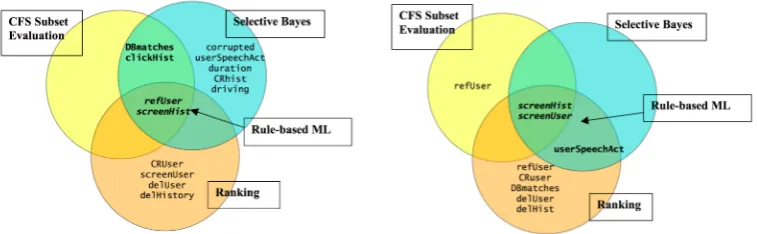
Table 2: Feature selection on PKI-discretised data (left) and on MDL-discretised data (right)
it doesn’t explicitly account for redundancy be-tween features, nor for non-numerical features. For the other 4 features which were discretised there is a binary split around one (fairly low) threshold: screenHist (.5), refUser(.375),
screenUser(1.0),CRUser(1.25).
Table 2 shows two figures illustrating the dif-ferent subsets of features chosen by the feature selection algorithms on discretised data. From these four subsets we extracted a fifth, using all the features which were chosen by at least two of the feature selection methods, i.e. the features in the overlapping circle regions shown in figure 2. For both data sets the highest ranking fea-tures are also the ones contained in the overlapping
regions, which are screenUser, refUser
andscreenHist. For implementation dialogue management needs to keep track of whether the user already saw a screen output in a previous in-teraction (screenUser), or in the same dialogue (screenHist), and whether this user (verbally) reacted to the screen output (refUser).
5 Performance of Different Learners and Feature Engineering
In this section we evaluate the performance of fea-ture engineering methods in combination with dif-ferent ML algorithms (where we treat feature op-timisation as an integral part of the training pro-cess). All experiments are carried out using 10-fold cross-validation. We take an approach similar to (Daelemans et al., 2003) where parameters of the classifier are optimised with respect to feature selection. We use a wide range of different multi-variate classifiers which reflect our hypothesis that a decision is based on various features in the con-text, and compare them against two simple base-line strategies, reflecting deterministic contextual behaviour.
5.1 Baselines
The simplest baseline we can consider is to always predict the majority class in the data, in our case
graphic-no. This yields a 45.6% wf-score. This baseline reflects a deterministic wizard strat-egy never showing a screen output.
A more interesting baseline is obtained by us-ing a 1-rule classifier. It chooses the feature which produces the minimum error (which is
refUser for the PKI discretised data set, and
screenHistfor the MDL set). We use the im-plementation of a one-rule classifier provided in theWEKA toolkit. This yields a 59.8% wf-score. This baseline reflects a deterministic wizard strat-egy which is based on a single feature only.
5.2 Machine Learners
For learning we experiment with five different types of supervised classifiers.We chose Na¨ıve Bayes as a joint (generative) probabilistic model, using theWEKAimplementation of (John and Lan-gley, 1995)’s classifier; Bayesian Networks as a graphical generative model, again using theWEKA
implementation; and we chose maxEnt as a dis-criminative (conditional) model, using the Max-imum Entropy toolkit (Le, 2003). As a rule in-duction algorithm we usedJRIP, theWEKA imple-mentation of (Cohen, 1995)’s Repeated Incremen-tal Pruning to Produce Error Reduction (RIPPER). And for decision trees we used the J4.8 classi-fier (WEKA’s implementation of the C4.5 system
(Quinlan, 1993)).
5.3 Comparison of Results
Feature transformation/ (acc./ wf-score (%))
1-rule baseline
Rule Induction
Decision Tree
maxEnt Na¨ıve
Bayes
Bayesian Network
Average
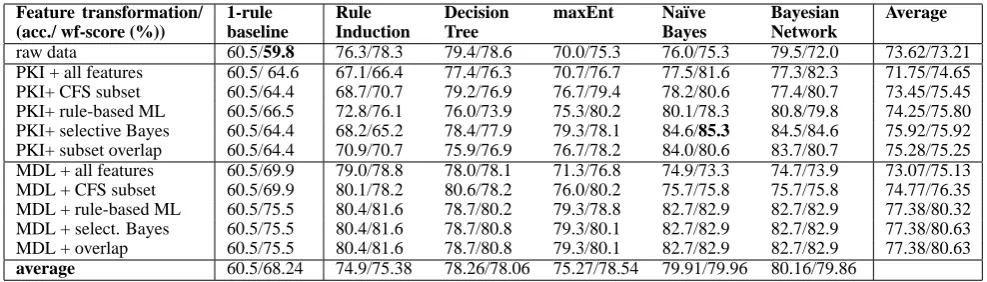
raw data 60.5/59.8 76.3/78.3 79.4/78.6 70.0/75.3 76.0/75.3 79.5/72.0 73.62/73.21 PKI + all features 60.5/ 64.6 67.1/66.4 77.4/76.3 70.7/76.7 77.5/81.6 77.3/82.3 71.75/74.65 PKI+ CFS subset 60.5/64.4 68.7/70.7 79.2/76.9 76.7/79.4 78.2/80.6 77.4/80.7 73.45/75.45 PKI+ rule-based ML 60.5/66.5 72.8/76.1 76.0/73.9 75.3/80.2 80.1/78.3 80.8/79.8 74.25/75.80 PKI+ selective Bayes 60.5/64.4 68.2/65.2 78.4/77.9 79.3/78.1 84.6/85.3 84.5/84.6 75.92/75.92 PKI+ subset overlap 60.5/64.4 70.9/70.7 75.9/76.9 76.7/78.2 84.0/80.6 83.7/80.7 75.28/75.25 MDL + all features 60.5/69.9 79.0/78.8 78.0/78.1 71.3/76.8 74.9/73.3 74.7/73.9 73.07/75.13 MDL + CFS subset 60.5/69.9 80.1/78.2 80.6/78.2 76.0/80.2 75.7/75.8 75.7/75.8 74.77/76.35 MDL + rule-based ML 60.5/75.5 80.4/81.6 78.7/80.2 79.3/78.8 82.7/82.9 82.7/82.9 77.38/80.32 MDL + select. Bayes 60.5/75.5 80.4/81.6 78.7/80.8 79.3/80.1 82.7/82.9 82.7/82.9 77.38/80.63 MDL + overlap 60.5/75.5 80.4/81.6 78.7/80.8 79.3/80.1 82.7/82.9 82.7/82.9 77.38/80.63
[image:6.595.70.564.62.203.2]average 60.5/68.24 74.9/75.38 78.26/78.06 75.27/78.54 79.91/79.96 80.16/79.86
Table 3: Average accuracy and wf-scores for models in feature engineering experiments .
sum (by class frequency in the data; 39.5%
graphic-yes, 60.5%graphic-no) of the f-scores of the individual classes. In table 3 we see fairly stable high performance for Bayesian models with MDL feature selection. However, the best performing model is Na¨ıve Bayes using wrap-per methods (selective Bayes) for feature selection and PKI discretisation. This model achieves a wf-score of 85.3%, which is a 25.5% improvement over the 1-rule baseline.
We separately explore the models and feature engineering techniques and their impact on the prediction accuracy for each trial/cross-validation. In the following we separate out the independent contribution of models and features. To assess the effects of models, feature discretisation and selection on performance accuracy, we conduct a hierarchical regression analysis. The models alone explain 18.1% of the variation in accuracy (R2 =.181) whereas discretisation methods only
contribute 0.4% and feature selection 1% (R2 =
.195). All parameters, except for discretisation methods have a significant impact on modelling accuracy (P < .001), indicating that feature selec-tion is an essential step for predicting wizard be-haviour. The coefficients of the regression model lead us to the following hypotheses which we ex-plore by comparing the group means for models, discretisation, and features selection methods. Ap-plying a Kruskal-Wallis test with Mann-Whitney tests as a post-hoc procedure (using Bonferroni correction for multiple comparisons), we obtained the following results:7
• All ML algorithms are significantly better than the majority and one-rule baselines. All
7
We cannot report full details here. Supplementary material is available atwww.coli.uni-saarland.de/ ˜vrieser/acl06-supplementary.html
except maxEnt are significantly better than the Rule Induction algorithm. There is no significant difference in the performance of Decision Tree, maxEnt, Na¨ıve Bayes, and Bayesian Network classifiers. Multivariate models being significantly better than the two baseline models indicates that we have a strategy that is based on context features.
• For discretisation methods we found that the classifiers were performing significantly bet-ter on MDL discretised data than on PKI or continuous data. MDL being significantly better than continuous data indicates that all wizards behaved as though using thresholds to make their decisions, and MDL being bet-ter than PKI supports the hypothesis that de-cisions were context dependent.
• All feature selection methods (except for CFS) lead to better performance than using all of the features. Selective Bayes and rule-based ML selection performed significantly better than CFS. Selective Bayes, rule-based ML, and subset-overlap showed no signifi-cant differences. These results show that wiz-ards behaved as though specific features were important (but they suggest that inner-feature relations used by CFS are less important).
max-Ent, Na¨ıve Bayes, and Bayesian Network clas-sifiers on MDL discretised data using Selective Bayes and Rule-based ML selection achieved the best results. The best performing feature
subset was screenUser,screenHist, and
userSpeechAct. The best performing model uses the richest feature space including the feature
driving.
Second, the regression analysis shows that us-ing these feature engineerus-ing techniques in combi-nation with improved ML algorithms is an essen-tial step for learning good prediction models from the small data sets which are typically available from multimodal WOZ studies.
6 Interpretation of the learnt Strategy
For interpreting the learnt strategies we discuss Rule Induction and Decision Trees since they are the easiest to interpret (and to implement in stan-dard rule-based dialogue systems). For both we explain the results obtained by MDL and selective Bayes, since this combination leads to the best per-formance.
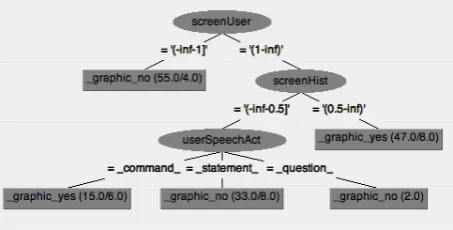
Rule induction: Figure 3 shows a reformula-tion of the rules from which the learned classifier is constructed. The feature screenUser plays a central role. These rules (in combination with the low thresholds) say that if you have already shown a screen output to this particular user in any previous turn (i.e.screenUser > 1), then do so again if the previous user speech act was a command (i.e. userSpeechAct=command) or if you have already shown a screen out-put in a previous turn in this dialogue (i.e.
screenHist>0.5). Otherwise don’t show screen output when asking a clarification.
Decision tree: Figure 4 shows the decision tree learnt by the classifier J4.8. The five rules contained in this tree also heavily rely on the user model as well as the previous screen his-tory. The rules constructed by the first two nodes (screenUser, screenHist) may lead to a repetitive strategy since the right branch will result in the same action (graphic-yes) in all future actions. The only variation is introduced by the speech act, collapsing the tree to the same rule set as in figure 3. Note that this rule-set is based on domain independent features.
Discussion: Examining the classifications made by our best performing Bayesian models we found
that the learnt conditional probability distribu-tions produce similar feature-value mappings to the rules described above. The strategy learnt by the classifiers heavily depends on features ob-tained in previous interactions, i.e. user model fea-tures. Furthermore these strategies can lead to repetitive action, i.e. if a screen output was once shown to this user, and the user has previously used or referred to the screen, the screen will be used over and over again.
[image:7.595.308.535.351.466.2]For learning a strategy which varies in context but adapts in more subtle ways (e.g. to the user model), we would need to explore many more strategies through interactions with users to find an optimal one. One way to reduce costs for build-ing such an optimised strategy is to apply Rein-forcement Learning (RL) with simulated users. In future work we will begin with the strategy learnt by supervised learning (which reflects sub-optimal average wizard behaviour) and optimise it for dif-ferent user models and reward structures.
Figure 4: Five-rule tree from J4.8 (“inf” =∞)
7 Summary and Future Work
IF screenUser>1 AND (userSpeechAct=command OR screenHist>0.5) THEN graphic=yes ELSE graphic=no
Figure 3: Reformulation of the rules learnt by JRIP
rule-based dialogue systems based on domain in-dependent features. We also showed that feature engineering is essential for achieving significant performance gains when using large feature spaces with the small data sets which are typical of di-alogue WOZ studies. By interpreting the learnt strategies we found them to be sub-optimal. In current research, RL is applied to optimise gies and has been shown to lead to dialogue strate-gies which are better than those present in the orig-inal data (Henderson et al., 2005). The next step towards a RL-based system is to add task-level and reward-level annotations to calculate reward func-tions, as discussed in (Rieser et al., 2005). We furthermore aim to learn more refined clarifica-tion strategies indicating the problem source and its severity.
Acknowledgements
The authors would like thank the ACL reviewers, Alissa Melinger, and Joel Tetreault for help and dis-cussion. This work is supported by the TALK project, www.talk-project.org, and the International Post-Graduate College for Language Technology and Cognitive Systems, Saarbr¨ucken.
References
William W. Cohen. 1995. Fast effective rule induction. In Proceedings of the 12th ICML-95.
Walter Daelemans, V´eronique Hoste, Fien De Meul-der, and Bart Naudts. 2003. Combined optimization of feature selection and algorithm parameter interac-tion in machine learning of language. In
Proceed-ings of the 14th ECML-03.
Usama Fayyad and Keki Irani. 1993. Multi-interval discretization of continuousvalued attributes for classification learning. In Proc. IJCAI-93.
Mark Hall. 2000. Correlation-based feature selection for discrete and numeric class machine learning. In
Proc. 17th Int Conf. on Machine Learning.
James Henderson, Oliver Lemon, and Kallirroi Georgila. 2005. Hybrid Reinforcement/Supervised Learning for Dialogue Policies from COMMUNI-CATOR data. In IJCAI workshop on Knowledge and
Reasoning in Practical Dialogue Systems,.
George John and Pat Langley. 1995. Estimating con-tinuous distributions in bayesian classifiers. In
Pro-ceedings of the 11th UAI-95. Morgan Kaufmann.
Ivana Kruijff-Korbayov´a, Nate Blaylock, Ciprian Ger-stenberger, Verena Rieser, Tilman Becker, Michael Kaisser, Peter Poller, and Jan Schehl. 2005. An ex-periment setup for collecting data for adaptive out-put planning in a multimodal dialogue system. In
10th European Workshop on NLG.
Pat Langley and Stephanie Sage. 1994. Induction of selective bayesian classifiers. In Proceedings of the
10th UAI-94.
Zhang Le. 2003. Maximum entropy modeling toolkit for Python and C++.
Oliver Lemon, Kallirroi Georgila, James Henderson, Malte Gabsdil, Ivan Meza-Ruiz, and Steve Young. 2005. Deliverable d4.1: Integration of learning and adaptivity with the ISU approach.
Sharon Oviatt, Rachel Coulston, and Rebecca Lunsford. 2004. When do we interact mul-timodally? Cognitive load and multimodal communication patterns. In Proceedings of the 6th
ICMI-04.
Sharon Oviatt. 2002. Breaking the robustness bar-rier: Recent progress on the design of robust mul-timodal systems. In Advances in Computers. Aca-demic Press.
Tim Paek and David Maxwell Chickering. 2005. The markov assumption in spoken dialogue manage-ment. In Proceedings of the 6th SIGdial Workshop
on Discourse and Dialogue.
Ross Quinlan. 1993. C4.5: Programs for Machine
Learning. Morgan Kaufmann.
Verena Rieser and Johanna Moore. 2005. Implica-tions for Generating Clarification Requests in Task-oriented Dialogues. In Proceedings of the 43rd ACL.
Verena Rieser, Ivana Kruijff-Korbayov´a, and Oliver Lemon. 2005. A corpus collection and annota-tion framework for learning multimodal clarificaannota-tion strategies. In Proceedings of the 6th SIGdial
Work-shop on Discourse and Dialogue.
David Traum and Pierre Dillenbourg. 1996. Mis-communication in multi-modal collaboration. In
Proceedings of the Workshop on Detecting, Repair-ing, and Preventing Human-Machine Miscommuni-cation. AAAI-96.
Ian H. Witten and Eibe Frank. 2005. Data Mining: