Experiments with Corpus-based LFG Specialization
N i c o l a C a n c e d d a a n d C h r i s t e r S a m u e l s s o n X e r o x R e s e a r c h C e n t r e E u r o p e ,
6, c h e m i n de M a u p e r t u i s 38240 M e y l a n , F r a n c e
{ c a n c e d d a . l s a m u e l s s o n } @ x r c e . x e r o x . c o m
A b s t r a c t
Sophisticated grammar formalisms, such as LFG, al- low concisely capturing complex linguistic phenom- ena. The powerful operators provided by such for- malisms can however introduce spurious ambigu- ity, making parsing inefficient. A simple form of corpus-based grammar pruning is evaluated experi- mentally on two wide-coverage grammars, one En- giish and one French. Speedups of up to a factor 6 were obtained, at a cost in grammatical coverage of about 13%. A two-stage architecture allows achiev- ing significant speedups without introducing addi- tional parse failures.
1 I n t r o d u c t i o n
Expressive grammar formalisms allow grammar de- velopers to capture complex linguistic generaliza- tions concisely and elegantly, thus greatly facilitat- ing grammar development and maintenance. (Car- rol, 1994) found that the empirical performance when parsing with unification-based grammars is nowhere near the theoretical worst-case complexity. Nonetheless, directly parsing with such grammars, in the form they were developed, can be very ineffi- cient. For this reason, grammars are typically com- piled into representations that allow faster parsing. This does however not solve the potential problem of the grammars overgenerating considerably, thus allowing large amounts of spurious ambiguity. In- deed, a current trend in high-coverage parsing, es- pecially when employing a statistical model of lan- guage, see, e.g., (Collins 97), is to allow the grammar to massively overgenerate and instead disambiguate by statistical means during or after parsing. If the benefits resulting from more concise grammatical de- scriptions are to outweigh the costs of spurious am- biguity, the latter must be brought down.
In such a situation, corpus-based compilation techniques can drastically improve parsing perfor- mance without burdening the grammar developer. The initial, and much seminal work in this area was been carried out by Rayner and coworkers, see (Rayner 1988), (Samuelsson and Rayner 91) and (Rayner and Carter 1996). In the current article,
we apply similar ideas to Lexical Functional Gram- mar (LFG) in the incarnation of the Xerox Linguis- tic Environment (XLE). The goal is to investigate to what extent corpus-based compilation techniques can reduce overgeneration and spurious ambiguity, and increase parsing efficiency, without jeopardiz- ing coverage. The rest of the article is organized as follows: Section 2 presents the relevant aspects of the LFG formalism and the pruning strategy em- ployed, Section 3 describes the experimental setup, Section 4 reports the experimental results and Sec- tion 5 relates this to other work.
2 L F G a n d G r a m m a r P r u n i n g
The LFG formalism (Kaplan and Bresnan, 1982) al- lows the right-hand sides (RHS) of grammar rules to consist of a regular expression over grammar sym-
bols. This makes it more appropriate to refer to
the grammar rules as rule schemata, since each RHS
can potentially be expanded into a (possibly infinite) number of distinct sequences of grammar symbols, each corresponding to a traditional phrase-structure rule. As can easily be imagined, the use of regular-
expression operators such as Kleene-star and com-
plementation may introduce a considerable amount of spurious ambiguity. Moreover, the LFG formal- ism provides operators which - - although not in- creasing its theoretical expressive power - - allow rules to be written more concisely. Examples of such
operators are the ignore operator, which allows skip-
ping any sequence of grammar symbols that matches
a given pattern; the shuffle operator, which allows
a set of grammar symbols to occur in any order;
and the linear precedence operator, which allows par-
tially specifying the order of grammar symbols. The pruning method we propose consists in elim- inating complex operators from the grammar de- scription by considering how they were actually in- stantiated when parsing a corpus. In LFGs, each rule scheme corresponds to a particular grammar symbol, since different expansions of the same sym- bol are expressed as alternatives in the regular ex- pression on its RHS. We can define a specific path through the RHS of a rule scheme by the choices
~ t f ~ 211
m a d e when matching it against some sequence of g r a m m a r symbols. Our training d a t a allows us to derive, for each training example, the choices made at each rule expansion. By applying these choices to the rule scheme in isolation, we can derive a phrase- structure rule from it,.
The g r a m m a r is specialized, or pruned, by retain-
ing all and only those phrase-structure rules that correspond to a p a t h taken through a rule scheme when expanding some node in some training exam- ple. Since the g r a m m a r formalism requires that each LHS occur only in one rule scheme in the gram- mar, extracted rules with the same LHS symbol are merged into a single rule scheme with a disjunction
operator at its top level. For instance, if a rule
scheme with the structure
A ~ B*{CI D}
is expanded in the training d a t a only in the following ways
A -> C A --+ B C
A -+ BD
then it will be replaced by a rule scheme with the following structure
A --+ { C I B C ] B D }
T h e same approach is taken to replace all regular- expression operators, other than concatenation, with the actual sequences of g r a m m a r symbols that are m a t c h e d against them. A more realistic example, taken from the actual data, is shown in Figure 1: none of the optional alternative portions following the V is ever used in any correct parse in the corpus.
Moreover, the A D V P preceding the V occurs only
0 or 1 times in correct parses.
Like other unification-based formalisms, lexical functional g r a m m a r s allow g r a m m a r rules to be an- notated with sets of feature-based constraints, here called "functional descriptions", whose purpose is both to enforce additional constraints on rule appli- cability and to build an enriched predicate-argument structure called "f-structure", which, together with the parse tree, constitutes the o u t p u t of the parsing process. As these constraints are maintained verba- t i m in the specialized version of the rule scheme, this poses no problem for this form of g r a m m a r pruning.
3 E x p e r i m e n t a l S e t u p
T h e experiments carried out to determine the ef- fectiveness of corpus-based specialization were per-
formed as illustrated in Figure 2. Two broad-
coverage L F G g r a m m a r s were used, one for French and one for English, both of which were developed
within the P a r g r a m project (Butt et al., 1999) dur- ing several years time. T h e French g r a m m a r consists of 133 rule schemata, the English g r a m m a r of 8.5 rule schemata.
Each g r a l m n a r is equipped with a treebank, which was developed for other purposes t h a n g r a m m a r spe- cialization. Each treebank was produced by letting the system parse a corpus of technical documenta- tion. Any sentence t h a t did not obtain any parse
was discarded. At this point, the French corpus
was reduced to 960 sentences, and the English cor- pus to 970. The average sentence length was 9 for French and 8 for English. For each sentence, a hu- m a n expert then selected the most appropriate anal- ysis a m o n g those returned by the parser.
In the current experiments, each treebank was used to specialize the g r a m m a r it had been devel- oped with. A set of 10-fold cross-validation experi- ments was carried out to measure several interesting quantities under different conditions. This means that, for each language, the corpus was r a n d o m l y split into ten equal parts, and one tenth at a time was held out for testing while the remaining nine tenths were used to specialize the g r a m m a r , and the results were averaged over the ten r u n s . . For each g r a m m a r the average number of parses per sentence, the fraction of sentences which still received at least
one parse (angparse) and the fraction of sentences for
which the parse selected by the expert was still de-
rived (coverage) were measured 1. T h e average C P U
time required by parsing was also measured, and this
was used to compute the speedup with respect to the
original g r a m m a r .
The thus established results constitute one d a t a point in the trade-off between ambiguity reduction on one side, which is in turn related to parsing speed, and loss in coverage on the other. In order to deter- mine other points of this trade-off, the same set. of experiments was performed where speciMization was inhibited for certain rule schemata. In particular, for each g r a m m a r , the two rule s c h e m a t a t h a t received the largest n u m b e r of distinct expansions in the cor- p o r a were determined. These proved to be those associated with the LHS symbols ' V P v e r b [ m a i n ] ' and ' N P ' for the French g r a m m a r , and ' V P v ' and ' N P a d j ' for the English one. 2 T h e experiments were repeated while inhibiting specialization of first the scheme with the most expansions, and then the two most expanded schemata.
Measures of coverage and speedup are i m p o r t a n t
1 A s l o n g a s we a r e i n t e r e s t e d i n p r e s e r v i n g t h e f - s t r u c t u r e a s s i g n e d t o s e n t e n c e s , t h i s n o t i o n o f c o v e r a g e is s t r i c t e r t h a n n e c e s s a r y . T h e s a m e f - s t r u c t u r e c a n i n f a c t b e a s s i g n e d b y m o r e t h a n o n e p a r s e , s o t h a t i n s o m e c a s e s a s e n t e n c e is c o n - s i d e r e d o u t o f c o v e r a g e e v e n i f t h e s p e c i a l i z e d g r a m m a r a s s i g n s t o i t t h e c o r r e c t f - s t r u c t u r e .
2 ' V P v ' a n d ' V P v e r b [ m a i n ] ' c o v e r V P s h e a d e d b y a m a i n v e r b . ' N P a d j ' c o v e r s N P s w i t h a d j e c t i v e s a t t a c h e d .
The original rule:
l/Pperfp --+
ADVP*
SE (t ADJUNCT)
($ ADV_TYPE) = t,padv
~/r
{ @M_Head_Perfp I@M_Head_Passp }
@( Anaph_Ctrl $)
{ AD
VP+
SE ('~ ADJUNCT)
($ ADV_TYPE) = vpadv
is replaced by the following:
ADVP
,[.E (~ ADJUNCT)
(.l. A D V _ T Y P E ) =
vpadv
l/'Pperfp --+
@PPadjunct
@PPcase_obl
{@M.Head_Pevfp [@M..Head_Passp}
@( Anaph_Ctrl ~ )
V
{ @M_Head_Perfp I@M_Head_Passp }
@( Anaph_Ctrl ~)
Figure 1: The pruning of a rule from the actual French grammar. The "*" and the " + " signs have the usual interpretation as in regular expressions. A sub-expression enclosed in parenthesis is optional. Alternative sub-expressions are enclosed in curly brackets and separated by the "[" sign. An "@" followed by an identifier is a macro expansion operator, and is eventually replaced by further functional descriptions.
Corpus
--..,,
0.1[
Disambiguated
Treebank treebank
Human expert
Grammar specialization
Specialized grammar
Figure 2: The setting for our experiments on grammar specialization.
indicators of what can be achieved with this form of grammar pruning. However, they could potentially be misleading, since failure times for uncovered sen- tences might be considerably lower than their pars- ing times, had they not been out of coverage. If the pruned grammar fails more frequently on sen- tences which take longer to parse, the measured speedup might be artificiMly high. This is easily
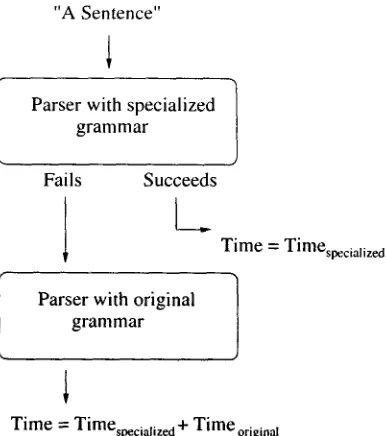
realized, as simply removing the hardest sentences froln the corpus would cause a decrease ill the av- erage parsing time, and thus result in a speedup, without any pruning at all. To factor out the contri- bution of uncovered sentences fi'om the results, the performance of a two-stage architecture analogous to that of (Samuelsson and Rayner, 1991) was siln- ulated, in which the pruned grammar is attempted
[image:3.612.109.573.90.298.2] [image:3.612.134.556.363.594.2]"A Sentence"
Parser with specialized grammar
Fails
1
Succeeds
L_
Time = Timespecialize d
Parser with original grammar
Time = Timespecialize d + Time original
Figure 3: A schematic representation of the simu- lated two-stage coverage-preserving architecture.
first, and the sentence is passed on to the original unpruned g r a m m a r whenever the pruned g r a m m a r fails to return a parse (see Figure 3). The mea- sured speedup of this simulated architecture, which
preserves the anyparse measure of the original g r a m -
mar, takes into account the contribution of uncov- ered sentences, as it penalizes sweeping difficult sen- tences under the carpet.
4
Experimental Results
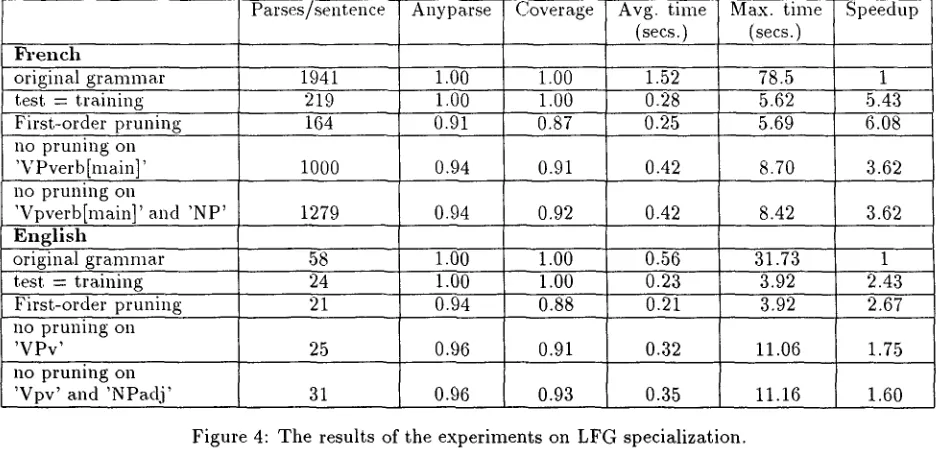
The results of the experiments described in the sec- tion above are s u m m a r i z e d in the table in Figure 4. T h e upper part of the table refers to experiments with the French g r a m m a r , the lower part to exper- iments with the English g r a m m a r . For each lan- guage, the first line presents d a t a gathered for the original g r a m m a r for comparison with the pruned g r a m m a r s . T h e figures in the second line were col- lected by pruning the g r a m m a r based on the whole corpus, and then testing on the corpus itself. The g r a m m a r s obtained in this way contain 516 and 388 disjuncts - - corresponding to purely concatenative
rules - - for French and English respectively. Any-
parse and coverage are not, of course, relevant in this case, but the statistics on parsing time are, es- pecially the one on the m a x i m u m parsing time. For each iteration in the 10-fold cross-validation experi- ment, the m a x i m u m parsing time was retained, and those ten times were eventually averaged. If pruning tended to leave sentences which take long to parse uncovered, then we would observe a significant dif- ference between the average over ma.ximum times on the g r a m m a r trained and tested on the same corpus
(which parses all sentences, including the hardest), and the average over m a x i m u m times for g r a m m a r s trained and tested on different sets. The fact t h a t this does not seem to be the case indicates t h a t prun- ing does not penalize difficult sentences. Note also that the average n u m b e r of parses per sentence is significantly smaller than with the full g r a m m a r , of almost a factor of 9 in the case of the French g r a m - inar.
T h e third line contains results for the fully p r u n e d
g r a m m a r . In the case of the French g r a m m a r a
s p e e d u p of a b o u t 6 is obtained with a loss in cov-
erage of 13%. The smaller speedup gained with
the English g r a m m a r can be explained by the fact t h a t here, the parsing times are lower in general, and that a non-negligible part of this time, espe- cially that needed for morphological analysis, is un- affected by pruning. Even in the case of the English g r a m m a r , though, speedup is substantial (2.67). For both g r a m m a r s , the reduction in the average m a x - i n m m parsing time is particularly good, confirming our hypothesis that t r i m m i n g the g r a m m a r by re- moving heavy constructs makes it considerably more efficient. A partially negative note comes from the average n u m b e r of disjuncts in the prun.ed grain- mars, which is 501 for French and 374 for English. C o m p a r i n g this figures to the n u m b e r of disjuncts in g r a m m a r s pruned on the full corpus (516 and 388), we find t h a t after training on nine tenths of the cor- pus, adding the last tenth still leads to an increase of 3-4% in the size of the resulting g r a m m a r s . In other words, the marginal gain of further training examples is still significant after considering a b o u t 900 sentences, indicating t h a t the training corpora are somewhat too small.
T h e last two lines for each language show figures for g r a m m a r s with pruning inhibited on the most variable and the two most variable symbols respec- tively. For both languages, inhibiting pruning on the most variable symbol has the expected effect of in- creasing both parsing time and coverage. Inhibiting pruning also on the second most variable symbol has ahnost no effect for French, and only a small effect for English.
T h e table in Figure 5 summarizes the measures on the simulated two-stage architecture. For both languages the best trade-off, once the distribution of uncovered sentences has been taken into account, is achieved by the fully pruned g r a m m a r s .
5 R e l a t e d W o r k
T h e work presented in the current article is related to previous work on corpus-based g r a m m a r spe- cialization as presented in (Rayner, 1988; Salnuels- son and Rayner, 1991; Rayner and Carter, 1996; Samuelsson, 1994; Srinivas a.nd Joshi, 1995; Neu- mann, 1997).
[image:4.612.102.295.80.298.2]Parses/sentence
F r e n c h
original g r a m m a r 1941
test = training 219
Anyparse Coverage Avg. time
(secs.)
Max. time
(secs.)
Speedup
1.00 1.OO 1.52 78.5 1
1.00 1.00 0.28 5.62 5.43
0.91 0.25
First-order pruning 164 0.87 5.69 6.08
no pruning on
'VPverb[main]' 1000 0.94 0.91 0.42 8.70 3.62
no pruning on
'Vpverb[main]' and ' N P '
First-order pruning
0.94 0.92 0.42 8.42
1279 3.62
0.88
1.00 1.00 0.56 31.73 1
1.00 1.00 0.23 3.92 2.43
0.94 0.21
0.91 E n g l i s h
original g r a m m a r 58
test = training 24
21
0.96 0.32
0.35 no pruning on
' V P v '
0.96 25
no pruning on
' V p v ' and ' N P a d j ' 31 0.93
3.92
11.06
11.16
Figure 4: T h e results of the experiments on L F G specialization.
Avg. C P U t i m e (secs.) Speedup
F r e n c h
0.570 2.67
0.616 2.47
0.614 2.48
First-order pruning
no pruning on 'VPverb[main]'
no pruning on 'VPverb[main]' and ' N P ' E n g l i s h
First-order pruning 0.311 1.81
no pruning on ' V P v ' 0.380 1.47
no pruning on ' V P v ' and ' N P a d j ' 0.397 1.40
2.67
1.75
1.60
Figure 5: Results for the simulated two-stage architecture.
T h e line of work described in (Rayner, 1988; Samuelsson and Rayner, 1991; Rayner and Carter, 1996; Samuelsson, 1994) deals with unification- based g r a m m a r s t h a t already have a purely- concatenative context-fi'ee backbone, and is more concerned with a different t~orm of specialization, consisting in the application of explanation-based learning (EBL). Here, the central idea is to collect the m o s t frequently occurring subtrees in a treebank and use t h e m as atomic units for parsing. T h e cited works differ mainly in the criteria adopted for select- ing subtrees fi'om the treebank. In (Rayner, 1988; Samuelsson and Rayner, 1991; Rayner and Carter, 1996) these criteria are handcoded: all subtrees sat- isfying some properties are selected, and a new gram- m a r rule is created by flattening each such subtree, i.e., by taking the root as lefl.-hand side and the yield as right-hand side, and in the process performing all unifications corresponding to the thus removed in- ternal nodes. Experiments carried out on a corpus of 15,000 trees from the ATIS domain using a ver- sion of the SRI Core Language Engine resulted in a speedup of a b o u t 3.4 at a cost of 5% in gralmnati-
cal coverage, which however was c o m p e n s a t e d by an increase in parsing accuracy.
Finding suitable tree-cutting criteria requires a considerable a m o u n t of work, and m u s t be repeated for each new g r a m m a r and for each new domain to which the g r a m m a r is to be specialized. Samuelsson (Samuelsson, 1994) proposes a technique to auto- matically selects what subtrees to retain. T h e se- lection of appropriate subtrees is done by choosing a subset of nodes at which to cut trees. Cutnodes
are determined by computing the entropy of each
node, and selecting only those nodes whose entropy exceeds a given threshold. Intuitively, nodes with low entropy indicate locations in the trees where a given symbol was expanded using a predictable set of rules, at least most of the times, so t h a t the loss of coverage t h a t derives from ignoring the remain- ing cases is low. Nodes with high entropy, on the other hand, indicate positions in which there is a high uncertainty in what rule was used to expand the symbol, so t h a t it is better to preserve all alter- natives. Several schemas are proposed to c o m p u t e entropies, each leading to a different trade-off be-
[image:5.612.100.568.84.311.2]tween coverage reduction and speedup. In general, results are not quite as good as those obtained using handcoded criteria, though of course the specialized g r a m m a r is obtained fully automatically, and thus with much less effort.
When ignoring issues related to the elimination of complex operators t"1"o111 the RHS of rule schemata, the grammar-pruning strategy described in the cur- rent article is equivalent to explanation-based learn- ing where all nodes have been selected,as eutnodes. Conversely, EBL can be viewed as higher-order g r a m m a r pruning, removing not grammar rules, but gramlnar-rule combinations.
Some of the work done on data-oriented parsing (DOP) (Bod, 1993; Bod and Scha, 1996; Bod and Kaplan, 1998; Sima'an, 1999) can also be considered related to our work, as it can be seen as a way to specialize in an gBL-like way the (initially unknown) g r a m m a r implicitly underlying a treebank.
(Srinivas and aoshi, 1995) and (Neumann, 1997) apply EBL to speed up parsing with tree-adjoining grammars and sentence generation with HPSGs re- spectively, though they do so by introducing new components in their systems rather then by modify- ing the grammars they use.
6
C o n c l u s i o n s
Sophisticated g r a m m a r formalisms are very useful and convenient when designing high-coverage gram- mars for natural languages. Very expressive gram- matical constructs can make the task of develop- ing and maintaining such a large resource consid- erably easier. On the other hand, their use can re- sult in a considerable increase in grammatical am- biguity. Gramnaar-compilation techniques based on g r a m m a r structure alone are insufficient remedies in those cases, as they cannot access the information required to determine which alternatives to retain and which alternatives to discard.
The current article demonstrates that a relatively simple pruning technique, employing the kind of ref- erence corpus that is typically used for g r a m m a r de- velopment and thus often already available, can sig- nificantly improve parsing performance. On large lexical functional grammars, speedups of up to a factor 6 were observed, at the price of a. reduction in grammatical coverage of about 13%. A simple two-stage architecture was also proposed that pre-
serves the anyparse measure of the original gram-
mar, demonstrating that significant speedups can be obtained without increasing the number of parsing failures.
Future work includes extending the study of corpus-based g r a m m a r specialization from first- order g r a m m a r pruning to higher-order gram- mar pruning, thus extending previous work on explanation-based learning for parsing, aad apply-
ing it to the LFG fornaalism.
R e f e r e n c e s
Rens Bod and Ronald Kaplan. 1998. A probabilistic corpus-driven model for lexical-functional analy-
sis. In Proceedings of Coling-ACL-98, Montreal,
Canada.
R. Bod and R. Scha. 1996. Data-oriented lan- guage processing: An overview. Technical report, ILLC, University of Amsterdam, Alnsterdam, The Netherlands.
Rens Bod. 1993. Using an annotated corpus as a
stochastic grammar. In Proceedings of EACL-93,
Utrecht, The Netherlands.
M. Butt, T.H. King, M.E. Nifio, and F. Segond.
1999. A Grammar Writer's Cookbook. CSLI Pub-
lications, Stanford, CA.
John Carrol. 1994. Relating complexity to practical performance in parsing with wide-coverage uni-
fication grammars. In Proceedings of (ACL '94),
Las Cruces, New Mexico, June.
Ronald Kaplan and Joan Bresnan. 1982. Lexical- functional grammar: A formal system for gram- matical representation. In Joan Bresnan, editor,
The Mental Representation of Grammatical Rela- tions, pages 173-281. MIT Press.
G/inter Neumann. 1997. Applying explanation-
based learning to control and speeding-up natu-
ral language generation. In Proceedings of A CL-
EACL-97, Madrid, Spain.
Manny Rayner and David Carter. 1996. Fast pars- ing using pruning and g r a m m a r specialization. In
Proceedings of the ACL-96, Santa. Cruz, CA. Manny Rayner. 1988. Applying explanation-based
generalization to natural-language processing. In Proceedings of the International Conference on Fifth Generation Computer Systems, Tokyo, Japan.
Christer Samuelsson and Manny Rayner. 1991.
Quantitative evaluation of explanation-based learning as an optimization tool for a large-scale
natural language system. In Proceedings of the
IJCAI-91, Sydney, Oz.
Christer Samuelsson. 1994. G r a m m a r specialization
through entropy thresholds. In Proceedings of the
ACL-94, Las Cruces, New Mexico. Available as cmp-lg/9405022.
Khalil Sima'an. 1999. Learning Efficient Dis-
ambiguation. Ph.D. thesis, Institute for Logic, Language and Computation, Amsterdam, The Netherlands.
B. Srinivas and A. Joshi. 1995. Some novel appli- cations of explanation-based learning to parsing
lexicalized tree-adjoining gramlnars. In Proceed-
ings of the ACL-95, Cambridge, MA.