Trainable M e t h o d s for Surface N a t u r a l L a n g u a g e G e n e r a t i o n
A d w a i t
Ratnaparkhi
I B M T J W a t s o n R e s e a r c h C e n t e rP.O. B o x 218
Y o r k t o w n H e i g h t s , N Y 10598 a r a t n a p a @ u s , ibm. c o m
Abstract
We present three systems for surface natural lan- guage generation that are trainable from annotated corpora. The first two systems, called NLG1 and NLG2, require a corpus marked only with domain- specific semantic attributes, while the last system, called NLG3, requires a corpus marked with both semantic attributes and syntactic dependency infor- mation. All systems attempt to produce a grammat- ical natural language phrase from a domain-specific semantic representation. NLG1 serves a baseline system and uses phrase frequencies to generate a whole phrase in one step, while NLG2 and NLG3 use maximum entropy probability models to indi- vidually generate each word in the phrase. The sys- tems NLG2 and NLG3 learn to determine both the word choice and the word order of the phrase. We present experiments in which we generate phrases to describe flights in the air travel domain.
1 I n t r o d u c t i o n
This paper presents three trainable systems for sur- face natural language generation (NLG). Surface NLG, for our purposes, consists of generating a grammatical natural language phrase that expresses the meaning of an input semantic representation. The systems take a "corpus-based" or "machine- learning" approach to surface NLG, and learn to generate phrases from semantic input by statisti- cally analyzing examples of phrases and their cor- responding semantic representations. The determi- nation of the content in the semantic representation, or "deep" generation, is not discussed here. Instead, the systems assume that the input semantic repre- sentation is fixed and only deal with how to express it in natural language.
This paper discusses previous approaches to sur- face NLG, and introduces three trainable systems for surface NLG, called NLG1, NLG2, and NLG3. Quantitative evaluation of experiments in the air travel domain will also be discussed.
2
Previous Approaches
Templates are the easiest way to implement surface NLG. A template for describing a flight noun phrase in the air travel domain might be f l i g h t departing from $city-fr at $time-dep and arriving in $city-to at $time-arr where the words starting with "$" are actually variables -- representing the departure city, and departure time, the arrival city, and the arrival time, respectively-- whose values will be extracted from the environment in which the template is used. The approach of writing individual templates is convenient, but m a y not scale to complex domains in which hundreds or thousands of templates would be necessary, and may have shortcomings in maintainability and text quality (e.g., see (Reiter, 1995) for a discussion).
There are more sophisticated surface genera- tion packages, such as FUF/SURGE (Elhadad and Robin, 1996), KPML (Bateman, 1996), MUMBLE (Meteer et al., 1987), and RealPro (Lavoie and Ram- bow, 1997), which produce natural language text from an abstract semantic representation. These packages require linguistic sophistication in order to write the abstract semantic representation, but they are flexible because minor changes to the input can accomplish major changes to the generated text.
The only trainable approaches (known to the au- thor) to surface generation are the purely statistical machine translation (MT) systems such as (Berger et al., 1996) and the corpus-based generation sys- tem described in (Langkilde and Knight, 1998). The MT systems of (Berger et al., 1996) learn to gen- erate text in the target language straight from the source language, without the aid of an explicit se- mantic representation. In contrast, (Langkilde and Knight, 1998) uses corpus-derived statistical knowl- edge to rank plausible hypotheses from a grammar- based surface generation component.
3 T r a i n a b l e S u r f a c e N L G
pairs as a semantic representation, which suffice as a representation for a limited domain like air travel. For example, the set of attribute-value pairs { $city- fr = New York City, $city-to = Seattle , $time-dep = 6 a.m., $date-dep = Wednesday } represent the meaning of the noun phrase % flight to Seattle t h a t departs from New York City at 6 a.m. on Wednes- day". The goal, more specifically, is then to learn the optimal
attribute ordering
andlexical choice
for the text to be generated from the attribute-value pairs. For example, the NLG system should auto- matically decide if the attribute ordering in "flights to New York in the evening" is b e t t e r or worse than the ordering in "flights in the evening to New York". Furthermore, it should automatically decide if the lexical choice in "flights departing to New York" is better or worse than the choice in "flights leaving to New York". T h e motivation for a trainable surface generator is to solve the above two problems in a way that reflects the observed usage of language in a corpus, but without the manual effort needed to construct a g r a m m a r or knowledge base.All the trainable NLG systems in this paper as- sume the existence of a large corpus of phrases in which the values of interest have been replaced with their corresponding attributes, or in other words, a corpus of
generation templates.
Figure 1 shows a sample of training data, where only words marked with a "$" are attributes. All of the NLG systems in this paper work in two steps as shown in Table 2. T h e systems NLG1, NLG2 and NLG3 all implement step 1; they produce a sequence of words intermixed with attributes, i.e., a template, from the the at- tributes alone. T h e values are ignored until step 2, when they replace their corresponding attributes in the phrase produced by step 1.3.1 N L G I : t h e b a s e l i n e
T h e surface generation model NLG1 simply chooses the most frequent template in the training d a t a that corresponds to a given set of attributes. Its perfor- mance is intended to serve as a baseline result to the more sophisticated models discussed later. Specifi- cally,
nlgl(A)
returns the phrase t h a t corresponds to the a t t r i b u t e set A:nlgl(A) = { argInaXphraseeTA[empty
string]C(phrase, A) TATA =
where
TA are
the phrases that have occurred with A in the training data, and whereC(phrase, A)
is the training d a t a frequency of the natural language phrasephrase
and the set of attributes A. NLG1 will fail to generate anything if A is a novel combi- nation of attributes.3 . 2 N L G 2 : n - g r a m m o d e l
The surface generation system NLG2 assumes that the best choice to express any given attribute-value
set is the word sequence with the highest probabil- ity that mentions all of the input attributes exactly once. When generating a word, it uses local infor- mation, captured by word n-grams, together with certain non-local information, namely, the subset of the original attributes that remain to be generated. The local and non-local information is integrated with use of features in a maximum entropy prob- ability model, and a highly pruned search procedure attempts to find the best scoring word sequence ac- cording to the model.
3.2.1 P r o b a b i l i t y M o d e l
The probability model in NLG2 is a conditional dis- tribution over V U * s t o p , , where V is the genera- tion vocabulary and where . s t o p . is a special "stop" symbol. The generation vocabulary V consists of all the words seen in the training data. T h e form of the maximum entropy probability model is identical to the one used in (Berger et al., 1996; Ratnaparkhi, 1998):
k f$(wi ,wi-1 ,wi-2,at~ri)
Y I j = I Otj
p(wilwi-l, wi-2,attri) =
Z ( W i - l , w i - 2 , a t t r i ) k
to t j = l
where wi ranges over V t3 . s t o p . and
{wi-l,wi-2,attri}
is the history, wherewi de-
notes the ith word in the phrase, and
attri
denotes the attributes t h a t remain to be generated at posi- tion i in the phrase. The f j , wherefj(a, b) E
{0, 1}, are calledfeatures
and capture any information in the history t h a t might be useful for estimatingp(wi[wi-1,
wi-2,attri).
The features used in NLG2are described in the next section, and the feature weights a j , obtained from the Improved Iterative Scaling algorithm (Berger et al., 1996), are set to maximize the likelihood of the training data. T h e probability of the sequence
W = wl ... wn,
given the attribute set A, (and also given t h a t its length is n) is:P r ( W = wa...wnllen(W) = n,A)
=
n
H p(wilwi_1, wi_2, attri )
i = l3.2.2 F e a t u r e S e l e c t i o n
The feature patterns, used in NLG2 are shown in Table 3. The actual features are created by match- ing the patterns over the training data, e.g., an ac- tual feature derived from the word bi-gram template might be:
1 if wi = from
f ( w i ,
Wi--1, Wi--2, attr~)
= andwi-t
= f l i g h t and $ c i t y -- f z Eattri
0 otherwise
flights on $air from $city-fr to $city-to the $time-depint of $date-dep
Strip flights on $air from $city-fr to $city-to leaving after $time-depaft on $date-dep flights leaving from $city-fr going to $city-to after Stime-depaft on $date-dep
flights leaving from $city-fr to $city-to the $time-depint of Sdate-dep $air flight $fltnum from $city-fr to $city-to on $date-dep
$city-fr to $city-to $air flight Sfltnum on the $date-dep Strip flights from $city-fr to $city-to
Input to Step 1: Output of Step 1:
Table 1: Sample training data { $city-fr, $city-to, $time-dep, $date-dep } '% flight to $city-to that departs from $city-fr at Stime-dep on $date-dep"
Input to Step 2:
Output of Step 2:
"a flight to $city-to that departs from $city-fr at $time-dep on $date-dep", { $city-fr = New York City, $city-to = Seattle , $time-dep = 6 a.m., $date-dep = Wednesday }
'% flight to Seattle that departs from New York City at 6 a.m. on Wednesday"
Table 2: Two steps of NLG process
Low frequency features involving word n - g r a m s tend to be unreliable; the NLG2 system therefore only uses features which occur K times or more in the training data.
3.2.3 S e a r c h P r o c e d u r e
The search procedure attempts to find a word se- quence wl . . . wn of any length n ~ M for the input attribute set A such that
1. wn is the stop symbol , s t o p ,
2. All of the attributes in A are mentioned at least once
3. All of the attributes in A are mentioned at most once
and where M is an heuristically set maximum phrase length.
The search is similar to a left-to-right breadth- first-search, except that only a fraction of the word sequences are considered. More specifically, the search procedure implements the recurrence:
WN,1 = top(N, (wlw e V}) Wg,i+l = top(N, next(WN,i))
The set WN# is the top N scoring sequences of length i, and the expression next(WN,i) returns all sequences w l . . . W i + l such that w l . . . w i E WN,i, and wi+l E V U . s t o p . . The expression top(N, next(WN#)) finds the top N sequences in next(Wg,i). During the search, any sequence that ends with , s t o p . is removed and placed in the set
of completed sequences. If N completed hypotheses are discovered, or if WN,M is computed, the search terminates. Any incomplete sequence which does not satisfy condition (3) is discarded and any com- plete sequence that does not satisfy condition (2) is also discarded.
When the search terminates, there will be at most N completed sequences, of possibly differing lengths. Currently, there is no normalization for different lengths, i.e., all sequences of length n < M are equiprobable:
P r ( l e n ( W ) = n) = -~ n < M = 0 n > M
NLG2 chooses the best answer to express the at- tribute set A as follows:
nlg2(A) = argmaXwew,,g 2 P r ( l e n ( W ) = n) . P r ( W l l e n ( W ) = n, A)
where Wnt~2 are the completed word sequences that satisfy the conditions of the NLG2 search described above.
3.3 N L G 3 : d e p e n d e n c y i n f o r m a t i o n
Description
No Attributes remaining Word bi-gram with attribute Word tri-gram with attribute
Feature f ( w i , Wi-1, Wi-2,
attri) . . . .
1 if
wi
= ? andattri
= {}, 0 otherwise1 if wi = ? and wi-1 = ? and ? E
attri, 0
otherwise 1 if wi =? andwi-lwi-~
= ? ? and ? Eattri, 0
otherwiseTable 3: Features patterns for NLG2. Any occurrence of "?" will be instantiated with an actual value from training data.
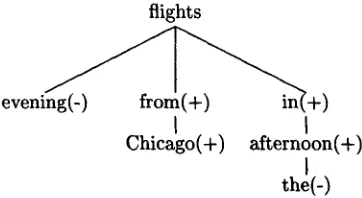
t o p - t o - b o t t o m instead of a word sequence from left- to-right, where each word is predicted in the context of its syntactically related parent, grandparent, and siblings. NLG3 requires a corpus that has been an- notated with tree structure like the sample depen- dency tree shown in Figure 1.
3.3.1 P r o b a b i l i t y M o d e l
T h e probability model for NLG3, shown in Figure 2, conditions on the parent, the two closest siblings, the direction of the child relative to the parent, and the attributes t h a t remain to be generated.
Just as in NLG2, p is a distribution over V t2 . s t o p , , and the Improved Iterative Scaling algo- rithm is used to find the feature weights a j . T h e expression
chi(w)
denotes the ith closest child to the headwordw, par(w)
denotes the parent of the headword w,dir E
{ l e f t , r i g h t } denotes the direc- tion of the child relative to the parent, andattrw,i
denotes the attributes t h a t remain to be generated in the tree when headword w is predicting its ith child. For example, in Figure 1, if w ="flights", then
Chl(W)
="evening" when generating the left children, andchl(w) ="from"
when generating the right children. As shown in Figure 3, the proba- bility of a dependency tree that expresses an at- tribute set A can be found by computing, for each word in the tree, the probability of generating its left children and then its right children. 1 In this formulation, the left children are generated inde- pendently from the right children. As in NLG2, NLG3 assumes the uniform distribution for the length probabilities P r ( # of left children = n) and P r ( # of right children = n) up to a certain maxi- mum length M ' = 10.3.3.2 F e a t u r e S e l e c t i o n
The feature patterns for NLG3 are shown in Ta- ble 4. As before, the actual features are created by matching the patterns over the training data. The features in NLG3 have access to syntactic informa- tion whereas the features in NLG2 do not. Low fre- quency features involving word n - g r a m s tend to be unreliable; the NLG3 system therefore only uses fea- tures which occur K times or more in the training data. Furthermore, if a feature derived from Table 4 looks at a particular word
chi(w)
and attribute a, we only allow it if a has occurred as a descendent of 1We use a d u m m y R O O T node to generate the top most head word of the phrasechi(w)
in some dependency tree in the training set.As an example, this condition allows features t h a t look at
chi(w)
= " t o " and $city-toEattrw,i
but dis- allows features t h a t look atch~(w) ="to"
and $city- frEattrw,i.
3.4 S e a r c h P r o c e d u r e
The idea behind the search procedure for NLG3 is similar to the search procedure for NLG2, namely, to explore only a fraction of the possible trees by con- tinually sorting and advancing only the top N trees at any given point. However, the dependency trees are not built left-to-right like the word sequences in NLG2; instead they are built from the current head (which is initially the root node) in the following order:
1. Predict the next left child (call it xt) 2. If it is * s t o p , , jump to (4)
3. Recursively predict children of xt. Resume from
(1)
4. Predict the next right child (call it Xr)
5. If it is *stop*, we are done predicting children for the current head
6. Recursively predict children o f x r . Resume from
(4)
As before, any incomplete trees t h a t have generated a particular attribute twice, as well as completed trees that have not generated a necessary attribute are discarded by the search. T h e search terminates when either N complete trees or N trees of the max- imum length M are discovered. NLG3 chooses the best answer to express the attribute set A as follows:
nlga(A) = argmax Pr(TIA )
TET.Iga
where Tntga are the completed dependency trees t h a t satisfy the conditions of the NLG3 search described above.
4 E x p e r i m e n t s
The training and test sets used to evaluate NLG1, NLG2 and NLG3 were derived semi-automatically from a pre-existing annotated corpus of user queries in the air travel domain. T h e annotation scheme used a total of 26 attributes to represent flights.
flights
e v e n ~ + )
I
I
Chicago(+) afternoon(+)
I
the(-)Figure 1': Sample dependency tree for the phrase evening flights from Chicago in the afternoon. - and +
signs indicate left or right child, respectively.
I-Ik Y J ( c h i [ t ° ) ' t o ' c h i - - l ( ~ ) ' c h i - - 2 ( ~ ) ' P a ~ ( ~ ) ' d t r ' a t t ~ o , i)
p(chiCw)[w, chi- 1 (w), chi-2 (w), par (w), dir, attr~,i ) - - - ~"Jffi' ~ J Z ( w , c h i _ 1 ( w ) , c h i - 2 ( w ) , p a r ( w ) , d i ~ , a t t r t u , i )
Z(w, ehi_l(w),chi_2(w),par(w),dir, attrw,4) = ~v,,
l-[j=lk OL~/J(w"w'chi-l(*Z)'chl-2(w)'par(tv)'dir'att*'~'i)
Figure 2: NLG3: Equations for the probability of the ith child of head word w, or chi(w)
Pr(TIA)
Prl¢lt(wlA)
Prri~ht(w[A)
= YI~eTPrl~ft(wlA)Prr~ght(wl A)
---- P r ( # of left children = n) YL=ln p(chi(w)lw,chi-l(w),chi-2(w),par(w),dir = left,attr~,i)
= P r ( ~ of right children = n) rI~=l p(chi(w)lw, chi-1 (w), chi-2 (w),par(w), dir = right, attrw,~)
Figure 3: NLG3: Equations for the probability of a dependency tree T
Description Siblings
Parent + sibling
Parent + grandparent
Feature f (chi(w), w, ch~_ 1 (w), chi_2 (w), par (w), dir, attrw,i) = . . .
1 if chi(w) =? and c h i - l ( w ) =? and chi-2(w) =? and dir =? and
? E attrw,i, 0 otherwise
1 if chi(w) =? and chi_t(w) =? and w =? and dir =? and ? E
attrw,i, 0 otherwise
1 ifchi(w) =? and w =? and par(w) =? and dir =? and ? • attrw,i, 0 otherwise
Table 4: Features patterns for NLG3. Any occurrence of "?" will be instantiated with an actual value from training data.
System Parameters
NLG1
NLG2 N=IO,M=30,K=3
NLG3 N=5,M=30,K=IO
% Correct % OK % Bad % No output % error reduction
from NLGI
84.9 4.9 7.2 3.0 -
88.2 4.7 6.4 0.7 22
89.9 4.4 5.5 0.2 33
Table 5: Weighted evaluation of trainable surface generation systems by judge A
System Parameters % Correct % OK % Bad % No output % error reduction
from NLG1
NLG1 81.6 8.4 7.0 3.0 -
NLG2 N=IO,M=30,K=3 86.3 5.8 7.2 0.7 26
NLG3 N=5,M=30,K=10 88.4 4.0 7.4 0.2 37
[image:5.612.273.454.86.185.2] [image:5.612.109.571.233.472.2] [image:5.612.126.558.537.598.2]System NLG1 NLG2 NLG3
Parameters % Correct % OK % Bad % No output % error reduction from NLG1
48.4 6.8 24.2 20.5
N=IO,M=30,K=3 64.7 12.1 22.6 0.5 32
N=5,M=30,K=IO 63.1 11.6 23.7 1.6 29
Table 7: Unweighted evaluation of trainable surface generation systems by judge A
System Parameters NLG1
NLG2 N=IO,M=30,K=3 NLG3 N=5,M=30,K=IO
% Correct % OK % Bad % No output % error reduction from NLG1
41.1 8.9 29.5 20.5
62.1 13.7 23.7 0.5 36
65.3 11.1 22.1 1.6 41
Table 8: Unweighted evaluation of trainable surface generation systems by judge B
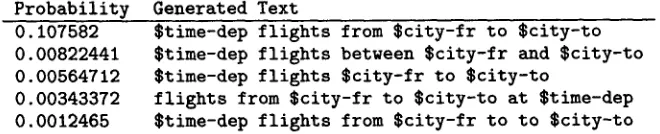
The training set consisted of 6000 templates describ- ing flights while the test set consisted of 1946 tem- plates describing flights. All systems used the same training set, and were tested on the attribute sets extracted from the phrases in the test set. For ex- ample, if the test set contains the template "flights to $city-to leaving at Stime-dep", the surface gener- ation systems will be told to generate a phrase for the attribute set { $city-to, Stime-dep }. The out- put of NLG3 on the attribute set { $city-to, $city-fr, $time-dep } is shown in Table 9.
There does not appear to be an objective auto- matic evaluation method 2 for generated text that correlates with how an actual person might judge the output. Therefore, two judges - - the author and a colleague - - manually evaluated the output of all three systems. Each judge assigned each phrase from each of the three systems one of the following rankings:
C o r r e c t : Perfectly acceptable
O K : Tense or agreement is wrong, but word choice is correct. (These errors could be corrected by post-processing with a morphological analyzer.) B a d : Words are missing or extraneous words are
present
No O u t p u t : The system failed to produce any out- put
While there were a total 1946 attribute sets from the test examples, the judges only needed to evalu- ate the 190 unique attribute sets, e.g., the attribute set { $city-fr $city-to } occurs 741 times in the test data. Subjective evaluation of generation output is 2 M e a s u r i n g word overlap or edit d i s t a n c e b e t w e e n t h e sys- t e m ' s o u t p u t a n d a "reference" set would b e a n a u t o m a t i c s c o r i n g m e t h o d . W e believe t h a t s u c h a m e t h o d does n o t a c c u r a t e l y m e a s u r e t h e c o r r e c t n e s s or g r a m m a t i c a l i t y of t h e text.
not ideal, but is arguably superior than an auto- matic evaluation that fails to correlate with human linguistic judgement.
The results of the manual evaluation, as well as the values of the search and feature selection param- eters for all systems, are shown in Tables 5, 6, 7, and 8. (The values for N, M, and K were determined by manually evaluating the output of the 4 or 5 most common attribute sets in the training data). The weighted results in Tables 5 and 6 account for mul- tiple occurrences of attribute sets, whereas the un- weighted results in Tables 7 and 8 count each unique attribute set once, i.e., { $city-fr $city-to } is counted 741 times in the weighted results but once in the un- weighted results. Using the weighted results, which represent testing conditions more realistically than the unweighted results, both judges found an im- provement from NLG1 to NLG2, and from NLG2 to NLG3. NLG3 cuts the error rate from NLG1 by at least 33% (counting anything without a rank of C o r r e c t as wrong). NLG2 cuts the error rate by at least 22% and underperforms NLG3, but requires far less annotation in its training data. NLG1 has no chance of generating anything for 3% of the data - - it fails completely on novel attribute sets. Using the unweighted results, both judges found an improve- ment from NLG1 to NLG2, but, surprisingly, judge A found a slight decrease while judge B found an increase in accuracy from NLG2 to NLG3. The un- weighted results show that the baseline NLG1 does well on the common attribute sets, since it correctly generates only less than 50% of the unweighted cases but over 80% of the weighted cases.
5 D i s c u s s i o n
The NLG2 and NLG3 systems automatically at- tempt to generalize from the knowledge inherent in the training corpus of templates, so that they can generate templates for novel attribute sets. There
[image:6.612.94.526.86.145.2] [image:6.612.97.526.182.241.2]Probability Generated Text
0.107582 0.00822441 0.00564712 0.00343372 0.0012465
$time-dep flights from $city-fr to $city-to $time-dep flights between $city-fr and $city-to Stime-dep flights $city-fr to $city-to
flights from $city-fr to $city-to at Stime-dep Stime-dep flights from $city-fr to to $city-to
Table 9: Sample output from NLG3. (Dependency tree structures are not shown.) Typical values for attributes: $time-dep -- "10 a.m.", $city-fr = "New York", $city-to = "Miami"
is some additional cost associated with producing the syntactic dependency annotation necessary for NLG3, but virtually no additional cost is associated with NLG2, beyond collecting the data itself and identifying the attributes.
The trainable surface NLG systems in this pa- per differ from grammar-based systems in how they determine the attribute ordering and lexical choice. NLG2 and NLG3 automatically determine attribute ordering by simultaneously searching multiple or- derings. In grammar-based approaches, such pref- erences need to be manually encoded. NLG2 and NLG3 solve the lexical choice problem by learning the words (via features in the maximum entropy probability model) that correlate with a given at- tribute and local context, whereas (Elhadad et al., 1997) uses a rule-based approach to decide the word choice.
While trainable approaches avoid the expense of crafting a grammar to determine attribute order- ing and lexicai choice, they are less accurate than grammar-based approaches. For short phrases, ac- curacy is typically 100% with grammar-based ap- proaches since the grammar writer can either cor- rect or add a rule to generate the phrase of interest once an error is detected. Whereas with NLG2 and NLG3, one can tune the feature patterns, search pa- rameters, and training data itself, but there is no guarantee that the tuning will result in 100% gener- ation accuracy.
Our approach differs from the corpus-based surface generation approaches of (Langkilde and Knight, 1998) and (Berger et al., 1996). (Langkilde and Knight, 1998) maps from semantics to words with a concept ontology, grammar, and lexicon, and ranks the resulting word lattice with corpus-based statistics, whereas NLG2 and NLG3 automatically learn the mapping from semantics to words from a corpus. (Berger et ai., 1996) describes a statistical machine translation approach that generates text in the target language directly from the source text. NLG2 and NLG3 are also statistical learning ap- proaches but generate from an actual semantic rep- resentation. This comparison suggests that statis- tical MT systems could also generate text from an "interlingua", in a way similar to that of knowledge-
based translation systems.
We suspect that our statistical generation ap- proach should perform accurately in domains of sim- ilar complexity to air travel. In the air travel do- main, the length of a phrase fragment to describe an attribute is usually only a few words. Domains which require complex and lengthy phrase fragments to describe a single attribute will be more challeng- ing to model with features that only look at word n-grams for n E {2, 3). Domains in which there is greater ambiguity in word choice will require a more thorough search, i.e., a larger value of N, at the expense of CPU time and memory. Most im- portantly, the semantic annotation scheme for air travel has the property that it is both rich enough to accurately represent meaning in the domain, but simple enough to yield useful corpus statistics. Our approach may not scale to domains, such as freely occurring newspaper text, in which the semantic an- notation schemes do not have this property.
Our current approach has the limitation that it ignores the values of attributes, even though they might strongly influence the word order and word choice. This limitation can be overcome by using features on values, so that NLG2 and NLG3 might discover - - to use a hypothetical example - - that "flights leaving $city-fr" is preferred over "flights from $city-fr" when $city-fr is a particular value, such as "Miami".
6 C o n c l u s i o n s
[image:7.612.171.501.86.153.2]notated data.
7 A c k n o w l e d g e m e n t s
The author thanks Scott McCarley for serving as the second judge, and Scott Axelrod, Kishore Papineni, and Todd Ward for their helpful comments on this work. This work was supported in part by DARPA Contract # MDA972-97-C-0012.
R e f e r e n c e s
John Bateman. 1996. Kpml development envi- ronment - multilingual linguistic resource devel- opment and sentence generation. Technical re- port, German Centre for Information Technol- ogy (GMD), Institute for Integrated Information and Publication Systems (IPSI), Darmstadt, Ger- many.
Adam Berger, Stephen A. Della Pietra, and Vin- cent J. Della Pietra. 1996. A Maximum Entropy
Approach to Natural Language Processing.
Com-
putational Linguistics,
22(1):39-71.Michael Elhadad and Jacques Robin. 1996. An overview of surge: a reusable comprehensive syn- tactic realization component. Technical Report 96-03, Ben Gurion University, Beer Sheva, Israel. Michael Elhadad, Kathleen McKeown, and Jacques
Robin. 1997. Floating constraints in lexical
choice.
Computational Linguistics,
pages 195-239.
Irene Langkilde and Kevin Knight. 1998. Genera- tion that exploits corpus-based statistical knowl-
edge. In
Proceedings of the 36th Annual Meeting
of the Association for Computational Linguistics
and 17th International Conference on Computa-
tional Linguistics,
University of Montreal, Mon-treal, Quebec, Canada.
Benoit Lavoie and Owen Rambow. 1997. A fast and portable realizer for text generation systems.
In
Proceedings of the Fifth Conference on Ap-
plied Natural Language Processing,
pages 265-268,Washington D.C., March 31-April 3.
M. W. Meteer, D. D. McDonald, S.D. Anderson, D. Forster, L.S. Gay, A.K. Huettner, and P. Si- bun. 1987. Mumble-86: Design and implementa- tion. Technical Report Technical Report COINS 87-87, University of Massachusetts at Amherst.
Adwait Ratnaparkhi. 1998.
Maximum Entropy
Models for Natural Language Ambiguity Resolu-
tion.
Ph.D. thesis, University of Pennsylvania.Ehud Reiter. 1995. Nlg vs. Templates. In
Proceed-
ings of the 5th European Workshop on Natural
Language Generation,
Leiden, The Netherlands.