A Flexible POS Tagger Using an Automatically Acquired
Language Model*
L l u f s M h r q u e z L S I - U P C
c / J o r d i Girona 1-3
08034 Barcelona. Catalonia
lluism©isi, upc. e s
L l u / s P a d r 6 L S I - U P C c / J o r d i G i r o n a 1-3 08034 B a r c e l o n a . C a t a l o n i a
padro@isi, upc. es
A b s t r a c t
We present an algorithm that automati- cally learns context constraints using sta- tistical decision trees. We then use the ac- quired constraints in a flexible POS tag- ger. The tagger is able to use informa- tion of any degree: n-grams, automati- cally learned context constraints, linguis- tically motivated manually written con- straints, etc. The sources and kinds of con- straints are unrestricted, and the language model can be easily extended, improving the results. The tagger has been tested and evaluated on the WSJ corpus.
1 I n t r o d u c t i o n
In NLP, it is necessary to model the language in a representation suitable for the task to be performed. The language models more commonly used are based on two main approaches: first, the linguistic ap- proach, in which the model is written by a linguist, generally in the form of rules or constraints (Vouti- lainen and Jgrvinen, 1995). Second, the automatic approach, in which the model is automatically ob- tained from corpora (either raw or annotated) 1 , and consists of n - g r a m s (Garside et al., 1987; Cutting et ah, 1992), rules (Hindle, 1989) or neural nets (Schmid, 1994). In the automatic approach we can distinguish two main trends: The low-level data trend collects statistics from the training corpora in the form of n - g r a m s , probabilities, weights, etc. The high level d a t a trend acquires more sophisticated in- formation, such as context rules, constraints, or de- cision trees (Daelemans et al., 1996; M/~rquez and Rodriguez, 1995; Samuelsson et al., 1996). The ac- quisition methods range from supervised-inductive- learning-from-example algorithms (Quinlan, 1986; *This research has been partially funded by the Span- ish Research Department (CICYT) and inscribed as TIC96-1243-C03-02
I When the model is obtained from annotated corpora we talk about supervised learning, when it is obtained from raw corpora training is considered unsupervised.
A h a et al., 1991) to genetic algorithm strategies (Losee, 1994), through the transformation-based error-driven algorithm used in (Brill, 1995), Still another possibility are the hybrid models, which try to join the advantages of both approaches (Vouti- lainen and Padr6, 1997).
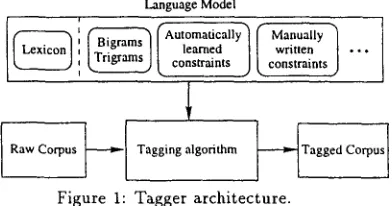
We present in this paper a hybrid approach that puts together both trends in a u t o m a t i c approach and the linguistic approach. We describe a POS tag- ger based on the work described in (Padr6, 1996), that is able to use b i / t r i g r a m information, auto- matically learned context constraints and linguisti- cally motivated manually written constraints. The sources and kinds of constraints are unrestricted, and the language model can be easily extended. The structure of the tagger is presented in figure 1.
Language Model
. I~:.i:;:;~: I / le~ed | t wri.e. | ...
l
i.wco us
Figure h Tagger architecture.
Corpus
We also present a constraint-acquisition algo- rithm that uses statistical decision trees to learn con- text constraints from annotated corpora and we use the acquired constraints to feed the POS tagger.
The paper is organized as follows. In section 2 we describe our language model, in section 3 we describe the constraint acquisition algorithm, and in section 4 we expose the tagging algorithm. Descriptions of the corpus used, the experiments performed and the results obtained can be found in sections 5 and 6. 2 L a n g u a g e M o d e l
We will use a hybrid language model consisting of an automatically acquired part and a linguist-written part.
[image:1.612.334.530.401.504.2]T h e a u t o m a t i c a l l y acquired part is divided in two kinds of information: on the one hand, we have bi- grams and trigrams collected from the a n n o t a t e d training corpus (see section 5 for details). On the other hand, we have context constraints learned from the same training corpus using statistical deci- sion trees, as described in section 3.
T h e linguistic part is very small - - s i n c e there were no available resources to develop it f u r t h e r - - and covers only very few cases, but it is included to il- lustrate the flexibility of the algorithm.
A sample rule of the linguistic part:
i 0 . 0
(XvauxiliarY.)
(-[VBN IN , : J J JJS J J R ] ) +
<VBN> ;
This rule states that a tag
past participle
( V B N ) is very compatible (10.0) with a left context consisting of a % v a u x i l i a r % (previously defined macro which includes all forms of "have" and "be") provided t h a t all the words in between d o n ' t have any of the tags in the set [ V B N I N , : J J J J S J J R ] . T h a t is, this rule raises the support for the tagpast partici-
ple
when there is an auxiliary verb to the left but only if there is not another candidate to be a past participle or an adjective inbetween. T h e tags [ I N , :] prevent the rule from being applied when the auxiliary verb and the participle are in two different phrases (a c o m m a , a colon or a preposition are con- sidered to mark the beginning of another phrase).T h e constraint language is able to express the same kind of patterns than the Constraint G r a m - m a r formalism (Karlsson et al., 1995), although in a different formalism. In addition, each constraint has a compatibility value that indicates its strength. In the middle run, the system will be adapted to accept
C G s .
3 C o n s t r a i n t A c q u i s i t i o n
Choosing, from a set of possible tags, the proper syn- tactic tag for a word in a particular context can be seen as a problem of classification. Decision trees, recently used in NLP basic tasks such as tagging and parsing (McCarthy and Lehnert, 1995: Daele- mans et al., 1996; Magerman, 1996), are suitable for performing this task.
A decision tree is a n - a r y branching tree that rep- resents a
classification rule
for classifying theobjects
of a certain domain into a set of mutually exclusiveclasses.
T h e domain objects are described as a set of a t t r i b u t e - v a l u e pairs, where eachattribute
mea- sures a relevant feature of an object taking a (ideally small) set of discrete, mutually incompatiblevalues.
Each n o n - t e r m i n a l node of a decision tree represents a question on (usually) one attribute. For each possi- ble value of this attribute there is a branch to follow. Leaf nodes represent concrete classes.Classify a new object with a decision tree is simply following the convenient path t h r o u g h the tree until a leaf is reached.
Statistical
decision trees only differs from c o m m o n decision trees in that leaf nodes define a conditional probability distribution on the set of classes.It is i m p o r t a n t to note that decision trees can be directly translated to rules considering, for each path from the root to a leaf, the conjunction of all ques- tions involved in this path as a condition and the class assigned to the leaf as the consequence. Statis- tical decision trees would generate rules in the same manner but assigning a certain degree of probability to each answer.
So the learning process of contextual constraints is performed by means of learning one statistical de- cision tree for each class of POS ambiguity -~ and con- verting them to constraints (rules) expressing com- patibility/incompatibility of concrete tags in certain contexts.
L e a r n i n g A l g o r i t h m
T h e algorithm we used for constructing the statisti- cal decision trees is a n o n - i n c r e m e n t a l supervised learning-from-examples algorithm of the T D I D T (Top Down Induction of Decision Trees) family. It constructs the trees in a t o p - d o w n way, guided by the distributional information of the examples, but not on the examples order (Quinlan, 1986). Briefly. the algorithm works as a recursive process that de- parts from considering the whole set of examples at the root level and constructs the tree i n a t o p - d o w n way branching at any n o n - t e r m i n a l node according to a certain
selected
attribute. T h e different val- ues of this attribute induce a partition of the set of examples in the corresponding subsets, in which the process is applied recursively in order to gener- ate the different subtrees. The recursion ends, in a certain node, either when all (or almost all) the re- maining examples belong to the same class, or when the number of examples is too small. These nodes are the leafs of the tree and contain the conditional probability distribution, of its associated subset, of examples, on the possible classes.T h e heuristic function for selecting the most useful attribute at each step is of a cru- cial importance in order to obtain simple trees, since no backtracking is performed. There ex- ist two main families of attribute-selecting func- tions:
information-based
(Quinlan, 1986: Ldpez, 1991) andstatistically--based
(Breiman et al., 1984; Mingers, 1989).Training Set
For each class of POS ambiguity the initial exam- ple set is built by selecting from the training corpus
all the occurrences of the words belonging to this ambiguity class. More particularly, the set of at- tributes that describe each example consists of the part-of-speech tags of the neighbour words, and the information about the word itself (orthography and the proper tag in its context). The window consid- ered in the experiments reported in section 6 is 3 words to the left and 2 to the right. The follow- ing are two real examples from the training set for the words that can be preposition and adverb at the same time (IN-RB conflict).
VB DT NN <"as" ,IN> DT JJ NN IN NN <"once",RB> VBN TO
Approximately 9 0 % of this set of examples is used for the construction of the tree. T h e remaining 1 0 % is used as fresh test corpus for the pruning process. Attribute Selection Function
For the experiments reported in section 6 we used a attribute selection function due to L6pez de Minta- ras (L6pez. 1991), which belongs to the information- based family. Roughly speaking, it defines a distance measure between partitions and selects for branch- ing the attribute that generates the closest partition to the correc* partaion, namely the one that joins together all the examples of the same class.
Let X be aset of examples, C the set of classes and
P c ( X ) the partition of X according to the values of C. The selected attribute will be the one that gen- erates the closest partition of X to Pc(X). For that we need to define a distance measure between parti- tions. Let PA(X) be the partition of X induced by the values of attribute A. The average information of such partition is defined as follows:
I(PA(X))
=-
~ ,
p(X,a) log,.p(X,a),
aEPa(X)where p(X. a) is the probability for an element of X belonging to the set a which is the subset of X whose examples have a certain value for the attribute .4, and it is estimated bv the ratio ~ This average
• I X l '
information measure reflects the randomness of dis- tribution of the elements of X between the classes of the partition induced by .4.. If we consider now the intersection between two different partitions induced by attributes .4 and B we obtain
I ( P A ( X ) N
PB(X))=
- E Z
p(X. aMb) log,.p(X, aAb).
aEP.a(A'} bEPB;XI
Conditioned information of P B ( X ) given P A ( X ) iS
I ( P B ( X ) I P A ( X ) ) =
I( P A ( X ) M P s ( X ) ) - I ( P ~ ( X ) ) =
- Z
Z
p(X, nb) log, p(X'anb)
p ( X , a ) a ~ P a ( X ~, b E P B t X ~It is easy to show that the measure
d(Pa(.Y). PB(X)) =
[(Ps(X)iPA(X))
+ I ( P A ( X ) I P B ( X ) )is a distance. Normalizing we obtain
d ( P A ( X ) . P B ( , \ ' ) )
d.,v(Pa(X). PB(.V)) =
I ( P a ( X ) a P B ( X ) ) "
with values in [0,1].
So the selected attribute will be that one that min- imizes the measure: d.v(Pc(X), PA(X)).
Branching Strategy
Usual T D I D T algorithms consider a branch for each value of the selected attribute. This strategy is not feasible when the number of values is big (or even in- finite). In our case the greatest number of values for an attribute is 45 - - t h e tag set size-- which is con- siderably big (this means that the branching factor could be 45 at every level of the tree 3). Some s.vs- terns perform a previous recasting of the attributes in order to have only binary-valued attributes and to deal with binary trees (Magerman, 1996). This can always be done but the resulting features lose their intuition and direct interpretation, and explode in number. We have chosen a mixed approach which consist of splitting for all values and afterwards join- ing the resulting subsets into groups for which we have not enough statistical evidence of being differ- ent distributions. This statistical evidence is tested with a X ~" test at a 5% level of significance. In order to avoid zero probabilities the following smoothing is performed. In a certain set of examples, the prob- ability of a tag ti is estimated by
I~,l+-~ ri(4) = ,+~
where m is the number of possible tags and n the number of examples.
Additionally. all the subsets that don't imply a reduction in the classification error are joined to- gether in order to have a bigger set of examples to be treated in the following step of the tree construc- tion. The classification error of a certain node is simply: I - maxt<i<m (t)(ti)).
Experiments reported in (.\I&rquez
and Rodriguez. 1995) show that in this way more compact and predictive trees are obtained.
Pruning the Tree
Decision trees that correctly classify all examples of the training set are not always the most predictive ones. This is due to the phenomenon known as o,'er- fitting. It occurs when the training set has a certain amount of misclassified examples, which is obviously the case of our training corpus (see section 5). If we
3In real cases the branching factor is much lower since not all tags appear always in all positions of the context.
force the learning algorithm to completely classify the examples then the resulting trees would fit also the noisy examples.
The usual solutions to this problem are: l) Prune the tree. either during the construction process (Quinlan. 1993) or afterwards (Mingers, 1989); 2) Smooth the conditional probability distributions us- ing fresh corpus a (Magerman, 1996).
Since another important, requirement of our prob- lem is to have small trees we have implemented a post-pruning technique. In a first step the tree is completely expanded and afterwards it is pruned following a minimal cost-complexity crite- rion (Breiman et al.. 1984). Roughly speaking this is a process that iteratively cut those subtrees pro- ducing only marginal benefits in accuracy, o b t a i n i n g smaller trees at each step. The trees of this sequence are tested using a, comparatively small, fresh part of the training set in order to decide which is the one with the highest degree of accuracy on new exam- ples. Experimental tests (M&rquez and Rodriguez, 1995) have shown that the pruning process reduces tree sizes at about 50% and improves their accuracy in a 2-5%.
An Ezample
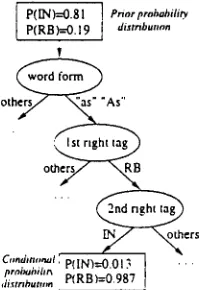
Finally, we present a real example of the simple ac- quired contextual constraints for the conflict I N - R B (preposition-adverb).
P(IN)=0.$1 ] Pnorprobability P(RB)=0.19 [ di~tnbunon
T
... ~ d n g h l m ~ g er s
U-"<
C,,.dm,,.wl: P ( I N ) = 0 . 0 1 3 ' ' 'probuiJilm
di.~tnbut.m P~RB~0.987
Figure 2: Example of a decision tree branch,
The tree branch in figure 2 is translated into the following constraints:
- 5 . 8 1 <["as . . . . As"],IN> ([RB'I) ([IN]); 2 . 3 6 6 <["as .... As"],RS> ([RB]) ([IN]); which express the compatibility
(either
positive or negative) of the word-tag pair in angle brackets with the given context. The compatibility value for each constraint is the mutual information between the tag and the context (Cover and Thomas, 1991). It is directly" computed from the probabilities in the tree.~Of course, this can be done only in the case of sta- tistical decision trees.
4 T a g g i n g A l g o r i t h m
Usual tagging algorithms are either n - g r a m oriented -such as Viterbi algorithm (Viterbi. 1967)- or a d - hoc for every case when they must deal with more complex information.
We use relaxation labelling as a tagging algorithm. Relaxation labelling is a generic name for a family of iterative algorithms which perform function opti- mization, based on local information. See (Torras. 1989) for a summary. Its most remarkable feature is that it can deal with any kind of constraints, thus the model can be improved by adding any constraints available and it makes the tagging algorithm inde- pendent of the complexity of the model.
The algorithm has been applied to part-of-speech tagging (Padr6, 1996), and to shallow parsing (Voutilainen and Padro. 1997).
T h e algorithm is described as follows:
Let. V = {Vl.t'2 . . . v,} be a set of variables (words).
Let
ti = {t].t~ . . . t~,}
be the set of possible labels (POS tags) for variablevi.
Let
C S
be a set of constraints between the labels of the variables. Each constraintC E C S
states a "compatibility value" C, for a combination of pairs variable-label. Any number of variables m a y be in- volved in a constraint.The aim of the algorithm is to find a weighted labelling 5 such that "global consistency" is maxi- mized. Maximizing "global consistency" is defined i is as maximizing for all
vi, ~ i P} x Sii,
where pj the weight for label j in variable vi andSij
the sup- port received by the same combination. The support for the pair variable-label expresseshow compatible
that pair is with the labels of neighbouring variables. according to the constraint set. It is a vector opti- mization and doesn't maximizeonly
the sum of the supports of all variables. It finds a weighted labelling such that any other choice wouldn't increase the sup- port forany
variable.The support is defined as the sum of the influence of every constraint on a label.
c..
Z
I n f ( r )
r 6 R , jwhere:
l~ij
is the set of constraints on label j for variable i, i.e. the constraints formed by any combination of variable-label pairs that includes the pair(ci. t i ).
I n f ( r ) = C, x p~'t,"n)
x ... x ,v~(m).. . is the prod- uct of the current weights ~ for the labels appearing5A weighted labelling is a weight assignment for each label of each variable such that the weights for the labels of the same variable add up to one.
[image:4.612.130.237.361.506.2]in the constraint except
(vi,t})
(representinghow
applicable
the constraint is in the current context) multiplied by Cr which is the constraint compatibil- ity value (statinghow compatible
the pair is with the context).Briefly, what the algorithm does is:
i. Start with a random weight assignment r. 2. C o m p u t e the support value for each label of
each variable.
3. Increase the weights of the labels more compat- ible with the context (support greater than 0) and decrease those of the less compatible labels (support less than 0) s, using the updating func- tion:
i(m + 1) =
p~(m) × (1 + s~j)
PJ
I~,
Zp~(m )
x (i + Sit:)k=l
where - l < S i j <_+1
4. If a stopping/convergence criterion 9 is satisfied, stop, otherwise go to step 2.
The cost of the algorithm is proportional to the product of the number of words by the number of constraints.
5 D e s c r i p t i o n o f t h e c o r p u s
We used the Wall Street Journal corpus to train and test the system. We divided it in three parts: 1,100 Kw were used as a training set, 20 Kw as a m o d e l - tuning set, and 50 Kw as a test set.
The tag set size is 45 tags. 36.4% of the words in the corpus are ambiguous, and the ambiguity ratio is 2.44 tags/word over the ambiguous words, 1.52 overall.
We used a lexicon derived from training corpora, that contains all possible tags for a word, as well as their lexical probabilities. For the words in test corpora not appearing in the train set, we stored all possible tags, but no lexical probability (i.e. we assume uniform distribution) l°.
The noise in the lexicon was filtered by manually checking the lexicon entries for the most frequent 200 words in the corpus 11 to eliminate the tags due to errors in the training set. For instance the original
ZWe use lexical probabilities as a starting point. SNegative values for support indicate
incompatibility.
9We use the criterion of stopping when there are no more changes, although more sophisticated heuristic pro- cedures are also used to stop relaxation processes (Ek- lundh and Rosenfeld, 1978; Richards et hi. , 1981).1°That is, we assumed a morphological analyzer that provides all possible tags for unknown words.
l~The 200 most frequent words in the corpus cover over half of it.
lexicon entry (numbers indicate frequencies in the training corpus) for the very c o m m o n word
the was
~he CD i DT 47715 JJ 7 NN I NNP 6 VBP 1
since it appears in the corpus with the six differ- ent tags: CD (cardinal), DT (determiner), JJ (ad- jective), NN (noun). NNP (proper noun) and VBP (verb-personal form). It is obvious that the only correct reading for
the
is determiner.The training set was used to estimate b i / t r i g r a m statistics and to perform the constraint learning.
The model-tuning set was used to tune the algo- rithm parameterizations, and to write the linguistic part of the model.
The resulting models were tested in the fresh test set.
6 E x p e r i m e n t s a n d r e s u l t s
The whole WSJ corpus contains 241 different classes of ambiguity. The 40 most representative classes t-" were selected for acquiring the corresponding deci- sion trees. T h a t produced 40 trees totaling up to 2995 leaf nodes, and covering 83.95% of the ambigu- ous words. Given that each tree branch produces as m a n y constraints as tags its leaf involves, these trees were translated into 8473 context constraints.
We also extracted the 1404 bigram restrictions and the 17387 trigram restrictions appearing in the training corpus.
Finally, the model-tuning set was tagged using a bigram model. The most c o m m o n errors com- mited by the bigram tagger were selected for manu- ally writing the sample linguistic part of the model, consisting of a set of 20 hand-written constraints.
From now on C will stands for the set of acquired context constraints. B for the bigram model, T for th.e trigram model, and H for the hand-written con- straints. Any combination of these letters will indi- cate the joining of the corresponding models ( B T , B C , B T C , etc.).
In addition, M L indicates a baseline model con- raining no constraints (this will result in a most- likely tagger) and H M M stands for a hidden Markov model bigram tagger (Elworthy, 1992).
We tested the tagger on the 50 Kw test set using all the combinations of the language models. Results are reported below.
The effect of the acquired rules on the number of errors for some of the most common cases is shown in table 1. XX/Y'Y stands for an error consisting of a word tagged ~t%_" when it should have been XX. Table 2 contains the meaning of all the involved tags. Figures in table 1 show that in all cases the learned constraints led to an improvement.
It is remarkable that when using C alone, the number of errors is lower than with any bigram
12In terms of number of examples.
J J / N N + N N / J J
VBD/VBN+VBN/VBD
I N / R B + R B / I N V B / V B P + V B P / V B N N / N N P + N N P / N N N N P / N N P S + N N P S / N N P"'that" 187
Total
ML C B
73+137 70+94 73+112
176+190 71+66 88+69
31+132 40+69 66+107
128+147 30+26 49+43
70+11 44+12 72+17
45+14 37+19 45+13
53 66
BC 69+102 63+56 43+17
32+27 45+16 46+15 45
T I TC
57+103 [ 61+95
56+57 55+57
77+68 47+67
31+32 32+18 69+27 50+18 54+12 51+12
60 I 40
B T [ BTC 67+101 t 62+93
65+60 59+61
65+98 46-z-83 28+32 ') .8,--3. ' ' '}
71+20 62+t.5
53+14 51+14
57 . 45
1341
it
631II
82°1 630II
7o3!603
731
~s51 iTable 1: Number of some common errors commited by each model
NN JJ VBD VBN RB IN VB V B P NNP NNPS
Noun [ I ambiguous
Adjective B 91.35%
Verb - past. tense T 91.82%
'verb - past participle BT 91.92%
Adverb
Preposition B C 91.96%
Verb - base form C 92.72%
Verb - personal form T C 92.82%
Proper noun B T C 92.55%
Plural proper noun Table 4: Results of our
Table 2: Tag meanings of constraint kinds
a n d / o r trigram model, that is, the acquired model performs better than the others estimated from the same training corpus.
We also find that the cooperation of a bigram or t r i g r a m model with the acquired one, produces even better results. This is not true in the cooperation of bigrams and trigrams with acquired constraints ( B T C ) , in this case the synergy is not enough to get a better joint result. This might be due to the fact t h a t the noise in B and T adds up and overwhelms the context constraints.
T h e results obtained by the baseline taggers can be found in table 3 and the results obtained using all the learned constraints together with the b i / t r i g r a m models in table 4.
] ambiguous I overall
ML [ 8 5 . 3 1 % 1 9 4 . 6 6 %
HMM 91.75% 97.00%
Table 3: Results of the baseline taggers
On the one hand. the results in tables 3 and 4 show t h a t our tagger performs slightly worse than a HMM tagger in the same conditions 13, that is, when using only bigram information.
13Hand analysis of the errors commited by the algo- rithm suggest that the worse results may be due to noise in the training and test corpora, i.e., relaxation algo- rithm seems to be more noise-sensitive than a Markov model. Further research is required on this point.
overall 96.86% 97.03% 97.06%
97.08% 97.36% 97.39% 97.29%
tagger using every combination
On the other hand, those results also show that since our tagger is more flexible t h a n a HMM, it can easily accept more complex information to improve its results up to 97.39% without modifying the algo- rithm.
I I ambigu°us
H 86.41%
BH 91.88%
T H 92.04%
B T H 92.32%
CH 91.97%
B C H 92.76% T C H 92.98% B T C H 92.71%
overall 95.06% 97.05% 97.11% 97.21% 97.08% 97.37% 97.45% 97.35%
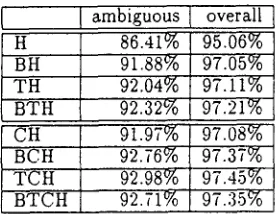
Table .5: Results of our tagger using every combination of constraint kinds and hand written constraints
Table 5 shows the results adding the hand written constraints. The hand written set is very small and only covers a few common error cases. T h a t pro- duces poor results when using t h e m alone (H). but they are good enough to raise the results given by the automatically acquired models up to 97.-15%.
Although the improvement obtained might seem small, it must be taken into .account that we are moving very close to the best achievable result with these techniques.
[image:6.612.75.523.49.144.2] [image:6.612.113.250.177.290.2] [image:6.612.348.483.178.277.2] [image:6.612.347.486.381.488.2]main office, or a noun, meaning the school head of-
rice,
Second, the WSJ corpus contains noise (mistagged words) that affects both the training and the test sets. The noise in the training set produces noisy -and so less precise- models. In the test set, it pro- duces a wrong estimation of accuracy, since correct answers are computed as wrong and vice-versa.
For instance, verb participle forms are sometimes tagged as such (VBIV) and also as adjectives ( J J) in other sentences with no structural differences:
• . . . failing_VBG ~o_TO voluntarily_KB
s u b m i t _ V B t h e _ D T
reques~ed_VBN
i n f o r m a % i o n . N N . . .
• . . . a_DT large_JJ sample_NN of_IN
married_JJ women_NNS with_IN at_II~
l e a s t _ J J S one_CD child..gN . . .
Another structure not coherently tagged are noun chains when the nouns are ambiguous and can be • also adjectives:
• . . . Mr._NNP Hahn_NNP ,_, the_DT
6 2 - y e a r - o l d _ J J c h a i r m a n _ N N a n d _ C C
chief_NN executive_JJ officer_NN of_IN
G e o r g i a - P a c i f i c _ ~ N P Corp._NNP . . .
• . . . Burger_NgP King_~NP
's_POS chief_JJ ezecutive_NN officer_NN ,_,
Barry_NNP Gibbons_NNP ,_, stars_VBZ i n l N ads_NNS saying_VBG . . .
• ... and_CC Barrett_NNP B._NNP
W e e k e s _ N N P ,_, c h a i r m a ~ t - N N ,_,
p r e s i d e n t _ N N a n d _ C C
chief_JJ
ezecutive_JJ
officer_NN . _.
• ... the_DT compaay_NN includes_VBZ
NeiI_NNP D a v e n p o r t _ N N P ,_, 47_CD ,_, p r e s i d e n t _ N N and_CC chief_NN ezecu~ive_NN
officer_NN ;_:
All this makes that the performance cannot reach 100%, and that an accurate analysis of the noise in WS3 corpus should be performed to estimate the actual upper bound that a tagger can achieve on these data. This issue will be addressed in further work.
7 C o n c l u s i o n s
We have presented an automatic constraint learning algorithm based on statistical decision trees.
We have used the acquired constraints in a p a r t - of-speech tagger that allows combining any kind of constraints in the language model.
The results obtained show a clear improvement in the performance when the automatically acquired constraints are added to the model. That indicates that relaxation labelling is a flexible algorithm able to combine properly different information kinds, and
that the constraints acquired by the learning algo- rithm capture relevant context information that was not included in the n-gram models.
It is difficult to compare the results to other works, since the accuracy varies greatly depending on the corpus, the tag set, and the lexicon or morphological analyzer used. The more similar conditions reported in previous work are those experiments performed on the WSJ corpus: (Brill, 1992) reports 3-4% er- ror rate, and (Daelemans et al., 1996) report 96.7% accuracy. We obtained a 97.39% accuracy with tri- grams plus automatically acquired constraints, and 97.45% when hand written constraints were added.
8 F u r t h e r W o r k
Further work is still to be done in the following di- rections:
• Perform a thorough analysis of the noise in the WSJ corpus to determine a realistic upper • bound for the performance that can be expected
from a POS tagger.
On the constraint learning algorithm:
• Consider more complex context features, such as non-limited distance or barrier rules in the style of (Samuelsson et al., 1996).
• Take into account morphological, semantic and other kinds of information.
• Perform a global smoothing to deal with low- frequency ambiguity classes.
On the tagging algorithms
• Study the convergence properties of the algo- rithm to decide whether the lower results at convergence are produced by the noise in the corpus.
• Use back-off techniques to minimize inter- ferences between statistical and learned con- straints.
• Use the algorithm to perform simultaneously POS tagging and word sense disambiguation, to take advantage of cross influences between both kinds of information.
R e f e r e n c e s
D.W. Aha, D. Kibler and M. Albert. 1991 Instance- based learning algorithms. In Machine Learning.
7:37-66. Belmont, California.
L. Breiman, J.H. Friedman, R.A. Olshen and C.J. Stone. 1984 Classification and Regression Trees. The Wadsworth Statistics/Probability Se- ries. Wadsworth International Group, Behnont, California.
E. Brill. 1992 A Simple Rule-Based Part-of-Speech. In
Proceedings of the Third Conference on Applied
Natural Language Processing.
ACL.E. Brill. 1995 Unsupervised Learning of Disam- biguation Rules for Part-of-speech Tagging. In
Proceedings of 3rd Workshop on Very Large Cor-
pora.
Massachusetts.T.M. Cover and J.A. Thomas (Editors) 1991 Ele- ments of information theory. John Wiley & Sons. D. Cutting, J. Kupiec, J. Pederson and P. Sibun. 1992 A Practical Part-of-Speech Tagger. In
Pro-
ceedings of the Third Conference on Applied Nat-
ural Language Processing.,
ACL.J. Eklundh and A. Rosenfeld. 1978 Convergence Properties of Relaxation Labelling. Technical Re- port no. 701. Computer Science Center. Univer- sity of Maryland.
D. Elworthy. 1993 Part-of-Speech and Phrasal Tagging. Technical report, SPRIT BRA-7315 Ac- quilex II, Working Paper WP #10.
W. Daelemans, J. Zavrel, P. Berck and S. Gillis. 1996 MTB: A Memory-Based Part-of-Speech Tagger Generator. In
Proceedings of ~th Work-
shop on Very Large Corpora.
Copenhagen, Den- mark.R. Garside, G. Leech and G. Sampson (Editors) 1987
The Computational Analysis of English.
London and New York: Longman.D. Hindle. 1989 Acquiring disambiguation rules from text. In
Proceedings ACL'89.
F. Karlsson 1990 Constraint Grammar as a Frame- work for Parsing Running Text. In H. Karlgren (ed.),
Papers presented to the 13th International
Conference on Computational Linguistics, Vol. 3.
Helsinki. 168-173.F. Karlsson, A. Voutilainen, J. Heikkil~ and A. Anttila. (Editors) 1995
Constraint Grammar:
A Language-Independent System for Parsing Un-
restricted
Tezt. Mouton de Gruyter, Berlin and New York.R. L6pez. 1991 A Distance-Based Attribute Selec- tion Measure for Decision Tree Induction. Ma- chine Learning. Kluwer Academic.
R.M. Losee. 1994 Learning Syntactic Rules and Tags with Genetic Algorithms for Information Retrieval and Filtering: An Empirical Basis for Grammatical Rules. Information Processing & Management, May.
M. Magerman. 1996 Learning Grammatical Struc- ture Using Statistical Decision-Trees. In
Lecture
Notes in Artificial Intelligence 11~7. Grammatical
Inference: Learning Syntax from Sentences.
Pro- ceedings ICGI-96. Springer.L. M£rquez and H. Rodriguez. 1995 Towards Learn- ing a Constraint Grammar from Annotated Cor- pora Using Decision Trees. ESPRIT BRA-7315 Acquilex II, Working Paper.
J.F. McCarthy and W.G. Lehnert. 1995 Using De- cision Trees for Coreference Resolution. In
Pro-
ceedings of l~th International Joint Conference on
Artificial Intelligence (IJCAI'95).
J. Mingers. 1989 An Empirical Comparison of Se- lection Measures for Decision-Tree Induction. In
Machine Learning.
3:319-342.J. Mingers. 1989 An Empirical Comparison of Prun- ing Methods for Decision-Tree Induction. In
Ma-
chine Learning.
4:227-243.L. Padr6. 1996 POS Tagging Using Relaxation Labelling. In
Proceedings of 16th International
Conference on Computational Linguistics.
Copen- hagen, Denmark.J.R. Quinlan. 1986 Induction of Decision Trees. In
Machine Learning.
1:81-106.J.R. Quinlan. 1993 C4.5: Programs for Machine Learning. San Mateo, CA. Morgan Kaufmann. 3. Richards, D. Landgrebe and P. Swain. 1981 On
the accuracy of pixel relaxation labelling.
IEEE
Transactions on System, Man and Cybernetics.
Vol. SMC-11C. Samuelsson, P. Tapanainen and A. Voutilainen. 1996 Inducing Constraint Grammars. In
Pro-
ceedings of the 3rd International Colloquium on
Grammatical Inference.
H. Schmid 1994 Part-of-speech tagging with neu- ral networks. In
Proceedings of 15th International
Conference on Computational Linguistics.
Kyoto, Japan.C. Torras. 1989 Relaxation and Neural Learning: Points of Convergence and Divergence.
Journal
of Parallel and Distributed Computing.
6:217-244 A.J. Viterbi. 1967 Error bounds for convolutionalcodes and an asymptotically optimal decoding al- gorithm. In
IEEE Transactions on Information
Theory.
pg 260-269, April.A. Voutilainen and T. J~rvinen. 1995 Specifying a shallow grammatical representation for parsing purposes. In
Proceedings of the 7th meeting of the
European Association for Computational Linguis-
tics.
210-214.