Convolution Kernels with Feature Selection
for Natural Language Processing Tasks
Jun Suzuki, Hideki Isozaki and Eisaku Maeda
NTT Communication Science Laboratories, NTT Corp. 2-4 Hikaridai, Seika-cho, Soraku-gun, Kyoto,619-0237 Japan
{jun, isozaki, maeda}@cslab.kecl.ntt.co.jp
Abstract
Convolution kernels, such as sequence and tree ker-nels, are advantageous for both the concept and ac-curacy of many natural language processing (NLP) tasks. Experiments have, however, shown that the over-fitting problem often arises when these ker-nels are used in NLP tasks. This paper discusses this issue of convolution kernels, and then proposes a new approach based on statistical feature selec-tion that avoids this issue. To enable the proposed method to be executed efficiently, it is embedded into an original kernel calculation process by using sub-structure mining algorithms. Experiments are undertaken on real NLP tasks to confirm the prob-lem with a conventional method and to compare its performance with that of the proposed method.
1 Introduction
Over the past few years, many machine learn-ing methods have been successfully applied to tasks in natural language processing (NLP). Espe-cially, state-of-the-art performance can be achieved with kernel methods, such as Support Vector Machine (Cortes and Vapnik, 1995). Exam-ples include text categorization (Joachims, 1998), chunking (Kudo and Matsumoto, 2002) and pars-ing (Collins and Duffy, 2001).
Another feature of this kernel methodology is that it not only provides high accuracy but also allows us to design a kernel function suited to modeling the task at hand. Since natural language data take the form of sequences of words, and are generally ana-lyzed using discrete structures, such as trees (parsed trees) and graphs (relational graphs), discrete ker-nels, such as sequence kernels (Lodhi et al., 2002), tree kernels (Collins and Duffy, 2001), and graph kernels (Suzuki et al., 2003a), have been shown to offer excellent results.
These discrete kernels are related to convolution kernels (Haussler, 1999), which provides the con-cept of kernels over discrete structures. Convolution kernels allow us to treat structural features without
explicitly representing the feature vectors from the input object. That is, convolution kernels are well suited to NLP tasks in terms of both accuracy and concept.
Unfortunately, experiments have shown that in some cases there is a critical issue with convolution kernels, especially in NLP tasks (Collins and Duffy, 2001; Cancedda et al., 2003; Suzuki et al., 2003b). That is, the over-fitting problem arises if large “sub-structures” are used in the kernel calculations. As a result, the machine learning approach can never be trained efficiently.
To solve this issue, we generally eliminate large sub-structures from the set of features used. How-ever, the main reason for using convolution kernels is that we aim to use structural features easily and efficiently. If use is limited to only very small struc-tures, it negates the advantages of using convolution kernels.
This paper discusses this issue of convolution kernels, and proposes a new method based on statis-tical feature selection. The proposed method deals only with those features that are statistically signif-icant for kernel calculation, large signifsignif-icant sub-structures can be used without over-fitting. More-over, the proposed method can be executed effi-ciently by embedding it in an original kernel cculation process by using sub-structure mining al-gorithms.
results described in Section 7 clarify the advantages of the proposed method.
2 Convolution Kernels
Convolution kernels have been proposed as a con-cept of kernels for discrete structures, such as se-quences, trees and graphs. This framework defines the kernel function between input objects as the con-volution of “sub-kernels”, i.e. the kernels for the decompositions (parts) of the objects.
LetX andY be discrete objects. Conceptually,
convolution kernels K(X, Y) enumerate all
sub-structures occurring inXandY and then calculate
their inner product, which is simply written as:
K(X, Y) =hφ(X), φ(Y)i=X i
φi(X)·φi(Y). (1)
φ represents the feature mapping from the
discrete object to the feature space; that is,
φ(X) = (φ1(X), . . . , φi(X), . . .).With sequence
kernels (Lodhi et al., 2002), input objectsXandY
are sequences, andφi(X) is a sub-sequence. With
tree kernels (Collins and Duffy, 2001),XandY are
trees, andφi(X)is a sub-tree.
When implemented, these kernels can be effi-ciently calculated in quadratic time by using dy-namic programming (DP).
Finally, since the size of the input objects is not constant, the kernel value is normalized using the following equation.
ˆ
K(X, Y) =p K(X, Y)
K(X, X)·K(Y, Y) (2)
The value ofKˆ(X, Y)is from 0 to 1,Kˆ(X, Y) = 1
if and only ifX=Y.
2.1 Sequence Kernels
To simplify the discussion, we restrict ourselves hereafter to sequence kernels. Other convolution kernels are briefly addressed in Section 5.
Many kinds of sequence kernels have been pro-posed for a variety of different tasks. This paper basically follows the framework of word sequence kernels (Cancedda et al., 2003), and so processes gapped word sequences to yield the kernel value.
LetΣbe a set of finite symbols, andΣnbe a set
of possible (symbol) sequences whose sizes are n
or less that are constructed by symbols inΣ. The
meaning of “size” in this paper is the number of symbols in the sub-structure. Namely, in the case of
sequence, sizenmeans lengthn. SandT can
rep-resent any sequence. siandtj represent theith and
jth symbols inS andT, respectively. Therefore, a
S
T 12 1 11+λ2
λ
λ1 λ λ1
1 11
a, b, c, aa, ab, ac, ba, bc, aba, aac, abc, bac, abac abc
S=
abac T=
p r o d .
1 0 1 0
1
0 0
1
0
2 1 1 0 1λ λ3
+ 0 λ 0 0 λ 0
( a, b, c, ab, ac, bc, abc)
( a, b, c, aa, ab, ac, ba, bc, aba, aac, abc, bac, abac)
u
3 5 3+ +λ λ
k e r n e l v al u e λ
s e q u e n ce s s u b-s e q u e n ce s
1 0
[image:2.595.322.531.76.176.2]0
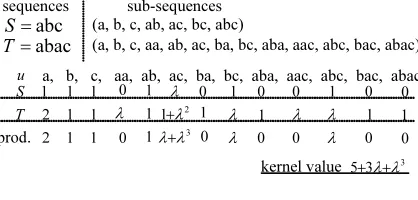
Figure 1: Example of sequence kernel output
sequenceS can be written asS =s1. . . si. . . s|S|,
where|S|represents the length of S. If sequence
uis contained in sub-sequenceS[i:j]def= si. . . sj
ofS (allowing the existence of gaps), the position
ofuinS is written asi = (i1 : i|u|). The length
of S[i] is l(i) = i|u| −i1 + 1. For example, if
u = ab and S = cacbd, then i = (2 : 4) and
l(i) = 4−2 + 1 = 3.
By using the above notations, sequence kernels can be defined as:
KSK(S, T) = X
u∈Σn
X
i|u=S[i]
λγ(i) X
j|u=T[j]
λγ(j), (3)
where λ is the decay factor that handles the gap
present in a common sub-sequence u, andγ(i) =
l(i)−|u|. In this paper,|means “such that”. Figure 1
shows a simple example of the output of this kernel.
However, in general, the number of features|Σn|,
which is the dimension of the feature space, be-comes very high, and it is computationally infeasi-ble to calculate Equation (3) explicitly. The efficient recursive calculation has been introduced in (Can-cedda et al., 2003). To clarify the discussion, we redefine the sequence kernels with our notation.
The sequence kernel can be written as follows:
KSK(S, T) =
n X
m=1
X
1≤i≤|S|
X
1≤j≤|T|
Jm(Si, Tj). (4)
whereSi andTj represent the sub-sequencesSi =
s1, s2, . . . , si andTj =t1, t2, . . . , tj, respectively. Let Jm(Si, Tj) be a function that returns the
value of common sub-sequences ifsi =tj.
Jm(Si, Tj) =Jm0 −1(Si, Tj)·I(si, tj) (5)
I(si, tj) is a function that returns a matching
value betweensiandtj. This paper definesI(si, tj)
as an indicator function that returns 1 ifsi=tj,
Then,Jm0 (Si, Tj) andJm00(Si, Tj) are introduced
to calculate the common gapped sub-sequences
be-tweenSiandTj.
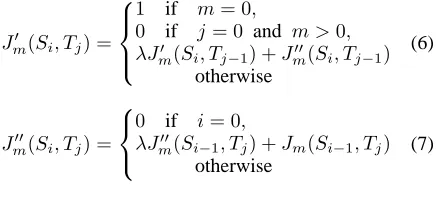
Jm0 (Si, Tj) =
1 if m= 0,
0 if j= 0 and m >0, λJm0 (Si, Tj−1) +Jm00(Si, Tj−1)
otherwise
(6)
Jm00(Si, Tj) =
0 if i= 0,
λJm00(Si−1, Tj) +Jm(Si−1, Tj)
otherwise
(7)
If we calculate Equations (5) to (7) recursively, Equation (4) provides exactly the same value as Equation (3).
3 Problem of Applying Convolution Kernels to NLP tasks
This section discusses an issue that arises when ap-plying convolution kernels to NLP tasks.
According to the original definition of convolu-tion kernels, all the sub-structures are enumerated and calculated for the kernels. The number of sub-structures in the input object usually becomes ex-ponential against input object size. As a result, all
kernel valuesKˆ(X, Y)are nearly 0 except the
ker-nel value of the object itself,Kˆ(X, X), which is 1.
In this situation, the machine learning process be-comes almost the same as memory-based learning. This means that we obtain a result that is very pre-cise but with very low recall.
To avoid this, most conventional methods use an approach that involves smoothing the kernel values or eliminating features based on the sub-structure size.
For sequence kernels, (Cancedda et al., 2003) use a feature elimination method based on the size of
sub-sequencen. This means that the kernel
calcula-tion deals only with those sub-sequences whose size
is n or less. For tree kernels, (Collins and Duffy,
2001) proposed a method that restricts the features based on sub-trees depth. These methods seem to work well on the surface, however, good results are
achieved only whennis very small, i.e.n= 2.
The main reason for using convolution kernels is that they allow us to employ structural features simply and efficiently. When only small sized
sub-structures are used (i.e. n= 2), the full benefits of
convolution kernels are missed.
[image:3.595.80.298.129.228.2]Moreover, these results do not mean that larger sized sub-structures are not useful. In some cases we already know that larger sub-structures are sig-nificant features as regards solving the target prob-lem. That is, these significant larger sub-structures,
Table 1: Contingency table and notation for the chi-squared value
c c¯ Prow
u Ouc=y Ou¯c Ou =x
¯
u Ouc¯ Ou¯¯c Ou¯
P
column Oc =M O¯c N
which the conventional methods cannot deal with efficiently, should have a possibility of improving the performance furthermore.
The aim of the work described in this paper is to be able to use any significant sub-structure effi-ciently, regardless of its size, to solve NLP tasks.
4 Proposed Feature Selection Method
Our approach is based on statistical feature selection in contrast to the conventional methods, which use sub-structure size.
For a better understanding, consider the two-class (positive and negative) supervised two- classifica-tion problem. In our approach we test the statisti-cal deviation of all the sub-structures in the training samples between the appearance of positive samples and negative samples. This allows us to select only the statistically significant sub-structures when cal-culating the kernel value.
Our approach, which uses a statistical metric to select features, is quite natural. We note, however, that kernels are calculated using the DP algorithm. Therefore, it is not clear how to calculate kernels ef-ficiently with a statistical feature selection method. First, we briefly explain a statistical metric, the
chi-squared (χ2) value, and provide an idea of how
to select significant features. We then describe a method for embedding statistical feature selection into kernel calculation.
4.1 Statistical Metric: Chi-squared Value
There are many kinds of statistical metrics, such as chi-squared value, correlation coefficient and mu-tual information. (Rogati and Yang, 2002) reported that chi-squared feature selection is the most effec-tive method for text classification. Following this
information, we use χ2 values as statistical feature
selection criteria. Although we selected χ2 values,
any other statistical metric can be used as long as it is based on the contingency table shown in Table 1.
We briefly explain how to calculate theχ2 value
by referring to Table 1. In the table, c andc¯
S T
1 2
1
11+λ2
λ λ
1
λ λ
1
( ) 2u
χ 0.10.51.2 1
1 1
1.50.9 0.8
a, b, c, aa, ab, ac, ba, bc, aba, aac, abc, bac, abac
abc S=
abac T =
p r o d .
1
0
1
0
1
0 0
1
0
2 1 1 0 1λ λ3
+ 0 λ 0 0 λ 0
1.0 τ=
t h r e s h o l d
2.5
1 1 λ
( a, b, c, ab, ac, bc, abc)
( a, b, c, aa, ab, ac, ba, bc, aba, aac, abc, bac, abac) u
3
5 3λ λ+ +
2+λ
0 0 0 0
2 1 1 0 1λ λ3
+ 0 λ 0 0 λ 0
k e r n e l v al u e
k e r n e l v al u e u n d e r t h e f e at u r e s e l e ct i o n f e at u r e s e l e ct i o n
λ
s e q u e n ce s s u b-s e q u e n ce s
1
0
0
[image:4.595.81.287.72.211.2]0
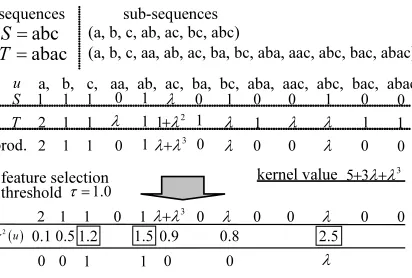
Figure 2: Example of statistical feature selection
and¯cfor the negative class.Ouc,Ouc¯,Ouc¯ andOu¯c¯
represent the number ofuthat appeared in the
pos-itive samplec, the number ofuthat appeared in the
negative sample¯c, the number ofuthat did not
ap-pear inc, and the number ofuthat did not appear
in¯c, respectively. Lety be the number of samples
of positive classcthat contain sub-sequenceu, and
xbe the number of samples that contain u. LetN
be the total number of (training) samples, andM be
the number of positive samples.
SinceN andM are constant for (fixed) data,χ2
can be written as a function ofxandy,
χ2(x, y) = N(Ouc·Ou¯c¯−Ouc¯ ·Ou¯c)
2
Ou·Ou¯·Oc·Oc¯
. (8)
χ2expresses the normalized deviation of the
obser-vation from the expectation.
We simply representχ2(x, y)asχ2(u).
4.2 Feature Selection Criterion
The basic idea of feature selection is quite natural.
First, we decide the thresholdτ of theχ2 value. If
χ2(u)< τ holds, that is,uis not statistically
signif-icant, thenuis eliminated from the features and the
value ofuis presumed to be 0 for the kernel value.
The sequence kernel with feature selection (FSSK) can be defined as follows:
KFSSK(S, T) = X
τ≤χ2(u)|u∈Σn
X
i|u=S[i]
λγ(i) X
j|u=T[j]
λγ(j). (9)
The difference between Equations (3) and (9) is simply the condition of the first summation. FSSK
selects significant sub-sequenceuby using the
con-dition of the statistical metricτ ≤χ2(u).
Figure 2 shows a simple example of what FSSK calculates for the kernel value.
4.3 Efficientχ2(u)Calculation Method
It is computationally infeasible to calculateχ2(u)
for all possible u with a naive exhaustive method.
In our approach, we use a sub-structure mining
al-gorithm to calculateχ2(u). The basic idea comes
from a sequential pattern mining technique, PrefixS-pan (Pei et al., 2001), and a statistical metric prun-ing (SMP) method, Apriori SMP (Morishita and Sese, 2000). By using these techniques, all the
sig-nificant sub-sequencesuthat satisfyτ ≤χ2(u)can
be found efficiently by depth-first search and prun-ing. Below, we briefly explain the concept involved in finding the significant features.
First, we denoteuv, which is the concatenation of
sequencesuandv. Then,u is a specific sequence
anduvis any sequence that is constructed byuwith
any suffixv. The upper bound of theχ2 value of
uvcan be defined by the value ofu(Morishita and
Sese, 2000).
χ2(uv)≤max χ2(yu, yu), χ2(xu−yu,0)
=χb2(u)
where xu and yu represent the value ofx and y
ofu. This inequation indicates that if χb2(u)is less
than a certain thresholdτ, all sub-sequencesuvcan
be eliminated from the features, because no
sub-sequenceuvcan be a feature.
The PrefixSpan algorithm enumerates all the sig-nificant sub-sequences by using a depth-first search and constructing a TRIE structure to store the sig-nificant sequences of internal results efficiently.
Specifically, PrefixSpan algorithm evaluates uw,
whereuwrepresents a concatenation of a sequence
uand a symbolw, using the following three
condi-tions.
1. τ ≤χ2(uw)
2. τ > χ2(uw), τ >χb2(uw) 3. τ > χ2(uw), τ ≤χb2(uw)
With 1, sub-sequenceuwis selected as a significant
feature. With 2, sub-sequenceuwand arbitrary
sub-sequencesuwv, are less than the thresholdτ. Then
wis pruned from the TRIE, that is, alluwvwherev
represents any suffix pruned from the search space.
With 3, uw is not selected as a significant feature
because theχ2value ofuwis less thanτ, however,
uwv can be a significant feature because the
upper-bound χ2 value ofuwv is greater than τ, thus the
search is continued touwv.
a b c c d b c a b a c a c d a b d
a b c c d b c b a c a c d a b d
⊥
a b c d
b c 1.0 τ= b: c: d: + 1 -1 + 1 -1 -1 a u= w= ( ) 2uw χ ( )
2
ˆ uw χ
T R I E r e p r e s e n t at i o n x y + 1 -1 + 1 -1 + 1 ab u= d c … w 2 3 1 1 2 1 + 1 -1 + 1 -1 -1
class t r ai n i n g d at a
su f f i x
c: d: w=
x y 1 1 10
5.0
0.0 5.00.8 5.00.8 2 .22 .2
1 .9 0.1 1 .9 1.9 0.8 0.8 5.0 2 .2 a: b: c: d: + 1 -1 + 1 -1 -1
u= Λ
w= x y 5 4 4 2 2 2 2 0 c d 1.9 1 .9 0.8 0.8 … a b c c
d b c a b a c a c d a b d
su f f i x
su f f i x a b c c d b c b a c a c d a b d 5 N= 2 M= 2 3 1 4 5 se ar ch o r d e r
p r u n e d
[image:5.595.75.292.73.254.2]p r u n e d
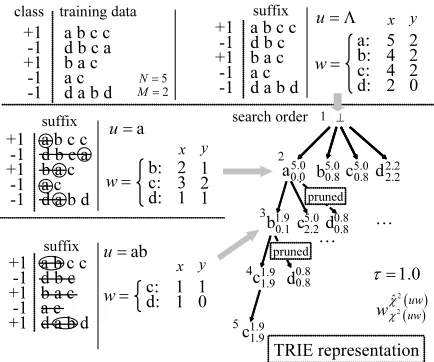
Figure 3: Efficient search for statistically significant sub-sequences using the PrefixSpan algorithm with SMP
by using a depth-first search with a TRIE represen-tation of the significant sequences. The values of
each symbol representχ2(u)andχb2(u)that can be
calculated from the number ofxuandyu. The TRIE
structure in the figure represents the statistically sig-nificant sub-sequences that can be shown in a path
from⊥to the symbol.
We exploit this TRIE structure and PrefixSpan pruning method in our kernel calculation.
4.4 Embedding Feature Selection in Kernel
Calculation
This section shows how to integrate statistical fea-ture selection in the kernel calculation. Our pro-posed method is defined in the following equations.
KFSSK(S, T) =
n X
m=1
X
1≤i≤|S|
X
1≤j≤|T|
Km(Si, Tj) (10)
LetKm(Si, Tj) be a function that returns the sum
value of all statistically significant common
sub-sequencesuifsi=tj.
Km(Si, Tj) = X
u∈Γm(Si,Tj)
Ju(Si, Tj), (11)
whereΓm(Si, Tj)represents a set of sub-sequences
whose size|u|ismand that satisfy the above
condi-tion 1. TheΓm(Si, Tj)is defined in detail in
Equa-tion (15).
Then, let Ju(Si, Tj),Ju0(Si, Tj)andJu00(Si, Tj)
be functions that calculate the value of the common
sub-sequences between Si and Tj recursively, as
well as equations (5) to (7) for sequence kernels. We
introduce a special symbolΛto represent an “empty
sequence”, and defineΛw=wand|Λw|= 1.
Juw(Si, Tj) =
J0
u(Si, Tj)· I(w)
if uw∈Γb|uw|(Si, Tj), 0 otherwise
(12)
where I(w) is a function that returns a matching
value ofw. In this paper, we defineI(w)is 1.
b
Γm(Si, Tj) has realized conditions 2 and 3; the
details are defined in Equation (16).
Ju0(Si, Tj) =
1 if u= Λ,
0 if j= 0 and u6= Λ, λJ0
u(Si, Tj−1) +Ju00(Si, Tj−1) otherwise
(13)
J00
u(Si, Tj) =
0 if i= 0, λJ00
u(Si−1, Tj) +Ju(Si−1, Tj)
otherwise
(14)
The following five equations are introduced to
se-lect a set of significant sub-sequences. Γm(Si, Tj)
andΓbm(Si, Tj)are sets of sub-sequences (features)
that satisfy condition 1 and 3, respectively, when
calculating the value between Si and Tj in
Equa-tions (11) and (12).
Γm(Si, Tj) ={u|u∈Γbm(Si, Tj), τ ≤χ2(u)} (15)
b
Γm(Si, Tj) =
Ψ(bΓ0
m−1(Si, Tj), si)
if si =tj ∅ otherwise
(16)
Ψ(F, w) ={uw|u∈F, τ ≤χb2(uw)}, (17)
where F represents a set of sub-sequences.
No-tice thatΓm(Si, Tj)andΓbm(Si, Tj)have only
sub-sequences u that satisfy τ ≤ χ2(uw) or τ ≤
b
χ2(uw), respectively, ifs
i = tj(= w); otherwise
they become empty sets.
The following two equations are introduced for
recursive set operations to calculateΓm(Si, Tj)and
b
Γm(Si, Tj).
b
Γ0m(Si, Tj) =
{Λ} ifm= 0,
∅ ifj= 0 and m >0, b
Γ0
m(Si, Tj−1)∪Γb00m(Si, Tj−1) otherwise
(18)
b
Γ00m(Si, Tj) =
∅ if i= 0 ,
b Γ00
m(Si−1, Tj)∪bΓm(Si−1, Tj)
otherwise
In the implementation, Equations (11) to (14) can be performed in the same way as those used to cal-culate the original sequence kernels, if the feature selection condition of Equations (15) to (19) has been removed. Then, Equations (15) to (19), which select significant features, are performed by the Pre-fixSpan algorithm described above and the TRIE representation of statistically significant features.
The recursive calculation of Equations (12) to (14) and Equations (16) to (19) can be executed in the same way and at the same time in parallel. As a result, statistical feature selection can be embedded in oroginal sequence kernel calculation based on a dynamic programming technique.
4.5 Properties
The proposed method has several important advan-tages over the conventional methods.
First, the feature selection criterion is based on a statistical measure, so statistically significant fea-tures are automatically selected.
Second, according to Equations (10) to (18), the proposed method can be embedded in an original kernel calculation process, which allows us to use the same calculation procedure as the conventional methods. The only difference between the original sequence kernels and the proposed method is that
the latter calculates a statistical metricχ2(u)by
us-ing a sub-structure minus-ing algorithm in the kernel calculation.
Third, although the kernel calculation, which uni-fies our proposed method, requires a longer train-ing time because of the feature selection, the se-lected sub-sequences have a TRIE data structure. This means a fast calculation technique proposed in (Kudo and Matsumoto, 2003) can be simply ap-plied to our method, which yields classification very quickly. In the classification part, the features (sub-sequences) selected in the learning part must be known. Therefore, we store the TRIE of selected sub-sequences and use them during classification.
5 Proposed Method Applied to Other Convolution Kernels
We have insufficient space to discuss this subject in detail in relation to other convolution kernels. How-ever, our proposals can be easily applied to tree ker-nels (Collins and Duffy, 2001) by using string en-coding for trees. We enumerate nodes (labels) of tree in postorder traversal. After that, we can em-ploy a sequential pattern mining technique to select statistically significant sub-trees. This is because we can convert to the original sub-tree form from the string encoding representation.
Table 2: Parameter values of proposed kernels and Support Vector Machines
parameter value
soft margin for SVM (C) 1000 decay factor of gap (λ) 0.5
threshold ofχ2(τ) 2.70553.8415
As a result, we can calculate tree kernels with sta-tistical feature selection by using the original tree kernel calculation with the sequential pattern min-ing technique introduced in this paper. Moreover, we can expand our proposals to hierarchically struc-tured graph kernels (Suzuki et al., 2003a) by using a simple extension to cover hierarchical structures.
6 Experiments
We evaluated the performance of the proposed method in actual NLP tasks, namely English ques-tion classificaques-tion (EQC), Japanese quesques-tion classi-fication (JQC) and sentence modality identiclassi-fication (MI) tasks.
We compared the proposed method (FSSK) with a conventional method (SK), as discussed in Sec-tion 3, and with bag-of-words (BOW) Kernel (BOW-K)(Joachims, 1998) as baseline methods.
Support Vector Machine (SVM) was selected as the kernel-based classifier for training and classifi-cation. Table 2 shows some of the parameter values that we used in the comparison. We set thresholds
ofτ = 2.7055(FSSK1) andτ = 3.8415(FSSK2)
for the proposed methods; these values represent the
10% and 5% level of significance in theχ2
distribu-tion with one degree of freedom, which used theχ2
significant test.
6.1 Question Classification
Question classification is defined as a task similar to text categorization; it maps a given question into a question type.
We evaluated the performance by using data provided by (Li and Roth, 2002) for English and (Suzuki et al., 2003b) for Japanese question classification and followed the experimental setting used in these papers; namely we use four typical question types, LOCATION, NUMEX, ORGANI-ZATION, and TIME TOP for JQA, and “coarse” and “fine” classes for EQC. We used the one-vs-rest classifier of SVM as the multi-class classification method for EQC.
question types input object : word sequences ([ ]: information of chunk andh i: named entity)
ABBREVIATION what,[B-NP] be,[B-VP] the,[B-NP] abbreviation,[I-NP] for,[B-PP] Texas,[B-NP],hB-GPEi?,[O] DESCRIPTION what,[B-NP] be,[B-VP] Aborigines,[B-NP] ?,[O]
HUMAN who,[B-NP] discover,[B-VP] America,[B-NP],hB-GPEi?,[O]
Figure 4: Examples of English question classification data
Table 3: Results of the Japanese question classification (F-measure)
(a) TIME TOP (b) LOCATION (c) ORGANIZATION (d) NUMEX
n
FSSK1 FSSK2 SK BOW-K
1 2 3 4 ∞
- .961 .958 .957 .956 - .961 .956 .957 .956 - .946 .910 .866 .223
.902 .909 .886 .855
-1 2 3 4 ∞
- .795 .793 .798 .792 - .788 .799 .804 .800 - .791 .775 .732 .169
.744 .768 .756 .747
-1 2 3 4 ∞
- .709 .720 .720 .723 - .703 .710 .716 .720 - .705 .668 .594 .035
.641 690 .636 .572
-1 2 3 4 ∞
- .912 .915 .908 .908 - .913 .916 .911 .913 - .912 .885 .817 .036
.842 .852 .807 .726
-6.2 Sentence Modality Identification
For example, sentence modality identification tech-niques are used in automatic text analysis systems that identify the modality of a sentence, such as “opinion” or “description”.
The data set was created from Mainichi news arti-cles and one of three modality tags, “opinion”, “de-cision” and “description” was applied to each sen-tence. The data size was 1135 sentences consist-ing of 123 sentences of “opinion”, 326 of “decision” and 686 of “description”. We evaluated the results by using 5-fold cross validation.
7 Results and Discussion
Tables 3 and 4 show the results of Japanese and En-glish question classification, respectively. Table 5 shows the results of sentence modality
identifica-tion. nin each table indicates the threshold of the
sub-sequence size. n=∞means all possible
sub-sequences are used.
First, SK was consistently superior to BOW-K. This indicates that the structural features were quite efficient in performing these tasks. In general we can say that the use of structural features can im-prove the performance of NLP tasks that require the details of the contents to perform the task.
Most of the results showed that SK achieves its
maximum performance when n = 2. The
per-formance deteriorates considerably oncenexceeds
4. This implies that SK with larger sub-structures degrade classification performance. These results show the same tendency as the previous studies dis-cussed in Section 3. Table 6 shows the precision and
recall of SK whenn=∞. As shown in Table 6, the
classifier offered high precision but low recall. This is evidence of over-fitting in learning.
As shown by the above experiments, FSSK
pro-Table 6: Precision and recall of SK:n=∞
Precision Recall F
MI:Opinion .917 .209 .339
JQA:LOCATION .896 .093 .168
vided consistently better performance than the ventional methods. Moreover, the experiments con-firmed one important fact. That is, in some cases
maximum performance was achieved with n =
∞. This indicates that sub-sequences created
us-ing very large structures can be extremely effective. Of course, a larger feature space also includes the
smaller feature spaces,Σn ⊂ Σn+1
. If the
perfor-mance is improved by using a largern, this means
that significant features do exist. Thus, we can im-prove the performance of some classification prob-lems by dealing with larger substructures. Even if
optimum performance was not achieved with n =
∞, difference between the performance of smaller
nare quite small compared to that of SK. This
indi-cates that our method is very robust as regards sub-structure size; It therefore becomes unnecessary for us to decide sub-structure size carefully. This in-dicates our approach, using large sub-structures, is better than the conventional approach of eliminating sub-sequences based on size.
8 Conclusion
Table 4: Results of English question classification (Accuracy)
(a) coarse (b) fine
n
FSSK1 FSSK2 SK BOW-K
1 2 3 4 ∞
- .908 .914 .916 .912 - .902 .896 .902 .906 - .912 .914 .912 .892
.728 .836 .864 .858
-1 2 3 4 ∞
- .852 .854 .852 .850 - .858 .856 .854 .854 - .850 .840 .830 .796
.754 .792 .790 .778
-Table 5: Results of sentence modality identification (F-measure)
(a) opinion (b) decision (c) description
n
FSSK1 FSSK2 SK BOW-K
1 2 3 4 ∞
- .734 .743 .746 .751 - .740 .748 .750 .750 - .706 .672 .577 .058
.507 .531 .438 .368
-1 2 3 4 ∞
- .828 .858 .854 .857 - .824 .855 .859 .860 - .816 .834 .830 .339
.652 .708 .686 .665
-1 2 3 4 ∞
- .896 .906 .910 .910 - .894 .903 .909 .909 - .902 .913 .910 .808
.819 .839 .826 .793
-Experiments show that our method is superior to conventional methods. Moreover, the results indi-cate that complex features exist and can be effective. Our method can employ them without over-fitting problems, which yields benefits in terms of concept and performance.
References
N. Cancedda, E. Gaussier, C. Goutte, and J.-M. Renders. 2003. Word-Sequence Kernels. Jour-nal of Machine Learning Research, 3:1059–1082. M. Collins and N. Duffy. 2001. Convolution Ker-nels for Natural Language. In Proc. of Neural In-formation Processing Systems (NIPS’2001). C. Cortes and V. N. Vapnik. 1995. Support Vector
Networks. Machine Learning, 20:273–297. D. Haussler. 1999. Convolution Kernels on
Dis-crete Structures. In Technical Report UCS-CRL-99-10. UC Santa Cruz.
T. Joachims. 1998. Text Categorization with Sup-port Vector Machines: Learning with Many Rel-evant Features. In Proc. of European Conference on Machine Learning (ECML ’98), pages 137– 142.
T. Kudo and Y. Matsumoto. 2002. Japanese Depen-dency Analysis Using Cascaded Chunking. In Proc. of the 6th Conference on Natural Language Learning (CoNLL 2002), pages 63–69.
T. Kudo and Y. Matsumoto. 2003. Fast Methods for Kernel-based Text Analysis. In Proc. of the 41st Annual Meeting of the Association for Computa-tional Linguistics (ACL-2003), pages 24–31. X. Li and D. Roth. 2002. Learning Question
Clas-sifiers. In Proc. of the 19th International
Con-ference on Computational Linguistics (COLING 2002), pages 556–562.
H. Lodhi, C. Saunders, J. Shawe-Taylor, N. Cris-tianini, and C. Watkins. 2002. Text Classification Using String Kernel. Journal of Machine Learn-ing Research, 2:419–444.
S. Morishita and J. Sese. 2000. Traversing Item-set Lattices with Statistical Metric Pruning. In Proc. of ACM SIGACT-SIGMOD-SIGART Symp. on Database Systems (PODS’00), pages 226– 236.
J. Pei, J. Han, B. Mortazavi-Asl, and H. Pinto. 2001. PrefixSpan: Mining Sequential Patterns Efficiently by Prefix-Projected Pattern Growth. In Proc. of the 17th International Conference on Data Engineering (ICDE 2001), pages 215–224. M. Rogati and Y. Yang. 2002. High-performing
Feature Selection for Text Classification. In
Proc. of the 2002 ACM CIKM International Con-ference on Information and Knowledge Manage-ment, pages 659–661.
J. Suzuki, T. Hirao, Y. Sasaki, and E. Maeda. 2003a. Hierarchical Directed Acyclic Graph Ker-nel: Methods for Natural Language Data. In Proc. of the 41st Annual Meeting of the Associ-ation for ComputAssoci-ational Linguistics (ACL-2003), pages 32–39.
[image:8.595.133.482.222.284.2]