Proceedings of the 45th Annual Meeting of the Association of Computational Linguistics, pages 128–135,
Generating Complex Morphology for Machine Translation
Einat Minkov∗
Language Technologies Institute Carnegie Mellon University
Pittsburgh, PA, USA [email protected]
Kristina Toutanova Microsoft Research Redmond, WA, USA [email protected]
Hisami Suzuki Microsoft Research Redmond, WA, USA [email protected]
Abstract
We present a novel method for predicting in-flected word forms for generating morpho-logically rich languages in machine trans-lation. We utilize a rich set of syntactic and morphological knowledge sources from both source and target sentences in a prob-abilistic model, and evaluate their contribu-tion in generating Russian and Arabic sen-tences. Our results show that the proposed model substantially outperforms the com-monly used baseline of a trigram target lan-guage model; in particular, the use of mor-phological and syntactic features leads to large gains in prediction accuracy. We also show that the proposed method is effective with a relatively small amount of data.
1 Introduction
Machine Translation (MT) quality has improved substantially in recent years due to applying data intensive statistical techniques. However, state-of-the-art approaches are essentially lexical, consider-ing every surface word or phrase in both the source sentence and the corresponding translation as an in-dependent entity. A shortcoming of this word-based approach is that it is sensitive to data sparsity. This is an issue of importance as aligned corpora are an ex-pensive resource, which is not abundantly available for many language pairs. This is particularly prob-lematic for morphologically rich languages, where word stems are realized in many different surface forms, which exacerbates the sparsity problem.
∗ This research was conducted during the author’s
intern-ship at Microsoft Research.
In this paper, we explore an approach in which words are represented as a collection of morpholog-ical entities, and use this information to aid in MT for morphologically rich languages. Our goal is two-fold: first, to allow generalization over morphology to alleviate the data sparsity problem in morphology generation. Second, to model syntactic coherence in the form of morphological agreement in the target language to improve the generation of morphologi-cally rich languages. So far, this problem has been addressed in a very limited manner in MT, most typ-ically by using a target language model.
In the framework suggested in this paper, we train a model that predicts the inflected forms of a se-quence of word stems in a target sentence, given the corresponding source sentence. We use word and word alignment information, as well as lexi-cal resources that provide morphologilexi-cal informa-tion about the words on both the source and target sides. Given a sentence pair, we also obtain syntactic analysis information for both the source and trans-lated sentences. We generate the inflected forms of words in the target sentence using all of the available information, using a log-linear model that learns the relevant mapping functions.
As a case study, we focus on the English-Russian and English-Arabic language pairs. Unlike English, Russian and Arabic have very rich systems of mor-phology, each with distinct characteristics. Trans-lating from a poor to a morphology-rich language is especially challenging since tailed morphological information needs to be de-coded from a language that does not encode this in-formation or does so only implicitly (Koehn, 2005). We believe that these language pairs are
tative in this respect and therefore demonstrate the generality of our approach.
There are several contributions of this work. First, we propose a general approach that shows promise in addressing the challenges of MT into morpholog-ically rich languages. We show that the use of both syntactic and morphological information improves translation quality. We also show the utility of source language information in predicting the word forms of the target language. Finally, we achieve these results with limited morphological resources and training data, suggesting that the approach is generally useful for resource-scarce language pairs.
2 Russian and Arabic Morphology
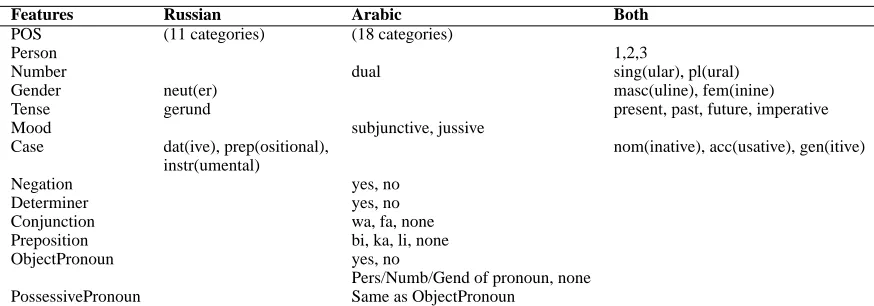
Table 1 describes the morphological features rele-vant to Russian and Arabic, along with their possible values. The rightmost column in the table refers to the morphological features that are shared by Rus-sian and Arabic, including person, number, gender and tense. While these features are fairly generic (they are also present in English), note that Rus-sian includes an additional gender (neuter) and Ara-bic has a distinct number notion for two (dual). A central dimension of Russian morphology is case marking, realized as suffixation on nouns and nom-inal modifiers1. The Russian case feature includes six possible values, representing the notions of sub-ject, direct obsub-ject, location, etc. In Arabic, like other Semitic languages, word surface forms may include proclitics and enclitics (or prefixes and suffixes as we refer to them in this paper), concatenated to in-flected stems. For nouns, prefixes include conjunc-tions (wa: “and”, fa: “and, so”), preposiconjunc-tions (bi: “by, with”, ka: “like, such as”, li: “for, to”) and a de-terminer, and suffixes include possessive pronouns. Verbal prefixes include conjunction and negation, and suffixes include object pronouns. Both object and possessive pronouns are captured by an indica-tor function for its presence or absence, as well as by the features that indicate their person, number and gender. As can be observed from the table, a large number of surface inflected forms can be gen-erated by the combination of these features, making
1Case marking also exists in Arabic. However, in many
in-stances, it is realized by diacritics which are ignored in standard orthography. In our experiments, we include case marking in Arabic only when it is reflected in the orthography.
the morphological generation of these languages a non-trivial task.
Morphologically complex languages also tend to display a rich system of agreements. In Russian, for example, adjectives agree with head nouns in num-ber, gender and case, and verbs agree with the sub-ject noun in person and number (past tense verbs agree in gender and number). Arabic has a similarly rich system of agreement, with unique characteris-tics. For example, in addition to agreement involv-ing person, number and gender, it also requires a de-terminer for each word in a definite noun phrase with adjectival modifiers; in a noun compound, a deter-miner is attached to the last noun in the chain. Also, non-human subject plural nouns require the verb to be inflected in a singular feminine form. Generating these morphologically complex languages is there-fore more difficult than generating English in terms of capturing the agreement phenomena.
3 Related Work
The use of morphological features in language mod-elling has been explored in the past for morphology-rich languages. For example, (Duh and Kirchhoff, 2004) showed that factored language models, which consider morphological features and use an opti-mized backoff policy, yield lower perplexity.
Features Russian Arabic Both
POS (11 categories) (18 categories)
Person 1,2,3
Number dual sing(ular), pl(ural)
Gender neut(er) masc(uline), fem(inine) Tense gerund present, past, future, imperative Mood subjunctive, jussive
Case dat(ive), prep(ositional), nom(inative), acc(usative), gen(itive) instr(umental)
Negation yes, no
Determiner yes, no
Conjunction wa, fa, none Preposition bi, ka, li, none ObjectPronoun yes, no
[image:3.612.87.524.69.222.2]Pers/Numb/Gend of pronoun, none PossessivePronoun Same as ObjectPronoun
Table 1: Morphological features used for Russian and Arabic
set of possible source transformations, incorporat-ing morphology. In general, this line of work fo-cused on translating from morphologically rich lan-guages into English; there has been limited research in MT in the opposite direction. Koehn (2005) in-cludes a survey of statistical MT systems in both di-rections for the Europarl corpus, and points out the challenges of this task. A recent work (El-Kahlout and Oflazer, 2006) experimented with English-to-Turkish translation with limited success, suggesting that inflection generation given morphological fea-tures may give positive results.
In the current work, we suggest a probabilistic framework for morphology generation performed as
post-processing. It can therefore be considered as
complementary to the techniques described above. Our approach is general in that it is not specific to a particular language pair, and is novel in that it al-lows modelling of agreement on the target side. The framework suggested here is most closely related to (Suzuki and Toutanova, 2006), which uses a proba-bilistic model to generate Japanese case markers for English-to-Japanese MT. This work can be viewed as a generalization of (Suzuki and Toutanova, 2006) in that our model generates inflected forms of words, and is not limited to generating a small, closed set of case markers. In addition, the morphology genera-tion problem is more challenging in that it requires handling of complex agreement phenomena along multiple morphological dimensions.
4 Inflection Prediction Framework
In this section, we define the task of of morphologi-cal generation as inflection prediction, as well as the
lexical operations relevant for the task.
4.1 Morphology Analysis and Generation
Morphological analysis can be performed by ap-plying language specific rules. These may include a full-scale morphological analysis with contextual disambiguation, or, when such resources are not available, simple heuristic rules, such as regarding the last few characters of a word as its morphogical suffix. In this work, we assume that lexiconsLSand
LT are available for the source and translation
lan-guages, respectively. Such lexicons can be created manually, or automatically from data. Given a lexi-conLand a surface wordw, we define the following operations:
• Stemming - letSw = {s1, ..., sl}be the set of
possible morphological stems (lemmas) of w
according toL.2
• Inflection - letIw = {i1, ..., im} be the set of
surface form words that have the same stem as
w. That is,i∈IwiffSiTSw6=∅.
• Morphological analysis - letAw={a1, ..., av}
be the set of possible morphological analyses forw. A morphological analysisais a vector of categorical values, where the dimensions and possible values for each dimension in the vector representation space are defined byL.
4.2 The Task
We assume that we are given aligned sentence pairs, where a sentence pair includes a source and a
tar-2
NN+sg+nom+neut
the
DET
allocation of resources has completed
NN+sg PREP NN+pl AUXV+sg VERB+pastpart
распределение
NN+sg+gen+pl+masc
ресурсов
VERB+perf+pass+part+neut+sg
завершено
[image:4.612.80.301.70.167.2]raspredelenie resursov zaversheno
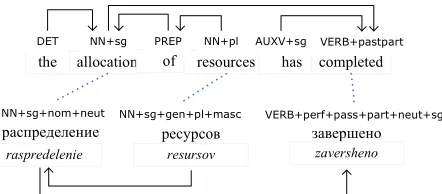
Figure 1: Aligned English-Russian sentence pair with syntactic and morphological annotation
get sentence, and lexiconsLS andLT that support
the operations described in the section above. Let a sentence w1, ...wt, ...wn be the output of a MT
system in the target language. This sentence can be converted into the corresponding stem set se-quence S1, ...St, ...Sn, applying the stemming
op-eration. Then the task is, for every stem set St in
the output sentence, to predict an inflectionytfrom
its inflection setIt. The predicted inflections should
both reflect the meaning conveyed by the source sen-tence, and comply with the agreement rules of the target language.3
Figure 1 shows an example of an aligned English-Russian sentence pair: on the source (English) side, POS tags and word dependency structure are indi-cated by solid arcs. The alignments between En-glish and Russian words are indicated by the dot-ted lines. The dependency structure on the Russian side, indicated by solid arcs, is given by a treelet MT system in our case (see Section 6.1), projected from the word dependency structure of English and word alignment information. Note that the Russian sen-tence displays agreement in number and gender be-tween the subject noun (raspredelenie) and the pred-icate (zaversheno); note also that resursov is in gen-itive case, as it modifies the noun on its left.
5 Models for Inflection Prediction
5.1 A Probabilistic Model
Our learning framework uses a Maximum Entropy Markov model (McCallum et al., 2000). The model decomposes the overall probability of a predicted inflection sequence into a product of local proba-bilities for individual word predictions. The local
3
That is, assuming that the stem sequence that is output by the MT system is correct.
probabilities are conditioned on the previousk pre-dictions. The model implemented here is of second order: at any decision pointtwe condition the prob-ability distribution over labels on the previous two predictions yt−1 andyt−2 in addition to the given
(static) word context from both the source and tar-get sentences. That is, the probability of a predicted inflection sequence is defined as follows:
p(y|x) =
n
Y
t=1
p(yt|yt−1, yt−2, xt), yt∈It
where xt denotes the given context at position t
andItis the set of inflections corresponding to St,
from which the model should chooseyt.
The features we constructed pair up predicates on the context (x, y¯ t−1, yt−2) and the target label (yt).
In the suggested framework, it is straightforward to encode the morphological properties of a word, in addition to its surface inflected form. For example, for a particular inflected word formyt and its
con-text, the derived paired features may include:
φk=
1 if surface wordytisy′ands′∈St+1
0 otherwise
φk+1=
n 1 if Gender(yt) =“Fem” and Gender(yt
−1) =“Fem”
0 otherwise
In the first example, a given neighboring stem set
St+1 is used as a context feature for predicting the
target wordyt. The second feature captures the
gen-der agreement with the previous word. This is possi-ble because our model is of second order. Thus, we can derive context features describing the morpho-logical properties of the two previous predictions.4 Note that our model is not a simple multi-class clas-sifier, because our features are shared across mul-tiple target labels. For example, the gender fea-ture above applies to many different inflected forms. Therefore, it is a structured prediction model, where the structure is defined by the morphological proper-ties of the target predictions, in addition to the word sequence decomposition.
5.2 Feature Categories
The information available for estimating the distri-bution over yt can be split into several categories,
4Note that while we decompose the prediction task
corresponding to feature source. The first ma-jor distinction is monolingual versus bilingual fea-tures: monolingual features refer only to the context (and predicted label) in the target language, while
bilingual features have access to information in the
source sentences, obtained by traversing the word alignment links from target words to a (set of) source words, as shown in Figure 1.
Both monolingual and bilingual features can be further split into three classes: lexical,
morpholog-ical and syntactic. Lexmorpholog-ical features refer to surface
word forms, as well as their stems. Since our model is of second order, our monolingual lexical fea-tures include the feafea-tures of a standard word trigram language model. Furthermore, since our model is discriminative (predicting word forms given their stems), the monolingual lexical model can use stems in addition to predicted words for the left and cur-rent position, as well as stems from the right con-text. Morphological features are those that refer to the features given in Table 1. Morphological infor-mation is used in describing the target label as well as its context, and is intended to capture morpho-logical generalizations. Finally, syntactic features can make use of syntactic analyses of the source and target sentences. Such analyses may be derived for the target language, using the pre-stemmed sen-tence. Without loss of generality, we will use here a dependency parsing paradigm. Given a syntactic analysis, one can construct syntactic features; for ex-ample, the stem of the parent word ofyt. Syntactic
features are expected to be useful in capturing agree-ment phenomena.
5.3 Features
Table 2 gives the full set of suggested features for Russian and Arabic, detailed by type. For
monolin-gual lexical features, we consider the stems of the
predicted word and its immediately adjacent words, in addition to traditional word bigram and trigram features. For monolingual morphological features, we consider the morphological attributes of the two previously predicted words and the current predic-tion; for monolingual syntactic features, we use the stem of the parent node.
The bilingual features include the set of words aligned to the focus word at positiont, where they are treated as bag-of-words, i.e., each aligned word
Feature categories Instantiations Monolingual lexical
Word stem st−1,st−2,st,st+1
Predicted word yt, yt−1, yt−2
Monolingual morphological
f:POS, Person, Number, Gender, Tense f(yt−2),f(yt−1),f(yt) Neg, Det, Prep, Conj, ObjPron, PossPron
Monolingual syntactic
Parent stem sH EAD(t)
Bilingual lexical
Aligned word setAl Alt, Alt−1, Alt+1
Bilingual morph & syntactic
f:POS, Person, Number, Gender, Tense f(Alt),f(Alt−1), Neg, Det, Prep, Conj, ObjPron, PossPron, f(Alt+1),f(AlH EAD(t)) Comp
Table 2: The feature set suggested for English-Russian and English-Arabic pairs
is assigned a separate feature. Bilingual lexical fea-tures can refer to words aligned toytas all as words
aligned to its immediate neighbors yt−1 andyt+1. Bilingual morphological and syntactic features
re-fer to the features of the source language, which are expected to be useful for predicting morphol-ogy in the target language. For example, the bilin-gual Det (determiner) feature is computed accord-ing to the source dependency tree: if a child of a word aligned to wt is a determiner, then the
fea-ture value is assigned its surface word form (such as a or the). The bilingual Prep feature is com-puted similarly, by checking the parent chain of the word aligned to wt for the existence of a
preposi-tion. This feature is hoped to be useful for predict-ing Arabic inflected forms with a prepositional pre-fix, as well as for predicting case marking in Rus-sian. The bilingual ObjPron and PossPron features represent any object pronoun of the word aligned to
wtand a preceding possessive pronoun, respectively.
These features are expected to map to the object and possessive pronoun features in Arabic. Finally, the bilingual Compound feature checks whether a word appears as part of a noun compound in the English source. f this is the case, the feature is assigned the value of “head” or “dependent”. This feature is rel-evant for predicting a genitive case in Russian and definiteness in Arabic.
6 Experimental Settings
In order to evaluate the effectiveness of the sug-gested approach, we performed reference
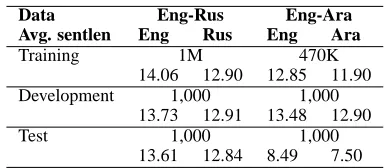
[image:5.612.312.582.71.224.2]Data Eng-Rus Eng-Ara Avg. sentlen Eng Rus Eng Ara
Training 1M 470K
14.06 12.90 12.85 11.90
Development 1,000 1,000
13.73 12.91 13.48 12.90
Test 1,000 1,000
13.61 12.84 8.49 7.50
Table 3: Data set statistics: corpus size and average sentence length (in words)
reference translations rather than the output of an
MT system as input.5 This allows us to evaluate our method with a reduced noise level, as the words and word order are perfect in reference translations. These experiments thus constitute a preliminary step for tackling the real task of inflecting words in MT.
6.1 Data
We used a corpus of approximately 1 million aligned sentence pairs for English-Russian, and 0.5 million pairs for English-Arabic. Both corpora are from a technical (software manual) domain, which we be-lieve is somewhat restricted along some morpho-logical dimensions, such as tense and person. We used 1,000 sentence pairs each for development and testing for both language pairs. The details of the datasets used are given in Table 3.
The sentence pairs were word-aligned using GIZA++ (Och and Ney, 2000) and submitted to a treelet-based MT system (Quirk et al., 2005), which uses the word dependency structure of the source language and projects word dependency structure to the target language, creating the structure shown in Figure 1 above.
[image:6.612.88.283.69.153.2]6.2 Lexicon
Table 4 gives some relevant statistics of the lexicons we used. For Russian, a general-domain lexicon was available to us, consisting of about 80,000 lemmas (stems) and 9.4 inflected forms per stem.6 Limiting the lexicon to word types that are seen in the train-ing set reduces its size substantially to about 14,000 stems, and an average of 3.8 inflections per stem. We will use this latter “domain-adapted” lexicon in our experiments.
5
In this case,ytshould equalwt, according to the task defi-nition.
6
The averages reported in Table 4 are by type and do not consider word frequencies in the data.
Source Stems Avg(|I|) Avg(|S|)
Rus. Lexicon 79,309 9.4
Lexicon∩Train 13,929 3.8 1.6
Ara. Lexicon∩Train 12,670 7.0 1.7
Table 4: Lexicon statistics
For Arabic, as a full-size Arabic lexicon was not available to us, we used the Buckwalter morpholog-ical analyzer (Buckwalter, 2004) to derive a lexicon. To acquire the stemming and inflection operators, we submit all words in our training data to the Buckwal-ter analyzer. Note that Arabic displays a high level of ambiguity, each word corresponding to many pos-sible segmentations and morphological analyses; we considered all of the different stems returned by the Buckwalter analyzer in creating a word’s stem set. The lexicon created in this manner contains 12,670 distinct stems and 89,360 inflected forms.
For the generation of word features, we only con-sider one dominant analysis for any surface word for simplicity. In case of ambiguity, we considered only the first (arbitrary) analysis for Russian. For Arabic, we apply the following heuristic: use the most frequent analysis estimated from the gold stan-dard labels in the Arabic Treebank (Maamouri et al., 2005); if a word does not appear in the treebank, we choose the first analysis returned by the Buckwal-ter analyzer. Ideally, the best word analysis should be provided as a result of contextual disambiguation (e.g., (Habash and Rambow, 2005)); we leave this for future work.
6.3 Baseline
As a baseline, we pick a morphological inflectionyt
at random fromIt. This random baseline serves as
an indicator for the difficulty of the problem. An-other more competitive baseline we implemented is a word trigram language model (LM). The LMs were trained using the CMU language modelling toolkit (Clarkson and Rosenfeld, 1997) with default settings on the training data described in Table 3.
6.4 Experiments
[image:6.612.313.548.72.116.2]of models including the full feature schemata as well as models that are restricted to feature subsets ac-cording to the feature types as described in Section 5.2. The models are as follows: Monolingual-Word, including LM-like and stem n-gram features only;
Bilingual-Word, which also includes bilingual
lex-ical features;7 Monolingual-All, which has access
to all the information available in the target lan-guage, including morphological and syntactic fea-tures; and finally, Bilingual-All, which includes all feature types from Table 2.
For each model and language, we perform feature selection in the following manner. The features are represented as feature templates, such as ”POS=X”, which generate a set of binary features correspond-ing to different instantiations of the template, as in
”POS=NOUN”. In addition to individual features, con-junctions of up to three features are also considered for selection (e.g.,”POS=NOUN&Number=plural”). Every conjunction of feature templates considered contains at least one predicate on the predictionyt,
and up to two predicates on the context. The feature selection algorithm performs a greedy forward step-wise feature selection on the feature templates so as to maximize development set accuracy. The algo-rithm is similar to the one described in (Toutanova, 2006). After this process, we performed some man-ual inspection of the selected templates, and finally obtained 11 and 36 templates for the
Monolingual-All and Bilingual-Monolingual-All settings for Russian,
respec-tively. These templates generated 7.9 million and 9.3 million binary feature instantiations in the fi-nal model, respectively. The corresponding num-bers for Arabic were 27 feature templates (0.7 mil-lion binary instantiations) and 39 feature templates (2.3 million binary instantiations) for
Monolingual-All and Bilingual-Monolingual-All, respectively.
7 Results and Discussion
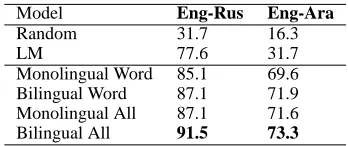
Table 5 shows the accuracy of predicting word forms for the baseline and proposed models. We report ac-curacy only on words that appear in our lexicons. Thus, punctuation, English words occurring in the target sentence, and words with unknown lemmas are excluded from the evaluation. The reported ac-curacy measure therefore abstracts away from the
is-7
Overall, this feature set approximates the information that is available to a state-of-the-art statistical MT system.
Model Eng-Rus Eng-Ara
Random 31.7 16.3
LM 77.6 31.7
Monolingual Word 85.1 69.6
Bilingual Word 87.1 71.9
Monolingual All 87.1 71.6
[image:7.612.339.513.70.143.2]Bilingual All 91.5 73.3
Table 5: Accuracy (%) results by model
sue of incomplete coverage of the lexicon. When we encounter these words in the true MT scenario, we will make no predictions about them, and simply leave them unmodified. In our current experiments, in Russian, 68.2% of all word tokens were in Cyril-lic, of which 93.8% were included in our lexicon. In Arabic, 85.5% of all word tokens were in Arabic characters, of which 99.1% were in our lexicon.8
The results in Table 5 show that the suggested models outperform the language model substantially for both languages. In particular, the contribution of both bilingual and non-lexical features is notewor-thy: adding non-lexical features consistently leads to 1.5% to 2% absolute gain in both monolingual and bilingual settings in both language pairs. We obtain a particularly large gain in the Russian bilin-gual case, in which the absolute gain is more than 4%, translating to 34% error rate reduction. Adding bilingual features has a similar effect of gaining about 2% (and 4% for Russian non-lexical) in ac-curacy over monolingual models. The overall accu-racy is lower in Arabic than in Russian, reflecting the inherent difficulty of the task, as indicated by the random baseline (31.7 in Russian vs. 16.3 in Ara-bic).
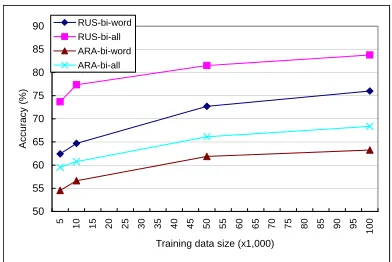
In order to evaluate the effectiveness of the model in alleviating the data sparsity problem in morpho-logical generation, we trained inflection prediction models on various subsets of the training data de-scribed in Table 3, and tested their accuracy. The results are given in Figure 2. We can see that with as few as 5,000 training sentences pairs, the model ob-tains much better accuracy than the language model, which is trained on data that is larger by a few orders of magnitude. We also note that the learning curve
8
50 55 60 65 70 75 80 85 90
5 10 15 20 52 30 35 40 45 05 55 60 65 70 75 80 85 90 95
1
0
0
Training data size (x1,000)
A
c
c
u
ra
c
y
(
%
)
[image:8.612.87.283.70.201.2]RUS-bi-word RUS-bi-all ARA-bi-word ARA-bi-all
Figure 2: Accuracy, varying training data size
becomes less steep as we use more training data, suggesting that the models are successfully learning generalizations.
We have also manually examined some repre-sentative cases where the proposed model failed to make a correct prediction. In both Russian and Ara-bic, a very common pattern was a mistake in pre-dicting the gender (as well as number and person in Arabic) of pronouns. This may be attributed to the fact that the correct choice of the pronoun requires coreference resolution, which is not available in our model. A more thorough analysis of the results will be helpful to bring further improvements.
8 Conclusions and Future Work
We presented a probabilistic framework for mor-phological generation given aligned sentence pairs, incorporating morpho-syntactic information from both the source and target sentences. The re-sults, using reference translations, show that the pro-posed models achieve substantially better accuracy than language models, even with a relatively small amount of training data. Our models using morpho-syntactic information also outperformed models us-ing only lexical information by a wide margin. This result is very promising for achieving our ultimate goal of improving MT output by using a special-ized model for target language morphological gener-ation. Though this goal is clearly outside the scope of this paper, we conducted a preliminary experi-ment where an English-to-Russian MT system was trained on a stemmed version of the aligned data and used to generate stemmed word sequences, which were then inflected using the suggested framework. This simple integration of the proposed model with
the MT system improved the BLEU score by 1.7. The most obvious next step of our research, there-fore, is to further pursue the integration of the pro-posed model to the end-to-end MT scenario.
There are multiple paths for obtaining further im-provements over the results presented here. These include refinement in feature design, word analysis disambiguation, morphological and syntactic anal-ysis on the source English side (e.g., assigning se-mantic role tags), to name a few. Another area of investigation is capturing longer-distance agreement phenomena, which can be done by implementing a global statistical model, or by using features from dependency trees more effectively.
References
Tim Buckwalter. 2004. Buckwalter arabic morphological ana-lyzer version 2.0.
Philip Clarkson and Roni Rosenfeld. 1997. Statistical language modelling using the CMU cambridge toolkit. In Eurospeech. Kevin Duh and Kathrin Kirchhoff. 2004. Automatic learning of
language model structure. In COLING.
Ilknur Durgar El-Kahlout and Kemal Oflazer. 2006. Initial ex-plorations in English to Turkish statistical machine transla-tion. In NAACL workshop on statistical machine translatransla-tion. Sharon Goldwater and David McClosky. 2005. Improving
sta-tistical MT through morphological analysis. In EMNLP. Nizar Habash and Owen Rambow. 2005. Arabic tokenization,
part-of-speech tagging and morphological disambiguation in one fell swoop. In ACL.
Philipp Koehn and Kevin Knight. 2003. Empirical methods for compound splitting. In EACL.
Philipp Koehn. 2005. Europarl: A parallel corpus for statistical machine translation. In MT Summit.
Young-Suk Lee. 2004. Morphological analysis for statistical machine translation. In HLT-NAACL.
Mohamed Maamouri, Ann Bies, Tim Buckwalter, and Hubert Jin. 2005. Arabic Treebank: Part 1 v 3.0. Linguistic Data Consortium.
Andrew McCallum, Dayne Freitag, and Fernando C. N. Pereira. 2000. Maximum entropy markov models for information extraction and segmentation. In ICML.
Sonja Nießen and Hermann Ney. 2004. Statistical machine translation with scarce resources using morpho-syntactic in-formation. Computational Linguistics, 30(2):181–204. Franz Josef Och and Hermann Ney. 2000. Improved statistical
alignment models. In ACL.
Maja Popovi´c and Hermann Ney. 2004. Towards the use of word stems and suffixes for statistical machine translation. In LREC.
Chris Quirk, Arul Menezes, and Colin Cherry. 2005. Depen-dency tree translation: Syntactically informed phrasal SMT. In ACL.
Hisami Suzuki and Kristina Toutanova. 2006. Learning to pre-dict case markers in Japanese. In COLING-ACL.