A Comparative Study of Parameter Estimation Methods for
Statistical Natural Language Processing
Jianfeng Gao*, Galen Andrew*, Mark Johnson*&, Kristina Toutanova*
*Microsoft Research, Redmond WA 98052, {jfgao,galena,kristout}@microsoft.com &Brown University, Providence, RI 02912, [email protected]
Abstract
This paper presents a comparative study of five parameter estimation algorithms on four NLP tasks. Three of the five algorithms are well-known in the computational linguistics community: Maximum Entropy (ME) estima-tion with L2 regularization, the Averaged Perceptron (AP), and Boosting. We also in-vestigate ME estimation with L1 regularization using a novel optimization algorithm, and BLasso, which is a version of Boosting with Lasso (L1) regularization. We first investigate all of our estimators on two re-ranking tasks: a parse selection task and a language model (LM) adaptation task. Then we apply the best of these estimators to two additional tasks involving conditional sequence models: a Conditional Markov Model (CMM) for part of speech tagging and a Conditional Random Field (CRF) for Chinese word segmentation. Our experiments show that across tasks, three of the estimators — ME estimation with L1 or
L2 regularization, and AP — are in a near sta-tistical tie for first place.
1
Introduction
Parameter estimation is fundamental to many sta-tistical approaches to NLP. Because of the high-dimensional nature of natural language, it is often easy to generate an extremely large number of features. The challenge of parameter estimation is to find a combination of the typically noisy, re-dundant features that accurately predicts the target output variable and avoids overfitting. Intuitively, this can be achieved either by selecting a small number of highly-effective features and ignoring the others, or by averaging over a large number of weakly informative features. The first intuition motivates feature selection methods such as Boosting and BLasso (e.g., Collins 2000; Zhao and
Yu, 2004), which usually work best when many features are completely irrelevant. L1 or Lasso regularization of linear models, introduced by Tibshirani (1996), embeds feature selection into regularization so that both an assessment of the reliability of a feature and the decision about whether to remove it are done in the same frame-work, and has generated a large amount of interest in the NLP community recently (e.g., Goodman 2003; Riezler and Vasserman 2004). If on the other hand most features are noisy but at least weakly correlated with the target, it may be reasonable to attempt to reduce noise by averaging over all of the features. ME estimators with L2 regularization, which have been widely used in NLP tasks (e.g., Chen and Rosenfeld 2000; Charniak and Johnson 2005; Johnson et al. 1999), tend to produce models that have this property. In addition, the perceptron algorithm and its variants, e.g., the voted or aver-aged perceptron, is becoming increasingly popular due to their competitive performance, simplicity in implementation and low computational cost in training (e.g., Collins 2002).
While recent studies claim advantages for L1 regularization, this study is the first of which we are aware to systematically compare it to a range of estimators on a diverse set of NLP tasks. Gao et al. (2006) showed that BLasso, due to its explicit use of
L1 regularization, outperformed Boosting in the LM adaptation task. Ng (2004) showed that for logistic regression, L1 regularization outperforms L2 regu-larization on artificial datasets which contain many completely irrelevant features. Goodman (2003) showed that in two out of three tasks, an ME esti-mator with a one-sided Laplacian prior (i.e., L1 regularization with the constraint that all feature weights are positive) outperformed a comparable estimator using a Gaussian prior (i.e., L2 regulari-zation). Riezler and Vasserman (2004) showed that an L1-regularized ME estimator outperformed an
L2-regularized estimator for ranking the parses of a stochastic unification-based grammar.
While these individual estimators are well de-scribed in the literature, little is known about the relative performance of these methods because the published results are generally not directly compa-rable. For example, in the parse re-ranking task, one cannot tell whether the L2- regularized ME approach used by Charniak and Johnson (2005) significantly outperforms the Boosting method by Collins (2000) because different feature sets and
n-best parses were used in the evaluations of these methods.
This paper conducts a much-needed comparative study of these five parameter estimation algorithms on four NLP tasks: ME estimation with L1 and L2 regularization, the Averaged Perceptron (AP), Boosting, and BLasso, a version of Boosting with Lasso (L1) regularization. We first investigate all of our estimators on two re-ranking tasks: a parse selection task and a language model adaptation task. Then we apply the best of these estimators to two additional tasks involving conditional sequence models: a CMM for POS tagging and a CRF for Chinese word segmentation. Our results show that ME estimation with L2 regularization achieves the best performing estimators in all of the tasks, and AP achieves almost as well and requires much less training time. L1 (Lasso) regularization also per-forms well and leads to sparser models.
2
Estimators
All the four NLP tasks studied in this paper are based on linear models (Collins 2000) which re-quire learning a mapping from inputs 𝑥 ∈ 𝑋to outputs 𝑦 ∈ 𝑌. We are given:
Training samples (𝑥𝑖, 𝑦𝑖) for 𝑖 = 1 … 𝑁,
A procedure 𝑮𝑬𝑵 to generate a set of candi-dates 𝑮𝑬𝑵(𝑥) for an input x,
A feature mapping Φ: 𝑋 × 𝑌 ↦ ℝ𝐷 to map each (𝑥, 𝑦) to a vector of feature values, and A parameter vector 𝒘 ∈ ℝ𝐷, which assigns a
real-valued weight to each feature.
For all models except the CMM sequence model for POS tagging, the components 𝑮𝑬𝑵, Φ and 𝒘 di-rectly define a mapping from an input 𝑥 to an output 𝐹(𝑥) as follows:
𝐹 𝑥 = arg max𝑦∈𝑮𝑬𝑵 𝑋 Φ 𝑥, 𝑦 ⋅ 𝒘. (1) In the CMM sequence classifier, locally normalized linear models to predict the tag of each word token are chained together to arrive at a probability
esti-mate for the entire tag sequence, resulting in a slightly different decision rule.
Linear models, though simple, can capture very complex dependencies because the features can be arbitrary functions of the input/output pair. For example, we can define a feature to be the log con-ditional probability of the output as estimated by some other model, which may in turn depend on arbitrarily complex interactions of „basic‟ features. In practice, with an appropriate feature set, linear models achieve very good empirical results on various NLP tasks. The focus of this paper however is not on feature definition (which requires domain knowledge and varies from task to task), but on parameter estimation (which is generic across tasks). We assume we are given fixed feature templates from which a large number of features are generated. The task of the estimator is to use the training samples to choose a parameter vector 𝒘, such that the mapping 𝐹(𝑥) is capable of correctly classifying unseen examples. We will describe the five estimators in our study individually.
2.1
ME estimation with
L2
regularization
Like many linear models, the ME estimator chooses 𝒘 to minimize the sum of the empirical loss on the training set and a regularization term:
𝒘 = arg min𝒘 𝐿 𝒘 + 𝑅 𝒘 . (2)
In this case, the loss term L(w) is the negative con-ditional log-likelihood of the training data,
𝐿 𝒘 = − 𝑛𝑖=1log 𝑃 𝑦𝑖 𝑥𝑖), where
𝑃 𝑦 𝑥) = exp Φ 𝑥, 𝑦 ⋅ 𝒘
exp(Φ 𝑥, 𝑦′ ⋅ 𝒘)
𝑦′∈𝐺𝐸𝑁 𝑥
and the regularizer term 𝑅 𝒘 = 𝛼 𝑤𝑗 𝑗2 is the weighted squared L2 norm of the parameters. Here, is a parameter that controls the amount of regu-larization, optimized on held-out data.
This is one of the most popular estimators, largely due to its appealing computational proper-ties: both 𝐿 𝒘 and 𝑅(𝒘) are convex and differen-tiable, so gradient-based numerical algorithms can be used to find the global minimum efficiently.
Because for some sentences there are multiple best parses (i.e., parses with the same F-Score), we used the variant of ME estimator described in Riezler et al. (2002), where 𝐿 𝒘 is defined as the likelihood of the best parses 𝑦 ∈ 𝑌(𝑥) relative to the n-best parser output 𝑮𝑬𝑵 𝑥 , (i.e., 𝑌 𝑥 ⊑ 𝑮𝑬𝑵(𝑥)): 𝐿 𝒘 = − log 𝑦𝑖∈𝑌(𝑥𝑖)𝑃(𝑦𝑖|𝑥𝑖)
𝑛
𝑖=1 .
We applied this variant in our experiments of parse re-ranking and LM adaptation, and found that on both tasks it leads to a significant improvement in performance for the L2-regularied ME estimator but not for the L1-regularied ME estimator.
2.2
ME estimation with
L1
regularization
This estimator also minimizes the negative condi-tional log-likelihood, but uses an L1 (or Lasso) penalty. That is, 𝑅(𝒘) in Equation (2) is defined according to 𝑅 𝒘 = 𝛼 𝑤𝑗 𝑗 . L1 regularization typically leads to sparse solutions in which many feature weights are exactly zero, so it is a natural candidate when feature selection is desirable. By contrast, L2 regularization produces solutions in which most weights are small but non-zero.
Optimizing the L1-regularized objective function is challenging because its gradient is discontinuous whenever some parameter equals zero. Kazama and Tsujii (2003) described an estimation method that constructs an equivalent constrained optimization problem with twice the number of variables. However, we found that this method is impracti-cally slow for large-scale NLP tasks. In this work we use the orthant-wise limited-memory qua-si-Newton algorithm (OWL-QN), which is a mod-ification of L-BFGS that allows it to effectively handle the discontinuity of the gradient (Andrew and Gao 2007). We provide here a high-level de-scription of the algorithm.
A quasi-Newton method such as L-BFGS uses first order information at each iterate to build an approximation to the Hessian matrix, 𝑯, thus mod-eling the local curvature of the function. At each step, a search direction is chosen by minimizing a quadratic approximation to the function:
𝑄 𝑥 =1
2 𝑥 − 𝑥0 ′𝑯 𝑥 − 𝑥0 + 𝑔0′(𝑥 − 𝑥0) where 𝑥0 is the current iterate, and 𝑔0 is the func-tion gradient at 𝑥0. If 𝑯 is positive definite, the
minimizing value of 𝑥 can be computed analytically according to: 𝑥∗= 𝑥0− 𝑯−1𝑔0.
L-BFGS maintains vectors of the change in gradient 𝑔𝑘− 𝑔𝑘−1 from the most recent iterations, and uses them to construct an estimate of the inverse Hessian 𝑯−𝟏. Furthermore, it does so in such a way that
𝑯−1𝑔
0 can be computed without expanding out the
full matrix, which is typically unmanageably large. The computation requires a number of operations linear in the number of variables.
OWL-QN is based on the observation that when restricted to a single orthant, the L1 regularizer is differentiable, and is in fact a linear function of 𝒘. Thus, so long as each coordinate of any two con-secutive search points does not pass through zero, 𝑅(𝒘) does not contribute at all to the curvature of the function on the segment joining them. There-fore, we can use L-BFGS to approximate the Hes-sian of 𝐿 𝒘 alone, and use it to build an approxi-mation to the full regularized objective that is valid on a given orthant. To ensure that the next point is in the valid region, we project each point during the line search back onto the chosen orthant.1 At each iteration, we choose the orthant containing the current point and into which the direction giving the greatest local rate of function decrease points.
This algorithm, although only a simple modifi-cation of L-BFGS, works quite well in practice. It typically reaches convergence in even fewer itera-tions than standard L-BFGS takes on the analogous
L2-regularized objective (which translates to less training time, since the time per iteration is only negligibly higher, and total time is dominated by function evaluations). We describe OWL-QN more fully in (Andrew and Gao 2007). We also show that it is significantly faster than Kazama and Tsujii‟s algorithm for L1 regularization and prove that it is guaranteed converge to a parameter vector that globally optimizes the L1-regularized objective.
2.3
Boosting
The Boosting algorithm we used is based on Collins (2000). It optimizes the pairwise exponential loss
(ExpLoss) function (rather than the logarithmic loss optimized by ME). Given a training sample (𝑥𝑖, 𝑦𝑖), for each possible output 𝑦𝑗 ∈ 𝑮𝑬𝑵(𝑥𝑖), we
define the margin of the pair (𝑦𝑖, 𝑦𝑗) with respect to 𝒘 as 𝑀 𝑦𝑖, 𝑦𝑗 =Φ 𝑥𝑖, 𝑦𝑖 ⋅ 𝒘 − Φ 𝑥𝑖, 𝑦𝑗 ⋅ 𝒘.
Then ExpLoss is defined as
ExpLoss 𝒘 = exp −M yi, yj 𝑦𝑗∈𝑮𝑬𝑵 𝑥𝑖
𝑖
(3)
Figure 1 summarizes the Boosting algorithm we used. It is an incremental feature selection proce-dure. After initialization, Steps 2 and 3 are repeated
T times; at each iteration, a feature is chosen and its weight is updated as follows.
First, we define Upd(𝒘, 𝑘, 𝛿) as an updated model, with the same parameter values as 𝑤 with the exception of 𝑤𝑘, which is incremented by 𝛿:
Upd 𝒘, 𝑘, 𝛿 = (𝑤1, … , 𝑤𝑘+ 𝛿, … , 𝑤𝐷)
Then, Steps 2 and 3 in Figure 1 can be rewritten as Equations (4) and (5), respectively.
𝑘∗, 𝛿∗ = arg min
𝑘,𝛿 ExpLoss(Upd 𝒘, 𝑘, 𝛿 ) (4)
𝒘𝑡 = Upd(𝒘𝑡−1, 𝑘∗, 𝛿∗) (5)
Because Boosting can overfit we update the weight of 𝑓𝑘∗ by a small fixed step size , as in Equation (6), following the FSLR algorithm (Hastie et al. 2001).
𝒘𝑡 = Upd(𝒘𝑡−1, 𝑘∗, 𝜖 × sign 𝛿∗ )
(6)
By taking such small steps, Boosting imposes a kind of implicit regularization, and can closely approximate the effect of L1 regularization in a local sense (Hastie et al. 2001). Empirically, smaller values of 𝜖 lead to smaller numbers of test errors.
2.4
Boosted Lasso
The Boosted Lasso (BLasso) algorithm was origi-nally proposed in Zhao and Yu (2004), and was adapted for language modeling by Gao et al. (2006). BLasso can be viewed as a version of Boosting with
L1 regularization. It optimizes an L1-regularized ExpLoss function:
LassoLoss 𝒘 = ExpLoss(𝒘) + 𝑅(𝒘) (7)
where 𝑅 𝒘 = 𝛼 𝑤𝑗 𝑗 .
BLasso also uses an incremental feature selec-tion procedure to learn parameter vector 𝒘, just as Boosting does. Due to the explicit use of the
regu-larization term 𝑅(𝒘), however, there are two major differences from Boosting.
At each iteration, BLasso takes either a forward step or a backward step. Similar to Boosting, at each forward step, a feature is selected and its weight is updated according to Eq. (8) and (9).
𝑘∗, 𝛿∗ = 𝑎𝑟𝑔 𝑚𝑖𝑛
𝑘,𝛿=±𝜖ExpLoss(Upd 𝒘, 𝑘, 𝛿 ) (8)
𝒘𝑡 = Upd(𝒘𝑡−1, 𝑘∗, 𝜖 × sign 𝛿∗ ) (9)
There is a small but important difference between Equations (8) and (4). In Boosting, as shown in Equation (4), a feature is selected by its impact on reducing the loss with its optimal update 𝛿∗. By contrast, in BLasso, as shown in Equation (8), rather than optimizing over 𝛿 for each feature, the loss is calculated with an update of either +𝜖 or −𝜖, i.e., grid search is used for feature weight estima-tion. We found in our experiments that this mod-ification brings a consistent improvement.
The backward step is unique to BLasso. At each iteration, a feature is selected and the absolute value of its weight is reduced by 𝜖 if and only if it leads to a decrease of the LassoLoss, as shown in Equations (10) and (11), where is a tolerance parameter.
𝑘∗= arg min
𝑘:𝑤𝑘≠0ExpLoss(Upd(𝒘, 𝑘, −𝜖sign 𝑤𝑘 ) (10)
𝒘𝑡 = Upd(𝒘𝑡−1, 𝑘∗,sign(𝑤
𝑘∗) × 𝜖) (11)
if LassoLoss 𝒘𝑡−1, 𝛼𝑡−1 − LassoLoss 𝒘𝑡, 𝛼𝑡 > 𝜃
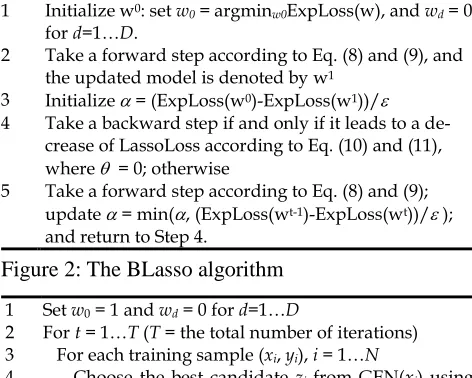
Figure 2 summarizes the BLasso algorithm we used. After initialization, Steps 4 and 5 are repeated
T times; at each iteration, a feature is chosen and its weight is updated either backward or forward by a fixed amount 𝜖. Notice that the value of 𝛼is adap-tively chosen according to the reduction of ExpLoss during training. The algorithm starts with a large initial 𝛼, and then at each forward step the value of 𝛼 decreases until ExpLoss stops decreasing. This is intuitively desirable: it is expected that most highly effective features are selected in early stages of training, so the reduction of ExpLoss at each step in early stages are more substantial than in later stages. These early steps coincide with the Boosting steps most of the time. In other words, the effect of backward steps is more visible at later stages. It can be proved that for a finite number of features and 𝜃=0, the BLasso algorithm shown in Figure 2 converges to the Lasso solution when 𝜖 → 0. See Gao et al. (2006) for implementation details, and Zhao and Yu (2004) for a theoretical justification for BLasso.
1 Set w0 = argminw0ExpLoss(w); and wd = 0 for d=1…D
2 Select a feature fk* which has largest estimated
impact on reducing ExpLoss of Equation (3) 3 Update λk* λk*+ δ*,and return to Step 2
2.5
Averaged Perceptron
The perceptron algorithm can be viewed as a form of incremental training procedure (e.g., using sto-chastic approximation) that optimizes a minimum square error (MSE) loss function (Mitchell, 1997). As shown in Figure 3, it starts with an initial pa-rameter setting and updates it for each training example. In our experiments, we used the Averaged Perceptron algorithm of Freund and Schapire (1999), a variation that has been shown to be more effective than the standard algorithm (Collins 2002). Let 𝒘𝑡,𝑖 be the parameter vector after the 𝑖th training sample has been processed in pass 𝑡 over the training data. The average parameters are de-fined as𝒘 =𝑻𝑵𝟏 𝒘𝒕 𝒊 𝒕,𝒊 where T is the number of epochs, and N is the number of training samples.
3
Evaluations
From the four tasks we consider, parsing and lan-guage model adaptation are both examples of re-ranking. In these tasks, we assume that we have been given a list of candidates 𝑮𝑬𝑵(𝑥) for each training or test sample 𝑥, 𝑦 , generated using a
baseline model. Then, a linear model of the form in Equation (1) is used to discriminatively re-rank the candidate list using additional features which may or may not be included in the baseline model. Since
the mapping from 𝑥 to 𝑦 by the linear model may make use of arbitrary global features of the output and is performed “all at once”, we call such a linear model a global model.
In the other two tasks (i.e., Chinese word seg-mentation and POS tagging), there is no explicit enumeration of 𝑮𝑬𝑵(𝑥). The mapping from 𝑥 to 𝑦 is determined by a sequence model which aggre-gates the decisions of local linear models via a dynamic program. In the CMM, the local linear models are trained independently, while in the CRF model, the local models are trained jointly. We call these two linear models local models because they dynamically combine the output of models that use only local features.
While it is straightforward to apply the five es-timators to global models in the re-ranking framework, the application of some estimators to the local models is problematic. Boosting and BLasso are too computationally expensive to be applied to CRF training and we compared the other three better performing estimation methods for this model. The CMM is a probabilistic sequence model and the log-loss used by ME estimation is most natural for it; thus we limit the comparison to the two kinds of ME models for CMMs. Note that our goal is not to compare locally trained models to globally trained ones; for a study which focuses on this issue, see (Punyakanok et al. 2005).
In each task we compared the performance of different estimators using task-specific measures. We used the Wilcoxon signed rank test to test the statistical significance of the difference among the competing estimators. We also report other results such as number of non-zero features after estima-tion, number of training iterations, and computation time (in minutes of elapsed time on an XEONTM MP 3.6GHz machine).
3.1
Parse re-ranking
We follow the experimental paradigm of parse re-ranking outlined in Charniak and Johnson (2005), and fed the features extracted by their pro-gram to the five rerankers we developed. Each uses a linear model trained using one of the five esti-mators. These rerankers attempt to select the best parse 𝑦 for a sentence 𝑥 from the 50-best list of possible parses 𝑮𝑬𝑵 𝑥 for the sentence. The li-near model combines the log probability calculated by the Charniak (2000) parser as a feature with 1,219,272 additional features. We trained the
fea-1 Initialize w0: set w0 =argminw0ExpLoss(w), and wd = 0
for d=1…D.
2 Take a forward step according to Eq. (8) and (9), and the updated model is denoted by w1
3 Initialize = (ExpLoss(w0)-ExpLoss(w1))/
4 Take a backward step if and only if it leads to a de-crease of LassoLoss according to Eq. (10) and (11), where = 0; otherwise
5 Take a forward step according to Eq. (8) and (9); update = min(, (ExpLoss(wt-1)-ExpLoss(wt))/);
[image:5.612.66.302.74.263.2]and return to Step 4.
Figure 2: The BLasso algorithm
1 Set w0 = 1 and wd = 0 for d=1…D
2 For t = 1…T (T = the total number of iterations) 3 For each training sample (xi, yi), i = 1…N
4
𝑧𝑖 = arg max
𝑧∈𝐺𝐸𝑁 𝑥_𝑖 Φ 𝑥𝑖, 𝑧 ⋅ 𝑤
Choose the best candidate zi from GEN(xi) using
the current model w,
5 w = w + η((xi, yi) – (xi, zi)), where η is the size of
learning step, optimized on held-out data.
ture weights w on Sections 2-19 of the Penn Tree-bank, adjusted the regularizer constant 𝛼 to max-imize the F-Score on Sections 20-21 of the Tree-bank, and evaluated the rerankers on Section 22. The results are presented in Tables 12 and 2, where
Baseline results were obtained using the parser by
Charniak (2000).
The ME estimation with L2 regularization out-performs all of the other estimators significantly except for the AP, which performs almost as well and requires an order of magnitude less time in training. Boosting and BLasso are feature selection methods in nature, so they achieve the sparsest models, but at the cost of slightly lower perfor-mance and much longer training time. The
L1-regularized ME estimator also produces a rela-tively sparse solution whereas the Averaged Per-ceptron and the L2-regularized ME estimator assign almost all features a non-zero weight.
3.2
Language model adaptation
Our experiments with LM adaptation are based on the work described in Gao et al. (2006). The va-riously trained language models were evaluated according to their impact on Japanese text input accuracy, where input phonetic symbols 𝑥 are mapped into a word string 𝑦. Performance of the application is measured in terms of character error
2
The result of ME/L2 is better than that reported in Andrew and Gao (2007) due to the use of the variant of
L2-regularized ME estimator, as described in Section 2.1.
CER # features time (min) #train iter Baseline 10.24%
MAP 7.98%
ME/L2 6.99% 295,337 27 665 ME/L1 7.01% 53,342 25 864
AP 7.23% 167,591 6 56
Boost 7.54% 32,994 175 71,000 BLasso 7.20% 33,126 238 250,000
Table 3. Performance summary of estimators (lower is better) on language model adaptation
ME/L2 ME/L1 AP Boost BLasso ME/L2 ~ >> >> >> ME/L1 ~ >> >> >>
AP << << >> ~
Boost << << << << BLasso << << ~ >>
Table 4. Statistical significance test results.
rate (CER), which is the number of characters wrongly converted from 𝑥 divided by the number of characters in the correct transcript.
Again we evaluated five linear rerankers, one for each estimator. These rerankers attempt to select the best conversions 𝑦 for an input phonetic string 𝑥 from a 100-best list 𝑮𝑬𝑵(𝑥)of possible conver-sions proposed by a baseline system. The linear model combines the log probability under a trigram language model as base feature and additional 865,190 word uni/bi-gram features. These uni/bi-gram features were already included in the trigram model which was trained on a background
domain corpus (Nikkei Newspaper). But in the linear model their feature weights were trained discriminatively on an adaptation domain corpus (Encarta Encyclopedia). Thus, this forms a cross domain adaptation paradigm. This also implies that the portion of redundant features in this task could be much larger than that in the parse re-ranking task, especially because the background domain is reasonably similar to the adaptation domain.
We divided the Encarta corpus into three sets that do not overlap. A 72K-sentences set was used as training data, a 5K-sentence set as development data, and another 5K-sentence set as testing data. The results are presented in Tables 3 and 4, where
Baseline is the word-based trigram model trained on background domain corpus, and MAP (maxi-mum a posteriori) is a traditional model adaptation method, where the parameters of the background model are adjusted so as to maximize the likelihood of the adaptation data.
F-Score # features time (min) # train iter Baseline 0.8986
ME/L2 0.9176 1,211,026 62 129 ME/L1 0.9165 19,121 37 174
AP 0.9164 939,248 2 8
Boosting 0.9131 6,714 495 92,600 BLasso 0.9133 8,085 239 56,500
Table 1: Performance summary of estimators on parsing re-ranking (ME/L2: ME with L2 regulari-zation; ME/L1: ME with L1 regularization)
ME/L2 ME/L1 AP Boost BLasso ME/L2 >> ~ >> >> ME/L1 << ~ > ~
AP ~ ~ >> >
Boost << < << ~ Blasso << ~ < ~
The results are more or less similar to those in the parsing task with one visible difference: L1 regularization achieved relatively better perfor-mance in this task. For example, while in the parsing task ME with L2 regularization significantly outperforms ME with L1 regularization, their per-formance difference is not significant in this task. While in the parsing task the performance differ-ence between BLasso and Boosting is not signifi-cant, BLasso outperforms Boosting significantly in this task. Considering that a much higher propor-tion of the features are redundant in this task than the parsing task, the results seem to corroborate the observation that L1 regularization is robust to the presence of many redundant features.
3.3
Chinese word segmentation
Our third task is Chinese word segmentation (CWS). The goal of CWS is to determine the boundaries between words in a section of Chinese text. The model we used is the hybrid Mar-kov/semi- Markov CRF described by Andrew (2006), which was shown to have state-of-the-art accuracy. We tested models trained with the various estimation methods on the Microsoft Research Asia corpus from the Second International Chinese Word Segmentation, and we used the same train/test split used in the competition. The model and experi-mental setup is identical with that of Andrew (2006) except for two differences. First, we extracted features from both positive and negative training examples, while Andrew (2006) uses only features that occur in some positive training example. Second, we used the last 4K sentences of the training data to select the weight of the regularizers and to determine when to stop perceptron training.
We compared three of the best performing es-timation procedures on this task: ME with L2 regu-larization, ME with L1 regularization, and the Av-eraged Perceptron. In this case, ME refers to mi-nimizing the negative log-probability of the correct segmentation, which is globally normalized, while the perceptron is trained using at each iteration the exact maximum-scoring segmentation with the
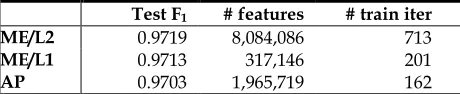
current weights. We observed the same pattern as in the other tasks: the three algorithms have nearly identical performance, while L1 uses only 6% of the features, and the Averaged Perceptron requires significantly fewer training iterations. In this case,
L1 was also several times faster than L2. The results are summarized in Table 5.3
We note that all three algorithms performed slightly better than the model used by Andrew (2006), which also used L2 regularization (96.84 F1). We believe the difference is due to the use of
features derived from negative training examples.
3.4
POS tagging
Finally we studied the impact of the regularization methods on a Maximum Entropy conditional Markov Model (MEMM, McCallum et al. 2000) for POS tagging. MEMMs decompose the conditional probability of a tag sequence given a word sequence as follows:
𝑃 𝑡1… 𝑡𝑛 𝑤1… 𝑤𝑛 = 𝑃(𝑡𝑖|𝑡𝑖−1… 𝑡𝑖−𝑘, 𝑤1… 𝑤𝑛) 𝑛
𝑖=1
where the probability distributions for each tag given its context are ME models. Following pre-vious work (Ratnaparkhi, 1996), we assume that the tag of a word is independent of the tags of all pre-ceding words given the tags of the previous two words (i.e., 𝑘=2 in the equation above). The local models at each position include features of the current word, the previous word, the next word, and features of the previous two tags. In addition to lexical identity of the words, we used features of word suffixes, capitalization, and number/special character signatures of the words.
We used the standard splits of the Penn Treebank from the tagging literature (Toutanova et al. 2003) for training, development and test sets. The training set comprises Sections 0-18, the development set — Sections 19-21, and the test set — Sections 22-24. We compared training the ME models using L1 and
L2 regularization. For each of the two types of regularization we selected the best value of the regularization constant using grid search to optim-ize the accuracy on the development set. We report final accuracy measures on the test set in Table 6.
The results on this task confirm the trends we have seen so far. There is almost no difference in
3 Only the L2 vs. AP comparison is significant at a 0.05
level according to the Wilcoxon signed rank test. Test F1 # features # train iter
ME/L2 0.9719 8,084,086 713 ME/L1 0.9713 317,146 201
[image:7.612.72.302.72.119.2]AP 0.9703 1,965,719 162
accuracy of the two kinds of regularizations, and indeed the differences were not statistically signif-icant. Estimation with L1 regularization required considerably less time than estimation with L2, and resulted in a model which is more than ten times smaller.
4
Conclusions
We compared five of the most competitive para-meter estimation methods on four NLP tasks em-ploying a variety of models, and the results were remarkably consistent across tasks. Three of the methods — ME estimation with L2 regularization, ME estimation with L1 regularization, and the Av-eraged Perceptron — were nearly indistinguishable in terms of test set accuracy, with ME estimation with L2 regularization perhaps enjoying a slight lead. Meanwhile, ME estimation with L1 regulari-zation achieves the same level of performance while at the same time producing sparse models, and the Averaged Perceptron provides an excellent com-promise of high performance and fast training.
These results suggest that when deciding which type of parameter estimation to use on these or similar NLP tasks, one may choose any of these three popular methods and expect to achieve com-parable performance. The choice of which to im-plement should come down to other considerations: if model sparsity is desired, choose ME estimation with L1 regularization (or feature selection methods such as BLasso); if quick implementation and training is necessary, use the Averaged Perceptron; and ME estimation with L2 regularization may be used if it is important to achieve the highest ob-tainable level of performance.
References
Andrew, G. 2006. A hybrid Markov/semi-Markov
condi-tional random field for sequence segmentation. In EMNLP,
465-472.
Andrew, G. and Gao, J. 2007. Scalable training of
L1-regularized log-linear models. In ICML.
Charniak, E. 2000. A maximum-entropy-inspired parser. In
NAACL, 132-139.
Charniak, E. and Johnson, M. 2005. Coarse-to-fine n-best
parsing and MaxEnt discriminative re-ranking. In ACL.
173-180.
Chen, S.F., and Rosenfeld, R. 2000. A survey of smoothing
techniques for ME models. IEEE Trans. On Speech and Audio
Processing, 8(2): 37-50.
Collins, M. 2000. Discriminative re-ranking for natural
language parsing. In ICML, 175-182.
Collins, M. 2002. Discriminative training methods for hid-den Markov models: Theory and experiments with
per-ceptron algorithms. In EMNLP, 1-8.
Freund, Y, R. Iyer, R. E. Schapire, and Y. Singer. 1998. An efficient boosting algorithm for combining preferences. In
ICML’98.
Freund, Y. and Schapire, R. E. 1999. Large margin
classifica-tion using the perceptron algorithm. In Machine Learning,
37(3): 277-296.
Hastie, T., R. Tibshirani and J. Friedman. 2001. The elements of
statistical learning. Springer-Verlag, New York.
Gao, J., Suzuki, H., and Yu, B. 2006. Approximation lasso
methods for language modeling. In ACL.
Goodman, J. 2004. Exponential priors for maximum entropy
models. In NAACL.
Johnson, M., Geman, S., Canon, S., Chi, Z., and Riezler, S. 1999. Estimators for stochastic “Unification-based”
grammars. In ACL.
Kazama, J. and Tsujii, J. 2003. Evaluation and extension of maximum entropy models with inequality constraints. In
EMNLP.
Malouf, R. 2002. A comparison of algorithms for maximum
entropy parameter estimation. In HLT.
McCallum A, D. Freitag and F. Pereira. 2000. Maximum entropy markov models for information extraction and
segmentation. In ICML.
Mitchell, T. M. 1997. Machine learning. The McGraw-Hill
Companies, Inc.
Ng, A. Y. 2004. Feature selection, L1 vs. L2 regularization,
and rotational invariance. In ICML.
Nocedal, J., and Wright, S. J. 1999. Numerical Optimization.
Springer, New York.
Punyakanok, V., D. Roth, W. Yih, and D. Zimak. 2005.
Learning and inference over constrained output. In IJCAI.
Ratnaparkhi, A. 1996. A maximum entropy part-of-speech tagger. In EMNLP.
Riezler, S., and Vasserman, A. 2004. Incremental feature
selection and L1 regularization for relax maximum
entro-py modeling. In EMNLP.
Riezler, S., King, T. H., Kaplan, R. M., Crouch, R., Maxwell, J., and Johnson, M. 2002. Parsing the wall street journal using a lexical-functional grammar and discriminative
estima-tion techniques. In ACL. 271-278.
Tibshirani, R. 1996. Regression shrinkage and selection via
the lasso. J. R. Statist. Soc. B, 58(1): 267-288.
Toutanova, K., Klein, D., Manning, C. D., and Singer, Y. 2003. Feature-rich Part-of-Speech tagging with a cyclic
dependency network. In HLT-NAACL, 252-259.
Zhao, P. and B. Yu. 2004. Boosted lasso. Tech Report, Statistics
Department, U. C. Berkeley.
Accuracy (%) # features # train iter
MEMM/L2 96.39 926,350 467
MEMM/L1 96.41 84,070 85