Identifying Non-explicit Citing Sentences for Citation-based
Summarization
Vahed Qazvinian Department of EECS University of Michigan
Ann Arbor, MI
Dragomir R. Radev Department of EECS and
School of Information University of Michigan
Ann Arbor, MI
Abstract
Identifying background (context) informa-tion in scientific articles can help schol-ars understand major contributions in their research area more easily. In this paper, we propose a general framework based on probabilistic inference to extract such context information from scientific papers. We model the sentences in an article and their lexical similarities as a Markov Ran-dom Field tuned to detect the patterns that context data create, and employ a Belief Propagation mechanism to detect likely context sentences. We also address the problem of generating surveys of scien-tific papers. Our experiments show greater pyramid scores for surveys generated us-ing such context information rather than citation sentences alone.
1 Introduction
In scientific literature, scholars use citations to re-fer to external sources. These secondary sources are essential in comprehending the new research. Previous work has shown the importance of cita-tions in scientific domains and indicated that ci-tations include survey-worthy information (Sid-dharthan and Teufel, 2007; Elkiss et al., 2008; Qazvinian and Radev, 2008; Mohammad et al., 2009; Mei and Zhai, 2008).
A citation to a paper in a scientific article may contain explicit information about the cited re-search. The following example is an excerpt from a CoNLL paper1 that contains information about Eisner’s work on bottom-up parsers and the notion of span in parsing:
“Another use of bottom-up is due to Eisner
(1996), who introduced the notion of a span.”
1Buchholz and Marsi “CoNLL-X Shared Task On Multi-lingual Dependency Parsing”, CoNLL 2006
However, the citation to a paper may not always include explicit information about the cited paper:
“This approach is one of those described in
Eis-ner (1996)”
Although this sentence alone does not provide any information about the cited paper, it suggests that its surrounding sentences describe the proposed approach in Eisner’s paper:
“... In an all pairs approach, every possible pair of two tokens in a sentence is considered and some score is assigned to the possibility of this pair having a (directed) dependency rela-tion. Using that information as building blocks, the parser then searches for the best parse for the sentence. This approach is one of those de-scribed in Eisner (1996).”
We refer to such implicit citations that contain information about a specific secondary source but do not explicitly cite it, as sentences with con-text information or concon-text sentences for short. We look at the patterns that such sentences cre-ate and observe that context sentences occur with-ing a small neighborhood of explicit citations. We also discuss the problem of extracting context sen-tences for a source-reference article pair. We pro-pose a general framework that looks at each sen-tence as a random variable whose value deter-mines its state about the target paper. In summary, our proposed model is based on the probabilistic inference of these random variables using graphi-cal models. Finally we give evidence on how such sentences can help us produce better surveys of re-search areas. The rest of this paper is organized as follows. Preceded by a review of prior work in Section 2, we explain the data collection and our annotation process in Section 3. Section 4 explains our methodology and is followed by experimental setup in Section 5.
#Refs
ACL-ID Author Title Year all AAN # Sents
P08-2026 McClosky & Charniak Self-Training for Biomedical Parsing 2008 12 8 102 N07-1025∗ Mihalcea Using Wikipedia for Automatic ... 2007 21 12 153
[image:2.595.73.530.62.185.2]N07-3002 Wang Learning Structured Classifiers ... 2007 22 14 74 P06-1101 Snow et, al. Semantic Taxonomy Induction ... 2006 19 9 138 P06-1116 Abdalla & Teufel A Bootstrapping Approach To ... 2006 24 10 231 W06-2933 Nivre et, al. Labeled Pseudo-Projective Dependency ... 2006 27 5 84 P05-1044 Smith & Eisner Contrastive Estimation: Training Log-Linear ... 2005 30 13 262 P05-1073 Toutanova et, al. Joint Learning Improves Semantic Role Labeling 2005 14 10 185 N03-1003 Barzilay & Lee Learning To Paraphrase: An Unsupervised ... 2003 26 13 203 N03-2016∗ Kondrak et, al. Cognates Can Improve Statistical Translation ... 2003 8 5 92
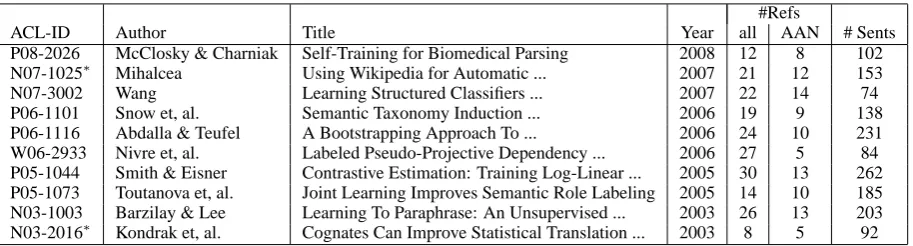
Table 1: Papers chosen from AAN as source papers for the evaluation corpus, together with their publi-cation year, number of references (in AAN) and number of sentences. Papers marked with∗are used to calculate inter-judge agreement.
2 Prior Work
Analyzing the structure of scientific articles and their relations has received a lot of attention re-cently. The structure of citation and collaboration networks has been studied in (Teufel et al., 2006; Newman, 2001), and summarization of scientific documents is discussed in (Teufel and Moens, 2002). In addition, there is some previous work on the importance of citation sentences. Elkiss et al, (Elkiss et al., 2008) perform a large-scale study on citations in the free PubMed Central (PMC) and show that they contain information that may not be present in abstracts. In other work, Nanba et al, (Nanba and Okumura, 1999; Nanba et al., 2004b; Nanba et al., 2004a) analyze citation sen-tences and automatically categorize them in order to build a tool for survey generation.
The text of scientific citations has been used in previous research. Bradshaw (Bradshaw, 2002; Bradshaw, 2003) uses citations to determine the content of articles. Similarly, the text of cita-tion sentences has been directly used to produce summaries of scientific papers in (Qazvinian and Radev, 2008; Mei and Zhai, 2008; Mohammad et al., 2009). Determining the scientific attribu-tion of an article has also been studied before. Siddharthan and Teufel (Siddharthan and Teufel, 2007; Teufel, 2005) categorize sentences accord-ing to their role in the author’s argument into pre-defined classes: Own, Other, Background, Tex-tual, Aim, Basis, Contrast.
Little work has been done on automatic cita-tion extraccita-tion from research papers. Kaplan et al, (Kaplan et al., 2009) introduces “citation-site” as a block of text in which the cited text is dis-cussed. The mentioned work uses a machine learning method for extracting citations from
re-search papers and evaluates the result using 4 an-notated articles.
In our work we use graphical models to ex-tract context sentences. Graphical models have a number of properties and corresponding tech-niques and have been used before on Information Retrieval tasks. Romanello et al, (Romanello et al., 2009) use Conditional Random Fields (CRF) to extract references from unstructured text in dig-ital libraries of classic texts. Similar work include term dependency extraction (Metzler and Croft, 2005), query expansion (Metzler and Croft, 2007), and automatic feature selection (Metzler, 2007).
3 Data
The ACL Anthology Network (AAN)2 is a col-lection of papers from the ACL Anthology3 pub-lished in the Computational Linguistics journal and proceedings from ACL conferences and work-shops and includes more than14,000papers over a period of four decades (Radev et al., 2009). AAN includes the citation network of the papers in the ACL Anthology. The papers in AAN are publicly available in text format retrieved by an OCR process from the original pdf files, and are segmented into sentences.
To build a corpus for our experiments we picked 10 recently published papers from various areas in NLP4, each of which had references for a to-tal of 203 candidate paper-reference pairs. Table 1 lists these papers together with their authors, titles, publication year, number of references, number of references within AAN, and the number of
sen-2
http://clair.si.umich.edu/clair/anthology/ 3
http://www.aclweb.org/anthology-new/
L&PS&al Sentence
· · ·
C C Jacquemin (1999) and Barzilay and McKeown (2001) identify
phrase level paraphrases, while Lin and Pantel (2001) and
Shinyama et al. (2002) acquire structural paraphrases encoded
as templates.
1 1 These latter are the most closely related to the sentence-level
para-phrases we desire, and so we focus in this section on template-induction approaches.
C 0 Lin and Pantel (2001) extract inference rules, which are related
to paraphrases (for example, X wrote Y implies X is the author of Y), to improve question answering.
1 0 They assume that paths in dependency trees that take similar
argu-ments (leaves) are close in meaning.
1 0 However, only two-argument templates are considered.
0 C Shinyama et al. (2002) also use dependency-tree information to
extract templates of a limited form (in their case, determined by the underlying information extraction application).
1 1 Like us (and unlike Lin and Pantel, who employ a single large
corpus), they use articles written about the same event in different newspapers as data.
1 1 Our approach shares two characteristics with the two methods just
described: pattern comparison by analysis of the patterns respec-tive arguments, and use of nonparallel corpora as a data source.
0 0 However, extraction methods are not easily extended to generation
methods.
1 1 One problem is that their templates often only match small
frag-ments of a sentence.
1 1 While this is appropriate for other applications, deciding whether
to use a given template to generate a paraphrase requires informa-tion about the surrounding context provided by the entire sentence.
[image:3.595.308.533.63.94.2]· · ·
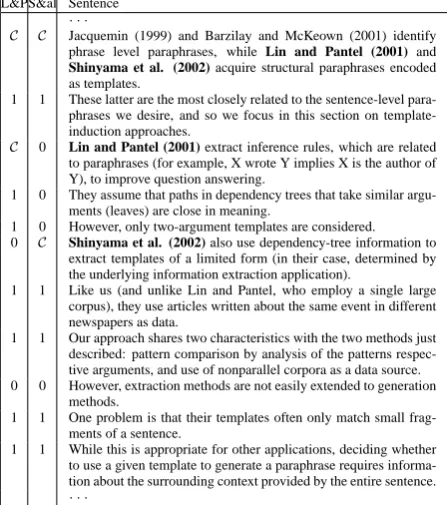
Table 2: Part of the annotation for N03-1003 with respect to two of its references “Lin and Pan-tel (2001)” (the first column) “Shinyama et al. (2002)” (the second column). Cs indicate explicit citations, 1s indicate implicit citations and 0s are none.
tences.
3.1 Annotation Process
We annotated the sentences in each paper from Ta-ble 1. Each annotation instance in our setting cor-responds to a paper-reference pair, and is a vec-tor in which each dimension corresponds to a sen-tence and is marked with aC if it explicitly cites the reference, and with a 1 if it implicitly talks about it. All other sentences are marked with0s. Table 2 shows a portion of two separate annota-tion instances of N03-1003 corresponding to two of its references. Our annotation has resulted in 203 annotation instances each corresponding to one paper-reference pair. The goal of this work is to automatically identify all context sentences, which are marked as “1”.
3.1.1 Inter-judge Agreement
We also asked a neutral annotator5 to annotate two of our datasets that are marked with∗in Ta-ble 1. For each paper-reference pair, the annotator was provided with a vector in which explicit
cita-5Someone not involved with the paper but an expert in NLP.
ACL-ID vector size # Annotations κ N07-1025∗ 153 21 0.889±0.30
[image:3.595.72.296.65.318.2]N03-2016∗ 92 8 0.853±0.35
Table 3: Average κ coefficient as inter-judge agreement for annotations of two sets
tions were already marked with Cs. The annota-tion guidelines instructed the annotator to look at each explicit citation sentence, and read up to 15 sentences before and after, then mark context sen-tences around that sentence with1s. Next, the 29 annotation instances done by the external annota-tor were compared with the corresponding anno-tations that we did, and the Kappa coefficient (κ) was calculated. Theκstatistic is formulated as
κ= Pr(a)−Pr(e) 1−Pr(e)
where P r(a) is the relative observed agreement among raters, andP r(e)is the probability that an-notators agree by chance if each annotator is ran-domly assigning categories. To calculateκ, we ig-nored all explicit citations (since they were pro-vided to the external annotator) and used the bi-nary categories (i.e., 1 for context sentences, and 0 otherwise) for all other sentences. Table 3 shows the annotation vector size (i.e., number of sen-tences), number of annotation instances (i.e., num-ber of references), and averageκfor each set. The average κ is above 0.85 in both cases, suggest-ing that the annotation process has a low degree of subjectivity and can be considered reliable.
3.2 Analysis
gap size 0 1 2 4 9 10 15 16 instance 273 14 2 1 2 1 1 1
Table 4: The distribution of gaps in the annotated data
sentences may result in information loss about the contributions of the cited paper.
1 2 3 4 5 6 7 8 9 0
20 40 60 80 100 120 140
cit 10
0
101
10−3 10−2
10−1 100
cit p(cit)
alpha= 3.13; D=0.02
a b
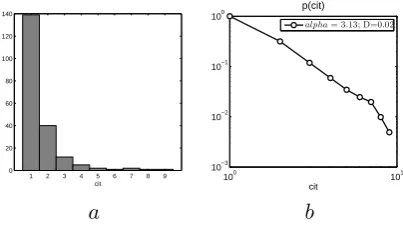
Figure 1: (a) Histogram of the number of differ-ent citations to each reference in a paper. (b) The distribution observed for the number of different citations on a log-log scale.
Next, we investigate the distance between con-text sentences and the closest citations. For each context sentence, we find its distance to the clos-ets context sentence or explicit citation. Formally, we define the gap to be the number of sentences between a context sentence (marked with 1) and the closest context sentence or explicit citation (marked with either C or 1) to it. For example, the second column of Table 2 shows that there is a gap of size 1 in the9th sentence in the set of
con-text and citation sentences about Shinyama et al. (2002). Table 4 shows the distribution of gap sizes in the annotated data. This observation suggests that the majority of context sentences directly oc-cur after or before a citation or another context sentence. However, it shows that gaps between sentences describing a cited paper actually exist, and a proposed method should have the capability to capture them.
4 Proposed Method
In this section we propose our methodology that enables us to identify the context information of a cited paper. Particularly, the task is to assign a bi-nary labelXC to each sentenceSifrom a paperS,
where XC = 1shows a context sentence related
to a given cited paper, C. To solve this problem we propose a systematic way to model the net-work level relationship between consecutive
sen-tences. In summary, each sentence is represented with a node and is given two scores (context, non-context), and we update these scores to be in har-mony with the neighbors’ scores.
A particular class of graphical models known as Markov Random Fields (MRFs) are suited for solving inference problems with uncertainty in ob-served data. The data is modeled as an undirected graph with two types of nodes: hidden and ob-served. Observed nodes represent values that are known from the data. Each hidden nodexu,
cor-responding to an observed nodeyu, represents the
true state underlying the observed value. The state of a hidden node is related to the value of its cor-responding observed node as well as the states of its neighboring hidden nodes.
The local Markov property of an MRF indi-cates that a variable is conditionally independent on all other variables given its neighbors: xv ⊥
⊥xV\cl(v)|xne(v), wherene(v)is the set of neigh-bors ofv, andcl(v) = {v} ∪ne(v)is the closed neighborhood ofv. Thus, the state of a node is as-sumed to statistically depend only upon its hidden node and each of its neighbors, and independent of any other node in the graph given its neighbors. Dependencies in an MRF are represented using two functions: Compatibility function (ψ) and Po-tential function (φ). ψuv(xc, xd) shows the edge
potential of an edge between two nodes u, v of classes xc and xd. Large values of ψuv would
indicate a strong association between xc and xd
at nodes u, v. The Potential function, φi(xc, yc),
shows the statistical dependency between xc and
ycat each nodeiassumed by the MRF model.
In order to find the marginal probabilities of
xis in a MRF we can use Belief Propagation
(BP) (Yedidia et al., 2003). If we assume theyis
are fixed and show φi(xi, yi) by φi(xi), we can
find the joint probability distribution for unknown variablesxias
p({x}) = 1
Z
Y
ij
ψij(xi, xj)
Y
i
φi(xi)
In the BP algorithm a set of new variablesmis introduced wheremij(xj) is the message passed
fromitojabout what statexjshould be in. Each
message, mij(xj), is a vector with the same
di-mensionality ofxjin which each dimension shows
Figure 2: The illustration of the message updating rule. Elements that make up the message from a nodeito another nodej: messages fromi’s neigh-bors, local evidence ati, and propagation function between i, j summed over all possible states of nodei.
nodei, in the BP algorithm, is also a vector with the same dimensionality of messages, and is pro-portional to the local evidence as well as all mes-sages from the node’s neighbors:
bi(xi)←kφi(xi)
Y
j∈ne(i)
mji(xi) (1)
where k is the normalization factor of the be-liefs about different classes. The message passed fromitojis proportional to the propagation func-tion betweeni, j, the local evidence at i, and all messages sent toifrom its neighbors exceptj:
mij(xj)←
X
xi
φi(xi)ψij(xi, xj)
Y
k∈ne(i)\j
[image:5.595.117.246.65.158.2]mki(xi) (2)
Figure 2 illustrates the message update rule. Convergence can be determined based on a va-riety of criteria. It can occur when the maximum change of any message between iteration steps is less than some threshold. Convergence is guaran-teed for trees but not for general graphs. However, it typically occurs in practice (McGlohon et al., 2009). Upon convergence, belief scores are deter-mined by Equation 1.
4.1 MRF construction
To find the sentences from a paper that form the context information of a given cited paper, we build an MRF in which a hidden node xi and
an observed nodeyi correspond to each sentence.
The structure of the graph associated with the MRF is dependent upon the validity of a basic as-sumption. This assumption indicates that the gen-eration of a sentence (in form of its words) only
(a) (b)
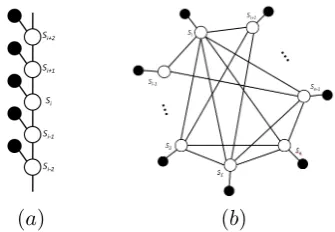
Figure 3: The structure of the MRF constructed based on the independence of non-adjacent sen-tences; (a) left, each sentence is independent on all other sentences given its immediate neighbors. (b) right, sentences have dependency relationship with each other regardless of their position.
depends on its surrounding sentences. Said dif-ferently, each sentence is written independently of all other sentences given a number of its neigh-bors. This local dependence assumption can result in a number of different MRFs, each built assum-ing a dependency between a sentence and all sen-tences within a particular distance. Figure 3 shows the structure of the two MRFs at either extreme of the local dependence assumption. In Figure 3 a, each sentence only depends on one following and one preceding sentence, while Figure 3 b shows an MRF in which sentences are dependent on each other regardless of their position. We refer to the former byBP1, and to the latter byBPn.
Gen-erally, we use BPi to denote an MRF in which
each sentence is connected to isentences before and after.
ψij(xc, xd) xd= 0 xd= 1
xc = 0 0.5 0.5
xc = 1 1−Sij Sij
Table 5: The compatibility function ψ between any two nodes in the MRFs from the sentences in scientific papers
4.2 Compatibility Function
[image:5.595.343.488.533.577.2]it has no effect on its neighbors’ classes. In con-trast, ifiis in class1its belief about its neighbor
j is determined by their mutual lexical similarity. If this similarity is close to 1 it indicates a stronger tie between i, j. However, ifi, j are not similar,
i’s probability of being in class 1, should not af-fect that of j’s. To formalize this assumption we use the sigmoid of the cosine similarity of two sen-tences to buildψ. More formally, we defineS to be
Sij =
1 1 +e−cosine(i,j)
The sigmoid function obtains a value of 0.5 for a cosine of 0 indicating that there is no bias in the association of the two sentences. The matrix in Ta-ble 5 shows the compatibility function built based on the above arguments.
4.3 Potential Function
The node potential function of an MRF can incor-porate some other features observable from data. Here, the goal is to find all sentences that are about a specific cited paper, without having explicit cita-tions. To build the node potential function of the observed nodes, we use some sentence level fea-tures. First, we use the explicit citation as an im-portant feature of a sentence. This feature can af-fect the belief of the corresponding hidden node, which can in turn affect its neighbors’ beliefs. For a given paper-reference pair, we flag (with a 1) each sentence that has an explicit citation to the reference.
The second set of features that we are inter-ested in are discourse-based features. In particu-lar we match each sentence with specific patterns and flag those that match. The first pattern is a bi-gram in which the first term matches any of “this; that; those; these; his; her; their; such; previ-ous”, and the second term matches any of “work; approach; system; method; technique; result; ex-ample”. The second pattern includes all sentences that start with “this; such”.
Finally, the similarity of each sentence to the reference is observable from the data and can be used as a sentence-level feature. Intuitively, if a sentence has higher similarity with the reference paper, it should have a higher potential of being in class 1 or C. The flag of each sentence here is a value between 0 and 1 and is determined by its cosine similarity to the reference. Once the flags for each sentence,Siare determined, we calculate
normalizedfi as the unweighted linear
combina-tion of individual features. Based onfis, we
com-pute the potential function,φ, as shown in Table 6.
φi(xc, yc) xc = 0 xc = 1
1−fi fi
Table 6: The node potential function φfor each node in the MRFs from the sentences in scientific papers is built using the sentences’ flags computed using sentence level features.
5 Experiments
The intrinsic evaluation of our methodology means to directly compare the output of our method with the gold standards obtained from the annotated data. Our methodology finds the sen-tences that cite a reference implicitly. Therefore the output of the inference method is a vector,υ, of 1’s and 0’s, whereby a 1 at element i means that sentence i in the source document is a con-text sentence about the reference while a0means an explicit citation or neither. The gold standard for each paper-reference pair,ω(obtained from the annotated vectors in Section 3.1 by changing all Cs to0s), is also a vector of the same format and dimensionality.
Precision, recall, andFβfor this task can be
de-fined as
p=υ·ω
υ·1; r=
υ·ω
ω·1; Fβ=
(1 +β2)p·r
β2p+r (3)
where 1 is a vector of 1’s with the same dimen-sionality andβ is a non-negative real number.
5.1 Baseline Methods
The first baseline that we use is an IR-based method. This baseline,B1, takes explicit citations
as an input but use them to find context sentences. Given a paper-reference pair, for each explicit ci-tation sentence, marked withC,B1 picks its
pre-ceding and following sentences if their similarities to that sentence is greater than a cutoff (the median of all such similarities), and repeats this for neigh-boring sentences of newly marked sentences. In-tuitively,B1 tries to find the best chain (window)
around citing sentences.
paper B1 B2 SVM BP1 BP4 BPn
P08-2026 0.441 0.237 0.249 0.470 0.613 0.285
N07-1025 0.388 0.102 0.124 0.313 0.466 0.138
N07-3002 0.521 0.339 0.232 0.742 0.627 0.315
P06-1101 0.125 0.388 0.127 0.649 0.889 0.193
P06-1116 0.283 0.104 0.100 0.307 0.341 0.130
W06-2933 0.313 0.100 0.176 0.338 0.413 0.160
P05-1044 0.225 0.100 0.060 0.172 0.586 0.094
P05-1073 0.144 0.100 0.144 0.433 0.518 0.171
N03-1003 0.245 0.249 0.126 0.523 0.466 0.125
[image:7.595.155.444.60.211.2]N03-2016 0.100 0.181 0.224 0.439 0.482 0.185
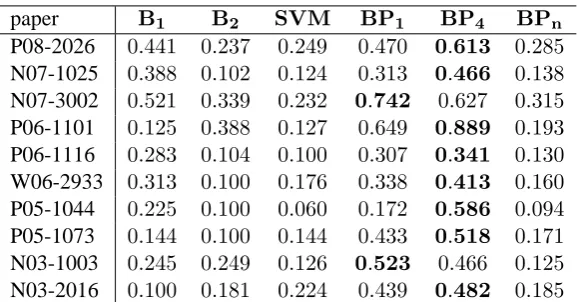
Table 7: AverageFβ=3 for similarity based baseline (B1), discourse-based baseline (B2), a supervised
method (SVM) and three MRF-based methods.
each sentence that is within a particular distance (4 in our experiments) of an explicit citation and matches one of the two patterns mentioned in Sec-tion 4.3. After marking all such sentences, B2
also marks all sentences between them and the closest explicit citation, which is no farther than 4 sentences away. This baseline helps us under-stand how effectively this sentence level feature can work in the absence of other features and the network structure.
Finally, we use a supervised method, SVM,
to classify sentences as context/non-context. We use 4 features to train the SVM model. These
4 features comprise the 3 sentence level features used in MRF’s potential function (i.e., similar-ity to reference, explicit citation, matching certain regular-expressions) and a network level feature: distance to the closes explicit citation. For each source paper, P, we use all other source papers and their source-reference annotation instances to train a model. We then use this model to clas-sify all instances in P. Although the number of references and thus source-reference pairs are dif-ferent for difdif-ferent papers, this can be considered similar to a 10-fold cross validation scheme, since for each source paper the model is built using all source-reference pairs of all other 9 papers.
We compare these baselines with 3 MRF-based systems each with a different assumption about in-dependence of sentences. BP1 denotes an MRF
in which each sentence is only connected to 1 sen-tence before and after. In BP4 locality is more
relaxed and each sentence is connected to 4 sen-tences on each sides. BPn denotes an MRF in
which all sentences are connected to each other regardless of their position in the paper.
Table 7 shows Fβ=3 for our experiments and
shows how BP4 outperforms the other methods
on average. The value 4 may suggest the fact that although sentences might be independent of dis-tant sentences, they depend on more than one sen-tence on each side.
The final experiment we do to intrinsically eval-uate the MRF-base method is to compare differ-ent sdiffer-entence-level features. The first feature used to build the potential function is explicit citations. This feature does not directly affect context sen-tences (i.e., it affects the marginal probability of context sentences through the MRF network con-nections). Therefore, we do not alter this fea-ture in comparing different feafea-tures. However, we look at the effect of the second and the third tures: hand-crafted regular expression-based fea-tures and similarity to the reference. For each pa-per, we useBP4to perform 3 experiments: two in
absence of each feature and one including all fea-tures. Figure 4 shows the average Fβ=3 for each
experiment. This plot shows that the features lead to better results when used together.
6 Impact on Survey Generation
We also performed an extrinsic evaluation of our context extraction methodology. Here we show how context sentences add important survey-worthy information to explicit citations. Previous work that generate surveys of scientific topics use the text of citation sentences alone (Mohammad et al., 2009; Qazvinian and Radev, 2008). Here, we show how the surveys generated using citations and their context sentences are better than those generated using citation sentences alone.
... Naturally, our current work on question answering for the reading comprehension task is most related to those of (Hirschman et al. , 1999; Charniak et al. , 2000; Riloffand Thelen, 2000 ; Wang et al. , 2000). In fact, all of this
body of work as well as ours are evaluated on the same set of test stories, and are developed (or trained) on the same development set of stories. The work of (Hirschman et al. , 1999) initiated this series of work, and it reported
an accuracy of 36.3% on answering the questions in the test stories. Subsequently, the work of (Riloffand Thelen ,
2000) and (Chaxniak et al. , 2000) improved the accuracy further to 39.7% and 41%, respectively. However, all of these three systems used handcrafted, deterministic rules and algorithms...
...The cross-model comparison showed that the performance ranking of these models was: U-SVM>PatternM
>S-SVM>Retrieval-M. Compared with retrieval-based [Yang et al. 2003], pattern-based [Ravichandran et al. 2002
and Soubbotin et al. 2002], and deep NLP-based [Moldovan et al. 2002, Hovy et al. 2001; and Pasca et al. 2001] answer selection, machine learning techniques are more effective in constructing QA components from scratch. These
techniques suffer, however, from the problem of requiring an adequate number of handtagged question-answer training pairs. It is too expensive and labor intensive to collect such training pairs for supervised machine learning techniques ...
... As expected, the definition and person-bio answer types are covered well by these resources. The web has been employed for pattern acquisition (Ravichandran et al. , 2003), document retrieval (Dumais et al. , 2002), query expansion (Yang et al. , 2003), structured information extraction, and answer validation (Magnini et al. , 2002). Some
of these approaches enhance existing QA systems, while others simplify the question answering task, allowing a less complex approach to find correct answers ...
Table 8: A portion of the QA survey generated by LexRank using the context information.
Figure 4: AverageFβ=3 forBP4 employing
dif-ferent features.
that contains two sets of cited papers and corre-sponding citing sentences, one on Question An-swering (QA) with 10 papers and the other on De-pendency Parsing (DP) with 16 papers. The QA set contains two different sets of nuggets extracted by experts respectively from paper abstracts and citation sentences. The DP set includes nuggets extracted only from citation sentences. We use these nugget sets, which are provided in form of regular expressions, to evaluate automatically gen-erated summaries. To perform this experiment we needed to build a new corpus that includes con-text sentences. For each citation sentence,BP4is
used on the citing paper to extract the proper con-text. Here, we limit the context size to be 4 on each side. That is, we attach to a citing sentence any of its 4 preceding and following sentences if
citation survey context survey
QA
CT nuggets 0.416 0.634
AB nuggets 0.397 0.594
DP
[image:8.595.77.295.301.463.2]CT nuggets 0.324 0.379
Table 9: Pyramid Fβ=3 scores of automatic
surveys of QA and DP data. The QA surveys are evaluated using nuggets drawn from citation texts (CT), or abstracts (AB), and DP surveys are evaluated using nuggets from citation texts (CT).
BP4 marks them as context sentences. Therefore, we build a new corpus in which each explicit ci-tation sentence is replaced with the same sentence attached to at most 4 sentence on each side.
After building the context corpus, we use LexRank (Erkan and Radev, 2004) to generate 2 QA and 2 DP surveys using the citation sentences only, and the new context corpus explained above. LexRank is a multidocument summarization sys-tem, which first builds a cosine similarity graph of all the candidate sentences. Once the network is built, the system finds the most central sentences by performing a random walk on the graph. We limit these surveys to be of a maximum length of 1000 words. Table 8 shows a portion of the sur-vey generated from the QA context corpus. This example shows how context sentences add mean-ingful and survey-worthy information along with citation sentences. Table 9 shows the Pyramid
data. The QA surveys are evaluated using nuggets drawn from citation texts (CT), or abstracts (AB), and DP surveys are evaluated using nuggets from citation texts (CT). In all evaluation instances the surveys generated with the context corpora excel at covering nuggets drawn from abstracts or cita-tion sentences.
7 Conclusion
In this paper we proposed a framework based on probabilistic inference to extract sentences that appear in the scientific literature, and which are about a secondary source, but which do not con-tain explicit citations to that secondary source. Our methodology is based on inference in an MRF built using the similarity of sentences and their lexical features. We show, by numerical exper-iments, that an MRF in which each sentence is connected to only a few adjacent sentences prop-erly fits this problem. We also investigate the use-fulness of such sentences in generating surveys of scientific literature. Our experiments on generat-ing surveys for Question Answergenerat-ing and Depen-dency Parsing show how surveys generated using such context information along with citation sen-tences have higher quality than those built using citations alone.
Generating fluent scientific surveys is difficult in absence of sufficient background information. Our future goal is to combine summarization and bibliometric techniques towards building au-tomatic surveys that employ context information as an important part of the generated surveys.
8 Acknowledgments
The authors would like to thank Arzucan ¨Ozg¨ur from University of Michigan for annotations.
This paper is based upon work supported by the National Science Foundation grant ”iOPENER: A Flexible Framework to Support Rapid Learning in Unfamiliar Research Domains”, jointly awarded to University of Michigan and University of Mary-land as IIS 0705832. Any opinions, findings, and conclusions or recommendations expressed in this paper are those of the authors and do not necessar-ily reflect the views of the National Science Foun-dation.
References
Shannon Bradshaw. 2002. Reference Directed Index-ing: Indexing Scientific Literature in the Context of Its Use. Ph.D. thesis, Northwestern University.
Shannon Bradshaw. 2003. Reference directed index-ing: Redeeming relevance for subject search in ci-tation indexes. In Proceedings of the 7th European Conference on Research and Advanced Technology for Digital Libraries.
Aaron Elkiss, Siwei Shen, Anthony Fader, G¨unes¸ Erkan, David States, and Dragomir R. Radev. 2008. Blind men and elephants: What do citation sum-maries tell us about a research article? Journal of the American Society for Information Science and Technology, 59(1):51–62.
G¨unes¸ Erkan and Dragomir R. Radev. 2004. Lexrank: Graph-based centrality as salience in text summa-rization. Journal of Artificial Intelligence Research (JAIR).
Dain Kaplan, Ryu Iida, and Takenobu Tokunaga. 2009. Automatic extraction of citation contexts for re-search paper summarization: A coreference-chain based approach. In Proceedings of the 2009 Work-shop on Text and Citation Analysis for Scholarly Digital Libraries, pages 88–95, Suntec City, Sin-gapore, August. Association for Computational Lin-guistics.
Mary McGlohon, Stephen Bay, Markus G. Anderle, David M. Steier, and Christos Faloutsos. 2009. Snare: a link analytic system for graph labeling and risk detection. In KDD ’09: Proceedings of the 15th ACM SIGKDD international conference on Knowl-edge discovery and data mining, pages 1265–1274.
Qiaozhu Mei and ChengXiang Zhai. 2008. Generating impact-based summaries for scientific literature. In Proceedings of ACL ’08, pages 816–824.
Donald Metzler and W. Bruce Croft. 2005. A markov random field model for term dependencies. In SI-GIR ’05: Proceedings of the 28th annual interna-tional ACM SIGIR conference on Research and de-velopment in information retrieval, pages 472–479.
Donald Metzler and W. Bruce Croft. 2007. Latent con-cept expansion using markov random fields. In SI-GIR ’07: Proceedings of the 30th annual interna-tional ACM SIGIR conference on Research and de-velopment in information retrieval, pages 311–318.
Donald A. Metzler. 2007. Automatic feature selection in the markov random field model for information retrieval. In CIKM ’07: Proceedings of the sixteenth ACM conference on Conference on information and knowledge management, pages 253–262.
In Proceedings of Human Language Technologies: The 2009 Annual Conference of the North American Chapter of the Association for Computational Lin-guistics, pages 584–592, Boulder, Colorado, June. Association for Computational Linguistics.
Hidetsugu Nanba and Manabu Okumura. 1999. To-wards multi-paper summarization using reference information. In IJCAI1999, pages 926–931.
Hidetsugu Nanba, Takeshi Abekawa, Manabu Oku-mura, and Suguru Saito. 2004a. Bilingual presri: Integration of multiple research paper databases. In Proceedings of RIAO 2004, pages 195–211, Avi-gnon, France.
Hidetsugu Nanba, Noriko Kando, and Manabu Oku-mura. 2004b. Classification of research papers us-ing citation links and citation types: Towards au-tomatic review article generation. In Proceedings of the 11th SIG Classification Research Workshop, pages 117–134, Chicago, USA.
Mark E. J. Newman. 2001. The structure of scientific collaboration networks. PNAS, 98(2):404–409.
Vahed Qazvinian and Dragomir R. Radev. 2008. Sci-entific paper summarization using citation summary networks. In COLING 2008, Manchester, UK.
Dragomir R. Radev, Pradeep Muthukrishnan, and Va-hed Qazvinian. 2009. The ACL anthology network corpus. In ACL workshop on Natural Language Processing and Information Retrieval for Digital Li-braries.
Matteo Romanello, Federico Boschetti, and Gregory Crane. 2009. Citations in the digital library of clas-sics: Extracting canonical references by using con-ditional random fields. In Proceedings of the 2009 Workshop on Text and Citation Analysis for Schol-arly Digital Libraries, pages 80–87, Suntec City, Singapore, August. Association for Computational Linguistics.
Advaith Siddharthan and Simone Teufel. 2007. Whose idea was this, and why does it matter? attribut-ing scientific work to citations. In Proceedattribut-ings of NAACL/HLT-07.
Simone Teufel and Marc Moens. 2002. Summarizing scientific articles: experiments with relevance and rhetorical status. Comput. Linguist., 28(4):409–445.
Simone Teufel, Advaith Siddharthan, and Dan Tidhar. 2006. Automatic classification of citation function. In Proceedings of the EMNLP, Sydney, Australia, July.
Simone Teufel. 2005. Argumentative Zoning for Im-proved Citation Indexing. Computing Attitude and Affect in Text: Theory and Applications, pages 159– 170.