Proceedings of the 2019 Conference on Empirical Methods in Natural Language Processing 6444
Towards Machine Reading for Interventions from
Humanitarian-Assistance Program Literature
Bonan Min, Yee Seng Chan, Haoling Qiu, and Joshua Fasching Raytheon BBN Technologies, Cambridge, Massachusetts
{bonan.min,yeeseng.chan,haoling.qiu,joshua.fasching}@raytheon.com
Abstract
Solving long-lasting problems such as food insecurity requires a comprehensive under-standing of interventions applied by govern-ments and international humanitarian assis-tance organizations, and their results and con-sequences. Towards achieving this grand goal, a crucial first step is to extract past interven-tions and when and where they have been ap-plied, from hundreds of thousands of reports automatically. In this paper, we developed a corpus annotated with interventions to foster research, and developed an information extrac-tion system for extracting intervenextrac-tions and their location and time from text. We demon-strate early, very encouraging results on ex-tracting interventions.
1 Introduction
The world is a complex socio-political system: there are long lasting problems such as food in-security, global warming and diseases affecting much of the world’s population, as well as burst-ing, extreme events such as war, natural disas-ters and financial crisis. Recently, there has been growing interests in applying event extraction to provide better situation awareness (“what hap-pened”), but rarely in terms of offering insight into providing guidance on what humanitarian assis-tance interventions have been applied in the past and how they influence the situation.
Furthermore, interventions may have intended outcomes and unintended consequences. An ex-ample of an unintended consequence is that free food distribution depresses prices for local pro-duce, and creates a disincentive for farmers. It is extremely useful to automatically extract interven-tions, their outcome and consequences from hun-dreds of thousands of articles, to provide to deci-sion makers in governments or humanitarian aid organizations a comprehensive understanding of
what intervention options are available when cri-sis happened, and what outcomes to expect when applying each of them.
This paper is a first step in this direction, starting with developing Information Extraction (IE) techniques to automatically extract interven-tions from text including academic studies, pro-gram/project guidance and evaluation documents from non-profit or international organizations.
We view interventions as a (series of) event(s)1 with time and space dimensions. For example:
S1:WFP is scaling up itsfood assistance activ-ities in Baghdad, Anbar, Dohuk and Ninewa gov-ernorates in 2018.
The intervention “Food Assistance” is happen-ing in the year 2018 in locations “Baghdad, Anbar, Dohuk and Ninewa governorates”. Being able to extract interventions and their location and time is a first step towards enabling comprehensive under-standing of their effects and consequences.
In this paper, we develop IE techniques towards reading for interventions. The basic methodology is to treat intervention extraction as an event ex-traction problem, and read intentional and factual statements about interventions in existing project documentation and evaluations literature. Our contributions are three fold:
• We construct a new corpus, annotated with interventions to foster research.
• We develop an IE algorithm for extracting in-terventions and their locations and time.
• Experiments show the effectiveness of our approach.
We discuss related work in the next section and describe our intervention extraction models in Section3. In Section4, we describe our ontology
1The main difference between an intervention and other
of intervention types and the intervention dataset. We present experiment results in Section5, before concluding in Section 6. The intervention cor-pus and source code are available at https:// github.com/BBN-E/mr-intervention.
2 Related Work
Event extraction is often formulated as a multi-stage (Ahn, 2006) classification (trigger clas-sification then argument identification) problem. Prior works either use high-level features (Huang and Riloff, 2012; Ji and Grishman, 2008) or are Neural Network models (Chen et al., 2015). Nguyen (2016) propose joint event extraction us-ing recurrent neural networks.
In need of labeled datasets for training models and evaluation, datasets such as MUC (Grishman and Sundheim, 1996), ACE (Doddington et al.,
2004) and Situation Frames (Strassel et al.,2017) have been developed. There are also datasets cre-ated for specific domains. An example is the GENIA biomedical event annotation (Kim et al.,
2008). Our work is the latest continuation along this path: creating a dataset to foster research in automatically extracting interventions from text, and demonstrating encouraging results.
3 Extraction Models
We model interventions as events. Given a sen-tence, we perform intervention extraction using a two-stage process:
• Trigger classification: Labeling words with their predicted intervention type (if any). For instance, in sentence S1, the extraction sys-tem should label “foodassistance”2as a trig-ger of an intervention typeprovide food.
• Argument classification: If a sentence con-tains predicted triggers {ti}, we pair each
ti with each entity and time mention {mj} in the sentence to generate candidate event arguments. Given a candidate argument (ti, mj), the system predicts its associated role (if any). For instance, given the can-didate argument (“food assistance”, “Bagh-dad”), it predicts the roleP lace.
To perform event trigger and argument classifi-cation, we developed two convolution neural net-work (CNN) models: one for performing trigger
2Our model makes predictions on single words, which we
[image:2.595.312.521.66.187.2]then automatically expand to phrases.
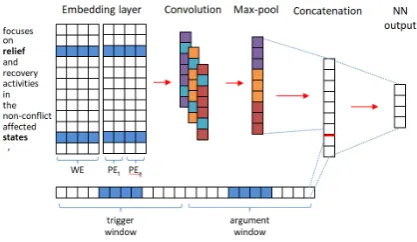
Figure 1: A CNN based model for event argument classification. WE is word embeddings. P Et and
P Eaare position embeddings, capturing a token’s dis-tance to the candidate trigger and argument respec-tively. These position embeddings are randomly ini-tialized and learnt during training.
extraction, and one for performing argument ex-traction. We show the argument model in Figure
1. These models are based on the work of Chen et al. (2015), which achieve competitive perfor-mance for event extraction.
Our trigger model uses pre-trained word em-beddings3(Baroni et al.,2014), and learns position embeddings during training (to represent relative distance of each word in the sentence to the can-didate trigger). Our argument model uses these, as well as position embeddings relative to the can-didate argument, and event embeddings (to rep-resent event type of predicted candidate trigger). The position and event embeddings are randomly initialized and learnt during training.
4 Intervention Ontology and Dataset
In this section, we first present the types of inter-ventions that we focus on, then describe a corpus annotated with intervention instances.
4.1 Intervention ontology
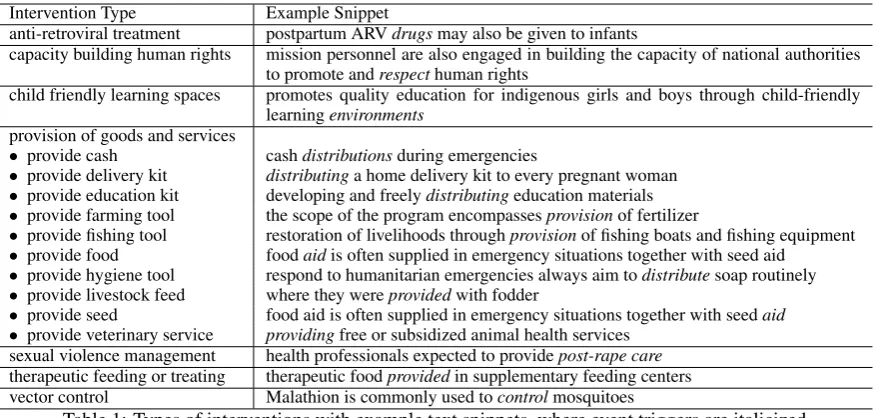
We focus on modeling interventions or humani-tarian assistances that are meant to alleviate mass suffering, improve socioeconomic conditions, and maintain human dignity. We list our intervention ontology in Table 1. Types include promotion ofanti-retroviralhealthcare, promoting respect of
human rights, ensuring children friendly learning spaces,management of sexual violence, therapeu-tic feeding of the severely malnourished, vector controlof insects and pests, andprovision of vari-ous humanitarian aidsuch as cash, food, etc.
3 EN-wform.w.5.cbow.neg10.400.subsmpl.txt.gz
Intervention Type Example Snippet
anti-retroviral treatment postpartum ARVdrugsmay also be given to infants
capacity building human rights mission personnel are also engaged in building the capacity of national authorities to promote andrespecthuman rights
child friendly learning spaces promotes quality education for indigenous girls and boys through child-friendly learningenvironments
provision of goods and services
• provide cash cashdistributionsduring emergencies
• provide delivery kit distributinga home delivery kit to every pregnant woman • provide education kit developing and freelydistributingeducation materials • provide farming tool the scope of the program encompassesprovisionof fertilizer
• provide fishing tool restoration of livelihoods throughprovisionof fishing boats and fishing equipment • provide food foodaidis often supplied in emergency situations together with seed aid
• provide hygiene tool respond to humanitarian emergencies always aim todistributesoap routinely • provide livestock feed where they wereprovidedwith fodder
• provide seed food aid is often supplied in emergency situations together with seedaid
• provide veterinary service providingfree or subsidized animal health services sexual violence management health professionals expected to providepost-rape care
[image:3.595.80.523.61.270.2]therapeutic feeding or treating therapeutic foodprovidedin supplementary feeding centers vector control Malathion is commonly used tocontrolmosquitoes
Table 1: Types of interventions with example text snippets, where event triggers are italicized.
4.2 An intervention corpus
State-of-the-art event extraction systems adopt a supervised approach where they learn from a cor-pus of manually labeled examples that are specific to a predefined event ontology. For instance, the Automatic Content Extraction (ACE) ( Dodding-ton et al., 2004) corpus contains more than 500 documents manually annotated with examples for 33 event types. We similarly take a supervised learning approach by collecting and annotating ex-amples for training extraction systems.
Humanitarian assistance programs are associ-ated with various documentation: project propos-als, guidances, progress reports, and evaluation re-ports on program execution. These documents are ideal for mining intervention instances. We col-lected several hundred documents from the fol-lowing sources:
• Literature reviews, e.g., the REFANI re-view4. which reviews Cash Transfer Pro-grammes and their impact on malnutrition in humanitarian contexts.
• Programme/project guidelines, e.g., the Sphere Handbook, which lists universal stan-dards in core areas of humanitarian response.
• Evaluation documents, which range from thorough external evaluation of intervention operations5, to brief presentations of re-sults in programme documents, and post-intervention summary articles.
4
www.actionagainsthunger.org/sites/default/files/ publications/REFANI-lit-review-2015 0.pdf
5E.g. bmcnutr.biomedcentral.com/articles/10.1186/
s40795-016-0102-6
• Programme documents by implementers6.
• Academic studies, such as
quasi-experimental studies from ebrary.ifpri.org.
4.3 Annotating intervention instances
We provided definitions and text examples for the intervention types 7 to two annotators, and then asked them to identify and annotate intervention instances for each document. Annotators are pro-vided with a User Interface (UI) (Chan et al.,
2019) which allows them to search for examples efficiently. 30 documents are annotated by two an-notators, resulting in an inter-annotator agreement of 0.83.
A total of 976 intervention instances (triggers) are found for the target intervention types. The “Count” column of Table2shows numbers of ex-amples for each intervention type.
5 Experiments
In this section, we first present experiments in ex-tracting interventions (triggers), and then describe early results on extracting locations and time for interventions.
As shown in Table1, a large number of the in-tervention types (e.g. provide cash, provide de-livery kit) have to do withprovision of goods and services. Although we have kept the labeling of these interventions separate during the annotation process, so that we could optionally perform fine-grained evaluation (and indeed we will later in this section), we found that these interventions share
6E.g. one.wfp.org/operations/current operations/
project docs/200275.pdf
Intervention Type Count F1-score anti-retroviral treatment 114 0.59 capacity building human rights 65 0.68 child friendly learning spaces 39 0.30 provision of goods and services 432 0.77 sexual violence management 131 0.45 therapeutic feeding or treating 49 0.52 vector control 146 0.67
[image:4.595.75.285.60.154.2]Aggregate 976 0.68
Table 2: Intervention types with number of trigger ex-amples and F1-scores based on 5-fold cross validation.
common trigger words (e.g. “provide”, “provi-sion”, “distribute”, etc.) and really rely on their ar-guments (e.g. “cash”, “fertilizer”, “fishing boats”) for disambiguation. Hence, we perform two sets of trigger classification evaluation: coarse-grained and fine-grained.
5.1 Coarse-grained trigger classification
Our annotated trigger examples are spread across 240 documents. We perform 5-fold cross vali-dation to evaluate trigger classification, over the 7 intervention types shown in Table 2. In each fold, we use 20% of the documents as test data and the remainder as training data. We per-formed minimal hyper-parameters tuning, using 30 epochs and batch size of 40. These were found to achieve good performance in preliminary exper-iments where we had further split the training data into training and development. We follow (Chen et al.,2015) for the values of the remaining hyper-parameters, e.g. CNN filter size of 3, position and event embeddings of length 5, etc. In our evalua-tion, a trigger is correctly classified if its interven-tion event type and offsets match those of a refer-ence trigger. We show the coarse-grained trigger classification scores in the column “F1-score” of Table2. We obtained a micro-averaged F1-score of 0.68 from the cross validation experiments.
Analysis on the decoding results show that amples vary greatly in terms of difficulty in ex-tracting them. For example, for “sexual violence management”, some triggers are phrases such as “post-rape care” that are straightforward for a clas-sifier to recognize, if given sufficient training data. However, there is a long tail of examples where long range dependencies need to be resolved in or-der to type them correctly. For example, in “ coun-seling... sexual violence” and “clinical manage-ment... sexual abuse”, the trigger words are often more than 5 tokens far away from additional con-textual clues that indicate the target type. We leave modeling these as future work.
5.2 Fine-grained trigger classification
As mentioned earlier in this section, we pro-pose that the intervention typeprovision of goods and services rely on their event arguments (arti-facts involved) for disambiguation into the finer-grained interventions listed in Table 1. To en-able this, we first need to detect mentions of dif-ferent goods/services in text. We adopt a simple list-based approach, where we manually compiled lists 8 of descriptors for each category. For in-stance, we use the descriptors (“livestock feed”, “fodder”, “hay”, etc.) for the category livestock feed.
Then, when we note that our coarse-grained trigger model had predicted a trigger instance of
provision of goods and servicesin a sentence, we check the trigger’s surrounding context (5 token window) for mentions of livestock feed, farming tool,fishing tool, etc. We thus deterministically re-labelprovision of goods and servicesinto the ap-propriate finer-grained intervention type, depend-ing on which category of descriptor is present in the trigger’s context window. As shown in Table2, the coarse-grained F1-score ofprovision of goods and servicesis 0.77. After performing the deter-ministic re-labeling into finer-grained intervention types, we obtain an aggregate F1-score of 0.56 when evaluating against our fine-grained trigger labels. Recall misses such as those resulting from incomplete descriptor lists, and precision misses resulting from multiple descriptor categories be-ing present within a trigger’s surroundbe-ing context, contributed to the drop in F1-score.
5.3 Extracting locations and time
We leverage the ACE corpus, which contains an-notations ofPlace and Time event arguments, to train an event type independentPlace/Time argu-ment classifier, based on the neural architecture described in Section3. In our evaluation, an argu-ment is correctly classified if its event type, event argument role, and offsets match any of the refer-ence event arguments.
Africa countries are often the focus sites of hu-manitarian programs and agencies, such as the World Food Programme (WFP). Hence, to evalu-ate the performance of our argument model for in-tervention events, we randomly selected 250 doc-uments from around 6,000 docdoc-uments collected fromallafrica.com.
8These lists are available athttps://github.com/
We first apply our coarse-grained trigger classi-fier on these documents. We then ask annotators to evaluate trigger predictions and retain only correct ones (188 triggers), which we subsequently use to evaluate our argument classifier. We focus on us-ing correct triggers to evaluate argument classifi-cation, to avoid error propagation (from erroneous trigger predictions) from muddling a fair assess-ment of the arguassess-ment classifier.
Our annotators assigned a total of 15 Time ar-guments and 77 Place arar-guments to the 188 event triggers. Our argument classifier predicted a total of 12 Time arguments, giving a precision, recall, and F1 of 0.92, 0.73, and 0.81 respectively. Our argument classifier predicted 30Placearguments, giving a precision, recall, and F1 of 0.93, 0.36, and 0.52 respectively.
6 Conclusion and Future Work
In this paper, we introduced a new corpus anno-tated with intervention events, and presented a sys-tem that achieves encouraging results.
Our next step is to annotate more documents and make them available to the research commu-nity to foster research in this area. We also plan to addLocationandTimeannotation on top of the intervention annotation.
Acknowledgements
The authors would like to thank Ben Watkins and colleagues at Kimetrica LLC for the inspiring discussions on interventions, and providing initial definitions of intervention types in Table 1. The authors also would like to thank the anonymous reviewers for their insightful comments, which helped us to improve the final version of the paper.
This work was supported by DARPA/I2O
and U.S. Army Research Office Contract No. W911NF-18-C-0003 under the World Modelers program. The views, opinions, and/or findings contained in this article are those of the author and should not be interpreted as representing the official views or policies, either expressed or implied, of the Department of Defense or the U.S. Government. This document does not contain technology or technical data controlled under either the U.S. International Traffic in Arms Regulations or the U.S. Export Administration Regulations.
References
David Ahn. 2006. The stages of event extraction. In ARTE, pages 1–8, Sydney, Australia. Association for Computational Linguistics.
Marco Baroni, Georgiana Dinu, and German Kruszewski. 2014. Don’t count, predict! a systematic comparison of context-counting vs. context-predicting semantic vectors. InACL-2014, pages 238–247, Baltimore, USA.
Yee Seng Chan, Joshua Fasching, Haoling Qiu, and Bonan Min. 2019. Rapid customization for event extraction. InProceedings of the 57th Annual Meet-ing of the Association for Computational LMeet-inguis- Linguis-tics: System Demonstrations, pages 31–36, Flo-rence, Italy. Association for Computational Linguis-tics.
Yubo Chen, Liheng Xu, Kang Liu, Daojian Zeng, and Jun Zhao. 2015. Event extraction via dy-namic multi-pooling convolutional neural networks. In ACL-IJCNLP2-2015, pages 167–176, Beijing, China. Association for Computational Linguistics.
George R. Doddington, Alexis Mitchell, Mark A. Przy-bocki, Lance A. Ramshaw, Stephanie M. Strassel, and Ralph M. Weischedel. 2004. The automatic content extraction (ace) program - tasks, data, and evaluation. In LREC. European Language Re-sources Association.
Ralph Grishman and Beth Sundheim. 1996. Mes-sage understanding conference-6: A brief history. In COLING 1996 Volume 1: The 16th Interna-tional Conference on ComputaInterna-tional Linguistics, volume 1.
Ruihong Huang and Ellen Riloff. 2012.Modeling tex-tual cohesion for event extraction. In AAAI-CAI, AAAI’12, pages 1664–1670. AAAI Press.
Heng Ji and Ralph Grishman. 2008.Refining event ex-traction through cross-document inference. In ACL-HLT-2008, pages 254–262, Columbus, Ohio. Asso-ciation for Computational Linguistics.
Jin-Dong Kim, Tomoko Ohta, and Jun’ichi Tsujii. 2008. Corpus annotation for mining biomedi-cal events from literature. BMC bioinformatics, 9(1):10.
Thien Huu Nguyen, Kyunghyun Cho, and Ralph Gr-ishman. 2016. Joint event extraction via recurrent neural networks. InNAACL-HLT-2016, pages 300– 309, San Diego, California. Association for Compu-tational Linguistics.