243
Extending Event Detection to New Types with Learning from Keywords
Viet Dac LaiandThien Huu Nguyen Department of Computer and Information Science
University of Oregon, OR, USA
{vietl,thien}@cs.uoregon.edu
Abstract
Traditional event detection classifies a word or a phrase in a given sentence for a set of prede-fined event types. The limitation of such pre-defined set is that it prevents the adaptation of the event detection models to new event types. We study a novel formulation of event detec-tion that describes types via several keywords to match the contexts in documents. This fa-cilitates the operation of the models to new types. We introduce a novel feature-based attention mechanism for convolutional neural networks for event detection in the new for-mulation. Our extensive experiments demon-strate the benefits of the new formulation for new type extension for event detection as well as the proposed attention mechanism for this problem.
1 Introduction
Event detection (ED) is a task of information ex-traction that aims to recognize event instances (event mentions) in text and classify them into spe-cific types of interest. Event mentions are usu-ally associated with an event trigger/anchor in the sentence of the event mentions, functioning as the main word to evoke the event. For instance, in the sentence”She is going to leave to become chair-man of Time Inc.”, an ED system should be able to recognize that the word “leave” is triggering an event of type “End-Position”.
There have been two major approaches for ED in the literature. The first approach focuses on the development of linguistic features to feed into the statistical models (i.e., MaxEnt) (Ahn, 2006; Ji and Grishman,2008;Liao and Grishman,2010; McClosky et al.,2011). The second approach, on the other hand, relies on deep learning (i.e., con-volutional neural networks (CNN)) to automati-cally induce features from data (Chen et al.,2015; Nguyen et al., 2016a; Liu et al., 2017; Lu and
Nguyen, 2018), thus significantly improving the performance for ED.
One limitation of the current approaches for ED is the assumption of a predefined set of event types for which data is manually annotated to train the models. For example, the popular benchmark dataset ACE 2005 for ED annotates 8 types and 33 subtypes of events. Once the models have been trained in this way, they are unable to extract in-stances of new, yet related types (i.e., having zero performance on the new types). To extend the op-eration of these models into the new types, the common approach is to spend some effort anno-tating data for the new types to retrain the mod-els. Unfortunately, this is an expensive process as we might need to obtain a large amount of labeled data to adequately represent various new event types in practice. Such expensive annota-tion has hindered the applicaannota-tion of ED systems on new types and calls for a better way to formu-late the ED problem to facilitate the extension of the models to new event types.
new event types and mitigating the needs for large amounts of annotated data for the new types.
The goal of this paper is to evaluate the effec-tiveness of LFK in the new type extension setting for ED where the models are trained on labeled data from some types but applied to extract in-stances of unseen types. We would like to pro-mote this problem as a new task for ED for fu-ture research. To set the baselines for this prob-lem, we employ the ACE 2005 dataset and recast it into LFK. We examine the performance of the baseline models for ED in the traditional formu-lation when they are adapted to LFK. The exper-iments show that with the new formulation, such ED models can actually recognize new event types although their performance should be still further improved in future research. Finally, we demon-strate one possibility to improve the performance of the baseline ED models in LFK by present-ing a novel attention mechanism for CNNs based on the feature space to fuse the representations of the keywords and contexts. We achieve the state-of-the-art performance for the new type extension with the proposed attention mechanism.
2 Related work
In the last decade, many machine learning sys-tems have been introduced to solve ED. Before the era of the deep neural networks, these systems are mainly based on supervised learning using exten-sive feature engineering with the machine learning frameworks (Ahn, 2006; Ji and Grishman, 2008; Hong et al.,2011;Riedel et al.,2009;Riedel and McCallum,2011a,b;Miwa et al., 2014;Li et al., 2014,2015). Recently, many advanced deep learn-ing methods were introduced to enhance event de-tectors such as distributed word embedding (Chen et al.,2015;Nguyen et al.,2016b;Liu et al.,2017; Nguyen and Nguyen,2019), convolutional neural networks (Chen et al., 2015, 2017; Nguyen and Grishman, 2015; Nguyen et al., 2016b; Nguyen and Grishman, 2018), recurrent neural networks (Nguyen et al.,2016b;Sha et al.,2018), and the at-tention mechanism (Liu et al.,2017;Nguyen and Nguyen, 2018b;Liu et al., 2018). However, the models proposed in these work cannot extend their operation to new event types.
Regarding the new formulations for ED, pre-vious studies(Bronstein et al., 2015;Peng et al., 2016) also examine keywords to specify event types. However, these studies do not investigate
the new type extension setting as we do in this. Recently, zero-shot learning is employed for new types in event extraction(Huang et al.,2018); how-ever, the event types are specified via the possible roles of the arguments participating into the events in this work. It also uses complicated natural lan-guage processing toolkits, making it difficult to apply and replicate the settings. Our work em-phasizes the simplicity in the setting for new type extension to facilitate future research. Finally, ex-tending ED to the new type is investigated using real examples as new event types (Nguyen et al., 2016c). However, it requires a large number of ex-amples to perform well. Our work instead requires only a few keywords to help the models achieve reasonable performance on new types.
3 Learning-from-Keywords for ED
3.1 Task Definition
In the learning-from-keyword formulation for ED, the inputs include a context (i.e., ann-word sen-tenceX ={x1, x2, . . . , xn}with an anchor word
located at position a(the word xa)) and a set of
keywordsK. The words inKare the possible trig-ger words of some event type of interest. The goal is to predict whether the wordxa inS expresses
the event type specified by K or not (i.e., a bi-nary classification problem to decide whether the context matches the event keywords or not). An example in LFK thus has the form(X, xa, K, Y)
whereY is either 1 or 0 to indicate the match of
XandK.
3.2 Data Generation
To facilitate the evaluation of the ED models in LFK for the new type extension setting, we need to obtain training and test/development datasets so the keyword sets of the examples in the test/development datasets define event types that are different from those specified by the keyword sets in the training datasets. To our best knowl-edge, there is no existing data following LFK set-ting, therefore, in this section, we present a pro-cess to automatically generate an ED dataset for LFK setting from an existing ED dataset.
We obtain these datasets by leveraging ACE 2005, the popular benchmark datasets for ED. ACE 2005 dataset is annotated for 8 event types
T = {t1, t2, . . . , t8}, and 33 event subtypes
instances (Other ∈ S/ ) . As each event subtype in ACE 2005 is associated with one event type, let
Cibe the set of subtypes corresponding to the type
ti ∈ T. Also, let Kj be the set of trigger words
for the event mentions of the subtypesj ∈ S.Kis
collected from training set of ACE 2005.
To generate the training and test/development datasets, we first split the documents in ACE 2005 into three partsDtrain,Dtest andDdevfollowing
the previous work on ED (Li et al., 2013). They would contain event mentions for all the possible event types and subtypes inT andS. Assume that we want to extend the system to a new event type
ttarget ∈ T, we need a train set without ttarget.
So, we remove every event mention whose sub-type belongs to Ctarget from Dtrain. Whereas,
samples with subtypes in Ctarget ∪ {Other} are kept in Dtest and Ddev. The results of this
re-moval process are called as D0train, D0test and
D0dev(fromDtrain,DtestandDdev, respectively).
They will be used to generate the actual train-ing/test/development datasets for LFK, respec-tively.
Specifically, for each of these datasets (i.e.,
D0train, D0test and Ddev0 ), the goal is to produce the positive and negative examples in correspond-ing LFK datasets. Algorithm1shows the pseudo-code to generate the training dataset for LFK from
D0train. The same algorithm can be applied for the test and development dastasets of LFK, but replace
D0trainwithD0testandDdev0 respectively in line 2, and replaceS \ CtargetwithCtargetin line 10.
Since the number of positive examples inDtest
set is small, we choose two event types (i.e., Con-flictandLife) that have the largest numbers of pos-itive examples in Dtest as the target types.
Ap-plying the data generation procedure above, we generate a dataset in LFK for each of these target types.
4 Model
This section first presents the typical deep learning models in the traditional ED formulation adapted to LFK. We then introduce a novel attention mech-anism to improve such models for LFK.
4.1 Baselines
As CNNs have been applied to the traditional for-mulation of ED since the early day (Chen et al., 2015;Nguyen and Grishman,2015,2016), we fo-cus on the CNN-based model in this work and
Algorithm 1Training dataset generation for LFK
1: Dtrain+ , Dtrain− ← ∅,∅ .Positive and negative example sets
2: for(X, xa, sj)∈Dtrain0 do .whereX: a
sentence,xa∈X: the anchor word,sj ∈ S:
the corresponding subtype 3: ifsj 6=“Other”then
4: foru= 1..5do
5: Kju ← A subset of Kj \ {xa}: |Kju|= 4
6: D+train ← D+train ∪
{(X, xa, Kju,1)}
7: end for
8: else . s=“Other”
9: sv ←Some subtype inS \ Ctarget
10: K←A subset ofKv:|K|= 4
11: Dtrain− ←D−train∪ {(X, xa, K,0)}
12: end if 13: end for
14: returnDtrain+ andD−train
leave the other models for future research. Encoding Layer: To prepare the sentence S
and the anchor xa for the models, we first
con-vert each word xi ∈ S into a concatenated
vec-tor h0i = [pi, qi], in which pi ∈ Ru is the posi-tion embedding vector and qi ∈ Rd is the word embedding of xi. We follow the settings for pi
andqidescribed in (Nguyen and Grishman,2015).
This step transforms S into a sequence of vector
H0= (h01, h02, . . . , h0n).
Convolution Layers: Following (Chen et al., 2015;Nguyen and Grishman,2015), we apply a convolutional layers with multiple window sizes for the filtersW overH0, resulting in a sequence of hidden vectors H1 = (h1
1, h12, . . . , h1n). Note
that we pad H0 with zero vectors to ensure that
H1 still has nvectors. We can essentially run m
convolutional layers in this way that would lead to
msequences of hidden vectorsH1, H2, . . . , Hm. Keyword Representation: We generate the representation vectorVKfor the keyword setKby
taking the average of the embeddings of its words. Given the keyword vectors VK and the
hid-den vector sequences from CNNs for S (i.e.,
H1, H2, . . . , Hm), the goal is to produce the fi-nal representationR=G(VK, H1, H2, . . . , Hm),
in the end to perform classification). There are two immediate baselines to obtainRadapted from the models for traditional ED:
(i) Concat: In this method, we apply the usual max-pooling operation over the hidden vectors for the last CNN layer Hm whose result is concate-nated withVK to produceR (Nguyen and
Grish-man,2015;Chen et al.,2015).
(ii)Attention: This method applies the popular attention method to aggregate the hidden vectors in Hm using V
K as the query (Bahdanau et al.,
2015). The formulas forRare shown below:
ui=σ(Wuhmi +bu)
c=σ(Wc[VK, hma] +bc)
αi=
exp(c>ui)
P
jexp(c>uj)
R=X i
αihmi
4.2 Conditional Feature-wise Attention
The interaction between the keywords and hidden vectors in the baselines is only done in the last layer, letting the intermediate CNN layers to de-cide the computation themselves without consid-ering the information from the keywords.
To overcome this limitation, we propose to in-ject supervision signals for each CNN layer in the modeling process. In particular, given the se-quence of hidden vectorsHi = (hi1, hi2, . . . , hin)
obtained by thei-th CNN layer, instead of directly sendingHi to the next layer, we use VK to
gen-erate the representation vectorsγi andβi, aiming
to reveal the underlying information/constraints from the keywords that thei-th CNN layer should reason about. Such representation vectors condi-tion and bias the hidden vectors inHi toward the
keywords based on the feature-wise affine trans-formation (Perez et al., 2018). The conditioned hidden vectors from this process (called H¯i = (¯hi1,¯hi2, . . . ,¯hin)) would be sent to the next CNN layer where the conditional process guided by the keywords continues:
γi=σ(WγiVK+biγ)
βi=σ(WβiVK+biβ) ¯
hij =γi∗hij+βi
whereσis a non-linear function whileWi
γ, biγ, Wβi
andbiβare model parameters.
We call the operation described in this section the Conditional Feature-wise Attention (CFA). The application of CFA into the two baselines ConcatandAttention leads to two new methods Concat-CFAandAttention-CFArespectively.
5 Experiments
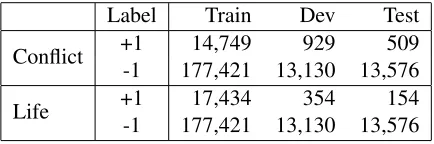
We use the datasets generated in Section 3.2 to evaluate the models in this section. Table1shows the staticstics of our generated datasets. This dataset will be publicly available to the commu-nity.
Label Train Dev Test
Conflict +1 14,749 929 509 -1 177,421 13,130 13,576
Life +1 17,434 354 154
[image:4.595.307.524.237.309.2]-1 177,421 13,130 13,576
Table 1: Numbers of the positive and negative samples of the LFK datasets.
5.1 Parameters
We examine four deep learning models: baselines (i.e.,ConcatandAttention) and the proposed mod-els (i.e.,Concat-CFAandAttention-CFA). Follow-ing (Nguyen and Grishman, 2015), we employ theword2vecword embeddings from (Mikolov et al.,2013) with 300 dimensions for the models in this work. The other parameters for the deep learning models in this work are tuned on the de-velopment datasets. In particular, we employ mul-tiple window sizes (i.e., 2, 3, 4 and 5) in the CNN layers, each has 100 filters. We use Adadelta as the optimizer with the learning rate set to 1.0. We apply a dropout with a rate of 0.5 to the final repre-sentation vectorR. Finally, we optimize the num-ber of CNN layers for each deep learning model.
In addition, we investigate the typical feature-based models with the MaxEnt classifier in the tra-ditional ED formulation for LFK to constitute the baselines for future research. In particular, we ex-amine four feature-based models for ED in LFK:
• Featurecombines the state-of-the-art feature set for ED designed in (Li et al., 2013) for the input context (S, xa) with the words in the
keyword setKto form its features
• Word2Vec utilizes the keyword representa-tionVKand the average of the embedding of
the words in the window size of 5 forxainS
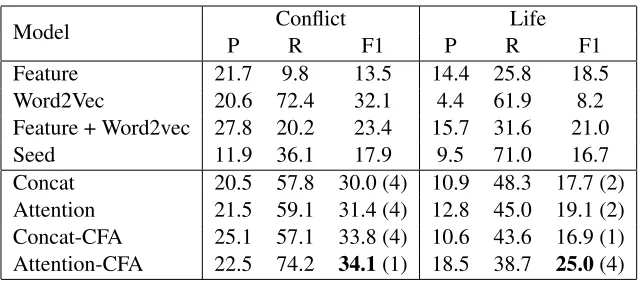
Model Conflict Life
P R F1 P R F1
Feature 21.7 9.8 13.5 14.4 25.8 18.5 Word2Vec 20.6 72.4 32.1 4.4 61.9 8.2 Feature + Word2vec 27.8 20.2 23.4 15.7 31.6 21.0
Seed 11.9 36.1 17.9 9.5 71.0 16.7
[image:5.595.138.458.60.201.2]Concat 20.5 57.8 30.0 (4) 10.9 48.3 17.7 (2) Attention 21.5 59.1 31.4 (4) 12.8 45.0 19.1 (2) Concat-CFA 25.1 57.1 33.8 (4) 10.6 43.6 16.9 (1) Attention-CFA 22.5 74.2 34.1(1) 18.5 38.7 25.0(4)
Table 2: Model performance. The numbers in the brackets indicate the optimized numbers of CNN layers.
• Feature + word2vecuses the aggregated fea-tures from above models
• Seedemploys the model with semantic fea-tures in (Bronstein et al.,2015).
5.2 Evaluation
Table 2 presents the performance of the models on the test performance for different datasets (i.e., withConflictandLifeas the target type). Among the features in the feature-based models, the em-bedding features in Word2Vec are very helpful for ED in LFK as the models with these features achieve the best performance (i.e., Word2Vec for
ConflictandFeature+Word2VecforLife). Among the deep learning models, the CFA-based mod-els (i.e.,Concat-CFAandAttention-CFA) are sig-nificantly better than their corresponding baseline models (i.e.,ConcatandAttention) over both Con-flict and Life with Attention. This confirms the benefits of CFA for ED in LFK.
Comparing the deep learning and the based models, it is interesting that the feature-based models with average word embedding fea-tures can perform better than the deep learning baseline models (i.e., Concat and Attention) for
Conflict. However, when the deep learning models are integrated with both attention and CFA (i.e.,
Attention-CFA), it achieves the best performance over both datasets. This helps to testify to the ad-vantage of deep learning and CFA for ED in the new type extension setting with LFK.
Finally, although the models can extract event mentions of the new types, the performance is still limited in general, illustrating the challenge of ED in this setting and leaving many rooms for future research (especially with deep learning) to improve the performance. We hope that the set-ting in this work presents a new way to evaluate
the effectiveness of the ED models.
6 Conclusion
We investigate a new formulation for event detec-tion task that enables the operadetec-tion of the models to new event types, featuring the use of keywords to specify the event types on the fly for the mod-els. A novel feature-wise attention technique is presented for the CNN models for ED in this for-mulation. Several models are evaluated to serve as the baselines for future research on this problem.
References
David Ahn. 2006. The stages of event extraction. In Proceedings of the Workshop on Annotating and Reasoning about Time and Events, pages 1–8.
Dzmitry Bahdanau, Kyunghyun Cho, and Yoshua Ben-gio. 2015. Neural machine translation by jointly learning to align and translate. InICLR.
Ofer Bronstein, Ido Dagan, Qi Li, Heng Ji, and Anette Frank. 2015. Seed-based event trigger labeling: How far can event descriptions get us? In ACL-IJCNLP (Volume 2: Short Papers), volume 2, pages 372–376.
Yubo Chen, Shulin Liu, Xiang Zhang, Kang Liu, and Jun Zhao. 2017. Automatically labeled data genera-tion for large scale event extracgenera-tion. InACL.
Yubo Chen, Liheng Xu, Kang Liu, Daojian Zeng, and Jun Zhao. 2015. Event extraction via dynamic multi-pooling convolutional neural networks. In ACL-IJCNLP (Volume 1: Long Papers), volume 1, pages 167–176.
Yu Hong, Jianfeng Zhang, Bin Ma, Jianmin Yao, Guodong Zhou, and Qiaoming Zhu. 2011. Using cross-entity inference to improve event extraction. InACL.
Heng Ji and Ralph Grishman. 2008. Refining event ex-traction through cross-document inference. InACL.
Qi Li, Heng Ji, Yu Hong, and Sujian Li. 2014. Con-structing information networks using one single model. InEMNLP.
Qi Li, Heng Ji, and Liang Huang. 2013. Joint event extraction via structured prediction with global fea-tures. InACL.
Xiang Li, Thien Huu Nguyen, Kai Cao, and Ralph Gr-ishman. 2015. Improving event detection with ab-stract meaning representation. InProceedings of the First Workshop on Computing News Storylines.
Shasha Liao and Ralph Grishman. 2010. Using doc-ument level cross-event inference to improve event extraction. InACL.
Jian Liu, Yubo Chen, Kang Liu, and Jun Zhao. 2018. Event detection via gated multilingual attention mechanism. InAAAI.
Shulin Liu, Yubo Chen, Kang Liu, and Jun Zhao. 2017. Exploiting argument information to improve event detection via supervised attention mechanisms. In ACL.
Weiyi Lu and Thien Huu Nguyen. 2018. Similar but not the same: Word sense disambiguation improves event detection via neural representation matching.
InEMNLP.
David McClosky, Mihai Surdeanu, and Christopher Manning. 2011. Event extraction as dependency parsing. InBioNLP Shared Task Workshop.
Tomas Mikolov, Ilya Sutskever, Kai Chen, Greg Cor-rado, and Jeffrey Dean. 2013. Distributed represen-tations of words and phrases and their composition-ality. InNIPS.
Makoto Miwa, Paul Thompson, Ioannis Korkontzelos, and Sophia Ananiadou. 2014. Comparable study of event extraction in newswire and biomedical do-mains. InCOLING.
Minh Nguyen and Thien Huu Nguyen. 2018b. Who is killed by police: Introducing supervised attention for hierarchical lstms. InCOLING.
Thien Nguyen and Ralph Grishman. 2018. Graph con-volutional networks with argument-aware pooling for event detection. InAAAI.
Thien Huu Nguyen, , Adam Meyers, and Ralph Gr-ishman. 2016a. New york university 2016 system for kbp event nugget: A deep learning approach. In TAC.
Thien Huu Nguyen, Kyunghyun Cho, and Ralph Gr-ishman. 2016b. Joint event extraction via recurrent neural networks. InNAACL.
Thien Huu Nguyen, Lisheng Fu, Kyunghyun Cho, and Ralph Grishman. 2016c. A two-stage approach for extending event detection to new types via neural networks. InProceedings of the 1st ACL Workshop on Representation Learning for NLP (RepL4NLP).
Thien Huu Nguyen and Ralph Grishman. 2015. Event detection and domain adaptation with convolutional neural networks. InACL-IJCNLP.
Thien Huu Nguyen and Ralph Grishman. 2016. Mod-eling skip-grams for event detection with convolu-tional neural networks. InEMNLP.
Trung Minh Nguyen and Thien Huu Nguyen. 2019. One for all: Neural joint modeling of entities and events. InAAAI.
Haoruo Peng, Yangqiu Song, and Dan Roth. 2016. Event detection and co-reference with minimal su-pervision. InEMNLP, pages 392–402.
Ethan Perez, Florian Strub, Harm De Vries, Vincent Dumoulin, and Aaron Courville. 2018. Film: Vi-sual reasoning with a general conditioning layer. In AAAI.
Sebastian Riedel, Hong-Woo Chun, Toshihisa Takagi, and Jun’ichi Tsujii. 2009. A markov logic approach to bio-molecular event extraction. InBioNLP 2009 Workshop.
Sebastian Riedel and Andrew McCallum. 2011a. Fast and robust joint models for biomedical event extrac-tion. InEMNLP.
Sebastian Riedel and Andrew McCallum. 2011b. Ro-bust biomedical event extraction with dual decom-position and minimal domain adaptation. InBioNLP Shared Task 2011 Workshop.