Proceedings of the First Workshop on Aggregating and Analysing Crowdsourced Annotations for NLP, pages 24–28 Hong Kong, China, November 3, 2019. c2019 Association for Computational Linguistics
24
A Dataset of Crowdsourced Word Sequences:
Collections and Answer Aggregation for Ground Truth Creation
Jiyi Li
University of Yamanashi, Kofu, Japan RIKEN AIP, Tokyo, Japan
Fumiyo Fukumoto
University of Yamanashi, Kofu, Japan
Abstract
The target outputs of many NLP tasks are word sequences. To collect the data for training and evaluating models, the crowd is a cheaper and easier to access than the oracle. To ensure the quality of the crowdsourced data, people can assign multiple workers to one question and then aggregate the multiple answers with di-verse quality into a golden one. How to aggre-gate multiple crowdsourced word sequences with diverse quality is a curious and challeng-ing problem. People need a dataset for ad-dressing this problem. We thus create a dataset (CrowdWSA2019) which contains the trans-lated sentences generated from multiple work-ers. We provide three approaches as the base-lines on the task of extractive word sequence aggregation. Specially, one of them is an orig-inal one we propose which models the reliabil-ity of workers. We also discuss some issues on ground truth creation of word sequences which can be addressed based on this dataset.
1 Introduction
For many tasks in NLP area, the target outputs are word sequences. To train and evaluate the models, the ground truth in the form of word sequences are required. Instead of the oracle which is expensive and has an insufficient number, the crowd which is cheaper and easier to access is a good alternative for collecting the gold standard data.
Because the ability of crowd workers is diverse, to guarantee the quality of the collected data, one solution is to generate redundant data by assigning multiple workers to one instance and then aggre-gate the multiple answers into golden ones. How to aggregate multiple word sequences with diverse quality is a research problem. In NLP areas such as machine translation, although a few evaluation metrics (Liu et al.,2016) such as BLEU (Papineni et al.,2002) can use multiple golden answers for
an instance, because the multiple crowdsourced answers are not golden ones, the aggregation ap-proach for generating a golden one based on these crowdsourced answers is indispensable.
In crowdsourcing area, there are many existing work on answer aggregation for labels (Dawid and Skene,1979;Whitehill et al., 2009;Zheng et al.,
2017).Snow et al.(2008) evaluated crowdsourced label annotations for some NLP tasks and used majority voting for label aggregation. However, there is little work on answer aggregation for word sequences. Nguyen et al.(2017) proposed an ag-gregation method based on HMM for a sequence of categorical labels and needs to be improved for aligning sparse and free word sequences. If treat-ing a word as a category, there are tens of thou-sands categories and a sequence only contains a small number of them. To address the problem of answer aggregation for word sequences, people need the datasets which contain multiple word se-quence answers provided by different crowd work-ers for one instance. However, we find that most of the existing datasets in NLP area only contain a single golden answer for one instance.
good word sequence from the candidates. One of them is our original approach which models the reliability of workers, because worker reliability is regarded as an important factor in label aggre-gation approaches (Zheng et al.,2017).
2 Datasets
2.1 Data Collections: CrowdWSA2019
A number of NLP tasks have the target outputs in the form of word sequences, e.g., machine transla-tion, text summarizatransla-tion, question and answering and so on. In different tasks, the properties of the word sequences, e.g., text length and syntax, can be different from each other. In this paper, without loss of generality, we create a dataset1 based on the machine translation task which uses short and complete sentences.
To collect the crowdsourced data, we first chose some collections of raw sentence pairs from the existing bilingual parallel corpora. The corpora we utilized are Japanese-English parallel corpora, i.e., JEC Basic Sentence Data2(one collection ex-tracted, named as J1) and Tanaka Corpus3 (two collections extracted, named as T1 and T2). We utilized Japanese as the source language and En-glish as the target language.
We uploaded the sentences in the source lan-guage (denoted asquestion) to a real world crowd-sourcing platform4. We asked the crowd workers to provide the translations in the target language (named as answer). Each crowdsourcing micro-task contained ten random source sentences in ran-dom order. A worker completed the sentences in a micro-task each time and can answer several ran-dom micro-tasks. For the evaluation based on this dataset, we can utilize the original sentences in the target language (named as true answer) of these raw sentence pairs to compare with the crowd-sourced data and the aggregated word sequences (named asestimated true answer).
For the quality of the collected data, because the purpose of creating this dataset is to ver-ify the word sequence aggregation methods, it would be better if the answers of word sequences have diverse quality. The crowd workers on the
1https://github.com/garfieldpigljy/ CrowdWSA2019
2
http://nlp.ist.i.kyoto-u.ac.jp/EN/ index.php?JEC%20Basic%20Sentence%20Data
3
https://github.com/odashi/small_ parallel_enja
4https://www.lancers.jp/
data #que. #wor. #ans. #apq mmr J1 250 70 2,490 9.96 0.1423 T1 100 42 1,000 10 0.5929 T2 100 43 1,000 10 0.5791
Table 1: Number of questions, workers and answers. #apq: average number of Answers Per Question. mmr: worker-question answer Matrix Missing Rate.
crowdsourcing platform are mainly Japanese na-tive speakers and non-nana-tive speakers of English. Their English abilities are diverse. In the task de-scription, we also encouraged the English begin-ners to join and provide answers so that the col-lected answers have diverse quality. Note that if the purpose is collecting high-quality annotation data for specific NLP tasks such as machine trans-lation, using experts or native speakers would be better for improving the data quality.
2.2 Exploration Study
We explore some properties of these collections. First, Table1lists the statistics of the three collec-tions. Besides the number of questions, workers and answers, it also shows two measures. #apq
is the average number of Answers Per Question. It shows the redundancy of the answers. mmris the worker-question answer Matrix Missing Rate. It shows the sparsity of the answers. Our collec-tions follows the practical scenario, i.e., when the number of questions is huge, it is impossible that each worker can answer all questions. The redun-dancy and sparsity may influence the results of an-swer aggregation approach. For example, it has been shown that the performance of some aggre-gation approaches for categorical labels may de-grade when themmris low (Li et al.,2017).
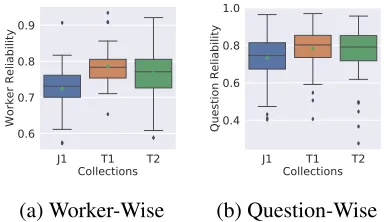
J1 T1 T2 Collections 0.6
0.7 0.8 0.9
Worker Reliability
(a) Worker-Wise
J1 T1 T2 Collections 0.4
0.6 0.8 1.0
Question Reliability
[image:3.595.84.280.67.178.2](b) Question-Wise
Figure 1: Answer Reliability by Embedding Similarity
J1 T1 T2 Collections 0.1
0.2 0.3 0.4 0.5 0.6
Worker GLEU
(a) Worker-Wise
J1 T1 T2 Collections 0.0
0.2 0.4 0.6
Question GLEU
[image:3.595.84.281.216.329.2](b) Question-Wise
Figure 2: Answer Reliability by GLEU
of J1 is larger and more low quality workers join the task, while the high quality workers on a non-native English crowdsourcing platform is limited.
Figure2shows the distribution of answer relia-bility measured by GLEU (Wu et al.,2016). To be consistent with the reliability of workers and ques-tions computed by embedding similarity, we use the mean of sentence-wise GLEU of all answers of a worker (question), in contrast to corpus-wise BLEU measure. In contrast to Figure1, the qual-ity on J1 is higher. One possible reason is that the low quality workers judged by embedding similar-ity can provide good words or phrases translations which the GLEU focuses on, but cannot provide good word orders and syntax on the sentence level which the DAN (Iyyer et al.,2015) model of uni-versal sentence encoder considers.
3 Extractive Answer Aggregation
When we obtain multiple answers for a given question, we need to aggregate them into one an-swer which can be used as the golden data in the collected dataset. There are at least two alter-natives of answer aggregation approaches for the case of word sequence, i.e., extractive and abstrac-tive answer aggregation. Extracabstrac-tive aggregation methods extract the potential optimal one from multiple worker answers; abstractive aggregation methods generate a new answer by analyzing and
understanding all of the worker answers. In the re-search area of crowdsourcing, most of the existing work of answer aggregation focus on categorical or numerical labels (Zheng et al.,2017). They es-timate a pre-defined category or value and thus are extractive approaches. In this paper, we focus on the baselines of extractive answer aggregation.
We define question setQ = {qi}i, worker set
W = {wk}k, answer setA = {aki}i,k, true
an-swer setZ ={zi}i and estimated true answer set
ˆ
Z ={zˆi}i. The answer set of a question isLi; the
answer set of a worker isVk. The encoder ise(·). We use cosine similarity forsimcomputation.
3.1 Sequence Majority Voting
Majority voting is one of the most typical an-swer aggregation approaches. For the specific data type of word sequences, we adapt it into a Sequence Majority Voting (SMV) approach. For each question, it first estimates the embed-dings of the true answers byeˆi = mean(e(Li));
after that it extracts the worker answer zˆi =
arg maxak
i sim(e(a
k
i),eˆi)as the true answer.
3.2 Sequence Maximum Similarity
We adapt the method inKobayashi(2018), which is proposed as a post-ensemble method for mul-tiple summarization generation models. For each question, it extracts the worker answer which has largest sum of similarity with other answers of this question. It can be regarded as creating a ker-nel density estimator and extract the maximum density answer. The kernel function uses the co-sine similarity. This Sequence Maximum Simi-larity (SMS) method can be formulated as zˆi =
arg max
ak1
i
P
k16=k2sim(e(a k1 i ), e(a
k2 i )).
3.3 Reliability Aware Sequence Aggregation
Both SMV and SMS do not consider the worker reliability. In crowdsourcing, worker reliability is diverse and is a useful information for estimating true answers. Existing work in the categorical swer aggregation strengthen the influences of an-swers provided by the workers with higher reli-ability. Therefore, we also propose an approach which models the worker reliability, named as Re-liability Aware Sequence Aggregation (RASA).
reliability; (3). EXTRACTION: for each question, it extracts a worker answer which is most similar with the embeddings of the estimated true answer. For estimating the embeddings of the true an-swers, we adapt the CATD approach (Li et al.,
2014) which is proposed for aggregating multiple numerical ratings. We extend it into our sequence case by adapting it to the sequence embeddings. We define the worker reliability asβ. The method iteratively estimatesβk andeˆi until convergence,
βk = χ2
(α/2,|Vk|)
P
(e(aki)−eˆi)2, ˆei =
P
βke(aki)
P
βk , where χ 2
is the chi-squared distribution and the significance levelαis set as 0.05 empirically. We initializeˆei
by using the SMV approach. SMS does not esti-mateeˆiand cannot initializeeˆi.
3.4 Experimental Results
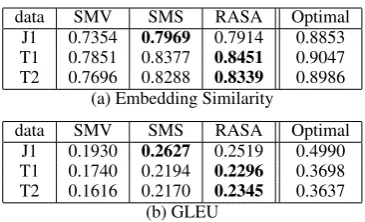
The evaluation metric is GLEU and the average similarity between the embeddings of the esti-mated true answers and the true answers (the orig-inal target sentences in the corpus) on the all ques-tions. For the extractive answer aggregation, there exists theoretical optimal performance. It is the performance of selecting the worker answer with largest embedding similarity (or GLEU) with the true answer. Table2lists the results.
First, both SMS and RASA outperform the na¨ıve baseline SMV. RASA is better than SMV because it considers the worker reliability. SMS is better than SMV as it is based on kernel den-sity estimation which is more sophisticated than majority voting. Second, SMS performs best on J1 collection and RASA performs better on T1 and T2 collection. One of the possible reasons is that J1 has more low quality workers. RASA tends to strengthen the influences of major work-ers. The estimated embeddings are near to the an-swers of “good” workers and the “good” work-ers are the ones that the embeddings of their an-swers are near to the estimated embeddings. If there are many low-quality workers, it is possi-ble to mistakenly regard a low-quality worker as a high-quality worker because this worker may pro-vide more similar answers with other (low-quality) workers. RASA thus may strengthen the answer by a low-quality worker. Third, the results on both embedding similarity and GLEU are consistent. Forth, in the theoretical optimal results, the qual-ity of J1 is higher than T1 and T2 on GLUE but lower on embedding similarity. This observation is consistent with that in Figure1and2in Section
data SMV SMS RASA Optimal J1 0.7354 0.7969 0.7914 0.8853 T1 0.7851 0.8377 0.8451 0.9047 T2 0.7696 0.8288 0.8339 0.8986
(a) Embedding Similarity
data SMV SMS RASA Optimal J1 0.1930 0.2627 0.2519 0.4990 T1 0.1740 0.2194 0.2296 0.3698 T2 0.1616 0.2170 0.2345 0.3637
[image:4.595.325.508.59.170.2](b) GLEU
Table 2: Results of extractive answer aggregation. The optimal result is the theoretical optimal performance of the collection for extractive answer aggregation.
2.2. Finally, all methods still cannot be close to the theoretical optimum. The performance is still possible to be improved.
4 Conclusion
In this paper, we proposed a dataset for the re-search of crowdsourced word sequence aggrega-tion. We also provided three approaches on these datasets for the task of extractive aggregation for crowdsourced word sequences. One of them con-siders the worker reliability. There are some future work on this topic of answer aggregation.
First, for abstractive answer aggregation ap-proach, an option is that we can train an encoder-decoder model to decode the estimated embed-dings of the true answer into a word sequence which can be different from worker answers. Therefore, the abstractive approaches are possible to reach better results than the optimal results of the extractive approaches shown in Table2.
Second, we can collect additional pairwise comparisons on the preferences of the worker an-swers by using another round of crowdsourcing tasks and extract the preferred answers. It is sim-ilar to a creator-evaluator framework (Baba and Kashima,2013). Otani et al.(2016) proposed an approach for aggregating the results of multiple machine translation systems with pairwise com-parisons. The typical approach of aggregating the pairwise comparison into a rank list was Bradley-Terry model (Bradley and Terry,1952); CrowdBT model (Chen et al., 2013) extended it in crowd-sourcing settings;Zhang et al.(2016) summarized more existing work.
Acknowledgments
References
Yukino Baba and Hisashi Kashima. 2013. Statistical quality estimation for general crowdsourcing tasks. In Proceedings of the 19th ACM SIGKDD Inter-national Conference on Knowledge Discovery and Data Mining, KDD ’13, pages 554–562, New York, NY, USA. ACM.
Ralph Allan Bradley and Milton E. Terry. 1952. Rank analysis of incomplete block designs: I. the method of paired comparisons. Biometrika, 39(3/4):324– 345.
Daniel Cer, Yinfei Yang, Sheng-yi Kong, Nan Hua, Nicole Limtiaco, Rhomni St. John, Noah Constant, Mario Guajardo-Cespedes, Steve Yuan, Chris Tar, Yun-Hsuan Sung, Brian Strope, and Ray Kurzweil. 2018. Universal sentence encoder. CoRR, abs/1803.11175.
Xi Chen, Paul N. Bennett, Kevyn Collins-Thompson, and Eric Horvitz. 2013. Pairwise ranking aggrega-tion in a crowdsourced setting. InProceedings of the Sixth ACM International Conference on Web Search and Data Mining, WSDM ’13, pages 193–202, New York, NY, USA. ACM.
A. P. Dawid and A. M. Skene. 1979. Maximum likeli-hood estimation of observer error-rates using the em algorithm. Journal of the Royal Statistical Society. Series C (Applied Statistics), 28(1):20–28.
Mohit Iyyer, Varun Manjunatha, Jordan Boyd-Graber, and Hal Daum´e III. 2015. Deep unordered compo-sition rivals syntactic methods for text classification. In Proceedings of the 53rd Annual Meeting of the Association for Computational Linguistics and the 7th International Joint Conference on Natural Lan-guage Processing (Volume 1: Long Papers), pages 1681–1691, Beijing, China. Association for Com-putational Linguistics.
Hayato Kobayashi. 2018.Frustratingly easy model en-semble for abstractive summarization. In Proceed-ings of the 2018 Conference on Empirical Methods in Natural Language Processing, pages 4165–4176, Brussels, Belgium. Association for Computational Linguistics.
Jiyi Li, Yukino Baba, and Hisashi Kashima. 2017. Hy-per questions: UnsuHy-pervised targeting of a few ex-perts in crowdsourcing. InProceedings of the 2017 ACM on Conference on Information and Knowledge Management, CIKM ’17, pages 1069–1078, New York, NY, USA. ACM.
Qi Li, Yaliang Li, Jing Gao, Lu Su, Bo Zhao, Mu-rat Demirbas, Wei Fan, and Jiawei Han. 2014. A confidence-aware approach for truth discovery on long-tail data.Proc. VLDB Endow., 8(4):425–436.
Chia-Wei Liu, Ryan Lowe, Iulian Serban, Mike Nose-worthy, Laurent Charlin, and Joelle Pineau. 2016.
How NOT to evaluate your dialogue system: An empirical study of unsupervised evaluation metrics
for dialogue response generation. InProceedings of the 2016 Conference on Empirical Methods in Natu-ral Language Processing, pages 2122–2132, Austin, Texas. Association for Computational Linguistics.
An Thanh Nguyen, Byron Wallace, Junyi Jessy Li, Ani Nenkova, and Matthew Lease. 2017. Aggregating and predicting sequence labels from crowd annota-tions. InProceedings of the 55th Annual Meeting of the Association for Computational Linguistics (Vol-ume 1: Long Papers), pages 299–309, Vancouver, Canada. Association for Computational Linguistics.
Naoki Otani, Toshiaki Nakazawa, Daisuke Kawahara, and Sadao Kurohashi. 2016. IRT-based aggrega-tion model of crowdsourced pairwise comparison for evaluating machine translations. In Proceed-ings of the 2016 Conference on Empirical Methods in Natural Language Processing, pages 511–520, Austin, Texas. Association for Computational Lin-guistics.
Kishore Papineni, Salim Roukos, Todd Ward, and Wei-Jing Zhu. 2002. Bleu: A method for automatic eval-uation of machine translation. In Proceedings of the 40th Annual Meeting on Association for Com-putational Linguistics, ACL ’02, pages 311–318, Stroudsburg, PA, USA. Association for Computa-tional Linguistics.
Rion Snow, Brendan O’Connor, Daniel Jurafsky, and Andrew Y. Ng. 2008. Cheap and fast—but is it good?: Evaluating non-expert annotations for nat-ural language tasks. In Proceedings of the Con-ference on Empirical Methods in Natural Language Processing, EMNLP ’08, pages 254–263, Strouds-burg, PA, USA. Association for Computational Lin-guistics.
Jacob Whitehill, Paul Ruvolo, Tingfan Wu, Jacob Bergsma, and Javier Movellan. 2009. Whose vote should count more: Optimal integration of labels from labelers of unknown expertise. In Proceed-ings of the 22Nd International Conference on Neu-ral Information Processing Systems, NIPS’09, pages 2035–2043, USA. Curran Associates Inc.
Yonghui Wu, Mike Schuster, Zhifeng Chen, Quoc V Le, Mohammad Norouzi, Wolfgang Macherey, Maxim Krikun, Yuan Cao, Qin Gao, Klaus Macherey, et al. 2016. Google’s neural ma-chine translation system: Bridging the gap between human and machine translation. arXiv preprint arXiv:1609.08144.
Xiaohang Zhang, Guoliang Li, and Jianhua Feng. 2016.
Crowdsourced top-k algorithms: An experimental evaluation.Proc. VLDB Endow., 9(8):612–623.