63
Towards Answer-unaware Conversational Question Generation
Mao Nakanishi Tetsunori Kobayashi Yoshihiko Hayashi School of Science and Engineering, Waseda University
Waseda-machi 27, Shinjuku, Tokyo 1690042, Japan
[email protected] [email protected] [email protected]
Abstract
Conversational question generation is a novel area of NLP research which has a range of potential applications. This paper is first to present a framework for conversational ques-tion generaques-tion that is unaware of the cor-responding answers. To properly generate a question coherent to the grounding text and the current conversation history, the proposed framework first locates the focus of a ques-tion in the text passage, and then identifies the question pattern that leads the sequential gen-eration of the words in a question. The exper-iments using the CoQA dataset demonstrate that the quality of generated questions greatly improves if the question foci and the ques-tion patterns are correctly identified. In addi-tion, it was shown that the question foci, even estimated with a reasonable accuracy, could contribute to the quality improvement. These results established that our research direction may be promising, but at the same time re-vealed that the identification of question pat-terns is a challenging issue, and it has to be largely refined to achieve a better quality in the end-to-end automatic question generation.
1 Introduction
Research on question generation has attracted con-siderable attention from NLP community, and sev-eral neural network-based methods have been pro-posed (Pan et al., 2019). Many of these meth-ods are developed for text-based question answer-ing (QA) with stand-alone interactions. That is, QA pairs is basically independent each other. Be-sides, they are generallyanswer-aware: a question generation system presumes that the correspond-ing answer to a to-be-generated question is becorrespond-ing supplied.
One of the recently emerging directions in QA is conversational QA, in which a series of inter-related QA turns is performed. Within this trend,
Gao et al. (2019) recently proposed a framework for conversational question generation. The pro-posed work is reported effective, but still answer-aware, which may prevent the proposed frame-work to be applied to practical applications such as chatbots and dialogue systems: answers are usu-ally not provided in the usage scenarios.
Being motivated by this situation, the present work is first to propose a framework for answer-unawareconversation question generation, by as-suming that questions coherent to the target text and the current conversation history can be gener-ated, provided the question focus and the question type are properly identified. To confirm this as-sumption, we have developed a deep neural archi-tecture for answer-unaware question generation, which first tries to locate the focus of a question in the grounding text passage, and then identify the question type that leads the sequential generation of the words in a question.
2 Related Work
Given a range of application areas, such as intelli-gent tutoring systems, dialogue systems and ques-tion answering systems, quesques-tion generaques-tion has attracted larger research attention in NLP com-munity. The major trend in question generation has shifted from template-based generation sys-tems to neural network-based end-to-end meth-ods (Pan et al., 2019), which generally employs encoder-decoder models. Succeeding the pioneer-ing work (Du et al.,2017), several proposals (Zhou et al., 2017; Du and Cardie, 2018; Yuan et al., 2017;Tang et al.,2017) have been made to chiefly improve the quality of generated questions. These methods all deal with text-based question answer-ing, which relies on datasets, such as SQuAD (Ra-jpurkar et al., 2018), which was originally de-veloped for the machine reading for question an-swering (MRQA) research. In the context of the present work, however, it should be noted that the majority of these methods are answer-aware, which means that a generation system requires the corresponding answer to a to-be-generated ques-tion is supplied.
Recently, research interests in MRQA have been extended to conversational-style QA, in which a series of inter-related QA turns is per-formed in the expectation that it would simu-late more natural interactions involving a human. Datasets such as CoQA (Reddy et al.,2019) and QuAC (Choi et al., 2018) have been developed to facilitate the relevant research efforts (Yatskar, 2019). Given this trend, Gao et al. (2019) was first to propose a framework for conversational ques-tion generaques-tion (CQG). Their proposal has initi-ated the dediciniti-ated field of CQG by particularly considering coreferences and conversion flows, both may be essential elements in conversational QA. Their proposal, however, remained answer-aware, which may somehow restrict its application areas, in particular such as dialogue systems. Thus
answer-unaware conversational question gen-erationfirst to offered by the present work would be a natural research direction to go.
3 Framework for Conversational Question Generation
3.1 Overview
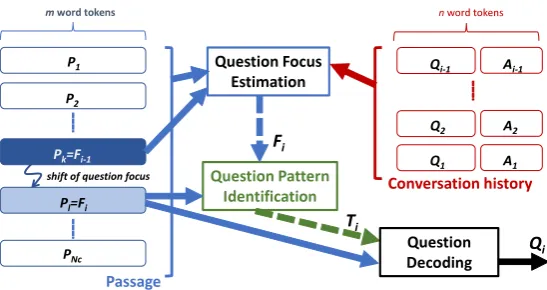
Figure 1 overviews our proposed framework for CQG, where the following assumptions are made.
• A question coherent to the current conversa-tional context can be generated primarily by knowing the current focus of interrogation, even without knowing the pre-defined corre-sponding answer. We herein expect that a
question focuscan be properly estimated as a textual region in the given passage by ex-ploitingconversation history.
• The quality of a question can be further im-proved, if the type of a question is identified ahead of time. We consider that thequestion patternthat linguistically realizes a question type could be identified by using the esti-mated question focus.
3.2 Problem Formulation
The generation of a conversational questionQ¯i at
the current (i-th) QA turn is formulated as follows.
¯
Qi= arg max Qi
P rob(Qi|P, Hi) (1)
Here,P denotes the whole text passage provided for the QA session, and Hi dictates the current
conversation history, which can be formulated as Hi = ((Q1, A1),· · ·,(Qi−1, Ai−1)). Notice
that the answer Ai corresponding to the
to-be-generated questionQ¯iisnotincluded in our
prob-lem formulation.
Question Focus Estimation: We assume that a question focusFican be located at a textual region
in the grounding text passageP, meaning that the answer of a to-be-generated question can be found in this textual region. Given the conversation his-toryHi, the estimation of a question focus is
for-mulated as a classification problem which identi-fies the most probable text chunkP¯ifrom theNc
-divided passagesP = (P1,· · ·, PNC).
Question Pattern Identification: We expect by additionally knowing the type of a question, such asWhen, Who, Where, and Did, the quality of a generated question may further improve. As de-tailed in the next section, we cast the identifica-tion of a quesidentifica-tion type as the classificaidentifica-tion from an inventory of question patterns, or as the actual generation of a question-leading linguistic expres-sion. As discussed in the later section, we experi-mentally compare these two methods. We denote a question patternTi as an element defined in the
set of question patternsTQ={T1,· · ·, TNT}.TQ
Wϭ
WϮ
WEĐ WŬс&ŝͲϭ
Wůс&ŝ
ŵǁŽƌĚƚŽŬĞŶƐ
YƵĞƐƚŝŽŶ&ŽĐƵƐ ƐƚŝŵĂƚŝŽŶ
Y
Y
Y
YƵĞƐƚŝŽŶWĂƚƚĞƌŶ /ĚĞŶƚŝĨŝĐĂƚŝŽŶ
&ŝ
dŝ
YƵĞƐƚŝŽŶ ĞĐŽĚŝŶŐ
Yŝ
ŶǁŽƌĚƚŽŬĞŶƐ
ŽŶǀĞƌƐĂƚŝŽŶŚŝƐƚŽƌLJ
[image:3.595.157.431.62.207.2]WĂƐƐĂŐĞ ƐŚŝĨƚŽĨƋƵĞƐƚŝŽŶĨŽĐƵƐ
Figure 1: Overview of the proposed framework.
Question Decoding: The conversational ques-tion generaques-tion as formulated in Eq.1 can be fur-ther conditioned by incorporating the estimated question focusFi, and the identified question
pat-tern Ti. We employ a conventional
encoder-decoder model for this process.
¯
Qi = arg max Qi
P rob(Qi|P, Hi, Fi, Ti) (2)
4 Model Description
This section details the components in the pro-posed framework, which are (1) Question focus estimation, (2) Question pattern identification, and (3) Question decoding.
Let us assume that the current time step is t =
iin the following descriptions. The input to the entire question generation system is the target text passagePand the current conversation historyHi.
The passageP is segmented into a sequence of Nc chunks(P1,· · ·, PNC), where the c-th chunk
Pc = (w1pc,· · ·, wmpc) is a sequence of m word
tokens.
Although the conversation history Hi at
the i-th QA turn is conceptually defined as Hi = ((Q1, A1),· · · ,(Qi−1, Ai−1)),
we implement it as the sequence of words taken from the question and the an-swer, separated by a separator: Hi = (· · · , wtq1· · ·wtq|Q|,hsepi, wta1,· · ·, wat|A|,· · ·). We henceforth abbreviated it as Hi = (wHi
1 · · ·wHni).
The question focus Fi for the i-th QA turn is
estimated as one of the chunks. It is hence de-noted as a sequence of m-word tokens: Fi = (wF
1,· · · , wFm).
The question pattern Ti that is identified for a
to-be-generated question is chosen from the
pre-defined setTQof linguistic expressions, or
gener-ated on-the-fly. It is formulgener-ated as a sequence ofl word tokens:Ti = (w1Ti,· · ·, wlTi).
4.1 Question Focus Estimation
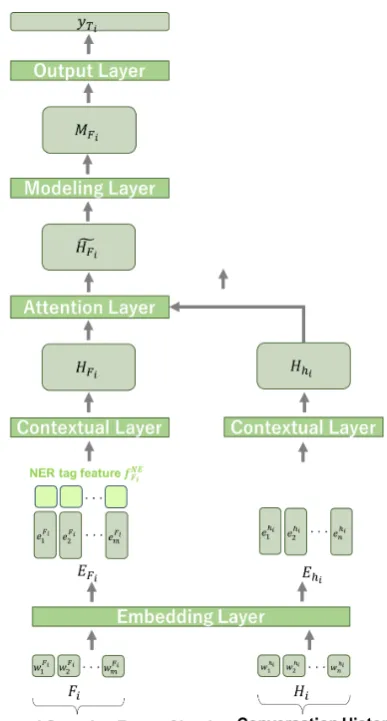
Figure2models the deep architecture for estimat-ing a question focus, which consists of embeddestimat-ing layer, contextual layers, attention layer, modeling layer, and output layer.
Figure 2: Question focus estimation model.
The embedding layer maps each chunk Pc
in the passage to a vector sequence Epc =
(epc
1 · · ·e
pc
[image:3.595.307.529.397.678.2]d-dimensional embedding vector for the i-th word token in Epc. We employ GloVe (Pennington
et al., 2014) vectors (d = 300) as word embed-dings. Similarly we map a conversation history HitoEHi = (eH1i· · ·eHni)∈Rn×d.
Two contextual layers, one is for passage chunks and the other is for conversation history, are both implemented by using Bi-GRU. The in-put to the passage context layer for a chunkPcis
the concatenation ofEpcandfQF
i−1. The latter
vec-torfiQF−1 carries important information in the sense that it specifies the question focus at the previous time step (t=i−1). The elements offiQF−1 are all one ifFi−1=Pc, otherwise they are all zero. The
representation of the current conversation history
EHi is also fed into the contextual layer. The
re-sulting contextual representationsHPc ∈
Rm×2v andHHi ∈
Rn×2vare fed into the attention layer. Herevrepresents the dimensionality of the hidden layers:v= 128in our experiments.
The attention layer captures the relative im-portance of each chunk seeing from the current conversation history as an attentional weight, and hence yields history-augmented contextual repre-sentations for the chunks, as formulated below. Here,WeandWhare trainable parameters.
eft,j =tanh(Wef[hci
t ;h Hi
j ]) (3)
αft,j = exp(e f t,j)
Pn
k=1exp(e
f t,k)
(4)
cft =X j
αft,jhci
j (5)
˜
hci
t =tanh(W f h[c
f t;h
ci
t ]) (6)
The modeling layer is also realized by employ-ing Bi-GRU, which captures interactions among the history-augmented contextual representations. That is, we expect that the resulting representation for a chunkMci ∈
Rm×2v incorporates relevant information from the conversation history.
The output layer, consists of two linear layers, predicts the most probable chunk indexyFi, which
means that the designated chunk is estimated as the current question focus Fi. The inputs to this
layer is [Mc1;Mc2,· · ·,;McN] ∈
R(Ncm)×2v, which is the concatenation of the chunk represen-tations yielded by the modeling layer.
4.2 Question Pattern Identification
[image:4.595.330.524.58.419.2]The proper identification of a question pattern help improve the quality of a generated question. We
Figure 3: Question pattern classification model.
approach this task by either of classification or generation, and experimentally compare them.
4.2.1 Question Pattern Classification
As displayed in Figure 3, the whole structure of the classification model is similar to that of the question focus estimation model. This model however only considers the chunk that is estimated as the current question focus. More specifically, the question focus is represented as [EFi;fN E
Fi ].
That is, the original representation for question fo-cusEFiis enhanced by the named-entity (NE) tag
featuresfFN E
i ∈ R
m×18. We assign to each word
token inFian NE tag with the BIO format. We use
spaCy1as the NE recogniizer, which maintains 18 NE types2.
The history-augmented representation of the question focus H˜F, yielded by the attention and
1
https://spacy.io
2https://spacy.io/api/annotation#
Figure 4: Question pattern generation model.
the modeling layers, is then fed into the output layer, and the index of the most probable question patternyTi ∈ R
NP is finally obtained, whereN
P
represents the number of pre-defined question pat-terns.
4.2.2 Question Pattern Generation
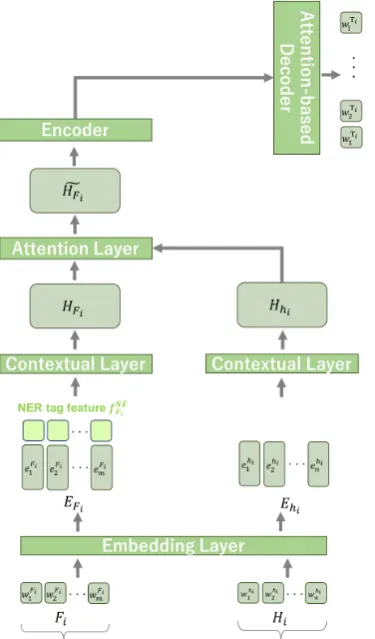
As illustrated in Figure 4, the generation model only differs from the classification model at the output layer: instead of the classification layer, this model naturally employs a conventional encoder-decoder layers for generating a question pattern.
The encoder takes the question focus H˜F as
the input, and encodes its word token sequence by employing Bi-GRU. The decoder generates the most probable question patternPias a sequence of
word tokens(wPi
1 ...w
Pi
l ), while attending to
rele-vant parts in the question focus chunk.
st=GRU(wtP−i1, ct−1, st−1) (7)
eqt,j =tanh(Weqst−1+UeqhEt−1) (8)
αqt,j = exp(e q t,j)
Pn
k=1exp(e
q t,k)
(9)
cqt =X j
αqt,jhEt (10)
˜
hqt =tanh(Whq[cqt;hEt ]) (11)
p(wPi
t |w Pi
<t, hi) =sof tmax(Wdh˜qt) (12)
[image:5.595.292.530.74.458.2]4.3 Question Decoding
Figure 5: Question decoding model.
The question decoding model also employs a conventional encoder-decoder model with atten-tion. Its behavior depends on whether a pre-dicted/generated question pattern is employed. That is, when a question pattern is not used, the input to the encoder is only the representations for a question focusFi. On the other hand, in the latter
case, the input to the encoder is the concatenation of the representation for the predicted/generated question pattern Ti = (w1Ti,· · · , w
Ti
l ) and the
question focus chunk Fi = (wF1i,· · · , wFmi),
de-limited by the separatorhsepi.
5 Experiments
5.1 Dataset
Figure 6: Example of a QA conversation in CoQA; adopted from (Reddy et al.,2019).
work (Gao et al., 2019). The dataset collects 8k text-grounded QA conversations, where 127k QA pairs are maintained.
An example conversation is given in Figure 6, where an answers is given in free-text, but its cor-responding textual region in the text passage is explicitly annotated asR: rationale. We identify each of the ground-truth question foci as a region in the passage that overlaps with a rationale given in the dataset.
As exemplified in this example, this dataset ex-hibits several conversational phenomena, includ-ing ellipsis, co-reference by pronouns. Naturally, a question is posed by reflecting the current conver-sational situation. As pointed out by (Reddy et al., 2019;Yatskar,2019), the question foci gradually shift through regions in the text passage as the QA session proceeds.
5.2 Experimental Settings
Passage chunks: The target text passage of a QA session is divided into Nc chunks of same
number of sentences. Our framework identifies
the most probable chunk as a question focus, im-plying that the division of a passage would affect the identification of a question focus, and hence the final results also. Thus we compare the exper-imental results while alteringNcamong 5 and 10.
Note that the average length of a rationale in the CoQA dataset is 10.3 words, and only a small por-tion of them (<5%) exceed a sentence boundary.
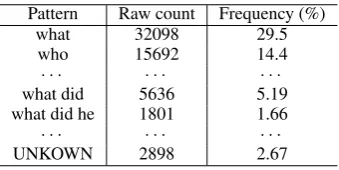
Question patterns: We defined a question pat-tern set by collecting Nt frequent sentence-leading n-grams from the training portion of the CoQA dataset. In preliminary experiments, we confirmed that the best results were achieved when we setn={1,2,3}andNt= 200. We thus only report the experimental results with this setting. Table1displays some question patterns and their frequencies. We train the question pattern identifi-cation models by limiting the number of examples to at most 300 to avoid the data imbalance across the patterns.
Pattern Raw count Frequency (%)
what 32098 29.5
who 15692 14.4
· · · ·
what did 5636 5.19
what did he 1801 1.66
· · · ·
UNKOWN 2898 2.67
Table 1: Question patterns (n={1,2,3}, N= 200).
Comparing baselines: Two baseline question generation systems are employed.
• NQG (Du et al.,2017) is used to assess the ef-ficacy of question focus prediction and ques-tion pattern identificaques-tion. We consider the whole passage as a single chunk when using this system. This means that a question focus is not narrowed down to some textual regiosn, rather it spreads to the whole passage.
6 Results and Discussions
6.1 Quality of the Generated Questions
The results shown in Table2establish our primary assumption, which states that a question coherent to the current conversational context can be gener-ated primarily by knowing the current focus of in-terrogation. As shown in the table, the qualities of generated questions (as measured by BLEU 1-4), when a question focus is estimated (Nc>1), were
better than that from the case where the whole text passage was simply considered as a question fo-cus (Nc= 1). These results indeed dictate that the
notion of question focus is effective.
Nc B1 B2 B3 B4
1 (whole passage) 30.19 12.85 0.32 0.13
5 (random) 33.83 16.08 0.59 0.13
5 (predicted) 34.64 16.65 0.70 0.18
10 (predicted) 34.71 16.68 0.70 0.17
5 (GT) 34.19 16.30 0.71 0.21
[image:7.595.307.534.62.157.2]10 (GT) 34.71 16.67 0.73 0.21
Table 2: Qualities (BLEU scores) of generated ques-tions (without considering question patterns).
The table further shows that the qualities of gen-erated questions were slightly better than that from the random choice of a chunk as question focus, suggesting that the incorporation of even an esti-mated question focus is effective. The displayed results, on the other hand, shows that the quality of generated questions (B1 around 34.6) is still not suffice by only knowing the question foci, suggest-ing the necessity of additional information.
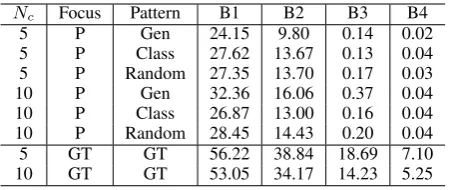
Given these discussions, Table 3 displays the qualities of generated questions under several con-ditions, and it confirms the above mentioned prospect may be probable. The major outcomes provided in the table are: (1) the generation qual-ity could be largely improved if the focus and the pattern of the to-be-generated question are cor-rectly identified, and (2) the current question pat-tern identification models severely suffer from the low accuracies, even with classification or genera-tion, and they are comparable or only slightly bet-ter than the Random baseline, largely affecting the final generation results.
Table4presents the comparison with the base-line systems. It clearly shows that our method with ground-truth question foci and question patterns largely outperformed the comparing systems, sug-gesting that our primary direction is promising. On the other hand, as our results with the
pre-Nc Focus Pattern B1 B2 B3 B4
5 P Gen 24.15 9.80 0.14 0.02
5 P Class 27.62 13.67 0.13 0.04
5 P Random 27.35 13.70 0.17 0.03
10 P Gen 32.36 16.06 0.37 0.04
10 P Class 26.87 13.00 0.16 0.04
10 P Random 28.45 14.43 0.20 0.04
5 GT GT 56.22 38.84 18.69 7.10
10 GT GT 53.05 34.17 14.23 5.25
Table 3: Qualities (BLEU scores) of generated ques-tions. P and GT in Focus column respectively indicate predicted and ground-truth foci. Gen and Class in Pat-tern column are generated and classified.
dicted question foci and question patterns were worse than that with the comparing systems, in-sisting that the current deficiency of our methods for question focus estimation and question pattern identification is obvious.
model B1 B2 B3 B4
NQG (GT) 33.3 16.1 0.85 0.22
CFNet 37.38 22.81 16.25
-Ours (P) 27.62 13.67 0.13 0.04
[image:7.595.81.282.260.336.2]Ours (GT) 56.22 38.84 18.69 7.10
Table 4: Comparison of the qualities (BLEU scores) with the baseline systems: NQG (Zhou et al.,2017) and CFNet (Gao et al.,2019).
6.2 Accuracy of Question Focus Estimation
Table5measures the accuracy of query focus esti-mation with varyingNc. The accuracy figures
pre-sented in the table may be reasonable, if not sat-isfactory. The longer chunks achieve apparently higher classification accuracies, but there may be a trade-off between the quality of generated ques-tions. A bigger textual region may not well con-strain the content of a to-be-generated question.
Nc Ave. Chunk Length Accuracy (%)
5 120 59.78
10 60 48.17
Table 5: Accuracy of question focus estimation.
6.3 Accuracy of Question Pattern Identification
[image:7.595.325.508.312.366.2] [image:7.595.331.499.575.607.2]per-formances obviously affected the quality of gener-ated questions.
Nc Focus n N Accuracy (%)
5 P 1, 2, 3 200 0.45
10 P 1, 2, 3 200 0.80
5 GT 1, 2, 3 200 0.73
[image:8.595.305.535.63.362.2]10 GT 1, 2, 3 200 0.62
Table 6: Accuracy of question pattern classification.
Nc Focus B1 B2 B3
5 P 20.00 3.39 0.000
10 P 18.68 3.47 0.14
5 GT 17.38 3.26 0.11
[image:8.595.91.269.100.153.2]10 GT 18.28 3.79 0.17
Table 7: Accuracy (BLEU scores) of question pattern generation.
Besides, the accuracies of generated question patterns are almost comparable across the pre-dicted and the ground-truth question foci. This insists that the identification of question patterns is almost impossible by only relying on the cur-rent inputs (question focus and conversation his-tory) and/or with the present models. This turns out that the process of question pattern identifica-tion has higher degree of freedom and should be more constrained with additional information such as entities appeared in the text passage.
6.4 Generated Question Examples
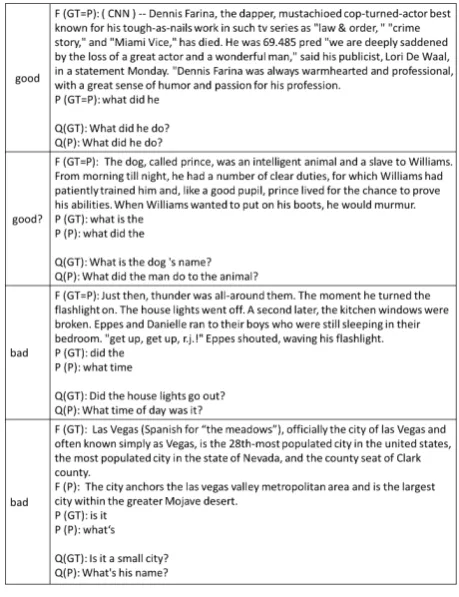
Figure7showcases generated examples.
In the top (good) example, both of question fo-cus estimation and question pattern identification were correct, leading to the generation of a ques-tion that completely matched with the ground-truth question.
The second example exhibits a mixed case. As the generated question is largely different from the ground-truth question, the BLEU score is quite low. However the generated question may be acceptable, given the QA conversation situation. This example suggests that we need to devise a better metrics for properly evaluating conversa-tionally adequate questions.
The third and fourth examples present failed question generation cases. The former example shows failed question pattern identification and the latter example further exemplifies a fail in question pattern identification. As a result, the generated questions made no senses to the current question foci.
Figure 7: Good and bad examples of generated ques-tions.
7 Conclusions
Conversational question generation (CQG) is a re-cently emerging area of NLP research initiated by (Gao et al., 2019). Given a range of po-tential practical applications, a question coher-ent to the currcoher-ent QA situation should be gener-ated even without the corresponding answer pro-vided. This study is first to propose a framework for answer-unaware CQG by assuming that the quality of questions can be improved by knowing the question focus and the question pattern. That is, the former contributes to choose a question topic (what-to-ask), and the later could lead the proper generation of the words in a question (how-to-ask). The experimental results confirmed that our research direction would be promising, but highlighted that further effort has to be made: in particular, the question pattern identification pro-cess should be greatly improved by enhancing the model and its ingredients.
[image:8.595.105.259.202.255.2]References
Eunsol Choi, He He, Mohit Iyyer, Mark Yatskar, Wen-tau Yih, Yejin Choi, Percy Liang, and Luke Zettle-moyer. 2018. QuAC: Question answering in con-text. InProceedings of the 2018 Conference on Em-pirical Methods in Natural Language Processing.
Xinya Du and Claire Cardie. 2018. Harvest-ing paragraph-level question-answer pairs from Wikipedia. InProceedings of the 56th Annual Meet-ing of the Association for Computational LMeet-inguis- Linguis-tics.
Xinya Du, Junru Shao, and Claire Cardie. 2017. Learn-ing to ask: Neural question generation for readLearn-ing comprehension. InProceedings of the 55th Annual Meeting of the Association for Computational Lin-guistics.
Yifan Gao, Piji Li, Irwin King, and Michael R. Lyu. 2019. Interconnected question generation with coreference alignment and conversation flow mod-eling. InProceedings of the 57th Annual Meeting of the Association for Computational Linguistics.
Liangming Pan, Wenqiang Lei, Tat-Seng Chua, and Min-Yen Kan. 2019. Recent advances in neural question generation. arXiv preprint arXiv:1905.08949.
Jeffrey Pennington, Richard Socher, and Christo-pher D. Manning. 2014. Glove: Global vectors for word representation. In Proceedings of the 2014 Conference on Empirical Methods in Natural Lan-guage Processing.
Pranav Rajpurkar, Robin Jia, and Percy Liang. 2018. Know what you don’t know: Unanswerable ques-tions for squad. InProceedings of the 56th Annual Meeting of the Association for Computational Lin-guistics.
Siva Reddy, Danqi Chen, and Christopher D. Manning. 2019. CoQA: A conversational question answering challenge.Transactions of the Association for Com-putational Linguistics, 7:249–266.
Duyu Tang, Nan Duan, Tao Qin, Zhao Yan, and Ming Zhou. 2017. Question answering and ques-tion generaques-tion as dual tasks. arXiv preprint arXiv:1706.02027.
Mark Yatskar. 2019. A qualitative comparison of CoQA, SQuAD 2.0 and QuAC. InProceedings of the 2019 Conference of the North American Chap-ter of the Association for Computational Linguistics: Human Language Technologies.
Xingdi Yuan, Tong Wang, Caglar Gulcehre, Alessan-dro Sordoni, Philip Bachman, Saizheng Zhang, Sandeep Subramanian, and Adam Trischler. 2017. Machine comprehension by text-to-text neural ques-tion generaques-tion.In Proceedings of the 2nd Workshop on Representation Learning for NLP.