Proceedings of the 2019 Conference on Empirical Methods in Natural Language Processing
6286
Learning with Noisy Labels for Sentence-level Sentiment Classification
Hao Wang\,‡ Bing Liu‡,∗ Chaozhuo Li§ Yan Yang\ Tianrui Li\
\School of Information Science and Technology, Southwest Jiaotong University
[email protected], {yyang; trli}@swjtu.edu.cn
‡Department of Computer Science, University of Illinois at Chicago
§State Key Lab of Software Development Environment, Beihang University
Abstract
Deep neural networks (DNNs) can fit (or even over-fit) the training data very well. If a DNN model is trained using data with noisy la-bels and tested on data with clean lala-bels, the model may perform poorly. This paper stud-ies the problem of learning with noisy labels for sentence-level sentiment classification. We propose a novel DNN model called NETAB(as shorthand for convolutional neuralNETworks withAB-networks) to handle noisy labels dur-ing traindur-ing. NETABconsists of two convolu-tional neural networks, one with a noise tran-sition layer for dealing with the input noisy la-bels and the other for predicting ‘clean’ lala-bels. We train the two networks using their respec-tive loss functions in a mutual reinforcement manner. Experimental results demonstrate the effectiveness of the proposed model.
1 Introduction
It is well known that sentiment annotation or la-beling is subjective (Liu,2012). Annotators often have many disagreements. This is especially so for crowd-workers who are not well trained. That is why one always feels that there are many errors in an annotated dataset. In this paper, we study whether it is possible to build accurate sentiment classifiers even with noisy-labeled training data. Sentiment classification aims to classify a piece of text according to the polarity of the sentiment ex-pressed in the text, e.g.,positiveornegative(Pang and Lee,2008;Liu,2012;Zhang et al.,2018). In this work, we focus on sentence-level sentiment classification (SSC) with labeling errors.
As we will see in the experiment section, noisy labels in the training data can be highly damag-ing, especially for DNNs because they easily fit the training data and memorize their labels even when training data are corrupted with noisy labels
∗
Corresponding author
(Zhang et al.,2017). Collecting datasets annotated with clean labels is costly and time-consuming as DNN based models usually require a large num-ber of training examples. Researchers and practi-tioners typically have to resort to crowdsourcing. However, as mentioned above, the crowdsourced annotations can be quite noisy.
Research on learning with noisy labels dates back to 1980s (Angluin and Laird,1988). It is still vibrant today (Mnih and Hinton,2012;Natarajan et al.,2013,2018;Menon et al.,2015;Gao et al.,
2016;Liu and Tao,2016;Khetan et al.,2018;Zhan et al., 2019) as it is highly challenging. We will discuss the related work in the next section.
This paper studies the problem of learning with noisy labels for SSC. Formally, we study the fol-lowing problem.
Problem Definition: Given noisy labeled train-ing sentencesS ={(x1, y1), ...,(xn, yn)}, where
xi|ni=1is thei-th sentence andyi ∈ {1, ..., c}is the
sentiment label of this sentence, the noisy labeled sentences are used to train a DNN model for a SSC task. The trained model is then used to classify sentences with clean labels to one of thec senti-ment labels.
In this paper, we propose a convolutional neu-ralNETwork withAB-networks (NETAB) to deal
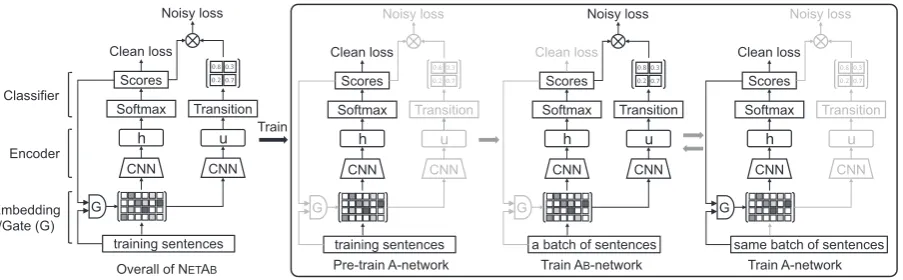
with noisy labels during training, as shown in Fig-ure1. We will introduce the details in the subse-quent sections. Basically, NETABconsists of two
convolutional neural networks (CNNs) (see Fig-ure1), one for learning sentiment scores to predict ‘clean’1 labels and the other for learning a noise transition matrix to handle input noisy labels. We call the two CNNs A-network and AB-network, respectively. The fundamental here is that (1) DNNs memorize easy instances first and
gradu-1Here we use clean with single quotes as it is not
ally adapt to hard instances as training epochs in-crease (Zhang et al., 2017; Arpit et al., 2017); and (2) noisy labels are theoretically flipped from the clean/true labels by a noise transition matrix (Sukhbaatar et al., 2015; Goldberger and Ben-Reuven,2017;Han et al.,2018a,b). We motivate and propose a CNN model with a transition layer to estimate the noise transition matrix for the input noisy labels, while exploiting another CNN to pre-dict ‘clean’ labels for the input training (and test) sentences. In training, we pre-train A-network in early epochs and then train AB-network and A-network with their own loss functions in an al-ternating manner. To our knowledge, this is the first work that addresses the noisy label problem in sentence-level sentiment analysis. Our experi-mental results show that the proposed model out-performs the state-of-the-art methods.
2 Related Work
Our work is related to sentence sentiment classi-fication (SSC). SSC has been studied extensively (Hu and Liu, 2004; Pang and Lee, 2005; Zhao et al., 2008; Narayanan et al., 2009; T¨ackstr¨om and McDonald,2011;Wang and Manning,2012;
Yang and Cardie, 2014; Kim, 2014; Tang et al.,
2015;Wu et al.,2017;Wang et al.,2018). None of them can handle noisy labels. Since many social media datasets are noisy, researchers have tried to build robust models (Gamon, 2004; Bar-bosa and Feng,2010;Liu et al.,2012). However, they treat noisy data as additional information and don’t specifically handle noisy labels. A noise-aware classification model in (Zhan et al., 2019) trains using data annotated with multiple labels.
Wang et al. (2016) exploited the connection of users and noisy labels of sentiments in social net-works. Since the two works use multiple-labeled data or users’ information (we only use single-labeled data, and we do not use any additional in-formation), they have different settings than ours.
Our work is closely related to DNNs based ap-proaches to learning with noisy labels. DNNs based approaches explored three main directions: (1) training DNNs on selected samples (Malach and Shalev-Shwartz,2017;Jiang et al.,2018;Ren et al.,2018;Han et al.,2018b), (2) modifying the loss function of DNNs with regularization biases (Mnih and Hinton,2012; Jindal et al., 2016; Pa-trini et al., 2017; Ghosh et al., 2017; Ma et al.,
2018; Zhang and Sabuncu, 2018), and (3)
plug-ging an extra layer into DNNs (Sukhbaatar et al.,
2015;Bekker and Goldberger, 2016;Goldberger and Ben-Reuven, 2017; Han et al., 2018a). All these approaches were proposed for image clas-sification where training images were corrupted with noisy labels. Some of them require noise rate to be known a priori in order to tune their mod-els during training (Patrini et al.,2017;Han et al.,
2018b). Our approach combines direction (1) and direction (3), and trains two networks jointly with-out knowing the noise rate. We have used five lat-est existing methods in our experiments for SSC. The experimental results show that they are infe-rior to our proposed method.
In addition, Xiao et al. (2015), Reed et al.
(2015), Guan et al.(2016), Li et al.(2017), Veit et al. (2017), and Vahdat (2017) studied weakly-supervised DNNs or semi-weakly-supervised DNNs. But they still need some clean-labeled training data. We use no clean-labeled data.
3 Proposed Model
Our model builds on CNN (Kim,2014). The key idea is to train two CNNs alternately, one for ad-dressing the input noisy labels and the other for predicting ‘clean’ labels. The overall architecture of the proposed model is given in Figure1. Before going further, we first introduce a proposition, a property, and an assumption below.
Proposition 1 Noisy labels are flipped from clean labels by an unknown noise transition matrix.
Proposition 1is reformulated from (Han et al.,
2018a) and has been investigated in (Sukhbaatar et al., 2015; Goldberger and Ben-Reuven, 2017;
Bekker and Goldberger, 2016). This proposition shows that if we know the noise transition matrix, we can use it to recover the clean labels. In other words, we can put noise transition matrix on clean labels to deal with noisy labels. Given these, we ask the following question: How to estimate such an unknown noise transition matrix?
Below we give a solution to this question based on the following property of DNNs.
Property 1 DNNs tend to prioritize memorization of simple instances first and then gradually mem-orize hard instances (Zhang et al.,2017).
Pre-train A-network Train AB-network Train A-network Embedding
/Gate (G) Encoder Classifier
Overall of NETAB
Train
training sentences CNN
h u
Softmax Noisy loss
Scores
Transition
G
Clean loss
CNN
training sentences CNN
h u
Softmax Noisy loss
Scores
Transition
G
Clean loss
CNN
a batch of sentences CNN
h u
Softmax Noisy loss
Scores
Transition
G
Clean loss
CNN
same batch of sentences CNN
h u
Softmax Noisy loss
Scores
Transition
G
Clean loss
[image:3.595.76.528.61.201.2]CNN
Figure 1: The proposed NETABmodel (left) and its training method (right). Components in light gray color denote that these components are deactivated during training in that stage. (Color online)
Assumption 1 The noise rate of the training data is less than50%.
This assumption is usually satisfied in practice because without it, it is hard to tackle the input noisy labels during training.
Based on the above preliminaries, we need to estimate the noisy transition matrix Q ∈ Rc×c
(c = 2 in our case, i.e., positive and negative), and train two classifiers y¨ ∼ P(¨y|x, θ) andby ∼
P(yb|x, ϑ), where x is an input sentence, y¨is its noisy label,ybis its ‘clean’ label, θandϑare the parameters of two classifiers. Note that bothy¨and
b
y here are the prediction results from our model, not the input labels. We propose to formulate the probability of the sentencexlabeled asjwith
P(¨y=j|x, θ) =X i
P(¨y=j|by=i)P(by=i|x, ϑ)
(1) whereP(¨y =j|yb= i)is an item (theji-th item) in the noisy transition matrixQ. We can see that the noisy transition matrix Q is exploited on the ‘clean’ scoresP(by|x, ϑ)to tackle noisy labels.
We now present our model NETAB and intro-duce how NETABperforms Eq. (1). As shown in Figure1, NETABconsists of two CNNs. The
in-tuition here is that we use one CNN to perform
P(yb = i|x, ϑ) and use another CNN to perform
P(¨y =j|x, θ). Meanwhile, the CNN performing
P(¨y = j|x, θ) estimates the noise transition ma-trix Qto deal with noisy labels. Thus we add a transition layer into this CNN.
More precisely, in Figure 1, the CNN with a clean loss performs P(yb = i|x, ϑ). We call this CNN the A-network. The other CNN with a noisy loss performs P(¨y = j|x, θ). We call this CNN the AB-network. AB-network shares all the pa-rameters of A-network except the papa-rameters from
the Gate unit and the clean loss. In addition, AB -network has a transition layer to estimate the noisy transition matrixQ. In such a way, A-network pre-dict ‘clean’ labels, and AB-network handles the in-put noisy labels.
We use cross-entropy with the predicted labels ¨
y and the input labels y (given in the dataset) to compute the noisy loss, formulated as below
Lnoisy=− 1
|S¨|
X
x∈S¨ X
i
I(y=i|x) logP(¨y=i|x)
(2) whereIis the indicator function (ify==i,I= 1;
otherwise, I= 0), and |S¨|is the number of
sen-tences to train AB-network in each batch.
Similarly, we use cross-entropy with the pre-dicted labels by and the input labelsy to compute the clean loss, formulated as
Lclean=− 1
|Sb|
X
x∈Sb
X
i
I(y=i|x) logP(yb=i|x)
(3) where|Sb|is the number of sentences to train A-network in each batch.
com-#Noisy Training Data #Clean Training Data #Validation Data #Test Data
Movie 13539P, 13350N 4265P, 4265N 105P, 106N 960P, 957N
Laptop 9702P, 7876N 1064P, 490N 33P, 20N 298P, 175N
[image:4.595.84.513.63.120.2]Restaurant 8094P, 10299N 1087P, 823N 39P, 14N 339P, 116N
Table 1: Summary statistics of the datasets. Number of positive (P) and negative (N) sentences in (noisy and clean) training data, validation data, and test data. The second column shows the statistics of sentences extracted from the 2,000 reviews of each dataset. The last three columns show the statistics of the sentences in three clean-labeled datasets, see “Clean-labeled Datasets”.
puteQas follows
Q= [q1;q2] (4)
qi=sof tmax(gifi), i= 1,2 (5)
gi=tanh(Wiu+bi) (6)
whereWi is a trainable parameter matrix, bi and
fi are two trainable parameter vectors. They are
trained in the AB-network. Finally,P(¨y=j|x, θ) is computed by Eq. (1).
In training, NETAB is trained end-to-end. Based on Proposition 1 and Property 1, we pre-train A-network in early epochs (e.g., 5 epochs). Then we train AB-network and A-network in an alternating manner. The two networks are trained using their respective cross-entropy loss. Given a batch of sentences, we first train AB -network. Then we use the scores predicted from A-network to select some possibly clean sentences from this batch and train A-network on the se-lected sentences. Specifically speaking, we use the predicted scores to compute sentiment labels byarg maxi{y¨=i|y¨∼ P(¨y|x, θ)}. Then we
se-lect the sentences whose resulting sentiment label equals to the input label. The selection process is marked by a Gate unit in Figure 1. When testing a sentence, we use A-network to produce the final classification result.
4 Experiments
In this section, we evaluate the performance of the proposed NETAB model. we conduct two types of experiments. (1) We corrupt clean-labeled datasets to produce noisy-labeled datasets to show the impact of noises on sentiment classification ac-curacy. (2) We collect some real noisy data and use them to train models to evaluate the performance of NETAB.
Clean-labeled Datasets. We use three clean labeled datasets. The first one is the movie sen-tence polarity dataset from (Pang and Lee,2005). The other two datasets are laptop and restaurant
datasets collected from SemEval-2016 2. The former consists of laptop review sentences and the latter consists of restaurant review sentences. The original datasets (i.e., Laptop and Restaurant) were annotated with aspect polarity in each sen-tence. We used all sentences with only one po-larity (positiveornegative) for their aspects. That is, we only used sentences with aspects having the same sentiment label in each sentence. Thus, the sentiment of each aspect gives the ground-truth as the sentiments of all aspects are the same.
For each clean-labeled dataset, the sentences are randomly partitioned into training set and test set with80%and20%, respectively. Following (Kim,
2014), We also randomly select 10% of the test data for validation to check the model during train-ing. Summary statistics of the training, validation, and test data are shown in Table1.
Noisy-labeled Training Datasets. For the above three domains (movie, laptop, and restau-rant), we collected 2,000 reviews for each domain from the same review source. We extracted sen-tences from each review and assigned review’s la-bel to its sentences. Like previous work, we treat 4 or 5 stars as positive and 1 or 2 stars as negative. The data is noisy because a positive (negative) review can contain negative (positive) sentences, and there are also neutral sentences. This gives us three noisy-labeled training datasets. We still use the same test sets as those for the clean-labeled datasets. Summary statistics of all the datasets are shown in Table1.
Experiment 1: Here we use the clean-labeled data (i.e., the last three columns in Table1). We corrupt the clean training data by switching the la-bels of some random instances based on a noise rate parameter. Then we use the corrupted data to train NETABand CNN (Kim,2014).
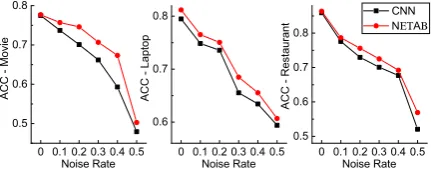
The test accuracy curves with the noise rates [0,0.1, 0.2, 0.3, 0.4, 0.5] are shown in Figure2.
2http://alt.qcri.org/semeval2016/
Methods Movie Laptop Restaurant ACC F1 pos F1 neg ACC F1 pos F1 neg ACC F1 pos F1 neg NBSVM-uni (Wang and Manning,2012) 0.6791 0.6663 0.6910 0.7637 0.8216 0.6500 0.7949 0.8478 0.6858 NBSVM-bi (Wang and Manning,2012) 0.6416 0.6438 0.6394 0.7784 0.8320 0.6749 0.7154 0.7834 0.5853 CNN (Kim,2014) 0.6667 0.6467 0.6844 0.7737 0.8381 0.6245 0.8329 0.8841 0.7007 Adaptation (Goldberger and Ben-Reuven,2017) 0.6682 0.6708 0.6656 0.7272 0.7936 0.5981 0.8285 0.8872 0.6422 Forward (Patrini et al.,2017) 0.6864 0.6753 0.6969 0.7547 0.8170 0.6282 0.8329 0.8882 0.6695 Backward (Patrini et al.,2017) 0.6651 0.6160 0.6830 0.7124 0.7834 0.5723 0.7890 0.8485 0.6521 Masking (Han et al.,2018a) 0.6708 0.6631 0.6782 0.7188 0.7787 0.6144 0.8219 0.8789 0.6639 Co-teaching (Han et al.,2018b) 0.6150 0.5980 0.6306 0.7145 0.7867 0.5686 0.7978 0.8575 0.6515 NETAB(Our method) 0.7047 0.7076 0.7017 0.7928 0.8487 0.6711 0.8593 0.9056 0.7241
Table 2: Accuracy (ACC) of both classes, F1 (F1 pos) of positive class and F1 (F1 neg) of negative class on clean test data/sentences. Training data are real noisy-labeled sentences.
0 0.1 0.2 0.3 0.4 0.5 0.5
0.6 0.7 0.8
A
C
C
M
o
v
ie
Noise Rate
0 0.1 0.2 0.3 0.4 0.5 0.6
0.7 0.8
A
C
C
L
a
p
to
p
Noise Rate
0 0.1 0.2 0.3 0.4 0.5 0.5
0.6 0.7 0.8
A
C
C
R
e
s
ta
u
ra
n
t
Noise Rate CNN NΕΤAΒ
Figure 2: Accuracy (ACC) on clean test data. For train-ing, the labels of clean data are flipped with the noise rates [0,0.1,0.2,0.3,0.4,0.5]. For example,0.1means that 10% of the labels are flipped. (Color online)
From the figure, we can see that the test accuracy drops from around 0.8 to 0.5 when the noise rate increases from 0 to 0.5, but our NETAB outforms CNN. The results clearly show that the per-formance of the CNN drops quite a lot with the noise rate increasing.
Experiment 2: Here we use the real noisy-labeled training data to train our model and the baselines, and then test on the test data in Table1. Our goal is two fold. First, we want to evaluate NETABusing real noisy data. Second, we want to
see whether sentences with review level labels can be used to build effective SSC models.
Baselines. We use one strong non-DNN base-line, NBSVM (with unigrams or bigrams features) (Wang and Manning, 2012) and six DNN base-lines. The first DNN baseline is CNN (Kim,
2014), which does not handle noisy labels. The other five were designed to handle noisy labels.
The comparison results are shown in Table 2. From the results, we can make the following ob-servations. (1) Our NETAB model achieves the
best ACC and F1 on all datasets except for F1 of negative class on Laptop. The results demon-strate the superiority of NETAB. (2) NETAB
out-performs the baselines designed for learning with noisy labels. These baselines are inferior to ours as they were tailored for image classification. Note
that we found no existing method to deal with noisy labels for SSC.
Training Details. We use the publicly available pre-trained embedding GloVe.840B (Pennington et al.,2014) to initialize the word vectors and the embedding dimension is 300.
For each baseline, we obtain the system from its author and use its default parameters. As the DNN baselines (except CNN) were proposed for image classification, we change the input channels from 3 to 1. For our NETAB, we follow Kim (2014) to use window sizes of 3, 4 and 5 words with 100 feature maps per window size, resulting in 300-dimensional encoding vectors. The input length of sentence is set to 40. The network parameters are updated using the Adam optimizer (Kingma and Ba,2014) with a learning rate of 0.001. The learning rate is clipped gradually using a norm of 0.96 in performing the Adam optimization. The dropout rate is 0.5 in the input layer. The number of epochs is 200 and batch size is 50.
5 Conclusions
This paper proposed a novel CNN based model for sentence-level sentiment classification learning for data with noisy labels. The proposed model learns to handle noisy labels during training by training two networks alternately. The learned noisy tran-sition matrices are used to tackle noisy labels. Ex-perimental results showed that the proposed model outperforms a wide range of baselines markedly. We believe that learning with noisy labels is a promising direction as it is often easy to collect noisy-labeled training data.
Acknowledgments
[image:5.595.74.290.229.318.2]References
Dana Angluin and Philip Laird. 1988. Learning from noisy examples. Machine Learning, 2(4):343–370.
Devansh Arpit, Stanislaw K. Jastrzebski, Nicolas Bal-las, David Krueger, Emmanuel Bengio, Maxinder S. Kanwal, Tegan Maharaj, Asja Fischer, Aaron C. Courville, Yoshua Bengio, and Simon Lacoste-Julien. 2017. A closer look at memorization in deep networks. InICML, pages 233–242.
Luciano Barbosa and Junlan Feng. 2010. Robust sen-timent detection on twitter from biased and noisy data. InCOLING, pages 36–44.
Alan Joseph Bekker and Jacob Goldberger. 2016. Training deep neural-networks based on unreliable labels. InICASSP, pages 2682–2686.
Michael Gamon. 2004. Sentiment classification on customer feedback data: Noisy data, large feature vectors, and the role of linguistic analysis. In COL-ING, pages 841–847.
Wei Gao, Lu Wang, Yu-Feng Li, and Zhi-Hua Zhou. 2016. Risk minimization in the presence of label noise. InAAAI, pages 1575–1581.
Aritra Ghosh, Himanshu Kumar, and PS Sastry. 2017. Robust loss functions under label noise for deep neu-ral networks. InAAAI, pages 1919–1925.
Jacob Goldberger and Ehud Ben-Reuven. 2017. Train-ing deep neural-networks usTrain-ing a noise adaptation layer. InICLR, pages 1–9.
Ziyu Guan, Long Chen, Wei Zhao, Yi Zheng, Shulong Tan, and Deng Cai. 2016. Weakly-supervised deep learning for customer review sentiment classifica-tion. InIJCAI, pages 3719–3725.
Bo Han, Jiangchao Yao, Gang Niu, Mingyuan Zhou, Tvor Tsang, Ya Zhang, and Masashi Sugiyama. 2018a. Masking: A new perspective of noisy su-pervision. InNIPS, pages 5836–5846.
Bo Han, Quanming Yao, Xingrui Yu, Gang Niu, Miao Xu, Weihua Hu, Ivor Tsang, and Masashi Sugiyama. 2018b. Co-teaching: Robust training of deep neu-ral networks with extremely noisy labels. InNIPS, pages 8527–8537.
Minqing Hu and Bing Liu. 2004. Mining and summa-rizing customer reviews. InKDD, pages 168–177.
Lu Jiang, Zhengyuan Zhou, Thomas Leung, Li-Jia Li, and Li Fei-Fei. 2018. Mentornet: Learning data-driven curriculum for very deep neural networks on corrupted labels. InICML, pages 2309–2318.
Ishan Jindal, Matthew Nokleby, and Xuewen Chen. 2016. Learning deep networks from noisy labels with dropout regularization. InICDM, pages 967– 972.
Ashish Khetan, Zachary C Lipton, and Animashree Anandkumar. 2018. Learning from noisy singly-labeled data. InICLR, pages 1–15.
Yoon Kim. 2014. Convolutional neural networks for sentence classification. In EMNLP, pages 1476– 1751.
Diederik P Kingma and Jimmy Ba. 2014. Adam: A method for stochastic optimization. arXiv preprint arXiv:1412.6980.
Yuncheng Li, Jianchao Yang, Yale Song, Liangliang Cao, Jiebo Luo, and Li-Jia Li. 2017. Learning from noisy labels with distillation. InCVPR, pages 1910– 1918.
Bing Liu. 2012. Sentiment analysis and opinion min-ing. Synthesis lectures on human language tech-nologies, 5(1):1–167.
Kun-Lin Liu, Wu-Jun Li, and Minyi Guo. 2012. Emoticon smoothed language models for twitter sentiment analysis. InAAAI, pages 1678–1684.
Tongliang Liu and Dacheng Tao. 2016. Classifica-tion with noisy labels by importance reweighting.
TPAMI, 38(3):447–461.
Xingjun Ma, Yisen Wang, Michael E Houle, Shuo Zhou, Sarah M Erfani, Shu-Tao Xia, Su-danthi Wijewickrema, and James Bailey. 2018. Dimensionality-driven learning with noisy labels. In
ICML, pages 3361–3370.
Eran Malach and Shai Shalev-Shwartz. 2017. Decou-pling “when to update” from “how to update”. In
NIPS, pages 960–970.
Aditya Menon, Brendan Van Rooyen, Cheng Soon Ong, and Bob Williamson. 2015. Learning from corrupted binary labels via class-probability estima-tion. InICML, pages 125–134.
Volodymyr Mnih and Geoffrey E Hinton. 2012. Learn-ing to label aerial images from noisy data. InICML, pages 567–574.
Ramanathan Narayanan, Bing Liu, and Alok Choud-hary. 2009. Sentiment analysis of conditional sen-tences. InEMNLP, pages 180–189.
Nagarajan Natarajan, Inderjit S Dhillon, Pradeep Ravikumar, and Ambuj Tewari. 2018. Cost-sensitive learning with noisy labels. Journal of Ma-chine Learning Research, 18:1–33.
Nagarajan Natarajan, Inderjit S Dhillon, Pradeep K Ravikumar, and Ambuj Tewari. 2013. Learning with noisy labels. InNIPS, pages 1196–1204.
Bo Pang and Lillian Lee. 2008. Opinion mining and sentiment analysis. Foundations and TrendsR in
In-formation Retrieval, 2(1–2):1–135.
Giorgio Patrini, Alessandro Rozza, Aditya Kr-ishna Menon, Richard Nock, and Lizhen Qu. 2017. Making deep neural networks robust to label noise: A loss correction approach. InCVPR, pages 1944– 1952.
Jeffrey Pennington, Richard Socher, and Christopher Manning. 2014. Glove: Global vectors for word representation. InEMNLP, pages 1532–1543.
Scott Reed, Honglak Lee, Dragomir Anguelov, Chris-tian Szegedy, Dumitru Erhan, and Andrew Rabi-novich. 2015. Training deep neural networks on noisy labels with bootstrapping. InICLR Workshop Track, pages 1–11.
Mengye Ren, Wenyuan Zeng, Bin Yang, and Raquel Urtasun. 2018. Learning to reweight examples for robust deep learning. InICML, pages 4331–4340.
Sainbayar Sukhbaatar, Joan Bruna, Manohar Paluri, Lubomir Bourdev, and Rob Fergus. 2015. Training convolutional networks with noisy labels. InICLR Workshop Track, pages 1–11.
Oscar T¨ackstr¨om and Ryan McDonald. 2011. Semi-supervised latent variable models for sentence-level sentiment analysis. InACL, pages 569–574.
Duyu Tang, Bing Qin, Furu Wei, Li Dong, Ting Liu, and Ming Zhou. 2015. A joint segmentation and classification framework for sentence level senti-ment classification. TASLP, 23(11):1750–1761.
Arash Vahdat. 2017. Toward robustness against la-bel noise in training deep discriminative neural net-works. InNIPS, pages 5596–5605.
Andreas Veit, Neil Alldrin, Gal Chechik, Ivan Krasin, Abhinav Gupta, and Serge Belongie. 2017. Learn-ing from noisy large-scale datasets with minimal su-pervision. InCVPR, pages 839–847.
Sida Wang and Christopher D Manning. 2012. Base-lines and bigrams: Simple, good sentiment and topic classification. InACL, pages 90–94.
Yaowei Wang, Yanghui Rao, Xueying Zhan, Huijun Chen, Maoquan Luo, and Jian Yin. 2016. Senti-ment and emotion classification over noisy labels.
Knowledge-Based Systems, 111:207–216.
Yequan Wang, Aixin Sun, Jialong Han, Ying Liu, and Xiaoyan Zhu. 2018. Sentiment analysis by capsules. InWWW, pages 1165–1174.
Fangzhao Wu, Jia Zhang, Zhigang Yuan, Sixing Wu, Yongfeng Huang, and Jun Yan. 2017. Sentence-level sentiment classification with weak supervision. InSIGIR, pages 973–976.
Tong Xiao, Tian Xia, Yi Yang, Chang Huang, and Xi-aogang Wang. 2015. Learning from massive noisy labeled data for image classification. In CVPR, pages 2691–2699.
Bishan Yang and Claire Cardie. 2014. Context-aware learning for sentence-level sentiment analysis with posterior regularization. InACL, pages 325–335.
Xueying Zhan, Yaowei Wang, Yanghui Rao, and Qing Li. 2019. Learning from multi-annotator data: A noise-aware classification framework. ACM Trans. Inf. Syst., 37(2):26:1–26:28.
Chiyuan Zhang, Samy Bengio, Moritz Hardt, Ben-jamin Recht, and Oriol Vinyals. 2017. Understand-ing deep learnUnderstand-ing requires rethinkUnderstand-ing generalization. InICLR, pages 1–15.
Lei Zhang, Shuai Wang, and Bing Liu. 2018. Deep learning for sentiment analysis: A survey. Wiley In-terdisciplinary Reviews: Data Mining and Knowl-edge Discovery, 8(4):e1253.
Zhilu Zhang and Mert Sabuncu. 2018. Generalized cross entropy loss for training deep neural networks with noisy labels. InNIPS, pages 8778–8788.