7
Identifying and Reducing Gender Bias in Word-Level Language Models
Shikha Bordia1 [email protected]
Samuel R. Bowman1,2,3 [email protected]
1Dept. of Computer Science
New York University 251 Mercer St New York, NY 10012
2Center for Data Science
New York University 60 Fifth Avenue New York, NY 10011
3Dept. of Linguistics
New York University 10 Washington Place New York, NY 10003
Abstract
Many text corpora exhibit socially problematic biases, which can be propagated or amplified in the models trained on such data. For
ex-ample,doctorcooccurs more frequently with
male pronouns than female pronouns. In this study we (i) propose a metric to measure gen-der bias; (ii) measure bias in a text corpus and the text generated from a recurrent neural net-work language model trained on the text cor-pus; (iii) propose a regularization loss term for the language model that minimizes the pro-jection of encoder-trained embeddings onto an embedding subspace that encodes gender; (iv) finally, evaluate efficacy of our proposed method on reducing gender bias. We find this regularization method to be effective in re-ducing gender bias up to an optimal weight assigned to the loss term, beyond which the model becomes unstable as the perplexity in-creases. We replicate this study on three train-ing corpora—Penn Treebank, WikiText-2, and CNN/Daily Mail—resulting in similar conclu-sions.
1 Introduction
Dealing with discriminatory bias in training data is a major issue concerning the mainstream im-plementation of machine learning. Existing bi-ases in data can be amplified by models and the resulting output consumed by the public can in-fluence them, encourage and reinforce harmful stereotypes, or distort the truth. Automated sys-tems that depend on these models can take prob-lematic actions based on biased profiling of indi-viduals. The National Institute for Standards and Technology (NIST) evaluated several facial recog-nition algorithms and found that they are systemat-ically biased based on gender (Ngan and Grother,
2015). Algorithms performed worse on faces la-beled as female than those lala-beled as male.
Models automating resume screening have also proved to have a heavy gender bias favoring male candidates (Lambrecht and Tucker, 2018). Such data and algorithmic biases have become a grow-ing concern. Evaluation and mitigation of biases in data and models that use the data has been a growing field of research in recent years.
One natural language understanding task vul-nerable to gender bias is language modeling. The task of language modeling has a number of prac-tical applications, such as word prediction used in onscreen keyboards. If possible, we would like to identify the bias in the data used to train these models and reduce its effect on model behavior.
Towards this pursuit, we aim to evaluate the ef-fect of gender bias on word-level language models that are trained on a text corpus. Our contributions in this work include: (i) an analysis of the gen-der bias exhibited by publicly available datasets used in building state-of-the-art language models; (ii) an analysis of the effect of this bias on re-current neural networks (RNNs) based word-level language models; (iii) a method for reducing bias learned in these models; and (iv) an analysis of the results of our method.
2 Related Work
Training Corpus
Generated Text Cross Entropy Loss
T
ra
in
in
g W
or
d L
ev
el
L
an
gu
ag
e M
od
el
Bias in Generated Text
Generated Text with Regularization Cross Entropy Loss
+ λ(N.B)
T
ra
in
in
g W
or
d L
ev
el
L
an
gu
ag
e M
od
el
Bias in Training Corpus
[image:2.595.103.491.61.238.2]Bias after Regularization
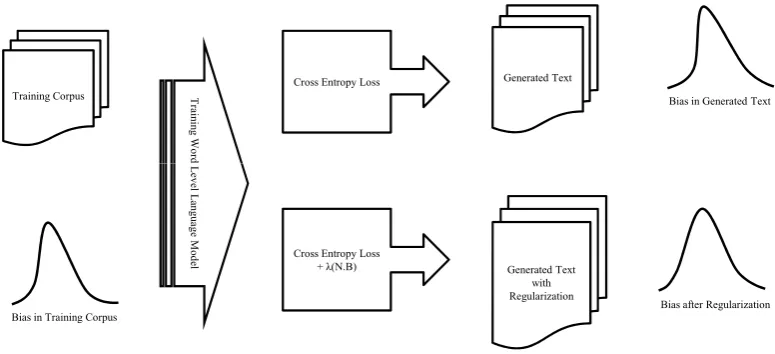
Figure 1: Word level language model is a three layer LSTM model.λcontrols the importance of minimizing bias
in the embedding matrix.
sentence—“Usually, smaller cottage-style houses have been demolished to make way for these Mc-Mansions.”, the word McMansions has a neg-ative connotation towards large and pretentious
houses. Epistemological biases are entailed, as-serted or hedged in the text. For example, in the sentence—“Kuypers claimed that the main-stream press in America tends to favor liberal viewpoints,”the word claimedhas a doubtful ef-fect on Kuypers statement as opposed to stated
in the sentence—“Kuypers stated that the main-stream press in America tends to favor liberal viewpoints.”It may be possible to capture both of these kinds of biases through the distributions of co-occurrences. In this paper, we deal with iden-tifying and reducing gender bias based on words co-occurring in a context window.
Bolukbasi et al.(2016) propose an approach to investigate gender bias present in popular word embeddings, such as word2vec (Mikolov et al.,
2013). They construct a gender subspace using a set of binary gender pairs. For words that are not explicitly gendered, the component of the word embeddings that project onto this subspace can be removed to debias the embeddings in the gender direction. They also propose a softer variation that balances reconstruction of the original em-beddings while minimizing the part of the embed-dings that project onto the gender subspace. We use the softer variation to debias the embeddings while training our language model.
Zhao et al.(2017) look at gender bias in the con-text of using structured prediction for visual object classification and semantic role labeling. They
ob-serve gender bias in the training examples and that their model amplifies the bias in its predictions. They impose constraints on the optimization to re-duce bias amplification while incurring minimal degradation in their model’s performance.
Word embeddings can capture the stereotypi-cal bias in human generated text leading to biases in NLP Applications. Caliskan et al. (2017) con-duct Word Embedding Association Test (WEAT). It is based on the hypothesis that word embeddings closer together in high dimensional space are se-mantically closer. They find strong evidence of social biases in pretrained word embeddings.
Rudinger et al. (2018) introduce Winogender schemas1 and evaluate three coreference resolu-tion systems—rule-based, statistical and neural systems. They find that these systems’ predictions strongly prefer one gender over the other for occu-pations.
Font and Costa-Juss`a (2019) study the impact of gender debiasing techniques byBolukbasi et al.
(2016) and Zhao et al. (2018) in machine trans-lation. They find these methods to be effective, and even a noted BLEU score improvement for the debiased model. Our work is closely related but while they use debiased pretrained embeddings, we train the word embeddings from scratch and debias them while the language model is trained.
May et al. (2019) extend WEAT to state-of-the-art sentence encoders: the Sentence Encoder Association Test (SEAT). They show that these tests can provide an evidence for presence of bias.
1It is Winograd Schema-style coreference dataset
However, the cosine similarity between sentences can be an inadequate measure of text similarity in sentences. In this paper, we attempt to mini-mize the cosine similarity between word embed-dings and gender direction.
Gonen and Goldberg (2019) conduct experi-ments using the debiasing techniques proposed by
Bolukbasi et al. (2016) and Zhao et al. (2018). They show that bias removal techniques based on gender direction are inefficient in removing all as-pects of bias. In a high dimensional space, spa-tial distribution of the gender neutral word embed-dings remain almost same after debiasing. This enables a gender-neutral classifier to still pick up the cues that encode other semantic aspects of bias. We use softer variation of the debiasing method proposed by Bolukbasi et al.(2016) and attempt to measure the debiasing effect from the minimal changes in the embedding space.
3 Methods
We first examine the bias existing in the datasets through qualitative and quantitative analysis of trained embeddings and cooccurrence patterns. We then train an LSTM word-level language model on a dataset and measure the bias of the generated outputs. As shown in Figure1, we then apply a regularization procedure that encourages the embeddings learned by the model to depend minimally on gender. We debias the input and the output embeddings individually as well as simul-taneously. Finally, we assess the efficacy of the proposed method in reducing bias.
We observe that when both input and output em-beddings are debiased together, the perplexity of the model shoots up by a much larger number than the input or the output embeddings debiased indi-vidually. We report our results when only input embeddings are debiased. This method, however, does not limit the model to capture other forms of bias being learned in other model parameters or output embeddings.
The code implementing our methods can be found in our GitHub repository.2
3.1 Datasets and Text Preprocessing
We compare the model on three datasets–Penn Treebank (PTB), WikiText-2 and CNN/Daily Mail. The first two have been used in language modeling for a long time. We include CNN/Daily
2https://github.com/BordiaS/language-model-bias
Mail dataset in our experiments as it contains a more diverse range of topics.
PTB Penn Treebank comprises of articles rang-ing from scientific abstracts, computer manuals, etc. to news articles. In our experiments, we observe that PTB has a higher count of male words than female words. Following prior lan-guage modeling work, we use the Penn Treebank dataset (PTB; Marcus et al., 1993) preprocessed byMikolov et al.(2010).
WikiText-2 WikiText-2 is twice the size of the PTB and is sourced from curated Wikipedia ar-ticles. It is more diverse and therefore has a more balanced ratio of female to male gender words than PTB. We use preprocessed WikiText-2 (Wikitext-2;Merity et al.,2016).
CNN/Daily Mail This dataset is curated from a diverse range of news articles on topics like sports, health, business, lifestyle, travel etc. This dataset has an even more balanced ratio of female to male gender words and thus, relatively less biased than the above two. However, this does not mean that the use of pronouns is not biased. This dataset was released as part of a summarization dataset by
Hermann et al.(2015), and contains 219,506 arti-cles from the newspaper the Daily Mail. We sub-sample the sentences by a factor of 100 in order to make the dataset more manageable for experi-ments.
3.2 Word-Level Language Model
We use a three-layer LSTM word-level language model (AWD-LSTM; Merity et al., 2018) with 1150 hidden units implemented in PyTorch.3 These models have an embedding size of 400 and a learning rate of 30.
We use a batch size of 80 for Wikitext-2 and 40 for PTB. Both are trained for 750 epochs. The PTB baseline model achieves a perplexity of 62.56. For WikiText-2, the baseline model achieves a perplexity of 67.67.
For CNN/Daily Mail, we use a batch size of 80 and train it for 500 epochs. We do early stopping for this model. The hyperparameters are chosen through a systematic trial and error approach. The baseline model achieves a perplexity of 118.01.
All three baseline models achieve reasonable perplexities indicating them to be good proxies for standard language models.
Fixed Context Infinite Context
λ µ σ β µ σ β P pl.
train 0.83 1.00 3.81 4.65
0.0 0.74 0.91 0.40 2.23 2.90 0.38 62.56 0.001 0.69 0.88 0.34 2.43 2.98 0.35 62.69
0.01 0.63 0.81 0.31 2.56 3.40 0.36 62.83
0.1 0.64 0.82 0.33 2.30 3.09 0.24 62.48
[image:4.595.183.417.64.172.2]0.5 0.70 0.91 0.39 2.91 3.76 0.38 62.5 0.8 0.76 0.96 0.45 3.43 4.06 0.26 63.36 1.0 0.84 0.94 0.38 2.42 3.02 -0.30 62.63
Table 1: Experimental results for Penn Treebank and generated text for differentλvalues
Fixed Context Infinite Context
λ µ σ β µ σ β P pl.
train 0.80 1.00 3.70 4.60
0.0 0.70 0.84 0.29 3.48 4.29 0.15 67.67
0.001 0.69 0.84 0.27 2.32 3.12 0.16 67.84
[image:4.595.184.416.210.320.2]0.01 0.61 0.79 0.20 1.88 2.69 0.14 67.78 0.1 0.65 0.82 0.24 2.26 3.11 0.06 67.89 0.5 0.70 0.88 0.31 2.25 3.17 0.20 69.07 0.8 0.65 0.84 0.28 2.07 2.98 0.18 69.36 1.0 0.74 0.92 0.27 2.32 3.21 -0.08 69.56
Table 2: Experimental results for WikiText-2 and generated text for differentλvalues
Fixed Context Infinite Context
λ µ σ β µ σ β P pl.
train 0.72 0.94 0.77 1.05
0.0 0.51 0.68 0.22 0.43 0.59 0.29 118.01 0.1 0.38 0.52 0.19 0.85 1.38 0.22 116.49
0.5 0.34 0.48 0.14 0.79 1.31 0.20 116.19
0.8 0.40 0.56 0.19 0.96 1.57 0.23 121.00 1.0 0.62 0.83 0.21 1.71 2.65 0.31 120.55
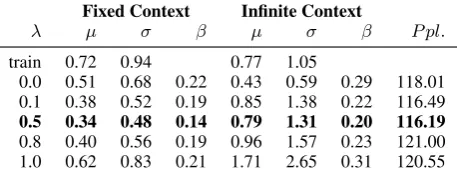
Table 3: Experimental results for CNN/Daily Mail and generated text for differentλvalues
3.3 Quantifying Biases
For numeric data, bias can be caused simply by class imbalance, which is relatively easy to quan-tify and fix. For text and image data, the com-plexity in the nature of the data increases and it becomes difficult to quantify. Nonetheless, defin-ing relevant metrics is crucial in assessdefin-ing the bias exhibited in a dataset or in a model’s behavior.
3.3.1 Bias Score Definition
In a text corpus, we can express the probability of a word occurring in context with gendered words as follows:
P(w|g) = c(w, g)/Σic(wi, g) c(g)/Σic(wi)
wherec(w, g)is a context window andgis a set of gendered words that belongs to either of the two categories: male or female. For example, when g=f, such words would includeshe,her,woman
etc. w is any word in the corpus, excluding stop words and gendered words. The bias score of a specific wordwis then defined as:
biastrain(w) = log
P(w|f) P(w|m)
This bias score is measured for each word in the text sampled from the training corpus and the text corpus generated by the language model. A posi-tive bias score implies that a word cooccurs more often with female words than male words. For an infinite context, the wordsdoctorandnursewould cooccur as many times with a female gender as with male gender words and the bias scores for these words will be equal to zero.
We conduct two sets of experiments where we define context windowc(w, g)as follows:
[image:4.595.185.414.357.445.2]We generated bias scores for several context win-dow sizes in the range(5,15). For a context sizek, there arekwords before andkwords after the tar-get wordwfor which the bias score is being mea-sured. Qualitatively, a smaller context window size has more focused information about the tar-get word. On the other hand, a larger window size captures topicality (Levy and Goldberg,2014). By choosing an optimal window ofk = 10, we give equal weight of 5% to the ten words before and the ten words after the target word.
Infinite Context In this scenario, we take an in-finite window of context with weights diminish-ing exponentially based on the distance between the target wordwand the gendered wordg. This method emphasizes on the fact that the nearest word has more information about the target word. The farther the context gets away from a word, the less information it has about the word. We give 5% weight to the words adjacent to the target word as in Fixed Context but reduce the weights of the words following by 5% and 95% to the rest; this applied recursively gives a base of 0.95. This method of exponential weighting instead of equal weighting adds to the stability of the measure.
3.3.2 Bias Reduction Measures
To evaluate debiasing of each model, we measure the bias for the generated corpus.
biasλ(w) = log(
P(w|f) P(w|m))
To estimate the amplification or reduction of the bias, we fit a univariate linear regression model over bias scores of context wordswas follows:
biasλ(w) =β∗biastrain(w) +c
whereβ is the scaled amplification measure rela-tive to the training data. Reducingβimplies debi-asing the model.
We also look at the distribution of the bias by evaluating mean absolute bias and deviation in bias scores for each context word in each of the generated corpora.
µλ =mean(abs(biasλ));σλ =stdev(biasλ)
We take the mean of absolute bias score as the word can be biased in either of the two directions.
3.4 Model Debiasing
Machine learning techniques that capture patterns in data to make coherent predictions can uninten-tionally capture or even amplify the bias in data (Zhao et al., 2017). We consider a gender sub-spacepresent in the learned embedding matrix in our model as introduced in the Bolukbasi et al.
(2016) paper. We train these embeddings on the word level language model instead of using the debiased pretrained embeddings (Font and Costa-Juss`a, 2019). We conduct experiments for the three cases where we debias—input embeddings, output embeddings, and both the embeddings si-multaneously.
Letw∈SW be a word embedding
correspond-ing to a word in the word embeddcorrespond-ing matrixW. Let
Di, . . . , Dn⊂SW
be thedefining sets4that contain gender-opposing words, e.g. man and woman. The defining sets are designed separately for each corpus since cer-tain words may not appear in another corpus. We consider it a defining set if both gender-opposing words occur in the training corpus.
If ui, vi are the embeddings corresponding to
the words manandwoman, then {ui,vi} = Di.
We consider the matrix C which is defined as a stack of difference vectors between the pairs in the defining sets. We have:
C=
(u1−2v1) .. . (un−2vn)
=UΣV
The difference between the pairs encodes the gender information corresponding to the gender pair. We then perform singular value decomposi-tion onC, obtainingUΣV. The gender subspace B is then defined as the firstkcolumns (wherek is chosen to capture50% of the variation) of the right singular matrixV:
B=V1:k
Let N be the matrix consisting of the embed-dings for which we would like the corresponding words to exhibit unbiased behavior. If we want the embeddings inN to have minimal bias, then its projection onto the gender subspaceB should be small in terms its the squared Frobenius norm.
Target Word λ Sample From Generated Text
0.0 “she was put on her own machine to raise money for her own wedding<unk>route which saw her
cryingand<unk>down a programme today . effects began by bottom of her marrow the<unk>” crying 0.5 “he<unk>in the americas with the<unk> which can spread a<unk>circumcision ceremony
made last month . as he<unk>his mother s<unk>cryingto those that”
1.0 “he discovered peaceful facebook remains when he was caughtcryingofficers but was arrested after they found the crash hire a man<unk>brown shocked his brother<unk>over”
0.0 “camilla said she talked to anyone and had previously left her love of two young children . it all comes with her family in conviction of her son s death . it s beenfragile. the<unk>and retail boy that was rik s same maker identified genuinely<unk>attacked all”
fragile 0.5 “his children at nearby children s hospital in<unk>and went<unk>years after he was arrested on
<unk>bail . she spent relaxed weeks in prison after being sharply infragile<unk>while she was jailed and strangled when she was born in<unk>virginia”
1.0 “could they possibly have a big barrier to jeff<unk>and<unk>my son all intelligence period that will contain the east country s world from all in the world the truth is when we moved clear before the split twenty days earlier that day . none of the distributed packs on the website can never<unk>
re able to<unk>it the second time so that fittingfragile<unk>are and less the country is<unk>
. it came as it was once<unk>million lead jobs mail yorkshire . adoption of these first product is ohio but it is currently almost impossible for the moon to address and fully offshore hotly ”
0.0 “mr<unk>worked traditions at the squadron base in<unk>rbs to marry the us government .he referring to the mainland them in february<unk>he kept communistleadershipfrom undergoing” leadership 0.5 “obama s first wife janet had a chance to run the opposition for a superbowl event for charity the majority of the south african people s travel stage<unk>leadershipwhile it was married off christ-mas”
1.0 “the woman s lungs and drinking the ryder of his daughters sleadershipmorris said businesses . however being of his mouth around wiltshire and burn talks from the hickey s<unk>employees”
0.0 “his legs and allegedly killed himself by suspicious points . in the latest case after an online page he leftprisonerin his home in<unk>near<unk>manhattan on saturday when he was struck in his car operating in<unk>bay smoking<unk>and<unk> <unk>when he had”
[image:6.595.71.529.65.422.2]prisoner 0.5 “it is something that the medicines can targetprisonerand destroy<unk>firms in the uk but i hope that there are something into the on top getting older people who have more branded them as poor .” 1.0 “the ankle follows a worker<unk>her<unk>prisonershe died this year before now an profile which clear her eye borrowed for her organ own role . it was a huge accident after the drugs she had”
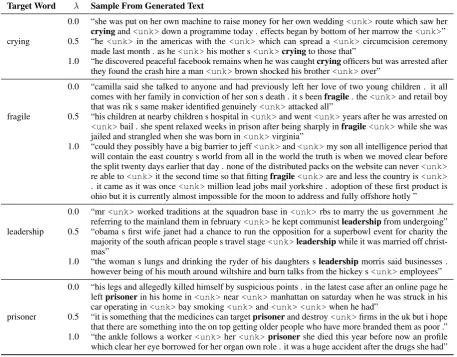
Table 4: Generated text comparison for CNN/Daily Mail for differentλvalues
Therefore, to reduce the bias learned by the em-bedding layer in the model, we can add the follow-ing bias regularization term to the trainfollow-ing loss:
LB=λkN Bk2F
where λ controls the importance of minimizing bias in the embedding matrixW (from whichN and B are derived) relative to the other compo-nents of the model loss. The matricesN and C are updated each iteration during the model train-ing.
We input 2000 random seeds in the language model as starting points to start word generation. We use the previous words as an input to the lan-guage model and perform multinomial selection to generate up the next word. We repeat this up to 500 times. In total, we generate106 tokens for all three datasets for eachλand measure the bias.
4 Experiments
4.1 Model
After achieving the baseline results, we run exper-iments to tuneλas hyperparameter. We report an in-depth analysis of bias measure on the models with debiased input embeddings.
4.2 Results and Text Examples
We calculate the measures stated in Section3.3for the three datasets and the generated corpora using the corresponding RNN models. The results are shown in Tables1,2and3. We see that theµ con-sistently decline as we increaseλuntil a point, be-yond which the model becomes unstable. So there is a scope of optimizing theλvalues. The detailed analysis is presented in Section4.3
with the words leadership andprisonersthat are stereotyped with male identity. These biases are reflected in the generated text forλ = 0. We no-tice increased mention of the less probable gen-der in the subsequent generated text with debias-ing (λ= 0.5,1.0). Forfragile, the generated text atλ= 1.0has reduced the mention of stereotyped female words but had no mentions of male words; resulting in a large chunk of neutral text. Simi-larly, inprisoners, the generated text forλ = 0.5 has no gender words.
However, these are small snippets and the bias scores presented in the supplementary table quan-tifies the distribution of gender words around the target word in the entire corpus. These target words are chosen as they are commonly perceived gender biases and in our study, they show promi-nent debiasing effect.5
4.3 Analysis and Discussion
We consider a text corpus to be biased when it has a skewed distribution of words cooccuring with one gender vs another. Any dataset that has such demographic bias can lead to (potentially unin-tended) social exclusion (Hovy,2015). PTB and WikiText-2 consist of news articles related to busi-ness, science, politics, and sports. These are all male dominated fields. However, CNN/Daily Mail consists of articles across diverse set of categories like entertainment, health, travel etc. Among the three corpora, Penn Treebank has more frequent mentions of male words with respect to female words and CNN/Daily Mail has the least.
As defined, bias score of zero implies perfectly neutral word, any value higher/lower implies fe-male/male bias. Therefore, the absolute value of bias score signifies presence of bias. Overall bias in a dataset can be estimated as the average of ab-solute bias score (µ). The aggregated abab-solute bias scores µ of the three datasets—Penn Treebank, WikiText-2, and CNN/Daily Mail—are 0.83, 0.80, and 0.72 respectively. Higherµvalue in this mea-sure means on-an-average the words in the entire corpus are more gender biased. As per the Tables
1,2, and3, we see that theµconsistently decline as we increaseλuntil a point, beyond which the model becomes unstable. So there is a scope of optimizing theλvalues.
The second measure we evaluated is the stan-dard deviation (σ) of the bias score distribution.
5For more examples, refer to the supplement
Less biased dataset should have the bias score con-centrating closer to zero and hence lowerσvalue. We consistently see that, with the initial increase ofλ, there is a decrease inσof the bias score dis-tribution.
The final measure to evaluate debiasing is com-parison of bias scores at individual word level. We regress the bias scores of the words in generated text against their bias scores in the training corpus after removing the outliers. The slope of regres-sionβsignifies the amplification or dampening ef-fect of the model relative to the training corpus. Unlike the previous measures, this measure gives clarity at word level bias changes. A drop inβ sig-nifies reduction in bias and vice versa. A negative βsignifies inversion in bias assuming there are no other effects of the loss term. In our experiments, we observeβ to increase with higher values ofλ possibly due to instability in model and none of those values go beyond 1.
We observe that corpus level bias scores likeµ, σ are less effective measures to study efficacy of debiasing techniques because they fail to track the improvements at word level. Instead, we recom-mend a word level score comparison likeβto eval-uate robustness of debiasing at corpus level.
To choose the context window in a more ro-bust manner, we take exponential weightings to the cooccurrences. The results for aggregated av-erage of absolute bias and standard deviation show the same pattern as in fixed context window.
As shown in the results above, we see that the standard deviation (σ), absolute mean (µ) and slope of regression (β) reduce for smaller λ rel-ative to those in training data and then increase with λto match the variance in the original cor-pus. This holds for the experiments conducted with fixed context window as well as with expo-nential weightings.
5 Conclusion
In this paper, we quantify and reduce gender bias in word level language models by defining a gen-der subspace and penalizing the projection of the word embeddings onto that gender subspace. We device a metric to measure gender bias in the train-ing and the generated corpus.
to study the change in bias scores at word level in generated text vs. training corpus. To calculate β, we conduct an in-depth regression analysis of the word level bias measures in the generated text corpus over the same for the training corpus.
Although we found mixed results on amplifica-tion of bias as stated byZhao et al.(2017), the de-biasing method shown byBolukbasi et al.(2016) was validated with the use of novel and robust bias measure designed in this paper. Our proposed methodology can deal with distribution of words in a vocabulary in word level language model and it targets one way to measure bias, but it’s highly likely that there is significant bias in the debiased models and data, just not bias that we can detect on this measure. It can be concluded different bias metrics show different kinds of bias (Gonen and Goldberg,2019).
We additionally observe a perplexity bias trade-off as a result of the additional bias regularization term. In order to reduce bias, there is a compro-mise on perplexity. Intuitively, as we reduce bias the perplexity is bound to increase due to the fact that, in an unbiased model, male and female words will be predicted with an equal probability.
6 Acknowledgements
We are grateful to Yu Wang and Jason Cramer for helping to initiate this project, to Nishant Subra-mani for helpful discussion, and to our reviewers for their thoughtful feedback. Bowman acknowl-edges support from Samsung Research.
References
Tolga Bolukbasi, Kai-Wei Chang, James Y Zou, Venkatesh Saligrama, and Adam T Kalai. 2016.
Man is to computer programmer as woman is to homemaker? Debiasing word embeddings. In D. D. Lee, M. Sugiyama, U. V. Luxburg, I. Guyon, and
R. Garnett, editors,Advances in Neural Information
Processing Systems 29, pages 4349–4357. Curran Associates, Inc.
Aylin Caliskan, Joanna J. Bryson, and Arvind
Narayanan. 2017. Semantics derived automatically
from language corpora contain human-like biases.
Science, 356(6334):183–186.
Joel Escud´e Font and Marta R. Costa-Juss`a. 2019.
Equalizing gender biases in neural machine trans-lation with word embeddings techniques. CoRR, abs/1901.03116.
Hila Gonen and Yoav Goldberg. 2019. Lipstick on a pig: Debiasing methods cover up systematic gender
biases in word embeddings but do not remove them. InProceedings of the 2019 Conference of the North American Chapter of the Association for Computa-tional Linguistics: Human Language Technologies. Association for Computational Linguistics.
Karl Moritz Hermann, Tomas Kocisky, Edward
Grefenstette, Lasse Espeholt, Will Kay, Mustafa
Su-leyman, and Phil Blunsom. 2015. Teaching
ma-chines to read and comprehend. In C. Cortes, N. D. Lawrence, D. D. Lee, M. Sugiyama, and R. Garnett,
editors,Advances in Neural Information Processing
Systems 28, pages 1693–1701. Curran Associates, Inc.
Dirk Hovy. 2015. Demographic factors improve
clas-sification performance. InProceedings of the 53rd
Annual Meeting of the Association for Computa-tional Linguistics and the 7th InternaComputa-tional Joint Conference on Natural Language Processing (Vol-ume 1: Long Papers), volume 1, pages 752–762.
Anja Lambrecht and Catherine E Tucker. 2018.
Al-gorithmic bias? an empirical study into
appar-ent gender-based discrimination in the display of
stem career ads. Social Science Research Network
(SSRN).
Omer Levy and Yoav Goldberg. 2014.
Dependency-based word embeddings. InProceedings of the 52nd
Annual Meeting of the Association for Computa-tional Linguistics (Volume 2: Short Papers), vol-ume 2, pages 302–308.
Mitchell P. Marcus, Beatrice Santorini, and Mary Ann Marcinkiewicz. 1993. Building a large annotated
corpus of english: The penn treebank.
Computa-tional Linguistics, 19(2):313–330.
Chandler May, Alex Wang, Shikha Bordia, Samuel R. Bowman, and Rachel Rudinger. 2019. On
measur-ing social bias in sentence encoders. In
Proceed-ings of the 2019 Conference of the North American Chapter of the Association for Computational Lin-guistics: Human Language Technologies. Associa-tion for ComputaAssocia-tional Linguistics.
Stephen Merity, Nitish Shirish Keskar, and Richard
Socher. 2018. Regularizing and optimizing LSTM
language models. In International Conference on Learning Representations.
Stephen Merity, Caiming Xiong, James Bradbury, and
Richard Socher. 2016. Pointer sentinel mixture
models. arXiv preprint arXiv:1609.07843.
Tomas Mikolov, Martin Karafi´at, Luk´as Burget, Jan Cernock´y, and Sanjeev Khudanpur. 2010.
Recur-rent neural network based language model. In
IN-TERSPEECH, pages 1045–1048. ISCA.
Tomas Mikolov, Ilya Sutskever, Kai Chen, Greg S Cor-rado, and Jeff Dean. 2013. Distributed representa-tions of words and phrases and their
compositional-ity. InAdvances in neural information processing
Mei Ngan and Patrick Grother. 2015. Face recogni-tion vendor test (FRVT) performance of automated gender classification algorithms. US Department of Commerce, National Institute of Standards and Technology.
Marta Recasens, Cristian Danescu-Niculescu-Mizil, and Dan Jurafsky. 2013. Linguistic models for
an-alyzing and detecting biased language. In
Proceed-ings of the 51st Annual Meeting of the Association for Computational Linguistics (Volume 1: Long Pa-pers), volume 1, pages 1650–1659.
Rachel Rudinger, Jason Naradowsky, Brian Leonard, and Benjamin Van Durme. 2018. Gender bias in
coreference resolution. InProceedings of the 2018
Conference of the North American Chapter of the Association for Computational Linguistics: Human Language Technologies, New Orleans, Louisiana. Association for Computational Linguistics.
Jieyu Zhao, Tianlu Wang, Mark Yatskar, Vicente Or-donez, and Kai-Wei Chang. 2017. Men also like shopping: Reducing gender bias amplification using
corpus-level constraints. InEMNLP, pages 2979–
2989. Association for Computational Linguistics.
Jieyu Zhao, Yichao Zhou, Zeyu Li, Wei Wang, and
Kai-Wei Chang. 2018. Learning gender-neutral word