Proceedings of NAACL-HLT 2019, pages 2820–2830 2820
Ranking-Based Autoencoder for Extreme Multi-label Classification
Bingyu Wang
Khoury College of CS Northeastern University
Li Chen
JD.com Inc.
Wei Sun
Department of ECE North Carolina State University
Kechen Qin
Khoury College of CS Northeastern University
Kefeng Li
JD.com Inc.
Hui Zhou
JD.com Inc.
Abstract
Extreme Multi-label classification (XML) is an important yet challenging machine learn-ing task, that assigns to each instance its most relevant candidate labels from an extremely large label collection, where the numbers of la-bels, features and instances could be thousands or millions. XML is more and more on de-mand in the Internet industries, accompanied with the increasing business scale / scope and data accumulation. The extremely large label collections yield challenges such as computa-tional complexity, inter-label dependency and noisy labeling. Many methods have been pro-posed to tackle these challenges, based on dif-ferent mathematical formulations. In this pa-per, we propose a deep learning XML method, with a word-vector-based self-attention, fol-lowed by a ranking-based AutoEncoder archi-tecture. The proposed method has three ma-jor advantages: 1) the autoencoder simulta-neously considers the inter-label dependencies and the feature-label dependencies, by project-ing labels and features onto a common em-bedding space; 2) the ranking loss not only improves the training efficiency and accuracy but also can be extended to handle noisy la-beled data; 3) the efficient attention mecha-nism improves feature representation by high-lighting feature importance. Experimental re-sults on benchmark datasets show the pro-posed method is competitive to state-of-the-art methods.
1 Introduction and Related Work
In multi-label classification (Tsoumakas and Katakis, 2007; Zhang and Zhou, 2014), one as-signs multiple labels to each instance. Multi-label classification has many real-word applications: for example, a movie may be associated with multi-ple genres, a web page may contain several
top-ics, and an image can be tagged with a few ob-jects. In these classification tasks, labels often ex-hibit complex dependencies: for example, Doc-umentary and Sci-Fi are usually mutually exclu-sive movie genres, whileHorrorandThrillerare typically highly correlated. Predicting labels inde-pendently fails to capture these dependencies and suffers suboptimal performance (Tsoumakas and Katakis, 2007; Ghamrawi and McCallum, 2005;
Li et al.,2016). Several methods that capture la-bel dependencies have been proposed, including Conditional Random Fields (CRF) (Lafferty et al.,
2001; Ghamrawi and McCallum, 2005), Classi-fier Chains (CC) (Read et al., 2011; Dembczyn-ski et al., 2010), Conditional Bernoulli Mixtures (CBM) (Li et al.,2016), and Canonical Correlated AutoEncoder (C2AE) (Yeh et al.,2017). However, these methods typically only work well on small-to-medium scale datasets.
Extreme multi-label classification (XML) is a multi-label classification task in which the num-ber of instances, features and labels are very large, often on the order of thousands to millions ( Zubi-aga,2012;Bhatia et al., 2015). It has numerous real-world applications such as merchandise tag-ging and text categorization. Although the label vocabulary is large, typically each instance only matches a few labels. The scale of the classifi-cation task, the inter-dependent labels, and label sparsity all pose significant challenges for accu-rate and efficient classification.
Many methods have been proposed for extreme multi-label classification. We group them into dif-ferent categories and describe representative meth-ods in each category.
Independent Classification: A popular method
prob-lems (Tsoumakas and Katakis, 2007; Hariharan et al., 2012; Babbar and Sch¨olkopf, 2017; Yen et al., 2016, 2017). A typical implementation is to treat labels independently and train one-vs-all classifiers for each of the labels. These inde-pendent classifiers can be trained in parallel and thus are computationally efficient in practice. Ig-noring the inter-label dependency also enables ef-ficient optimization algorithm, which further re-duces computational cost. However, ignoring la-bel dependency inherently limits prediction accu-racy. A competitive method in this category is called PD-Sparse (Yen et al., 2016), with a vari-ant of the Block-Coordinate Frank-Wolfe training algorithm that exploits data sparsity and achieves complexity sub-linear in the number of primal and dual variables. PD-Sparse (Yen et al.,2016) shows better performance with less training and prediction time than 1-vs-all Logistic Regression or SVM on extreme multi-label datasets.
Tree Based Classifiers: Following the success
of tree-based algorithms in binary classification problems, people also proposed tree-based al-gorithms for multi-label classification (Agrawal et al., 2013; Weston et al., 2013; Prabhu and Varma,2014), which achieve promising prediction accuracy. Similar to decision trees, these methods make classification decisions in each branch split. Different from decision trees, each split evaluates all features, instead of one, to make a decision. Also, each decision is for a subset of labels rather than one label. Finally, via ensembling and par-allel implementation, trees can boost their predic-tion accuracy with practically affordable compu-tational cost. Among these tree based classifiers, FastXML (Prabhu and Varma,2014) further opti-mizes an nDCG-based ranking loss function and achieves significantly higher accuracy than other peer methods.
Embedding:A major difficulty of extreme multi-label classification is the large number of multi-labels. When labels are inter-dependent, one can attempt to find a lower dimensional latent label space from which one can fully reconstruct the original la-bel space. Over the past decade, many meth-ods were proposed to find this latent label space. In early work, methods were proposed to lin-early project the original label space into a lower-dimension space and reconstruct predictions from that space (Tai and Lin, 2012; Balasubramanian and Lebanon, 2012). However, there are two
as-sumptions: (1) the label dependency is linear and (2) the label matrix is low-rank, which do not al-ways hold, as reflected by the low prediction ac-curacy of these methods. To overcome the limi-tation of the linear assumption, different methods were proposed using non-linear embeddings, in-cluding kernels, sub-sampling (Yu et al., 2014), feature-aware (Lin et al., 2014;Yeh et al., 2017) and pairwise distance preservation (Bhatia et al.,
2015). Among these methods, SLEEC (Bhatia et al.,2015) stands out for less training time and higher accuracies. SLEEC introduces a method for learning a small ensemble of local pairwise distance preserving embeddings which allows it to avoid the low-rank and linear-dependency as-sumption.
Deep Learning:Deep learning has not been well studied for XML, although it has achieved great successes in binary and multi-class classification problems (Lin et al.,2017;Kim,2014).
FastText (Grave et al., 2017) reconstructs a document representation by averaging the em-bedding of the words in the document, followed by a softmax transformation. It is a simple but very effective and accurate multi-class text clas-sifier, as demonstrated in both sentiment analysis and multi-class classification (Grave et al.,2017). However, FastText may not be directly applicable for more complicated problems, like XML.
BoW-CNN (Johnson and Zhang, 2014) learns powerful embedding of small text regions by ap-plying CNN to high-dimensional text data. The embedding of all regions are sent to one or mul-tiple convolutional layers, a pooling layer and the output layer at the end.
probabilities/scores may not be directly compara-ble. This is problematic because in many applica-tions the requirement is to rank all labels accord-ing to their relevance, as opposed to makaccord-ing an independent binary decision on each label. The third defect is that XML-CNN requires raw docu-ments as input since it adopts the CNN structure on top of sentences (Kim,2014); this is problem-atic when datasets are given in other formats such as bag-of-words for text.
C2AE (Yeh et al.,2017) uses a ranking loss as the training objective. But the ranking loss em-ployed there needs to compare all (positive la-bel, negative label) pairs, and therefore does not scale well to extreme data. Furthermore, C2AE only takes the bag-of-words representation (one-hot encoding) as the input, which makes it harder to learn powerful representations from extreme multi-label dataset.
Our Contribution In this paper, we propose a
new deep learning method to address extreme multi-label classification. Our contributions are as follows:
• Motivated by the recent success of attention techniques, we propose an efficient attention mechanism that can learn rich representations from any type of input features, including but not limited to bag-of-words, raw documents and images.
• Inspired by C2AE, our proposed model projects both features and labels onto com-mon latent spaces wherein correlations be-tween features and labels are exploited. By decoding this latent space into the original label space in the prediction stage, the de-pendencies between labels are implicitly cap-tured.
• We propose a margin-based ranking loss that is simultaneously more effective for extreme settings and more tolerant towards noisy la-beling.
2 The Proposed Method (Rank-AE)
In this section, we introduce the data format in XML, and the proposed networks, including the marginal-based ranking loss and attentions.
fully connected
fully connected
fully connected
Encoder
Decoder
Embedding & Atten
fully connected
fully connected x
y
(xh, yh) y' xh
yh
x'
[image:3.595.307.525.61.183.2]Feature Emebdding
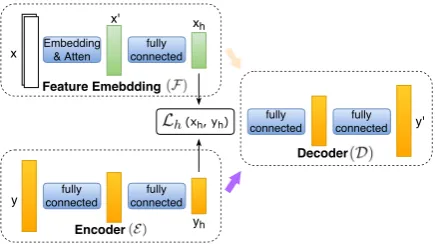
Figure 1: Ranking-based AutoEncoder for XML.
2.1 Data Format
In XML, we are given a set of label candidates
Y ={1,2, . . . , L}. The datasetDconsists of fea-tures and labels: D = {(xi, yi)}Ni=1, whereinN
is number of data, and each instancex ∈ RV (V
is the feature dimension) matches a label subset y ⊆ Y, which can be written as a binary vec-tory = {0,1}L, with each bity
l representing the
presence or absence of labell. Given such dataset, our goal is to build a classifierc:RV → {0,1}L,
mapping an instance to a subset of labels with ar-bitrary size.
2.2 Auto-Encoder Network
Inspired by the C2AE (Yeh et al., 2017), we pro-pose a Ranking-based Auto-Encoder (Rank-AE), as depicted in Figure1. Similar to C2AE, Rank-AE includes three mapping functions to be trained: a mapping from input featuresxto feature embed-dings xh, denoted as F(x), where h is the
em-bedding size; an encoder from output labels y to label embeddingsyh asE(y); a decoder from
la-bel embeddings yh to output labels y0, written as
D(yh). The proposed model is built on two
as-sumptions: first, each instance can be represented from two different aspects, features x and labels y, so there exists a common latent space between x andy; second, labels can be reproduced by an autoencoder. Based on these two assumptions, we design the object function as below:
L(D) = min
F,E,DLh(xh, yh) +λLae(y, y
0)
(1)
wherein lossLh(xh, yh)aims to find the common
latent space for inputxand outputyandLae(y, y0)
During inference, a given input xˆ will be first transformed into a vector in latent space xˆh =
F(ˆx), which will then be fed into the label decoder to compute the predictionsyˆ=D(ˆxh). It is worth
mentioning that although the label encoderEis ig-nored during the prediction, it is able to exploit cross-label dependency during the label embed-ding stage (Yeh et al., 2017). Recent work ( Ku-rata et al.,2016;Baker and Korhonen,2017) also show that using co-occurring labels information to initialize the neural network can further improve accuracy in multi-label classification.
2.3 LhandLaeLoss Functions
Learning Common Embedding (Lh).
Minimiz-ing the common hidden space loss Lh has been proposed based on different considerations (Zhang and Schneider,2011;Yeh et al.,2017;Shen et al.,
2018), ranging from canonical correlation anal-ysis to alignment of two spaces with a perspec-tive of cross-view. Since the hidden space is usu-ally small and requires less computational cost, we simply employ the mean squared loss forLh.
Reconstructing Output (Lae). Unlike Lh with small space,Laeloss usually involves a large num-ber of labels. Moreover,Lae also directly affects
the classification performance significantly since different loss functions lead to their own proper-ties (Hajiabadi et al.,2017). Accordingly, solving such problems with large scale and desirable prop-erties presents open challenges in three aspects: 1) how to improve time efficiency, 2) how to produce comparable labels scores and 3) how to deal with noise labels. Unfortunately, most of the related deep learning methods only target one or two as-pects. C2AE attempts to minimize the number of misclassified pairs between relevant and irrelevant labels, as a result its computational complexity is quadratic with number of labels in the worst case; also it fails to scale well on large number of in-put features or labels due to its inefficient imple-mentation1. XML-CNN (Liu et al.,2017) achieves computational efficiency by training a deep neural network with hidden layers much smaller than the output layer with binary cross-entropy loss (BCE), which has linear complexity in number of labels. Despite this, BCE loss could neither capture la-bel dependencies nor produce directly compara-ble label scores, since each label is treated
inde-1https://github.com/dhruvramani/
C2AE-Multilabel-Classification
pendently. Moreover, BCE loss tends to be sensi-tive to label noise, which is frequently observed in XML data (Reed et al.,2014;Ghosh et al.,2017). To void the aforementioned issues, we propose a marginal-based ranking loss in AutoEncoder:
Lae(y, y0) =LP(y, y0) +LN(y, y0) (2)
LP(y, y0) = X
n∈N(y)
max
p∈P(y)(m+y
0
n−y0p)+ (3)
LN(y, y0) =
X
p∈P(y)
max
n∈N(y)(m+y
0
n−y
0
p)+ (4)
whereinN(y)is the set of negative label indexes, P(y)is the complement ofN(y), and marginm∈
[0,1]is a hyper-parameter for controlling the mini-mal distance between positive and negative labels. The loss consists of two parts: 1) LP targets to raise the minimal score from positive labels over all negative labels at least by m; 2) LN aims to penalize the most violated negative label under all positive labels by m. The proposed loss has the following attractive properties: 1) having linear complexity in number of labelsO(L); 2) capturing the relative rankings between positive and negative labels; 3) tolerating the noisy labels with a tunable hyper-parameterm. To explain the last property, assume yn0 and y0p are the predicted probabilities bounded in[0,1], then on one extreme case with noise-free labels andm= 1, all positive labels are raised to probability1, while negatives are penal-ized to0; on the other extreme case with all ran-dom labels, e.g. from i.i.d. Bernoulli distribution, settingm = 0indicates that the annotated labels are completely random noises.
2.4 Dual Attention
Word Embedding
e1 e2 e3 e4
v1e1
v3e3
v2e2
v4e4 X
x'
w1w2w3w4 v1V2V3V4
V I
x
F2
F1 Attention
a1 a2 a3 a4
X
A
m1 m2 m3 m4
P
E
[image:5.595.307.527.62.124.2]V' M
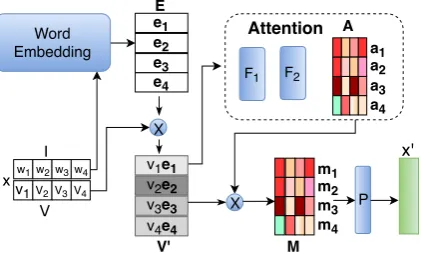
Figure 2: Dual-Attention in Feature Embedding.
In our proposed attention module, it also con-sists of spatial-wise and channel-wise attentions. First, we force spatial-wise attention to attend on a list of important words in a way that simply multiply word embeddings by term-frequency or tf-idf (whichever is provided in the feature ma-trix). It is worth noting that spatial-wise mod-ule does not involve any parameters, but it ef-ficiently captures the importance of words with numerical statistics, like tf-idf. We demonstrate spatial-wise attention on the left side of Figure2, where the inputx= (I, V)contains bag-of-words vector I = (w1, w2, . . . , wn)T ∈ Rn and tf-idf
vector V = (v1, v2, . . . , vn)T ∈ Rn.
Bag-of-words I are fed into an embedding layer E = (e1,e2, . . . ,en)T ∈ Rn×C to get the word
em-beddings, where ej ∈ RC is word embedding
vector of wj. Then we multiply word
embed-dings byV to obtain weighted word embeddings:
V0 = (v1e1, v2e2, . . . , vnen)T ∈Rn×C.
The channel attention is designed to empha-size the significant aspects by assigning different weights on bits in a word embedding. For exam-ple, in the word embedding of “apple”, some of the bits may reflect fruit, while others may indicate the company name. To achieve this, we adopt the ex-citation network from the SENet (Hu et al.,2017) with a slight increase in model complexity. The excitation network includes two fully connected layers with a non-linearity activation function in between, see the top-right part in Figure2:
AT =σ F2δ(F1V0T)
= (a1,a2, . . . ,an) (5)
wherein A ∈ Rn×C, δ andσ refer to the two
activation functions, ReLU and Sigmoid, F1 ∈
R
C
r×C and F2 ∈ RC×
C
r are the two fully
con-nected layers, with word embedding size C and
Dataset train test label feature cardinality inst/L Delicious* 12,920 3,185 983 500 19.03 312
Mediamill* 30,993 12,914 101 120 4.38 1,902
RCV* 623,847 155,962 2,456 47,236 4.79 1,219
IMDb 27,417 6,740 28 115,554 2.4 2,937
EURLex 15,539 3,909 3,993 5,000 5.31 26
[image:5.595.75.286.66.194.2]Wiki10 14,146 6,616 30,938 101,938 18.64 9
Table 1: Dataset Characteristics: train, test, label and feature are the numbers of training, testing, labels and features respectively; cardinality is the average number of label per instance; inst/L is the average number of instances per label. * indicates only feature matrix is provided and no raw document.
reduction ratio r. After obtaining the attention matrix A, we can apply those attentions to the weighted word embeddings to get a re-scaled word embedding matrix M: M = V0 ◦ A = (m1,m2, . . . ,mn)T ∈Rn×C, which is computed
via the element-wise product. The obtained at-tention matrixAintroduces dynamics conditioned on the input weighted word embeddings and fur-ther boosts feature discriminability. The last step is to feed the re-scaled embedding matrix into an average pooling to obtain the feature embedding x0 ∈ RC. With the proposed spatial-wise and
channel-wise attentions, Rank-AE can learn rich feature representations in an efficient way.
3 Experiments & Analysis
3.1 Dataset & Experiment Setup
Dataset. Our experiments are conducted on six extreme multi-label datasets and their character-istics are shown in Table 1, among which IMDb is crawled from online movie database2 and the rest five datasets are downloaded from the extreme classification repository3. For datasets from the repository, we adopt the provided train/test split, and for IMDb we randomly choose 20% of the data as test set and the rest of80%as training set. For all datasets, we reserve another20%of train-ing data as validation for tuntrain-ing hyper-parameters. After tuning, all models are trained on the entire training set.
Among these datasets, three of them are only provided with BoW feature matrix: Delicious, Mediamill (dense feature matrix extracted from image data) and RCV, which are only feasi-ble for the non-deep learning methods (SLEEC, FastXML, PDSparse) and Rank-AE. We provide
2
https://www.imdb.com/
3http://manikvarma.org/downloads/XC/
both feature matrix and raw documents for IMDb, EURLex and Wiki10, which are feasible for both deep learning and non-deep learning methods. For those data with both formats, we remove the words from the raw documents that do not have corre-sponding BoW features so that the vocabulary size is the same for both deep and non-deep learning methods.
Evaluation Metrics. To evaluate the
perfor-mances of each model, we adopt the metrics that have been widely used in XML: Precision at top k (P@k), and the Normalized Discounted Cummu-lated Gains at top k (n@k) (Bhatia et al., 2015;
Prabhu and Varma, 2014; Yen et al., 2016; Liu et al.,2017).P@kis a measure based on the frac-tion of correct predicfrac-tions in the top k predicted scoring labels andn@kis a normalized metric for Discounted Cumulative Gain:
P@k= 1
k X
l∈rankk(ˆy)
yl (6)
DCG@k= X
l∈rankk(ˆy)
yl
log(l+ 1) (7)
nDCG@k= DCG@K
Pmin(k,|y|)
l=1 log(1l+1)
(8)
wherein therankkreturnsklargest indices of the
prediction yˆin a descending order, and|y|is the number of positive labels in ground truth. In the results, we report the average P@kand n@k on testing set withk= 1,3,5respectively.
Hyper-parameters. In Rank-AE, we use the fixed neural network architecture, with two fully con-nected layers in bothEncoderandDecoder, and one fully connected layer followingEmbedding
& Atten network in Feature Embedding. We
also fix most of the hyper-parameters, including hidden dimensionh(100 for small number of la-bels data and 200 for large ones), word embed-ding size C = 100, and reduction ratio r = 4. The remaining hyper-parameters, such as balance λbetweenLhandLae, marginminLae, and
oth-ers (decay, learning rate) in the optimization algo-rithms, are tuned on validation set. In addition, if the vocabulary for BoW is available, e.g. IMDb and Wiki10, theWord Embeddingcomponent is initialized by Glove4, a pre-trained word embed-dings of 100 dimensions; if it is not, e.g. Medi-amill, Delicious and RCV, a random initialization is employed.
4https://nlp.stanford.edu/projects/
glove/
For the existing methods with the same train/test split, we take the scores from the orig-inal papers for SLEEC, FastXML and PD-Sparse directly. For the new datasets and splits, the hyper-parameters are tuned on the validation set for all methods, as suggested in their papers.
3.2 Comparisons with Related Methods
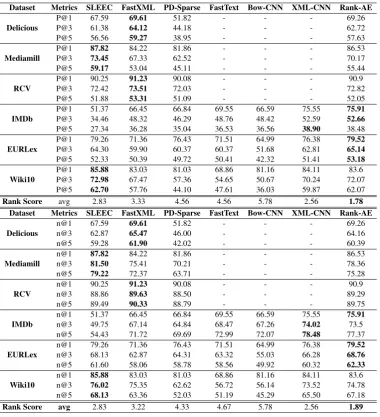
We evaluate the proposed Rank-AE with other six state-of-the-art methods, SLEEC, FastXML, PD-Sparse, FastText, Bow-CNN and XML-CNN, which are the leading methods among their cat-egories. Among them, FastText, Bow-CNN and XML-CNN only take raw documents, which are not available for Delicious, Mediamill and RCV datasets. For Rank-AE, we adopt the raw text as the input for IMDb, and feature matrix for the rest. The performances evaluated onP@kandn@k with k = 1,3,5 are summarized in Table 2 (a) and (b) separately. As reported, Rank-AE reaches the best performances on two datasets (IMDb and EURLex) out of 6 datasets, while SLEEC achieves the best performances on Mediamill and Wiki10, and FastXML performs the best on Delicious and RCV. In general, SLEEC and FastXML are very competitive to each other in non-deep learning methods, but PD-Sparse performs worse. Rank-AE always performs better than PD-Sparse with at least 1%increase, up to almost20% improve-ment on Delicious data. When compared with FastXML, Rank-AE outperforms on 4 datasets with1%to10%growth, but underperforms on De-licious and RCV with 1% decrease. SLEEC, as the best non-deep learning method in our experi-ments, performs almost identical to Rank-AE, but on IMDb data, it performs7% ∼ 15% less than non-deep methods, and even worse than Rank-AE. Comparing Rank-AE with deep learning meth-ods, we narrow down to three datasets with avail-able raw documents: IMDb, EURLex and Wiki10. As shown in Table 2, FastText and Bow-CNN, not planned for XML but for multi-class, perform much worse than XML-CNN and Rank-AE as ex-pected. On the other hand, XML-CNN achieves close performance to Rank-AE: with similar per-formance on IMDb dataset, but lower scores on EURLex and Wiki10 with 2%drop in P@k and n@k. In spite of this, Rank-AE, trained on fea-ture matrix for EURLex and Wiki10, surprisingly performs better than XML-CNN on raw data.
Dataset Metrics SLEEC FastXML PD-Sparse FastText Bow-CNN XML-CNN Rank-AE
Delicious
P@1 67.59 69.61 51.82 - - - 69.26
P@3 61.38 64.12 44.18 - - - 62.72
P@5 56.56 59.27 38.95 - - - 57.63
Mediamill
P@1 87.82 84.22 81.86 - - - 86.53
P@3 73.45 67.33 62.52 - - - 70.17
P@5 59.17 53.04 45.11 - - - 55.44
RCV
P@1 90.25 91.23 90.08 - - - 90.9
P@3 72.42 73.51 72.03 - - - 72.82
P@5 51.88 53.31 51.09 - - - 52.05
IMDb
P@1 51.37 66.45 66.84 69.55 66.59 75.55 75.91
P@3 34.46 48.32 46.29 48.76 48.42 52.59 52.66
P@5 27.34 36.28 35.04 36.53 36.56 38.90 38.48
EURLex
P@1 79.26 71.36 76.43 71.51 64.99 76.38 79.52
P@3 64.30 59.90 60.37 60.37 51.68 62.81 65.14
P@5 52.33 50.39 49.72 50.41 42.32 51.41 53.18
Wiki10
P@1 85.88 83.03 81.03 68.86 81.16 84.11 83.6 P@3 72.98 67.47 57.36 54.65 50.67 70.24 72.07 P@5 62.70 57.76 44.10 47.61 36.03 59.87 62.07
Rank Score avg 2.83 3.33 4.56 4.56 5.78 2.56 1.78 Dataset Metrics SLEEC FastXML PD-Sparse FastText Bow-CNN XML-CNN Rank-AE
Delicious
n@1 67.59 69.61 51.82 - - - 69.26
n@3 62.87 65.47 46.00 - - - 64.16
n@5 59.28 61.90 42.02 - - - 60.39
Mediamill
n@1 87.82 84.22 81.86 - - - 86.53
n@3 81.50 75.41 70.21 - - - 78.36
n@5 79.22 72.37 63.71 - - - 75.28
RCV
n@1 90.25 91.23 90.08 - - - 90.9
n@3 88.86 89.63 88.50 - - - 89.29
n@5 89.49 90.33 88.79 - - - 89.75
IMDb
n@1 51.37 66.45 66.84 69.55 66.59 75.55 75.91
n@3 49.75 67.14 64.84 68.47 67.26 74.02 73.5
n@5 54.43 71.72 69.69 72.99 72.07 78.48 77.37
EURLex
n@1 79.26 71.36 76.43 71.51 64.99 76.38 79.52
n@3 68.13 62.87 64.31 63.32 55.03 66.28 68.76
n@5 61.60 58.06 58.78 58.56 49.92 60.32 62.33
Wiki10
n@1 85.88 83.03 81.03 68.86 81.16 84.11 83.6 n@3 76.02 75.35 62.62 56.72 56.14 73.52 74.78 n@5 68.13 63.36 52.03 51.19 45.29 65.50 67.18
[image:7.595.110.491.60.478.2]Rank Score avg 2.83 3.22 4.33 4.67 5.78 2.56 1.89
Table 2: Comparisons with other methods (P@kandn@kare reported in the top and bottom tables respectively). ’-’ indicates unavailable due to raw documents are not available for these deep learning methods, and number in bold is the best result in the line.
could perform the best on all datasets. We discover that each dataset has its own intrinsic properties, such as diversity of labels, number of features, av-erage number of relevant labels per instance and average number of training instances per label, see Table 1. All those properties will affect training procedure, for example, how much flexibility a model should be in order to explain labels well by the given training data. Because those factors are always changing from data to data, they also in-fluence the performances on different models. In order to have a reasonable comparisons, we report the average ranking score for each method. To compute the average ranks, we first rank the meth-ods based on their performance in each row in Ta-ble2, then average them through all rows, and
re-port the final ranking scores in the last row of each table. The average ranking scores show that Rank-AE is the best model with ranking scores1.78 in [email protected]@k.
3.3 Comparisons with Noise Labels
40 45 50 55 60 65 70 75p@1 40 42 44 46 48 50 52p@3
FastXML PD-Sparse XML-CNN Rank-AE BCE-AE
32 34 36 38
p@5
0 10 20 30 40 50 60 40 45 50 55 60 65 70 75n@1
0 10 20 30 40 50 60 55
60 65 70 75n@3
0 10 20 30 40 50 60 60 65 70 75 Missing Rate Performance(%) n@5 50 55 60 65 70 75p@1 35 40 45 50 p@3 25.0 27.5 30.0 32.5 35.0 37.5 p@5
0 10 20 30 40 50 60 50 55 60 65 70 75n@1
0 10 20 30 40 50 60 45 50 55 60 65 70 75n@3
0 10 20 30 40 50 60 50 55 60 65 70 75 80
Missing and Invalid Rate
Performance(%)
[image:8.595.72.288.61.308.2]n@5
Figure 3: Comparisons on noisy labelling IMDb data.
missing and invalid labels: flipping either from positive to negative or from negative to positive with a noise rate. The noise rates are varied from
0% to 60% on 80% of the training set, and the rest of20%is noise-free validation set for model selection. We select five algorithms: FastXML, PD-Sparse, XML-CNN, Rank-AE and BCE-AE, wherein BCE-AE is our proposed method but us-ing binary cross-entropy loss inLae(y, y0). Com-paring BCE-AE with Rank-AE can be used to ver-ify whether the robustness to label noise is due to the use of marginal ranking loss.
The performances are reported on the same clean test set, shown in Figure3. Rank-AE con-sistently outperforms other four approaches and has the best robustness tolerating noise labels. Be-sides, FastXML and PD-Sparse are more toler-ant to missing noises than XML-CNN, which may due to XML-CNN has greater capacity and thus more prone to over-fitting the noise. Furthermore, when comparing Rank-AE with BCE-AE, both of which share the same structure but have different loss functions, the proposed marginal-based rank-ing loss seems to be robuster than binary cross-entropy loss.
3.4 More Analysis in Rank-AE
Ablation Study. The effectiveness and robust-ness of Rank-AE have been demonstrated in the previous section. However, it is not clear to us
50.0 52.5 55.0 57.5 60.0 62.5 65.0 67.5 70.0Delicious 45 50 55 60 65 70 75 80 85 90Mediamill
No attn No loss Rank-AE
40 50 60 70 80 90 RCV
P@1 P@3 P@5 35 40 45 50 55 60 65 70 75 80IMDb
P@1 P@3 P@5 50 55 60 65 70 75 80 85EURLex
P@1 P@3 P@5 20 30 40 50 60 70 80
Precision at Top K
Performance(%)
Wiki10
Figure 4: Precision at top k comparisons: No attn (/) is no attention Rank-AE; No loss (+) is using binary cross entropy lose instead of marginal ranking loss; Rank-AE (x) is our proposed model.
yet that if the effectiveness benefits from the pro-posed components, such as attention mechanism and marginal ranking loss. To further understand the impacts from these two factors, we conduct a controlling experiment with three different set-tings: 1) removing the Attention component A
in Figure 2 from Rank-AE, in which case V0 is directly passed to the average pooling to obtain x0, called No attn; or 2) examining the perfor-mances by replacing the marginal ranking loss (Lae) with a binary cross entropy loss, namedNo loss; or 3) keeping the originalRank-AEwithout any change. In Figure4, P@kis reported on the six datasets for the ablation experiment, because n@kis similar toP@k, thus eliminated here. The comparisons results show that Rank-AE without any change works better than the other two on all datasets consistently, especially on Wiki10. First, channel-attention extracts richer information from the word embeddings by introducing the channel weights. Thus, it is more suitable when clas-sification tasks become more complicated and a word more likely represents multiple aspects. Sec-ond, Rank-AE gains some advantage of tolerating noise labels with marginal ranking loss compar-ing to BCE loss. We could even further infer that IMDb and RCV may have relatively less noise la-bels since the performance does not benefit much from the marginal ranking loss.
[image:8.595.310.525.66.220.2]Figure 5: Visualization for Attention in Rank-AE. The labels are movie genres split by underline, and the input is a movie story line.
.
employ the visualization tool (Lin et al.,2017) to highlight important words based on the attention output. Specifically, we run our method on IMDb dataset, wherein each instance is a movie story as-sociated with relevant genres as labels. Instead of extracting V0 matrix using the proposed spatial-wise attention, we obtain a fixed size embeddings from a bidirectional LSTM on variable length of sentence, fed to our channel-attention network. Through the channel-attention network, we can observe the attention matrixAfor each input doc-ument. By summing up the attention weights of each word embedding vector, we can visualize the overall attention for that word with the visualiza-tion tool5. We randomly select three movies from IMDb testing set (See Figure 5). By looking at the highlighted regions, we can see that the pro-posed channel-attention is able to focus more on the words that are highly related to the topics.
4 Conclusion
In this paper, we propose a marginal ranking loss, which not only predicts comparable labels scores between labels, more suitable for ranking metrics,
5The visualization tool is provided by
https://github.com/kaushalshetty/ Structured-Self-Attention
but also consistently performs better on noisy la-beling data, with both missing and invalid labels. In addition, the dual-attention component allows Rank-AE to learn more powerful feature represen-tations efficiently. By integrating those compo-nents, Rank-AE usually achieves the best or the second best on six benchmark XML datasets com-paring with other outstanding methods in state-of-the-art.
Acknowledgements
Most of this work was done when Bingyu Wang and Wei Sun were interning at JD.Com Inc. We thank Javed Aslam, Virgil Pavlu and Cheng Li from Khoury College of Computer Sciences at Northeastern University for comments that greatly improved the manuscript. We would also like to show our gratitude to our anonymous NAACL-HLT reviwers for the helpful suggestions to make the paper better.
References
Rahul Agrawal, Archit Gupta, Yashoteja Prabhu, and
Manik Varma. 2013. Multi-label learning with
millions of labels: Recommending advertiser bid
international conference on World Wide Web, pages 13–24. ACM.
Rohit Babbar and Bernhard Sch¨olkopf. 2017. Dismec: distributed sparse machines for extreme multi-label
classification. In Proceedings of the Tenth ACM
International Conference on Web Search and Data Mining, pages 721–729. ACM.
Simon Baker and Anna Korhonen. 2017.
Initializ-ing neural networks for hierarchical multi-label text classification. BioNLP 2017, pages 307–315.
Krishnakumar Balasubramanian and Guy Lebanon. 2012. The landmark selection method for multiple output prediction. arXiv preprint arXiv:1206.6479.
Kush Bhatia, Himanshu Jain, Purushottam Kar, Manik Varma, and Prateek Jain. 2015. Sparse local embed-dings for extreme multi-label classification. In Ad-vances in Neural Information Processing Systems, pages 730–738.
Krzysztof Dembczynski, Weiwei Cheng, and Eyke Hullermeier. 2010. Bayes optimal multilabel classi-fication via probabilistic classifier chains. InICML, volume 10, pages 279–286.
Nadia Ghamrawi and Andrew McCallum. 2005. Col-lective multi-label classification. InProceedings of the 14th ACM international conference on Informa-tion and knowledge management, pages 195–200. ACM.
Aritra Ghosh, Himanshu Kumar, and PS Sastry. 2017. Robust loss functions under label noise for deep neu-ral networks. InAAAI, pages 1919–1925.
Edouard Grave, Tomas Mikolov, Armand Joulin, and Piotr Bojanowski. 2017. Bag of tricks for efficient text classification. InProceedings of the 15th Con-ference of the European Chapter of the Association for Computational Linguistics, EACL, pages 3–7.
Hamideh Hajiabadi, Diego Molla-Aliod, and Reza Monsefi. 2017. On extending neural networks with loss ensembles for text classification.arXiv preprint arXiv:1711.05170.
Bharath Hariharan, SVN Vishwanathan, and Manik Varma. 2012. Efficient max-margin multi-label clas-sification with applications to zero-shot learning.
Machine learning, 88(1-2):127–155.
Jie Hu, Li Shen, and Gang Sun. 2017.
Squeeze-and-excitation networks. arXiv preprint
arXiv:1709.01507, 7.
Rie Johnson and Tong Zhang. 2014. Effective
use of word order for text categorization with
convolutional neural networks. arXiv preprint
arXiv:1412.1058.
Yoon Kim. 2014. Convolutional neural
net-works for sentence classification. arXiv preprint
arXiv:1408.5882.
Gakuto Kurata, Bing Xiang, and Bowen Zhou. 2016. Improved neural network-based multi-label classifi-cation with better initialization leveraging label
co-occurrence. InProceedings of the 2016 Conference
of the North American Chapter of the Association for Computational Linguistics: Human Language Technologies, pages 521–526.
John Lafferty, Andrew McCallum, and Fernando CN
Pereira. 2001. Conditional random fields:
Prob-abilistic models for segmenting and labeling
se-quence data. InICML 2001.
Cheng Li, Bingyu Wang, Virgil Pavlu, and Javed
Aslam. 2016. Conditional bernoulli mixtures for
multi-label classification. In International Confer-ence on Machine Learning, pages 2482–2491.
Zhouhan Lin, Minwei Feng, Cicero Nogueira dos San-tos, Mo Yu, Bing Xiang, Bowen Zhou, and Yoshua Bengio. 2017. A structured self-attentive sentence
embedding. arXiv preprint arXiv:1703.03130.
Zijia Lin, Guiguang Ding, Mingqing Hu, and Jianmin Wang. 2014. Multi-label classification via
feature-aware implicit label space encoding. In
Interna-tional conference on machine learning, pages 325– 333.
Jingzhou Liu, Wei-Cheng Chang, Yuexin Wu, and
Yiming Yang. 2017. Deep learning for extreme
multi-label text classification. InProceedings of the 40th International ACM SIGIR Conference on Re-search and Development in Information Retrieval, pages 115–124. ACM.
Yashoteja Prabhu and Manik Varma. 2014. Fastxml: A fast, accurate and stable tree-classifier for extreme
multi-label learning. In Proceedings of the 20th
ACM SIGKDD international conference on Knowl-edge discovery and data mining, pages 263–272. ACM.
Jesse Read, Bernhard Pfahringer, Geoff Holmes, and Eibe Frank. 2011. Classifier chains for multi-label classification.Machine learning, 85(3):333.
Scott Reed, Honglak Lee, Dragomir Anguelov, Chris-tian Szegedy, Dumitru Erhan, and Andrew
Rabi-novich. 2014. Training deep neural networks on
noisy labels with bootstrapping. arXiv preprint
arXiv:1412.6596.
Xiaobo Shen, Weiwei Liu, Ivor Wai-Hung Tsang, Quansen Sun, and Yew-Soon Ong. 2018. Compact multi-label learning. InAAAI.
Farbound Tai and Hsuan-Tien Lin. 2012. Multilabel classification with principal label space
transforma-tion. Neural Computation, 24(9):2508–2542.
Grigorios Tsoumakas and Ioannis Katakis. 2007.
Multi-label classification: An overview.
Jason Weston, Ameesh Makadia, and Hector Yee.
2013. Label partitioning for sublinear ranking.
In International Conference on Machine Learning, pages 181–189.
Sanghyun Woo, Jongchan Park, Joon-Young Lee, and In So Kweon. 2018. Cbam: Convolutional block
attention module. In Proc. of European Conf. on
Computer Vision (ECCV).
Chih-Kuan Yeh, Wei-Chieh Wu, Wei-Jen Ko, and
Yu-Chiang Frank Wang. 2017. Learning deep latent
space for multi-label classification. InAAAI, pages 2838–2844.
Ian EH Yen, Xiangru Huang, Wei Dai, Pradeep Ravikumar, Inderjit Dhillon, and Eric Xing. 2017. Ppdsparse: A parallel primal-dual sparse method for
extreme classification. In Proceedings of the 23rd
ACM SIGKDD International Conference on Knowl-edge Discovery and Data Mining, pages 545–553. ACM.
Ian En-Hsu Yen, Xiangru Huang, Pradeep Raviku-mar, Kai Zhong, and Inderjit Dhillon. 2016. Pd-sparse: A primal and dual sparse approach to ex-treme multiclass and multilabel classification. In In-ternational Conference on Machine Learning, pages 3069–3077.
Hsiang-Fu Yu, Prateek Jain, Purushottam Kar, and In-derjit Dhillon. 2014. Large-scale multi-label learn-ing with misslearn-ing labels. InInternational conference on machine learning, pages 593–601.
Min-Ling Zhang and Zhi-Hua Zhou. 2014. A
re-view on multi-label learning algorithms. IEEE
transactions on knowledge and data engineering, 26(8):1819–1837.
Yi Zhang and Jeff Schneider. 2011. Multi-label output codes using canonical correlation analysis. In Pro-ceedings of the fourteenth international conference on artificial intelligence and statistics, pages 873– 882.
Arkaitz Zubiaga. 2012. Enhancing navigation on
wikipedia with social tags. arXiv preprint