Proceedings of NAACL-HLT 2019, pages 2306–2317 2306
Question Answering by Reasoning Across Documents
with Graph Convolutional Networks
Nicola De Cao University of Edinburgh University of Amsterdam [email protected]
Wilker Aziz University of Amsterdam
Ivan Titov University of Edinburgh University of Amsterdam [email protected]
Abstract
Most research in reading comprehension has focused on answering questions based on in-dividual documents or even single paragraphs. We introduce a neural model which integrates and reasons relying on information spread within documents and across multiple docu-ments. We frame it as an inference problem on a graph. Mentions of entities are nodes of this graph while edges encode relations between different mentions (e.g., within- and cross-document coreference). Graph convolutional networks (GCNs) are applied to these graphs and trained to perform multi-step reasoning. Our Entity-GCN method is scalable and com-pact, and it achieves state-of-the-art results on a multi-document question answering dataset, WIKIHOP(Welbl et al.,2018).
1 Introduction
The long-standing goal of natural language under-standing is the development of systems which can acquire knowledge from text collections. Fresh in-terest in reading comprehension tasks was sparked by the availability of large-scale datasets, such as SQuAD (Rajpurkar et al., 2016) and CNN/Daily Mail (Hermann et al.,2015), enabling end-to-end training of neural models (Seo et al.,2016;Xiong et al., 2016; Shen et al., 2017). These systems, given a text and a question, need to answer the query relying on the given document. Recently, it has been observed that most questions in these datasets do not require reasoning across the doc-ument, but they can be answered relying on in-formation contained in a single sentence ( Weis-senborn et al., 2017). The last generation of large-scale reading comprehension datasets, such as a NarrativeQA (Kocisky et al., 2018), Trivi-aQA (Joshi et al., 2017), and RACE (Lai et al.,
2017), have been created in such a way as to ad-dress this shortcoming and to ensure that systems
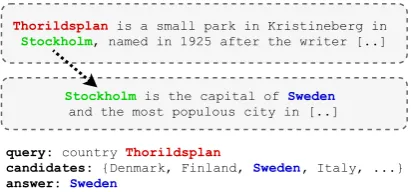
query: country Thorildsplan
candidates: {Denmark, Finland, Sweden, Italy, ...} answer: Sweden
Thorildsplan is a small park in Kristineberg in Stockholm, named in 1925 after the writer [..]
[image:1.595.314.520.221.317.2]Stockholm is the capital of Sweden and the most populous city in [..]
Figure 1: A sample from WIKIHOPwhere multi-step reasoning and information combination from different documents is necessary to infer the correct answer.
relying only on local information cannot achieve competitive performance.
Even though these new datasets are challeng-ing and require reasonchalleng-ing within documents, many question answering and search applications re-quire aggregation of information across multiple documents. The WIKIHOPdataset (Welbl et al.,
2018) was explicitly created to facilitate the devel-opment of systems dealing with these scenarios. Each example in WIKIHOP consists of a collec-tion of documents, a query and a set of candidate answers (Figure 1). Though there is no guaran-tee that a question cannot be answered by relying just on a single sentence, the authors ensure that it is answerable using a chain of reasoning crossing document boundaries.
Though an important practical problem, the multi-hop setting has so far received little at-tention. The methods reported by Welbl et al.
goes beyond concatenation is due to Dhingra et al. (2018), where they augment RNNs with jump-links corresponding to co-reference edges. Though these edges provide a structural bias, the RNN states are still tasked with passing the infor-mation across the document and performing multi-hop reasoning.
Instead, we frame question answering as an inference problem on a graph representing the document collection. Nodes in this graph corre-spond to named entities in a document whereas edges encode relations between them (e.g., cross-and within-document coreference links or simply co-occurrence in a document). We assume that reasoning chains can be captured by propagat-ing local contextual information along edges in this graph using a graph convolutional network (GCN) (Kipf and Welling,2017).
The multi-document setting imposes scalabil-ity challenges. In realistic scenarios, a system needs to learn to answer a query for a given col-lection (e.g., Wikipedia or a domain-specific set of documents). In such scenarios one cannot af-ford to run expensive document encoders (e.g., RNN or transformer-like self-attention (Vaswani et al.,2017)), unless the computation can be pre-processed both at train and test time. Even if (similarly to WIKIHOP creators) one considers a coarse-to-fine approach, where a set of potentially relevant documents is provided, re-encoding them in a query-specific way remains the bottleneck. In contrast to other proposed methods (e.g., (Dhingra et al.,2018;Raison et al.,2018;Seo et al.,2016)), we avoid training expensive document encoders.
In our approach, only a small query encoder, the GCN layers and a simple feed-forward an-swer selection component are learned. Instead of training RNN encoders, we use contextualized embeddings (ELMo) to obtain initial (local) rep-resentations of nodes. This implies that only a lightweight computation has to be performed on-line, both at train and test time, whereas the rest is preprocessed. Even in the somewhat contrived WIKIHOPsetting, where fairly small sets of can-didates are provided, the model is at least 5 times faster to train than BiDAF.1 Interestingly, when we substitute ELMo with simple pre-trained word embeddings, Entity-GCN still performs on par
1When compared to the ‘small’ and hence fast BiDAF
model reported inWelbl et al.(2018), which is 25% less ac-curate than our Entity-GCN. Larger RNN models are prob-lematic also because of GPU memory constraints.
with many techniques that use expensive question-aware recurrent document encoders.
Despite not using recurrent document encoders, the full Entity-GCN model achieves over 2% im-provement over the best previously-published re-sults. As our model is efficient, we also reported results of an ensemble which brings further 3.6% of improvement and only 3% below the human performance reported byWelbl et al.(2018). Our contributions can be summarized as follows:
• we present a novel approach for multi-hop QA that relies on a (pre-trained) document encoder and information propagation across multiple documents using graph neural net-works;
• we provide an efficient training technique which relies on a slower offline and a faster on-line computation that does not require ex-pensive document processing;
• we empirically show that our algorithm is ef-fective, presenting an improvement over pre-vious results.
2 Method
In this section we explain our method. We first introduce the dataset we focus on, WIKIHOP
by Welbl et al. (2018), as well as the task ab-straction. We then present the building blocks that make up our Entity-GCN model, namely, an en-tity graphused to relate mentions to entities within and across documents, adocument encoder used to obtain representations of mentions in context, and arelational graph convolutional networkthat propagates information through the entity graph.
2.1 Dataset and Task Abstraction
Data The WIKIHOPdataset comprises of tuples
hq, Sq, Cq, a?iwhere: qis a query/question,Sqis
a set of supporting documents,Cqis a set of
candi-date answers (all of which are entities mentioned in Sq), and a? ∈ Cq is the entity that correctly
et al. (2018) retrieved the supporting documents
Sqfrom the corpus looking at mentions of subject
and object entities in the text. Note that the setSq
(not the KB) is provided to the QA system, and not all of the supporting documents are relevant for the query but some of them act as distractors. Queries, on the other hand, are not expressed in natural lan-guage, but instead consist of tupleshs, r,?iwhere the object entity is unknown and it has to be in-ferred by reading the support documents. There-fore, answering a query corresponds to finding the entitya?that is the object of a tuple in the KB with subjectsand relationramong the provided set of candidate answersCq.
Task The goal is to learn a model that can iden-tify the correct answera? from the set of support-ing documents Sq. To that end, we exploit the
available supervision to train a neural network that computes scores for candidates inCq. We estimate
the parameters of the architecture by maximizing the likelihood of observations. For prediction, we then output the candidate that achieves the high-est probability. In the following, we present our model discussing the design decisions that enable multi-step reasoning and an efficient computation.
2.2 Reasoning on an Entity Graph
Entity graph In an offline step, we organize the content of each training instance in a graph con-necting mentions of candidate answers within and across supporting documents. For a given query
q=hs, r,?i, we identify mentions inSqof the
en-tities inCq∪ {s}and create one node per mention.
This process is based on the following heuristic:
1. we consider mentions spans in Sq exactly
matching an element of Cq ∪ {s}.
Admit-tedly, this is a rather simple strategy which may suffer from low recall.
2. we use predictions from a coreference reso-lution system to add mentions of elements in
Cq ∪ {s} beyond exact matching (including
both noun phrases and anaphoric pronouns). In particular, we use the end-to-end corefer-ence resolution byLee et al.(2017).
[image:3.595.314.519.62.180.2]3. we discard mentions which are ambiguously resolved to multiple coreference chains; this may sacrifice recall, but avoids propagating ambiguity.
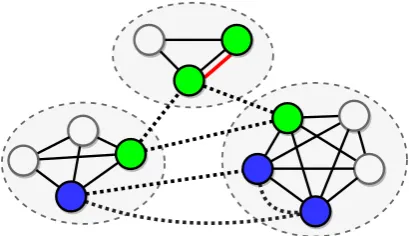
Figure 2: Supporting documents (dashed ellipses) or-ganized as a graph where nodes are mentions of ei-ther candidate entities or query entities. Nodes with the same color indicates they refer to the same entity (ex-act match, coreference or both). Nodes are connected by three simple relations: one indicating co-occurrence in the same document (solid edges), another connect-ing mentions that exactly match (dashed edges), and a third one indicating a coreference (bold-red line).
To each nodevi, we associate a continuous
an-notation xi ∈ RD which represents an entity in
the context where it was mentioned (details in Sec-tion2.3). We then proceed to connect these men-tions i) if they co-occur within the same document (we will refer to this as DOC-BASED edges), ii) if the pair of named entity mentions is identical (MATCH edges—these may connect nodes across and within documents), or iii) if they are in the same coreference chain, as predicted by the exter-nal coreference system (COREFedges). Note that
MATCH edges when connecting mentions in the same document are mostly included in the set of edges predicted by the coreference system. Hav-ing the two types of edges lets us distHav-inguish be-tween less reliable edges provided by the coref-erence system and more reliable (but also more sparse) edges given by the exact-match heuristic. We treat these three types of connections as three different types of relations. See Figure 2 for an illustration. In addition to that, and to prevent hav-ing disconnected graphs, we add a fourth type of relation (COMPLEMENT edge) between any two nodes that are not connected with any of the other relations. We can think of these edges as those in the complement set of the entity graph with re-spect to a fully connected graph.
graph. The algorithm is parameterized by a graph convolutional network (GCN) (Kipf and Welling, 2017), in particular, we employ relational-GCNs (Schlichtkrull et al.,2018), an ex-tended version that accommodates edges of differ-ent types. In Section2.4we describe the propaga-tion rule.
Each step of the algorithm (also referred to as ahop) updates all node representations in parallel. In particular, a node is updated as a function of messages from its direct neighbours, and a mes-sage is possibly specific to a certain relation. At the end of the first step, every node is aware of ev-ery other node it connects directly to. Besides, the neighbourhood of a node may include mentions of the same entity as well as others (e.g., same-document relation), and these mentions may have occurred in different documents. Taking this idea recursively, each further step of the algorithm lows a node to indirectly interact with nodes al-ready known to their neighbours. AfterLlayers of R-GCN, information has been propagated through paths connecting up toL+ 1nodes.
We start with node representations {h(0)i }N i=1,
and transform them by applying L layers of R-GCN obtaining {h(L)i }N
i=1. Together with a
rep-resentationqof the query, we define a distribution over candidate answers and we train maximizing the likelihood of observations. The probability of selecting a candidatec∈Cqas an answer is then
P(c|q, Cq, Sq)∝exp
max
i∈Mc
fo([q,h(L)i ])
,
(1) where fo is a parameterized affine
transforma-tion, andMcis the set of node indices such that i ∈ Mc only if node vi is a mention of c. The
maxoperator in Equation1is necessary to select the node with highest predicted probability since a candidate answer is realized in multiple locations via different nodes.
2.3 Node Annotations
Keeping in mind we want an efficient model, we encode words in supporting documents and in the query using only a pre-trained model for contex-tualized word representations rather than training our own encoder. Specifically, we use ELMo2( Pe-ters et al.,2018), a pre-trained bi-directional
lan-2The use of ELMo is an implementation choice, and, in
principle, any other contextual pre-trained model could be used (Radford et al.,2018;Devlin et al.,2018).
guage model that relies on character-based input representation. ELMo representations, differently from other pre-trained word-based models (e.g.,
word2vec (Mikolov et al., 2013) or GloVe ( Pen-nington et al., 2014)), are contextualized since each token representation depends on the entire text excerpt (i.e., the whole sentence).
We choose not to fine tune nor propagate gradi-ents through the ELMo architecture, as it would have defied the goal of not having specialized RNN encoders. In the experiments, we will also ablate the use of ELMo showing how our model behaves using non-contextualized word represen-tations (we use GloVe).
Documents pre-processing ELMo encodings are used to produce a set of representations {xi}Ni=1, wherexi∈RDdenotes theith candidate
mention in context. Note that these representa-tions do not depend on the query yet and no train-able model was used to process the documents so far, that is, we use ELMo as a fixed pre-trained en-coder. Therefore, we can pre-compute representa-tion of menrepresenta-tions once and store them for later use.
Query-dependent mention encodings ELMo encodings are used to produce a query represen-tation q ∈ RK as well. Here, q is a
concatena-tion of the final outputs from a bidirecconcatena-tional RNN layer trained to re-encode ELMo representations of words in the query. The vectorqis used to com-pute a query-dependent representation of mentions {ˆxi}Ni=1as well as to compute a probability
distri-bution over candidates (as in Equation1). Query-dependent mention encodingsˆxi = fx(q,xi)are
generated by a trainable functionfx which is
pa-rameterized by a feed-forward neural network.
2.4 Entity Relational Graph Convolutional Network
Our model uses a gated version of the original R-GCN propagation rule. At the first layer, all hidden node representation are initialized with the query-aware encodingsh(0)i = xˆi. Then, at each
layer0 ≤ ` ≤ L, the update messageu(`)i to the
ith node is a sum of a transformationfsof the
cur-rent node representationh(`)i and transformations of its neighbours:
u(`)i =fs(h(`)i ) +
1
|Ni| X
j∈Ni X
r∈Rij
whereNi is the set of indices of nodes neighbour-ing theith node,Rij is the set of edge annotations
between iand j, and fr is a parametrized
func-tion specific to an edge typer ∈ R. Recall the available relations from Section2.2, namely,R=
{DOC-BASED,MATCH,COREF,COMPLEMENT}. A gating mechanism regulates how much of the update message propagates to the next step. This provides the model a way to prevent completely overwriting past information. Indeed, if all neces-sary information to answer a question is present at a layer which is not the last, then the model should learn to stop using neighbouring information for the next steps. Gate levels are computed as
a(`)i =σ
fa
[u(`)i ,h(`)i ]
, (3)
where σ(·) is the sigmoid function and fa a
parametrized transformation. Ultimately, the up-dated representation is a gated combination of the previous representation and a non-linear transfor-mation of the update message:
h(`+1)i =φ(u(`)i )a(`)i +h(`)i (1−a(`)i ), (4)
where φ(·) is any nonlinear function (we used
tanh) andstands for element-wise multiplica-tion. All transformationsf∗are affine and they are
not layer-dependent (since we would like to use as few parameters as possible to decrease model complexity promoting efficiency and scalability).
3 Experiments
In this section, we compare our method against re-cent work as well as preforming an ablation study using the WIKIHOP dataset (Welbl et al., 2018). See AppendixAin the supplementary material for a description of the hyper-parameters of our model and training details.
WIKIHOP We use WIKIHOPfor training, val-idation/development and test. The test set is not publicly available and therefore we measure per-formance on the validation set in almost all ex-periments. WIKIHOP has 43,738/ 5,129/ 2,451 query-documents samples in the training, valida-tion and test sets respectively for a total of 51,318 samples. Authors constructed the dataset as de-scribed in Section 2.1 selecting samples with a graph traversal up to a maximum chain length of 3 documents (see Table 1 for additional dataset statistics). WIKIHOP comes in two versions, a
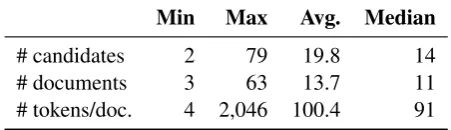
Min Max Avg. Median
# candidates 2 79 19.8 14
# documents 3 63 13.7 11
[image:5.595.305.531.64.129.2]# tokens/doc. 4 2,046 100.4 91
Table 1: WIKIHOPdataset statistics fromWelbl et al.
(2018): number of candidates and documents per sam-ple and document length.
standard (unmasked) one and a masked one. The masked version was created by the authors to test whether methods are able to learn lexical abstrac-tion. In this version, all candidates and all men-tions of them in the support documents are re-placed by random but consistent placeholder to-kens. Thus, in the masked version, mentions are always referred to via unambiguous surface forms. We do not use coreference systems in the masked version as they rely crucially on lexical realization of mentions and cannot operate on masked tokens.
3.1 Comparison
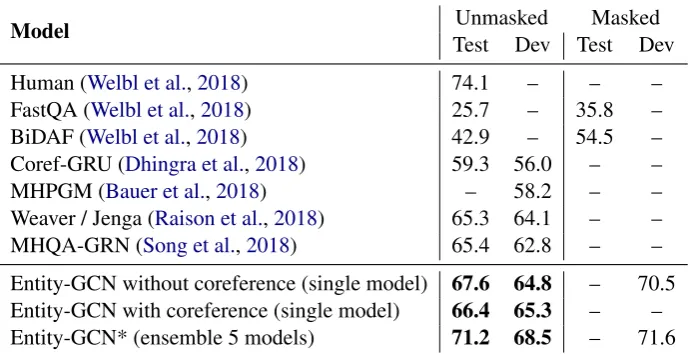
In this experiment, we compare our Enitity-GCN against recent prior work on the same task. We present test and development re-sults (when present) for both versions of the dataset in Table 2. From Welbl et al. (2018), we list an oracle based on human performance as well as two standard reading comprehension models, namely BiDAF (Seo et al., 2016) and FastQA (Weissenborn et al.,2017). We also com-pare against Coref-GRU (Dhingra et al., 2018), MHPGM (Bauer et al., 2018), and Weaver ( Rai-son et al.,2018). Additionally, we include results of MHQA-GRN (Song et al.,2018), from a recent arXiv preprint describing concurrent work. They jointly train graph neural networks and recurrent encoders. We report single runs of our two best single models and an ensemble one on the un-masked test set (recall that the test set is not pub-licly available and the task organizers only report unmasked results) as well as both versions of the validation set.
Model Unmasked Masked Test Dev Test Dev
Human (Welbl et al.,2018) 74.1 – – – FastQA (Welbl et al.,2018) 25.7 – 35.8 – BiDAF (Welbl et al.,2018) 42.9 – 54.5 – Coref-GRU (Dhingra et al.,2018) 59.3 56.0 – – MHPGM (Bauer et al.,2018) – 58.2 – – Weaver / Jenga (Raison et al.,2018) 65.3 64.1 – – MHQA-GRN (Song et al.,2018) 65.4 62.8 – –
[image:6.595.127.472.64.241.2]Entity-GCN without coreference (single model) 67.6 64.8 – 70.5 Entity-GCN with coreference (single model) 66.4 65.3 – – Entity-GCN* (ensemble 5 models) 71.2 68.5 – 71.6
Table 2: Accuracy of different models on WIKIHOP closed test set and public validation set. Our Entity-GCN outperforms recent prior work without learning any language model to process the input but relying on a pre-trained one (ELMo – without fine-tunning it) and applying R-GCN to reason among entities in the text. * with coreference for unmasked dataset and without coreference for the masked one.
(20), and smaller batch size due to the scalabil-ity issues (both memory and computation costs). We compare applying the same reductions.3 Even-tually, we also report an ensemble of 5 indepen-dently trained models. All models are trained on the same dataset splits with different weight ini-tializations. The ensemble prediction is obtained
asarg max
c 5 Q
i=1
Pi(c|q, Cq, Sq)from each model.
3.2 Ablation Study
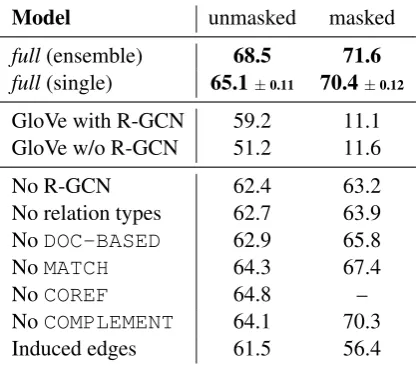
To help determine the sources of improvements, we perform an ablation study using the publicly available validation set (see Table 3). We per-form two groups of ablation, one on the embed-ding layer, to study the effect of ELMo, and one on the edges, to study how different relations af-fect the overall model performance.
Embedding ablation We argue that ELMo is crucial, since we do not rely on any other context encoder. However, it is interesting to explore how our R-GCN performs without it. Therefore, in this experiment, we replace the deep contextualized embeddings of both the query and the nodes with GloVe (Pennington et al.,2014) vectors (insensi-tive to context). Since we do not have any compo-nent in our model that processes the documents, we expect a drop in performance. In other words, in this ablation our model tries to answer questions
3Besides, we could not run any other method we
com-pare with combined with ELMo without reducing the dimen-sionality further or having to implement a distributed version.
without reading the context at all. For example, in Figure1, our model would be aware that “Stock-holm” and “Sweden” appear in the same document but any context words, including the ones encod-ing relations (e.g., “is the capital of”) will be hid-den. Besides, in the masked case all mentions be-come ‘unknown’ tokens with GloVe and therefore the predictions are equivalent to a random guess. Once the strong pre-trained encoder is out of the way, we also ablate the use of our R-GCN com-ponent, thus completely depriving the model from inductive biases that aim at multi-hop reasoning.
The first important observation is that replacing ELMo by GloVe (GloVe with R-GCN in Table3) still yields a competitive system that ranks far above baselines from (Welbl et al.,2018) and even above the Coref-GRU ofDhingra et al.(2018), in terms of accuracy on (unmasked) validation set. The second important observation is that if we then remove R-GCN (GloVe w/o R-GCN in Ta-ble 3), we lose 8.0 points. That is, the R-GCN component pushes the model to perform above Coref-GRU still without accessing context, but rather by updating mention representations based on their relation to other ones. These results high-light the impact of our R-GCN component.
us-Model unmasked masked
full(ensemble) 68.5 71.6
full(single) 65.1±0.11 70.4±0.12
GloVe with R-GCN 59.2 11.1 GloVe w/o R-GCN 51.2 11.6
No R-GCN 62.4 63.2
No relation types 62.7 63.9
NoDOC-BASED 62.9 65.8
NoMATCH 64.3 67.4
NoCOREF 64.8 –
NoCOMPLEMENT 64.1 70.3
[image:7.595.77.286.64.247.2]Induced edges 61.5 56.4
Table 3: Ablation study on WIKIHOP validation set. Thefull modelis our Entity-GCN with all of its com-ponents and other rows indicate models trained without a component of interest. We also report baselines using GloVe instead of ELMo with and without R-GCN. For thefull modelwe reportmean±1 stdover 5 runs.
ing only self-loops – No R-GCN in Table3). The results suggest that WIKIPHOPgenuinely requires
multihop inference, as our best model is 6.1% and 8.4% more accurate than this local model, in un-masked and un-masked settings, respectively.4 How-ever, it also shows that ELMo representations cap-ture predictive context feacap-tures, without being ex-plicitly trained for the task. It confirms that our goal of getting away with training expensive doc-ument encoders is a realistic one.
We then inspect our model’s effectiveness in making use of the structure encoded in the graph. We start naively by fully-connecting all nodes within and across documents without distinguish-ing edges by type (No relation types in Table 3). We observe only marginal improvements with re-spect to ELMo alone (No R-GCN in Table3) in both the unmasked and masked setting suggest-ing that a GCN operatsuggest-ing over a naive entity graph would not add much to this task and a more infor-mative graph construction and/or a more sophisti-cated parameterization is indeed needed.
Next, we ablate each type of relations inde-pendently, that is, we either remove connections of mentions that co-occur in the same docu-ment (DOC-BASED), connections between men-tions matching exactly (MATCH), or edges pre-dicted by the coreference system (COREF). The
4Recall that all models in the ensemble use the same
lo-cal representations, ELMo.
first thing to note is that the model makes better use of DOC-BASED connections than MATCH or
COREFconnections. This is mostly because i) the majority of the connections are indeed between mentions in the same document, and ii) without connecting mentions within the same document we remove important information since the model is unaware they appear closely in the document. Secondly, we notice that coreference links and complement edges seem to play a more marginal role. Though it may be surprising for coreference edges, recall that theMATCHheuristic already cap-tures the easiest coreference cases, and for the rest the out-of-domain coreference system may not be reliable. Still, modelling all these different rela-tions together gives our Entity-GCN a clear advan-tage. This is our best system evaluating on the de-velopment. Since Entity-GCN seems to gain little advantage using the coreference system, we report test results both with and without using it. Surpris-ingly, with coreference, we observe performance degradation on the test set. It is likely that the test documents are harder for the coreference system.5 We do perform one last ablation, namely, we re-place our heuristic for assigning edges and their labels by a model component that predicts them. The last row of Table 3 (Induced edges) shows model performance when edges are not predeter-mined but predicted. For this experiment, we use a bilinear functionfe(ˆxi,ˆxj) = σ ˆx>i Weˆxj
that predicts the importance of a single edge connect-ing two nodesi, jusing the query-dependent rep-resentation of mentions (see Section 2.3). The performance drops below ‘No R-GCN’ suggesting that it cannot learn these dependencies on its own. Most results are stronger for the masked set-tings even though we do not apply the coreference resolution system in this setting due to masking. It is not surprising as coreferred mentions are la-beled with the same identifier in the masked ver-sion, even if their original surface forms did not match (Welbl et al.(2018) used WIKIPEDIAlinks for masking). Indeed, in the masked version, an entity is always referred to via the same unique surface form (e.g.,MASK1) within and across doc-uments. In the unmasked setting, on the other hand, mentions to an entity may differ (e.g., “US” vs “United States”) and they might not be retrieved by the coreference system we are employing,
mak-5Since the test set is hidden from us, we cannot analyze
Relation Accuracy P@2 P@5 Avg.|Cq| Supports
overall (ensemble) 68.5 81.0 94.1 20.4±16.6 5129 overall (single model) 65.3 79.7 92.9 20.4±16.6 5129
3 best
member of political party 85.5 95.7 98.6 5.4±2.4 70 record label 83.0 93.6 99.3 12.4±6.1 283
publisher 81.5 96.3 100.0 9.6±5.1 54
3 worst
place of birth 51.0 67.2 86.8 27.2±14.5 309 place of death 50.0 67.3 89.1 25.1±14.3 159
[image:8.595.93.506.64.207.2]inception 29.9 53.2 83.1 21.9±11.0 77
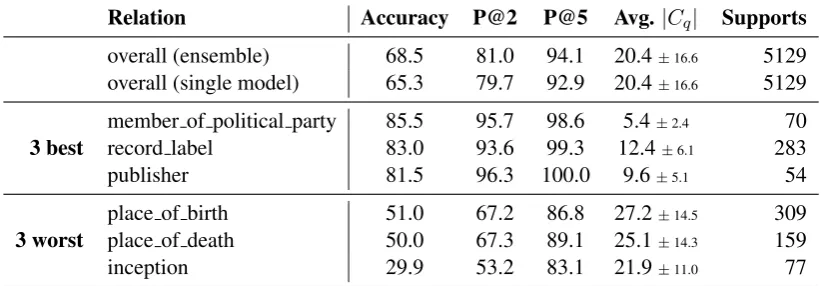
Table 4: Accuracy and precision at K (P@K in the table) analysis overall and per query type. Avg. |Cq|indicates
the average number of candidates with one standard deviation.
ing the task harder for all models. Therefore, as we rely mostly on exact matching when constructing our graph for the masked case, we are more effec-tive in recovering coreference links on the masked rather than unmasked version.6
4 Error Analysis
In this section we provide an error analysis for our best single model predictions. First of all, we look at which type of questions our model per-forms well or poorly. There are more than 150 query types in the validation set but we filtered the three with the best and with the worst accu-racy that have at least 50 supporting documents and at least 5 candidates. We show results in Ta-ble4. We observe that questions regarding places (birth and death) are considered harder for Entity-GCN. We then inspect samples where our model fails while assigning highest likelihood and no-ticed two principal sources of failure i) a mismatch between what is written in WIKIPEDIAand what is
annotated in WIKIDATA, and ii) a different degree of granularity (e.g., born in “London” vs “UK” could be considered both correct by a human but not when measuring accuracy). See Table6in the supplement material for some reported samples.
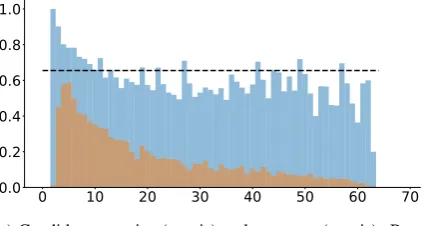
Secondly, we study how the model performance degrades when the input graph is large. In particu-lar, we observe a negative Pearson’s correlation (-0.687) between accuracy and the number of candi-date answers. However, the performance does not decrease steeply. The distribution of the number of candidates in the dataset peaks at 5 and has an av-erage of approximately 20. Therefore, the model
6Though other systems do not explicitly link matching
mentions, they similarly benefit from masking (e.g., masks essentially single out spans that contain candidate answers).
does not see many samples where there are a large number of candidate entities during training. Dif-ferently, we notice that as the number of nodes in the graph increases, the model performance drops but more gently (negative but closer to zero Pear-son’s correlation). This is important as document sets can be large in practical applications. See Fig-ure3in the supplemental material for plots.
5 Related Work
In previous work, BiDAF (Seo et al., 2016), FastQA (Weissenborn et al., 2017), Coref-GRU (Dhingra et al., 2018), MHPGM (Bauer et al., 2018), and Weaver / Jenga (Raison et al.,
2018) have been applied to multi-document ques-tion answering. The first two mainly focus on sin-gle document QA andWelbl et al.(2018) adapted both of them to work with WIKIHOP. They pro-cess each instance of the dataset by concatenat-ing all d ∈ Sq in a random order adding
doc-ument separator tokens. They trained using the first answer mention in the concatenated document and evaluating exact match at test time. Coref-GRU, similarly to us, encodes relations between entity mentions in the document. Instead of us-ing graph neural network layers, as we do, they augment RNNs with jump links corresponding to pairs of corefereed mentions. MHPGM uses a multi-attention mechanism in combination with external commonsense relations to perform mul-tiple hops of reasoning. Weaver is a deep co-encoding model that uses several alternating bi-LSTMs to process the concatenated documents and the query.
2018a), including those involving document level modeling (Peng et al.,2017). They have also been applied in the context of asking questions about knowledge contained in a knowledge base (Zhang et al.,2018b). InSchlichtkrull et al.(2018), GCNs are used to capture reasoning chains in a knowl-edge base. Our work and unpublished concurrent work by Song et al. (2018) are the first to study graph neural networks in the context of multi-document QA. Besides differences in the architec-ture,Song et al.(2018) propose to train a combi-nation of a graph recurrent network and an RNN encoder. We do not train any RNN document en-coders in this work.
6 Conclusion
We designed a graph neural network that oper-ates over a compact graph representation of a set of documents where nodes are mentions to en-tities and edges signal relations such as within and cross-document coreference. The model learns to answer questions by gathering evidence from different documents via a differentiable mes-sage passing algorithm that updates node repre-sentations based on their neighbourhood. Our model outperforms published results where abla-tions show substantial evidence in favour of multi-step reasoning. Moreover, we make the model fast by using pre-trained (contextual) embeddings.
Acknowledgments
We would like to thank Johannes Welbl for help-ing to test our system on WIKIHOP. This project is supported by SAP Innovation Center Network, ERC Starting Grant BroadSem (678254) and the Dutch Organization for Scientific Re-search (NWO) VIDI 639.022.518. Wilker Aziz is supported by the Dutch Organisation for Scientific Research (NWO) VICI Grant nr. 277-89-002.
References
Joost Bastings, Ivan Titov, Wilker Aziz, Diego Marcheggiani, and Khalil Simaan. 2017. Graph convolutional encoders for syntax-aware neural ma-chine translation. InProceedings of the 2017 Con-ference on Empirical Methods in Natural Language Processing, pages 1957–1967. Association for Com-putational Linguistics.
Lisa Bauer, Yicheng Wang, and Mohit Bansal. 2018.
Commonsense for generative multi-hop question an-swering tasks. In Proceedings of the 2018 Con-ference on Empirical Methods in Natural Language
Processing, pages 4220–4230. Association for Com-putational Linguistics.
Jacob Devlin, Ming-Wei Chang, Kenton Lee, and Kristina Toutanova. 2018. BERT: Pre-training of Deep Bidirectional Transformers for Language Un-derstanding. arXiv preprint arXiv:1810.04805.
Bhuwan Dhingra, Qiao Jin, Zhilin Yang, William Co-hen, and Ruslan Salakhutdinov. 2018. Neural mod-els for reasoning over multiple mentions using coref-erence. InProceedings of the 2018 Conference of the North American Chapter of the Association for Computational Linguistics: Human Language Tech-nologies, Volume 2 (Short Papers), pages 42–48, New Orleans, Louisiana. Association for Computa-tional Linguistics.
Karl Moritz Hermann, Tomas Kocisky, Edward Grefenstette, Lasse Espeholt, Will Kay, Mustafa Su-leyman, and Phil Blunsom. 2015. Teaching ma-chines to read and comprehend. InAdvances in Neu-ral Information Processing Systems, pages 1693– 1701.
Mandar Joshi, Eunsol Choi, Daniel Weld, and Luke Zettlemoyer. 2017. TriviaQA: A large scale dis-tantly supervised challenge dataset for reading com-prehension. In Proceedings of the 55th Annual Meeting of the Association for Computational Lin-guistics (Volume 1: Long Papers), volume 1, pages 1601–1611.
Diederik P Kingma and Jimmy Ba. 2015. Adam: A method for stochastic optimization. Kinga, D., and J. Ba Adam. ”A method for stochastic optimization.” International Conference on Learning Representa-tions (ICLR)., 5.
Thomas N Kipf and Max Welling. 2017. Semi-supervised classification with graph convolutional networks. International Conference on Learning Representations (ICLR).
Tomas Kocisky, Jonathan Schwarz, Phil Blunsom, Chris Dyer, Karl Moritz Hermann, Gabor Melis, and Edward Grefenstette. 2018. The NarrativeQA read-ing comprehension challenge. Transactions of the Association for Computational Linguistics, 6:317– 328.
Guokun Lai, Qizhe Xie, Hanxiao Liu, Yiming Yang, and Eduard Hovy. 2017. RACE: Large-scale read-ing comprehension dataset from examinations. In Proceedings of the 2017 Conference on Empirical Methods in Natural Language Processing, pages 785–794, Copenhagen, Denmark. Association for Computational Linguistics.
Diego Marcheggiani and Ivan Titov. 2017. Encoding sentences with graph convolutional networks for se-mantic role labeling. InProceedings of the 2017 Conference on Empirical Methods in Natural Lan-guage Processing, pages 1506–1515. Association for Computational Linguistics.
Tomas Mikolov, Ilya Sutskever, Kai Chen, Greg S Cor-rado, and Jeff Dean. 2013. Distributed representa-tions of words and phrases and their compositional-ity. InAdvances in neural information processing systems, pages 3111–3119.
Nanyun Peng, Hoifung Poon, Chris Quirk, Kristina Toutanova, and Wen-tau Yih. 2017. Cross-sentence n-ary relation extraction with graph lstms. Transac-tions of the Association for Computational Linguis-tics, 5:101–115.
Jeffrey Pennington, Richard Socher, and Christopher Manning. 2014. GloVe: Global vectors for word representation. InProceedings of the 2014 confer-ence on empirical methods in natural language pro-cessing (EMNLP), pages 1532–1543.
Matthew Peters, Mark Neumann, Mohit Iyyer, Matt Gardner, Christopher Clark, Kenton Lee, and Luke Zettlemoyer. 2018. Deep contextualized word rep-resentations. In Proceedings of the 2018 Confer-ence of the North American Chapter of the Associ-ation for ComputAssoci-ational Linguistics: Human Lan-guage Technologies, Volume 1 (Long Papers), pages 2227–2237, New Orleans, Louisiana. Association for Computational Linguistics.
Alec Radford, Karthik Narasimhan, Tim Salimans, and Ilya Sutskever. 2018. Improving language under-standing with unsupervised learning. Technical re-port, OpenAI.
Martin Raison, Pierre-Emmanuel Mazar´e, Rajarshi Das, and Antoine Bordes. 2018. Weaver: Deep co-encoding of questions and documents for machine reading. In Proceedings of the International Con-ference on Machine Learning (ICML).
Pranav Rajpurkar, Jian Zhang, Konstantin Lopyrev, and Percy Liang. 2016.SQuAD: 100,000+ questions for machine comprehension of text. InProceedings of the 2016 Conference on Empirical Methods in Natu-ral Language Processing, pages 2383–2392, Austin, Texas. Association for Computational Linguistics.
Michael Schlichtkrull, Thomas N. Kipf, Peter Bloem, Rianne van den Berg, Ivan Titov, and Max Welling. 2018. Modeling relational data with graph convolu-tional networks. InThe Semantic Web, pages 593– 607, Cham. Springer International Publishing.
Minjoon Seo, Aniruddha Kembhavi, Ali Farhadi, and Hannaneh Hajishirzi. 2016. Bidirectional atten-tion flow for machine comprehension. International Conference on Learning Representations (ICLR).
Yelong Shen, Po-Sen Huang, Jianfeng Gao, and Weizhu Chen. 2017. Reasonet: Learning to stop reading in machine comprehension. InProceedings of the 23rd ACM SIGKDD International Conference on Knowledge Discovery and Data Mining, pages 1047–1055. ACM.
Linfeng Song, Zhiguo Wang, Mo Yu, Yue Zhang, Radu Florian, and Daniel Gildea. 2018. Exploring Graph-structured Passage Representation for Multi-hop Reading Comprehension with Graph Neural Networks.arXiv preprint arXiv:1809.02040.
Nitish Srivastava, Geoffrey Hinton, Alex Krizhevsky, Ilya Sutskever, and Ruslan Salakhutdinov. 2014. Dropout: A simple way to prevent neural networks from overfitting. The Journal of Machine Learning Research, 15(1):1929–1958.
Ashish Vaswani, Noam Shazeer, Niki Parmar, Jakob Uszkoreit, Llion Jones, Aidan N Gomez, Łukasz Kaiser, and Illia Polosukhin. 2017. Attention is all you need. InAdvances in Neural Information Pro-cessing Systems, pages 5998–6008.
Denny Vrandeˇci´c. 2012. Wikidata: A new platform for collaborative data collection. InProceedings of the 21st International Conference on World Wide Web, pages 1063–1064. ACM.
Dirk Weissenborn, Georg Wiese, and Laura Seiffe. 2017. Making neural qa as simple as possible but not simpler. In Proceedings of the 21st Confer-ence on Computational Natural Language Learn-ing (CoNLL 2017), pages 271–280. Association for Computational Linguistics.
Johannes Welbl, Pontus Stenetorp, and Sebastian Riedel. 2018. Constructing datasets for multi-hop reading comprehension across documents. Transac-tions of the Association for Computational Linguis-tics, 6:287–302.
Caiming Xiong, Victor Zhong, and Richard Socher. 2016. Dynamic coattention networks for question answering. arXiv preprint arXiv:1611.01604.
Yuhao Zhang, Peng Qi, and Christopher D. Manning. 2018a. Graph convolution over pruned dependency trees improves relation extraction. InProceedings of the 2018 Conference on Empirical Methods in Nat-ural Language Processing, pages 2205–2215. Asso-ciation for Computational Linguistics.
A Implementation and Experiments Details
A.1 Architecture
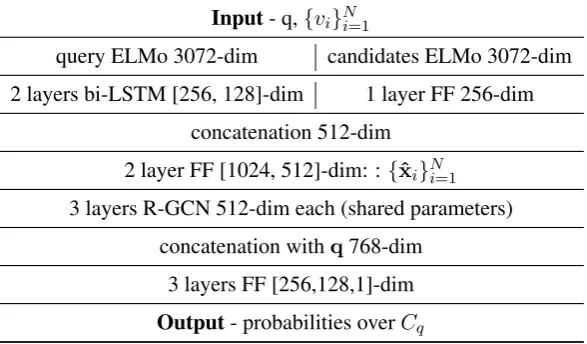
See table5for an outline of Entity-GCN architec-tural detail. Here the computational steps
1. ELMo embeddings are a concatenation of three 1024-dimensional vectors resulting in 3072-dimensional input vectors{xi}Ni=1.
2. For the query representation q, we apply 2 bi-LSTM layers of 256 and 128 hidden units to its ELMo vectors. The concatenation of the forward and backward states results in a 256-dimensional question representation.
3. ELMo embeddings of candidates are pro-jected to 256-dimensional vectors, concate-nated to theq, and further transformed with a two layers MLP of 1024 and 512 hidden units in 512-dimensional query aware entity representations{ˆxi}Ni=1∈R512.
4. All transformationsf∗ in R-GCN-layers are
affine and they do maintain the input and out-put dimensionality of node representations the same (512-dimensional).
5. Eventually, a 2-layers MLP with [256, 128] hidden units takes the concatenation between {h(L)i }N
i=1 and q to predict the probability
that a candidate node vi may be the answer
to the queryq(see Equation1).
During preliminary trials, we experimented with different numbers of R-GCN-layers (in the range 1-7). We observed that with WIKIHOP, for
L ≥ 3 models reach essentially the same perfor-mance, but more layers increase the time required to train them. Besides, we observed that the gating mechanism learns to keep more and more informa-tion from the past at each layer making unneces-sary to have more layers than required.
A.2 Training Details
We train our models with a batch size of 32 for at most 20 epochs using the Adam opti-mizer (Kingma and Ba, 2015) with β1 = 0.9, β2 = 0.999and a learning rate of10−4. To help
against overfitting, we employ dropout (drop rate ∈ 0,0.1,0.15,0.2,0.25) (Srivastava et al.,2014) and early-stopping on validation accuracy. We re-port the best results of each experiment based on accuracy on validation set.
B Error Analysis
In Table 6, we report three samples from WIKI -HOPdevelopment set where out Entity-GCN fails. In particular, we show two instances where our model presents high confidence on the answer, and one where is not. We commented these sam-ples explaining why our model might fail in these cases.
C Ablation Study
In Figure3, we show how the model performance goes when the input graph is large. In particular, how Entity-GCN performs as the number of can-didate answers or the number of nodes increases.
0 10 20 30 40 50 60 70 0.0
0.2 0.4 0.6 0.8 1.0
(a) Candidates set size (x-axis) and accuracy (y-axis). Pear-son’s correlation of−0.687(p <10−7
).
0 50 100 150 200
0.0 0.2 0.4 0.6 0.8 1.0
[image:11.595.311.527.277.390.2](b) Nodes set size (x-axis) and accuracy (y-axis). Pearson’s correlation of−0.385(p <10−7).
Input- q,{vi}Ni=1
query ELMo 3072-dim candidates ELMo 3072-dim
2 layers bi-LSTM [256, 128]-dim 1 layer FF 256-dim
concatenation 512-dim
2 layer FF [1024, 512]-dim: :{ˆxi}Ni=1
3 layers R-GCN 512-dim each (shared parameters)
concatenation withq768-dim
3 layers FF [256,128,1]-dim
[image:12.595.153.447.92.264.2]Output- probabilities overCq
Table 5: Model architecture.
ID WH dev 2257 Gold answer 2003 (p= 14.1)
Query inception (of) Derrty Entertainment Predicted answer 2000 (p= 15.8)
Support 1 Derrty Entertainmentis a record label founded by [...]. The first album released under Derrty Entertainmentwas Nelly ’sCountry Grammar.
Support 2 Country Grammaris the debut single by American rapper Nelly. The song was pro-duced by Jason Epperson. It was released in2000, [...]
(a) In this example, the model predicts the answer correctly. However, there is a mismatch between what is written in WIKIPEDIAand what is annotated in WIKIDATA. In WIKIHOP, answers are generated with WIKIDATA.
ID WH dev 2401 Gold answer Adolph Zukor (p= 7.1e−4%)
Query producer (of) Forbidden Paradise Predicted answer Jesse L. Lask (p= 99.9%)
Support 1 Forbidden Paradiseis a [...] drama film produced byFamous Players-Lasky[...]
Support 2 Famous Players-LaskyCorporation was [...] from the merger ofAdolph Zukor’s Fa-mous Players Film Company [..] and theJesse L. LaskyFeature Play Company.
(b) In this sample, there is ambiguity between two entities since both are correct answers reading the passages but only one is marked as correct. The model fails assigning very high probability to only on one of them.
ID WH dev 3030 Gold answer Scania (p= 0.029%)
Query place of birth (of) Erik Penser Predicted answer Esl¨ov (p= 97.3%)
Support 1 Nils WilhelmErik Penser(born August 22, 1942, inEsl¨ov,Sk˚ane) is a Swedish [...]
Support 2 Sk˚aneCounty, sometimes referred to as “ScaniaCounty ” in English, is the [...]
(c) In this sample, there is ambiguity between two entities since the city Esl¨ov is located in the Scania County (English name of Sk˚ane County). The model assigning high probability to the city and it cannot select the county.
[image:12.595.72.521.609.684.2]