157
Train One Get One Free: Partially Supervised Neural Network for
Bug Report Duplicate Detection and Clustering
Lahari Poddar1,2
Luis Marujo2
Leonardo Neves2
Sergey Tulyakov2
1School of Computing, National University of Singapore
2Snap Research
{lneves, willb, luis.marujo}@snap.com
{stulyakov, pradeep.karuturi}@snap.com
William Brendel2
Pradeep Karuturi2
Abstract
Tracking user reported bugs requires consider-able engineering effort in going through many repetitive reports and assigning them to the correct teams. This paper proposes a neural ar-chitecture that can jointly (1) detect if two bug reports are duplicates, and (2) aggregate them into latent topics. Leveraging the assumption that learning the topic of a bug is a sub-task for detecting duplicates, we design a loss function that can jointly perform both tasks but needs supervision for only duplicate classification, achieving topic clustering in an unsupervised
fashion. We use a two-step attention
mod-ule that uses self-attention for topic clustering and conditional attention for duplicate detec-tion. We study the characteristics of two types of real world datasets that have been marked for duplicate bugs by engineers and by non-technical annotators. The results demonstrate that our model not only can outperform state-of-the-art methods for duplicate classification on both cases, but can also learn meaningful latent clusters without additional supervision.
1 Introduction
User feedback is a key part of the development and improvement of software products. Each piece of feedback needs to be manually reviewed and assigned to the correct engineer responsible for maintaining the feature mentioned in the report. On online platforms with millions of users, differ-ent users tend to report the same issue, yielding a large number of duplicate reports. Sorting through these massive volumes of bug reports incur a sig-nificant amount of engineering time and cost. Ad-ditionally, these services are constantly releasing new product features. Therefore, we cannot rely on static annotated data for product feature clas-sification because they rapidly become outdated. This motivates us to develop a framework that can
automatically identify duplicate bug reports and cluster them without requiring additional labels.
Previous research in the software engineer-ing domain has addressed duplicates detection and product feature identification as two separate problems framed as independent fully-supervised
classification tasks (Nguyen et al., 2012;
Bud-hiraja et al., 2018b; Jonsson et al., 2016; Mani
et al.,2018). However, we observe that users
gen-erally report issues when accessing certain fea-tures of a product, e.g., ‘app crashed when open-ing camera’, ‘chat won’t load’ and so on (here,
camera andchat are the product features,
re-spectively). Hence, two reports should at least
discuss the same feature to be considered as dupli-cates. Therefore, we hypothesize that determining
the feature discussed in a report is a sub-task of
detecting whether or not a report is a duplicate to another one.
Inspired by the effectiveness of Siamese archi-tectures for modeling pairs of texts (Tan et al.,
2015;Bowman et al.,2015), we use a shared
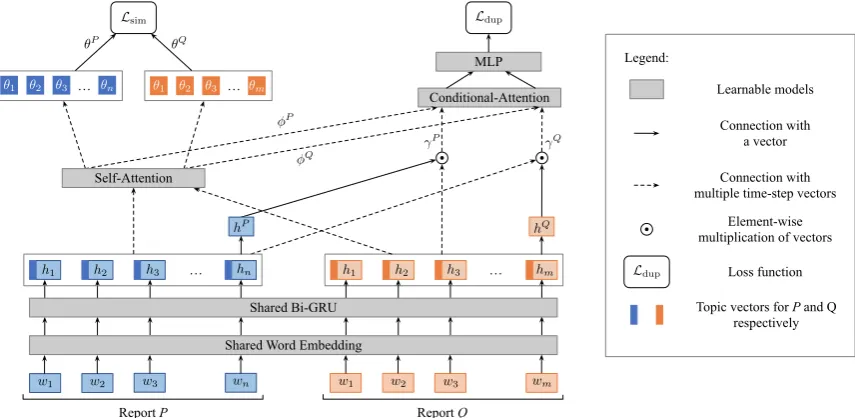
Re-current Neural Network (RNN) to encode the two reports. We note that the latent vectors, learned by an RNN for a sequence of words, encode a multi-tude of semantic information; all of which may not be necessary to understand the topic of the report. We decompose the latent semantic vectors in order to distill only the topical information in a few des-ignated dimensions. This allows us to perform the sub-task of feature-based clustering using only a subset of dimensions, and use the complete vector for the duplicate classification task. We propose a partially supervised learning framework that uses the label for duplicity through a similarity loss on the designated topic dimensions of the latent rep-resentation to learn topic clusters.
modeling and learn a conditional attention using a memory vector for duplicate classification.
To summarize, we present a systematic study of a classic problem in the software industry. The work has three major contributions.
• We propose a neural model for multi-task
learning that requires supervision for only one of the tasks.
• The model uses semantic space
decomposi-tion and a hierarchical-condidecomposi-tional attendecomposi-tion module to perform the tasks of duplicate de-tection and topic based clustering.
• We present the challenges we faced during
our experience obtaining labels from non-technical annotators, and conduct extensive experiments on both engineer labeled and non-technical labeled datasets.
2 Related Work
The software engineering community has con-ducted some research work for detecting duplicate
bugs. In Minh (2014), a combination of n-gram
features and cluster shrinkage algorithm is used
for duplicate classification, whereas, inSun et al.
(2011) the BM-25 based scoring has been used akin to information retrieval engines. A combina-tion of tf-idf and topics learned by LDA have also
been used (Nguyen et al.,2012;Budhiraja et al.,
2018b). Recently, word embeddings have been used to compute similarity of two reports(Yang
et al., 2016; Budhiraja et al., 2018a). However,
in these approaches, the sequence information of a natural language sentence is not captured.
Among the NLP community, the closest line of applicable work are the generic approaches of
tex-tual similarity (Cer et al.,2017;Wang et al.,2017;
Neculoiu et al.,2016;Yin et al.,2016). They
pre-dominantly employ Siamese architecture (Mueller
and Thyagarajan, 2016; Severyn and Moschitti,
2015) and more recently, attention mechanism
(Wang et al.,2017;Shen et al.,2018;Wang et al.,
2018; Tran and Niedere´ee, 2018). Inspired by
these approaches, we propose a solution for du-plicate detection while utilizing the partial
super-vision to achieve a sub-task of clusteringfor free.
Solving owner attribution of a report has been approached using feature-based methods (Jonsson
et al.,2016;Xuan et al.,2012) and very recently
using deep learning solutions (Mani et al.,2018).
However, the connection between these two prob-lems have not been explored and they require su-pervision for product feature identification.
3 Annotation Challenges
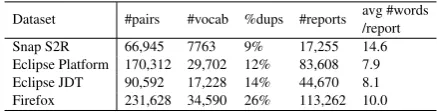
We consider a dataset consisting of user reported bugs collected from the Snapchat app. The bugs have been submitted by beta-testers using a bug-tracking functionality named Shake2Report(S2R) within the app. In S2R a user can submit a small textual description of the bug and attach a screen-shot of the app while experiencing the issue. In this work, we only consider the textual descrip-tions of the reports.
Following previous work of duplicate bug
track-ing (Lazar et al., 2014), we first studied 500
pairs of reports marked as duplicates by engi-neers. However, these pose several challenges. Firstly, we realized that engineers often needed ad-ditional meta-data such as stack-traces and times-tamps to accurately determine whether or not a pair of reports referred to the same problem. On the other hand, such additional meta-data cannot be made available to external crowd-sourced an-notators due to legal and user privacy restrictions. Finally, the total amount of reports was far beyond what an engineering team could tackle, hence the need for our classification system, which helps scaling the bug report load while maintaining the annotation quality.
Our task is to automatically classify report pairs, and to add engineers to the loop only when
pairs are textually ambiguous. We asked
non-expert annotators to label the pairs only according to their semantic similarity (no metadata). The an-notators had a high agreement among themselves
with a Krippendorff’s alpha (Krippendorff,1970)
score of0.78. After adding engineers to the
anno-tation pool, the score dropped to0.58. To
under-stand this disparity, consider the pairs:
• “Crashed when posting story from memories”
and“Crashed while exporting from memories”
• “Stuck on typing notification”and“Did not get
notification for this group chat”
Although not marked as duplicates by non-experts, they referred to the same underlying prob-lem from the engineering side. While out-of-scope for this paper, we plan to conduct a dedicated study to explore these differences in future work.
As mentioned in the introduction, bug§team
product features (and therefore the teams
work-ing on them) are constantly evolvwork-ing. Also,
non-expert annotators cannot be assumed to have any knowledge of these assignments, so we treat
bug§team assignments as an unsupervised task.
4 Proposed Method
We now describe the proposed learning framework
as shown in Figure 1. Given a pair of reports
P and Q, the system uses a single binary label
rpP, Qq (1 if the reports are duplicate, 0
other-wise) to supervise both tasks: duplicate classifi-cation and topic similarity modeling.
4.1 Text Encoder
This component takes a bug report represented as a
sequence of wordstw1, w2,¨ ¨ ¨ , wnuas input and
encodes it to latent vectorsth1,h2,¨ ¨ ¨ ,hnu.
We first use word embeddings to transform all
words in a text into finite d-dimensional vectors
tv1,v2,¨ ¨ ¨,vnu. The vectors are then fed to a
Gated Recurrent Unit (GRU) layer (Chung et al., 2014). We use bi-directional GRU units to encode the context information around a word. For a word
wi, outputs from the forward and backward GRUs
are latent vectors of dimensiong and denoted as
hfi andhbi, respectively. We concatenate these two
vectors to form a single latent representation of the
word as,hi“hfi ‘hbi .
4.2 Semantic Space Decomposition
A word’s encoded representation hi has various
information intertwined in an abstract way within the vector dimensions. It is difficult to interpret in-dividual dimensions and meaningfully use a subset of dimensions for a different sub-task.
We aim to distill the coarser topical information into designated dimensions within the vector, stor-ing other finer pieces of information in remainstor-ing dimensions. Such disentanglement allows us to do the topic similarity modeling using only the desig-nated dimensions and ignore the rest.
To this end, we force the network to learn
top-ical information about each word in the first k
dimensions of its latent vector space. For a bi-directional GRU, we have two encoded
represen-tations for theithword from the forward and
back-ward passes i.e., hfi, andhbi. We define the topic
vector of a wordias,
θi “hfir1 :ks ‘h
b
ir1 :ks (1)
wherehfir1 :ksandhbir1 :ksdenote the firstk
di-mensions in the GRU encoded latent vectors from the forward and backward passes respectively.
4.3 Topic Similarity Modeling
We aggregate the topic vectors of the constituent words to represent the topic of a report, and use a self-attention layer to learn the weights of the words important in determining the topic:
zi “tanhpW¨hi`biq (2)
αi “ řexppziq
iexppziq
, (3)
θ“
n ÿ
i“1
αi¨θi. (4)
whereαi is the weight for word wi and θ is the
topic vector of the report. Note that only the des-ignated topical dimensions of the words contribute to representing the topic vector of the report.
In order to learn the semantic space of topic vec-tors, we need to constrain them in such a way that
if two reports (P andQ) have similar topics (e.g.,
both are talking about camera), their θP andθQ
values should be closer and vice-versa. Since only the ground-truth label for duplicity is available,
we consider this signal as partially observed for
the topic modeling task. Following our hypothesis that determining the topic of a report is a sub-task for duplicate detection, there can be three possible cases for a pair of reports:
Case 1:Duplicates from the same topic;
Case 2:Non-duplicates from different topics;
Case 3:Non-duplicates from the same topic.
Since for duplicate tickets (P, Q) their topics are bound to be same, we reduce the distance between
θP, andθQ in our loss. However, non-duplicate
pairs may or may not be from the same topic (Case 2, and 3).
We do not include Case 3 in the loss, as infer-ring it is difficult without explicit labels. We as-sume that if a pair of non-duplicate reports have no word overlap (apart from stopwords), then only they belong to different topics i.e., Case 2. For such pairs we wish to increase the distances be-tween their topic vectors. We imbue this principle in the network through the following loss function:
Lsim“rpP, Qq ¨SCpθP,θQq (5)