2407
Learning to Denoise Distantly-Labeled Data for Entity Typing
Yasumasa Onoe and Greg Durrett Department of Computer Science The University of Texas at Austin
{yasumasa, gdurrett}@cs.utexas.edu
Abstract
Distantly-labeled data can be used to scale up training of statistical models, but it is typi-cally noisy and that noise can vary with the distant labeling technique. In this work, we propose a two-stage procedure for handling this type of data: denoise it with a learned model, then train our final model on clean and denoised distant data with standard super-vised training. Our denoising approach con-sists of two parts. First, a filtering function discards examples from the distantly labeled data that are wholly unusable. Second, a rela-beling function repairs noisy labels for the re-tained examples. Each of these components is a model trained on synthetically-noised exam-ples generated from a small manually-labeled set. We investigate this approach on the ultra-fine entity typing task ofChoi et al. (2018). Our baseline model is an extension of their model with pre-trained ELMo representations, which already achieves state-of-the-art perfor-mance. Adding distant data that has been de-noised with our learned models gives further performance gains over this base model, out-performing models trained on raw distant data or heuristically-denoised distant data.
1 Introduction
With the rise of data-hungry neural network mod-els, system designers have turned increasingly to unlabeled and weakly-labeled data in order to scale up model training. For information extrac-tion tasks such as relaextrac-tion extracextrac-tion and entity typing, distant supervision (Mintz et al.,2009) is a powerful approach for adding more data, using a knowledge base (Del Corro et al., 2015; Ra-binovich and Klein, 2017) or heuristics (Ratner et al.,2016;Hancock et al.,2018) to automatically label instances. One can treat this data just like any other supervised data, but it is noisy; more effec-tive approaches employ specialized probabilistic
models (Riedel et al.,2010;Ratner et al.,2018a), capturing its interaction with other supervision (Wang and Poon,2018) or breaking down aspects of a task on which it is reliable (Ratner et al.,
2018b). However, these approaches often require sophisticated probabilistic inference for training of the final model. Ideally, we want a technique that handles distant data just like supervised data, so we can treat our final model and its training proce-dure as black boxes.
This paper tackles the problem of exploiting weakly-labeled data in a structured setting with a two-stage denoising approach. We can view a dis-tant instance’s label as a noisy version of a true un-derlying label. We therefore learn a model to turn a noisy label into a more accurate label, then ap-ply it to each distant example and add the resulting denoised examples to the supervised training set. Critically, the denoising model can condition on both the example and its noisy label, allowing it to fully leverage the noisy labels, the structure of the label space, and easily learnable correspondences between the instance and the label.
Concretely, we implement our approach for the task of fine-grained entity typing, where a single entity may be assigned many labels. We learn two denoising functions: arelabelingfunction takes an entity mention with a noisy set of types and returns a cleaner set of types, closer to what manually la-beled data has. A filtering function discards ex-amples which are deemed too noisy to be useful. These functions are learned by taking manually-labeled training data, synthetically adding noise to it, and learning to denoise, similar to a conditional variant of a denoising autoencoder (Vincent et al.,
2008). Our denoising models embed both entities and labels to make their predictions, mirroring the structure of the final entity typing model itself.
We evaluate our model following Choi et al.
en-According to the review aggregator Rotten Tomatoes , 89 % of critics gave [the film] positive reviews.
film, movie, show, art, entertainment, creation
[The film] is based on a hit London and New York play , which was based on a best-selling book.
film, movie, show, art, entertainment, creation
(a)
(b) Djokovic lost to [Rafael Nadal] on Monday, in a rain-delayed U.S. Open final.
player, tennis player, champion, achiever, winner, contestant, person, athlete
(d)
“A pretty good day all round,” said [Gascoyne , a British veteran of stints with the original Tyrrell team] in a roller-coaster F1 career.
region
(c)
[image:2.595.84.522.63.157.2]person ✔
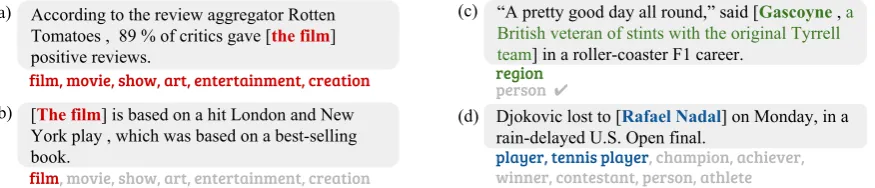
Figure 1: Examples selected from the Ultra-Fine Entity Typing dataset ofChoi et al.(2018). (a) A manually-annotated example. (b) The head word heuristic functioning correctly but missing types in (a). (c) Entity linking providing the wrong types. (d) Entity linking providing correct but incomplete types.
tity typing scenario and use the same two distant supervision sources as them, based on entity link-ing and head words. On top of an adapted model fromChoi et al.(2018) incorporating ELMo ( Pe-ters et al., 2018), na¨ıvely adding distant data ac-tually hurts performance. However, when our learned denoising model is applied to the data, performance improves, and it improves more than heuristic denoising approaches tailored to this dataset. Our strongest denoising model gives a gain of 3 F1absolute over the ELMo baseline, and
a 4.4 F1 improvement over naive incorporation
of distant data. This establishes a new state-of-the-art on the test set, outperforming concurrently published work (Xiong et al.,2019) and matching the performance of a BERT model (Devlin et al.,
2018) on this task. Finally, we show that denois-ing helps even when the label set is projected onto the OntoNotes label set (Hovy et al.,2006;Gillick et al., 2014), outperforming the method of Choi et al.(2018) in that setting as well.
2 Setup
We consider the task of predicting a structured tar-get y associated with an input x. Suppose we have high-quality labeled data of n (input, tar-get) pairs D = { x(1), y(1)
, . . . ,(x(n), y(n))}, and noisily labeled data ofn0 (input, target) pairs D0 = {(x(1), ynoisy(1) ), . . . ,(x(n0), y(n
0)
noisy)}. For our
tasks, D is collected through manual annotation andD0is collected by distant supervision. We use
two models to denoise data from D0: a filtering functionf disposes of unusable data (e.g., misla-beled examples) and a relabeling functiong trans-forms the noisy target labels ynoisy to look more like true labels. This transformation improves the noisy data so that we can use it toDwithout intro-ducing damaging amounts of noise. In the second stage, a classification model is trained on the aug-mented data (Dcombined with denoisedD0) and
predictsygivenxin the inference phase.
2.1 Case Study: Ultra-Fine Entity Typing
The primary task we address here is the fine-grained entity typing task ofChoi et al.(2018). In-stances in the corpus are assigned types from a vo-cabulary of more than 10,000 types, which are di-vided into three classes:9generaltypes,121 fine-grained types, and10,201ultra-finetypes. This dataset consists of 6K manually annotated exam-ples and approximately 25M distantly-labeled ex-amples. 5M examples are collected using entity linking (EL) to link mentions to Wikipedia and gather types from information on the linked pages. 20M examples (HEAD) are generated by extract-ing nominal head words from raw text and treatextract-ing these as singular type labels.
Figure 1 shows examples from these datasets which illustrate the challenges in automatic anno-tation using distant supervision. The manually-annotated example in (a) shows how numerous the gold-standard labeled types are. By contrast, the HEAD example (b) shows that simply treating the head word as the type label, while correct in this case, misses many valid types, including more general types. The EL example (c) is incorrectly annotated asregion, whereas the correct coarse type is actually person. This error is charac-teristic of entity linking-based distant supervision since identifying the correct link is a challenging problem in and of itself (Milne and Witten,2008): in this case, Gascoyneis also the name of a re-gion in Western Australia. The EL example in (d) has reasonable types; however, human annotators could choose more types (grayed out) to describe the mention more precisely. The average number of types annotated by humans is5.4per example while the two distant supervision techniques com-bined yields1.5types per example on average.
Djokovic lost to [Rafael Nadal] on Monday, ...
player
tennis_player
A person who participates in or is skilled at some game
An athlete who plays tennis
+ +
Rafael Nadal
Good
Bad
✕
tennis player winner athlete baseball player person
Yes
Yes
Yes
No
Yes
✕
[image:3.595.74.526.63.231.2]Filter Relabel
Figure 2: Denoising models. TheFilter model predicts whether the example should be kept at all; if it is kept, the Relabelmodel attempts to automatically expand the label set. Φm is a mention encoder, which can be a
state-of-the-art entity typing model.Φtencodes noisy types from distant supervision.
completely incorrect types, and (2) systematically miss certain types.
3 Denoising Model
To handle the noisy data, we propose to learn a denoising model as shown in Figure 2. This de-noising model consists of filtering and relabeling functions to discard and relabel examples, respec-tively; these rely on a shared mention encoder and type encoder, which we describe in the following sections. The filtering function is a binary clas-sifier that takes these encoded representations and predicts whether the example is good or bad. The relabeling function predicts a new set of labels for the given example.
We learn these functions in a supervised fash-ion. Training data for each is created through syn-thetic noising processes applied to the manually-labeled data, as described in Sections3.3and3.4.
For the entity typing task, each example(x, y) takes the form((s, m), t), wheresis the sentence,
m is the mention span, and t is the set of types (either clean or noisy).
3.1 Mention Encoder
This encoder is a functionΦm(s, m)which maps
a sentencesand mentionmto a real-valued vec-tor vm. This allows the filtering and relabeling
function to recognize inconsistencies between the given example and the provided types. Note that these inputssandmare the same as the inputs for the supervised version of this task; we can there-fore share an encoder architecture between our de-noising model and our final typing model. We use
an encoder followingChoi et al.(2018) with a few key differences, which are described in Section4.
3.2 Type Encoder
The second component of our model is a module which produces a vector vt = Φt(t). This is an
encoder of an unordered bag of types. Our basic type encoder uses trainable vectors as embeddings for each type and combines these with summing. That is, the noisy typest1, . . . , tm are embedded
into type vectors{t1, . . . ,tm}. The final
embed-ding of the type sett=P jtj.
Type Definition Encoder Using trainable type
embeddings exposes the denoising model to po-tential data sparsity issues, as some types appear only a few or zero times in the training data. Therefore, we also assign each type a vector based on its definition in WordNet (Miller,1995). Even low-frequent types are therefore assigned a plausi-ble embedding.1
Let wji denote the ith word of the jth type’s most common WordNet definition. Each wij is embedded using GloVe (Pennington et al.,2014). The resulting word embedding vectors wji are fed into a bi-LSTM (Hochreiter and Schmidhu-ber, 1997; Graves and Schmidhuber, 2005), and a concatenation of the last hidden states in both directions is used as the definition representation wj. The final representation of the definitions is the sum over these vectors for each type: w =
1We found this technique to be more effective than using
P kwk.
Our finalvt = [t;w], the concatenation of the
type and definition embedding vectors.
3.3 Filtering Function
The filtering function f is a binary classifier de-signed to detect examples that are completely mis-labeled. Formally, f is a function mapping a la-beled example(s, m, t) to a binary indicatorz of whether this example should be discarded or not.
In the forward computation, the feature vectors vm and vt are computed using the mention and
type encoders. The model prediction is defined as
P(error) = σ u>Highway([vm;vt])
, whereσ
is a sigmoid function,uis a parameter vector, and Highway(·)is a 1-layer highway network ( Srivas-tava et al.,2015). We can applyf to each distant pair in our distant datasetD0 and discard any ex-ample predicted to be erroneous (P(error)>0.5).
Training data We do not know a priori which
examples in the distant data should be discarded, and labeling these is expensive. We therefore con-struct synthetic training dataDerrorforf based on the manually labeled data D. For 30% of the ex-amples in D, we replace the gold types for that example with non-overlapping types taken from another example. The intuition for this procedure follows Figure 1: we want to learn to detect ex-amples in the distant data like Gascoyne where heuristics like entity resolution have misfired and given a totally wrong label set.
Formally, for each selected example((s, m), t), we repeatedly draw another example((s0, m0), t0) fromDuntil we findt0error that does not have any common types with t. We then create a positive training example((s, m, t0error), z = 1). We create a negative training example((s, m, t), z = 0) us-ing the remainus-ing70%of examples. f is trained
onDerrorusing binary cross-entropy loss.
3.4 Relabeling Function
The relabeling functiongis designed to repair ex-amples that make it through the filter but which still have errors in their type sets, such as missing types as shown in Figure1b and1d.gis a function from a labeled example (s, m, t) to an improved type set˜tfor the example.
Our model computes feature vectorsvmandvt
by the same procedure as the filtering functionf. The decoder is a linear layer with parametersD∈ R|V
t|×(d
m+dt). We computee = σ(D[v
m;vt]),
whereσis an element-wise sigmoid operation de-signed to give binary probabilities for each type.
Once g is trained, we make a prediction t˜for each (s, m, t) ∈ D0 and replace t by ˜t to create
the denoised dataD0denoise ={(s, m,t˜), . . .}. For the final prediction, we choose all typest` where
e`>0.5, requiring at least two types to be present
or else we discard the example.
Training data We train the relabeling function
g on another synthetically-noised dataset Ddrop generated from the manually-labeled data D. To mimic the type distribution of the distantly-labeled examples, we take each example(s, m, t)and ran-domly drop each type with a fixed rate0.7 inde-pendent of other types to produce a new type set
t0. We perform this process for all examples inD and create a noised training setDdrop, where a sin-gle training example is((s, m, t0), t). gis trained onD0
dropwith a binary classification loss function over types used inChoi et al.(2018), described in the next section.
One can think of g as a type of denoising autoencoder (Vincent et al., 2008) whose recon-structed typest˜are conditioned onvas well ast.
4 Typing Model
In this section, we define the sentence and men-tion encoder Φm, which is use both in the
de-noising model as well as in the final prediction task. We extend previous attention-based models for this task (Shimaoka et al., 2017; Choi et al.,
2018). At a high level, we have an instance en-coder Φm that returns a vector vm ∈ RdΦ, then multiply the output of this encoding by a matrix and apply a sigmoid to get a binary prediction for each type as a probability of that type applying.
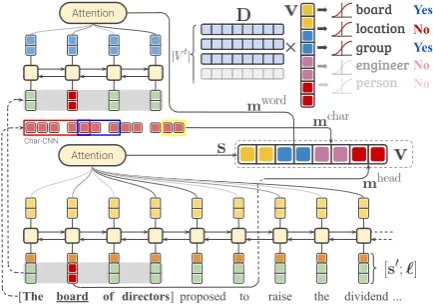
Figure 3 outlines the overall architecture of our typing model. The encoder Φm consists of
four vectors: a sentence representations, a word-level mention representation mword, a character-level mention representation mchar, and a head-word mention vector mhead. The first three of these were employed by Choi et al.(2018). We have modified the mention encoder with an addi-tional bi-LSTM to better encode long mentions, and additionally used the headword embedding di-rectly in order to focus on the most critical word. These pieces use pretrained contextualized word embeddings (ELMo) (Peters et al.,2018) as input.
Pretrained Embeddings Tokens in the sentence
board location group engineer person
Yes No Yes No No
✕
[The board of directors] proposed to raise the dividend ...
Attention Attention
[image:5.595.72.289.62.214.2]Char-CNN
Figure 3: Sentence and mention encoder used to predict types. We compute attention over LSTM encodings of the sentence and mention, as well as using character-level and head-word representations to capture addi-tional mention properties. These combine to form an encoding which is used to predict types.
using ELMo; let s0i ∈ RdELM o denote the
em-bedding of theith word. As suggested inPeters et al. (2018), we learn task specific parameters
γtask ∈ Randstask ∈ R3governing these embed-dings. We do not fine-tune the parameters of the ELMo LSTMs themselves.
Sentence Encoder FollowingChoi et al.(2018), we concatenate the mth word vector sm in the
sentence with a corresponding location embed-ding `m ∈ Rdloc. Each word is assigned one
of four location tokens, based on whether (1) the word is in the left context, (2) the word is the first word of the mention span, (3) the word is in the mention span (but not first), and (4) the word is in the right context. The input vectors [s0;`]are fed into a bi-LSTM encoder, with hid-den dimension is dhid, followed by a span atten-tion layer (Lee et al., 2017; Choi et al., 2018): s = Attention(bi-LSTM([s0;l])), where s is the final representation of the sentences.
Mention Encoder To obtain a mention
repre-sentation, we use both word and character infor-mation. For the word-level representation, the mention’s contextualized word vectorsm0are fed into a bi-LSTM with hidden dimension is dhid. The concatenated hidden states of both directions are summed by a span attention layer to form the word-level mention representation: mword = Attention(bi-LSTM(m0)).
Second, a character-level representation is com-puted for the mention. Each character is embedded and then a 1-D convolution (Collobert et al.,2011) is applied over the characters of the mention. This
gives a character vectormchar.
Finally, we take the contextualized word vector of the headwordmheadas a third component of our representation. This can be seen as a residual con-nection (He et al., 2016) specific to the mention head word. We find the headwords in the mention spans by parsing those spans in isolation using the spaCy dependency parser (Honnibal and Johnson,
2015). Empirically, we found this to be useful on long spans, when the span attention would often focus on incorrect tokens.
The final representation of the inputxis a con-catenation of the sentence, the word- & character-level mention, and the mention headword repre-sentations,v=s;mword;mchar;mhead∈RdΦ.
Decoder We treat each label prediction as an in-dependent binary classification problem. Thus, we compute a score for each type in the type vocab-ularyVt. Similar to the decoder of the relabeling functiong, we computee = σ(Ev), where E ∈ R|Vt|×dΦ ande ∈ R|Vt|. For the final prediction, we choose all typest` wheree` >0.5. If none of
e`is greater than0.5, we chooset` = arg maxe
(the single most probable type).
Loss Function We use the same loss function as
Choi et al.(2018) for training. This loss partitions the labels in general, fine, and ultra-fine classes, and only treats an instance as an example for types of the class in question if it contains a label for that class. More precisely:
L=Lgeneral1general(t) +Lfine1fine(t)
+Lultra-fine1ultra-fine(t),
(1)
whereL...is a loss function for a specific type class: general, fine-grained, or ultra-fine, and
1...(t) is an indicator function that is active when
one of the typestis in the type class. EachL...is a sum of binary cross-entropy losses over all types in that category. That is, the typing problem is viewed as independent classification for each type. Note that this loss function already partially re-pairs the noise in distant examples from missing labels: for example, it means that examples from HEAD do not count as negative examples for gen-eral types when these are not present. However, we show in the next section that this is not suffi-cient for denoising.
Implementation Details The settings of
hyper-parameters in our model largely followsChoi et al.
pre-trained ELMo-Small model.2 The word embed-ding sizedELMois1024. The type embedding size and the type definition embedding size are set to 1024. For most of other model hyperparameters, we use the same settings as Choi et al. (2018):
dloc = 50, dhid = 100, dchar = 100. The num-ber of filters in the 1-d convolutional layer is50. Dropout is applied withp= 0.2for the pretrained embeddings, andp = 0.5for the mention repre-sentations. We limit sentences to 50 words and mention spans to 20 words for computational rea-sons. The character CNN input is limited to 25 characters; most mentions are short, so this still captures subword information in most cases. The batch size is set to100. For all experiments, we use the Adam optimizer (Kingma and Ba,2014). The initial learning rate is set to 2e-03. We imple-ment all models3 using PyTorch. To use ELMo, we consult the AllenNLP source code.
5 Experiments
Ultra-Fine Entity Typing We evaluate our
ap-proach on the ultra-fine entity typing dataset from
Choi et al. (2018). The 6K manually-annotated English examples are equally split into the train-ing, development, and test examples by the au-thors of the dataset. We generate synthetically-noised data,DerrorandDdrop, using the 2K training set to train the filtering and relabeling functions,f
andh. We randomly select 1M EL and 1M HEAD examples and use them as the noisy dataD0. Our augmented training data is a combination of the manually-annotated dataDandD0
denoised.
OntoNotes In addition, we investigate if denois-ing leads to better performance on another dataset. We use the English OntoNotes dataset (Gillick et al., 2014), which is a widely used benchmark for fine-grained entity typing systems. The orig-inal training, development, and test splits contain 250K, 2K, and 9K examples respectively. Choi et al. (2018) created an augmented training set that has 3.4M examples. We also construct our own augmented training sets with/without denois-ing usdenois-ing our noisy dataD0, using the same label mapping from ultra-fine types to OntoNotes types described inChoi et al.(2018).
2
https://allennlp.org/elmo
3The code for experiments is available at https://
github.com/yasumasaonoe/DenoiseET
5.1 Ultra-Fine Typing Results
We first compare the performance of our approach to several benchmark systems, then break down the improvements in more detail. We use the model architecture described in Section4and train it on the different amounts of data: manually la-beled only, naive augmentation (adding in the raw distant data), and denoised augmentation. We compare our model toChoi et al. (2018) as well as to BERT (Devlin et al.,2018), which we fine-tuned for this task. We adapt our task to BERT by forming an input sequence ”[CLS] sentence [SEP] mention [SEP]” and assign the seg-ment embedding A to the sentence and B to the mention span.4 Then, we take the output vector at the position of the[CLS]token (i.e., the first to-ken) as the feature vectorv, analogous to the usage for sentence pair classification tasks. The BERT model is fine-tuned on the 2K manually annotated examples. We use the pretrained BERT-Base, un-cased model5 with a step size of 2e-05 and batch size 32.
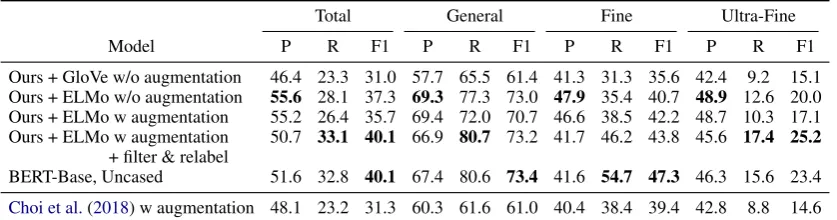
Results Table 1 compares the performance of
these systems on the development set. Our model with no augmentation already matches the system ofChoi et al.(2018) with augmentation, and incor-porating ELMo gives further gains on both preci-sion and recall. On top of this model, adding the distantly-annotated data lowers the performance; the loss function-based approach of (Choi et al.,
2018) does not sufficiently mitigate the noise in this data. However, denoising makes the distantly-annotated data useful, improving recall by a sub-stantial margin especially in the general class. A possible reason for this is that the relabeling func-tion tends to add more general types given finer types. BERT performs similarly to ELMo with denoised distant data. As can be seen in the per-formance breakdown, BERT gains from improve-ments in recall in the fine class.
Table 2 shows the performance of all settings on the test set, with the same trend as the perfor-mance on the development set. Our approach out-performs the concurrently-published Xiong et al.
(2019); however, that work does not use ELMo. Their improved model could be used for both
de-4We investigated several approaches, including taking the
head word piece from the last layer and using that for classi-fication (more closely analogous to whatDevlin et al.(2018) did for NER), but found this one to work best.
5https://github.com/google-research/
Total General Fine Ultra-Fine
Model P R F1 P R F1 P R F1 P R F1
Ours + GloVe w/o augmentation 46.4 23.3 31.0 57.7 65.5 61.4 41.3 31.3 35.6 42.4 9.2 15.1 Ours + ELMo w/o augmentation 55.6 28.1 37.3 69.3 77.3 73.0 47.9 35.4 40.7 48.9 12.6 20.0 Ours + ELMo w augmentation 55.2 26.4 35.7 69.4 72.0 70.7 46.6 38.5 42.2 48.7 10.3 17.1 Ours + ELMo w augmentation 50.7 33.1 40.1 66.9 80.7 73.2 41.7 46.2 43.8 45.6 17.4 25.2
+ filter & relabel
BERT-Base, Uncased 51.6 32.8 40.1 67.4 80.6 73.4 41.6 54.7 47.3 46.3 15.6 23.4
[image:7.595.91.510.63.173.2]Choi et al.(2018) w augmentation 48.1 23.2 31.3 60.3 61.6 61.0 40.4 38.4 39.4 42.8 8.8 14.6
Table 1: Macro-averaged P/R/F1 on the dev set for the entity typing task ofChoi et al.(2018) comparing various systems. ELMo gives a substantial improvement over baselines. Over an ELMo-equipped model, data augmen-tation using the method ofChoi et al. (2018) gives no benefit. However, our denoising technique allow us to effectively incorporate distant data, matching the results of a BERT model on this task (Devlin et al.,2018).
noising as well as prediction in our setting, and we believe this would stack with our approach.
Usage of Pretrained Representations Our
model with ELMo trained on denoised data matches the performance of the BERT model. We experimented with incorporating distant data (raw and denoised) in BERT, but the fragility of BERT made it hard to incorporate: training for longer generally caused performance to go down after a while, so the model cannot exploit large external data as effectively. Devlin et al. (2018) prescribe training with a small batch size and very specific step sizes, and we found the model very sensitive to these hyperparameters, with only 2e-05 giving strong results. The ELMo paradigm of incorpo-rating these as features is much more flexible and modular in this setting. Finally, we note that our approach could use BERT for denoising as well, but this did not work better than our current ap-proach. Adapting BERT to leverage distant data effectively is left for future work.
5.1.1 Comparing Denoising Models
We now explicitly compare our denoising ap-proach to several baselines. For each denoising method, we create the denoised EL, HEAD, and EL & HEAD dataset and investigate performance on these datasets. Any denoised dataset is com-bined with the 2K manually-annotated examples and used to train the final model.
Heuristic Baselines These heuristics target the same factors as our filtering and relabeling func-tions in a non-learned way.
SYNONYMS ANDHYPERNYMS For each type
observed in the distant data, we add its synonyms and hypernyms using WordNet (Miller, 1995). This is motivated by the data construction process inChoi et al.(2018).
Model P R F1
Ours + GloVe w/o augmentation 47.6 23.3 31.3 Ours + ELMo w/o augmentation 55.8 27.7 37.0 Ours + ELMo w augmentation 55.5 26.3 35.7 Ours + ELMo w augmentation 51.5 33.0 40.2
+ filter & relabel
BERT-Base, Uncased 51.6 33.0 40.2
Choi et al.(2018) w augmentation 47.1 24.2 32.0
[image:7.595.315.518.249.351.2]LABELGCN (Xiong et al.,2019) 50.3 29.2 36.9
Table 2: Macro-averaged P/R/F1 on the test set for the entity typing task ofChoi et al.(2018). Our denoising approach gives substantial gains over naive augmenta-tion and matches the performance of a BERT model.
COMMONTYPEPAIRS We use type pair statis-tics in the manually labeled training data. For each base type that we observe in a distant example, we add any type which is seen more than 90% of the time the base type occurs. For instance, the type art is given at least 90% of the times thefilmtype is present, so we automatically add artwheneverfilmis observed.
OVERLAP We train a model on the
manually-labeled data only, then run it on the distantly-labeled data. If there is an intersection between the noisy typestand the predicted typetˆ, we com-bine them and use as the expanded type˜t. Inspired by tri-training (Zhou and Li,2005), this approach adds “obvious” types but avoids doing so in cases where the model has likely made an error.
ef-EL & HEAD EL HEAD
Type Denoising Method P R F1 P R F1 P R F1
RAWDATA 55.2 26.4 35.7 52.3 26.1 34.8 52.8 28.4 36.9
Heuristic Baselines SYNONYMS& HYPERNYMS 43.0 30.0 35.3 47.5 26.3 33.9 44.8 31.7 37.1
PAIR 50.2 29.0 36.8 49.6 27.0 35.0 50.6 31.2 38.6
OVERLAP 50.0 32.3 39.2 49.5 30.8 38.0 50.6 31.4 38.7
Proposed Approach FILTER 53.1 28.2 36.8 51.9 26.5 35.1 51.2 31.2 38.7
RELABEL 52.1 32.2 39.8 50.2 31.4 38.6 50.2 31.8 38.9 FILTER& RELABEL 50.7 33.1 40.1 52.7 30.5 38.7 50.7 32.1 39.3
[image:8.595.84.514.64.187.2]Choi et al.(2018) 48.1 23.2 31.3 50.3 19.6 28.2 48.4 22.3 30.6
Table 3: Macro-averaged P/R/F1 on the dev set for the entity typing task ofChoi et al.(2018) with various types of augmentation added. The customized loss fromChoi et al.(2018) actually causes a decrease in performance from adding any of the datasets. Heuristics can improve incorporation of this data: a relabeling heuristic (Pair) helps on HEAD and a filtering heuristic (Overlap) is helpful in both settings. However, our trainable filtering and relabeling models outperform both of these techniques.
fective heuristic technique. This simple filtering and expansion heuristic improves recall on EL. FILTER, our model-based example selector, gives
similar improvements to PAIR and OVERLAP on the HEAD setting, where filtering noisy data ap-pears to be somewhat important.6 RELABEL and
OVERLAPboth improve performance on both EL and HEAD while other methods do poorly on EL. Combining the two model-based denoising tech-niques, FILTER& RELABEL outperforms all the baselines.
5.2 OntoNotes Results
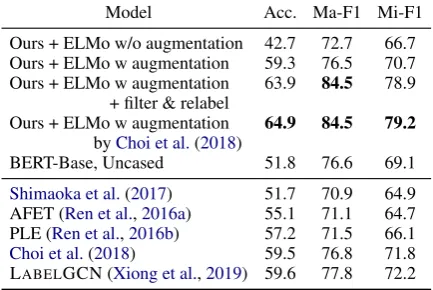
We compare our different augmentation schemes for deriving data for the OntoNotes standard as well. Table4lists the results on the OntoNotes test set following the adaptation setting of Choi et al.
(2018). Even on this dataset, denoising signifi-cantly improves over naive incorporation of dis-tant data, showing that the denoising approach is not just learning quirks of the ultra-fine dataset. Our augmented set is constructed from 2M seed examples while Choi et al. (2018) have a more complex procedure for deriving augmented data from 25M examples. Ours (total size of 2.1M) is on par with their larger data (total size of 3.4M), despite having 40% fewer examples. In this set-ting, BERT still performs well but not as well as our model with augmented training data.
One source of our improvements from data aug-mentation comes from additional data that is able to be used because some OntoNotes type can be derived. This is due to denoising doing a better job
6One possible reason for this is identifying stray word
senses; filmcan refer to the physical photosensitive object, among other things.
Model Acc. Ma-F1 Mi-F1
Ours + ELMo w/o augmentation 42.7 72.7 66.7 Ours + ELMo w augmentation 59.3 76.5 70.7 Ours + ELMo w augmentation 63.9 84.5 78.9
+ filter & relabel
Ours + ELMo w augmentation 64.9 84.5 79.2
byChoi et al.(2018)
BERT-Base, Uncased 51.8 76.6 69.1
Shimaoka et al.(2017) 51.7 70.9 64.9
AFET (Ren et al.,2016a) 55.1 71.1 64.7
PLE (Ren et al.,2016b) 57.2 71.5 66.1
Choi et al.(2018) 59.5 76.8 71.8
LABELGCN (Xiong et al.,2019) 59.6 77.8 72.2
Table 4: Test results on OntoNotes. Denoising helps substantially even in this reduced setting. Using fewer distant examples, we nearly match the performance us-ing the data fromChoi et al.(2018) (see text).
of providing correct general types. In the EL set-ting, this yields 730k usable examples out of 1M (vs 540K for no denoising), and in HEAD, 640K out of 1M (vs. 73K).
5.3 Analysis of Denoised Labels
To understand what our denoising approach does to the distant data, we analyze the behavior of our filtering and relabeling functions. Table5reports the average numbers of types added/deleted by the relabeling function and the ratio of examples dis-carded by the filtering function.
[image:8.595.308.525.257.402.2]defini-General Fine Ultra-Fine
Data Add Del Add Del Add Del Filter (%)
EL 0.87 0.01 0.36 0.17 2.03 0.12 9.4
HEAD 1.18 0.00 0.51 0.01 1.15 0.16 10.0
Table 5: The average number of types added or deleted by the relabeling function per example. The right-most column shows that the rate of examples discarded by the filtering function.
tions, so those labels often do not include ultra-fine types. The filtering function discards similar numbers of examples for the EL and HEAD data: 9.4%and10%respectively.
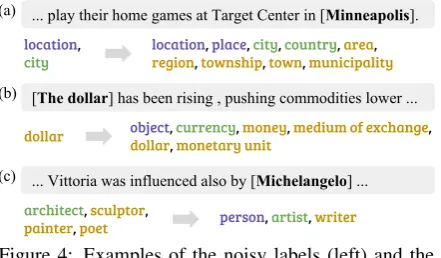
Figure 4shows examples of the original noisy labels and the denoised labels produced by the relabeling function. In example (a), taken from the EL data, the original labels, {location, city}, are correct, but human annotators might choose more types for the mention span,
Min-neapolis. The relabeling function retains the
original types about the geography and adds ultra-fine types about administrative units such as {township, municipality}. In exam-ple (b), from the HEAD data, the original label, {dollar}, is not so expressive by itself since it is a name of a currency. The labeling func-tion adds coarse types,{object, currency}, as well as specific types such as {medium of
exchange, monetary unit}. In another
EL example (c), the relabeling function tries to add coarse and fine types but struggles to assign mul-tiple diverse ultra-fine types to the mention span
Michelangelo, possibly because some of these
types rarely cooccur (painterandpoet).
6 Related Work
Past work on denoising data for entity typ-ing has used multi-instance multi-label learntyp-ing (Yaghoobzadeh and Sch¨utze, 2015, 2017;Murty et al.,2018). One view of these approaches is that they delete noisily-introduced labels, but they can-not add them, or filter bad examples. Other work focuses on learning type embeddings (Yogatama et al., 2015; Ren et al., 2016a,b); our approach goes beyond this in treating the label set in a struc-tured way. The label set of Choi et al.(2018) is distinct in not being explicitly hierarchical, mak-ing past hierarchical approaches difficult to apply. Denoising techniques for distant supervision have been applied extensively to relation extrac-tion. Here, multi-instance learning and
probabilis-... play their home games at Target Center in [Minneapolis]. (a)
location,
city location, place, city, country, region, township, town, municipalityarea,
... Vittoria was influenced also by [Michelangelo] ... (c)
architect, sculptor,
[image:9.595.308.529.63.192.2]painter, poet person, artist, writer
[The dollar] has been rising , pushing commodities lower ...
dollar
(b)
object, currency, money, medium of exchange,
dollar, monetary unit
Figure 4: Examples of the noisy labels (left) and the denoised labels (right) for mentions (bold). The col-ors correspond to type classes: general(purple), fine-grained(green), andultra-fine(yellow).
tic graphical modeling approaches have been used (Riedel et al., 2010;Hoffmann et al.,2011; Sur-deanu et al.,2012;Takamatsu et al.,2012) as well as deep models (Lin et al.,2016;Feng et al.,2017;
Luo et al.,2017;Lei et al.,2018;Han et al.,2018), though these often focus on incorporating signals from other sources as opposed to manually labeled data.
7 Conclusion
In this work, we investigated the problem of de-noising distant data for entity typing tasks. We trained a filtering function that discards examples from the distantly labeled data that are wholly un-usable and a relabeling function that repairs noisy labels for the retained examples. When distant data is processed with our best denoising model, our final trained model achieves state-of-the-art performance on an ultra-fine entity typing task.
Acknowledgments
References
Eunsol Choi, Omer Levy, Yejin Choi, and Luke Zettle-moyer. 2018. Ultra-Fine Entity Typing. In Proceed-ings of the 56th Annual Meeting of the Association for Computational Linguistics.
Ronan Collobert, Jason Weston, L´eon Bottou, Michael Karlen, Koray Kavukcuoglu, and Pavel P. Kuksa. 2011. Natural Language Processing (Almost) from Scratch. Journal of Machine Learning Research, 12:2493–2537.
Luciano Del Corro, Abdalghani Abujabal, Rainer Gemulla, and Gerhard Weikum. 2015. FINET: Context-Aware Fine-Grained Named Entity Typing. InProceedings of the 2015 Conference on Empirical Methods in Natural Language Processing.
Jacob Devlin, Ming-Wei Chang, Kenton Lee, and Kristina Toutanova. 2018. BERT: Pre-training of Deep Bidirectional Transformers for Language Un-derstanding.CoRR, abs/1810.04805.
Xiaocheng Feng, Jiang Guo, Bing Qin, Ting Liu, and Yongjie Liu. 2017. Effective Deep Memory Net-works for Distant Supervised Relation Extraction. In Proceedings of the Twenty-Sixth International Joint Conference on Artificial Intelligence, IJCAI-17.
Dan Gillick, Nevena Lazic, Kuzman Ganchev, Jesse Kirchner, and David Huynh. 2014. Context-Dependent Fine-Grained Entity Type Tagging.
CoRR, abs/1412.1820.
Alex Graves and J¨urgen Schmidhuber. 2005. Frame-wise phoneme classification with bidirectional LSTM and other neural network architectures. Neu-ral Networks, 18(5-6):602–610.
Xu Han, Zhiyuan Liu, and Maosong Sun. 2018. De-noising Distant Supervision for Relation Extraction via Instance-Level Adversarial Training. CoRR, abs/1805.10959.
Braden Hancock, Paroma Varma, Stephanie Wang, Martin Bringmann, Percy Liang, and Christopher R´e. 2018. Training Classifiers with Natural Lan-guage Explanations. InProceedings of the 56th An-nual Meeting of the Association for Computational Linguistics.
Kaiming He, Xiangyu Zhang, Shaoqing Ren, and Jian Sun. 2016. Deep Residual Learning for Image Recognition. In 2016 IEEE Conference on Com-puter Vision and Pattern Recognition, CVPR.
Sepp Hochreiter and J¨urgen Schmidhuber. 1997. Long short-term memory. Neural computation, 9(8):1735–1780.
Raphael Hoffmann, Congle Zhang, Xiao Ling, Luke S. Zettlemoyer, and Daniel S. Weld. 2011.
Knowledge-Based Weak Supervision for Informa-tion ExtracInforma-tion of Overlapping RelaInforma-tions. In Pro-ceedings of the 49th Annual Meeting of the Associ-ation for ComputAssoci-ational Linguistics: Human Lan-guage Technologies.
Matthew Honnibal and Mark Johnson. 2015. An Im-proved Non-monotonic Transition System for De-pendency Parsing. InProceedings of the 2015 Con-ference on Empirical Methods in Natural Language Processing.
Eduard Hovy, Mitchell Marcus, Martha Palmer, Lance Ramshaw, and Ralph Weischedel. 2006. OntoNotes: The 90% Solution. InProceedings of the 2006 Con-ference of the North American Chapter of the Asso-ciation for Computational Linguistics: Human Lan-guage Technologies.
Diederik P. Kingma and Jimmy Ba. 2014. Adam: A Method for Stochastic Optimization. CoRR, abs/1412.6980.
Kenton Lee, Luheng He, Mike Lewis, and Luke Zettle-moyer. 2017. End-to-end Neural Coreference Reso-lution. InProceedings of the 2017 Conference on Empirical Methods in Natural Language Process-ing.
Kai Lei, Daoyuan Chen, Yaliang Li, Nan Du, Min Yang, Wei Fan, and Ying Shen. 2018. Cooperative Denoising for Distantly Supervised Relation Extrac-tion. InProceedings of the 27th International Con-ference on Computational Linguistics.
Yankai Lin, Shiqi Shen, Zhiyuan Liu, Huanbo Luan, and Maosong Sun. 2016. Neural Relation Extrac-tion with Selective AttenExtrac-tion over Instances. In Pro-ceedings of the 54th Annual Meeting of the Associa-tion for ComputaAssocia-tional Linguistics.
Bingfeng Luo, Yansong Feng, Zheng Wang, Zhanx-ing Zhu, Songfang Huang, Rui Yan, and Dongyan Zhao. 2017. Learning with Noise: Enhance Dis-tantly Supervised Relation Extraction with Dynamic Transition Matrix. InProceedings of the 55th An-nual Meeting of the Association for Computational Linguistics.
George A. Miller. 1995.WordNet: A Lexical Database for English.Commun. ACM, 38(11):39–41.
David Milne and Ian H. Witten. 2008. Learning to Link with Wikipedia. In Proceedings of the 17th ACM Conference on Information and Knowledge Man-agement.
Shikhar Murty, Patrick Verga, Luke Vilnis, Irena Radovanovic, and Andrew McCallum. 2018. Hier-archical Losses and New Resources for Fine-grained Entity Typing and Linking. In Proceedings of the 56th Annual Meeting of the Association for Compu-tational Linguistics.
Jeffrey Pennington, Richard Socher, and Christo-pher D. Manning. 2014. Glove: Global Vectors for Word Representation. In Proceedings of the 2014 Conference on Empirical Methods in Natural Lan-guage Processing.
Matthew E. Peters, Mark Neumann, Mohit Iyyer, Matt Gardner, Christopher Clark, Kenton Lee, and Luke Zettlemoyer. 2018. Deep Contextualized Word Rep-resentations. InProceedings of the 2018 Conference of the North American Chapter of the Association for Computational Linguistics: Human Language Technologies.
Maxim Rabinovich and Dan Klein. 2017. Fine-Grained Entity Typing with High-Multiplicity As-signments. InProceedings of the 55th Annual Meet-ing of the Association for Computational LMeet-inguis- Linguis-tics.
Alexander Ratner, Stephen H. Bach, Henry Ehrenberg, Jason Fries, Sen Wu, and Christopher R´e. 2018a. Snorkel: Rapid Training Data Creation with Weak Supervision. InProceedings of VLDB.
Alexander Ratner, Braden Hancock, Jared Dunnmon, Frederic Sala, Shreyash Pandey, and Christopher R´e. 2018b. Training Complex Models with Multi-Task Weak Supervision.CoRR, abs/1810.02840.
Alexander Ratner, Chris De Sa, Sen Wu, Daniel Sel-sam, , and Christopher R´e. 2016. Data Program-ming: Creating Large Training Sets, Quickly. In
Proceedings of NeurIPS.
Xiang Ren, Wenqi He, Meng Qu, Lifu Huang, Heng Ji, and Jiawei Han. 2016a. AFET: Automatic Fine-Grained Entity Typing by Hierarchical Partial-Label Embedding. InProceedings of the 2016 Conference on Empirical Methods in Natural Language Pro-cessing.
Xiang Ren, Wenqi He, Meng Qu, Clare R. Voss, Heng Ji, and Jiawei Han. 2016b. Label Noise Reduction in Entity Typing by Heterogeneous Partial-Label Em-bedding. InProceedings of the 22nd ACM SIGKDD International Conference on Knowledge Discovery and Data Mining.
Sebastian Riedel, Limin Yao, and Andrew McCallum. 2010. Modeling Relations and Their Mentions with-out Labeled Text. InMachine Learning and Knowl-edge Discovery in Databases.
Sonse Shimaoka, Pontus Stenetorp, Kentaro Inui, and Sebastian Riedel. 2017. Neural Architectures for Fine-grained Entity Type Classification. In Proceed-ings of the 15th Conference of the European Chapter of the Association for Computational Linguistics.
Rupesh Kumar Srivastava, Klaus Greff, and J¨urgen Schmidhuber. 2015. Highway Networks. CoRR, abs/1505.00387.
Mihai Surdeanu, Julie Tibshirani, Ramesh Nallapati, and Christopher D. Manning. 2012. Multi-instance Multi-label Learning for Relation Extraction. In
Proceedings of the 2012 Joint Conference on Empir-ical Methods in Natural Language Processing and Computational Natural Language Learning.
Shingo Takamatsu, Issei Sato, and Hiroshi Nakagawa. 2012. Reducing Wrong Labels in Distant Supervi-sion for Relation Extraction. InProceedings of the 50th Annual Meeting of the Association for Compu-tational Linguistics.
Pascal Vincent, Hugo Larochelle, Yoshua Bengio, and Pierre-Antoine Manzagol. 2008. Extracting and composing robust features with denoising autoen-coders. In Proceedings of the 25th International Conference on Machine Learning.
Hai Wang and Hoifung Poon. 2018. Deep Probabilistic Logic: A Unifying Framework for Indirect Supervi-sion. InProceedings of the 2018 Conference on Em-pirical Methods in Natural Language Processing.
Wenhan Xiong, Jiawei Wu, Deren Lei, Mo Yu, Shiyu Chang, Xiaoxiao Guo, and William Yang Wang. 2019. Imposing Label-Relational Inductive Bias for Extremely Fine-Grained Entity Typing. In Proceed-ings of the 2019 Conference of the North American Chapter of the Association for Computational Lin-guistics: Human Language Technologies.
Yadollah Yaghoobzadeh and Hinrich Sch¨utze. 2015. Corpus-level Fine-grained Entity Typing Using Contextual Information. InProceedings of the 2015 Conference on Empirical Methods in Natural Lan-guage Processing.
Yadollah Yaghoobzadeh and Hinrich Sch¨utze. 2017. Multi-level Representations for Fine-Grained Typ-ing of Knowledge Base Entities. InProceedings of the 15th Conference of the European Chapter of the Association for Computational Linguistics.
Dani Yogatama, Daniel Gillick, and Nevena Lazic. 2015. Embedding Methods for Fine Grained Entity Type Classification. InProceedings of the 53rd An-nual Meeting of the Association for Computational Linguistics and the 7th International Joint Confer-ence on Natural Language Processing.
Zhi-Hua Zhou and Ming Li. 2005. Tri-Training: Ex-ploiting Unlabeled Data Using Three Classifiers.