Adversarial Training for Relation Extraction
Yi Wu
Computer Science Division UC Berkeley
David Bamman School of Information
UC Berkeley
Stuart Russell Computer Science Division
UC Berkeley
Abstract
Adversarial training is a mean of regu-larizing classification algorithms by gen-erating adversarial noise to the training data. We apply adversarial training in re-lation extraction within the multi-instance multi-label learning framework. We eval-uate various neural network architectures on two different datasets. Experimental re-sults demonstrate that adversarial training is generally effective for both CNN and RNN models and significantly improves the precision of predicted relations. 1 Introduction
Despite the recent successes of deep neural net-works on various applications, neural network models tend to be overconfident about the noise in input signals. Adversarial examples (Szegedy et al., 2013) are examples generated by adding noise in the form of small perturbations to the original data, which are often indistinguishable for humans but drastically increase the loss incurred in a deep model. Adversarial training ( Goodfel-low et al., 2014) is a technique for regularizing deep models by encouraging the neural network to correctly classify both unmodified examples and perturbed ones, which in practice not only en-hances the robustness of the neural network but also improves its generalizability. Previous work has largely applied adversarial training on straight-forward classification tasks, including image clas-sification (Goodfellow et al.,2014) and text clas-sification (Miyato et al.,2016), where the goal is simply predicting a single label for every exam-ple and the training examexam-ples are able to provide strong supervision. It remains unclear whether ad-versarial training could be still effective for tasks with much weaker supervision, e.g., distant
super-vision (Mintz et al., 2009), or a different evalu-ation metric other than prediction accuracy (e.g., F1 score).
This paper focuses on the task of relation ex-traction, where the goal is to predict the relation that exists between a particular entity pair given several text mentions. One popular way to han-dle this problem is the multi-instance multi-label learning framework (MIML) (Hoffmann et al., 2011; Surdeanu et al., 2012) with distant super-vision (Mintz et al., 2009), where the mentions for an entity pair are aligned with the relations in Freebase (Bollacker et al.,2008). In this setting, relation extraction is much harder than the canon-ical classification problem in two respects: (1) although distant supervision can provide a large amount of data, the training labels are very noisy, and due to the multi-instance framework, the su-pervision is much weaker; (2) the evaluation met-ric of relation extraction is often the precision-recall curve or F1 score, which cannot be repre-sented (and thereby optimized) directly in the loss function.
In order to evaluate the effectiveness of adver-sarial training for relation extraction, we apply it to two different architectures (a convoluational neu-ral network and a recurrent neuneu-ral network) on two different datasets. Experimental results show that even on this harder task with much weaker super-vision, adversarial training can still improve the performance on all of the cases we studied.
2 Related Work
Neural Relation Extraction: In recent years, neural network models have shown superior per-formance over approaches using hand-crafted fea-tures in various tasks. Convolutional neural net-works (CNN) are among the first deep mod-els that have been applied to relation
tion (Santos et al., 2015;Nguyen and Grishman, 2015). Variants of convolutional networks include piecewise-CNN (PCNN) (Zeng et al.,2014), split CNN (Adel et al., 2016), CNN with sentence-wise pooling (Jiang et al., 2016) and attention CNN (Wang et al., 2016). Recurrent neural net-works (RNN) are another popular choice, and have been used in recent work in the form of recurrent CNNs (Cai et al.,2016) and attention RNNs (Zhou et al.,2016). An instance-level selective attention mechanism was introduced for MIML byLin et al. (2016), and has significantly improved the predic-tion accuracy for several of these base deep mod-els.
Adversarial Training: Adversarial training (AT) (Goodfellow et al., 2014) was originally in-troduced in the context of image classification tasks where the input data is continuous. Miyato et al.(2015,2016) adapts AT to text classification by adding perturbations on word embeddings and also extends AT to a semi-supervised setting by minimizing the entropy of the predicted label dis-tributions on unlabeled data.
AT introduces an end-to-end and deterministic way of data perturbation by utilizing the gradi-ent information. There are also other works for regularizing classifiers by adding random noise to the data, such as dropout (Srivastava et al.,2014) and its variant for NLP tasks, word dropout (Iyyer et al., 2015). Xie et al. (2017) discusses vari-ous data noising techniques for language models. Søgaard(2013) andLi et al.(2017) focus on lin-guistic adversaries.
3 Methodology
We first introduce MIML and then describe the base neural network models we consider:1
piece-wise CNN (Zeng et al.,2015) (PCNN) and bidi-rectional GRU (Cho et al.,2014) (RNN). We also utilize the selective attention mechanism in Lin et al. (2016) for both PCNN and RNN models. Adversarial training is presented at the end of this section.
3.1 Preliminaries
In MIML, we consider the set of text sentences
X = {x1, x2, . . . , xn}for each entity pair.
Sup-posing we haveRpredefined relations (including NA) to extract, we want to predict the probabil-1We primarily focus on effectiveness of AT. Other tech-niques in Sec.2are complementary to our focus.
RNN / PCNN
𝑣𝑖(1) 𝑣𝑖(2) 𝑣𝑖(3) 𝑣eos
𝑠𝑖
𝑤𝑖(1) 𝑤𝑖(2) 𝑤𝑖(3) 𝑤eos
𝑥𝑖
𝑒𝑖(1) 𝑒𝑖(2) 𝑒𝑖(3)
+ + +
𝑝𝑖(3)
𝑝𝑖(1) 𝑝𝑖(2) 0
dropouton the output
[image:2.595.315.516.61.184.2]variable
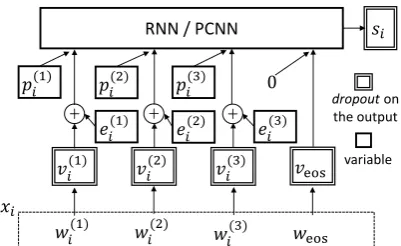
Figure 1: The computation graph of encoding a sentence xi with adversarial training. ei denotes
the adversarial perturbation w.r.t. xi. Dropout is
placed on the output of the variables in the double-lined rectangles.
ity of each of theRrelations given the mentions. Formally, for each relationr, we want to predict
P(r|x1, . . . , xn).
Note that since an entity pair may have no re-lations, we introduce a special relationNA to the label set. Hence, we simply assume there will be at leastone relation existing for every entity pair. During evaluation, we ignore the probability pre-dicted for theNArelation.
3.2 Neural Architectures
Input Representation: For each sentencexi, we
use pretrained word embeddings to project each word token intodw-dimensional space. Note that
we also need to include the entity position infor-mation inxi. Here we introduce an extra feature
vector p(iw) for each word w to encode the enti-ties’ positions. One choice is theposition embed-ding(Zeng et al.,2014): for each wordw, we com-pute the relative distances to the two entities and embed the distances in two dp-dimensional
vec-tors, which are then concatenated asp(iw). Position embedding introduces extra variables in the model and slows down the training time. We also inves-tigate a simpler choice,indicator encoding: when a word w is exactly an entity, we generate a dp
-dimensional~1vector and a~0vector otherwise. In our experiments, position embedding is crucial for PCNN due to the spatial invariance of CNN. For RNN, position embedding helps little (likely be-cause an RNN has the capacity of exploiting tem-poral dependencies) so we adopt indicator encod-ing instead.
Sentence Encoder: For a sentencexi, we want
representation ofxito derive a feature vectorsi =
f(xi;θ)given a set of parametersθ. We consider
both PCNN and RNN asf(xi;θ).
For PCNN, inheriting the settings from (Zeng et al., 2014), we adopt a convolution kernel with window size 3 and ds output channels and then
apply piecewise pooling and ReLU (Nair and Hin-ton,2010) as an activation function to eventually obtain a3·ds-dimensional feature vectorsi.
For RNN, we adopt bidirectional GRU withds
hidden units and concatenate the hidden states of the last timesteps from both the forward and the backward RNN as a2·ds-dimensional feature
vec-torsi.
Selective Attention: Following Lin et al. (2016), for each relation r, we aim to softly se-lect an attended sentencesr by taking a weighted
average of s1, s2, . . . , sn, namelysr = Piαrisi.
Here αr denotes the attention weights w.r.t.
re-lation r. For computing the weights, we define a query vector qr for each relation r and
com-puteαr =softmax(ur)whereur
i =tanh(si)>qr.
The query vectorqrcan be considered as the
em-bedding vector for the relationr, which is jointly learned with other model parameters.
Loss Function: For an entity pair, we com-pute the probability of relationrbyP(r|X;θ) =
softmax(Asr+b), whereAis the projection matrix
andbis the bias. For the multi-label setting, sup-poseK relations r1, . . . , rK exist forX. Simply
taking the summation over the log probabilities of all those labels yields the final loss function
L(X;θ) =−XK
i=1
logP(ri|X;θ). (1)
Dropout: For regularizing the parameters, we apply dropout (Srivastava et al.,2014) to both the word embedding and the sentence feature vector
si. Note that we do not perform dropout on the
position embeddingpi.
3.3 Adversarial Training
Adversarial training (AT) is a way of regulariz-ing the classifier to improve robustness to small worst-caseperturbations by computing the gradi-ent direction of a loss function w.r.t. the data. AT generates continuous perturbations, so we add the adversarial noise at the level of the word embed-dings, similar to Miyato et al. (2016). Formally, consider the input data X and suppose the word embedding of all the words inXisV. AT adds a
Dataset #Rel #Ent-Pair #Mention Sent-Len NYT-Train 58 290429 577434 145
[image:3.595.310.526.62.95.2]UW-Train 5 132419 546731 120
Table 1: Dataset statistics (#Rel includesNA).
small adversarial perturbationeadv toV and opti-mizes the following objective instead of Eq.(1).
Ladv(X;θ) = L(X+eadv;θ), where (2)
eadv = arg max
kek≤L(X+e; ˆθ) (3)
Hereθˆdenotes a fixed copy of the current value ofθ. Since Eq.(3) is computationally intractable for neural nets,Goodfellow et al.(2014) proposes to approximate Eq.(3) by linearizingL(X; ˆθ)near
X:
eadv=g/kgk, whereg=∇VL(X; ˆθ). (4)
HereV denotes the word embedding ofallthe words in X. Accordingly, in Eq. 4, kgkdenotes the norm of gradients overall the words fromall the sentences inX. In addition, we do not perturb the feature vectorpfor entity positions. A visual-ization of the process is demonstrated in Fig.1. 4 Experiments
To measure the effectiveness of adversarial train-ing on relation extraction, we evaluate both the CNN (PCNN) and RNN (bi-GRU) models on two different datasets, the NYT dataset (NYT) developed by Riedel et al. (2010) and the UW dataset (UW) by Liu et al. (2016). All code is implemented in Tensorflow (Abadi et al., 2016) and available at https://github.
com/jxwuyi/AtNRE. We adopt Adam
opti-mizer (Kingma and Ba,2014) with learning rate 0.001, batch size 50 and dropout rate 0.5. For adversarial training, the only parameter is . In each of the following experiments, we fixed all the hyper-parameters of the base model, performed a binary search solely onand showed the most ef-fective value of.
4.1 Datasets
Recall 0.1 0.2 0.3 0.4 AUC PCNN 0.667 0.572 0.476 0.392 0.329 PCNN-Adv 0.717 0.589 0.511 0.407 0.356 RNN 0.668 0.586 0.524 0.442 0.351 RNN-Adv 0.728 0.646 0.553 0.481 0.382 Table 2: Precisions of various models for differ-ent recalls on the NYT dataset, with best values in bold.
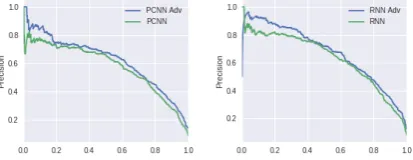
Figure 2: PR curves for PCNN (left) and RNN (right) on the NYT dataset with (blue) and without (green) adversarial training.
demonstrate the applicability of adversarial train-ing on various evaluation setttrain-ings.
Since the test set of the UW dataset only con-tains 200 sentences, we adopt a subset of the test set from the NYT dataset: all the entity pairs with the corresponding 4 relations in UW and another 1500 randomly selectedNApairs.
4.2 Practical Performances The NYT dataset:
We utilize the word embeddings released by Lin et al.(2016), which hasdw = 50dimensions. For
model parameters, we setde = 5(dimension of
the entity position feature vector) and ds = 230
(dimension of sentence feature vector) for PCNN
andde = 3 and ds = 150 for RNN. For
adver-sarial training, we choose = 0.01 for PCNN and = 0.02 for RNN. We empirically observed that when adding dropout to the word embeddings, PCNN performs significantly worse. Hence we only apply dropout tosifor PCNN. However, even
with a dropout rate of 0.5, RNN still performs well. We conjecture that it is due to PCNN being more sensitive to input signals and the dimension-ality of the word embedding (dw = 50) being very
small.
The precision-recall curves for different mod-els on the test set are shown in Fig. 2. Since the precision drops significantly with large recalls on the NYT dataset, we emphasize a part of the curve with recall number smaller than 0.5 in the
Recall 0.1 0.2 0.3 0.4 AUC
PCNN 0.765 0.717 0.713 0.677 0.576 PCNN-Adv 0.844 0.750 0.738 0.707 0.619 RNN 0.823 0.822 0.791 0.752 0.631 RNN-Adv 0.929 0.878 0.850 0.779 0.671 Table 3: Precisions of various models for different recalls on the UW dataset, with best values in bold.
Figure 3: PR curves for PCNN (left) and RNN (right) on the UW dataset with (blue) and without (green) adversarial training.
figure. Adversarial training significantly improves the precision for both PCNN and RNN models. We also show the precision numbers for some par-ticular recalls as well as the AUC (for the whole PR curve) in Table2, where RNN generally leads to better precision.
The UW dataset:
We train a word embedding of dw = 200
di-mensions using Glove (Pennington et al., 2014) on the New York Times Corpus in this experi-ment. For model parameters, we set the entity fea-ture dimension de = 5 and sentence feature
di-mension ds = 250 for PCNN and de = 3 and
ds = 200 for RNN. For adversarial training, we
choose = 0.05 for PCNN and = 0.5 for RNN. Since here word embedding dimension dw
is larger than that used for the NYT dataset, which implies that we now have word embeddings with larger norms, accordingly the optimal value of
increases. The precision-recall curves on the test data are shown in Fig.3, where adversarial train-ing again significantly improves the precision for both models. The precision numbers for some par-ticular recall values as well as the AUC numbers are demonstrated in Table3. Similarly RNN yields superior performances on the UW dataset.
4.3 Discussion
[image:4.595.75.283.183.262.2]robustness to input embeddings. The CNN, in contrast, has far fewer parameters which leads to much faster training and testing, which suggests a practical trade-off.
Notably, although the improvement under AUC by adversarial training are roughly the same for both RNN and CNN, the optimalvalue for RNN is always much larger than CNN. This implies that empirically RNN is more robust under adversarial attacks than CNN, which also helps RNN maintain higher precision as recall increases.
Choice of: When= 0, the AT loss (Eq.(2)) de-generates to the original loss (Eq.(1)); when be-comes too large, the noise can change the seman-tics of a sentence2 and make the model extremely
hard to correctly classify the adversarial examples. Notably, the optimal value ofis much smaller than the norm of the word embedding, which im-plies adversarial training works most effectively when only producing tiny perturbations on word features while keeping the semantics of sentences unchanged3.
Connection to other approaches: Li et al. (2017);Xie et al.(2017) proposes linguistic adver-saries techniques to enhance the robustness of the model by randomly changing the word tokens in a sentence. This explicitly modifies the semantics of a sentence. By contrast, adversarial training fo-cuses on smaller and continuous perturbations in the embedding space while preserving the seman-tics of sentences. Hence, adversarial training is complementary to linguistic adversaries.
Acknowledgments
We would like to thank our anonymous review-ers for valuable discussions. We also appreciate the generous help from Angli Liu and Yankai Lin. This work is partially supported by the DARPA PPAML program, contract FA8750-14-C-0011.
References
Mart´ın Abadi, Ashish Agarwal, Paul Barham, Eugene Brevdo, Zhifeng Chen, Craig Citro, Greg S Corrado, Andy Davis, Jeffrey Dean, Matthieu Devin, et al. 2Whenis large enough, e.g., comparable to the norm of input embeddings, and if we add the perturbation to word wand consider its nearest unperturbed word embedding in the embedding space, the nearest word will be different from the original wordw. This implicitly changes the content of a sentence.
3The nearest neighbor of wordwremains unchanged after
wbeing perturbed with the optimal.
2016. Tensorflow: Large-scale machine learning on heterogeneous distributed systems. arXiv preprint arXiv:1603.04467.
Heike Adel, Benjamin Roth, and Hinrich Sch¨utze. 2016. Comparing convolutional neural networks to traditional models for slot filling. InNAACL HLT 2016, The 2016 Conference of the North Ameri-can Chapter of the Association for Computational Linguistics: Human Language Technologies, San Diego, California, USA, June 12 - June 17, 2016.
Kurt Bollacker, Colin Evans, Praveen Paritosh, Tim Sturge, and Jamie Taylor. 2008. Freebase: a collab-oratively created graph database for structuring hu-man knowledge. In Proceedings of the 2008 ACM SIGMOD international conference on Management of data, pages 1247–1250. ACM.
Rui Cai, Xiaodong Zhang, and Houfeng Wang. 2016. Bidirectional recurrent convolutional neural network for relation classification. Proceedings of the 54th Annual Meeting of the Association for Computa-tional Linguistics. Association for ComputaComputa-tional Linguistics.
Kyunghyun Cho, Bart Van Merri¨enboer, Dzmitry Bah-danau, and Yoshua Bengio. 2014. On the properties of neural machine translation: Encoder-decoder ap-proaches. arXiv preprint arXiv:1409.1259.
Ian J Goodfellow, Jonathon Shlens, and Christian Szegedy. 2014. Explaining and harnessing adver-sarial examples. arXiv preprint arXiv:1412.6572.
Raphael Hoffmann, Congle Zhang, Xiao Ling, Luke Zettlemoyer, and Daniel S Weld. 2011. Knowledge-based weak supervision for information extraction of overlapping relations. InProceedings of the 49th Annual Meeting of the Association for Computa-tional Linguistics: Human Language Technologies-Volume 1, pages 541–550. Association for Compu-tational Linguistics.
Mohit Iyyer, Varun Manjunatha, Jordan L Boyd-Graber, and Hal Daum´e III. 2015. Deep unordered composition rivals syntactic methods for text classi-fication. InProceedings of ACL.
Xiaotian Jiang, Quan Wang, Peng Li, and Bin Wang. 2016. Relation extraction with instance multi-label convolutional neural networks. Proceedings of COLING.
Diederik Kingma and Jimmy Ba. 2014. Adam: A method for stochastic optimization. arXiv preprint arXiv:1412.6980.
Yankai Lin, Shiqi Shen, Zhiyuan Liu, Huanbo Luan, and Maosong Sun. 2016. Neural relation extraction with selective attention over instances. In Proceed-ings of ACL, volume 1, pages 2124–2133.
Angli Liu, Stephen Soderland, Jonathan Bragg, Christopher H Lin, Xiao Ling, and Daniel S Weld. 2016. Effective crowd annotation for relation ex-traction. InProceedings of the NAACL-HLT.
Mike Mintz, Steven Bills, Rion Snow, and Dan Juraf-sky. 2009. Distant supervision for relation extrac-tion without labeled data. In Proceedings of the Joint Conference of the 47th Annual Meeting of the ACL and the 4th International Joint Conference on Natural Language Processing of the AFNLP: Vol-ume 2-VolVol-ume 2, pages 1003–1011. Association for Computational Linguistics.
Takeru Miyato, Andrew M Dai, and Ian Good-fellow. 2016. Adversarial training methods for semi-supervised text classification. arXiv preprint arXiv:1605.07725.
Takeru Miyato, Shin-ichi Maeda, Masanori Koyama, Ken Nakae, and Shin Ishii. 2015. Distributional smoothing with virtual adversarial training. arXiv preprint arXiv:1507.00677.
Vinod Nair and Geoffrey E Hinton. 2010. Rectified linear units improve restricted boltzmann machines. InProceedings of the 27th international conference on machine learning (ICML-10), pages 807–814. Thien Huu Nguyen and Ralph Grishman. 2015.
Rela-tion extracRela-tion: Perspective from convoluRela-tional neu-ral networks. InProceedings of NAACL-HLT, pages 39–48.
Jeffrey Pennington, Richard Socher, and Christopher D Manning. 2014. Glove: Global vectors for word representation. In Proceedings of EMNLP, vol-ume 14, pages 1532–1543.
Sebastian Riedel, Limin Yao, and Andrew McCallum. 2010. Modeling relations and their mentions with-out labeled text. Machine learning and knowledge discovery in databases, pages 148–163.
Cicero Nogueira dos Santos, Bing Xiang, and Bowen Zhou. 2015. Classifying relations by ranking with convolutional neural networks.
Anders Søgaard. 2013. Part-of-speech tagging with antagonistic adversaries. In Proceedings of ACL, pages 640–644.
Nitish Srivastava, Geoffrey E Hinton, Alex Krizhevsky, Ilya Sutskever, and Ruslan Salakhutdinov. 2014. Dropout: a simple way to prevent neural networks from overfitting. Journal of Machine Learning Re-search, 15(1):1929–1958.
Mihai Surdeanu, Julie Tibshirani, Ramesh Nallapati, and Christopher D Manning. 2012. Multi-instance
multi-label learning for relation extraction. In Pro-ceedings of the 2012 joint conference on empirical methods in natural language processing and compu-tational natural language learning, pages 455–465. Association for Computational Linguistics.
Christian Szegedy, Wojciech Zaremba, Ilya Sutskever, Joan Bruna, Dumitru Erhan, Ian Goodfellow, and Rob Fergus. 2013. Intriguing properties of neural networks. arXiv preprint arXiv:1312.6199.
Linlin Wang, Zhu Cao, Gerard de Melo, and Zhiyuan Liu. 2016. Relation classification via multi-level at-tention cnns. In Proceedings of the 54th Annual Meeting of the Association for Computational Lin-guistics. Association for Computational Linguistics. Ziang Xie, Sida I Wang, Jiwei Li, Daniel L´evy, Aiming Nie, Dan Jurafsky, and Andrew Y Ng. 2017. Data noising as smoothing in neural network language models. arXiv preprint arXiv:1703.02573.
Daojian Zeng, Kang Liu, Yubo Chen, and Jun Zhao. 2015. Distant supervision for relation extraction via piecewise convolutional neural networks. In Pro-ceedings of EMNLP, pages 1753–1762.
Daojian Zeng, Kang Liu, Siwei Lai, Guangyou Zhou, Jun Zhao, et al. 2014. Relation classification via convolutional deep neural network. InProceedings of COLING, pages 2335–2344.