Sentence Simplification with Deep Reinforcement Learning
Xingxing Zhang and Mirella Lapata Institute for Language, Cognition and Computation
School of Informatics, University of Edinburgh 10 Crichton Street, Edinburgh EH8 9AB [email protected],[email protected]
Abstract
Sentence simplification aims to make sen-tences easier to read and understand. Most recent approaches draw on insights from machine translation to learn simpli-fication rewrites from monolingual cor-pora of complex and simple sentences. We address the simplification problem with an encoder-decoder model coupled with a deep reinforcement learning frame-work. Our model, which we call DRESS (as shorthand for Deep REinforcement Sentence Simplification), explores the space of possible simplifications while learning to optimize a reward function that encourages outputs which are simple, flu-ent, and preserve the meaning of the in-put. Experiments on three datasets demon-strate that our model outperforms compet-itive simplification systems.1
1 Introduction
The main goal ofsentence simplification is to re-duce the linguistic complexity of text, while still retaining its original information and meaning. The simplification task has been the subject of several modeling efforts in recent years due to its relevance for NLP applications and individ-uals alike (Siddharthan, 2014; Shardlow, 2014). For instance, a simplification component could be used as a preprocessing step to improve the perfor-mance of parsers (Chandrasekar et al.,1996), sum-marizers (Beigman Klebanov et al.,2004), and se-mantic role labelers (Vickrey and Koller, 2008; Woodsend and Lapata,2014). Automatic simplifi-cation would also benefit people with low-literacy skills (Watanabe et al.,2009), such as children and 1Our code and data are publicly available athttps://
github.com/XingxingZhang/dress.
non-native speakers as well as individuals with autism (Evans et al.,2014), aphasia (Carroll et al., 1999), or dyslexia (Rello et al.,2013).
The most prevalent rewrite operations which give rise to simplified text include substituting rare words with more common words or phrases, ren-dering syntactically complex structures simpler, and deleting elements of the original text ( Sid-dharthan,2014). Earlier work focused on individ-ual aspects of the simplification problem. For ex-ample, several systems performed syntactic sim-plification only, using rules aimed at sentence splitting (Carroll et al.,1999;Chandrasekar et al., 1996; Vickrey and Koller, 2008; Siddharthan, 2004) while others turned to lexical simplification by substituting difficult words with more common WordNet synonyms or paraphrases (Devlin,1999; Inui et al.,2003;Kaji et al.,2002).
Recent approaches view the simplification pro-cess more holistically as a monolingual text-to-text generation task borrowing ideas from statistical machine translation. Simplification rewrites are learned automatically from exam-ples of complex-simple sentences extracted from online resources such as the ordinary and sim-ple English Wikipedia. For example, Zhu et al. (2010) draw inspiration from syntax-based translation and propose a model similar to Ya-mada and Knight (2001) which additionally per-forms simplification-specific rewrite operations (e.g., sentence splitting). Woodsend and Lapata (2011) formulate simplification in the framework of Quasi-synchronous grammar (Smith and Eis-ner, 2006) and use integer linear programming to score the candidate translations/simplifications. Wubben et al.(2012) propose a two-stage model: initially, a standard phrase-based machine transla-tion (PBMT) model is trained on complex-simple sentence pairs. During inference, theK-best out-puts of the PBMT model are reranked according
to their dis-similarity to the (complex) input sen-tence. The hybrid model developed in Narayan and Gardent (2014) also operates in two phases. Initially, a probabilistic model performs sentence splitting and deletion operations over discourse representation structures assigned by Boxer ( Cur-ran et al.,2007). The resulting sentences are fur-ther simplified by a model similar toWubben et al. (2012). Xu et al. (2016) train a syntax-based machine translation model on a large scale para-phrase dataset (Ganitkevitch et al., 2013) using simplification-specific objective functions and fea-tures to encourage simpler output.
In this paper we propose a simplification model which draws on insights from neural machine translation (Bahdanau et al.,2015;Sutskever et al., 2014). Central to this approach is an encoder-decoder architecture implemented by recurrent neural networks. The encoder reads the source sequence into a list of continuous-space repre-sentations from which the decoder generates the target sequence. Although our model uses the encoder-decoder architecture as its backbone, it must also meet constraints imposed by the sim-plification task itself, i.e., the predicted output must be simpler, preserve the meaning of the in-put, and grammatical. To incorporate this knowl-edge, the model is trained in a reinforcement learning framework (Williams,1992): it explores the space of possible simplifications while learn-ing to maximize an expected reward function that encourages outputs which meet simplification-specific constraints. Reinforcement learning has been previously applied to extractive summariza-tion (Ryang and Abekawa,2012), information ex-traction (Narasimhan et al.,2016), dialogue gen-eration (Li et al.,2016), machine translation, and image caption generation (Ranzato et al.,2016).
We evaluate our system on three publicly available datasets collated automatically from Wikipedia (Zhu et al., 2010;Woodsend and Lap-ata,2011) and human-authored news articles (Xu et al.,2015b). We experimentally show that the re-inforcement learning framework is the key to suc-cessful generation of simplified text bringing sig-nificant improvements over strong simplification models across datasets.
2 Neural Encoder-Decoder Model
We will first define a basic encoder-decoder model for sentence simplification and then ex-plain how to embed it in a reinforcement learning
framework. Given a (complex) source sentence
X= (x1, x2, . . . , x|X|), our model learns to
pre-dict its simplified target Y = (y1, y2, . . . , y|Y|).
Inferring the targetY given the sourceXis a typi-cal sequence to sequence learning problem, which can be modeled with attention-based encoder-decoder models (Bahdanau et al., 2015; Luong et al., 2015). Sentence simplification is slightly different from related sequence transduction tasks (e.g., compression) in that it can involve split-ting operations. For example, a long source sen-tence (In 1883, Faur married Marie Fremiet, with whom he had two sons.) can be simplified as two sentences (In 1883, Faur married Marie Fremiet. They had two sons.). Nevertheless, we still view the target as a sequence, i.e., two or more se-quences concatenated with full stops.
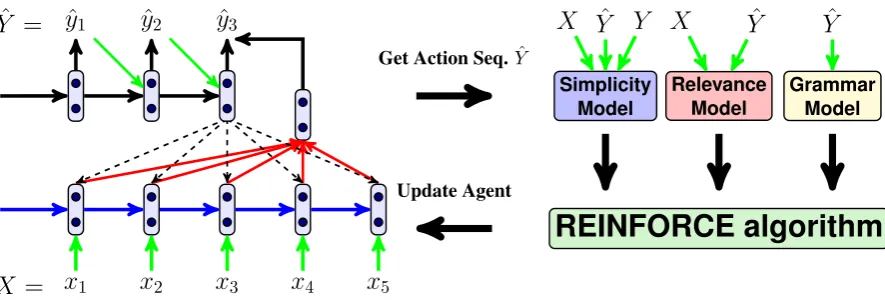
The encoder-decoder model has two parts (see left hand side in Figure 1). The encoder trans-forms the source sentence X into a sequence of hidden states (hS
1,hS2, . . . ,hS|X|) with a Long
Short-Term Memory Network (LSTM;Hochreiter and Schmidhuber 1997), while the decoder uses another LSTM to generate one wordyt+1at a time
in the simplified target Y. Generation is condi-tioned on all previously generated wordsy1:t and
a dynamically created context vectorct, which
en-codes the source sentence:
P(Y|X) = |Y|
Y
t=1
P(yt|y1:t−1, X) (1)
P(yt+1|y1:t, X) =softmax(g(hTt,ct)) (2)
where g(·) is a one-hidden-layer neural network with the following parametrization:
g(hT
t,ct) =Wotanh(UhhTt +Whct) (3)
where Wo ∈ R|V|×d, Uh ∈ Rd×d, and Wh ∈
Rd×d;|V|is the output vocabulary size anddthe
hidden unit size. hT
t is the hidden state of the
de-coder LSTM which summarizesy1:t, i.e., what has
been generated so far:
hT
t =LSTM(yt,hTt−1) (4)
The dynamic context vectorctis the weighted sum
of the hidden states of the source sentence:
ct= |X|
X
i=1
whose weightsαtiare determined by anattention
mechanism:
αti= exp(h T t ·hSi)
P
iexp(hTt ·hSi) (6)
where · is the dot product between two vec-tors. We use the dot product here mainly for ef-ficiency reasons; alternative ways to compute at-tention scores have been proposed in the litera-ture and we refer the interested reader to Luong et al.(2015). The model sketched above is usually trained by minimizing the negative log-likelihood of the training source-target pairs.
3 Reinforcement Learning for Sentence Simplification
In this section we present DRESS, our Deep
REinforcement Sentence Simplification model. Despite successful application in numerous se-quence transduction tasks (Jean et al., 2015; Chopra et al., 2016; Xu et al., 2015a), a vanilla encoder-decoder model is not ideal for sentence simplification. Although a number of rewrite oper-ations (e.g., copying, deletion, substitution, word reordering) can be used to simplify text, copy-ing is by far the most common. We empirically found that 73% of the target words are copied from the source in the Newsela dataset. This num-ber further increases to 83% when considering Wikipedia-based datasets (we provide details on these datasets in Section5). As a result, a generic encoder-decoder model learns to copy all too well at the expense of other rewrite operations, often parroting back the source or making only a few trivial changes.
To encourage a wider variety of rewrite oper-ations while remaining fluent and faithful to the meaning of the source, we employ a reinforce-ment learning framework (see Figure1). We view the encoder-decoder model as an agent which first reads the source sentenceX; then at each step, it takes an actionyˆt∈V (whereV is the output
vo-cabulary) according to a policyPRL( ˆyt|y1:ˆ t−1, X)
(see Equation (2)). The agent continues to take actions until it produces an End Of Sentence (EOS) token yielding the action sequence Yˆ = (ˆy1,yˆ2, . . . ,yˆ|Yˆ|), which is also the simplified
out-put of our model. A reward r is then received and the REINFORCE algorithm (Williams,1992) is used to update the agent. In the following, we first introduce our reward and then present the de-tails of the REINFORCE algorithm.
3.1 Reward
The reward r( ˆY) for system output Yˆ is the weighted sum of the three components aimed at capturing key aspects of the target output, namely simplicity, relevance, and fluency:
r( ˆY) =λSrS+λRrR+λFrF (7)
whereλS, λR, λF ∈[0,1];r( ˆY)is a shorthand for
r(X, Y,Yˆ)whereXis the source,Y the reference (or target), andYˆ the system output. rS,rR, and
rF are shorthands for simplicityrS(X, Y,Yˆ),
rel-evancerR(X,Yˆ), and fluencyrF( ˆY). We provide
details for each reward summand below.
Simplicity To encourage the model to apply a wide range of simplification operations, we use SARI (Xu et al., 2016), a recently proposed metric which compares System output Against References and against theInput sentence. SARI is the arithmetic average of n-gram precision and recall of three rewrite operations: addition, copy-ing, and deletion. It rewards addition operations where system output was not in the input but oc-curred in the references. Analogously, it rewards words retained/deleted in both the system output and the references. In experimental evaluationXu et al.(2016) demonstrate that SARI correlates well with human judgments of simplicity, whilst cor-rectly rewarding systems that both make changes and simplify the input.
X
=
x
1x
2x
3x
4x
5ˆ
Y
= ˆ
y
1y
ˆ
2y
ˆ
3Get Action Seq.Yˆ
Update Agent
Simplicity
Model RelevanceModel GrammarModel
REINFORCE algorithm
ˆ
Y
X
Y
ˆ
[image:4.595.78.521.62.212.2]X
Y Y
ˆ
Figure 1: Deep reinforcement learning simplification model.Xis the complex sentence,Y the reference (simple) sentence andYˆ the action sequence (simplification) produced by the encoder-decoder model.
and the reference, reverse SARI can be used to es-timate how good a reference is with respect to the system output. Our first reward is therefore the weighted sum of SARI and reverse SARI:
rS=βSARI(X,Y , Yˆ )+(1−β)SARI(X, Y,Yˆ) (8)
Relevance While the simplicity-based re-ward rS tries to encourage the model to make
changes, the relevance rewardrRensures that the
generated sentences preserve the meaning of the source. We use an LSTM sentence encoder to convert the source X and the predicted target Yˆ
into two vectors qX and qYˆ. The relevance
rewardrRis simply the cosine similarity between
these two vectors:
rR= cos(qX,qYˆ) = ||qqX ·qYˆ
X|| ||qYˆ|| (9)
We use a sequence auto-encoder (SAE;Dai and Le 2015) to train the LSTM sentence encoder on both the complex and simple sentences. Specifi-cally, the SAE uses sentenceX = (x1, . . . , x|X|)
to infer itself via an encoder-decoder model (with-out an attention mechanism). Firstly, an encoder LSTM convertsXinto a sequence of hidden states
(h1, . . . ,h|X|). Then, we use h|X| to initialize
the hidden state of the decoder LSTM and re-cover/generateXone word at a time.
Fluency Xu et al.(2016) observe that SARI cor-relates less with fluency compared to other met-rics such as BLEU (Papineni et al., 2002). The fluency rewardrF models the well-formedness of
the generated sentences explicitly. It is the normal-ized sentence probability assigned by an LSTM
language model trained on simple sentences:
rF = exp
1
|Yˆ|
|Yˆ|
X
i=1
logPLM(ˆyi|yˆ0:i−1)
(10)
We take the exponential of Yˆ’s perplexity to en-sure thatrF ∈[0,1]as is the case withrSandrR.
3.2 The REINFORCE Algorithm
The goal of the REINFORCE algorithm is to find an agent that maximizes the expected reward. The training loss for one sequence is its negative ex-pected reward:
L(θ) =−E(ˆy1,...,yˆ|Yˆ|)∼PRL(·|X)[r(ˆy1, . . .,yˆ|Yˆ|)]
wherePRLis our policy, i.e., the distribution
pro-duced by the encoder-decoder model (see Equa-tion(2)) andr(·) is the reward function of an ac-tion sequence Yˆ = (ˆy1, . . . ,yˆ|Yˆ|), i.e., a
gener-ated simplification. Unfortunately, computing the expectation term is prohibitive, since there is an infinite number of possible action sequences. In practice, we approximate this expectation with a single sample from the distribution ofPLR(·|X).
We refer toWilliams(1992) for the full derivation of the gradients. The gradient ofL(θ)is:
∇L(θ)≈
P|Yˆ|
t=1∇logPRL(ˆyt|yˆ1:t−1, X)[r(ˆy1:|Yˆ|)−bt]
To reduce the variance of gradients, we also intro-duce a baseline linear regression model bt to
es-timate the expected future reward at timet( Ran-zato et al.,2016).bttakes the concatenation ofhTt
andctas input and outputs a real value as the
trained by minimizing mean squared error. We do not back-propagate this error to hT
t orct during
training (Ranzato et al.,2016).
3.3 Learning
Presented in its original form, the REINFORCE algorithm starts learning with a random policy. This assumption can make model training chal-lenging for generation tasks like ours with large vocabularies (i.e., action spaces). We address this issue by pre-training our agent (i.e., the encoder-decoder model) with a negative log-likelihood ob-jective (see Section 2), making sure it can pro-duce reasonable simplifications, thereby starting off with a policy which is better than random. We follow prior work (Ranzato et al., 2016) in adopting a curriculum learning strategy. In the be-ginning of training, we give little freedom to our agent allowing it to predict the last few words for each target sentence. For every target sequence, we use negative log-likelihood to train the firstL
(initially,L= 24) tokens and apply the reinforce-ment learning algorithm to the (L+ 1)th tokens onwards. Every two epochs, we set L=L−3
and the training terminates whenLis 0.
4 Lexical Simplification
Lexical substitution, the replacement of complex words with simpler alternatives, is an integral part of sentence simplification (Specia et al., 2012). The model presented so far learns lexical substitu-tion and other rewrite operasubstitu-tionsjointly. In some cases, words are predicted because they seem nat-ural in the their context, but are poor substitutes for the content of the complex sentence. To coun-tenance this, we learn lexical simplifications ex-plicitlyand integrate them with our reinforcement learning-based model.
We use an pre-trained encoder-decoder model (which is trained on a parallel corpus of com-plex and simple sentences) to obtain probabilis-tic word alignments, aka attention scores (see αt
in Equation (6)). LetX = (x1, x2, . . . , x|X|)
de-note a source sentence andY = (y1, y2, . . . , y|Y|)
a target sentence. We convertX into |X|hidden states(v1,v2, . . . ,v|X|)with an LSTM. Note that
vt∈Rd×1 corresponds to the context dependent
representation ofxt. Letαtdenote the alignment
scoresαt1, αt2, . . . , αt|X|. The lexical
simplifica-tion probability of yt given the source sentence
and the alignment scores is:
PLS(yt|X, αt) =softmax(Wlst) (11)
whereWl∈R|V|×dandstrepresents the source:
st= |X|
X
i=1
αtivi (12)
The lexical simplification model on its own encourages lexical substitutions, without taking into account what has been generated so far (i.e.,y1:t−1) and as a result fluency could be
com-promised. A straightforward solution is to inte-grate lexical simplification with our reinforcement learning trained model (Section3) using linear in-terpolation, whereη∈[0,1]:
P(yt|y1:t−1, X) = (1−η)PRL(yt|y1:t−1, X) +η PLS(yt|X, αt) (13)
5 Experimental Setup
In this section we present our experimental setup for assessing the performance of the simplification model described above. We give details on our datasets, model training, evaluation protocol, and the systems used for comparison.
Datasets We conducted experiments on three simplification datasets. WikiSmall (Zhu et al., 2010) is a parallel corpus which has been exten-sively used as a benchmark for evaluating text sim-plification systems (Wubben et al., 2012; Wood-send and Lapata, 2011; Narayan and Gardent, 2014;Zhu et al.,2010). It contains automatically aligned complex and simple sentences from the or-dinary and simple English Wikipedias. The test set consists of 100 complex-simple sentence pairs. The training set contains 89,042 sentence pairs (after removing duplicates and test sentences). We randomly sampled 205 pairs for development and used the remaining sentences for training.
contains 8 (reference) simplifications for 2,359 sentences partitioned into 2,000 for development and 359 for testing. After removing duplicates and sentences in development and test sets, the result-ing trainresult-ing set contains 296,402 sentence pairs.
Our third dataset is Newsela, a corpus collated by Xu et al. (2015b) who argue that Wikipedia-based resources are suboptimal due to the auto-matic sentence alignment which unavoidably in-troduces errors, and their uniform writing style which leads to systems that generalize poorly. Newsela2consists of 1,130 news articles, each
re-written four times by professional editors for chil-dren at different grade levels (0 is the most com-plex level and 4 is simplest).Xu et al.(2015b) pro-vide multiple aligned complex-simple pairs within each article. We removed sentence pairs corre-sponding to levels 0–1, 1–2, and 2–3, since they were too similar to each other. The first 1,070 documents were used for training (94,208 sen-tence pairs), the next 30 documents for develop-ment (1,129 sentence pairs) and the last 30 docu-ments for testing (1,076 sentence pairs).3 We are
not aware of any published results on this dataset. Training Details We trained our models on an Nvidia GPU card. We used the same hyper-parameters across datasets. We first trained an encoder-decoder model, and then performed re-inforcement learning training (Section 3), and trained the lexical simplification model (Sec-tion 4). Encoder-decoder parameters were uni-formly initialized to [−0.1,0.1]. We used Adam (Kingma and Ba,2014) to optimize the model with learning rate 0.001; the first momentum coefficient was set to 0.9 and the second momentum coeffi-cient to 0.999. The gradient was rescaled when the norm exceeded 5 (Pascanu et al.,2013). Both encoder and decoder LSTMs have two layers with 256 hidden neurons in each layer. We regularized all LSTMs with a dropout rate of 0.2 (Zaremba et al., 2014). We initialized the encoder and de-coder word embedding matrices with 300 dimen-sional Glove vectors (Pennington et al.,2014).
During reinforcement training, we used plain stochastic gradient descent with a learning rate of 0.01. We set β = 0.1, λS = 1, λR = 0.25
and λF = 0.5.4 Training details for the lexical
2https://newsela.com
3If a sentence has multiple references in the development or test set, we use the reference with highest simplicity level. 4Weights were tuned on the development set of the Newsela dataset and kept fixed for the other two datasets.
simplification model are identical to the encoder-decoder model except that word embedding matri-ces were randomly initialized. The weight of the lexical simplification model was set toη= 0.1.
To reduce vocabulary size, named entities were tagged with the Stanford CoreNLP (Manning et al., 2014) and anonymized with a NE@N to-ken, where NE ∈ {PER,LOC,ORG,MISC} and
N indicates NE@N is theN-th distinct NE typed entity. For example, “John and Bob are . . . ” be-comes “PER@1 and PER@2 are . . . ”. At test time, we de-anonymize NE@N tokens in the out-put by looking them up in their source sentences. Note that the de-anonymization may fail, but the chance is small (around 2% of the time on the Newsela development set). We replaced words oc-curring three times or less in the training set with UNK. At test time, when our models predict UNK, we adopt the UNK replacement method proposed inJean et al.(2015).
Evaluation Following previous work ( Wood-send and Lapata, 2011;Xu et al., 2016) we eval-uated system output automatically adopting met-rics widely used in the simplification literature. Specifically, we used BLEU5 (Papineni et al.,
2002) to assess the degree to which generated simplifications differed from gold standard refer-ences and the Flesch-Kincaid Grade Level index (FKGL;Kincaid et al. 1975) to measure the read-ability of the output (lower FKGL6 implies
sim-pler output). In addition, we used SARI (Xu et al., 2016), which evaluates the quality of the output by comparing it against the source and reference simplifications.7 BLEU, FKGL, and SARI are
all measured at corpus-level. We also evaluated system output by eliciting human judgments via Amazon’s Mechanical Turk. Specifically (self-reported) native English speakers were asked to rate simplifications on three dimensions: Fluency (is the output grammatical and well formed?), Ad-equacy(to what extent is the meaning expressed in the original sentence preserved in the output?) and Simplicity(is the output simpler than the original sentence?). All ratings were obtained using a five point Likert scale.
Comparison Systems We compared our model against several systems previously proposed in the literature. These include PBMT-R, a
mono-5With the defaultmtevalv13a.plsettings.
Newsela BLEU FKGL SARI PBMT-R 18.19 7.59 15.77 Hybrid 14.46 4.01 30.00 EncDecA 21.70 5.11 24.12 DRESS 23.21 4.13 27.37
DRESS-LS 24.30 4.21 26.63
WikiSmall BLEU FKGL SARI PBMT-R 46.31 11.42 15.97 Hybrid 53.94 9.20 30.46 EncDecA 47.93 11.35 13.61 DRESS 34.53 7.48 27.48
DRESS-LS 36.32 7.55 27.24
[image:7.595.316.519.60.269.2]WikiLarge BLEU FKGL SARI PBMT-R 81.11 8.33 38.56 Hybrid 48.97 4.56 31.40 SBMT-SARI 73.08 7.29 39.96 EncDecA 88.85 8.41 35.66 DRESS 77.18 6.58 37.08 DRESS-LS 80.12 6.62 37.27
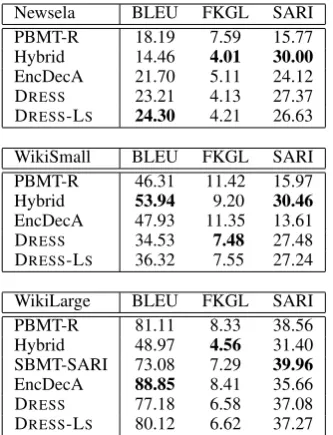
Table 1: Automatic evaluation on Newsela, Wik-iSmall, and WikiLarge test sets.
lingual phrase-based machine translation system with a reranking post-processing step8 (Wubben
et al., 2012) and Hybrid, a model which first performs sentence splitting and deletion opera-tions over discourse representation structures and then further simplifies sentences with PBMT-R (Narayan and Gardent, 2014). Hybrid9 is state
of the art on the WikiSmall dataset. Compar-isons with SBMT-SARI, a syntax-based transla-tion model trained on PPDB (Ganitkevitch et al., 2013) and tuned with SARI (Xu et al.,2016), are problematic due to the size of PPDB which is con-siderably larger than any of the datasets used in this work (it contains 106 million sentence pairs with 2 billion words). Nevertheless, we compare10
against SBMT-SARI, but only models trained on Wikilarge, our largest dataset.
6 Results
Since Newsela contains high quality simplifica-tions created by professional editors, we per-formed the bulk of our experiments on this dataset. Specifically, we set out to answer two ques-tions: (a) which neural model performs best and (b) how do neural models which are resource lean and do not have access to linguistic annotations fare against more traditional systems. We there-fore compared the basic attention-based encoder-8We made a good-faith effort to re-implement their sys-tem following closely the details inWubben et al.(2012).
9We are grateful to Shashi Narayan for running his system on our three datasets.
10The output of SBMT-SARI is publicly available.
Newsela Fluency Adequacy Simplicity All PBMT-R 3.56 3.58∗∗ 2.09∗∗ 3.08∗∗ Hybrid 2.70∗∗ 2.51∗∗ 2.99 2.73∗∗ EncDecA 3.63 2.99 2.56∗∗ 3.06∗∗
DRESS 3.65 2.94 3.10 3.23
DRESS-LS 3.71 3.07 3.04 3.28
Reference 3.90 2.81∗∗ 3.42∗∗ 3.38 WikiSmall Fluency Adequacy Simplicity All PBMT-R 3.91 3.74∗∗ 2.80∗∗ 3.48∗ Hybrid 3.26∗∗ 3.42 2.82∗∗ 3.17∗∗ DRESS-LS 3.92 3.36 3.55 3.61
Reference 3.74∗ 3.34 3.13∗∗ 3.41∗∗ WikiLarge Fluency Adequacy Simplicity All PBMT-R 3.68 3.63∗ 2.70∗∗ 3.34∗ Hybrid 2.60∗∗ 2.42∗∗ 3.52 2.85∗∗ SBMT-SARI 3.34∗∗ 3.51∗ 2.77∗∗ 3.21∗∗ DRESS-LS 3.70 3.28 3.42 3.46 Reference 3.79 3.72∗∗ 2.86∗∗ 3.46 Table 2: Mean ratings elicited by humans on Newsela, WikiSmall, and WkiLarge test sets. Rat-ings significantly different from DRESS-LS are marked with * (p <0.05) and ** (p <0.01). Sig-nificance tests were performed using a student
t-test.
decoder model (EncDecA), with the deep rein-forcement learning model (DRESS; Section 3), and a linear combination of DRESSand the lexi-cal simplification model (DRESS-LS; Section 4). Neural models were further compared against two strong baselines, PBMT-R and Hybrid. Ta-ble3 shows example output of all models on the Newsela dataset.
The top block in Table1summarizes the results of our automatic evaluation. As can be seen, all neural models obtain higher BLEU, lower FKGL and higher SARI compared to PBMT-R. Hybrid has the lowest FKGL and highest SARI. Com-pared to EncDecA, DRESSscores lower on FKGL and higher on SARI, which indicates that the model has indeed learned to optimize the reward function which includes SARI. Integrating lexical simplification (DRESS-LS) yields better BLEU, but slightly worse FKGL and SARI.
[image:7.595.99.266.61.279.2]Complex There’s just one major hitch: the primary purpose of education is to develop citizens with a wide variety of skills.
Reference The purpose of education is to develop a wide range of skills.
PBMT-R It’s just one major hitch: the purpose of education is tomake people with a wide variety of skills.
Hybrid one hitch the purpose is to develop citizens.
EncDecA Thekeyof education is to developpeoplewith a wide variety of skills.
DRESS There’s just one major hitch: themain goalof education is to develop peoplewith
lots ofskills.
DRESS-LS There’s just one major hitch: themain goalof education is to develop citizens with
lots ofskills.
Complex “They were so burdened by the past they couldn’t think about the future,” said Barnet, 62, who was president of Columbia Records, the No.1 record label in the United States, before joining Capitol.
Reference Capitol was stuck in the past. It could not think about the future, Barnett said. PBMT-R “They were soaffectedby the past they couldn’t think about the future,” said Barnett,
62, was president of Columbia Records, before joining Capitolbuilding.
Hybrid ‘They were so burdened by the past they couldn’t think about the future,” said Barnett, 62, who was Columbia Records, president of the No.1 record label in the united states, before joining Capitol.
EncDecA “They were so burdened by the past they couldn’t think about the future,” said Bar-nett, who was president of Columbia Records, the No.1 record labels in the United States.
DRESS “They were sosickerby the past they couldn’t think about the future,” said Barnett, who was president of Columbia Records.
DRESS-LS “They were so burdened by the past they couldn’t think about the future,” said Bar-nett, who was president of Columbia Records.
Table 3: System output for two sentences (Newsela development set). Substitutions are shown in bold.
Hybrid on Fluency, Simplicity, and overall. The fact that neural models (EncDecA, DRESS and DRESS-LS) fare well on Fluency, is perhaps not surprising given the recent success of LSTMs in language modeling and neural machine translation (Zaremba et al.,2014;Jean et al.,2015).
Neural models obtain worse ratings on Ade-quacy but are closest to the human references on this dimension. DRESS-LS (and DRESS) are sig-nificantly better (p < 0.01) on Simplicity than EncDecA, PBMT-R, and Hybrid which indicates that our reinforcement learning based model is ef-fective at creating simpler output. Combined rat-ings (All) for DRESS-LSare significantly different compared to the other models but not to DRESS and the Reference. Nevertheless, integration of the lexical simplification model boosts performance as ratings increase almost across the board (Sim-plicity is slightly worse). Returning to our origi-nal questions, we find that neural models are more fluent than comparison systems, while perform-ing non-trivial rewrite operations (see the SARI
scores in Table1) which yield simpler output (see the Simplicity column in Table2). Based on our judgment elicitation study, neural models trained with reinforcement learning perform best, with DRESS-LShaving a slight advantage.
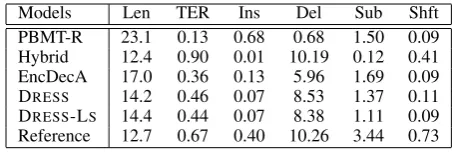
We further analyzed model performance by computing various statistics on the simplified out-put. We measured average sentence length and the degree to which DRESSand comparison sys-tems perform rewriting operations. We approxi-mated the latter with Translation Error Rate (TER; Snover et al. 2006), a measure commonly used to automatically evaluate the quality of machine translation output. We used TER to compute the (average) number of edits required to change an original complex sentence to simpler output. We also report the number of edits by type, i.e., the number of insertions, substitutions, deletions, and shifts needed (on average) to convert complex to simple sentences.
Models Len TER Ins Del Sub Shft PBMT-R 23.1 0.13 0.68 0.68 1.50 0.09 Hybrid 12.4 0.90 0.01 10.19 0.12 0.41 EncDecA 17.0 0.36 0.13 5.96 1.69 0.09 DRESS 14.2 0.46 0.07 8.53 1.37 0.11
DRESS-LS 14.4 0.44 0.07 8.38 1.11 0.09
[image:9.595.69.297.61.137.2]Reference 12.7 0.67 0.40 10.26 3.44 0.73 Table 4: Output length (average number of to-kens), TER scores and number of edits by type (Insertions, Deletions, Substitutions, Shifts) on the Newsela test set. Higher TER means that more rewriting operations are performed.
DRESS-LS), which indicates that they actively perform rewriting. Perhaps Hybrid is too ag-gressive when simplifying a sentence, it obtains low Fluency and Adequacy scores in human eval-uation (Table 2). There is a strong correlation between sentence length and number of deletion operations (i.e., more deleteions lead to shorter sentences) and PBMT-R performs very few dele-tions. Overall, reinforcement learning encourages deletion (see DRESS and DRESS-LS), while per-forming a reasonable amount of additional oper-ations (e.g., substitutions and shifts) compared to EncDecA and PBMT-R.
The middle blocks in Tables1and2report re-sults on the WikiSmall dataset. FKGL and SARI follow a similar pattern as on Newsela. BLEU scores for PBMT-R, Hybrid, and EncDecA are much higher compared to DRESSand DRESS-LS. Hybrid obtains best BLEU and SARI scores, while DRESS and DRESS-LS do very well on FKGL. In human evaluation, we elicited judgments on the entire WikiSmall test set (100 sentences). We compared DRESS-LS, with PBMT-R, Hybrid, and gold standard Reference simplifications. As hu-man experiments are time consuming and ex-pensive, we did not include other neural models besides DRESS-LS based on our Newsela study which showed that EncDecA is inferior to vari-ants trained with reinforcement learning and that DRESS-LS is the better performing model (how-ever, we do compare all models in Table 1). DRESS-LS is significantly better on Simplicity than PBMT-R, Hybrid, and the Reference. It per-forms on par with PBMT-R on Fluency and worse on Adequacy (but still closer to the human Ref-erence than PBMT-R or Hybrid). When combin-ing all ratcombin-ings (All in Table2), DRESS-LS is sig-nificantly better than PBMT-R, Hybrid, and the Reference.
The bottom blocks in Tables1 and2report re-sults on Wikilarge. We compared our models with PBMT-R, Hybrid, and SBMT-SARI (Xu et al., 2016). The FKGL follows a similar pattern as in the previous datasets. PBMT-R and our mod-els are best in terms of BLEU while SBMT-SARI outperforms all other systems on SARI.11Because
there are 8 references for each complex sentence in the test set, BLEU scores are much higher com-pared to Newsela and WikiSmall. In human eval-uation, we again elicited judgments for 100 ran-domly sampled test sentences. We ranran-domly se-lected one of the 8 references as the Reference upper bound. On Simplicity, DRESS-LS is sig-nificantly better than all comparison systems, ex-cept Hybrid. On Adequacy, it is better than Hybrid but significantly worse than other comparison sys-tems. On Fluency, it is on par with PBMT-R12but
better than Hybrid and SBMT-SARI. On All di-mension DRESS-LS significantly outperforms all comparison systems.
7 Conclusions
We developed a reinforcement learning-based text simplification model, which can jointly model simplicity, grammaticality, and semantic fidelity to the input. We also proposed a lexical simplifi-cation component that further boosts performance. Overall, we find that reinforcement learning of-fers a great means to inject prior knowledge to the simplification task achieving good results across three datasets. In the future, we would like to ex-plicitly model sentence splitting and simplify en-tire documents (rather than individual sentences). Beyond sentence simplification, the reinforcement learning framework presented here is potentially applicable to generation tasks such as sentence compression (Chopra et al., 2016), generation of programming code (Ling et al., 2016), or poems (Zhang and Lapata,2014).
Acknowledgments We would like to thank Li Dong, Jianpeng Cheng, Shashi Narayan and the EMNLP reviewers for their valuable feedback. We are also grateful to Shashi Narayan for supplying us with the output of his system and Wei Xu for her help with this work. The authors acknowledge the support of the European Research Council (award number 681760).
11BLEU and SARI scores reported inXu et al.(2016) are 72.36 and 37.91, and measured at sentence-level.
References
Dzmitry Bahdanau, Kyunghyun Cho, and Yoshua Ben-gio. 2015. Neural machine translation by jointly learning to align and translate. In Proceedings of ICLR, San Diego, CA.
Beata Beigman Klebanov, Kevin Knight, and Daniel Marcu. 2004. Text simplification for information-seeking applications. InProceedings of ODBASE, volume 3290 ofLecture Notes in Computer Science, pages 735–747, Agia Napa, Cyprus. Springer.
J. Carroll, G. Minnen, D. Pearce, Y. Canning, S. De-vlin, and J Tait. 1999. Simplifying text for language-impaired readers. InProceedings of the 9th EACL, pages 269–270, Bergen, Norway.
R. Chandrasekar, C. Doran, and B. Srinivas. 1996. Mo-tivations and methods for text simplification. In Pro-ceedings of the 16th COLING, pages 1041–1044, Copenhagen, Denmark.
Sumit Chopra, Michael Auli, and Alexander M. Rush. 2016. Abstractive sentence summarization with at-tentive recurrent neural networks. InProceedings of NAACL: HLT, pages 93–98, San Diego, CA.
James Curran, Stephen Clark, and Johan Bos. 2007. Linguistically motivated large-scale nlp with c&c and boxer. In Proceedings of the 45th ACL Com-panion Volume Proceedings of the Demo and Poster Sessions, pages 33–36, Prague, Czech Republic.
Andrew M Dai and Quoc V Le. 2015. Semi-supervised sequence learning. InAdvances in Neural Informa-tion Processing Systems, pages 3079–3087.
Siobhan Devlin. 1999. Simplifying Natural Language for Aphasic Readers. Ph.D. thesis, University of Sunderland.
Richard Evans, Constantin Or asan, and Iustin Dor-nescu. 2014. An evaluation of syntactic simplifica-tion rules for people with autism. InProceedings of the 3rd Workshop on Predicting and Improving Text Readability for Target Reader Populations (PITR), pages 131–140, Gothenburg, Sweden.
Juri Ganitkevitch, Benjamin Van Durme, and Chris Callison-Burch. 2013. PPDB: The paraphrase database. In Proceedings of NAACL-HLT, pages 758–764, Atlanta, GA.
Sepp Hochreiter and J¨urgen Schmidhuber. 1997. Long short-term memory. Neural computation, 9(8):1735–1780.
Kentaro Inui, Atsushi Fujita, Tetsuro Takahashi, Ryu Iida, and Tomoya Iwakura. 2003. Text simplifica-tion for reading assistance: A project note. In Pro-ceedings of the 2nd International Workshop on Para-phrasing, pages 9–16, Sapporo, Japan.
S´ebastien Jean, Orhan Firat, Kyunghyun Cho, Roland Memisevic, and Yoshua Bengio. 2015. Montreal neural machine translation systems for WMT15. In Proceedings of the 10th Workshop on Statistical Ma-chine Translation, pages 134–140, Lisbon, Portugal. Nobuhiro Kaji, Daisuke Kawahara, Sadao Kurohashi, and Satoshi Sato. 2002. Verb paraphrase based on case frame alignment. InProceedings of 40th ACL, pages 215–222, Philadelphia, PA.
David Kauchak. 2013. Improving text simplification language modeling using unsimplified text data. In Proceedings of the 51st ACL, pages 1537–1546, Sofia, Bulgaria.
J Peter Kincaid, Robert P Fishburne Jr, Richard L Rogers, and Brad S Chissom. 1975. Derivation of new readability formulas (automated readability in-dex, fog count and flesch reading ease formula) for navy enlisted personnel. Technical report, DTIC Document.
Diederik Kingma and Jimmy Ba. 2014. Adam: A method for stochastic optimization. arXiv preprint arXiv:1412.6980.
Jiwei Li, Will Monroe, Alan Ritter, Dan Jurafsky, Michel Galley, and Jianfeng Gao. 2016. Deep re-inforcement learning for dialogue generation. In Proceedings of the 2016 EMNLP, pages 1192–1202, Austin, TX.
Wang Ling, Phil Blunsom, Edward Grefenstette, Karl Moritz Hermann, Tom´aˇs Koˇcisk´y, Fumin Wang, and Andrew Senior. 2016. Latent predictor networks for code generation. InProceedings of the 54th ACL, pages 599–609, Berlin, Germany. Thang Luong, Hieu Pham, and Christopher D.
Man-ning. 2015. Effective approaches to attention-based neural machine translation. In Proceedings of the 2015 EMNLP, pages 1412–1421, Lisbon, Portugal. Christopher D. Manning, Mihai Surdeanu, John Bauer,
Jenny Finkel, Steven J. Bethard, and David Mc-Closky. 2014. The Stanford CoreNLP natural lan-guage processing toolkit. InACL System Demon-strations, pages 55–60.
Karthik Narasimhan, Adam Yala, and Regina Barzilay. 2016. Improving information extraction by acquir-ing external evidence with reinforcement learnacquir-ing. In Proceedings of the 2016 EMNLP, pages 2355– 2365, Austin, TX.
Shashi Narayan and Claire Gardent. 2014. Hybrid sim-plification using deep semantics and machine trans-lation. InProceedings of the 52nd ACL, pages 435– 445, Baltimore, MD.
Razvan Pascanu, Tomas Mikolov, and Yoshua Bengio. 2013. On the difficulty of training recurrent neural networks. ICML (3), 28:1310–1318.
Jeffrey Pennington, Richard Socher, and Christopher D Manning. 2014. Glove: Global vectors for word representation. In In Proceedings of the EMNLP 2014, volume 14, pages 1532–43, Doha, Qatar. MarcAurelio Ranzato, Sumit Chopra, Michael Auli,
and Wojciech Zaremba. 2016. Sequence level train-ing with recurrent neural networks. InProceedings of ICLR, San Juan, Puerto Rico.
Luz Rello, Clara Bayarri, Azuki G´orriz, Ricardo Baeza-Yates, Saurabh Gupta, Gaurang Kanvinde, Horacio Saggion, Stefan Bott, Roberto Carlini, and Vasile Topac. 2013. Dyswebxia 2.0!: More acces-sible text for people with dyslexia. InProceedings of the 10th International Cross-Disciplinary Confer-ence on Web Accessibility, pages –, Brazil.
Seonggi Ryang and Takeshi Abekawa. 2012. Frame-work of automatic text summarization using rein-forcement learning. In Proceedings of the 2012 EMNLP-CoNLL, pages 256–265, Jeju Island, Korea. Matthew Shardlow. 2014. A survey of automated text simplification. International Journal of Advanced Computer Science and Applications, pages 581– 701. Special Issue on Natural Language Processing. Advaith Siddharthan. 2004. Syntactic simplification and text cohesion. in research on language and com-putation. Research on Language and Computation, 4(1):77–109.
Advaith Siddharthan. 2014. A survey of research on text simplification.International Journal of Applied Linguistics, 165(2):259–298.
David A Smith and Jason Eisner. 2006. Quasi-synchronous grammars: Alignment by soft projec-tion of syntactic dependencies. In Proceedings of the NAACL 206 Workshop on Statistical Machine Translation, pages 23–30, New York City.
Matthew Snover, Bonnie Dorr, Richard Schwartz, Lin-nea Micciulla, and John Makhoul. 2006. A study of translation edit rate with targeted human annotation. In Proceedings of association for machine transla-tion in the Americas, volume 200.
Lucia Specia, Sujay Kumar Jauhar, and Rada Mihalcea. 2012. Semeval-2012 task 1: English lexical simpli-fication. In In Proceedings of *SEM 2012, pages 347–355, Montr´eal, Canada.
Ilya Sutskever, Oriol Vinyals, and Quoc V Le. 2014. Sequence to sequence learning with neural net-works. InAdvances in Neural Information Process-ing Systems, pages 3104–3112.
D. Vickrey and D. Koller. 2008. Sentence simplifica-tion for semantic role labeling. In Proceedings of ACL-08: HLT, pages 344–352, Columbus, OH.
Willian Massami Watanabe, Arnaldo Candido Junior, Vin´ıcius Rodriguez de Uz˜eda, Renata Pontin de Mattos Fortes, Thiago Alexandre Salgueiro Pardo, and Sandra Maria Alu´sio. 2009. Facilita: reading assistance for low-literacy readers. InProceedings of the 27th ACM International Conference on De-sign of Communication, Bloomington, IN.
Ronald J Williams. 1992. Simple statistical gradient-following algorithms for connectionist reinforce-ment learning. Machine learning, 8(3-4):229–256. Kristian Woodsend and Mirella Lapata. 2011.
Learn-ing to simplify sentences with quasi-synchronous grammar and integer programming. InProceedings of the 2011 EMNLP, pages 409–420, Edinburgh, Scotland.
Kristian Woodsend and Mirella Lapata. 2014. Text rewriting improves semantic role labeling. Journal of Artificial Intelligence Research, 51:133–164. Sander Wubben, Antal Van Den Bosch, and Emiel
Krahmer. 2012. Sentence simplification by mono-lingual machine translation. InProceedings of the 50th ACL, pages 1015–1024, Jeju Island, Korea. Kelvin Xu, Jimmy Ba, Ryan Kiros, Kyunghyun Cho,
Aaron Courville, Ruslan Salakhutdinov, Richard S Zemel, and Yoshua Bengio. 2015a. Show, attend and tell: Neural image caption generation with vi-sual attention. arXiv preprint arXiv:1502.03044, 2(3):5.
Wei Xu, Chris Callison-Burch, and Courtney Napoles. 2015b. Problems in current text simplification re-search: New data can help. Transactions of the As-sociation for Computational Linguistics, 3:283–297. Wei Xu, Courtney Napoles, Ellie Pavlick, Quanze Chen, and Chris Callison-Burch. 2016. Optimizing statistical machine translation for text simplification. Transactions of the Association for Computational Linguistics, 4:401–415.
Kenji Yamada and Kevin Knight. 2001. A syntax-based statistical translation model. InProceedings of the 39th ACL, pages 523–530, Toulouse, France. Wojciech Zaremba, Ilya Sutskever, and Oriol Vinyals.
2014. Recurrent neural network regularization. arXiv preprint arXiv:1409.2329.
Xingxing Zhang and Mirella Lapata. 2014. Chinese poetry generation with recurrent neural networks. In Proceedings of the 2014 EMNLP, pages 670–680, Doha, Qatar.