Connotation Frames of Power and Agency in Modern Films
Maarten Sap Marcella Cindy Prasetio Ari Holtzman
Hannah Rashkin Yejin Choi
Paul G. Allen School of Computer Science & Engineering University of Washington, Seattle, USA
{msap,mcp21,ahai,hrashkin,yejin}@cs.washington.edu
Abstract
The framing of an action influences how we perceive its actor. We introduce conno-tation frames ofpowerandagency, a prag-matic formalism organized using frame se-mantic representations, to model how dif-ferent levels of power and agency are im-plicitly projected on actors through their actions. We use the new power and agency frames to measure the subtle, but prevalent, gender bias in the portrayal of modern film characters and provide in-sights that deviate from the well-known Bechdel test. Our contributions include an extended lexicon of connotation frames along with a web interface that provides a comprehensive analysis through the lens of connotation frames.
1 Introduction
A viewer’s impression of a movie character is in-fluenced by how they are written and portrayed, which can in turn influence how people form stereotypes on gender norms (Behm-Morawitz and Mastro,2008). A character’s actions can be projected with varying levels of power and agency, depending on the specific verbs used. For instance, somebody who “accepts” things is implied to be a passive decision-maker (or of lower agency) than somebody who “assesses” things. While not ex-plicitly stated, these connotative meanings pro-jected by different verbs can influence the assump-tions the audience makes about the people being described. These assumptions can have negative consequences if they reinforce negative stereo-types (Walton and Spencer,2009).
To formalize this implicit information about people projected by actions, we introducepower
andagencyconnotation frames, two new types of
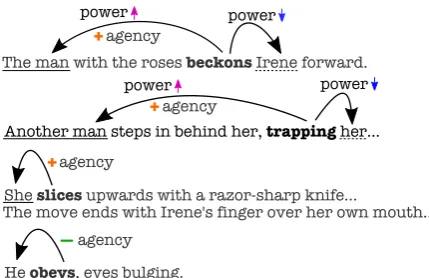
The man with the roses beckons Irene forward. agency
Another man steps in behind her, trapping her...
She slices upwards with a razor-sharp knife...
The move ends with Irene's finger over her own mouth...
He obeys, eyes bulging. agency
agency
agency
power
+ power
+
+
power
—
[image:1.595.308.523.220.359.2]power
Figure 1: An excerpt from a box-office hit, Sher-lock Holmes(2009). Boldedwords are the predi-cates, solid underlined phrases are the agent of the verb, and dash underlined words are the theme. The full example with additional nuanced discus-sion is available in Figure6in the appendix.
predicate-specific connotative relationships as an extension to Rashkin et al. (2016)’s connotation frame lexicon. For instance, in Figure1, the verb “beckoning” implies that its theme (Irene) has less power than its agent (the man). In the third line, Irene displays strong agency when she “slices” in self-defense. In contrast, when the man “obeys”, the man has low implied agency.
Using the new connotation lexicon, we present a quantitative study to reveal the subtle, but preva-lent gender1bias in modern films. Going beyond
the surface level analysis such as screen time or number of female characters (Google,2017), our study aims for a more focused and precise anal-ysis of power differentials between fictional men and women.
In summary, our major contributions include the creation and release of a lexicon with two new connotative dimensions:powerandagencyand an
1We acknowledge that gender lies on a spectrum, and
re-ducing it to a male-female binary is simplistic, however our data limits a more complex understanding of gender.
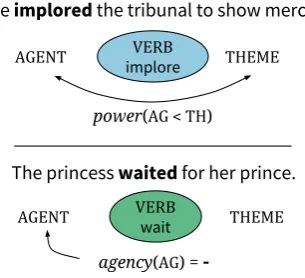
AGENT THEME
power(AG < TH) VERB implore
He implored the tribunal to show mercy.
The princess waited for her prince.
AGENT THEME
agency(AG) = -VERB
[image:2.595.308.535.62.261.2]wait
Figure 2: The formal notation of the connotation frames of power and agency. The first example shows the relative power differential implied by the verb “implored”, i.e., the agent (“he”) is in a position of less power than the theme (“the tri-bunal”). In contrast, “He demandedthe tribunal show mercy” implies that the agent has authority over the theme. The second example shows the low level of agency implied by the verb“waited”.
interactive demo website of our findings (see Fig-ure5in the appendix for a screenshot).2
Further-more, as will be seen in Section4.1, connotation frames offer new insights that complement and de-viate from the well-known Bechdel test (Bechdel,
1986). In particular, we find that high-agency women through the lens of connotation frames are rare in modern films. It is, in part, because some movies (e.g., Snow White) accidentally pass the Bechdel test and also because even movies with strong female characters are not entirely free from the deeply ingrained biases in social norms.
2 Connotation Frames of Power and Agency
We create two new connotation relations, power
andagency (examples in Figure 3), as an expan-sion of the existing connotation frame lexicons.3
Three AMT crowdworkers annotated the verbs with placeholders to avoid gender bias in the con-text (e.g., Xrescued Y; an example task is shown in the appendix in Figure7). We define the anno-tated constructs as follows:
Power Differentials Many verbs imply the au-thority levels of the agent and theme relative to
2http://homes.cs.washington.edu/˜msap/
movie-bias/.
3The lexicons and a demo are available at http://
homes.cs.washington.edu/˜msap/movie-bias/.
power(AG<TH) power(AG>TH)
[image:2.595.104.257.68.207.2]agency(AG)=− agency(AG)=+
Figure 3: Sample verbs in the connotation frames with high annotator agreement. Size is indicative of verb frequency in our corpus (bigger = more frequent), color differences are only for legibility.
one another. For example, if the agent “dom-inates” the theme (denoted as power(AG>TH)), then the agent is implied to have a level of control over the theme. Alternatively, if the agent “hon-ors” the theme (denoted aspower(AG<TH)), the writer implies that the theme is more important or authoritative. We used AMT crowdsourcing to la-bel 1700 transitive verbs for power differentials. With three annotators per verb, the inter-annotator agreement is 0.34 (Krippendorff’sα).
Agency The agency attributed to the agent of the verb denotes whether the action being described implies that the agent is powerful, decisive, and capable of pushing forward their own storyline. For example, a person who is described as “ex-periencing” things does not seem as active and de-cisive as someone who is described as “determin-ing” things. AMT workers labeled 2000 transi-tive verbs for implying high/moderate/low agency (inter-annotator agreement of 0.27). We denote high agency as agency(AG)=+, and low agency
asagency(AG)=−.
13.5% 13.7% 72.8%
0% 20% 40% 60% 80%
Theme Equal Agent
% v
erbs
Power label distribution
10.6% 11.3% 78.1%
0% 20% 40% 60% 80%
Negative Neutral Positive
% v
erbs
[image:3.595.324.511.61.130.2]Agency label distribution
Figure 4: Label distributions for power and
agencybased on the crowdsourced annotations.
and positive/negative as well as the skews in the distributions of labels (i.e. more positive than neg-ative labels, see Figure4). Note that a similar dif-ference between KA scores and soft percent agree-ment was found in our previous connotation frame work (Rashkin et al.,2016).
3 Bias in Movie Scripts
We use 772 movie scripts from (Gorinski and La-pata,2015) as a test bed to validate our new con-notation frames. Scripts have distinct structure, which allows us to easily parse narrations, dia-logues and character names.
We automatically extract 21K male/female characters, using a name-gender list4 along with
gender specific lexicons (e.g., “actor”/“actresses”, “duke”/“duchess”) to automatically assign gender based on their first three narrations. To iden-tify verbs with characters as their agent, we de-pendency parse the narratives using the SpaCy5
parser. Power and agency label distributions in our corpus are consistent with the annotation distribu-tion (Figure4), and there is little variance across movies (see Figure8in the appendix).
In our dataset, there are nearly twice as many men as there are women (34.6%women), in line with previous findings by Smith et al. (2015) and Radford and Gall´e(2015). Women are also less present on screen and speak less in movies (Google, 2017). We control for that disparity in all subsequent analyses by including the number of words for each character (standardized) as a co-variate. Findings in all the following sections hold when controlling for movie genre (as retrieved fromIMDB.com), as well as when controlling for effects from individual movies.
4http://www.cs.cmu.edu/Groups/AI/util/
areas/nlp/corpora/names/0.html
5https://spacy.io/
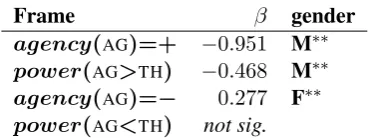
Frame β gender
[image:3.595.73.284.65.154.2]agency(AG)=+ −0.951 M∗∗ power(AG>TH) −0.468 M∗∗ agency(AG)=− 0.277 F∗∗ power(AG<TH) not sig.
Table 1: Power and agency connotation frames for male and female narratives, controlled for length of narrative text. β represents the change in log-odds of a character being male/female were the corresponding frame to change by one unit. Sig-nificant results (∗∗ :p<.001) are in bold. “Male”
was coded as 0, “Female” as 1.
3.1 Bias in Narratives
Narratives describe what characters aredoing. We investigate how they vary in terms of power and
agency, using our connotation frames. We mea-sure how each standardized frame metric is asso-ciated with the gender of the character through a logistic regression, controlling for the total num-ber of words that the character said, and correcting for multiple comparisons using Holm’s correction (Holm,1979).
Listed in Table 1, our results show that male characters are portrayed with higher level of agency compared to women. Men are also por-trayed to have more authority than women as they are more often the agent of powerful verbs.
This suggests that screenwriters tend to have fe-male characters contribute more to the aesthetic of the movie through low-agency verbs, rather than the plot, which is reminiscent of existing gender bias tests for movies (Yehl,2013).
3.2 Bias in Character Expression
To further our validation of the new connota-tive dimensions, we look at how characters ex-press themselves in movies. Using our connota-tion frames and LIWC (Tausczik and Pennebaker,
2016), we compile metrics for every character’s dialogue. As in subsection3.1, metrics were stan-dardized for better β interpretability. LIWC re-sults that are not discussed below can be found in the appendix (Tables4and5).
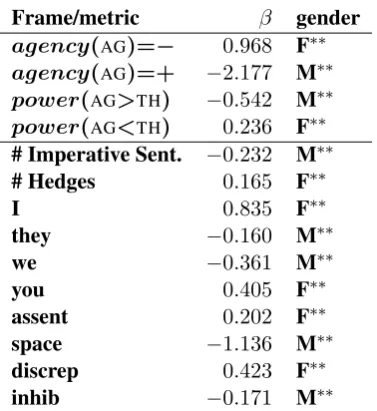
re-Frame/metric β gender agency(AG)=− 0.968 F∗∗ agency(AG)=+ −2.177 M∗∗ power(AG>TH) −0.542 M∗∗ power(AG<TH) 0.236 F∗∗ # Imperative Sent. −0.232 M∗∗
# Hedges 0.165 F∗∗
I 0.835 F∗∗
they −0.160 M∗∗
we −0.361 M∗∗
you 0.405 F∗∗
assent 0.202 F∗∗
space −1.136 M∗∗
discrep 0.423 F∗∗
[image:4.595.88.277.60.266.2]inhib −0.171 M∗∗
Table 2: Gender association with our connotation frames and a subset of LIWC metrics for char-acters’ dialogue, controlled for number of words spoken. All results are significant (∗∗:p<.001).
flects real-world dialogues (Prabhakaran et al.,
2014). The usage of imperatives tends to con-vey power and dominance according to the find-ings ofBramsen et al.(2011). Along with the fact that female characters tend to agree (assent) more than male characters, this corroborates the finding in subsection 3.1 that male characters are gener-ally given more power and agency. Furthermore, male characters use inhibitory language more ( in-hib), which contains words pertaining to blocking or allowing, suggesting that these characters are in positions of power.
Further evidence of power imbalances is found through function words. Women tend to useI and
youpronouns more, whereas men useweandthey
pronouns more, echoing real life (Schwartz et al.,
2013). Kacewicz et al. (2014) found an associa-tion between using “I” pronouns and being lower status, and conversely between “we” pronouns and being higher status. This corroborates the theory that women in movies are generally portrayed with a lower status than men.
Men in movies tend to mention more physi-cal actions (spacecategory) whereas women tend talk about what “could” be but isn’t (discrep; e.g.,“should”, “would”). This evokes more com-manding connotations for male characters and subordinate connotations for female ones, rein-forcing gender stereotypes.
These findings, rooted in previous research, confirm that our connotation frames capture
exist-Metric/Frame β P/F
F dial. # Words 10.02 pass∗∗ F dial. agency(AG)=+ −9.65 fail∗∗ F dial. power(AG>TH) 2.05 pass∗ F narr. power(AG>TH) −1.19 fail∗
Table 3: Significant correlates of passing the Bechdel test. F: metric for female characters, computed on the dialogues (dial.) or on the nar-ratives (narr.).∗ :p<.05;∗∗:p<.001.
ing bias in how male and female characters display different levels of power and agency in their dia-logue.
4 Power, Agency and the Bechdel test
A movie passes the Bechdel test (Bechdel,1986) if it (1) has two (named) female characters, (2) who talk to each other, (3) about something other than a man. While this is a low bar, a surprising number of movies fail at least one of the three criteria. In particular, as many as 42% of the movies in our dataset fail the test according to an online database of the Bechdel scores.6
4.1 Beyond the Bechdel Test
We provide comparative insights between the analysis based on connotation frames and the Bechdel test. First, we aggregate our connota-tion frames, both on dialogue and narraconnota-tion, into movie-level averages per gender. Then, we add features capturing presence of female/male char-acters (e.g., # F/M words, # F/M charchar-acters). Table 3 shows the correlation between passing the Bechdel test and our movie-level connotation frame features using a multivariate logistic regres-sion.
As expected, a movie with more female speak-ing time is more likely to pass the Bechdel test since it mostly captures female representation. We also find that female characters using agent-empowering verbs, which tend to be more as-sertive, slightly increases the odds of passing the Bechdel test. Female speakers who use empower-ing verbs, regardless of the verb’s agent, tend to go against the gender-norms of hedging and being less assertive (as we showed in subsection3.2).
Unexpectedly, movies where women talk with high agency are much less likely to pass the
6Available at http://bechdeltest.com. We use
[image:4.595.310.523.61.132.2]Bechdel test. Perhaps these movies typically only show scenes of women interacting in a male-dominated setting. Similarly, the use of more agent-empowering verbs in female narra-tives decrease the odds of passing the Bechdel test. Chances of two powerful women talking to each other might be lower because movies are less likely to have a lot of powerful women.7
Power and Agency of Princesses We further provide a qualitative analysis using Wikipedia plot summaries for movies that are not in our script dataset. Bechdel-passing movies with female pro-tagonists, such as Frozen (2013) or Cinderella
(1950), still perpetuate negative female stereo-types. In Frozen, Elsa is portrayed as the only high agency, high power woman, as seen below.8
Anna and Cinderella, despite also being protago-nists, display significantly less power and agency.
low high
low
high low
high
neg pos
neg pos
neg pos
Power Agency
0% 20% 40% 60% 80%
Elsa Anna Cinderella Elsa Anna Cinderella
% v
erbs
Power and Agency levels of Disney princesses
The Bechdel test is limited, either by being too inclusive of movies who portray women in non-authoritative, passive positions or by excluding movies that have strong women with agency, who just happen not to talk to each other about some-thing besides men. Our extensions to the connota-tion frame lexicon provide finer grained informa-tion about how women are portrayed through their expression and their actions, which can act com-plementary to measures of their presence.
5 Related work
There is much prior research focus on bias in so-cial media (Garcia et al.,2014;Prabhakaran et al.,
2014;Ratkiewicz et al., 2011; Yano et al., 2010;
Srivastava and Sahami,2009), complementing our investigation on movies. Fast et al. (2016) ex-amine the stereotypes present in fan-fiction
us-7Similar observations may have inspired the Mako Mori
test (Romano,2013), which looks at whether there’s a female character with a story arc that doesn’t support a man’s.
8Note that plot summaries are more biased toward active
verbs, which explains the low negative agency for all charac-ters.
ing a lexicon-based strategy that focus on com-monly gender-biased attributes (e.g.,emotionalfor women) rather than the overall power dynamics of the story. In a similar vein, Ramakrishna et al.
(2015) learn word-level “gender ladenness” fea-tures by looking at the neighbors of 925 manually annotated words.
There exist various sets of high-level criteria to assess gender bias of character portrayal in fic-tion (Yehl,2013;Romano, 2013; Powers, 2016).
Agarwal et al.(2015), in particular, automate the Bechdel test using social network features, finding that women are less central to the plot in movies that fail it. We compare our linguistic analysis of power and agency with the Bechdel test, demon-strating the need for more fine-grained analysis of how gender is depicted in movies.
Close in spirit to our investigation, Schofield and Mehr(2016) train a number of classifiers over movie scripts for determining the gender of indi-vidual (and pairs) of speakers as well as the ex-pected length of their relationships. In contrast, we focus on understanding how the gender of a given character implicitly relates to features that track their control over their own path (agency) and the world around them (power).
6 Conclusion
We created and released new connotation frames ofpower andagency, allowing for more nuanced writing analysis than previously possible. We vali-date our new frames through a case study on movie scripts. Specifically, we analyze differences in power and agency for male and female characters, and compare these dimensions to the Bechdel test. Our connotation frames confirm evidence of im-balances in gender portrayal in movies.
Acknowledgments
References
Apoorv Agarwal, Jiehan Zheng, Shruti Kamath, Sri-ramkumar Balasubramanian, and Shirin Ann Dey. 2015. Key female characters in film have more to talk about besides men: Automating the bechdel test. InHLT-NAACL.
Alison Bechdel. 1986. Dykes to watch out for. Fire-brand Books.
Elizabeth Behm-Morawitz and Dana E Mastro. 2008. Mean girls? the influence of gender portrayals in teen movies on emerging adults’ gender-based atti-tudes and beliefs. Journalism & Mass Communica-tion Quarterly, 85(1):131–146.
Philip Bramsen, Martha Escobar-Molano, Ami Patel, and Rafael Alonso. 2011. Extracting social power relationships from natural language. InACL.
Ethan Fast, Tina Vachovsky, and Michael S Bernstein. 2016. Shirtless and dangerous: Quantifying linguis-tic signals of gender bias in an online fiction writing community. InICWSM.
David Garcia, Ingmar Weber, and Venkata Rama Kiran Garimella. 2014. Gender asymmetries in reality and fiction: The bechdel test of social media. InICWSM.
Google. 2017. Using technology to address gender bias in film. https://www.google.com/ about/main/gender-equality-films/ index.html.
Philip John Gorinski and Mirella Lapata. 2015. Movie script summarization as graph-based scene extrac-tion. InNAACL.
Sture Holm. 1979. A simple sequentially rejective multiple test procedure. Scandinavian journal of statistics, pages 65–70.
Ewa Kacewicz, James W Pennebaker, Matthew Davis, Moongee Jeon, and Arthur C Graesser. 2014. Pronoun use reflects standings in social hierar-chies. Journal of Language and Social Psychology, 33(2):125–143.
Kelsey Powers. 2016. The furiosa test developed from female presence in mad max: Fury road.
http://www.calvin.edu/chimes/2015/
11/09/the-furiosa-test-developed-
from-female-presence-in-mad-max-fury-road.
Vinodkumar Prabhakaran, Emily E Reid, and Owen Rambow. 2014. Gender and power: How gen-der and gengen-der environment affect manifestations of power. InEMNLP.
Will Radford and Matthias Gall´e. 2015. Roles for the boys?: Mining cast lists for gender and role distribu-tions over time. InWWW.
Anil Ramakrishna, Nikolaos Malandrakis, Elizabeth Staruk, and Shrikanth S Narayanan. 2015. A quanti-tative analysis of gender differences in movies using psycholinguistic normatives. InEMNLP.
Hannah Rashkin, Sameer Singh, and Yejin Choi. 2016. Connotation frames: A Data-Driven investigation. InACL.
Jacob Ratkiewicz, Michael Conover, Mark R Meiss, Bruno Gonc¸alves, Alessandro Flammini, and Fil-ippo Menczer. 2011. Detecting and tracking polit-ical abuse in social media. ICWSM.
Aja Romano. 2013. The mako mori test:
‘pa-cific rim’ inspires a bechdel test alternative. https://www.dailydot.com/parsec/
fandom/mako-mori-test-bechdel-pacific-rim/.
Alexandra Schofield and Leo Mehr. 2016. Gender-distinguishing features in film dialogue. InCLfL@ NAACL-HLT.
H Andrew Schwartz, Johannes C Eichstaedt, Mar-garet L Kern, Lukasz Dziurzynski, Stephanie M Ra-mones, Megha Agrawal, Achal Shah, Michal Kosin-ski, David Stillwell, Martin E P Seligman, and Lyle H Ungar. 2013. Personality, gender, and age in the language of social media: the open-vocabulary approach.PLoS One, 8(9):e73791.
Stacy L Smith, Marc Choueiti, Katherine Pieper, Traci Gillig, Carmen Lee, and Dylan DeLuca. 2015. In-equality in 700 popular films: Examining portrayals of gender, race & lgbt status from 2007 to 2014. Me-dia, Diversity & Social Change Initiative, USC An-nenberg School for Communication and Journalism. Ashok N Srivastava and Mehran Sahami. 2009. Text mining: Classification, clustering, and applications. CRC Press.
Yla R Tausczik and James W Pennebaker. 2016. The psychological meaning of words: LIWC and com-puterized text analysis methods. J. Lang. Soc. Psy-chol.
Gregory M Walton and Steven J Spencer. 2009. Latent ability: Grades and test scores systematically under-estimate the intellectual ability of negatively stereo-typed students. Psychological Science, 20(9):1132– 1139.
Tae Yano, Philip Resnik, and Noah A Smith. 2010. Shedding (a thousand points of) light on biased lan-guage. In Proceedings of the NAACL HLT 2010 Workshop on Creating Speech and Language Data with Amazon’s Mechanical Turk.
Joshua Yehl. 2013. Kelly sue deconnick talks captain marvel, pretty deadly, and the sexy lamp test.
http://www.ign.com/articles/2013/
06/20/kelly-sue-deconnick-talks-