C r o s s - L a n g u a g e I n f o r m a t i o n R e t r i e v a l for T e c h n i c a l D o c u m e n t s
A t s u s h i F u j i i a n d T e t s u y a I s h i k a w a University of L i b r a r y a n d I n f o r m a t i o n Science
1-2 K a s u g a T s u k u b a 305-8550, J A P A N { f u j i i , i s h i k a w a } @ u l i s , a c . j p
A b s t r a c t
This paper proposes a Japanese/English cross- language information retrieval (CLIR) system targeting technical documents. Our system first translates a given query containing tech- nical terms into the target language, and then retrieves documents relevant to the translated query. The translation of technical terms is still problematic in that technical terms are often compound words, and thus new terms can be progressively created simply by combining ex- isting base words. In addition, Japanese of- ten represents loanwords based on its phono- gram. Consequently, existing dictionaries find it difficult to achieve sufficient coverage. To counter the first problem, we use a compound word translation method, which uses a bilin- gual dictionary for base words and collocational statistics to resolve translation ambiguity. For the second problem, we propose a translitera- tion method, which identifies phonetic equiva- lents in the target language. We also show the effectiveness of our system using a test collec- tion for CLIR.
1 I n t r o d u c t i o n
Cross-language information retrieval (CLIR), where the user presents queries in one language to retrieve documents in another language, has recently been one of the major topics within the information retrieval community. One strong motivation for CLIR is the growing number of documents in various languages accessible via the Internet. Since queries and documents are in different languages, CLIR requires a trans- lation phase along with the usual monolingual retrieval phase. For this purpose, existing CLIR
systems adopt various techniques explored in natural language processing (NLP) research. In brief, bilingual dictionaries, corpora, thesauri and machine translation (MT) systems are used to translate queries o r / a n d documents.
In this paper, we propose a Japanese/English CLIR system for technical documents, focus- ing on translation of technical terms. Our purpose also includes integration of different components within one framework. Our re- search is partly motivated by the "NACSIS" test collection for IR systems (Kando et al., 1998) 1 , which consists of Japanese queries and Japanese/English abstracts extracted from technical papers (we will elaborate on the NAC- SIS collection in Section 4). Using this col- lection, we investigate the effectiveness of each component as well as the overall performance of the system.
As with MT systems, existing CLIR systems still find it difficult to translate technical terms and proper nouns, which are often unlisted in general dictionaries. Since most CLIR systems target newspaper articles, which are comprised mainly of general words, the problem related to unlisted words has been less explored than other CLIR subtopics (such as resolution of transla- tion ambiguity). However, Pirkola (1998), for example, used a subset of the TREC collection related to health topics, and showed that com- bination of general and domain specific (i.e., medical) dictionaries improves the CLIR perfor- mance obtained with only a general dictionary. This result shows the potential contribution of technical term translation to CLIR. At the same time, note that even domain specific dictionaries
lhttp ://www. rd. nacs is. ac. j p/-nt cadm/index-en, html
do not exhaustively list possible technical terms. We classify problems associated with technical term translation as given below:
(1) technical terms are often compound word~ which can be progressively created simply by combining multiple existing morphemes ("base words"), and therefore it is not en- tirely satisfactory to exhaustively enumer- ate newly emerging terms in dictionaries,
(2) Asian languages often represent loanwords based on their special phonograms (primar- ily for technical terms and proper nouns), which creates new base words progressively (in the case of Japanese, the phonogram is called katakana).
To counter problem (1), we use the c o m p o u n d word translation method we proposed (Fujii and Ishikawa, 1999), which selects appropri- ate translations based on the probability of oc- currence of each combination of base words in the target language. For problem (2), we use "transliteration" (Chen et al., 1998; Knight and Graehl, 1998; Wan and Verspoor, 1998). Chen et al. (1998) and Wan and Verspoor (1998) proposed English-Chinese transliteration meth- ods relying on the property of the Chinese phonetic system, which cannot be directly ap- plied to transliteration between English and Japanese. Knight and Graehl (1998) proposed a Japanese-English transliteration m e t h o d based on the mapping probability between English and Japanese katakana sounds. However, since their m e t h o d needs large-scale phoneme inven- tories, we propose a simpler approach using surface mapping between English and katakana characters, rather than sounds.
Section 2 overviews our CLIR system, and Section 3 elaborates on the t r a n s l a t i o n mod- ule focusing on compound word translation and transliteration. Section 4 then evaluates the effectiveness of our CLIR system by way of the standardized IR evaluation m e t h o d used in T R E C programs.
2 S y s t e m O v e r v i e w
Before explaining our CLIR system, we clas- sify existing CLIR into three approaches in
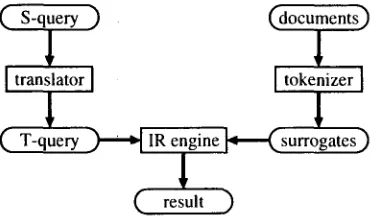
terms of the implementation of the translation phase. The first approach translates queries into the document language (Ballesteros and Croft, 1998; Carbonell et al., 1997; Davis and Ogden, 1997; Fujii and Ishikawa, 1999; Hull and Grefenstette, 1996; Kando and Aizawa, 1998; O k u m u r a et al., 1998), while the second ap- proach translates documents into the query lan- guage (Gachot et al., 1996; Oard and Hack- ett, 1997). The third approach transfers both queries and documents into an interlingual rep- resentation: bilingual thesaurus classes (Mon- gar, 1969; Salton, 1970; Sheridan and Ballerini, 1996) and language-independent vector space models (Carbonell et al., 1997; Dumais et al., 1996). We prefer the first approach, the "query translation", to other approaches because (a) translating all the documents in a given col- lection is expensive, (b) the use of thesauri re- quires manual construction or bilingual compa- table corpora, (c) interlingual vector space mod- els also need comparable corpora, and (d) query translation can easily be combined with existing IR engines and thus the implementation cost is low. At the same time, we concede that other CLIR approaches are worth further exploration. Figure 1 depicts the overall design of our CLIR system, where most components are the same as those for monolingual IR, excluding
"translator".
First, "tokenizer" processes "documents" in a given collection to produce an inverted file ("surrogates"). Since our system is bidirec- tional, tokenization differs depending on the target language. In the case where documents are in English, tokenization involves eliminat- ing stopwords and identifying root forms for inflected words, for which we used "Word- Net" (Miller et al., 1993). On the other hand, we segment Japanese documents into lexical units using the "ChaSen" morphological ana- lyzer (Matsumoto et al., 1997) and discard stop- words. In the current implementation, we use word-based uni-gram indexing for b o t h English and Japanese documents. In other words, com- p o u n d words are decomposed into base words in the surrogates. Note that indexing and re- trieval methods are theoretically independent of
!
the translation method.
Thereafter, the "translator" processes a query in the source language ("S-query") to output the translation ("T-query"). T-query can con- sist of more than one translation, because mul- tiple translations are often appropriate for a sin- gle technical term.
Finally, the "IR engine" computes the sim- ilarity between T-query and each document in the surrogates based on the vector space model (Salton and McGill, 1983), and sorts doc- ument according to the similarity, in descending order. We compute term weight based on the notion of TF.IDF. Note that T-query is decom- posed into base words, as performed in the doc- ument preprocessing.
In Section 3, we will explain the "translator" in Figure 1, which involves compound word translation and transliteration modules.
( S-query ) (documents)
1
1
]translator ] ] tokenizer ]
( T-query ~ IR engine I: ~surrogates)
( result )
Figure 1: The overall design of our CLIR system
3 T r a n s l a t i o n M o d u l e
3.1 O v e r v i e w
Given a query in the source language, tokeniza- tion is first performed as for target documents (see Figure 1). To put it more precisely, we use WordNet and ChaSen for English and Japanese queries, respectively. We then discard stop- words and extract only content words. Here, "content words" refer to both single and com- pound words. Let us take the following query as an example:
improvement of data mining methods.
For this query, we discard "of", to extract "im- provement" and "data mining methods".
Thereafter, we translate each extracted con- tent word individually. Note that we currently do not consider relation (e.g. syntactic relation and collocational information) between content words. If a single word, such as "improvement" in the example above, is listed in our bilingual dictionary (we will explain the way to produce the dictionary in Section 3.2), we use all pos- sible translation candidates as query terms for the subsequent retrieval phase.
Otherwise, compound word translation is performed. In the case of Japanese-English translation, we consider all possible segmenta- tions of the input word, by consulting the dic- tionary. Then, we select such segmentations that consist of the minimal number of base words. During the segmentation process, the dictionary derives all possible translations for base words. At the same time, transliteration is performed whenever k a t a k a n a sequences un- listed in the dictionary are found. On the other hand, in the case of English-Japanese transla- tion, transliteration is applied to any unlisted base word (including the case where the input English word consists of a single base word). Fi- nally, we compute the probability of occurrence of each combination of base words in the target language, and select those with greater proba- bilities, for both Japanese-English and English- Japanese translations.
3.2 C o m p o u n d W o r d T r a n s l a t i o n
This section briefly explains the compound word translation method we previously pro- posed (Fujii and Ishikawa, 1999). This method translates input compound words on a word-by- word basis, maintaining the word order in the source language 2. The formula for the source compound word and one translation candidate are represented as below.
S = 8 1 , 8 2 , . . . , 8 n
T = t l , t 2 , • • • , t n
2A preliminary study showed that approximately 95% of compound technical terms defined in a bilingual dic- tionary maintain the same word order in both source and target languages.
[image:3.612.85.271.343.453.2]Here, si and ti denote i-th base words in source and target languages, respectively. Our task, i.e., to select T which maximizes
P(TIS),
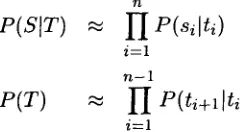
is transformed into Equation (1) through use of the Bayesian theorem.arg n ~ x
P(TIS )
= arg n ~ xP(SIT ) • P(T)
(1)P(SIT )
andP(T)
are approximated as in Equa- tion (2), which has commonly been used in the recent statistical NLP research (Church and Mercer, 1993).n
P(SIT) ~ I~P(silti)
i----1 n - 1
P(T)
"~ 1Y~ p(ti+llti)
i = l
(2)
We produced our own dictionary, because conventional dictionaries are comprised primar- ily of general words and verbose definitions aimed at human readers. We extracted 59,533 English/Japanese translations consisting of
two
base words from the EDR technical terminol- ogy dictionary, which contains about 120,000 translations related to the information process- ing field (Japan Electronic Dictionary Research Institute, 1995), and segment Japanese entries into two parts 3. For this purpose, simple heuris- tic rules based mainly on Japanese character types (i.e.,kanji, katakana, hiragana,
alpha- bets and other characters like numerals) were used. Given the set of compound words where Japanese entries are segmented, we correspond English-Japanese base words on a word-by-word basis, maintaining the word order between En- glish and Japanese, to produce a Japanese- English/English-Japanese base word dictionary. As a result, we extracted 24,439 Japanese base words and 7,910 English base words from the EDR dictionary. During the dictionary produc- tion, we also count the collocational frequency for each combination of si and ti, in order to estimateP(silti).
Note that in the case where3The number of base words can easily be identified based on English words, while Japanese compound words lack lexical segmentation.
si
istransliterated
intoti,
we use an arbitrar- ily predefined value forP(s,ilti).
For the esti- mation ofP(ti+llti),
we use the word-based bi- gram statistics obtained from target language corpora, i.e., "documents" in the collection (see Figure 1).3.3 T r a n s l i t e r a t i o n
Figure 2 shows example correspondences be- tween English and (romanized)
katakana
words, where we insert hyphens between eachkatakana
character for enhanced readability. The basis of our transliteration method is analogous to that for compound word translation described in Section 3.2. The formula for the source word and one transliteration candidate are rep- resented as below.S -~ s 1 , 8 2 , . . . , 8 n
T z t l , t 2 , . . . , t n
However, unlike the case of compound word translation, si and ti denote i-th "symbols" (which consist of one or more letters), respec- tively. Note that we consider only such T's that are indexed in the inverted file, because our transliteration method often outputs a num- ber of incorrect words with great probabilities. Then, we compute
P(TIS )
for each T using Equations (1) and (2) (see Section 3.2), and select k-best candidates with greater probabili- ties. The crucial content here is the way to pro- duce a bilingual dictionary forsymbols.
For this purpose, we used approximately 3,000katakana
entries and their English translations listed in our base word dictionary. To illustrate our dic- tionary production method, we consider Fig- ure 2 again. Looking at this figure, one may notice that the first letter in eachkatakana
character tends to be contained in its corre- sponding English word. However, there are a few exceptions. A typical case is that since Japanese has no distinction between "L" and "R" sounds, the two English sounds collapse into the same Japanese sound. In addition, a single English letter corresponds to multiplekatakana
characters, such as "x" to"ki-su"
in "<text,te-ki-su-to>".
To sum up, English and [image:4.612.142.263.248.314.2]romanized katakana words are not exactly iden- tical, b u t similar to each other.
English katakana system
mining data network text collocation
shi-su-te-mu ma-i-ni-n-gu dee-ta ne-tto-waa-ku te-ki-su-to ko-ro-ke-i-sho-n
Figure 2: Examples of English-katakana corre- spondence
We first mangally define the similarity be- tween the EngliSh letter e and the first roman- ized letter for each katakana character j , as shown in Table 1. In this table, "phonetically similar" letters refer to a certain pair of letters, such as "L" and "R ''4. We then consider the similarity for afiy possible combination of let- ters in English and romanized katakana words, which can be represented as a matrix, as shown in Figure 3. This figure shows the similarity between letters in "<text, te-ki-su-to>". We put a d u m m y letter "$", which has a positive similarity only t.o itself, at the end of b o t h En- glish and katakana words. One may notice t h a t matching plausible symbols can be seen as find- ing the p a t h which maximizes the total similar- ity from the first to last letters. The best p a t h can easily be found by, for example, Dijkstra's algorithm (Dijkstra, 1959). From Figure 3, we can derive the following correspondences: "<re, te>", "<X, ki-su>" and "<t, to>". The resultant correspondences contain 944 Japanese and 790 English symbol types, from which we also estimated P(si[ti) and P(ti+l]ti).
As can be predicted, a preliminary experi- ment showed that our transliteration m e t h o d is not accurate when compared with a word- based translation. For example: the Japanese word "re-ji-su-ta (register)" is transliterated to "resister", "resistor" and "register", with the probability score in descending order. How-
4~re identified approximately twenty pairs of phonet- ically similar letters.
ever, combined with the c o m p o u n d word trans- lation, irrelevant transliteration o u t p u t s are ex- p e c t e d to be discarded. For example, a com- p o u n d word like "re-ji-su-ta tensou 9engo (reg- ister transfer language)" is successfully trans- lated, given a set of base words "ten.sou (trans- fer)" and "gengo (language)" as a context.
Table 1: The similarity b e t w e e n English and Japanese letters
condition similarity
e and j are identical 3
e and j are phonetically similar
both e and j axe vowels or consonants 1
otherwise 0
E t
e
x
t
$
te ki
J
S U to
i 1 2 3 0
o o o
.). ...
o
0 0 o 0
Figure 3: An example matrix for English- Japanese symbol matching (arrows denote the best path)
4 E v a l u a t i o n
This section investigates the performance of our C L I R system based on the T R E C - t y p e evalu- ation methodology: the system o u t p u t s 1,000 top documents, and T R E C evaluation software is used to calculate the recall-precision trade-off and l l - p o i n t average precision.
For the purpose of our evaluation, we used the NACSIS test collection (Kando et al., 1998). This collection consists of 21 Japanese queri~'s and approximately 330,000 documents (in el-
[image:5.612.109.250.112.200.2] [image:5.612.317.513.247.475.2] [image:5.612.343.497.329.471.2]ther a confl)ination of English a n d Japanese or either of the languages individually), collected fi'om technical papers published by 65 Japanese associations tbr various fields. Each document consists of the document ID, title, name(s) of author(s), name/date of conference, hosting or- ganization, abstract and keywords, from which titles, abstracts and keywords were used for our evaluation. We used as target documents ap- proximately 187,000 entries where abstracts are in both English and Japanese. Each query con- sists of the title of the topic, description, narra- tive and list of synonyms, from which we used only the description. Roughly speaking, most topics are related to electronic, information and control engineering. Figure 4 shows example de- scriptions (translated into English by one of the authors). Relevance assessment was performed based on one of the three ranks of relevance, i.e., "relevant", "partially relevant" and "irrel- evant". In our evaluation, relevant documents refer to both "relevant" and "partially relevant" documents 5.
ID 0005 0006 0019 0024
description
dimension reduction for clustering intelligent information retrieval
syntactic analysis methods for Japanese machine translation systems
Figure 4: Example descriptions in the NACSIS query
4.1 E v a l u a t i o n o f c o m p o u n d w o r d t r a n s l a t i o n
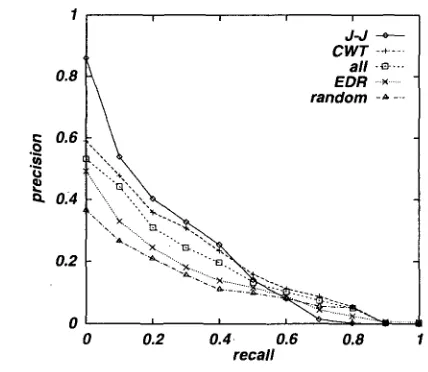
We compared the following query translation methods:
(1 i a control, in which all possible translations derived from the (original) EDR technical terminology dictionary are used as query terms ("EDR"),
(2) all possible base word translations derived from o u r dictionary are used ("all"),
5The result did not significantly change depending on whether we regarded "partially relevant" as relevant or not.
(3) randomly selected k translations derived from our bilingual dictionary are used ("random"),
(4) k-best translations through compound word translation are used ("C\¥T").
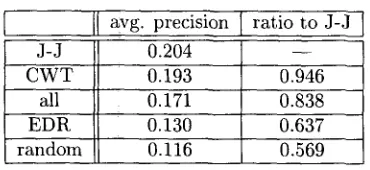
For system "EDR", compound words unlisted in the EDR dictionary were manuMly segmented so that substrings (shorter compound words or base words) can be translated. For both sys- tems "random" and "CWT", we arbitrarily set k = 3. Figure 5 and Table 2 show the recall- precision curve and l 1-point average precision for each method, respectively. In these, "J-J" refers to the result obtained by the Japanese- Japanese IR system, which uses as documents Japanese titles/abstracts/keywords comparable to English fields in the NACSIS collection. This can be seen as the upper bound for CLIR perfor- mance 6. Looking at these results, we can con- clude that the dictionary production and prob- abilistic translation methods we proposed are effective for CLIR.
0.8
¢ 0.6
.9
0.4
0.2
i i , ,
j _ j o C W T
...
all -~,..
\ E D R --~ ...
~,, ,~,
r a n d o m -A-.-
-~.:::..,.×.,.
(,2 , ,0 0.2 0 . 4 0.6 0.8
recall
Figure 5: RecM1-Precision curves for evaluation of compound word translation
6Regrettably, since the NACSIS collection does not contain English queries, we cannot estimate the upper bound performance by English-English IR.
[image:6.612.322.536.423.609.2]Table 2: Comparison of average precision for evaluation of c o m p o u n d word translation
II avg. precision [ratio to J-3
J-J 0.204 - -
CWT 0.193 0.946
all 0.171 0.838
EDR 0.130 0.637
random 0.116 0.569
4.2 E v a l u a t i o n o f t r a n s l i t e r a t i o n
In the NACSIS collection, three queries con- tain katakana (base) words unlisted in our bilin- gual dictionary: Those words are "ma-i-ni- n-gu (mining)" and "ko-ro-ke-i-sho-n (colloca- tion)". However, to emphasize the effectiveness of transliteration, we compared the following ex- treme cases:
(1) a control, in which every katakana word is discarded from queries ("control"),
(2) a case where transliteration is applied to every katakana word and top 10 candidates are used ("translit").
Both cases use system " C W T " in Section 4.1. In the case of "translit", we do not use katakana entries listed in the base word dictionary. Fig- ure 6 and Table 3 show the recall-precision curve and l l - p o i n t average precision for each case, re- spectively. In these, results for " C W T " corre- spond to those in Figure 5 and Table 2, respec- tively. We can conclude that our transliteration m e t h o d significantly improves the baseline per- fomlance (i.e., "control"), and comparable to word-based translation ill terms of C L I R per- formance.
An interesting observation is that the use of transliteration is robust against typos in docu- ments, because a number of similar strings are used as query terms. For example, our translit- eration m e t h o d produced the following strings for "ri-da-ku-sho-n (reduction)":
riduction, redction, redaction, reduc- tion.
All of these words are effective for retrieval, be- cause they are contained in the target docu- ments.
1 i i , i
J - J . ~
C W T -+ -- t r a n s l i t .~-.-
0 . 8 " c o n t r o l 1.-~ ...
0 . 6 .~2
0 . 4
t "'x..
""s.-...
x ... ""~:
... x . . -[-- l I I ~ • " ~ -
0 0.2 0.4 0.6 0.8
recall
0 . 2
Figure 6: Recall-Precision curves for evaluation of transliteration
Table 3: Comparison of average precision for evaluation of transliteration
II avg. precision ratio to J-J
J-J 0.204 - -
CWT 0.193 0.946
translit 0.193 0.946
control 0.115 0.564
4.3 E v a l u a t i o n o f t h e overall
p e r f o r m a n c e
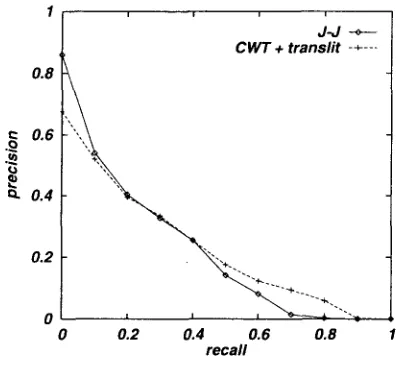
We compared our system ( " C W T + t r a n s l i t " ) with the Japanese-Japanese I R system, where
(unlike the evaluation in Section 4.2) transliter- ation was applied only to "ma-i-ni-n-gu (min- ing)" and "ko-ro-ke-i-sho-n (collocation)". Fig- ure 7 and Table 4 show the recall-precision curve and l 1-point average precision for each sys- tem, respectively, from which one can see that our C L I R system is quite comparable with the monolingual I R system in performance. In ad- dition, from Figure 5 to 7, one can see that the monolingual system generally performs b e t t e r
[image:7.612.89.274.108.193.2] [image:7.612.319.528.117.302.2] [image:7.612.328.513.417.485.2]at lower re(:all while the CLIR system pertbrms
b ( , I t ( , r at higher recall.
For further investigation, let us discuss sim- ilar (~xperim(mtal results reported by Kando and Aizawa (1998), where a bilingual dictionary produced ti'om Japanese/English keyword pairs in the NACSIS documents is used for query translation. Their evaluation m e t h o d is al- most the same as pertbrmed in our experinmnts. One difference is that they use the "OpenText" search engine 7, and thus the performance tbr Jal)anese-Japanese IR is higher than obtained in out" evaluation. However, the performance of their Japanese-English C L I R systems, which is roughly 50-60% of that for their Japanese- Japanese IR system, is comparable with our C L I R system performance. It is expected that using a more sophisticated search engine, our C L I R system will achieve a higher performance than that obtained by Kando and Aizawa.
0.8
0.6
.o la
D. O.4
0.2
J - J o
C W T + translit - + - - -
"',,
• - . ÷ . " ' - k .
0 0.2 0.4 0.6 0.8
recall
Figure 7: Recall-Precision curves for evaluation of overall performance
5 C o n c l u s i o n
In this paper, we proposed a J a p a n e s e / E n g l i s h cross-language information retrieval system, targeting technical documents. We combined a query translation module, which performs
7Devcloped by OpenText Corp.
Table 4: Comparison of average precision tbr evaluation of overall l)erfbrmance
II avg. I)recision ratio to J-.l
• I-J 0.204 --
CWT + translit 0.212 1.04
c o m p o u n d wor(1 translation and translitera- tion, with an existing monolingual retrieval method. Our experimental results showed that c o m p o u n d word translation and transliteration methods individually improve on the baseline performance, and when used together the im- provement is even greater. F u t u r e work will in- elude the application of a u t o m a t i c word align- ment m e t h o d s (Fung, 1995; S m a d j a et al., 1996) to enhance the dictionary.
A c k n o w l e d g m e n t s
The authors would like to thank Noriko K a n d o (National Center for Science Information Sys- tems, Japan) for her s u p p o r t with the NACSIS collection.
R e f e r e n c e s
Lisa Ballesteros and W. Bruce Croft. 1998. Resolv- ing ambiguity for cross-language retrieval. In Pro- ceedings of the 21th Annual International ACM SIGIR Conference on Research and Development in Information Retrieval, pages 64-71.
Jaime G. Carbonell, Yiming Yang, Robert E. Fred- erking, Ralf D. Brown, Yibing Geng, and Danny Lee. 1997. Translingual information retrieval: A comparative evaluation. In Proceedings of the 15th International Joint Conference on Artficial Intelligence, pages 708-714.
Hsin-Hsi Chen, Sheng-Jie Huang, Yung-Wei Ding, and Shih-Chung Tsai. 1998. Proper name trans- lation in cross-language information retrieval. In Proceedings of the 36th Annual Meeting of the As- sociation for Computational Linguistics and the 17th InteT'national Conference on Computational Linguistics, pages 232-236.
Kenneth W. Church and Robert L. Mercer. 1993. Introduction to the special issue on computa- tional linguistics using large corpora. Computa- tional Linguistics, 19(1):1-24.
Mark W. Davis and William C. Ogden. 1997. QUILT: hnI)lementing a large-scale cross-language
[image:8.612.92.294.363.548.2]text retrieval system. In Proceedings of the 20th Annual International A CM SIGIR Conference on Research and Development in Information Re-
trieval, pages 92-98.
Edsgar W. Dijkstra. 1959. A note on two problems
in connexion with graphs. Numerische Mathe-
matik, 1:269-271.
Susan T. Dumais, Thomas K. Landauer, and Michael L. Littman. 1996. Automatic cross- linguistic information retrieval using latent se-
mantic indexing. In ACM SIGIR Workshop on
Cross-Linguistic Information Retrieval.
Atsushi Fujii and Tetsuya Ishikawa. 1999. Cross- language information retrieval using compound word translation. In Proceedings of the 18th In- ternational Conference on Computer Processing
of Oriental Languages, pages 105-110.
Pascale Fung. 1995. A pattern matching method for finding noun and proper noun translations from noisy parallel corpora. In Proceedings of the 33rd Annual Meeting of the Association for Computa-
tional Linguistics, pages 236-243.
Denis A. Gachot, Elke Lange, and Jin Yang. 1996. The SYSTRAN NLP browser: An application of machine translation technology in multilingual in-
formation retrieval. In A CM SIGIR Workshop on
Cross-Linguistic Information Retrieval.
David A. Hull and Gregory Grefenstette. 1996. Querying across languages: A dictionary-based approach to multilingual information retrieval.
In Proceedings of the 19th Annual International
ACM SIGIR Conference on Research and Devel-
opment in Information Retrieval, pages 49-57.
Japan Electronic Dictionary Research Institute. 1995. Technical terminology dictionary (informa- tion processing). (In Japanese).
Noriko Kando and Akiko Aizawa. 1998. Cross- lingual information retrieval using automatically generated multilingual keyword clusrters. In Pro- ceedings of the 3rd International Workshop on In-
formation Retrieval with Asian Languages, pages
86--94.
Noriko Kando, Teruo Koyama, Keizo Oyama, Kyo Kageura, Masaharu Yoshioka, Toshihiko Nozue, Atsushi Matsumura, and Kazuko Kuriyama. 1998. NTCIR: NACSIS test collection project. In
The 20th Annual BCS-IRSG Colloquium on In- formation Retrieval Research.
Kevin Knight and Jonathan Graehl. 1998. Ma- chine transliteration. Computational Linguistics,
24(4) :599-612.
Yuji Matsumoto, Akira Kitauchi, Tatsuo Yamashita, Osamu Imaichi, and Tomoaki Imamura. 1997.
Japanese morphological mlalysis system ChaSen manual. Technical Report NAIST-IS-TR97007, NAIST. (In Japanese).
George A. Miller, Richard Beckwith, Christiane Fell- baum, Derek Gross, Katherine Miller, and Randee Tengi. 1993. Five papers on WordNet. Techni- cal Report CLS-Rep-43, Cognitive Science Labo- ratory, Princeton University.
P. E. Mongar. 1969. International co-operation in abstracting services for road engineering. The In-
formation Scientist, 3:51-62.
Douglas W. Oard and Paul Hackett. 1997. Docu- ment translation for cross-language text retrieval at the University of Maryland. In The 6th Text Retrieval Conference.
Akitoshi Okumura, Kai Ishikawa, and Kenji Satoh. 1998. Translingual information retrieval by a bilingual dictionary and comparable corpus. In
The 1st International Conference on Language Resources and Evaluation, workshop on translin- gual information management: current levels and future abilities.
Ari Pirkola. 1998. The effects of query structure and dictionary setups in dictionary-based cross- language information retrieval. In Proceedings of the 21th Annual International ACM SIGIR Con- ference on Research and Development in Informa-
tion Retrieval, pages 55-63.
Gerard Salton and Michael J. McGill. 1983.
Introduction to Modern Information Retrieval.
McGraw-Hill.
Gerard Salton. 1970. Automatic processing of for- eign language documents. Journal of the Amer-
ican Society for Information Science, 21(3):187-
194.
PgLraic Sheridan and Jean Paul Ballerini. 1996. Ex- periments in multilingual information retrieval us- ing the SPIDER system. In PTvceedings of the 19th Annual International ACM SIGIR Confer- ence on Research and Development in Informa-
tion Retrieval, pages 58-65.
Frank Smadja, Kathleen R. McKeown, and Vasileios Hatzivassiloglou. 1996. Translating collocations for bilingual lexicons: A statistical approach.
Computational Linguistics, 22(1):1-38.
Stephen Wan and Cornelia Maria Verspoor. 1998. Automatic English-Chinese name transliteration for development of multilingual resources. In Pro- ceedings of the 36th Annual Meeting of the Associ- ation for Computational Linguistics and the 17th International Conference on Computational Lin-
guistics, pages 1352-1356.