Dependencies vs. Constituents for Tree-Based Alignment
Daniel Gildea
Computer Science Department University of Rochester
Rochester, NY 14627
Abstract
Given a parallel parsed corpus, statistical tree-to-tree alignment attempts to match nodes in the syntactic trees for a given sentence in two languages. We train a probabilistic tree transduction model on a large automatically parsed Chinese-English corpus, and evaluate re-sults against human-annotated word level align-ments. We find that a constituent-based model performs better than a similar probability model trained on the same trees converted to a depen-dency representation.
1 Introduction
Statistical approaches to machine translation, pio-neered by Brown et al. (1990), estimate parame-ters for a probabilistic model of word-to-word cor-respondences and word re-orderings directly from large corpora of parallel bilingual text. In re-cent years, a number of syntactically motivated ap-proaches to statistical machine translation have been proposed. These approaches assign a parallel tree structure to the two sides of each sentence pair, and model the translation process with reordering oper-ations defined on the tree structure. The tree-based approach allows us to represent the fact that syn-tactic constituents tend to move as unit, as well as systematic differences in word order in the gram-mars of the two languages. Furthermore, the tree structure allows us to make probabilistic indepen-dence assumptions that result in polynomial time algorithms for estimating a translation model from parallel training data, and for finding the highest probability translation given a new sentence.
Wu (1997) modeled the reordering process with binary branching trees, where each production could be either in the same or in reverse order going from source to target language. The trees of Wu’s Inversion Transduction Grammar were derived by synchronously parsing a parallel corpus, using a grammar with lexical translation probabilities at the leaves and a simple grammar with a single nonter-minal providing the tree structure. While this gram-mar did not represent traditional syntactic categories
such as verb phrases and noun phrases, it served to restrict the word-level alignments considered by the system to those allowable by reordering operations on binary trees.
Yamada and Knight (2001) present an algorithm for estimating probabilistic parameters for a simi-lar model which represents translation as a sequence of re-ordering operations over children of nodes in a syntactic tree, using automatic parser output for the initial tree structures. This gives the translation model more information about the structure of the source language, and further constrains the reorder-ings to match not just a possible bracketing as in Wu (1997), but the specific bracketing of the parse tree provided.
Recent models of alignment have attempted to exploit syntactic information from both languages by aligning a pair of parse trees for the same sen-tence in either language node by node. Eisner (2003) presented such a system for transforming semantic-level dependecy trees into syntactic-level dependency trees for text generation. Gildea (2003) trained a system on parallel constituent trees from the Korean-English Treebank, evaluating agreement with hand-annotated word alignments. Ding and Palmer (2004) align parallel dependency trees with a divide and conquer strategy, choosing a highly likely word-pair as a splitting point in each tree. In addition to providing a deeper level of representa-tion for the transformarepresenta-tions of the translarepresenta-tion model to work with, tree-to-tree models have the advan-tage that they are much less computationally costly to train than models which must induce tree struc-ture on one or both sides of the translation pair. Because Expectation Maximization for tree-to-tree models iterates over pairs of nodes in the two trees, it isO(n2)in the sentence length, rather thanO(n6) for Wu’s Inversion Transduction Grammar orO(n4
) for the Yamada and Knight tree-to-string model.
converted to a dependency representation. The trees are converted using a set of deterministic head rules for each language. The dependency representation equalizes some differences in the annotation style between the English and Chinese treebanks. How-ever, the dependency representation makes the as-sumption that not only the bracketing structure, but also the head word choices, will correspond in the two trees. Our evaluation is in terms of agreement with word-level alignments created by bilingual hu-man annotators. Our model of alignment is that of Gildea (2003), reviewed in Section 2 and extended to dependency trees in Section 3. We describe our data and experiments in Section 4, and discuss re-sults in Section 5.
2 The Tree-to-Tree Model
A tree-to-tree alignment model has tree transforma-tion operatransforma-tions for reordering a node’s children, in-serting and deleting nodes, and translating individ-ual words at the leaves of the parse trees. The trans-formed tree must not only match the surface string of the target language, but also the tree structure as-signed to the string by the parser. In order to pro-vide enough flexibility to make this possible, tree transformation operations allow a single node in the source tree to produce two nodes in the target tree, or two nodes in the source tree to be grouped to-gether and produce a single node in the target tree. The model can be thought of as a synchronous tree substitution grammar, with probabilities parameter-ized to generate the target tree conditioned on the structure of the source tree.
The probability P(Tb|Ta) of transforming the
source tree Ta into target tree Tb is modeled in a
sequence of steps proceeding from the root of the target tree down. At each level of the tree:
1. At most one of the current node’s children is grouped with the current node in a single
ele-mentary tree, with probabilityPelem(ta|εa ⇒ children(εa)), conditioned on the current
nodeεa and its children (ie the CFG
produc-tion expandingεa).
2. An alignment of the children of the current elementary tree is chosen, with probability
Palign(α|εa⇒children(ta)). This alignment operation is similar to the re-order operation in the tree-to-string model, with the extension that 1) the alignmentαcan include insertions and deletions of individual children, as nodes in either the source or target may not corre-spond to anything on the other side, and 2) in the case where two nodes have been grouped
into ta, their children are re-ordered together
in one step.
In the final step of the process, as in the tree-to-string model, lexical items at the leaves of the tree are translated into the target language according to a distributionPt(f|e).
Allowing non-1-to-1 correspondences between nodes in the two trees is necessary to handle the fact that the depth of corresponding words in the two trees often differs. A further consequence of allowing elementary trees of size one or two is that some reorderings not allowed when reordering the children of each individual node separately are now possible. For example, with our simple tree
A
B
X Y
Z
if nodes A and B are considered as one elementary tree, with probabilityPelem(ta|A⇒BZ), their
col-lective children will be reordered with probability
Palign({(1,1)(2,3)(3,2)}|A⇒XYZ)
A
X Z Y
giving the desired word ordering XZY. However, computational complexity as well as data sparsity prevent us from considering arbitrarily large ele-mentary trees, and the number of nodes considered at once still limits the possible alignments. For ex-ample, with our maximum of two nodes, no trans-formation of the tree
A
B
W X
C
Y Z
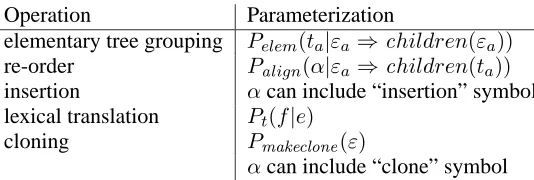
Operation Parameterization
elementary tree grouping Pelem(ta|εa⇒children(εa))
re-order Palign(α|εa⇒children(ta)) insertion αcan include “insertion” symbol lexical translation Pt(f|e)
cloning Pmakeclone(ε)
[image:3.595.172.439.70.160.2]αcan include “clone” symbol
Table 1: The probabilistic tree-to-tree model
ultimately interested in predicting the correct target string, regardless of its structure, we do not assign probabilities to these steps. The nonterminals on the target side are ignored entirely, and while the align-ment algorithm considers possible pairs of nodes as elementary trees on the target side during training, the generative probability model should be thought of as only generating single nodes on the target side. Thus, the alignment algorithm is constrained by the bracketing on the target side, but does not generate the entire target tree structure.
While the probability model for tree transforma-tion operates from the top of the tree down, proba-bility estimation for aligning two trees takes place by iterating through pairs of nodes from each tree in bottom-up order, as sketched below:
for all nodesεain source treeTa in bottom-up order
do
for all elementary treestarooted inεado
for all nodesεbin target treeTbin bottom-up or-der do
for all elementary treestbrooted inεbdo
for all alignmentsαof the children oftaand
tbdo
β(εa, εb) +=
Pelem(ta|εa)Palign(α|εi)
Q
(i,j)∈αβ(εi, εj)
end for end for end for end for end for
The outer two loops, iterating over nodes in each tree, requireO(|T|2
). Because we restrict our ele-mentary trees to include at most one child of the root node on either side, choosing elementary trees for a node pair is O(m2
), wherem refers to the maxi-mum number of children of a node. Computing the alignment between the2mchildren of the elemen-tary tree on either side requires choosing which sub-set of source nodes to delete, O(22m
), which sub-set of target nodes to insert (or clone),O(22m
), and how to reorder the remaining nodes from source to target tree, O((2m)!). Thus overall complexity of the algorithm isO(|T|2
m242m
(2m)!), quadratic in the size of the input sentences, but exponential in
the fan-out of the grammar.
2.1 Clone Operation
Both our constituent and dependency models make use of the “clone” operation introduced by Gildea (2003), which allows words to be aligned even in cases of radically mismatched trees, at a cost in the probability of the alignment. Allowing m-to-n matching of up to two nodes on either side of the parallel treebank allows for limited non-isomorphism between the trees. However, even given this flexibility, requiring alignments to match two input trees rather than one often makes tree-to-tree alignment more constrained than tree-to-tree-to-string alignment. For example, even alignments with no change in word order may not be possible if the structures of the two trees are radically mismatched. Thus, it is helpful to allow departures from the con-straints of the parallel bracketing, if it can be done in without dramatically increasing computational complexity.
The clone operation allows a copy of a node from the source tree to be made anywhere in the target tree. After the clone operation takes place, the trans-formation of source into target tree takes place using the tree decomposition and subtree alignment oper-ations as before. The basic algorithm of the previ-ous section remains unchanged, with the exception that the alignmentsαbetween children of two ele-mentary trees can now include cloned, as well as in-serted, nodes on the target side. Given thatα speci-fies a new cloned node as a child ofεj, the choice of
which node to clone is made as in the tree-to-string model:
Pclone(εi|clone∈α) =
Pmakeclone(εi)
P
kPmakeclone(εk)
the complexity polynomial in the size of the input sentences.
3 Dependency Tree-to-Tree Alignments
Dependencies were found to be more consistent than constituent structure between French and En-glish by Fox (2002), though this study used a tree representation on the English side only. We wish to investigate whether dependency trees are also more suited to tree-to-tree alignment.
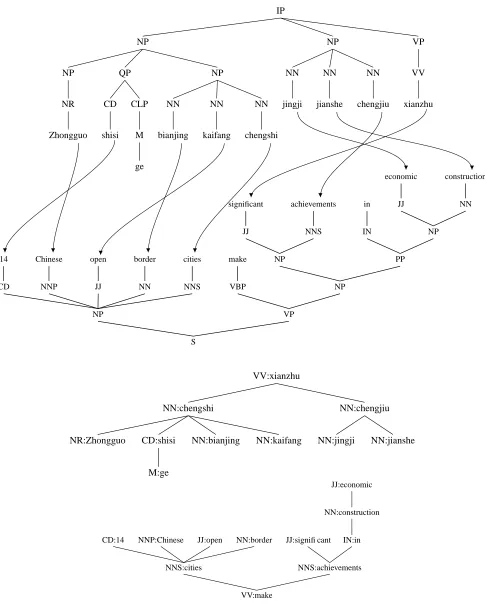
Figure 1 shows a typical Xinhua newswire tence with the Chinese parser output, and the sen-tence’s English translation with its parse tree. The conversion to dependency representation is shown below the original parse trees.
Examination of the trees shows both cases where the dependency representation is more similar across the two languages, as well as its potential pitfalls. The initial noun phrase, “14 Chinese open border cities” has two subphrases with a level of constituent structure (the QP and the lower NP) not found in the English parse. In this case, the difference in constituent structure derives primar-ily from differences in the annotation style between the original English and Chinese treebanks (Marcus et al., 1993; Xue and Xia, 2000; Levy and Man-ning, 2003). These differences disappear in the con-stituent representation. In general, the number of levels of constituent structure in a tree can be rela-tively arbitrary, while it is easier for people (whether professional syntacticians or not) to agree on the word-to-word dependencies.
In some cases, differences in the number of level may be handled by the tree-to-tree model, for ex-ample by grouping the subject NP and its base NP child together as a single elementary tree. How-ever, this introduces unnecessary variability into the alignment process. In cases with large difference in the depths of the two trees, the aligner may not be able to align the corresponding terminal nodes because only one merge is possible at each level. In this case the aligner will clone the subtree, at an even greater cost in probability.
The rest of our example sentence, however, shows cases where the conversion to dependency structure can in some cases exacerbate differences in constituent structure. For example, jingji and
jianshe are sisters in the original constituent
struc-ture, as are their English translations, economic and
construction. In the conversion to Chinese
depen-dency structure, they remain sisters both dependent on the noun chengjiu (achievements) while in En-glish, economic is a child of construction. The correspondence of a three-noun compound in
Chi-nese to a noun modified by prepositional phrase and an adjective-noun relation in English means that the conversion rules select different heads even for pieces of tree that are locally similar.
3.1 The Dependency Alignment Model
While the basic tree-to-tree alignment algorithm is the same for dependency trees, a few modifications to the probability model are necessary.
First, the lexical translation operation takes place at each node in the tree, rather than only at the leaves. Lexical translation probabilities are main-tained for each word pair as before, and the lexical translation probabilities are included in the align-ment cost for each elealign-mentary tree. When both el-ementary trees contain two words, either alignment is possible between the two. The direct alignment between nodes within the elementary tree has prob-ability1−Pswap. A new parameterPswapgives the
probability of the upper node in the elementary tree in English corresponding to the lower node in Chi-nese, and vice versa. Thus, the probability for the following transformation:
A
B
X Y
⇒ B’
A’
X Y
is factored as Pelem(AB|A⇒B) Pswap Pt(A0|A) Pt(B0|B)Palign({(1,1)(2,2)}|A⇒XY).
Our model does not represent the position of the head among its children. While this choice would have to be made in generating MT output, for the purposes of alignment we simply score how many tree nodes are correctly aligned, without flattening our trees into a string.
We further extended the tree-to-tree alignment al-gorithm by conditioning the reordering of a node’s children on the node’s lexical item as well as its syn-tactic category at the categories of its children. The lexicalized reordering probabilities were smoothed with the nonlexicalized probabilities (which are themselves smoothed with a uniform distribution). We smooth using a linear interpolation of lexical-ized and unlexicallexical-ized probabilities, with weights proportional to the number of observations for each type of event.
4 Experiments
re-IP
NP
NP
NR
Zhongguo
QP
CD
shisi CLP
M
ge
NP
NN
bianjing
NN
kaifang
NN
chengshi
NP
NN
jingji
NN
jianshe
NN
chengjiu
VP
VV
xianzhu
S NP
CD 14
NNP Chinese
JJ open
NN border
NNS cities
VP VBP
make
NP NP
JJ significant
NNS achievements
PP IN
in
NP JJ
economic
NN construction
VV:xianzhu
NN:chengshi
NR:Zhongguo CD:shisi
M:ge
NN:bianjing NN:kaifang
NN:chengjiu
NN:jingji NN:jianshe
VV:make NNS:cities
CD:14 NNP:Chinese JJ:open NN:border
NNS:achievements
JJ:significant IN:in
[image:5.595.67.552.81.689.2]NN:construction JJ:economic
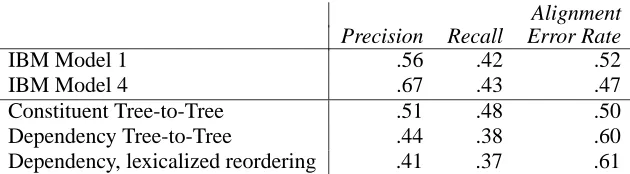
Alignment Precision Recall Error Rate
IBM Model 1 .56 .42 .52
IBM Model 4 .67 .43 .47
Constituent Tree-to-Tree .51 .48 .50
Dependency Tree-to-Tree .44 .38 .60
[image:6.595.150.465.71.158.2]Dependency, lexicalized reordering .41 .37 .61
Table 2: Alignment results on Chinese-English corpus. Higher precision and recall correspond to lower alignment error rate.
stricted ourselves to sentences of no more than 25 words in either language, resulting in a training cor-pus of 18,773 sentence pairs with a total of 276,113 Chinese words and 315,415 English words. The Chinese data were automatically segmented into to-kens, and English capitalization was retained. We replace words occurring only once with an unknown word token, resulting in a Chinese vocabulary of 23,783 words and an English vocabulary of 27,075 words. Chinese data was parsed using the parser of Bikel (2002), and English data was parsed us-ing Collins (1999). Our hand-aligned test data were those used in Hwa et al. (2002), and consisted of 48 sentence pairs also with less than 25 words in either language, for a total of 788 English words and 580 Chinese words. The hand aligned data consisted of 745 individual aligned word pairs. Words could be aligned one-to-many in either direction. This limits the performance achievable by our models; the IBM models allow one-to-many alignments in one direc-tion only, while the tree-based models allow only one-to-one alignment unless the cloning operation is used. A separate set of 49 hand-aligned sentence pairs was used to control overfitting in training our models.
We evaluate our translation models in terms of agreement with human-annotated word-level align-ments between the sentence pairs. For scoring the viterbi alignments of each system against gold-standard annotated alignments, we use the align-ment error rate (AER) of Och and Ney (2000), which measures agreement at the level of pairs of words:1
AER = 1− 2|A∩G|
|A|+|G|
whereAis the set of word pairs aligned by the auto-matic system, andGthe set aligned in the gold stan-dard. For a better understanding of how the models
1While Och and Ney (2000) differentiate between sure and
possible hand-annotated alignments, our gold standard align-ments come in only one variety.
differ, we break this figure down into precision:
P = |A∩G|
|A|
and recall:
R= |A∩G|
|G|
Since none of the systems presented in this com-parison make use of hand-aligned data, they may differ in the overall proportion of words that are aligned, rather than inserted or deleted. This affects the precision/recall tradeoff; better results with re-spect to human alignments may be possible by ad-justing an overall insertion probability in order to optimize AER.
cross-validation data, though in practice AER was nearly constant for both tree-based models after the first iteration.
5 Discussion
The constituent-based version of the alignment model significantly outperforms the dependency-based model. The IBM models outperform the con-stituent tree-to-tree model to a lesser degree, with tree-to-tree achieving higher recall, and IBM higher precision. It is particularly significant that the tree-based model gets higher recall than the other mod-els, since it is limited to one-to-one alignments un-less the clone operation is used, bounding the recall it can achieve.
In order to better understand the differences be-tween the constituent and dependency representa-tions of our data, we analyzed how well the two representations match our hand annotated alignment data. We looked for consistently aligned pairs of constituents in the two parse trees. By consistently aligned, we mean that all words within the English constituent are aligned to words inside the Chinese constituent (if they are aligned to anything), and vice versa. In our example in Figure 1, the NP “14 Chinese border cities” and the Chinese subject NP “Zhongguo shisi ge bianjing kaifang chengshi” are consistenly aligned, but the PP “in economic con-struction” has no consistently aligned constituent in the Chinese sentence. We found that of the 2623 constituents in our English parse trees (not count-ing unary consituents, which have the same bound-aries as their children), for 1044, or 40%, there ex-ists some constituent in the Chinese parse tree that is consistently aligned. This confirms the results of Fox (2002) and Galley et al. (2004) that many trans-lation operations must span more than one parse tree node. For each of our consistently aligned pairs, we then found the head word of both the Chinese and English constituents according to our head rules. The two head words correspond in the annotated alignments 67% of the time (700 out of 1044 con-sistently aligned constituent pairs). While the head-swapping operation of our translation model will be able to handle some cases of differing heads, it can only do so if the two heads are adjacent in both tree structures.
Our system is trained and test on automatically generated parse trees, which may contribute to the mismatches in the tree structures. As our test data was taken from the Chinese Treebank, hand-annotated parse trees were available for the Chinese, but not the English, sentences. Running the analy-sis on hand-annotated Chinese trees found slightly
better English/Chinese agreement overall, but there were still disagreements in the head words choices for a third of all consistently aligned constuent pairs. Running our alignment system on gold standard trees did not improve results. The comparison be-tween parser output and gold standard trees is sum-marized in Table 3.
We used head rules developed for statistical parsers in both languages, but other rules may be better suited to the alignment task. For example, the tensed auxiliary verb is considered the head of English progressive and perfect verb phrases, rather than the present or past particple of the main verb. Such auxiliaries carry agreement information rele-vant to parsing, but generally have no counterpart in Chinese. A semantically oriented dependency struc-ture, such as Tree Adjoining Grammar derivation trees, may be more appropriate for alignment.
6 Conclusion
We present a comparison of constituent and de-pendency models for tree-to-tree alignment. De-spite equalizing some mismatches in tree structure, the dependency representation does not perform as well, likely because it is less robust to large differ-ences between the tree structures.
Acknowledgments We are very grateful to
Re-becca Hwa, Hao Zhang, everyone at the 2003 John Hopkins speech and language summer research workshop, and EMNLP’s reviewers for their assis-tance, criticism, and data. This work was partially supported by NSF ITR IIS-09325646, NSF research infrastructure grant EIA-0080124, and NSF grant 0121285 to the summer workshop.
References
Daniel M. Bikel. 2002. Design of a multi-lingual, parallel-processing statistical parsing engine. In
Proceedings ARPA Workshop on Human Lan-guage Technology.
Peter F. Brown, John Cocke, Stephen A. Della Pietra, Vincent J. Della Pietra, Frederick Je-linek, John D. Lafferty, Robert L. Mercer, and Paul S. Roossin. 1990. A statistical approach to machine translation. Computational Linguistics, 16(2):79–85, June.
Peter F. Brown, Stephen A. Della Pietra, Vincent J. Della Pietra, and Robert L. Mercer. 1993. The mathematics of statistical machine translation: Parameter estimation. Computational
Linguis-tics, 19(2):263–311.
Statisti-Chinese Parse Trees Automatic Treebank
Proportion of English constits w/ consistently aligned Chinese constit .40 .42
Proportion of above with heads words aligned .67 .66
Constituent-Based AER .50 .51
[image:8.595.92.517.71.148.2]Dependency-Based AER .60 .62
Table 3: Comparison of automatically generated and hand-annotated Chinese parse trees.
cal Models for Natural Language Parsing. Ph.D.
thesis, University of Pennsylvania, Philadelphia. Yuan Ding and Martha Palmer. 2004. Automatic
learning of parallel dependency treelet pairs. In
The First International Joint Conference on Nat-ural Language Processing (IJCNLP).
Jason Eisner. 2003. Learning non-isomorphic tree mappings for machine translation. In
Proceed-ings of the 41st Meeting of the Association for Computational Linguistics, companion volume,
Sapporo, Japan.
Heidi J. Fox. 2002. Phrasal cohesion and statisti-cal machine translation. In In Proceedings of the
2002 Conference on Empirical Methods in Natu-ral Language Processing (EMNLP 2002), pages
304–311.
Michel Galley, Mark Hopkins, Kevin Knight, and Daniel Marcu. 2004. What’s in a translation rule? In Proceedings of the Human Language
Technology Conference/North American Chapter of the Association for Computational Linguistics (HLT/NAACL).
Daniel Gildea. 2003. Loosely tree-based alignment for machine translation. In Proceedings of the
41th Annual Conference of the Association for Computational Linguistics (ACL-03), pages 80–
87, Sapporo, Japan.
Rebecca Hwa, Philip Resnik, Amy Weinberg, and Okan Kolak. 2002. Evaluating translational cor-respondence using annotation projection. In
Pro-ceedings of the 40th Annual Conference of the Association for Computational Linguistics (ACL-02).
Roger Levy and Christopher Manning. 2003. Is it harder to parse Chinese, or the Chinese Tree-bank? In Proceedings of the 41th Annual
Con-ference of the Association for Computational Lin-guistics (ACL-03), Sapporo, Japan.
Mitchell P. Marcus, Beatrice Santorini, and Mary Ann Marcinkiewicz. 1993. Building a large annotated corpus of English: The Penn treebank. Computational Linguistics, 19(2):313– 330, June.
Franz Josef Och and Hermann Ney. 2000. Im-proved statistical alignment models. In
Proceed-ings of the 38th Annual Conference of the Asso-ciation for Computational Linguistics (ACL-00),
pages 440–447, Hong Kong, October.
Dekai Wu. 1997. Stochastic inversion transduction grammars and bilingual parsing of parallel cor-pora. Computational Linguistics, 23(3):377–403. Nianwen Xue and Fei Xia. 2000. The bracketing guidelines for the penn chinese treebank. Tech-nical Report IRCS-00-08, IRCS, University of Pennsylvania.
Kenji Yamada and Kevin Knight. 2001. A syntax-based statistical translation model. In
Proceed-ings of the 39th Annual Conference of the Asso-ciation for Computational Linguistics (ACL-01),