Abstract—Lindane, an organochlorine pesticide, can remain for a long period of time in soil matrix due to its interactions with soil organic matter, and its poor solubility in water (7 mg per L); this represents a danger for human health as it was one of the most used pesticides in the last decade throughout the world. Cyclodextrins are natural molecules obtained from the enzymatic degradation of starch. They have a hydrophilic surface and a hydrophobic cavity, in which guest hydrophobic substances can enter. This phenomenon is called inclusion complexation. In this work the behavior of cyclodextrins as lindane solubility improvers in a soil washing remediation technique was studied, finding that these substances can enhance water lindane solubility up to more than 3 times its normal water solubility.
Index Terms—Lindane, cyclodextrin, soil remediation, desorption.
I. INTRODUCTION
Lindane, common name given to the γ isomer of 1,2,3,4,5,6-hexachlorocyclohexane (fig. 1), can remain for a long period of time in soils where it has been applied as a pesticide to treat plagues, this process depends on the kind of soil [1]-[3] and its organic matter (OM) content. This represents a worldwide problem due to the damages lindane can cause to human health [4], [5]. Therefore, it is very important to develop environment-friendly techniques to remediate lindane contaminated soils.
Cl
Cl
Cl
Cl
Cl
Cl
Figure 1. Chemical structure of lindane
Manuscript received June 23, 2008. This work was fully supported by the Escuela Superior de Ingeniería Química e Industrias Extractivas Postgraduate Section of the Instituto Politécnico Nacional.
B. B. and N. M. E. Authors are with the Instituto Politécnico Nacional, México, D. F. 07738 Mexico (phone: +52-5557-296-000 ext. 55283; e-mail: ([email protected], [email protected]).
E. R. Author is with the Department of Biotechnology and Engineering, CINVESTAV-IPN, México, D. F. 07320 Mexico (e-mail:
Several investigations have been made in order to find pesticide degradation techniques, however, a general method, which works with all kind of contaminants that may be present in soil, has not yet been found. Some of these works imply the use of microorganisms to degrade pesticides, but unfortunately this kind of technology has some disadvantages such as slow degradation rate, growth and survival of microorganisms at the system conditions, among others [6]. Another technique is chemical degradation, which can be performed by photolytic [7], electrochemical [8] or ozonation processes. Nevertheless, this kind of technologies requires the design of specific catalytic systems [9]; besides, lindane has a very low rate reaction constant with ozone [10]. Another technique used is soil washing remediation, and one of the most used procedures for this matter is the use of surfactants, but even though this technique is considered one of the most efficient for contaminated soil remediation, surfactants are not natural compounds, and there can be potential losses of it in soil. In contrast with surfactants, many authors have proved that cyclodextrins (CDs) do not interact with soils [11]. These substances are produced by the enzymatic degradation of starch [12], and they are formed by α–D-glucosidal units. α-,
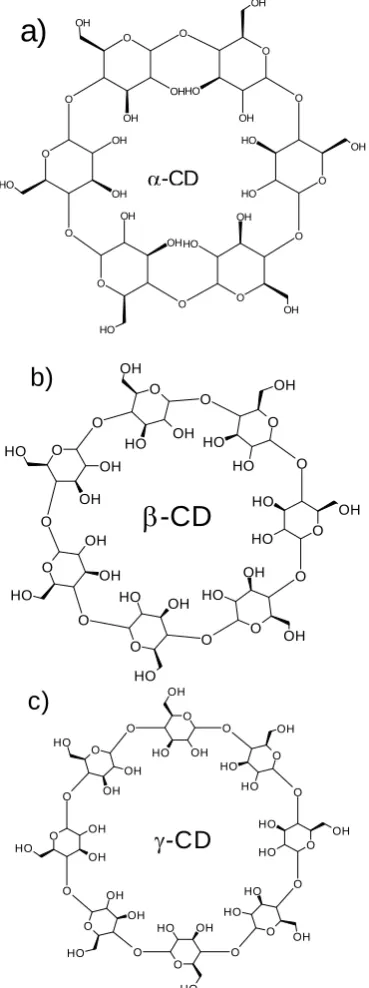
β-, and γ-CDs are the most important ones, having 6, 7, and 8 units respectively (fig. 2.). CDs are substances having interesting features because, due to their atom orientation, they have a hydrophilic surface and a hydrophobic cavity, in which a guest molecule can enter; this phenomenon is called inclusion complexation. This feature has been well implemented when improving water solubility of organic substances, as well as in the treatment of contaminated sites by pesticides, polycyclic aromatic hydrocarbons, colorants, heavy metals, among others [13], [14].
In this work a soil washing technique to remediate a lindane contaminated soil using CD aqueous solutions was studied. The first stage was to characterize the soil, and obtain from it a soil with no OM to observe its affect on adsorption-desorption behavior, then a study on the effect of CD aqueous solutions on lindane water solubility was done. Finally, the contaminated soil was washed with CD aqueous solutions in Batch and column systems.
Enhanced Desorption of Lindane from an
Agricultural Soil Assisted by Cyclodextrin
Aqueous Solutions
O O O O OH OH O O OH O H O O OH O H O O OH OH O O H OH O O H OH OH OH O H O H OH OH α-CD
a)
O O O O O H O H O O O O O OH OH O O H OH O OH OH O OH O H O O H O H O OH O H O H OH OH OH OH O H O Hβ
-CD
b)
O O O O O H O H OH O O O O O O OH OH O H O OH OH O H O OH OH O H O OH O H O H O O H O H OH O O H O H OH O O H OH OHγ
-CD
c)
Figure 2 Chemical structures of a) α-, b) β-, and c) γ-CDs
II. SYSTEM DESCRIPTION
A. Obtaining of Model Soil
In order to observe the influence of OM along this study, a soil model, without OM, was obtained from the agricultural soil (real soil), in order to do this, 300 g of real soil were place in a porcelain basin and then incinerated in an oven at 823 K for 24 hours.
B. Soil Characterization
The soil parameters measured for the two types of soils were pH [15], electric conductivity [16], cation exchange capacity [17], moisture [18], water retention capacity [19], texture [20], OM [21], hydrophobicity [22], and X-ray diffraction according to the methodology previously reported. The heavy metal content was measured only for real soil since model soil was obtained from it.
C. Lindane Calibration Curve using a Gas
Chromatographer (CG) with Capture Electron Detector (ECD)
In order to quantify lindane concentrations along this study, a calibration curve was made using a Perkin Elmer GC model N611-9000 equipped with ECD. The method used in the chromatographer is shown in table I.
Table I. Chromatographic Conditions
Oven Temperature (K) 483 Injector Temperature (K) 513 Detector Temperature (K) 623 Carrier Gas Nitrogen at 10 psi Time of analysis 11 minutes
The column installed in the CG was an Alltech Heliflex AT-1301 capillary column. Due to poor water lindane solubility, a stock solution of 100 ppm of lindane in methanol was prepared. Dilutions of the stock solution were made to achieve final concentrations of 25, 15, 13, 10, 7, 5, 3, 1, and 0.5 ppm of lindane. The volume of the injections was 1 μL using a 10 μL syringe brand Hamilton model Microliter #701. All injections were made in triplicate.
D. Kinetics of Lindane Solubility in CD Solutions
A solution of CD at a concentration of 2.41x10⁻⁴ M was
prepared. This concentration was chosen because it keeps a 10:1 CD-lindane molar ratio to the maximum amount of lindane soluble in water (7 mg per L). Twenty five mL of solution were put in an amber bottle (to avoid light through the solution), lindane was added and the bottle was capped and taken to a Gemmyco Shaking Lab Incubator model IN-666 at 250 rpm, samples were taken along the time line and lindane was quantified with CG until equilibrium was observed. Once the time when equilibrium is reached was known, solutions of CDs at concentrations of 2.41x10⁻⁵ M
and 2.41x10⁻⁶ M were prepared. These concentrations keep
1:1 and 1:10 CD-lindane molar ratios respectively to the maximum amount of lindane soluble in water. Twenty five milliliters of each solution were put in amber bottles, lindane was added and they were shaken for 700 minutes, samples were taken and quantified with GC. This was done for each kind of CD. Each experiment was done in triplicate.
E. Kinetics of Lindane Adsorption on Soils
Due to poor water lindane solubility, a solution of lindane in methanol at a concentration of 25 ppm was prepared. Twenty g of real and model soil were placed in amber bottles containing 200 mL of 25 ppm lindane solution. The bottles were shaken at 250 rpm, samples were taken along the time line and lindane was quantified with CG until equilibrium was observed. Once the time when equilibrium is reached was known, 200 mL of 25 ppm lindane solution were added to 5, 10 and 15 g of each kind of soil, they were shaken for 5000 minutes, then samples were taken and lindane was quantified with GC. Each experiment was done in triplicate.
F. Kinetics of Lindane Desorption from Soils using Aqueous CD Solutions in a Batch System
[image:2.595.316.540.157.225.2]supernatant was separated and the remaining soil was dried in an oven at 323 K. A sample of 50 g was taken and put in an amber bottle; 50 mL of CD solution at a concentration of 2.4x10⁻⁴ M were added. This was done for natural and model
soil separately. The bottles were shaken at 250 rpm, samples were taken along the time line and lindane was quantified with CG until equilibrium was observed. Once the time when equilibrium is reached was known, samples of 50 g of both contaminated soils were taken into amber bottles, to which 50 mL of CD solutions at concentrations of 2.4x10⁻⁵ and
2.4x10⁻⁶ were added, this was done for each kind of
[image:3.595.306.548.152.511.2]cyclodextrin. They were shaken for 5500 minutes; samples were taken and lindane was quantified with GC. Temperature was not controlled. Each experiment was done in triplicate. This procedure is well ilustrated in fig. 3
Figure 3. Batch system used along this study
G. Kinetics of Lindane Desorption from Soils using Aqueous CD Solutions in a Column System
Three samples of 50 g of contaminated soil were taken and with them, a column was packed, then 50 mL of CD solution at a concentration of 2.4x10⁻⁴ M were forced to pass through
the column, samples were taken at the output stream after 1st,
5th, and 10th refluxes and lindane was quantified by CG. This
was done for each kind of CD and soil. Then columns were packed with 50 g of contaminated soil and 50 mL of CD solution at concentrations of 2.4x10⁻⁵ and 2.4x10⁻⁶ M passed
through the column and back fed 10 times, after all the refluxes were achieved, samples were taken and lindane was quantified by CG. This was done for each kind of CD and soil. Each experiment was done in triplicate.
III. RESULTS AND DISCUSSION
A. Soil Characterization
Soil was not contaminated by heavy metals, and the content for this matter was in the range according to Mexican regulations. This is important because heavy metals could compete for the space into the CD cavity with lindane [23], [24]. The soil heavy metal content is shown in table II.
Table II. Soil heavy metal content
Metal Soil Content (ppm)
Lead 0.011 Manganese 0.265 Zinc 0.044 Iron 11.05 Copper 0.067 Chromium 0.0.19
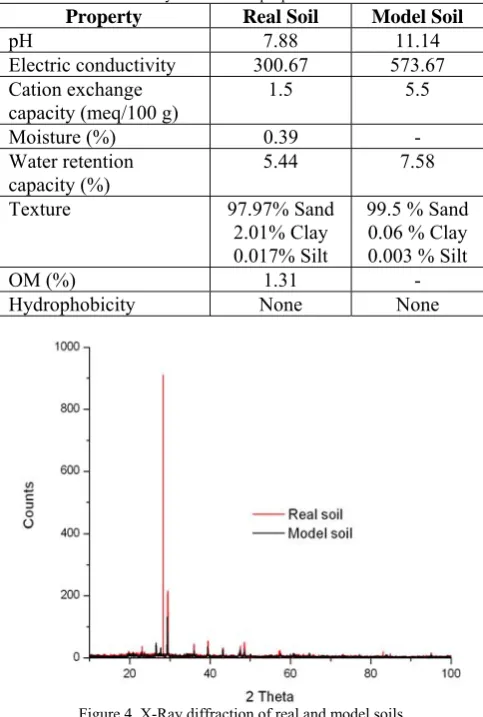
After elimination of OM, which was done in order to observe its influence along this study, the two soils had different properties (table III), which indicates a change in their compositions, therefore, corroborates elimination of OM. X-Ray diffraction figures also show a decrease in the composition of the two soils, with calcite and quartz being the most important components of both (fig. 4).
Table III. Physicochemical properties of the soils
Property Real Soil Model Soil
pH 7.88 11.14
Electric conductivity 300.67 573.67 Cation exchange
capacity (meq/100 g)
1.5 5.5
Moisture (%) 0.39 -
Water retention
capacity (%) 5.44 7.58
Texture 97.97% Sand
2.01% Clay 0.017% Silt
99.5 % Sand 0.06 % Clay 0.003 % Silt
OM (%) 1.31 -
Hydrophobicity None None
Figure 4. X-Ray diffraction of real and model soils
B. Lindane Calibration Curve using a Gas
Chromatographer (CG) with Capture Electron Detector (ECD)
[image:3.595.89.249.251.374.2] [image:3.595.325.530.616.786.2]C. Kinetics of Lindane Solubility in CD Solutions
[image:4.595.306.547.49.259.2]As shown in fig. 6, we observed that γ-CD could improve water lindane solubility up to more than 23 ppm, i.e., a little more than 3 times normal water lindane solubility, α, and β-CDs had similar behaviors and they could improve water lindane solubility up to 13 ppm.
Figure 6. Lindane solubility in aqueous solutions of α-, β- and γ-CDs
[image:4.595.50.287.134.336.2]D. Kinetics of Lindane Adsorption on Soils
[image:4.595.308.545.383.578.2]Figure 7 shows that model soil presents more lindane adsorption than real soil, this is probably because the spaces where OM was before eliminating it where filled with the pesticide molecules.
Figure 7. Lindane retention on real and model soils
E. Kinetics of Lindane Desorption from Soils using Aqueous CD Solutions in a Batch System
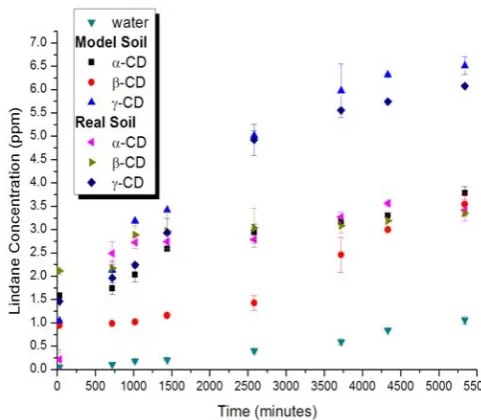
Lindane desorptions from soils using Batch systems are
shown in fig. 8 for real soil and model soil, we can see that
γ-CD had a very good performance in both cases, this is probably because it has the biggest cavity volume comparing it to α-, and β-CDs, which had similar behaviors removing lindane from contaminated soils, water had a poor performance. We observe also that CDs had better performances in model soil than in real soil; this is probably due to the lack of OM in model soil with witch contaminants can interact and form bonds.
Figure 8. Lindane desorption from soils using CDs solutions and water in a
Batch system
F. Kinetics of Lindane Desorption from Soils using Aqueous CD Solutions in a Column System
In fig. fig. 9 lindane desorptions are shown, CDs had similar behaviors as in Batch systems, i.e., γ-CD had the best
performance and α-, and β-CDs had similar behaviors. In this study we could also observed that CDs had better performances in model soil that in real soil.
Figure 9. Lindane desorption from soils using CDs solutions and water in a column system
G. Conclusion
[image:4.595.51.282.420.620.2]ACKNOWLEDGMENT
B. B. Author thanks CONACYT for the scholarship granted to him, as well as, Miriam Gómez, Arizbeth Pérez, and Ricardo Santillán from the Environmental Engineering Research Laboratory of the Instituto Politécnico Nacional Postgraduate Section, Mr. Cirino Rojas for his help in Chromatographic Analysis and Dr. Carlos Lobato from the University of Tabasco for his advices.
REFERENCES
[1] I. C. MacRae, K. Raghu, and T. F. Castro, “Persistence and biodegradation of four common isomers of benzene hexachloride in submerged soils,” J. Agric. Food Chem., vol. 15 (5), 1967, pp 911–914 [2] S. Voerman, and A. F. H. Besemer, “Residues of dieldrin, lindane, DDT, and parathion in a light sandy soil after repeated application throughout a period of 15 years,” J. Agric. Food Chem., vol. 18 (4),
1970, pp 717–719
[3] E. P. Lichtenstein, T. W. Fuhremann, and K. R. Schulz, “Persistence and vertical distribution of DDT, lindane, and aldrin residues, 10 and 15 years after a single soil application,” J. Agric. Food Chem., vol. 19 (4), 1971, pp 718–721
[4] K. Muir, S. Rattanamongkolgul, M. Smallman, M. Thomas, S. Downer, and C. Jenkinson, “Breast cancer incidence and its possible spatial association with pesticide application in two counties of England,”
Public Health, vol. 118, 2004, pp 513–520
[5] K. F. Rivett, H. Chesterman, D. N. Kellett, A. J. Newman, N. Alastair, “Worden effects of feeding lindane to dogs for periods of up to 2 years,” Toxicology, vol. (3), 1978, pp 273-289,
[6] G. Jozefaciuk, A. Muranyi, and E. Fenyvesi, “Effect of randomly methylated β-cyclodextrin on physical properties of soils,” Environ. Sci. Technol., vol 37 (3), 2003, pp 3012-3017
[7] V. Balakrishnan, E. Buncel, and G. Vanloon, “Micellar catalyzed degradation of fenitrothion, an organophosphorous pesticide, in solution and soils,” Environ. Sci. Technol., vol. 39, 2005, pp 5824-5830
[8] B. Gözmen, M. A. Oturan, N. Oturan, and O. Erbatur, “Indirect electrochemical treatment of bisphenol: A in water via electrochemically generated Fenton’s reagent,” Environ. Sci. Technol., vol. 37, 2003, 3716-3723
[9] G. Boschin, A. D'Agostina; C. Antonioni, D. Locati, and A. Arnoldi, “Hydrolytic degradation of azimsulfuron, a sulfonylurea herbicide,”
Chemosphere, vol. 68, (2007), pp 1312-1317
[10] K. Ikehata, and M. Gamal, “Aqueous pesticide degradation by ozonation and ozone-based advanced oxidation proceses: A review (Part 1),” Ozone Sci. Eng., vol. 27, 2005, pp 83-114
[11] Q. Zeng, H. Tang, B. Liao, T. Zhong, and C. Tang, “Solubilization and desorption of methyl-parathion from porous media: A comparison of hydroxypropyl-β-cyclodextrin and two nonionic surfactants,” Water Research., vol. 40, 2006, pp 1351–1358
[12] E. Ozmen, and M. Yilmaz, “Use of β-cyclodextrin and starch based polymers for sorption of Congo red from aqueous solutions,” J. of Hazardous Materials, vol. 148, 2007, pp 303-310
[13] S. Ishiwata, and M. Kamiya, “Cyclodextrin inclusion: Catalytic effects on the degradation of organophosphorous pesticides in neutral aqueous solution,” Chemosphere, vol. 39, pp 1595-1600
[14] C. Viglianti, K. Hanna, C. De Brauer, and P. Germain, “Removal of polycyclic aromatic hydrocarbons from aged-contaminated soil using cyclodextrins: Experimental study,” Environ. Pollution, vol. 140, 2006, pp 427-435
[15] H. Rütters, A. Höllrigl, R. Kreuzig, and M. Bahadir, ”Sorption Behavior of Prochloraz in Different Soils,” J. Agric. Food Chem., vol
47, 1999,pp 1242-1246
[16] R. McBride, A. Gordon, and S. Shrive, “Estimating forest soil quality from terrain measurements of apparent electrical conductivity,” Soil Sci. Soc. Amer. J., vol. 54, 1990, pp 290-293.
[17] L. Fenn, and D. Kissel, “The Influence of Cation Exchange Capacity and Depth of Incorporation on Ammonia Volatilization from Ammonium Compounds Applied to Calcareous Soils,” Soil Sci. Soc. Am. J., vol. 40, 1976, pp 394-398
[18] W. Marlatt, and F. Binkowski, “A Rapid Method for Calculating Soil Moisture Content from Gravimetric Samples,” Agron. J., vol. 53, 1961, pp 134-137
[19] AOAC, Official Methods of Analysis of the Association of Official Analytical Chemists, 13th Edition, 1980, Washington, DC, EUA
[20] G. J. Bouyoucos, “Directions for making mechanical analyses of soils by the hydrometer method,” Soil Sci., vol. 42, 1936, pp 225-228
[21] ASTM, “Method D2974-87, Standard Test Method for Moisture, Ash, and Organic Matter of Peat and Other Organic Soils” 1987
[22] U. Buczko, and O. Bens,
“Assessing Soil Hydrophobicity and Its Variability through the Soil Profile Using Two Different Methods,”
Soil. Sci. Soc. Am. J., vol. 70, 2006, pp 718-727
[23] S. Ehsan, S. Prasher, and W. Marshall, “Simultaneous mobilization of heavy metals and polychlorinated biphenyl (PCB) compounds from soil with cyclodextrin and EDTA in admixture,” Chemosphere, vol. 68,
2007, pp 150–158