CORE: Context-Aware Open Relation Extraction
with Factorization Machines
Fabio Petroni
Sapienza University of Rome Rome, Italy
Luciano Del Corro
Max Planck Institute for Informatics Saarbr¨ucken, Germany
Rainer Gemulla
University of Mannheim Mannheim, Germany
Abstract
We propose CORE, a novel matrix fac-torization model that leverages contextual information for open relation extraction. Our model is based on factorization ma-chines and integrates facts from various sources, such as knowledge bases or open information extractors, as well as the con-text in which these facts have been ob-served. We argue that integrating contex-tual information—such as metadata about extraction sources, lexical context, or type information—significantly improves pre-diction performance. Open information extractors, for example, may produce ex-tractions that are unspecific or ambiguous when taken out of context. Our experi-mental study on a large real-world dataset indicates that CORE has significantly bet-ter prediction performance than state-of-the-art approaches when contextual infor-mation is available.
1 Introduction
Open relation extraction(open RE) is the task of extracting new facts for a potentially unbounded set of relations from various sources such as knowledge bases or natural language text. The task is closely related totargeted information ex-traction(IE), which aims to populate a knowledge base (KB) with new facts for the KB’s relations, such as wasBornIn(Sepp Herberger, Mannheim). Existing methods either reason within the KB it-self (Franz et al., 2009; Nickel et al., 2011; Dru-mond et al., 2012) or leverage large text corpora to learn patterns that are indicative of KB rela-tions (Mintz et al., 2009; Surdeanu et al., 2012; Min et al., 2013). In both cases, targeted IE meth-ods are inherently limited to an (often small) set of predefined relations, i.e., they are not “open”.
The open RE task is also related to open infor-mation extraction(open IE) (Banko et al., 2007; Del Corro and Gemulla, 2013), which extracts large amounts of surface relations and their ar-guments from natural language text; e.g., “critiz-ices”(“Dante”, “Catholic Church”).1 Although
open IE is a domain-independent approach, the ex-tracted surface relations are purely syntactic and often ambiguous or noisy. Moreover, open IE methods usually do not “predict” facts that have not been explicitly observed in the input data. Open RE combines the above tasks by predicting new facts for an open set of relations. The key challenge in open RE is to reason jointly over the universal schema consisting of KB relations and surface relations (Riedel et al., 2013).
A number of matrix or tensor factorization mod-els have recently been proposed in the context of relation extraction (Nickel et al., 2012; Riedel et al., 2013; Huang et al., 2014; Chang et al., 2014). These models use the available data to learn la-tent semantic representations of entities (or entity pairs) and relations in a domain-independent way; the latent representations are subsequently used to predict new facts. Existing models often focus on either targeted IE or open RE. Targeted mod-els are used for within-KB reasoning; they rely on the closed-world assumption and often do not scale with the number of relations. Open RE mod-els use the open-world assumption, which is more suitable for the open RE task because the avail-able data is often highly incomplete. In this paper, we propose CORE, a novel open RE factorization model that incorporates and exploits contextual in-formation to improve prediction performance.
Consider for example the sentence “Tom Peloso joined Modest Mouse to record their fifth studio album”. Open IE systems may extract the sur-face fact“join”(TP, MM) from this sentence. Note 1We mark (non-disambiguated) mentions of entities and relations in quotation marks throughout this paper.
that surface relation “join” is unspecific; in this case, it refers to becoming a member of a music band (as opposed to, say, an employee of a com-pany). Most existing open RE systems use the extracted surface fact for further reasoning, but they ignore the context from which the fact was extracted. We argue in this paper that exploiting contextual information is beneficial for open RE. For our example, we may use standard NLP tools like a named entity recognizer to detect that TP is a person and MM an organization. These coarse-grained types give us hints about the domain and range of the “join” relation for the surface fact, al-though the actual meaning of “join” still remains opaque. Now imagine that the above sentence was extracted from a newspaper article published in the music section. This information can help to infer that “join” indeed refers to joining a band. Other contextual information, such as the words “record” and “album” that occur in the sentence, further strengthen this interpretation. A context-aware open RE system should leverage such in-formation to accurately predict facts like “is band member of”(TP, MM) and “plays with”(TP, MM). Note that the prediction of the fact “is band member of”(TP, MM) is facilitated if we make use of a KB that knows that TP is a musician and MM is a music band. If TP and/or MM are not present in the knowledge base, however, such a reason-ing does not apply. In our work, we consider both linkedentities(in-KB) and non-linkedentity men-tions(out of-KB). Since KB are often incomplete, this open approach to handle named entities allows us to extract facts for all entities, even if they do not appear in the KB.
In this paper, we propose CORE, a flexible open RE model that leverages contextual infor-mation. CORE is inspired by the combined fac-torization and entity model (FE) of Riedel et al. (2013). As FE, CORE associates latent semantic representations with entities, relations, and argu-ments. In contrast to FE, CORE uses factorization machines (Rendle, 2012) as its underlying frame-work, which allows us to incorporate context in a flexible way. CORE is able to leverage and inte-grate arbitrary contextual information associated with the input facts into its open RE factoriza-tion model. To support reasoning under the open-world assumption, we propose an efficient method for parameter estimation in factorization machines based on Bayesian personalized ranking (Rendle
et al., 2009).
We conducted an experimental study on a real-world dataset using contextual information along the lines mentioned above. Our model is exten-sible, i.e., additional contextual information can be integrated when available. Even with limited amount of contextual information used in our ex-periments, our CORE model provided higher pre-diction performance than previous models. Our findings validate the usefulness of contextual in-formation for the open RE task.
2 Related Work
There is a large body of related work on relation extraction; we restrict attention to methods that are most similar to our work.
Targeted IE. Targeted IE methods aim to ex-tract from natural-language text new instances of a set of predefined relations, usually taken from a KB. Most existing methods make use of distant supervision, i.e., they start with a set of seed in-stances (pairs of entities) for the relations of inter-est, search for these seed instances in text, learn a relation extractor from the so-obtained training data, and optionally iterate (Mintz et al., 2009; Surdeanu et al., 2012; Min et al., 2013). Open RE models are more general then targeted IE meth-ods in that they additionally reason about surface relations that do not correspond to KB relations. For this reason, Riedel et al. (2013) argued and experimentally validated that open RE models can outperform targeted IE methods.
Open IE. In contrast to targeted IE, the goal of open IE is to extract all (or most) relations ex-pressed in natural-language text, whether or not these relations are defined in a KB (Banko et al., 2007; Fader et al., 2011; Del Corro and Gemulla, 2013). The facts obtained by open IE meth-ods are often not disambiguated, i.e., the enti-ties and/or the relation are not linked to a knowl-edge base; e.g., “criticizes”(“Dante”, “Catholic Church”). The goal of our work is to reason about extracted open-IE facts and their contextual infor-mation. Our method is oblivious to the actual open IE method being used.
et al., 2011; Takamatsu et al., 2011; Min et al., 2012; Akbik et al., 2012; de Lacalle and La-pata, 2013). For example, if “criticizes” and “hates” are clustered together, then we may pre-dict “hates”(“Dante”, “Catholic Church”) from the above fact (which is actually not true). The general problem with relation clustering is its “black and white” approach to relations: either two relations are the same or they are different. This assumption generally does not hold for the surface relations extracted by open IE systems (Riedel et al., 2013); examples of other types of relationships between relations include implication or mutual exclusion.
Tensor factorization. Matrix or tensor factor-ization approaches try to address the above prob-lem: instead of clustering relations, they directly predict facts. Both matrix and tensor models learn and make use of semantic representations of rela-tions and their arguments. The semantic represen-tations ideally captures all the information present in the data; it does not, however, establish a direct relationship (such as synonymy) between different KB or surface relations.
Tensor factorization models conceptually model the input data as a subject×relation×object tensor, in which non-zero values correspond to input facts. The tensor is factored to construct a new tensor in which predicted facts take large non-zero values. Examples of such tensor fac-torization models are TripleRank (Franz et al., 2009), RESCAL (Nickel et al., 2011; Nickel et al., 2012), or PITF (Drumond et al., 2012). Tensor factorization models are generally well-suited to reason within a KB because they are able to pre-dict relations between arbitrary pairs of subjects and objects. In the context of open RE, however, these methods suffer from limited scalability with the number of relations as well as from their large prediction space (Chang et al., 2014).
Matrix factorization. The key difference be-tween matrix and tensor factorization models is that the former restrict the prediction space, i.e., these models generally cannot predict arbitrary facts. Similar to distant supervision approaches, matrix factorization models focus on predicting facts for which some direct evidence exists. In more detail, most methods restrict the prediction space to the set of facts for which the subject and the object share at least some relation in the input data. For this reason, matrix factorization models
are not suited for in-KB reasoning; an individual pair of entities usually does not occur in more than one KB relation. In the open RE context, how-ever, input relations are semantically related so that many subject-object pairs belong to multiple relations. The key advantage of matrix methods is (1) that this restriction allows them to use addi-tional features—such as features for each subject-object pair—and (2) that they scale much better with the number of relations. Examples of such matrix factorization models include (Tresp et al., 2009; Jiang et al., 2012; Fan et al., 2014; Huang et al., 2014). Chang et al. (2014) have also shown that a combination of matrix and tensor factoriza-tion models can be fruitful. Closest to our work is the “universal schema” matrix factorization ap-proach of Riedel et al. (2013), which combines a latent features model, a neighborhood model and an entity model but does not incorporate context. Our CORE model follows the universal schema idea, but uses a more general factorization model, which includes the information captured by the la-tent features and entity model (but not the neigh-borhood model), and incorporates contextual in-formation.
Using contextual information. It is well known that contextual information can improve IE meth-ods. Information such as bag-of-words, part-of-speech tags, entity types, or parse trees have been integrated into many existing systems (Mintz et al., 2009; Zhang et al., 2012; Takamatsu et al., 2011; Zhou et al., 2007; de Lacalle and Lapata, 2013; Akbik et al., 2012). Our work differs in that we integrate contextual information into an open RE system. To do so, we leverage factoriza-tion machines (Rendle et al., 2011; Rendle, 2012), which have been successfully applied to exploit contextual information in the context of recom-mender systems. We show how to model open RE data and context with factorization machines and provide a method for parameter estimation under the open-world assumption.
3 The CORE Model
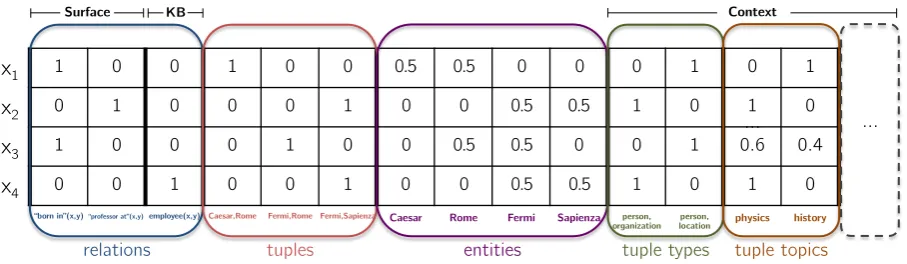
1 0 0 1 0 0 0.5 0.5 0 0 0 1 0 1
0 1 0 0 0 1 0 0 0.5 0.5 1 0 1 0
1 0 0 0 1 0 0 0.5 0.5 0 0 1 0.6 0.4
0 0 1 0 0 1 0 0 0.5 0.5 1 0 1 0
“born in”(x,y) employee(x,y) Caesar,Rome Fermi,Rome Fermi,Sapienza Caesar Rome Fermi Sapienza person,
organization locationperson, physics history
relations tuples entities tuple types tuple topics
x1
x2
x3
x4
Surface KB Context
… …
[image:4.595.72.526.60.192.2]“professor at”(x,y)
Figure 1: Example for representing a context-aware open RE problem with CORE
topic:music, word:record, word:album, . . .}). De-note byR the set of all observedrelations, byE the set of all observedentities, and byT ⊆E×E the set of all observed entity pairs, which we refer to as tuples. Afact takes form r(t) and is com-posed of a relationr ∈ Rand a tuplet∈ T; e.g., “join”(TP, MM). Note that there may be multiple observations for a fact. Finally, denote byC the set of allcontextual variables; each observation is associated with a setc ⊆ C of context variables. In this paper we restrict attention to categorical context variables; our model can potentially han-dle continuous context as in (Renhan-dle, 2012). Problem definition. The open RE task is to pro-duce a ranked list of tuplesTr ⊆T for each
rela-tionr∈R; the list is restricted to new tuples, i.e., tuplest∈T for whichr(t)has not been observed in the input. The rank of each tuple reflects the model’s prediction of the likelihood that the corre-sponding fact is indeed true. A good model thus ranks correct facts higher than incorrect ones. Modeling facts. Denote byV =R∪T∪E∪C the set of all observed relations, tuples, entities, and contextual variables. For ease of exposition, we refer to the elements of V as variables. We model the input data in terms of a matrix in which each row corresponds to a fact (i.e., not an obser-vation) and each column to a variable. We group columns according to the type of the variables; e.g, there are relation columns, tuple columns, entity columns, and a group of columns for each type of contextual information. The matrix is populated such that in each row the values of each column group sum up to unity, i.e., we normalize values within column groups. In particular, we set to 1 the values of the variable of the relation and the tuple of the corresponding fact. We set to0.5the variables corresponding to the two entities referred
to by the fact. An example is shown in Fig. 1. Here the first row, for instance, corresponds to the fact “born in”(Caesar, Rome). Note that we model tuples and entities separately: the entity variables expose which arguments belong to the fact, the tu-ple variables expose their order.
as-sociated with each fact is given by the aggregated, normalized context of its tuple.
Fig. 1 shows context information arranged in two groups: tuple types and tuple topics. We cap-ture information such as that the tuple (Caesar, Rome) has only been seen in articles on history or that tuple (Fermi, Rome) is mentioned in both physics and history articles (slightly more often in the former). Since context is associated with tu-ples, facts 2 and 4 on (Fermi, Sapienza) share con-textual information. This form of context sharing (as well as entity sharing) allows us to propagate information about tuples across various relations. Factorization model. CORE employs a matrix factorization model based on factorization ma-chines and the open-world assumption to capture latent semantic information about the individual variables. In particular, we associate with each variable v ∈ V a bias termbv ∈ Rand a latent
feature vectorfv ∈Rd, where thedimensionality
dof the latent feature space is a hyperparameter of our model. Denote byXthe set of rows in the in-put matrix, which we henceforth refer to as train-ing points. For each traintrain-ing pointx∈X, denote by xv the value of variablev ∈ V in the
corre-sponding row of the matrix. Our model associates with training pointx ∈Xascores(x)computed as follows:
s(x) =X
v∈V
xvbv+ X
v1∈V X
v2∈V\{v1}
xv1xv2fTv1fv2 (1)
Here the bias terms models the contribution of each individual variable to the final score, whereas the latent feature vectors model the contribution of all pairwise interactions between variables. Note that only bias terms and feature vectors corre-sponding to non-zero entries inxaffect the score and thatxis often sparse. Since we can compute s(x)in time linear to both the number of nonzero entries in x and the dimensionality d (Rendle, 2012), score computation is fast. As discussed below, we (roughly) estimate bias terms and fea-ture vectors such that observed facts achieve high scores. We may thus think of each feature vector as a low-dimensional representation of the global information contained in the corresponding vari-able.
Prediction. Given estimates for bias terms and latent feature vectors, we rank unobserved facts as follows. Fix a relationr ∈ R and a tuplet ∈ T
such thatr(t)has not been observed. As indicated above, our model overcomes the key problem that there is no observation, and thus no context, for r(t) by context aggregation and sharing. In par-ticular, we create an test pointxˆ for tupler(t) in a way similar to creating data points, i.e., we set the relation, tuple, and entity variables accordingly and add the aggregated, normalized context oft. Once test pointxˆhas been created, we can predict its scores(ˆx)using Eq. (1). We then rank each un-observed tuple by its so-obtained score, i.e., tuples with higher scores are ranked higher. The resulting ranking constitutes the listTrof predicted facts for
relationr.
Bayesian personalized ranking. The parame-ters of our model are given byΘ ={bv,fv |v∈
V }. In approaches based on the closed-world as-sumption,Θis estimated by minimizing the error between model predictions and target values (e.g., 1 for true facts, 0 for false facts). In our setting of open RE, all our observations are positive, i.e., we do not have negative training data. One way to handle the absence of negative training data is to associate a target value of 0 to all unobserved facts. This closed-world approach essentially as-sumes that all unobserved facts are false, which may not be a suitable assumption for the sparsely observed relations of open RE. Following Riedel et al. (2013), we adopt the open-world assump-tion instead, i.e., we treat each unobserved facts as unknown. Since factorization machines origi-nally require explicit target values (e.g., feedback in recommender systems), we need to adapt pa-rameter estimation to the open-world setting.
In more detail, we employ a variant of the Bayesian personalized ranking (BPR) optimiza-tion criterion (Rendle et al., 2009). We asso-ciate with each training pointx a set of negative samples X−
x. Each negative sample x− ∈ Xx−
is an unobserved fact with its associated context (constructed as described in the prediction section above). Generally, the negative samplesx−should
be chosen such that they are “less likely” to be true than factx. We maximize the following optimiza-tion criterion:
1
|X| X
x∈X
X
x−∈X− x
lnσ(δ(x, x−)) |X−
x| −λkΘxk
2
(2)
whereσ(x) = 1
differ-ence of scores, andΘx = {bv,fv |xv 6= 0}the
subset of the model parameters relevant for train-ing point x. Here we use L2 regularization con-trolled by a single hyperparameterλ. In essence, the BPR criterion aims to maximize the average “difference” lnσ(δ(x, x−))between the score of
fact x and each of its negative samples x−,
av-eraged over all facts. In other words, we aim to scorexhigher than eachx−. (Note that under the
closed-world assumption, we would instead con-siderx−as being false.) For a more in-depth
dis-cussion of BPR, see (Rendle et al., 2009).
Sampling negative evidence. To make BPR ef-fective, the set of negative samples needs to be chosen carefully. A naive approach is to take the set of all unobserved facts between each relation r ∈ R and each tuplet ∈ T (or E ×E) as the set X−
x. The reasoning is that, after all, we
ex-pect “random” unobserved facts to be less likely to be true than observed facts. This naive approach is problematic, however, because the set of nega-tive samples is independent ofxand thus not suf-ficiently informative (i.e., it contains many irrele-vant samples).
To overcome this problem, the negative sample set needs to be related toxin some way. Since we ultimately use our model to rank tuples for each relation individually, we consider as negative evi-dence forx only unobserved facts from the same relation (Riedel et al., 2013). In more detail, we (conceptually) build a negative sample setX−
r for
each relationr ∈R. We include intoX−
r all facts
r(t)—again, along with their context—such that t ∈ T is an observed tuple but r(t) is an unob-served fact. Thus the subject-object pairtof enti-ties is not observed with relationrin the input data (but with some other relation). The set of negative samples associated with each training point x is defined by the relationrof the fact contained inx, that isX−
x = Xr−. Note that we do not actually
construct the negative sample sets; see below.
Parameter estimation. We maximize Eq. (2) using stochastic gradient ascent. This allows us to avoid constructing the sets X−
x, which are
of-ten infeasibly large, and worked well in our ex-periments. In particular, in each stochastic gra-dient step, we randomly sample a training point x∈X, and subsequently randomly sample a neg-ative samplex− ∈X−
x. This sampling procedure
can be implemented very efficiently. We then
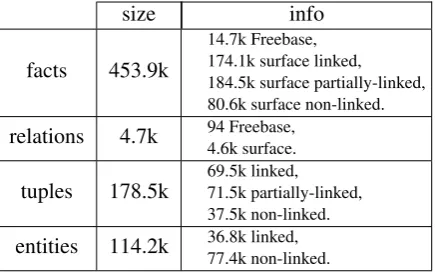
per-size info
facts 453.9k
14.7k Freebase, 174.1k surface linked, 184.5k surface partially-linked, 80.6k surface non-linked. relations 4.7k 94 Freebase,4.6k surface.
[image:6.595.309.527.62.199.2]tuples 178.5k 69.5k linked,71.5k partially-linked, 37.5k non-linked. entities 114.2k 36.8k linked,77.4k non-linked.
Table 1: Dataset statistics.
form the following ascent step with learning rate η:
Θ←Θ +η∇Θ lnσ(d(x, x−))−λkΘxk2
One can show that the stochastic gradient used in the formula above is an unbiased estimate of the gradient of Eq. (2). To speed up parameter es-timation, we use a parallel lock-free version of stochastic gradient ascent as in Recht et al. (2011). This allows our model to handle (reasonably) large datasets.
4 Experiments
We conducted an experimental study on real-world data to compare our CORE model with other state-of-the-art approaches.2 Our
experi-mental study closely follows the one of Riedel et al. (2013).
4.1 Experimental Setup
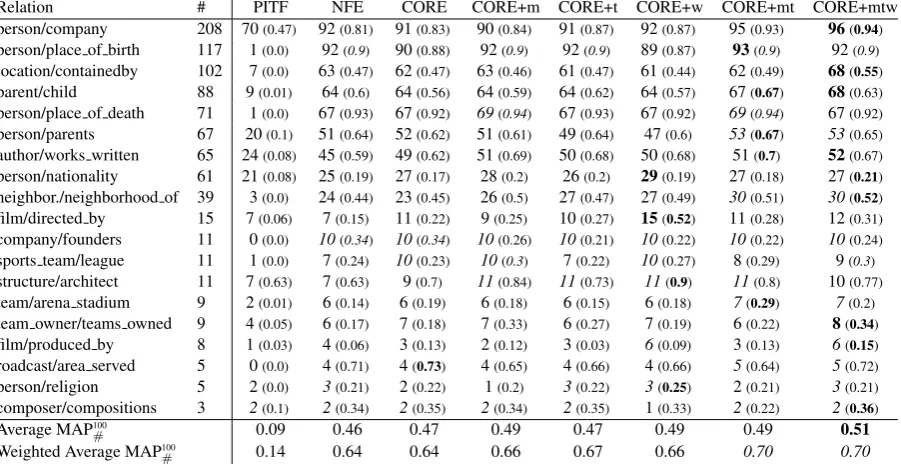
Relation # PITF NFE CORE CORE+m CORE+t CORE+w CORE+mt CORE+mtw person/company 208 70(0.47) 92(0.81) 91(0.83) 90(0.84) 91(0.87) 92(0.87) 95(0.93) 96(0.94)
person/place of birth 117 1(0.0) 92(0.9) 90(0.88) 92(0.9) 92(0.9) 89(0.87) 93(0.9) 92(0.9)
location/containedby 102 7(0.0) 63(0.47) 62(0.47) 63(0.46) 61(0.47) 61(0.44) 62(0.49) 68(0.55)
parent/child 88 9(0.01) 64(0.6) 64(0.56) 64(0.59) 64(0.62) 64(0.57) 67(0.67) 68(0.63)
person/place of death 71 1(0.0) 67(0.93) 67(0.92) 69(0.94) 67(0.93) 67(0.92) 69(0.94) 67(0.92)
person/parents 67 20(0.1) 51(0.64) 52(0.62) 51(0.61) 49(0.64) 47(0.6) 53(0.67) 53(0.65)
author/works written 65 24(0.08) 45(0.59) 49(0.62) 51(0.69) 50(0.68) 50(0.68) 51(0.7) 52(0.67)
person/nationality 61 21(0.08) 25(0.19) 27(0.17) 28(0.2) 26(0.2) 29(0.19) 27(0.18) 27(0.21)
neighbor./neighborhood of 39 3(0.0) 24(0.44) 23(0.45) 26(0.5) 27(0.47) 27(0.49) 30(0.51) 30(0.52)
film/directed by 15 7(0.06) 7(0.15) 11(0.22) 9(0.25) 10(0.27) 15(0.52) 11(0.28) 12(0.31)
company/founders 11 0(0.0) 10(0.34) 10(0.34) 10(0.26) 10(0.21) 10(0.22) 10(0.22) 10(0.24)
sports team/league 11 1(0.0) 7(0.24) 10(0.23) 10(0.3) 7(0.22) 10(0.27) 8(0.29) 9(0.3)
structure/architect 11 7(0.63) 7(0.63) 9(0.7) 11(0.84) 11(0.73) 11(0.9) 11(0.8) 10(0.77)
team/arena stadium 9 2(0.01) 6(0.14) 6(0.19) 6(0.18) 6(0.15) 6(0.18) 7(0.29) 7(0.2)
team owner/teams owned 9 4(0.05) 6(0.17) 7(0.18) 7(0.33) 6(0.27) 7(0.19) 6(0.22) 8(0.34)
film/produced by 8 1(0.03) 4(0.06) 3(0.13) 2(0.12) 3(0.03) 6(0.09) 3(0.13) 6(0.15)
roadcast/area served 5 0(0.0) 4(0.71) 4(0.73) 4(0.65) 4(0.66) 4(0.66) 5(0.64) 5(0.72)
person/religion 5 2(0.0) 3(0.21) 2(0.22) 1(0.2) 3(0.22) 3(0.25) 2(0.21) 3(0.21)
composer/compositions 3 2(0.1) 2(0.34) 2(0.35) 2(0.34) 2(0.35) 1(0.33) 2(0.22) 2(0.36)
Average MAP100
# 0.09 0.46 0.47 0.49 0.47 0.49 0.49 0.51
Weighted Average MAP100
[image:7.595.74.525.64.296.2]# 0.14 0.64 0.64 0.66 0.67 0.66 0.70 0.70
Table 2: True facts and MAP100
# (in parentheses) in the top-100 evaluation-set tuples for Freebase
rela-tions. We consider as context the article metadata (m), the tuple types (t) and the bag-of-words (w). Best value per relation in bold (unique winner) or italic (multiple winners). Average weighs are#column values.
method. If no match was found, the entity men-tion was kept as is. There were around 2.2M tu-ples (distinct entity pairs) in this dataset, out of which 580k were fully linked to Freebase. For each of these tuples, the dataset additionally in-cluded all of the corresponding facts from Free-base. Using the metadata3 of each New York
Times article, we enriched each surface fact by the following contextual information: news desk (e.g., sports desk, foreign desk), descriptors (e.g., finances, elections), online section (e.g., sports, business), section (e.g., a, d), publication year, and bag-of-words of the sentence from which the sur-face fact has been extracted.
Training data. From the raw dataset described above, we filtered out all surface relations with less than 10 instances, and all tuples with less than two instances, as in Riedel et al. (2013). Tab. 1 summarizes statistics of the resulting dataset. Here we considered a fact or tuple as linkedif both of its entities were linked to Freebase, as partially-linked if only one of its entities was linked, and as non-linked otherwise. In contrast to previous work (Riedel et al., 2013; Chang et al., 2014), we retain partially-linked and non-linked facts in our dataset.
3Further information can be found at htps://
catalog.ldc.upenn.edu/LDC2008T19.
Evaluation set. Open RE models produce pre-dictions for all relations and all tuples. To keep the experimental study feasible and comparable to previous studies, we use the full training data but evaluate each model’s predictions on only the sub-sample of 10k tuples (≈6%of all tuples) of Riedel et al. (2013). The subsample consisted of 20% linked, 40% partially-linked and 40% non-linked tuples. For each (surface) relation and method, we predicted the top-100 new facts (not in training) for the tuples in the subsample.
Considered methods. We compared various forms of our CORE model with PITF and the matrix factorization model NFE. Our study fo-cused on these two factorization models because they outperformed other models (including non-factorization models) in previous studies (Riedel et al., 2013; Chang et al., 2014). All models were trained with the full training data described above. PITF (Drumond et al., 2012). PITF is a recent tensor factorization method designed for within-KB reasoning. PITF is based on factorization ma-chines so that we used our scalable CORE imple-mentation for training the model.
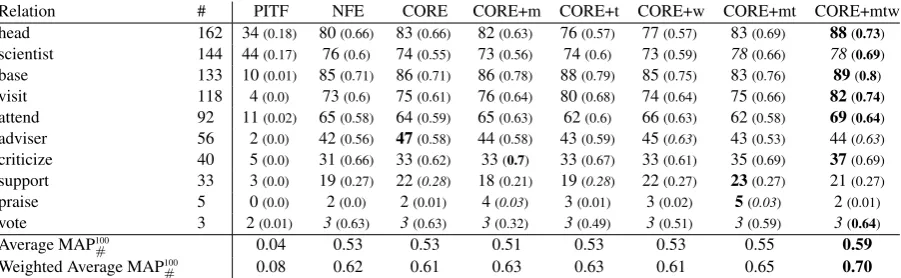
Relation # PITF NFE CORE CORE+m CORE+t CORE+w CORE+mt CORE+mtw head 162 34(0.18) 80(0.66) 83(0.66) 82(0.63) 76(0.57) 77(0.57) 83(0.69) 88(0.73)
scientist 144 44(0.17) 76(0.6) 74(0.55) 73(0.56) 74(0.6) 73(0.59) 78(0.66) 78(0.69)
base 133 10(0.01) 85(0.71) 86(0.71) 86(0.78) 88(0.79) 85(0.75) 83(0.76) 89(0.8)
visit 118 4(0.0) 73(0.6) 75(0.61) 76(0.64) 80(0.68) 74(0.64) 75(0.66) 82(0.74)
attend 92 11(0.02) 65(0.58) 64(0.59) 65(0.63) 62(0.6) 66(0.63) 62(0.58) 69(0.64)
adviser 56 2(0.0) 42(0.56) 47(0.58) 44(0.58) 43(0.59) 45(0.63) 43(0.53) 44(0.63)
criticize 40 5(0.0) 31(0.66) 33(0.62) 33(0.7) 33(0.67) 33(0.61) 35(0.69) 37(0.69)
support 33 3(0.0) 19(0.27) 22(0.28) 18(0.21) 19(0.28) 22(0.27) 23(0.27) 21(0.27)
praise 5 0(0.0) 2(0.0) 2(0.01) 4(0.03) 3(0.01) 3(0.02) 5(0.03) 2(0.01)
vote 3 2(0.01) 3(0.63) 3(0.63) 3(0.32) 3(0.49) 3(0.51) 3(0.59) 3(0.64)
Average MAP100
# 0.04 0.53 0.53 0.51 0.53 0.53 0.55 0.59
Weighted Average MAP100
[image:8.595.73.524.62.201.2]# 0.08 0.62 0.61 0.63 0.63 0.61 0.65 0.70
Table 3: True facts and MAP100
# (in parentheses) in the top-100 evaluation-set tuples for surface relations.
We consider as context the article metadata (m), the tuple types (t) and the bag-of-words (w). Best value per relation in bold (unique winner) or italic (multiple winners). Average weighs are#column values.
model (N), a matrix factorization model (F), and an entity model (E). The F and E models together are similar (but not equal) to our CORE model without context. The NFE model outperformed tensor models (Chang et al., 2014) as well as clus-tering methods and distantly supervised methods in the experimental study of Riedel et al. (2013) for open RE tasks. We use the original source code of Riedel et al. (2013) for training.
CORE. We include multiple variants of our model in the experimental study, each differing by the amount of context being used. We con-sider as context the article metadata (m), the tu-ple types (t) and the bag-of-words (w). Each tutu-ple type is a pair of subject-object types of (e.g. (per-son, location)). The basic CORE model uses rela-tions, tuples and entities as variables. We addition-ally consider the CORE+t, CORE+w, CORE+mt, and CORE+mtw models, where the suffix indi-cates which contextual information has been in-cluded. The total number of variables in the re-sulting models varied between 300k (CORE) to 350k (CORE+mtw). We used a modified version of libfmfor training.4 Our version adds support
for BPR and parallelizes the training algorithm.
Methodology. To evaluate the prediction perfor-mance of each method, we followed Riedel et al. (2013). We considered a collection of 19 Freebase relations (Tab. 2) and 10 surface relations (Tab. 3) and restrict predictions to tuples in the evaluation set.
Evaluation metrics. For each relation and method, we computed the top-100 evaluation set predictions and labeled them manually. We used
4http://www.libfm.org
as evaluation metrics the mean average precision defined as:
MAP100# =
P100
k=1Ik·P@k
min{100,#} (3) where indicator Ik takes value 1 if the k-th
pre-diction is true and 0 otherwise, and#denotes the number of true tuples for the relation in the top-100 predictions of all models. The denominator is included to account for the fact that the eval-uation set may include less than 100 true facts. MAP100
# reflects how many true facts are found
by each method as well as their ranking. If all# facts are found and ranked top, then MAP100
# = 1.
Note that our definition of MAP100
# differs slightly
from Riedel et al. (2013); our metric is more ro-bust because it is based on completely labeled evaluation data. To compare the prediction per-formance of each system across multiple rela-tions, we averaged MAP100
# values, in both an
un-weighted and a un-weighted (by#) fashion.
Parameters. For all systems, we usedd= 100 latent factors, λ = 0.01 for all variables, a constant learning rate of η = 0.05, and ran 1000epochs of stochastic gradient ascent. These choices correspond to the ones of Riedel et al. (2013); no further tuning was performed.
4.2 Results.
Prediction performance. The results of our ex-perimental study are summarized in Tab. 2 (Free-base relations) and Tab. 3 (surface relations). As mentioned before, all reported numbers are with respect to our evaluation set. Each entry shows the number of true facts in the top-100 predictions and, in parentheses, the MAP100
col-author(x,y)
ranked list of tuples
1 (Winston Groom, Forrest Gump) 2 (D. M. Thomas, White Hotel) 3 (Roger Rosenblatt, Life Itself) 4 (Edmund White, Skinned Alive) 5 (Peter Manso, Brando: The Biography) 6 (Edward J. Renehan Jr., The Lion's Pride) 7 (Richard Taruskin, Stravinsky and …) …
similar relations
0.98 “reviews x by y”(x,y) 0.97 “book by”(x,y) 0.95 “author of”(x,y) 0.95 ” ‘s novel”(x,y) 0.95 “ ‘s book”(x,y) 0.91 “who wrote”(x,y) 0.89 “ ’s poem”(x,y) ...
similar relations
0.87 “scientist”(x,y) 0.84 “scientist with”(x,y) 0.80 “professor at”(x,y) 0.79 “scientist for”(x,y) 0.78 “neuroscientist at”(x,y) 0.76 “geneticist at”(x,y) 0.75 “physicist at”(x,y) …
ranked list of tuples
1 (Riordan Roett, Johns Hopkins University) 2 (Dr. R. M. Roberts, University of Missouri) 3 (Linda Mayes, Yale University) 4 (Daniel T. Jones, Cardiff Business School) 5 (Russell Ross, University of Iowa) 6 (Eva Richter, Kingsborough College) 7 (M.L. Weidenbaum, Washington University) …
[image:9.595.73.527.63.149.2]“scientist at”(x,y)
Figure 2: Some facts predicted by our model for the Freebase relation author(x,y) and the surface relation ”scientist at”(x,y). Most similar relations also reported, using cosine similarity between the correspond-ing latent feature vectors as distance.
umn list the total number of true facts found by at least one method. The last two lines show the ag-gregated MAP100
# scores.
We start our discussion with the results for Free-base relations (Tab. 2). First note that the PITF model generally did not perform well; as dis-cussed before, tensor factorization models such as PITF suffer from a large prediction space and cannot incorporate tuple-level information. NFE and CORE, both matrix factorization models, per-formed better and were on par with each other. This indicates that our use of factorization ma-chines does not affect performance in the ab-sence of context; after all, both methods essen-tially make use of the same amount of informa-tion. The key advantage of our model over NFE is that we can incorporate contextual tion. Our results indicate that using such informa-tion indeed improves predicinforma-tion performance. The CORE+mtw model performed best overall; it in-creased the average MAP100
# by four points (six
points weighted) compared to the best context-unware model. Note that for some relations, in-cluding only subsets of the contextual informa-tion produced better results than using all contex-tual information (e.g., film/directed by). We thus conjecture that extending our model by variable-specific regularization terms may be beneficial.
Tab. 3 summarizes our results for surface rela-tions. In general, the relative performance of the models agreed with the one on Freebase relations. One difference is that using bag-of-word context significantly boosted prediction performance. One reason for this boost is that related surface rela-tions often share semantically related words (e.g., “professor at” and “scientist at”) and may occur in similar sentences (e.g., mentioning “university”, “research”, ...).
Anecdotal results. Fig. 2 shows the top test-set predictions of CORE+mtw for the author and “sci-entist at” relations. In both cases, we also list re-lations that have a similar semantic representation in our model (highest cosine similarity). Note that semantic similarity of relations is one aspect of our model; predictions incorporate other aspects such as context (i.e., two “similar” relations in different contexts are treated differently).
Training time. We used a machine with 16 -cores Intel Xeon processor and 128GB of mem-ory. Training CORE took roughly one hour, NFE roughly six hours (single core only), and training CORE+mtw took roughly 20 hours. Our imple-mentation can handle reasonably large data, but an investigation of faster, more scalable training methods appears worthwhile.
5 Conclusion
We proposed CORE, a matrix factorization model for open RE that incorporates contextual infortion. Our model is based on factorization ma-chines and the open-world assumption, integrates various forms of contextual information, and is tensible. Our experimental study suggests that ex-ploiting context can significantly improve predic-tion performance.
References
Alan Akbik, Larysa Visengeriyeva, Priska Herger, Holmer Hemsen, and Alexander L¨oser. 2012. Un-supervised discovery of relations and discriminative
extraction patterns. InProceedings of the 24th
Inter-national Conference on Computational Linguistics (COLING 2012).
Michele Banko, Michael J Cafarella, Stephen Soderl, Matt Broadhead, and Oren Etzioni. 2007. Open
in-formation extraction from the web. InProceedings
Kai-Wei Chang, Wen-tau Yih, Bishan Yang, and Christopher Meek. 2014. Typed tensor decom-position of knowledge bases for relation
extrac-tion. In Proceedings of the 2014 Conference on
Empirical Methods in Natural Language Processing (EMNLP).
Oier Lopez de Lacalle and Mirella Lapata. 2013. Un-supervised relation extraction with general domain
knowledge. InProceedings of the 2013 Conference
on Empirical Methods in Natural Language Pro-cessing (EMNLP).
Luciano Del Corro and Rainer Gemulla. 2013.
Clausie: clause-based open information extraction. InProceedings of the 22nd International Conference on World Wide Web (WWW).
Lucas Drumond, Steffen Rendle, and Lars Schmidt-Thieme. 2012. Predicting rdf triples in incomplete
knowledge bases with tensor factorization. In
Pro-ceedings of the 27th Annual ACM Symposium on Ap-plied Computing (SAC).
Anthony Fader, Stephen Soderland, and Oren Etzioni. 2011. Identifying relations for open information
ex-traction. InProceedings of the 2011 Conference on
Empirical Methods in Natural Language Processing (EMNLP).
Miao Fan, Deli Zhao, Qiang Zhou, Zhiyuan Liu, Thomas Fang Zheng, and Edward Y Chang. 2014. Distant supervision for relation extraction with
ma-trix completion. InProceedings of the 52nd Annual
Meeting of the Association for Computational Lin-guistics (ACL).
Thomas Franz, Antje Schultz, Sergej Sizov, and Steffen Staab. 2009. Triplerank: Ranking semantic web
data by tensor decomposition. InProceedings of the
8th International Semantic Web Conference (ISWC). Takaaki Hasegawa, Satoshi Sekine, and Ralph Grish-man. 2004. Discovering relations among named
entities from large corpora. In Proceedings of the
42nd Annual Meeting on Association for Computa-tional Linguistics (ACL).
Yi Huang, Volker Tresp, Maximilian Nickel, Achim Rettinger, and Hans-Peter Kriegel. 2014. A scalable approach for statistical learning in semantic graphs. Semantic Web, 5(1):5–22.
Xueyan Jiang, Volker Tresp, Yi Huang, and Maxi-milian Nickel. 2012. Link prediction in
multi-relational graphs using additive models. In
Proceed-ings of the 2012 International Workshop on Seman-tic Technologies meet Recommender Systems & Big Data (SeRSy).
Bonan Min, Shuming Shi, Ralph Grishman, and Chin-Yew Lin. 2012. Ensemble semantics for large-scale
unsupervised relation extraction. InProceedings of
the 2012 Joint Conference on Empirical Methods in Natural Language Processing and Computational Natural Language Learning (EMNLP-CoNLL).
Bonan Min, Ralph Grishman, Li Wan, Chang Wang, and David Gondek. 2013. Distant supervision for relation extraction with an incomplete knowledge
base. In Proceedings of the 2013 Conference of
the North American Chapter of the Association for Computational Linguistics: Human Language Tech-nologies (HLT-NAACL).
Mike Mintz, Steven Bills, Rion Snow, and Dan Ju-rafsky. 2009. Distant supervision for relation
ex-traction without labeled data. InProceedings of the
Joint conference of the 47th Annual Meeting of the Association for Computational Linguistics and the 4th International Joint Conference on Natural Lan-guage Processing of the Asian Federation of Natural Language Processing (ACL-IJCNLP).
Maximilian Nickel, Volker Tresp, and Hans-Peter Kriegel. 2011. A three-way model for collective
learning on multi-relational data. InProceedings of
the 28th international conference on machine learn-ing (ICML).
Maximilian Nickel, Volker Tresp, and Hans-Peter Kriegel. 2012. Factorizing yago: scalable
ma-chine learning for linked data. InProceedings of the
21st International Conference on World Wide Web (WWW).
Benjamin Recht, Christopher Re, Stephen Wright, and Feng Niu. 2011. Hogwild: A lock-free approach
to parallelizing stochastic gradient descent. In
Pro-ceedings of the 25th Annual Conference on Neural Information Processing Systems (NIPS).
Steffen Rendle, Christoph Freudenthaler, Zeno
Gant-ner, and Lars Schmidt-Thieme. 2009. Bpr:
Bayesian personalized ranking from implicit
feed-back. InProceedings of the 25th Conference on
Un-certainty in Artificial Intelligence (UAI).
Steffen Rendle, Zeno Gantner, Christoph Freuden-thaler, and Lars Schmidt-Thieme. 2011. Fast context-aware recommendations with factorization
machines. InProceedings of the 34th international
ACM conference on Research and development in Information Retrieval (SIGIR).
Steffen Rendle. 2012. Factorization machines with
libfm. ACM Transactions on Intelligent Systems and
Technology (TIST), 3(3):57.
Sebastian Riedel, Limin Yao, Andrew McCallum, and Benjamin M Marlin. 2013. Relation extraction with
matrix factorization and universal schemas. In
Pro-ceedings of the 2013 Conference of the North Amer-ican Chapter of the Association for Computational Linguistics: Human Language Technologies (HLT-NAACL).
E. Sandhaus. 2008. The New York Times Annotated
Corpus. Linguistic Data Consortium, Philadelphia,
Yusuke Shinyama and Satoshi Sekine. 2006. Preemp-tive information extraction using unrestricted
rela-tion discovery. InProceedings of the 2006
Confer-ence of the North American Chapter of the Associ-ation for ComputAssoci-ational Linguistics: Human Lan-guage Technologies (HLT-NAACL).
Mihai Surdeanu, Julie Tibshirani, Ramesh Nallapati, and Christopher D Manning. 2012. Multi-instance
multi-label learning for relation extraction. In
Pro-ceedings of the 2012 Joint Conference on Empirical Methods in Natural Language Processing and Com-putational Natural Language Learning (EMNLP-CoNLL).
Shingo Takamatsu, Issei Sato, and Hiroshi Nakagawa. 2011. Probabilistic matrix factorization leveraging
contexts for unsupervised relation extraction. In
Ad-vances in Knowledge Discovery and Data Mining, pages 87–99. Springer.
Volker Tresp, Yi Huang, Markus Bundschus, and Achim Rettinger. 2009. Materializing and
query-ing learned knowledge. InProceedings of the 2009
International Workshop on Inductive Reasoning and Machine Learning for the Semantic Web (IRMLeS). Limin Yao, Aria Haghighi, Sebastian Riedel, and
An-drew McCallum. 2011. Structured relation
discov-ery using generative models. InProceedings of the
2011 Conference on Empirical Methods in Natural Language Processing (EMNLP).
Congle Zhang, Raphael Hoffmann, and Daniel S. Weld. 2012. Ontological smoothing for relation
extraction with minimal supervision. In
Proceed-ings of the 26th Conference on Artificial Intelligence (AAAI).
GuoDong Zhou, Min Zhang, DongHong Ji, and QiaoMing Zhu. 2007. Tree kernel-based relation extraction with context-sensitive structured parse
tree information. InProceedings of the 2007 Joint