Translation as Weighted Deduction
Adam Lopez University of Edinburgh
10 Crichton Street Edinburgh, EH8 9AB
United Kingdom [email protected]
Abstract
We present a unified view of many trans-lation algorithms that synthesizes work on deductive parsing, semiring parsing, and efficient approximate search algorithms. This gives rise to clean analyses and com-pact descriptions that can serve as the ba-sis for modular implementations. We illus-trate this with several examples, showing how to build search spaces for several dis-parate phrase-based search strategies, inte-grate non-local features, and devise novel models. Although the framework is drawn from parsing and applied to translation, it is applicable to many dynamic program-ming problems arising in natural language processing and other areas.
1 Introduction
Implementing a large-scale translation system is a major engineering effort requiring substantial time and resources, and understanding the traoffs involved in model and algorithm design de-cisions is important for success. As the space of systems described in the literature becomes more crowded, identifying their common elements and isolating their differences becomes crucial to this understanding. In this work, we present a com-mon framework for model manipulation and anal-ysis that accomplishes this, and use it to derive sur-prising conclusions about phrase-based models.
Most translation algorithms do the same thing: dynamic programming search over a space of weighted rules (§2). Fortunately, we need not search far for modular descriptions of dy-namic programming algorithms. Deductive logic
(Pereira and Warren, 1983), extended with semir-ings (Goodman, 1999), is an established formal-ism used in parsing. It is occasionally used to describe formally syntactic translation mod-els, but these treatments tend to be brief (Chiang, 2007; Venugopal et al., 2007; Dyer et al., 2008; Melamed, 2004). We apply weighted deduction much more thoroughly, first extending it to phrase-based models and showing that the set of search strategies used by these models have surprisingly different implications for model and search error (§3,§4). We then show how it can be used to an-alyze common translation problems such as non-local parameterizations (§5), alignment, and novel model design (§6). Finally, we show that it leads to a simple analysis of cube pruning (Chiang, 2007), an important approximate search algorithm (§7).
2 Translation Models
A translation model consists of two distinct ele-ments: anunweightedruleset, and a parameteriza-tion (Lopez, 2008). Arulesetlicenses the steps by which a source stringf1...fI may be rewritten as a target string e1...eJ, thereby defining the finite set of all possible rewritings of a source string. A parameterizationdefines a weight function over every sequence of rule applications.
In a phrase-based model, the ruleset is simply the unweighted phrase table, where each phrase pairfi...fi0/ej...ej0states that phrasefi...fi0in the source is rewritten asej...ej0 in the the target.
The model operates by iteratively applying rewrites to the source sentence until each source word has been consumed by exactly one rule. We call a sequence of rule applications aderivation. A target stringe1...eJ yielded by a derivationDis obtained by concatenating the target phrases of the rules in the order in which they were applied. We
defineY(D)to be the target string yielded byD. Now consider the Viterbi approximation to a noisy channel parameterization of this model,
P(f|D)·P(D).1 We defineP(f|D)in the stan-dard way.
P(f|D) = Y fi...fi0/ej...ej0∈D
p(fi...fi0|ej...ej0)
(1) Note that in the channel model, we can replace any rule application with any other rule containing the same source phrase without affecting the partial score of the rest of the derivation. We call this a localparameterization.
Now we define a standardn-gram modelP(D).
P(D) = Y ej∈Y(D)
p(ej|ej−n+1...ej−1) (2)
This parameterization differs from the channel model in an important way. If we replace a single rule in the derivation, the partial score of the rest of derivation is also affected, because the terms
ej−n+1...ejmay come from more than one rule. In other words, this parameterization encodes a de-pendency between the steps in a derivation. We call this anon-localparameterization.
3 Translation As Deduction
For the first part of the discussion that follows, we consider deductive logics purely over unweighted rulesets. As a way to introduce deductive logic, we consider the CKY algorithm for context-free pars-ing, a common example that we will revisit in§6.2. It is also relevant since it can form the basis of a decoder for inversion transduction grammar (Wu, 1996). In the discussion that follows, we useA,B, andCto denote arbitrary nonterminal symbols,S
to denote the start nonterminal symbol, and a to denote a terminal symbol. CKY works on gram-mars in Chomsky normal form: all rules are either binary as inA→BC, or unary as inA→a.
The number of possible binary-branching parses of a sentence is defined by the Catalan num-ber, an exponential combinatoric function (Church and Patil, 1982), so dynamic programming is cru-cial for efficiency. CKY computes all parses in cubic time by reusing subparses. To parse a sen-tencea1...aK, we compute a set of items in the
1The true noisy channel parameterizationp(f|e)·p(e) would require a marginalization overD, and is intractable for most models.
form[A, k, k0], whereAis a nonterminal category,
kandk0 are both integers in the range[0, n]. This item represents the fact that there is some parse of span ak+1...ak0 rooted at A (span indices are on the spaces between words). CKY works by creat-ing items over successively longer spans. First it creates items[A, k−1, k]for any ruleA→asuch thata=ak. It then considers spans of increasing length, creating items[A, k, k0]whenever it finds two items[B, k, k00]and[C, k00, k0]for some gram-mar ruleA→BCand some midpointk00. Its goal is an item[S,0, K], indicating that there is a parse ofa1...aKrooted atS.
A CKY logic describes its actions asinference rules, equivalent to Horn clauses. The inference rule is a list ofantecedents, items and rules that must all be true for the inference to occur; and a singleconsequentthat is inferred. To denote the creation of item [A, k, k0] based on existence of ruleA→BCand items[B, k, k00]and[C, k00, k0], we write an inference rule with antecedents on the top line and consequent on the second line, follow-ing Goodman (1999) and Shieber et al. (1995).
R(A→BC) [B, k, k00] [C, k00, k0] [A, k, k0]
We now give the complete Logic CKY.
item form:[A, k, k0] goal:[S,0, K]
rules:
R(A→ak) [A, k−1, k]
R(A→BC) [B, k, k00] [C, k00, k0] [A, k, k0]
(Logic CKY) A benefit of this declarative description is that complexity can be determined by inspection (McAllester, 1999). We elaborate on complexity in§7, but for now it suffices to point out that the number of possible items and possible deductions depends on the product of the domains of the free variables. For example, the number of possible CKY items for a grammar with G nonterminals is O(GK2), becausek andk0 are both in range [0, K]. Likewise, the number of possible inference rules that can fire isO(G3K3).
3.1 A Simple Deductive Decoder
source sentence. Despite its simplicity, the search space can be very large—in the limit there could be a translation for every possible segmentation of the sentence, so there are exponentially many possible derivations. Fortunately, we know that monotone decoding can easily be cast as a dy-namic programming problem. For any position i
in the source sentencef1...fI, we can freely com-bine any partial derivation covering f1...fi on its left with any partial derivation coveringfi+1...fI on its right to yield a complete derivation.
In our deductive program for monotone decod-ing, an item simply encodes the index of the right-most word that has been rewritten.
item form:[i]
goal:[I] rule:
[i] R(fi+1...fi0/ej...ej0) [i0]
(Logic MONOTONE) This is the algorithm of Zens and Ney (2004). With a maximum phrase length ofm,i0will range over[i+ 1,min(i+m, I)], giving a complexity of
O(Im). In the limit it isO(I2).
3.2 More Complex Decoders
Now we consider phrase-based decoders with more permissive reordering. In the limit we al-low arbitrary reordering, so our item must contain a coverage vector. Let V be a binary vector of length I; that is, V ∈ {0,1}I. Le 0m be a vec-tor of m0’s. For example, bit vector 00000will be abbreviated 05 and bit vector 000110 will be abbreviated031201. Finally, we will need bitwise AND(∧) andOR(∨). Note that we impose an
ad-ditional requirement that is not an item in the de-ductive system as a side condition(we elaborate on the significance of this in§4).
item form:[{0,1}I] goal:[1I] rule:
[V] R(fi+1...fi0/ej...ej0) [V ∨0i1i0−i
0I−i0
] V ∧0
i1i0−i0I−i0 = 0I
(Logic PHRASE-BASED) The runtime complexity is exponential, O(I22I). Practical decoding strategies are more restrictive, implementing what is frequently called a distor-tion limitorreordering limit. We found that these terms are inexact, used to describe a variety of quite different strategies.2 Since we did not feel that the relationship between these various strate-gies was obvious or well-known, we give logics
2Costa-juss`a and Fonollosa (2006) refer to the reordering
limit and distortion limit as two distinct strategies.
for several of them and a brief analysis of the implications. Each strategy uses a parameter d, generically called the distortion limit or reorder-ing limit.
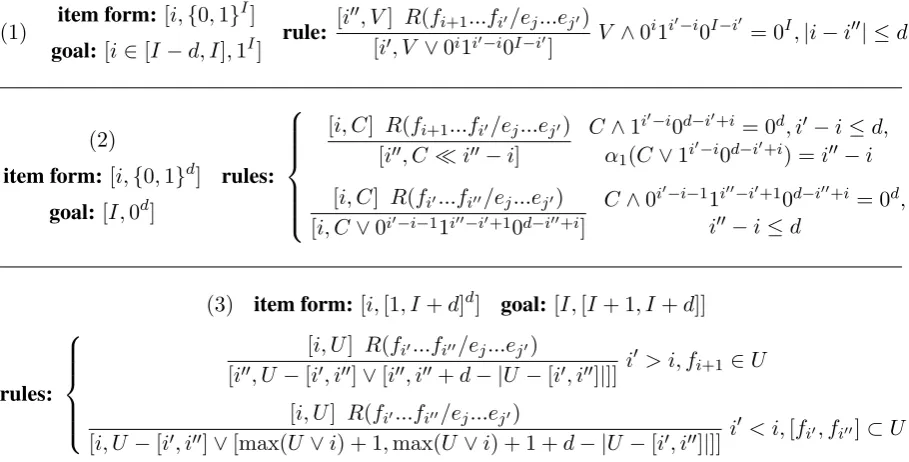
The Maximum Distortion d strategy (MDd) requires that the first word of a phrase chosen for translation be withindwords of the the last word of the most recently translated phrase (Figure 1).3 The effect of this strategy is that, up to the last word covered in a partial derivation, there must be a covered word in everydwords. Its complexity isO(2I).4
MDdcan produce partial derivations that cannot be completed by any allowed sequence of jumps. To prevent this, theWindow Length dstrategy (WLd) enforces a tighter restriction that the last word of a phrase chosen for translation cannot be more thandwords from the leftmost untranslated word in the source (Figure 1).5 For this logic we use a bitwise shift operator (), and a predicate (α1) that counts the number of leading ones in a bit array.6 Its runtime is exponential in parameter
d, butlinearin sentence length,O(d22dI). The First d Uncovered Words strategy (FdUW) is described by Tillman and Ney (2003) and Zens and Ney (2004), who call it the IBM Constraint.7It requires at least one of the leftmost
duncovered words to be covered by a new phrase. Items in this strategy contain the index i of the rightmost covered word and a vectorU ∈ [1, I]d of thedleftmost uncovered words (Figure 1). Its complexity is O(dI d+1I ), which is roughly ex-ponential ind.
There are additional variants, such as the Maxi-mum Jumpdstrategy(MJd), a polynomial-time strategy described by Kumar and Byrne (2005), and possibly others. We lack space to describe all of them, but simply depicting the strategies as log-ics permits us to make some simple analyses.
First, it should be clear that these reorder-ing strategies define overlappreorder-ing but not identical search spaces: for most values ofdit is
impossi-3
Moore and Quirk (2007) give a nice description of MDd. 4
We could obtain a tighter bound by subtracting number of the vectors containing the forbidden sequence0d1.
5
We do not know if WLdis documented anywhere, but from inspection it is used in Moses (Koehn et al., 2007). This was confirmed by Philipp Koehn and Hieu Hoang (p.c.).
6When a phrase covers the first uncovered word in the
source sentence, the new first uncovered word may be further along in the sentence (if the phrase completely filled a gap), or just past the end of the phrase (otherwise).
(1) item form:[i,{0,1} I]
goal:[i∈[I−d, I],1I] rule:
[i00, V] R(fi+1...fi0/ej...ej0) [i0, V ∨0i1i0−i
0I−i0
] V ∧0 i1i0−i
0I−i0 = 0I,|i−i00| ≤d
(2)
item form:[i,{0,1}d] goal:[I,0d]
rules:
[i, C] R(fi+1...fi0/ej...ej0) [i00, Ci00−i]
C∧1i0−i0d−i0+i = 0d, i0−i≤d, α1(C∨1i
0−i
0d−i0+i) =i00−i
[i, C] R(fi0...fi00/ej...ej0) [i, C∨0i0−i−1
1i00−i0+1
0d−i00+i ]
C∧0i0−i−11i00−i0+10d−i00+i = 0d, i00−i≤d
(3) item form:[i,[1, I +d]d] goal:[I,[I + 1, I+d]]
rules:
[i, U] R(fi0...fi00/ej...ej0)
[i00, U −[i0, i00]∨[i00, i00+d− |U −[i0, i00]|]] i 0
> i, fi+1∈U
[i, U] R(fi0...fi00/ej...ej0)
[i, U −[i0, i00]∨[max(U ∨i) + 1,max(U ∨i) + 1 +d− |U−[i0, i00]|]] i 0
[image:4.595.74.529.74.305.2]< i,[fi0, fi00]⊂U
Figure 1: Logics (1) MDd, (2) WLd, and (3) FdUW. Note that the goal item of MDd(1) requires that the last word of the last phrase translated be withindwords of the end of the source sentence.
ble to findd0 such that any of the other strategies would be identical (except for degenerate cases
d = 0 and d = I). This has important ramifi-cations for scientific studies: results reported for one strategy may not hold for others, and in cases where the strategy is not clearly described it may be impossible to replicate results. Furthermore, it should be clear that the strategy can have signifi-cant impact on decoding speed and pruning strate-gies (§7). For example, MDd is more complex than WLd, and we expect implementations of the former to require more pruning and suffer from more search errors, while the latter would suffer from more model errors since its space of possible reorderings is smaller.
We emphasize that many other translation mod-els can be described this way. Logics for the IBM Models (Brown et al., 1993) would be similar to our logics for phrase-based models. Syntax-based translation logics are similar to parsing logics; a few examples already appear in the literature (Chi-ang, 2007; Venugopal et al., 2007; Dyer et al., 2008; Melamed, 2004). For simplicity, we will use the MONOTONElogic for the remainder of our examples, but all of them generalize to more com-plex logics.
4 Adding Local Parameterizations via Semiring-Weighted Deduction
So far we have focused solely on unweighted log-ics, which correspond to search using only rule-sets. Now we turn our focus to parameterizations. As a first step, we consider only local parame-terizations, which make computing the score of a derivation quite simple. We are given a set of in-ferences in the following form (interpreting side conditionsB1...BM as boolean constraints).
A1...AL
C B1...BM
Now suppose we want to find the highest-scoring derivation. Each antecedent itemA` has a proba-bilityp(A`): ifA`is a rule, then the probability is given, otherwise its probability is computed recur-sively in the same way that we now computep(C). SinceCcan be the consequent of multiple deduc-tions, we take the max of its current value (initially 0) and the result of the new deduction.
p(C) = max(p(C),(p(A1)×...×p(AL))) (3)
If for everyA` that is an item, we replacep(A`) recursively with this expression, we end up with a maximization over a product of rule probabilities. Applying this to logic MONOTONE, the result will be a maximization (over all possible derivations
We might also want to calculate the total prob-ability of all possible derivations, which is useful for parameter estimation (Blunsom et al., 2008). We can do this using the following equation.
p(C) =p(C) + (p(A1)×...×p(AL)) (4)
Equations 3 and 4 are quite similar. This suggests a useful generalization: semiring-weighted deduc-tion (Goodman, 1999).8 A semiring hA,⊗,⊕i
consists of a domain A, a multiplicative
opera-tor ⊗ and an additive operator ⊕.9 In Equa-tion 3 we use the Viterbi semiringh[0,1],×,maxi, while in Equation 4 we use the inside semiring h[0,1],×,+i. The general form of Equations 3 and 4 can be written for weightsw∈A.
w(C)⊕=w(A1)⊗...⊗w(A`) (5)
Many quantities can be computed simply by us-ing the appropriate semirus-ing. Goodman (1999) de-scribes semirings for the Viterbi derivation,k-best Viterbi derivations, derivation forest, and number of paths.10 Eisner (2002) describes the expec-tation semiring for parameter learning. Gimpel and Smith (2009) describeapproximation semir-ings for approximate summing in (usually in-tractable) models. In parsing, the boolean semir-ingh{>,⊥},∩,∪iis used to determine grammati-cality of an input string. In translation it is relevant for alignment (§6.1).
5 Adding Non-Local Parameterizations with thePRODUCTTransform
A problem arises with the semiring-weighted de-ductive formalism when we add non-local parame-terizations such as ann-gram model (Equation 2). Suppose we have a derivationD = (d1, ..., dM), where eachdm is a rule application. We can view the language model as a function onD.
P(D) =f(d1, ..., dm, ..., dM) (6)
The problem is that replacing dm with a lower-scoring rule d0m may actually improve f due to
8
General weighted deduction subsumes semiring-weighted deduction (Eisner et al., 2005; Eisner and Blatz, 2006; Nederhof, 2003), but semiring-weighted deduction covers all translation models we are aware of, so it is a good first step in applying weighted deduction to translation.
9
See Goodman (1999) for additional conditions on semir-ings used in this framework.
10Eisner and Blatz (2006) give an alternate strategy for the
best derivation.
the language model dependency. This means that
f is nonmonotonic—it does not display the opti-mal substructure property on partial derivations, which is required for dynamic programming (Cor-men et al., 2001). The logics still work for some semirings (e.g. boolean), but not others. There-fore, non-local parameterizations break semiring-weighted deduction, because we can no longer use the same logic under all semirings. We need new logics; for this we will use a logic programming transform called the PRODUCT transform (Cohen et al., 2008).
We first define a logic for the non-local param-eterization. The logic for an n-gram language model generates sequence e1...eQ by generating each new word given the pastn−1words.11
item form:[eq, ..., eq+n−2]goal:[eQ−n+2, ..., eQ]
rule: [eq, ..., eq+n−2]R(eq, ..., eq+n−1) [eq+1, ..., eq+n−1]
(Logic NGRAM) Now we want to combine NGRAM and MONO
-TONE. To make things easier, we modify MONO
-TONEto encode the idea that once a source phrase has been recognized, its target words are gener-ated one at a time. We will useueandveto denote (possibly empty) sequences inej...e0j. Borrowing the notation of Earley (1970), we encode progress using a dotted phraseue•ve.
item form:[i, ue•ve] goal:[I, ue•] rules:
[i, ue•] R(fi+1...fi0/ejve) [i0, e
j•ve]
[i, ue•ejve] [i, ueej•ve] (Logic MONOTONE-GENERATE) We combine NGRAM and MONOTONE -GENERATE using the PRODUCT transform, which takes two logics as input and essentially does the following.12
1. Create a new item type from the cross-product of item types in the input logics. 2. Create inference rules for the new item type
from the cross-product of all inference rules in the input logics.
3. Constrain the new logic as needed. This is done by hand, but quite simple, as we will show by example.
11
We ignore start and stop probabilities for simplicity. 12The description of Cohen et al. (2008) is much more
(1)
item form:[i, ue•ve, eq, ..., eq+n−2]
goal:[I, ue•, eQ−n+2, ..., eQ]
rules:
[i, ue•, eq, ..., eq+n−2] R(fi...fi0/ejue) R(eq, ..., eq+n−1) [i0, ej•ue, eq+1, ..., eq+n−1]
[i, ue•ejve, eq, ..., eq+n−2] R(eq, ..., eq+n−1)
[i, ueej•ve, eq+1, ..., eq+n−1]
(2)
item form:[i, ue•ve, ej, ..., ej+n−2] goal:[I, ue•, eJ−n+2, ..., eJ]
rules:
[i, ue•, ej−n+1, ..., ej−1] R(fi...fi0/ejve) R(ej−n+1, ..., ej) [i0, e
j•ve, ej−n+2, ..., ej]
[i, ue•ejve, ej−n+1, ..., ej−1] R(ej−n+1, ..., ej) [i, ueej•ve, ej−n+2, ..., ej]
(3) item form:[i, ue•ve, ei, ..., en−i−2] goal:[I, ue•, eI−n+2, ..., eI]
[image:6.595.68.530.81.337.2]rule: [i, ej−n+1, ..., ej−1] R(fi...fi0/ej...ej0)R(ej−n+1, ..., ej)...R(ej0−n+1, ..., ej0) [i0, ej0−n+2, ..., ej0]
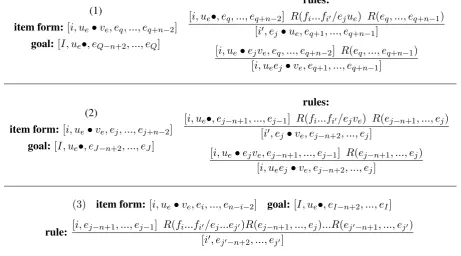
Figure 2: Logics (1) MONOTONE-GENERATE◦NGRAM, (2) MONOTONE-GENERATE+NGRAMand (3) MONOTONE-GENERATE+NGRAMSINGLE-SHOT.
The first two steps give us logic MONOTONE -GENERATE◦NGRAM(Figure 2). This is close to what we want, but not quite done. The constraint we want to apply is that each word written by logic MONOTONE-GENERATEis equal to the word gen-erated by logic NGRAM. We accomplish this by unifying variables eq and en−i in the inference rules, giving us logic MONOTONE-GENERATE+ NGRAM(Figure 2).
This logic restores the optimal subproblem property and we can apply semiring-weighted de-duction. Efficient algorithms are given in§7, but a brief comment is in order about the new logic. In most descriptions of phrase-based decoding, then-gram language model is applied all at once. MONOTONE-GENERATE+NGRAMapplies then -gram language model one word at a time. This illuminates a space of search strategies that are to our knowledge unexplored. If a four-word phrase were proposed as an extension of a partial hypoth-esis in a typical decoder implementation using a five-word language model, all four n-grams will be applied even though the firstn-gram might have a very low score. Viewing eachn-gram applica-tion as producing a new state may yield new strate-gies for approximate search.
We can derive the more familiar logic by
ap-plying a different transform: unfolding (Eisner and Blatz, 2006). The idea is to replace an item with the sequence of antecedents used to pro-duce it (similar to function inlining). This gives us MONOTONE-GENERATE+NGRAM SINGLE -SHOT(Figure 2).
We call the ruleset-based logic the minimal logic and the logic enhanced with non-local pa-rameterization thecomplete logic. Note that the set of variables in the complete logic is a superset of the set of variables in the minimal logic. We can view the minimal logic as a projection of the complete logic into a smaller dimensional space. It is important to note that complete logic is sub-stantially more complex than the minimal logic, by a factor ofO(|VE|n)for a target vocabulary of
VE. Thus, the complexity of non-local parameteri-zations often makes search spaces large regardless of the complexity of the minimal logic.
6 Other Uses of thePRODUCTTransform
The PRODUCT transform can also implement alignment and help derive new models.
6.1 Alignment
given a reference target sentence r1, ..., rJ, and we require the translation model to generate only derivations that produce that sentence. Alignment is often used in training both generative and dis-criminative models (Brown et al., 1993; Blunsom et al., 2008; Liang et al., 2006). Our approach to alignment is similar to the one for language mod-eling. First, we implement a logic requiring an input to be identical to the reference.
item form:[j]
goal:[J] rule: [j]
[j+ 1] ej+1=rj+1
(Logic RECOGNIZE) The logic only reaches its goal if the input is iden-tical to the reference. In fact, partial derivations must produce a prefix of the reference. When we combine this logic with MONOTONE-GENERATE, we obtain a logic that only succeeds if the transla-tion logic generates the reference.
item form:[i, j, ue•ve] goal:[I, j, ue•]
rules:
[i, j, ue•] R(fi...fi0/ej...ej0) [i0, j,•ej...ej0]
[i, j, ue•ejve] [i, j+ 1, ueej•ve]
ej+1 =rj+1
(Logic MONOTONE-ALIGN) Under the boolean semiring, this (minimal) logic decides if a training example is reachable by the model, which is required by some discriminative training regimens (Liang et al., 2006; Blunsom et al., 2008). We can also compute the Viterbi deriva-tion or the sum over all derivaderiva-tions of a training example, needed for some parameter estimation methods. Cohen et al. (2008) derive an alignment logic for ITG from the product of two CKY logics.
6.2 Translation Model Design
A motivation for many syntax-based translation models is to use target-side syntax as a language model (Charniak et al., 2003). Och et al. (2004) showed that simply parsing the N-best outputs of a phrase-based model did not work; to ob-tain the full power of a language model, we need to integrate it into the search process. Most ap-proaches to this problem focus on synchronous grammars, but it is possible to integrate the target-side language model with a phrase-based transla-tion model. As an exercise, we integrate CKY with the output of logic MONOTONE-GENERATE. The constraint is that the indices of the CKY items unify with theitemsof the translation logic, which
form a word lattice. Note that this logic retains the rules in the basic MONOTONElogic, which are not depicted (Figure 3).
The result is a lattice parser on the output of the translation model. Lattice parsing is not new to translation (Dyer et al., 2008), but to our knowl-edge it has not been used in this way. Viewing translation as deduction is helpful for the design and construction of novel models.
7 Algorithms
Most translation logics are too expensive to ex-haustively search. However, the logics conve-niently specify the full search space, which forms a hypergraph (Klein and Manning, 2001).13 The equivalence is useful for complexity analysis: items correspond to nodes and deductions corre-spond to hyperarcs. These equivalences make it easy to compute algorithmic bounds.
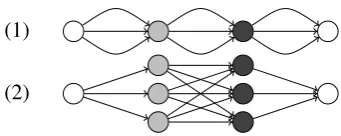
Cube pruning (Chiang, 2007) is an approxi-mate search technique for syntax-based translation models with integrated language models. It op-erates on two objects: a −LM graph containing no language model state, and a+LM hypergraph containing state. The idea is to generate a fixed number of nodes in the +LM for each node in the−LM graph, using a clever enumeration strat-egy. We can view cube pruning as arising from the interaction between a minimal logic and the state splits induced by non-local features. Figure 4 shows how the added state information can dra-matically increase the number of deductions that must be evaluated. Cube pruning works by con-sidering the most promising states paired with the most promising extensions. In this way, it easily fits any search space constructed using the tech-nique of§5. Note that the efficiency of cube prun-ing is limited by the minimal logic.
Stack decodingis a search heuristic that simpli-fies the complexity of searching a minimal logic. Each item is associated with a stack whose signa-ture is a projection of the item signasigna-ture (or a pred-icate on the item signatures)—multiple items are associated to the same stack. The strength of the pruning (and resulting complexity improvements) depending on how much the projection reduces the search space. In many phrase-based implemen-tations the stack signature is just the number of
13Specifically a B-hypergraph, equivalent to an and-or
item forms:[i, ue•ve],[A, i, ue•ve, i0, u0e•v
0
e] goal:[S,0,•, I, ue•] rules:
[i, ue•] R(fi+1...fi0/ejve) R(A→ej) [A, i, ue•, i0, ej •ve]
[i, ue•ejve] R(A→ej) [A, i, ue•ejve, i, ueej•ve]
[image:8.595.142.462.62.162.2][B, i, ue•ve, i00, u00e •v00e] [C, i00, ue00•ve00, i0, u0e•ve0] R(A→BC) [A, i, ue•ve, i0, u0e•ve0]
Figure 3: Logic MONOTONE-GENERATE+ CKY
(1)
(2)
Figure 4: Example graphs corresponding to a sim-ple minimal (1) and comsim-plete (2) logic, with cor-responding nodes in the same color. The state-splitting induced by non-local features produces in a large number of arcs which must be evaluated, which can be reduced by cube pruning.
words translated, but other strategies are possible (Tillman and Ney, 2003).
It is worth noting that logic FdUW (§3.2), de-pends on stack pruning for speed. Because the number of stacks is linear in the length of the in-put, so is the number of unpruned nodes in the search graph. In contrast, the complexity of logic WLdis naturally linear in input length. As men-tioned in§3.2, this implies a wide divergence in the model and search errors of these logics, which to our knowledge has not been investigated.
8 Related Work
We are not the first to observe that phrase-based models can be represented as logic programs (Eis-ner et al., 2005; Eis(Eis-ner and Blatz, 2006), but to our knowledge we are the first to provide explicit logics for them.14 We also showed that deductive logic is a useful analytical tool to tackle a variety of problems in translation algorithm design.
Our work is strongly influenced by Goodman (1999) and Eisner et al. (2005). They describe many issues not mentioned here, including con-ditions on semirings, termination concon-ditions, and strategies for cyclic search graphs. However,
14Huang and Chiang (2007) give an informal example, but
do not elaborate on it.
while their weighted deductive formalism is gen-eral, they focus on concerns relevant to parsing, such as boolean semirings and cyclicity. Our work focuses on concerns common for translation, in-cluding a general view of non-local parameteriza-tions and cube pruning.
9 Conclusions and Future Work
We have described a general framework that syn-thesizes and extends deductive parsing and semir-ing parssemir-ing, and adapts it to translation. Our goal has been to show that logics make an attractive shorthand for description, analysis, and construc-tion of translaconstruc-tion models. For instance, we have shown that it is quite easy to mechanically con-struct search spaces using non-local features, and to create exotic models. We showed that differ-ent flavors of phrase-based models should suffer from quite different types of error, a problem that to our knowledge was heretofore unknown. How-ever, we have only scratched the surface, and we believe it is possibly to unify a wide variety of translation algorithms. For example, we believe that cube pruning can be described as an agenda discipline in chart parsing (Kay, 1986).
Although the work presented here is abstract, our motivation is practical. Isolating the errors in translation systems is a difficult task which can be made easier by describing and analyzing mod-els in a modular way (Auli et al., 2009). Fur-thermore, building large-scale translation systems from scratch should be unnecessary if existing sys-tems were built using modular logics and algo-rithms. We aim to build such systems.
Acknowledgments
[image:8.595.97.268.206.274.2]Chris Dyer, Josh Schroeder, the three anonymous EACL reviewers, and one anonymous NAACL re-viewer for very helpful comments on earlier drafts; and to Wilker Aziz, Yin-Wen Chang, Shay Co-hen, and Michael Collins for corrections to the published version. Any remaining errors are my own. This research was supported by the Euroma-trix Project funded by the European Commission (6th Framework Programme).
References
M. Auli, A. Lopez, P. Koehn, and H. Hoang. 2009. A systematic analysis of translation model search spaces. InProc. of WMT, Mar.
P. Blunsom, T. Cohn, and M. Osborne. 2008. A dis-criminative latent variable model for statistical ma-chine translation. InProc. of ACL:HLT.
P. F. Brown, S. A. D. Pietra, V. J. D. Pietra, and R. L. Mercer. 1993. The mathematics of statistical ma-chine translation: Parameter estimation. Computa-tional Linguistics, 19(2):263–311, Jun.
E. Charniak, K. Knight, and K. Yamada. 2003. Syntax-based language models for statistical ma-chine translation. In Proceedings of MT Summit, Sept.
D. Chiang. 2007. Hierarchical phrase-based transla-tion. Computational Linguistics, 33(2):201–228. K. Church and R. Patil. 1982. Coping with syntactic
ambiguity or how to put the block in the box on the table. Computational Linguistics, 8(3–4):139–149, Jul.
S. B. Cohen, R. J. Simmons, and N. A. Smith. 2008. Dynamic programming algorithms as products of weighted logic programs. InProc. of ICLP. T. H. Cormen, C. D. Leiserson, R. L. Rivest, and
C. Stein. 2001. Introduction to Algorithms. MIT Press, 2nd edition.
M. R. Costa-juss`a and J. A. R. Fonollosa. 2006. Statis-tical machine reordering. InProc. of EMNLP, pages 70–76, Jul.
C. J. Dyer, S. Muresan, and P. Resnik. 2008. General-izing word lattice translation. InProc. of ACL:HLT, pages 1012–1020.
J. Earley. 1970. An efficient context-free parsing algo-rithm. Communications of the ACM, 13(2):94–102, Feb.
J. Eisner and J. Blatz. 2006. Program transformations for optimization of parsing algorithms and other weighted logic programs. InProc. of Formal Gram-mar, pages 45–85.
J. Eisner, E. Goldlust, and N. A. Smith. 2005. Compil-ing comp lCompil-ing: Weighted dynamic programmCompil-ing and the Dyna language. InProc. of HLT-EMNLP, pages 281–290.
J. Eisner. 2002. Parameter estimation for probabilistic finite-state transducers. InProc. of ACL, pages 1–8, Jul.
G. Gallo, G. Longo, and S. Pallottino. 1993. Di-rected hypergraphs and applications. Discrete Ap-plied Mathematics, 42(2), Apr.
K. Gimpel and N. A. Smith. 2009. Approximation semirings: Dynamic programming with non-local features. InProc. of EACL, Mar.
J. Goodman. 1999. Semiring parsing. Computational Linguistics, 25(4):573–605, Dec.
L. Huang and D. Chiang. 2007. Forest rescoring: Faster decoding with integrated language models. In Proc. of ACL, pages 144–151, Jun.
M. Kay. 1986. Algorithm schemata and data structures in syntactic processing. In B. J. Grosz, K. S. Jones, and B. L. Webber, editors,Readings in Natural Lan-guage Processing, pages 35–70. Morgan Kaufmann. D. Klein and C. Manning. 2001. Parsing and
hyper-graphs. InProc. of IWPT.
P. Koehn, H. Hoang, A. Birch, C. Callison-Burch, M. Federico, N. Bertoldi, B. Cowan, W. Shen, C. Moran, R. Zens, C. Dyer, O. Bojar, A. Constantin, and E. Herbst. 2007. Moses: Open source toolkit for statistical machine translation. InProc. of ACL Demo and Poster Sessions, pages 177–180, Jun. S. Kumar and W. Byrne. 2005. Local phrase
reorder-ing models for statistical machine translation. In Proc. of HLT-EMNLP, pages 161–168.
P. Liang, A. Bouchard-Cˆot´e, B. Taskar, and D. Klein. 2006. An end-to-end discriminative approach to ma-chine translation. InProc. of ACL-COLING, pages 761–768, Jul.
A. Lopez. 2008. Statistical machine translation. ACM Computing Surveys, 40(3), Aug.
J. B. Mari˜no, R. E. Banchs, J. M. Crego, A. de Gispert, P. Lambert, J. A. R. Fonollosa, and M. R. Costa-juss`a. 2006. N-gram based statistical machine translation. Computational Linguistics, 32(4):527– 549, Dec.
D. McAllester. 1999. On the complexity analysis of static analyses. InProc. of Static Analysis Sympo-sium, volume 1694/1999 ofLNCS. Springer Verlag. I. D. Melamed. 2004. Statistical machine translation
by parsing. InProc. of ACL, pages 654–661, Jul. R. C. Moore and C. Quirk. 2007. Faster beam-search
decoding for phrasal statistical machine translation. InProc. of MT Summit.
M.-J. Nederhof. 2003. Weighted deductive parsing and Knuth’s algorithm. Computational Linguistics, 29(1):135–143, Mar.
F. J. Och, D. Gildea, S. Khudanpur, A. Sarkar, K. Ya-mada, A. Fraser, S. Kumar, L. Shen, D. Smith, K. Eng, V. Jain, Z. Jin, and D. Radev. 2004. A smor-gasbord of features for statistical machine transla-tion. InProc. of HLT-NAACL, pages 161–168, May. F. C. N. Pereira and D. H. D. Warren. 1983. Parsing as
deduction. InProc. of ACL, pages 137–144. S. M. Shieber, Y. Schabes, and F. C. N. Pereira. 1995.
Principles and implementation of deductive parsing. Journal of Logic Programming, 24(1–2):3–36, Jul. C. Tillman and H. Ney. 2003. Word reordering and
a dynamic programming beam search algorithm for statistical machine translation. Computational Lin-guistics, 29(1):98–133, Mar.
D. Wu. 1996. A polynomial-time algorithm for sta-tistical machine translation. InProc. of ACL, pages 152–158, Jun.