Proceedings of the 2019 Conference on Empirical Methods in Natural Language Processing 2163
To Annotate or Not?
Predicting Performance Drop under Domain Shift
Hady Elsahar and Matthias Gall´e
NAVER LABS Europe
{hady.elsahar,matthias.galle}@naverlabs.com
Abstract
Performance drop due to domain-shift is an endemic problem for NLP models in produc-tion. This problem creates an urge to con-tinuously annotate evaluation datasets to mea-sure the expected drop in the model perfor-mance which can be prohibitively expensive and slow. In this paper, we study the problem of predicting the performance drop of mod-ern NLP models under domain-shift, in the ab-sence of any target domain labels. We investi-gate three families of methods (H-divergence, reverse classification accuracy and confidence measures), show how they can be used to pre-dict the performance drop and study their ro-bustness to adversarial domain-shifts. Our re-sults on sentiment classification and sequence labelling show that our method is able to pre-dict performance drops with an error rate as low as2.15%and0.89%for sentiment analy-sis and POS tagging respectively.
1 Introduction
Building Natural Language Processing models that perform well in the wild is still an open and challenging problem. It is well known that mod-ern machine-learning models can be brittle, mean-ing that – even when achievmean-ing impressive perfor-mance on the evaluation set – their perforperfor-mance can degrade significantly when exposed to new ex-amples with differences in vocabulary and writ-ing style (Blitzer and Pereira,2007;Jia and Liang, 2017; Brun and Nikoulina, 2018). This drop in performance when changing from domain Ds to
domain Dt can be due to a variety of causes.
It could be because of Co-variate Shift (Shi-modaira, 2000; Storkey, 2009), where the input distribution changes, but the conditional distribu-tion does not, i.e. PDs(y|x) = PDt(y|x) but PDs(x) 6=PDt(x); or due toConcept Shift, when PDs(y|x) 6= PDt(y|x) and PDs(x) = PDt(x),
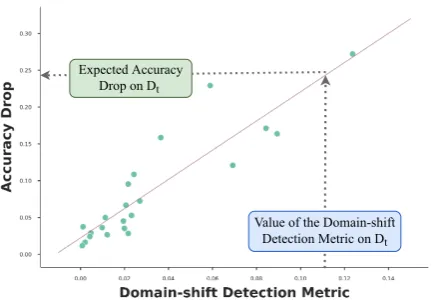
Value of the Domain-shift Detection Metric on Dt
[image:1.595.309.526.221.371.2]Expected Accuracy Drop on Dt
Figure 1: In this paper we introduce several domain-shift detection metrics (x-axis) and employ them to es-timate the performance drop on a new target domain
Dtby regressing on those metrics and their associated real performance drop (green dots).
or Label Shift, when PDs(y) 6= PDt(y) and PDs(x|y) = PDt(x|y) (Zhang et al., 2013;
Lip-ton et al.,2018), or a mix between them (Moreno-Torres et al.,2012;Quionero-Candela et al.,2009). Such changes are often the norm in many real-world applications, creating an urge in the industry to continuously check that models in production are performing well in the wild or when there is a new client or a new type of data. However, con-tinuously sampling and annotating data-points can be prohibitively slow and costly, particularly when a large annotated sample is needed to correctly represent the target joint distribution or when the change can be gradual (Kifer et al.,2004).
the decision to annotate more data for retraining or even adjusting the model accordingly (e.g. per-forming unsupervised domain adaptation).
We propose a method that takes advantage of several domain-shift detection metrics and employ them to estimate through regression the perfor-mance drop on a target domain on which no an-notated data is available, The overall approach is schematically depicted in Fig. 1. The relation-ship between the domain shift metrics and the real performance drop of different domains is pre-computed over different existing domains (green dots in Fig. 1), and for a new target domains the performance drop can be estimated simply by evaluating the function learned through simple re-gression. This process directly yields the value of performance drop the model will suffer when ex-posed to this target domain examples. We believe is more interpretable and useful to ML practition-ers than other intermediate signals such as of out-of-distribution detection methods.
This paper introduces the following contribu-tions:
• We introduce a new task and methodology for directly predicting performance drop of a model under domain-shift, without the need of labeled examples from the target domain.
• We survey, formalize and evaluate domain-shift detection metrics from 3 different fami-lies (§2) and propose new adaptations.
• We benchmark each proposes metric on two tasks of different natures: document classi-fication and sequence labeling (§3 and §4), and show their robustness under adversarial domain-shift scenarios.
2 Measuring Performance Drop
We are interested in the problem of measuring the performance drop of classifierC, trained on sam-ples from the source domain Ds when applied to
the target domainDtsamples. In the presence of
labeled samples fromDt, this could empirically be
measured by the difference in test errors between the source and target domain.
∆R= P r
(x,y)∈Ds(C(x)6=y)−(x,yP r)∈Dt(C(x)6=y) (1)
To calculate this value empirically, one would need annotated examples in the form of a labeled test set for each new target domain, which is costly
and/or time-consuming. In this section we intro-duce several metrics of different natures that cor-relate with the drop in a model performance with-out the need of any annotated examples from the target domain. In particular, we will consider three families of measures:
• H-divergence based metrics: based on the capacity of another classification model to distinguish between samples from Ds and Dt.
• Confidence-based, using the certainty of the model over its predictions.
• Reverse classification accuracy, where pre-dicted values are used as pseudo-labels over
Dt.
2.1 H-divergence based metrics
Building upon previous work from Kifer et al. (2004) for detecting domain change in data streams, Ben-David et al. (2010) define the tar-get error of a model under domain-shift in terms of its source error and the divergence between the distributions of the two domains. This domain di-vergence is referred to as the H-divergence and formalized as follows: given a hypothesis classH
that consists of a set of binary classifiersh:X → {0,1}theH-divergence can be represented as:
2 sup h∈H
|P rx∼Ds[h(x) = 1]−P rx∼Dt[h(x) = 1]| (2)
This translates to calculating the capacity of the hypothesis classHto distinguish between the dis-tributions of both domains Ds and Dt.1
Ben-David et al.(2010) prove that for a symmetric hy-pothesis class theH-divergence can be calculated through a finite sample sampled fromDsandDt.2
Calculating the value forH-divergence exactly re-quires finding the hypothesis h ∈ H that has minimum error on the binary classification prob-lem between samples fromDs and Dt, which is
intractable in practice. Thus, Ben-David et al. (2006) approximates this through learning a model that discriminates between the source and target examples. This approximated value is often re-ferred to as the ProxyA-distance (PAD).
Given a domain classifierGd:x → [0,1]
param-eterized byθd, we calculatePADas the following:
1
For simplicity we abuse the notation here by usingDs andDtto refer both to the distribution and the set of samples of the source and target domain respectively.
PAD= 1−2E(Gd)
s.t.;
E(G) = 1− 1 |D|
X
xi∈Ds,Dt
|G(xi)−I(xi∈Ds)|
(3)
whereIis an indicator function.
ThePADmeasure is task-agnostic and measures therefore only the co-variate shift. It has been used before to measure domain discrepancy be-tween datasets (Blitzer et al., 2007; Rai et al., 2010) for NLP applications. However, different from the time when PAD was introduced, mod-ern NLP models not only compute a mapping be-tween input and labels, but also infer an intermedi-ate representation. For a given task, this represen-tation is supposed to provide a view of the input that highlights the relevant part that could be help-ful for a correct classification in this task. In par-ticular, those intermediate representations should not be sensitive to task-irrelevant features that pro-vide nevertheless strong signals to distinguish be-tween the source and the target domains (yielding high PAD values). As an example, consider the task of named entity extraction on top of the 20 newsgroup dataset: theTo: field is a highly dis-criminating feature for domain classification but arguably irrelevant to the task of extracting named entities.
Following this intuition, we propose a modifi-cation to thePADmeasure. It is the classification accuracy of discriminating between the interme-diate representation coming from – respectively – source and target domain (we use the last layer of the neural network). We assume that the task clas-sifierCconsists of two functionsGf andGy. The
first projects the input to a hidden representation of sizem:Gf :X→ Rm; while the second is a
lin-ear layer that uses this representation to predict the class labelsGy :Rm→[0,1]|Y|. Differently from PAD, the domain classifierG∗d:Rm →[0,1]takes
the hidden representations as an input instead of the original input. The learnable parameters of
Gf,GyandG∗dareθf,θyandθd∗respectively. Our
proposed metricPAD*is then:
PAD*= 1−2E(G∗d(Gf(x))
θf, θy are learned by minimizing the loss
func-tion of the task. Afterwardsθf is frozen andθd∗is
learned by minimizing the negative log-likelihood loss3 for the domain discrimination task between
DsandDt.
2.2 Confidence Based Metrics
While the final decision of classifiers is discrete, the weight given to that decision can be inter-preted as the confidence the model has in that de-cision. This has been the basis of overcoming domain-shift using many self-training techniques which select the most confident examples as new training examples, together with the predicted class as pseudo-label (McClosky et al., 2006). However, modern neural networks are known to give wrongly calibrated confidence scores (Guo et al., 2017) meaning that the associated proba-bility scores to the predicted class label does not reflect its correctness likelihood.
A few calibration techniques have been pro-posed to overcome this problem. For its simplicity and effectiveness we follow the temperature scal-ing method (Guo et al.,2017). It is a post training method that rescales the logits of any neural net-work model to soften the softmax by raising the output entropy of the probabilities scores.
Given a model trained on the source domain dataset Ds, let z be the logits vector produced
by the very last layer for a given input, yield-ing the non-calibrated confidence score q =
max
k (softmax(z))
k for the predicted class label.
The calibrated confidence score bq is calculated then as follows:
b
q =max
k (softmax(z/T))
k (4)
Where T is a learnable scalar “temperature” pa-rameter. T can be learned by minimizing the neg-ative log likelihood loss over the validation set
Dsval;4
T∗=argmin T
− N
X
i=1
1[k=yi]log(softmax(zi/T))
!
(xi, yi)∈Dsval, T >0 (5)
Where 1[k=yi] is a one hot vector containing one in front of the true class label yi and zero
elsewhere.
Accordingly, we introduce two confidence based metrics to measure the domain-shift between the
3
Minimizing the Huber loss as in (Ben-David et al.,2006) provides very similar results.
source and the target datasetsDsandDt.
1)CONFthe drop in average probability scores of the predicted class:
CONF= 1
|Ds|
X
i:xi∈Ds qi−
1
|Dt|
X
j:xj∈Dt
qj (6)
2)CONF CALIBthe drop in average calibrated
probability scores for the predicted class:
CONF CALIB= 1
|Ds|
X
i:xi∈Ds
b
qi−
1
|Dt|
X
j:xj∈Dt
b
qj
(7)
2.3 Reverse Classification Accuracy
The idea of reverse classification accuracy is to use a classifier trained on the source domain to pseudo-label the target domain. That new dataset is then used to train a new classifier whose accu-racy is measured on held-out data from the source domain. This was used in the past to select among existing models or datasets the best-performing one for a given target domain (Fan and Davidson, 2006;Zhong et al.,2010). In order to use this to create a proxy for domain-shift, we proceed as fol-lows: a task classifierCis trained on the annotated source domain datasetDswhich is then run to
cre-ate pseudo-labels for the unlabeled target dataDt.
Those pseudo-labels are then used as training data for a reverse classifierCˆ– using the same architec-ture and training algorithm used to obtainC. The performance of both classifiers are compared on a heldout subsetD0s ∈ Ds from the source domain
datasets and used to define theRCAmeasure
RCA= 1 |D0
s| m0
X
xi,yi∈Ds0
I[yi =C(xi)]−I
h
yi =Cˆ(xi)
i
(8)
TheRCAmeasure could be low because of two reasons. It could be due to the domain-shift we try to capture, as a very different distribution would have a major impact in the training data generated on top ofDt. Or it could be due to the
accumula-tion of error created by the “back-and-forth” train-ing. IfDt follows the same distribution thanDs,
than the measure would only capture the impact of that accumulation of errors. To remove this source of errors, we also propose another measureRCA*
which is the performance difference of Cˆ and a classifierC0 trained in the same way but using as target domain held-out data from the source do-main. C is used again to pseudo-label a dataset,
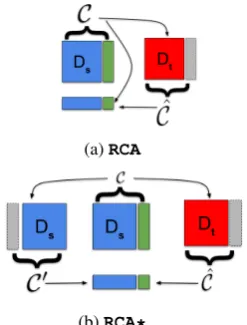
(a)RCA
[image:4.595.360.484.63.226.2](b)RCA*
Figure 2: The classifierCis trained on source domain (blue) with true labels (green) and is applied on target domain data (red) to create pseudo labels (grey). In the case ofRCA* C is also applied on a held-out source domain data (blue). Pseudo-labels (grey) are then used to train new classifiers (Cˆand forRCA*alsoC0). They are later applied on a test set of the source domain to calculateRCAandRCA*.
which is this time taken from the same distribu-tion thanDs, and this new dataset is then used as
training data for C0. RCA* is then calculated as follows:
RCA*= 1 |D0
s| m0
X
xi,yi∈Ds0
I
yi =C0(xi)−I
h
yi =Cˆ(xi)
i
(9)
A schematic view of these two measures is depicted in Fig.2.
3 Experiments
3.1 Regression of Performance Drop
We present a regression based method that can di-rectly estimate the performance drop of a model trained onDsand tested onDt. This method does
not require any labeling inDthowever it assumes
the availability of a small fixed number of labeled evaluation datasetsDo∈D\ {Ds, Dt}.
For each one of these fixed evaluation datasets, using simple linear regression we fit a regression line between the drop in the model accuracy and a domain-shift detection metrics of choice (§2). Af-terwards, by calculating the value of this domain-shift detection metric ondtwe can then use this
re-gression line to predict the performance drop when evaluating the modeldt.
0.65 0.70 0.75 0.80 0.85 0.90 0.95 1.00 0.0
0.1 0.2
0.3 PAD
0.00 0.05 0.10 0.15 0.20 0.25 0.30 0.35 0.40 0.0
0.1 0.2
0.3 RCA
0.00 0.02 0.04 0.06 0.08 0.10 0.12 0.0
0.1 0.2
0.3 CONF
0.5 0.6 0.7 0.8 0.9 0.0
0.1 0.2
0.3 PAD*
0.00 0.05 0.10 0.15 0.20 0.25 0.30 0.35 0.0
0.1 0.2
0.3 RCA*
0.00 0.02 0.04 0.06 0.08 0.10 0.12 0.14 0.0
0.1 0.2
0.3 CONF_CALIB
Metric
C
la
ssi
fic
at
io
n
Dr
[image:5.595.88.510.68.211.2]op
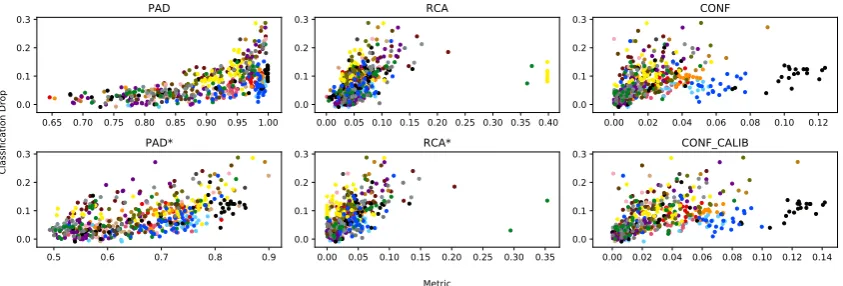
Figure 3: Scatter plots showing correlations between the values of each proposed domain similarity metric (x-axis) and the actual classification drop (y-axis) for the sentiment classification task. Each point corresponds to a single domain-shift scenario. Different colors represent different source domains and hence a single trained model on the source domain dataset.
Error (MAE) and Max error between our predicted values of performance drop using our method and the actual performance drop ondt.
To put in perspective the predictive power of this regression method on each proposed metric, we implement a baseline (Mean) that instead of learn-ing a regression it always gives the average classi-fication drop over all evaluation datasets inDo.
We also experiment with doing linear regres-sion using all metrics proposed in §2 at once
(Ensemble).
3.2 Datasets
We evaluate our metrics across two tasks of differ-ent nature namely sdiffer-entimdiffer-ent analysis and part-of-speech (POS) tagging.
3.2.1 Sentiment Analysis
For sentiment analysis we follow (Blitzer et al., 2007;Ruder and Plank,2018) by using the Ama-zon multidomain reviews dataset in English.5 Al-though this dataset contains several domains they still come from the same platform which can re-strain some diversity. To alleviate this we com-bine it with two other datasets namely Yelp6 and IMDB movie reviews dataset7. Although the pre-processed dataset in (Blitzer et al.,2007) is widely used, it only consists of 4 domains and the input documents are reduced to theirTF-IDFweights which is not a suitable input for modern NLP ar-chitectures. Thus we perform a different
prepro-5
http://jmcauley.ucsd.edu/data/amazon/index.html 6
https://www.yelp.com/dataset
7https://ai.stanford.edu/ amaas/data/sentiment/
cessing across a wider range of domains as fol-lows: After removing redundant reviews, we pre-process the dataset to obtain binary labels such that reviews with 1 to 3 stars are labeled as neg-ative while reviews with 4 or 5 stars are labeled as positive. Finally we randomly sample 21K re-views (10K train, 10K valid and 1K test) from 21 domains. Yelp and IMDB datasets follow the same preprocessing steps and are added as 2 extra do-mains. This yield a total new dataset with23 do-mains for sentiment analysis yielding506 domain-shift scenarios.8
3.2.2 Part of Speech Tagging
For part of speech tagging we select 4 publicly available 9 Universal Dependencies datasets for English (Nivre et al., 2016). We split the EWT dataset (UD for English web treebank) according to each sub-category, while keeping the rest of the smaller datasets as is. This yields in total 8 do-mains with roughly comparable sizes (∼4K sen-tences each) yielding in total 56 domain-shift sce-narios.
3.3 Experiment Setup and Training Details
For each domain-shift scenario, the task model is trained on the source domain training split. Test-ing is performed on both source and target do-mains test sets. Simultaneously, we calculate each of our proposed metrics in §2. Note here that some of those metrics such as PAD, PAD*, RCA
8
This makes 10x more examples and 40x more domain-shift scenarios than the widely used version of (Blitzer et al.,
2007).
and RCA* require the text of the target domain test set. None of the proposed metrics require any labels from the target domain, in line with the unsupervised scenario we are considering. The initial word embeddings are a hyperparameter, and we consider random initialization, pretrained GloVe (Pennington et al., 2014) with several di-mensions and contextualized word embeddings using ELMo (Peters et al., 2018). As model ar-chitectures we use Multi-Layer Bi-LSTM (Graves and Schmidhuber,2005) followed by a multi-layer feed-foward NN and a softmax. In sentiment anal-ysis the feed forward network is applied on the last output of the Bi-LSTM to produce one label pre-diction for the whole sentence, while for POS tag-ging it is applied to each output to produce a label prediction for each corresponding token.
For training the domain classifiers used to calcu-late the PAD and PAD* metrics, we use similar model architecture as in sentiment analysis, ini-tialized from scratch in case ofPAD or initialized with the weights of the best task model in case of
PAD*. Afterwards, they are trained to discrimi-nate between inputs of the source and target do-main datasets.
To calculate CONF CALIB, the best performing model is selected and its confidence weights are calibrated using temperature scaling on the source domain validation set.
Each model is trained using Adam optimza-tion (Kingma and Ba, 2015) and early stopping with patience5over the source domain validation set.
All models and training code have been imple-mented using AllenNLP (Gardner et al., 2018) and made publicly available in addition to the Datasets.10 The detailed hyper-parameters and the test results for each source domain dataset are shown in the appendix.
4 Evaluation Results
Fig.3contains a plot for each of the proposed met-rics, showing the value of that measure vs the ac-tual drop in performance for the sentiment analysis task. Each point corresponds to a single domain-shift scenario. While there is an overall trend be-tween each of our proposed metrics and the actual drop in classification accuracy, the actual trend differs depending on which source domain was
10https://github.com/hadyelsahar/
domain-shift-prediction
used.11 This is unsurprising as all measures but
PAD are model-specific. Instead of computing overall correlation trends, we decide to evaluate the capacity of each measure to serve as a predic-tor of the classification drop, as detailed in the next section.
4.1 Error in Performance Drop Prediction
Table 1 shows the mean absolute and maximum error values of the regression process that predicts the performance drop of a model trained overds
and evaluated on dt. The baseline that predicts
always the mean performance drop achieves on a mean absolute error of 5.2%and max error of 12.77% for sentiment analysis, while this num-ber drops for POS tagging to a mean of 1.06% and max of 1.67% in the worse case. All our proposed metrics improve significantly over that, withPAD*clearly improving over all other in both datasets. Overall, the best performing method is
PAD*with2.15%and0.88%mean absolute error in prediction of performance drop for sentiment analysis and POS tagging respectively. Learning an ensemble between all metrics does not guaran-tee to provide the best predictions, which could be due to the small size of the points used for regres-sion.
4.2 Impact of Number of Domains
Our proposed method for detecting performance drop assumes the existence of several evaluation datasets from different domains. This is a non-negligible cost, as having so many evaluation dataset from different domains might not be real-istic in many scenarios. In this section we evaluate the impact of having a lower number of source do-mains from which to learn the classification drop. We sample randomly a smaller number of datasets, and repeat the experiment. In Fig. 4 and Fig. 5 we report the results of that with 5 different runs of sampling. As expected, the error decreases by increasing the number of out of domain test sets. However, prediction error enters an accept-able score with only 3 annotated source domains.
4.3 Adversarial Shift
PAD*andPADare calculated solely from
learn-ing to classify between the source and target do-mains and could therefore be particularly sensi-tive to task irrelevant domain-shifts i.e. input
sig-11Each source domain corresponds to a single trained
Sentiment POS tagging MAE Max MAE Max
Mean 5.2±2.02 12.77 1.06±0.36 1.67
RCA 2.88±1.31 7.17 1.08±0.31 1.58 RCA* 2.92±1.39 7.42 1.05±0.27 1.42
CONF 2.85±1.69 8.86 0.89±0.39 1.75 CONF_CALIB 2.67±1.49 8.13 1.12±0.45 1.83
PAD 2.51±1.54 8.16 1.24±0.37 1.7 PAD* 2.15±0.88 4.64 0.89±0.1 0.99
[image:7.595.74.288.65.205.2]Ensemble 2.22±0.9 5.02 1.03±0.42 1.78
Table 1: Mean absolute error (MAE) and max error (Max) of the performance drop prediction for the task of sentiment analysis (left) and POS tagging (right). Best results (the lower the better) are shown in bold
while best results within each family of measure are underlined.
2 3 4 5 6 7 8 9 10 11 12 13 14 15 16 17 18 19 20 21 22 Number of Domains used for regression
2×100
3×100
4×100
6×100
Err
or
in
est
im
ati
on
of
cl
f d
rop PADPAD*
[image:7.595.310.522.67.154.2]RCA RCA* CONF CONF_CALIB Mean
Figure 4: Fig. showing effect of number of domains on the prediction of accuracy drop for sentiment analysis.
nals that can help to differentiate domains apart have has no impact on the task itself. To evalu-ate the robustness of each of our proposed metrics in this specific scenario, we perform an experi-ment by applying an adversarial domain-shift. For each domain-shift scenario in the sentiment analy-sis task we add a different unique tag<SOURCE>
and <TARGET>in the beginning of each exam-ple in the source and the target domains respec-tively: this has no impact on the final task classifi-cation, but makes it trivial to discriminate between the two domains. The results of re-running the same experiment on this modified dataset are in Table2. As expected,PADis greatly affected, not performing better than the baseline which just pre-dicts the mean classification drop. The other two families are less or not at all affected. Surprisingly,
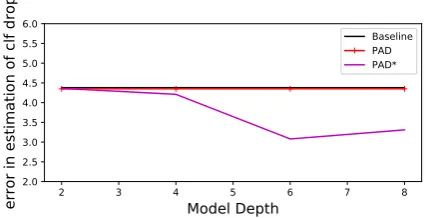
PAD*also degrades significantly, despite using a task representation which should learn to discard the useless (for the task prediction) newly intro-duced token. To understand this better, we an-alyze the behaviour of the models with different depths. In Fig.7the best performing model for a
2 3 4 5 6 7
Number of Domains used for regression 100
1.5×100
3×100
4×100
6×100
Err
or
in
est
im
ati
on
of
clf
dr
op PAD
PAD* RCA RCA* CONF CONF_CALIB Mean
Figure 5: Fig. showing effect of number of domains on the prediction of accuracy drop for POS tagging.
MAE max
Mean 4.35±2.31 10.79
RCA 3.63±1.95 9.56
RCA* 3.67±1.93 8.44
CONF 2.88±1.16 5.5
CONF_CALIB 2.81±1.09 5.48
PAD 4.35±2.31 10.79
PAD* 4.6±2.14 10.77
[image:7.595.342.492.202.343.2]Ensemble 3.02±0.98 5.88
Table 2: Mean absolute error and Max error of per-formance drop prediction for sentiment analysis under adversarial shift evaluation (The lower the better).
given depth is used: the results indicate that the capacity for predicting the classification drop us-ingPAD*is greatly influenced only if the model is very shallow. This becomes clearer in Fig.6where we repeat the plots from Fig.3 for this adversar-ial dataset restricting the hyper-paramater search of the task model to models of a fixed depths. At any model depth thePADmeasure is always maxi-mal (1.00) as it learns to differentiate perfectly the two domains. While this is also the case forPAD*
in the case of model of depth 2, deeper model are less sensitive to that. This might indicate that the higher layer (which are used as input representa-tion for the domain classificarepresenta-tion models used to calculatePAD*) are learning to ignore the domain token as it is irrelevant for the task at hand. The rest of the metrics are more robust with respect to adversarial examples and model depth, which might make them good candidates for cases of se-vere co-variate shift.
5 Related Work
[image:7.595.76.287.307.394.2]Model depth = 2
0.995 1.000 1.005 0.0
0.1 0.2 0.3
PAD
0.0 0.2 0.4 0.0
0.1 0.2 0.3
RCA
0.000 0.025 0.050 0.0
0.1 0.2 0.3
CONF
0.96 0.98 1.00 0.0
0.1 0.2 0.3
PAD*
0.0 0.2 0.0 0.1 0.2 0.3
RCA*
0.00 0.05 0.0
0.1 0.2 0.3
CONF_CALIB
Model depth = 5
0.995 1.000 1.005 0.0
0.1 0.2
PAD
0.0 0.2 0.4 0.0
0.1 0.2
RCA
0.000 0.025 0.050 0.075 0.0
0.1 0.2
CONF
0.6 0.8 0.0
0.1 0.2
PAD*
0.0 0.2 0.0 0.1 0.2
RCA*
0.00 0.05 0.0
0.1 0.2
[image:8.595.83.525.64.190.2]CONF_CALIB
Figure 6: Measure vs drop in performance in the adversarial case, restricting the hyper-parameter search to models of depth 2 (left) and 5 (right)
2 3 4 5 6 7 8
Model Depth 2.0
2.5 3.0 3.5 4.0 4.5 5.0 5.5 6.0
err
or
in
est
im
ati
on
of
clf
dr
op
Baseline PAD PAD*
Figure 7: The effect of the task model depth on the capacity of the metric to estimate the drop in classifica-tion under adversarial evaluaclassifica-tion.
Ben-David et al.,2010). Kifer et al.(2004); Ben-David et al. (2006) formalize the concept of H -divergence to measure domain discrepancy. Later on, Blitzer et al. (2008) introduce the Proxy A -distance as a proxy to H-divergence which was used by Blitzer et al. (2007); Rai et al. (2010) to gain insights about adaptability of representa-tions for domain adaptation and active learning. More recently, Ruder et al. (2017) showed that ProxyA-distance is effective as a similarity metric for dataset selection. H-divergence has inspired a large body of work (Ganin et al., 2016; Tzeng et al.,2017) for domain adaptation by minimizing the H-divergence between domains using a do-main adversarial loss.
There exists a large line of work on develop-ing domain similarity metrics for data selection under transfer learning (Moore and Lewis,2010; Plank and van Noord,2011;Axelrod et al.,2011; Wu and Huang,2016), however there is no con-sensus on which similarity measure is suitable for which NLP task. Ruder and Plank (2017) show that a combination of several of those similar-ity features re-weighted using Bayesian
Optimiza-tion performs the best across several tasks. This method however is not fully unsupervised as it re-quires an annotated validation set from each target domain.
The closest work to ours areRavi et al.(2008); Van Asch and Daelemans (2010), as they also tackle the problem of predicting performance of models at test time. They introduce a set of do-main similarity metric that correlates with the per-formance of a model on a test set for both part-of-speech tagging and parsing. However, many of those measure are built on top of heavily hand-crafted features and evaluated through shallow models which are different to the way modern NLP models are built now.
Confidence scores can be a good estimation of domain similarity, however it is well known for modern neural networks that their confidence scores are usually mis-calibrated. Because of that, many self-training techniques rely on an ensem-ble of models to calculate for bootstrapping in-domain examples training examples, such as co-training and tri-co-training (Zhou and Li,2005), tri-training with dis-agreement (Søgaard, 2010) and multi-task tri-training (Ruder and Plank,2018). In our paper we aim to measure the potential classi-fication drop of a specific model due to domain-shift. Training an ensemble of models of the same architecture in hand might be expensive and inefficient for just measuring domain-shift. We try to overcome this problem by calibrating con-fidence scores (Zadrozny and Elkan, 2002; Guo et al., 2017; DeVries and Taylor, 2018). Us-ing confidence scores of calibrated models has shown a large success in out of distribution detec-tion (Hendrycks and Gimpel, 2017;Liang et al., 2018,2017;Lee et al.,2018).
[image:8.595.74.289.251.360.2]and Davidson,2006;Zhong et al.,2010) was first introduced as a part of “Transfer Cross Validation” to select both models and data in a cross valida-tion framework, optimized for transfer learning. More recently, this was adapted as a confidence estimator to predicting segmentation performance in the clinical domain (Valindria et al.,2017). The same idea has been used recently used for evaluat-ing GANs for image generation (Shmelkov et al., 2018).
6 Conclusion
In this paper we studied the problem of predic-tion of performance drop due to domain-shift for modern NLP models, having no labeled target do-main data but at least few fixed evaluation datasets from other domains. We investigated three fam-ily of metrics for measuring domain similarity. In each of them we introduced a novel adaptation on existing metrics to adapt to the different nature of modern NLP models and possibly obtain higher prediction scores of the performance drop. Our evaluation over two NLP tasks show that this drop can be estimated very accurately even when only few other source-domains evaluation datasets are available. In general, the family ofH-divergence based measures perform the best. However, they are prone to fail when there is a severe change in the marginal distribution that is task irrelevant. In particular, the well establishedPADmeasure is
rendered useless in a setting where we artificially exaggerate that phenomena. Using a task-specific representation is slightly more robust to that prob-lem, although only if a deeper model is used.
A strong family of measures that does not have that drawback are confidence-based measures, but they require access to the confidence weights and not only the predicted labels by the model. Un-fortunately, our adaptation of the reverse classi-fication accuracy measure RCA* does not obtain higher performance than the simple RCA. This
could be due to the fact that datasets sampled from the same domain can still be subjected to sample selection bias. In the future work, we plan to in-vestigate ways to solve that. These conclusions are summarized in Table3, which we recommend as guideline when deciding what measure to use.
Acknowledgments
This work was partially funded through the Eu-ropean Unions Horizon 2020 research and
in-Measure Robust to Black box Good with small
co-variate shift Target Data
PAD X X X
PAD* (X) X X
RCA X X X
RCA* X X X
CONF X X X
[image:9.595.308.525.64.170.2]CONF CALIB X X X
Table 3: Summary of domain similarity metrics dis-cussed in this work and their different characteristics.
novation programme under grant agreement No. 786741 (SMOOTH Platform).
References
Amittai Axelrod, Xiaodong He, and Jianfeng Gao. 2011.Domain adaptation via pseudo in-domain data selection. ACM.
Shai Ben-David, John Blitzer, Koby Crammer, Alex Kulesza, Fernando Pereira, and Jennifer Wortman Vaughan. 2010. A theory of learning from different domains.Machine Learning, 79(1-2):151–175.
Shai Ben-David, John Blitzer, Koby Crammer, and
Fernando Pereira. 2006. Analysis of
representa-tions for domain adaptation. In Advances in Neu-ral Information Processing Systems 19, Proceedings of the Twentieth Annual Conference on Neural In-formation Processing Systems, Vancouver, British Columbia, Canada, December 4-7, 2006, pages 137–144.
John Blitzer, Koby Crammer, Alex Kulesza, Fernando
Pereira, and Jennifer Wortman. 2008. Learning
bounds for domain adaptation. InAdvances in neu-ral information processing systems, pages 129–136.
John Blitzer, Mark Dredze, and Fernando Pereira.
2007. Biographies, bollywood, boom-boxes and
blenders: Domain adaptation for sentiment classi-fication. InACL 2007, Proceedings of the 45th An-nual Meeting of the Association for Computational Linguistics, June 23-30, 2007, Prague, Czech Re-public.
John Blitzer and Fernando Pereira. 2007. Domain
adaptation of natural language processing systems.
University of Pennsylvania, pages 1–106.
Caroline Brun and Vassilina Nikoulina. 2018.
As-pect based sentiment analysis into the wild. In Pro-ceedings of the 9th Workshop on Computational Ap-proaches to Subjectivity, Sentiment and Social Me-dia Analysis, WASSA@EMNLP 2018, Brussels, Bel-gium, October 31, 2018, pages 116–122.
Wei Fan and Ian Davidson. 2006. Reverse testing: an efficient framework to select amongst classifiers un-der sample selection bias. InProceedings of the 12th ACM SIGKDD international conference on Knowl-edge discovery and data mining, pages 147–156. ACM.
Yaroslav Ganin, Evgeniya Ustinova, Hana Ajakan, Pascal Germain, Hugo Larochelle, Franc¸ois Lavi-olette, Mario Marchand, and Victor S. Lempitsky.
2016. Domain-adversarial training of neural
net-works. Journal of Machine Learning Research, 17:59:1–59:35.
Matt Gardner, Joel Grus, Mark Neumann, Oyvind Tafjord, Pradeep Dasigi, Nelson Liu, Matthew Pe-ters, Michael Schmitz, and Luke Zettlemoyer. 2018. Allennlp: A deep semantic natural language pro-cessing platform. arXiv preprint arXiv:1803.07640.
Alex Graves and J¨urgen Schmidhuber. 2005. Frame-wise phoneme classification with bidirectional lstm and other neural network architectures. Neural Net-works, 18(5-6):602–610.
Chuan Guo, Geoff Pleiss, Yu Sun, and Kilian Q. Wein-berger. 2017. On calibration of modern neural net-works. In Proceedings of the 34th International Conference on Machine Learning, ICML 2017, Syd-ney, NSW, Australia, 6-11 August 2017, pages 1321– 1330.
Dan Hendrycks and Kevin Gimpel. 2017. A baseline
for detecting misclassified and out-of-distribution examples in neural networks. In5th International Conference on Learning Representations, ICLR 2017, Toulon, France, April 24-26, 2017, Confer-ence Track Proceedings. OpenReview.net.
Robin Jia and Percy Liang. 2017. Adversarial exam-ples for evaluating reading comprehension systems. InEmpirical Methods in Natural Language Process-ing (EMNLP).
Daniel Kifer, Shai Ben-David, and Johannes Gehrke.
2004. Detecting change in data streams. In
(e)Proceedings of the Thirtieth International Con-ference on Very Large Data Bases, Toronto, Canada, August 31 - September 3 2004, pages 180–191.
Diederik P. Kingma and Jimmy Ba. 2015. Adam: A
method for stochastic optimization. In 3rd Inter-national Conference on Learning Representations, ICLR 2015, San Diego, CA, USA, May 7-9, 2015, Conference Track Proceedings.
Kimin Lee, Honglak Lee, Kibok Lee, and Jinwoo Shin. 2018. Training confidence-calibrated classifiers for detecting out-of-distribution samples. In 6th Inter-national Conference on Learning Representations, ICLR 2018, Vancouver, BC, Canada, April 30 - May 3, 2018, Conference Track Proceedings. OpenRe-view.net.
Shiyu Liang, Yixuan Li, and R. Srikant. 2017. Prin-cipled detection of out-of-distribution examples in neural networks.CoRR, abs/1706.02690.
Shiyu Liang, Yixuan Li, and R. Srikant. 2018. Enhanc-ing the reliability of out-of-distribution image detec-tion in neural networks. In6th International Confer-ence on Learning Representations, ICLR 2018, Van-couver, BC, Canada, April 30 - May 3, 2018, Con-ference Track Proceedings. OpenReview.net.
Zachary C. Lipton, Yu-Xiang Wang, and Alexander J.
Smola. 2018. Detecting and correcting for label
shift with black box predictors. In Proceedings of the 35th International Conference on Machine Learning, ICML 2018, Stockholmsm¨assan, Stock-holm, Sweden, July 10-15, 2018, volume 80 of
Proceedings of Machine Learning Research, pages 3128–3136. PMLR.
David McClosky, Eugene Charniak, and Mark John-son. 2006. Effective self-training for parsing. In
Human Language Technology Conference of the North American Chapter of the Association of Com-putational Linguistics, Proceedings, June 4-9, 2006, New York, New York, USA.
Robert C. Moore and William D. Lewis. 2010.
Intel-ligent selection of language model training data. In
ACL 2010, Proceedings of the 48th Annual Meet-ing of the Association for Computational LMeet-inguis- Linguis-tics, July 11-16, 2010, Uppsala, Sweden, Short Pa-pers, pages 220–224. The Association for Computer Linguistics.
Jose G Moreno-Torres, Troy Raeder, Roc´ıO Alaiz-Rodr´ıGuez, Nitesh V Chawla, and Francisco Her-rera. 2012. A unifying view on dataset shift in clas-sification.Pattern Recognition, 45(1):521–530.
Joakim Nivre, Marie-Catherine de Marneffe, Filip Ginter, Yoav Goldberg, Jan Hajic, Christopher D. Manning, Ryan T. McDonald, Slav Petrov, Sampo Pyysalo, Natalia Silveira, Reut Tsarfaty, and Daniel
Zeman. 2016. Universal dependencies v1: A
mul-tilingual treebank collection. In Proceedings of the Tenth International Conference on Language Resources and Evaluation LREC 2016, Portoroˇz, Slovenia, May 23-28, 2016.European Language Re-sources Association (ELRA).
Jeffrey Pennington, Richard Socher, and
Christo-pher D. Manning. 2014. Glove: Global vectors for
word representation. In Proceedings of the 2014 Conference on Empirical Methods in Natural Lan-guage Processing, EMNLP 2014, October 25-29, 2014, Doha, Qatar, A meeting of SIGDAT, a Special Interest Group of the ACL, pages 1532–1543. ACL.
Matthew E. Peters, Mark Neumann, Mohit Iyyer, Matt Gardner, Christopher Clark, Kenton Lee, and Luke
Zettlemoyer. 2018. Deep contextualized word
Barbara Plank and Gertjan van Noord. 2011. Effective measures of domain similarity for parsing. InThe 49th Annual Meeting of the Association for Com-putational Linguistics: Human Language Technolo-gies, Proceedings of the Conference, 19-24 June, 2011, Portland, Oregon, USA, pages 1566–1576. The Association for Computer Linguistics.
Joaquin Quionero-Candela, Masashi Sugiyama, Anton Schwaighofer, and Neil D Lawrence. 2009. Dataset shift in machine learning. The MIT Press.
Piyush Rai, Avishek Saha, Hal Daum´e III, and Suresh
Venkatasubramanian. 2010. Domain adaptation
meets active learning. InProceedings of the NAACL HLT 2010 Workshop on Active Learning for Natural Language Processing, pages 27–32. Association for Computational Linguistics.
Sujith Ravi, Kevin Knight, and Radu Soricut. 2008. Automatic prediction of parser accuracy. In 2008 Conference on Empirical Methods in Natural Lan-guage Processing, EMNLP 2008, Proceedings of the Conference, 25-27 October 2008, Honolulu, Hawaii, USA, A meeting of SIGDAT, a Special In-terest Group of the ACL, pages 887–896. ACL.
Sebastian Ruder, Parsa Ghaffari, and John G. Breslin.
2017. Data selection strategies for multi-domain
sentiment analysis.CoRR, abs/1702.02426.
Sebastian Ruder and Barbara Plank. 2017. Learning
to select data for transfer learning with bayesian optimization. InProceedings of the 2017 Confer-ence on Empirical Methods in Natural Language Processing, EMNLP 2017, Copenhagen, Denmark, September 9-11, 2017, pages 372–382. Association for Computational Linguistics.
Sebastian Ruder and Barbara Plank. 2018. Strong
baselines for neural semi-supervised learning under domain shift. In Proceedings of the 56th Annual Meeting of the Association for Computational Lin-guistics, ACL 2018, Melbourne, Australia, July 15-20, 2018, Volume 1: Long Papers, pages 1044–1054.
Hidetoshi Shimodaira. 2000. Improving predictive in-ference under covariate shift by weighting the log-likelihood function. Journal of statistical planning and inference, 90(2):227–244.
Konstantin Shmelkov, Cordelia Schmid, and Karteek
Alahari. 2018. How good is my gan? In
Com-puter Vision - ECCV 2018 - 15th European Con-ference, Munich, Germany, September 8-14, 2018, Proceedings, Part II, volume 11206 ofLecture Notes in Computer Science, pages 218–234. Springer.
Anders Søgaard. 2010. Simple semi-supervised train-ing of part-of-speech taggers. InACL 2010, Pro-ceedings of the 48th Annual Meeting of the Asso-ciation for Computational Linguistics, July 11-16, 2010, Uppsala, Sweden, Short Papers, pages 205– 208.
Amos Storkey. 2009. When training and test sets are different: characterizing learning transfer. Dataset shift in machine learning, pages 3–28.
Eric Tzeng, Judy Hoffman, Kate Saenko, and Trevor
Darrell. 2017. Adversarial discriminative domain
adaptation. In2017 IEEE Conference on Computer Vision and Pattern Recognition, CVPR 2017, Hon-olulu, HI, USA, July 21-26, 2017, pages 2962–2971. IEEE Computer Society.
Vanya V Valindria, Ioannis Lavdas, Wenjia Bai, Kon-stantinos Kamnitsas, Eric O Aboagye, Andrea G Rockall, Daniel Rueckert, and Ben Glocker. 2017. Reverse classification accuracy: predicting segmen-tation performance in the absence of ground truth.
IEEE transactions on medical imaging, 36(8):1597– 1606.
Vincent Van Asch and Walter Daelemans. 2010. Us-ing domain similarity for performance estimation. In Proceedings of the 2010 Workshop on Domain Adaptation for Natural Language Processing, pages 31–36. Association for Computational Linguistics.
Fangzhao Wu and Yongfeng Huang. 2016. Sentiment
domain adaptation with multiple sources. In Pro-ceedings of the 54th Annual Meeting of the Associ-ation for ComputAssoci-ational Linguistics, ACL 2016, Au-gust 7-12, 2016, Berlin, Germany, Volume 1: Long Papers. The Association for Computer Linguistics.
Bianca Zadrozny and Charles Elkan. 2002. Transform-ing classifier scores into accurate multiclass proba-bility estimates. InProceedings of the Eighth ACM SIGKDD International Conference on Knowledge Discovery and Data Mining, July 23-26, 2002, Ed-monton, Alberta, Canada, pages 694–699.
Kun Zhang, Bernhard Sch¨olkopf, Krikamol Muandet,
and Zhikun Wang. 2013. Domain adaptation under
target and conditional shift. In Proceedings of the 30th International Conference on Machine Learn-ing, ICML 2013, Atlanta, GA, USA, 16-21 June
2013, volume 28 of JMLR Workshop and
Confer-ence Proceedings, pages 819–827. JMLR.org.
Erheng Zhong, Wei Fan, Qiang Yang, Olivier Ver-scheure, and Jiangtao Ren. 2010. Cross validation framework to choose amongst models and datasets for transfer learning. InJoint European Conference on Machine Learning and Knowledge Discovery in Databases, pages 547–562. Springer.
Zhi-Hua Zhou and Ming Li. 2005. Tri-training: