Proceedings of the 2019 Conference on Empirical Methods in Natural Language Processing and the 9th International Joint Conference on Natural Language Processing, pages 2712–2722,
2712
Query-Focused Scenario Construction
Su Wang1,2 Greg Durrett3 Katrin Erk1
1Department of Linguistics
2Department of Statistics and Data Science
3Department of Computer Science
The University of Texas at Austin
[email protected] [email protected] [email protected]
Abstract
The news coverage of events often contains not one but multiple incompatible accounts of what happened. We develop a query-based system that extracts compatible sets of events (scenarios) from such data, formulated as one-class clustering. Our system incrementally evaluates each event’s compatibility with al-ready selected events, taking order into ac-count. We use synthetic data consisting of ar-ticle mixtures for scalable training and evalu-ate our model on a new human-curevalu-ated dataset of scenarios about real-world news topics. Stronger neural network models and harder synthetic training settings are both important to achieve high performance, and our final sce-nario construction system substantially outper-forms baselines based on prior work.
1 Introduction
While a situation is developing, news reports often contain multiple contradictory stories (scenarios) of what happened, and it is hard to piece together the individual scenarios. For example, surround-ing the disappearance of the Saudi journalist Jamal Khashoggi, there were initially multiple conflict-ing accounts of what happened. One states that he was the victim of a murder scheme; an alternative suggests that he walked out of the consulate alive. The task of identifying these individual scenarios is also being considered in the Active Interpreta-tion of Disparate Alternatives (AIDA) program,1 and in a recent Text Analysis Conference (TAC).2 We frame the task as query-based scenario dis-covery: given a topic (e.g., the disappearance of Jamal Khashoggi) and a query (e.g. Jamal Khashoggi was murdered), we want to retrieve
1
https://www.darpa.mil/program/active-interpretation-of-disparate-alternatives
2https://tac.nist.gov/2018/SM-KBP/
index.html
Query: Jamal Khashoggi was murdered.
Jamal Khashoggi entered the consulate of Saudi Arabia consulate in Istambul.He exited the Saudi consulate after a few minutes. The team wanted to arrest Khashoggi but botched it.He never exited the Saudi consulate but died there. Khashoggi, according to the reporter, was seen on a flight leaving Turkey for Estonia.A team flew from Saudi Arabia to Turkey prior to Khashoggi’s appointment at the consulate specifically to intercept him. The team was sent by the Saudi crown prince with the order to murder Khashoggi.Jamal A. Khashoggi works for The Washington Post, and is the editor-in-chief of Al-Arab News.
Figure 1: An example for query-based scenario con-struction. Given thequery, we want to select event-denoting sentences from a document mixture to build a target scenario with a sequence of compatible events. The mixture also contains sentences which may be ir-relevant or part of an alternative scenario.
a scenario, a set of compatible events, from the given reports. We formulate query-based scenario discovery as one-class clustering (Bekkerman and Crammer, 2008). We specifically focus on dis-covering a scenario of compatible events ( Barzi-lay and Lapata, 2008; Chambers and Jurafsky,
2008,2009;Mostafazadeh et al.,2017) in a collec-tion of related and unrelated event-denoting sen-tences, which may contain conflicting and irrele-vant information. We start with a query (see Fig-ure1) and then iteratively insert sentences into the “scenario-in-construction”. Sentences are chosen based on overall compatibility as well as the ease with which scenario sentences can be arranged into an order. We additionally use an adapted rela-tion network (Santoro et al.,2017) to assess con-nections between words.
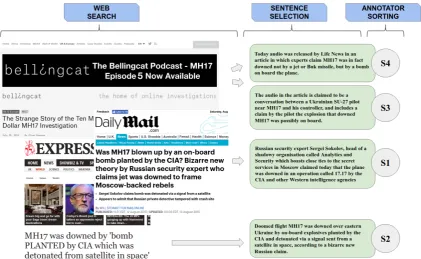
outper-Figure 2: Phase 2 (cf. Table1) of generating human evaluation data Human100: given the topicWhy did MH-17 crash? and the scenarioMH-17 had a bomb on board. The annotator searches the web and finds the webpages above. From these pages, she first selects 4 sentences which are relevant, then sorts them so that they make a consistent scenario that could be read from start to finish.
form lexical baselines and the strong neural model proposed inWang et al.’s seminal work.
Our contribution is three-fold: (1) A query-based scenario construction task, for which we introduce a model to iteratively build a scenario with compatible events, exploiting ordering. (2) A human-curated evaluation set consisting of multi-ple accounts of real-world new events, along with a collection of scalably-built synthetic simulation datasets, which we show serve as an effective source of training data. (3) Comprehensive experi-ments and analysis that cast light on the properties of the task and data, as well as on the challenges.
2 Background
Our work traces its roots to research in script
(Schank and Abelson,1977;Mooney and DeJong,
1985) and narrative schema learning (Chambers and Jurafsky,2008;Pichotta and Mooney,2016). Early work explored tasks such as script model-ing (Mooney and DeJong, 1985). Recent work built on the idea that compatibility of events can be learned from corpus data, evaluated on narrative cloze (Chambers and Jurafsky, 2009) and predicting-next-events (Pichotta and Mooney,
2016;Mostafazadeh et al.,2017).
We introduce a task with a more practical objec-tive in mind: given a query or an information cue, extract the rest of the pieces to build a compati-ble scenario. The task is related to conversation disentanglement of multiple entangled conversa-tions in a dialogue transcript (Elsner and Char-niak, 2008, 2011; Jiang et al., 2018; Kummer-feld et al., 2019), and more closely to narrative clustering (Wang et al., 2018), i.e. identifying all the scenarios in an information source by group-ing relevant sentences/events. UnlikeWang et al.
(2018), we do not attempt to identify all the sce-narios in the source, but are guided by one par-ticular user’s information need (e.g. the scenario about Khashoggi’s murder, as opposed to all the theories regarding his disappearance, like inWang et al.(2018)). Further, we do not assume the num-ber of scenarios is known a priori (asWang et al.
(2018) do).
[image:2.595.87.509.61.320.2]Topic question:Why did MH-17 crash?
scenario 1.MH-17 had a bomb on board
(1) Doomed flight MH17 was downed over eastern Ukraine by on-board explosives planted by the CIA and detonated via a signal sent from a satellite in space, according to a bizarre new Russian claim. (2) Russian security expert Sergei Sokolov head of a shadowy organisation called Analytics and Security which boasts close ties to the secret services in Moscow claimed today that the plane was downed in an operation called 17.17 by the CIA and other Western intelligence agencies. (3) Today audio was released by Life News in an article in which experts claim MH17 was in fact downed not by a jet or Buk missile, but by a bomb on board the plane. (4) The audio in the article is claimed to be a conversation between a Ukrainian SU-27 pilot near MH17 and his controller, and includes a claim by the pilot the explosion that downed MH17 was possibly on board.
scenario 2.MH-17 was shot down by missiles.
(1) The shoot-down occurred in the War in Donbass, during the Battle of Shakhtarsk, in an area controlled by pro-Russian rebels. (2) The responsibility for investigation was delegated to the Dutch Safety Board (DSB) and the Dutch-led joint investigation team (JIT), who concluded that the airliner was downed by a Buk surface-to-air missile launched from pro-Russian separatist-controlled territory in Ukraine. (3) According to the JIT, the Buk that was used originated from the 53rd Anti-Aircraft Missile Brigade of the Russian Federation, and had been transported from Russia on the day of the crash, fired from a field in a rebel-controlled area, and the launcher returned to Russia after it was used to shoot down MH17. (4) Previously, the investigative website Bellingcat has pointed to involvement of the same brigade using open-source information.
Table 1: An example from the crowdsourced Human100 dataset. Phase 1 (in bold): an MTurk worker writes (by web searching and editing) a topic question and two scenarios that answers the question. Phase 2: an annotator elaborates on the two scenarios (also through search-and-edit) with a compatible scenario.
and Karthikeyan,2014). Finally, our task is super-ficially similar to query-based summarization ( Ot-terbacher et al.,2005;Baumel et al.,2018) but has a different goal: we want to distinguish potentially conflicting narrative scenarios rather than conduct single-topic information compression. We also distinguish our work from multi-document sum-marization (McKeown et al., 2002;Radev et al.,
2005), as we are explicitly drawing distinctions among conflictive scenarios rather than summariz-ing the entire (ssummariz-ingle) topic.
3 Data
This section first introduces our human-curated, realistic evaluation data for our objective. Then we describe how we synthesized various types of training data for our model.
3.1 Human-curated Data
Realistic data on this task is hard to obtain, as after a time, a single scenario tends to dominate in the news. The Linguistics Data Consortium (LDC) has data for the AIDA project, and the 2018 Text Analysis Conference (TAC) had a hypothesis generation task, but both use a single topic only (the Russia-Ukraine conflict of 2014), with no hy-potheses available (TAC) or no hyhy-potheses at sen-tence level (LDC). As a step in the direction of re-alistic data for the task, we had human annotators collect news items that have multiple scenarios of what happened around the same topic (Table1).
We collected data in two phases: in phase 1, we asked workers on Amazon Mechanical Turk (MTurk) to provide (1) a topic in the form of an
English wh-question; (2) two scenarios that an-swer the topic question mutually exclusively. See the bold text in Table1for an example. In phase 2 (Figure 2), a group of non-Turk annotators3 pieced together English sentences from the web to elaborate on the scenarios from phase 1 (Table
1, non-bold). Annotators were instructed to build scenarios which can be read fluently. Sentences that could be copy-and-pasted directly from web search results were prioritized. When such sen-tences were unattainable, annotators were allowed to edit the style of the text to fit the scenario in the tone of a news report. We allowed this relaxation because, as mentioned above, often one scenario is dominant in web search results. For instance, in the Jamal Khashoggi story, English media almost unanimously report that he was a victim of murder, whereas the alternative scenario – he “disappeared and is still alive” is harder to find. A set of 100 mixtures were collected this way. We refer to the dataset asHuman100(stats in Table2).4
Wang et al. (2018) gauge the difficulty of a mixture by measuring thetopic similaritybetween the target and the distractor(s) using the cosine distance between the average word embeddings. A mixture of documents (or scenarios) will typ-ically be more difficult to separate if the scenar-ios/documents are more topically similar, since lexical cues are less reliable in this case.
Specif-3In our pilots for phase 2, the data Turkers created were
not ideal, therefore we opted for hiring local annotators which produced higher quality results.
4Available before main conference: http:
Figure 3: Synthetic data generation illustrated with our running example. First randomly sample news para-graphs (one is randomly assigned as the target scenario, the rest are distractors) and random sentences, then mix the target scenario with (a) other complete distractor scenarios (red) and (b) random sentences.
ically, Wang et al. found that their models strug-gled to separate scenarios even at 0.6 topical sim-ilarity, with accuracy on a binary clustering task dropping from 85% (all) to 68% (the hard ones). By this criterion Human100, at 0.8 average topic similarity cosine, is a hard dataset that challenges NLP models for their abilities to perform beyond shallow textual inference. Human-level perfor-mance is nonetheless fairly strong: 0.81 with dis-tractor scenarios, and 0.97 with randomly sampled sentences (both are F1 scores, more details in Sec-tion 5).
3.2 Training with Proxy Synthetic Data
The idea we follow for synthetic data creation is the same as in Wang et al. (2018): we can use different articles as proxies for different scenarios, even though articles in the synthetic setting do not necessarily belong to the same topic. Our hypoth-esis is that a model trained to predict which sen-tences came from the same news article will also do better at predicting which sentences come from the same scenario in the human-curated data.
We synthesize data from two source corpora: the New York Times portion of English
Giga-Corpus #scenarios Vocab Words/scenario Sents/scenario Human100 200 (2/topic) - 127.9 4
NYT 1.14m 50,000 189.5 9.5
[image:4.595.94.268.62.319.2]ROC 113k 39,954 46.5 5.0
Table 2: Corpora statistics. Top: human-curated data; Bottom: synthetic data. For NYT, we truncated the vocabulary to the most frequent 50k (the full vocab-ulary is over 100k). For NYT and ROC we apply a 85%/5%/10% split to construct train/dev/test sets. The two datasets share 27,795 words in vocabulary.
word (Graff et al., 2003) (NYT), which Wang et al.(2018) used to construct their document mix-tures, and ROCStories (Mostafazadeh et al.,2017) (ROC). NYT is chosen for having the same do-main as the human-constructed news data.5 With ROC we want to gauge the generality of our ap-proach out-of-domain: on news-only data a model could “cheat” by memorizing common named en-tities. We want to see to what extent models go beyond that to learn general event compatibility.
The synthesis method is summarized in Figure
3, with corpus statistics in Table2. In the first con-dition we mix a randomly sampled target scenario with a distractor scenario (also randomly sam-pled), followingWang et al.(2018). The mixtures are denotedNYT/ROC-w18. For the second con-dition, we replace the distractor scenario with un-connected randomly sampled sentences (corpus-wide), henceNYT/ROC-rand. We also combine both conditions, giving a mixture with both types of distractors. We also vary the number of distrac-tor scenarios in a mixture (2, 3, or, 4, including the target scenario). To equalize the number of sentences in mixtures, we pad them all to a fixed number of sentences. We call these NYT/ROC-2/3/4.
4 Models
Given a query q and a mixture of sentences, we want to select sentences that form a compatible scenario with the query. Our models select the sentences iteratively: the process begins with a
target set T(1) = {q}(i.e. initialized with only the query in the set) and acandidate setC(1) (i.e.
5
the mixture), and terminates at some time step i
with a predicted scenarioT(i).
We experiment with two termination condi-tions: (1)fixed #sentences: a pre-specified num-ber of sentences are extracted; (2)dynamic #sen-tences: a special end-of-scenario token<end>is predicted as the next candidate. (1) simulates the case where the user desires to specify the amount of information to be extracted (i.e. a consistent yet not necessarily all-inclusive scenario), and (2) the case where the model finds a complete scenario.6
Notation We describe one step of candidate se-lection without loss of generality, thus whenever no confusion arises, we drop the timestep super-scripts to use T,C for simplification. t ∈ T de-notes a sentence in the target scenario, andc∈ Ca candidate. We use bold lower case letters for em-beddings. The acronyms for the models are intro-duced at the beginning of model description (e.g.
COMPfor compatibility-attention).
4.1 Architectures
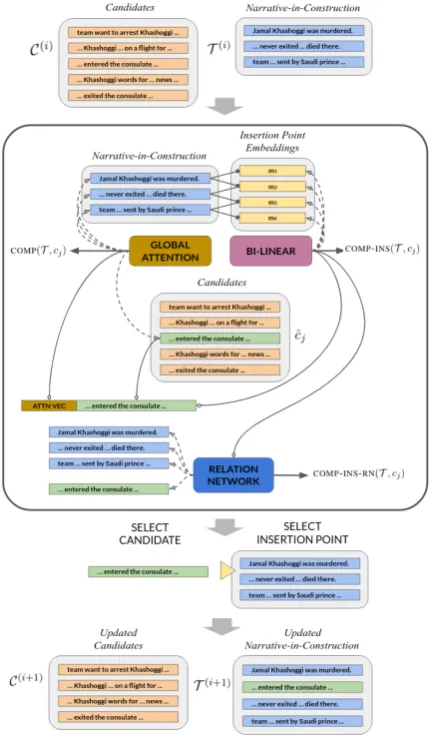
Compatibility-Attention (COMP) In scenario building, intuitively we select a candidate cj that fits best with T such that the updated target sce-nario isT ∪ {cj}, the most compatible scenario-in-construction possible. The predictioncˆjis then:
ˆ
cj =argmax cj∈C
COMP(T, cj) (1)
For example, take the example in Figure 1, He never exited the consulate but died there is a good candidate, as it clearly relates to the sce-nario that Khashoggi was murdered, compatible with the current scenario-in-construction T(1) = {Jamal Khashoggi was murdered}.
Now note for T(i), where i > 1 (i.e. multi-ple sentences in the scenario-in-construction), its member sentences do not contribute equally to the decision on aˆcj. For example, sayT(2)={Jamal
Khashoggi was murdered;A team flew from Saudi Arabia ... to intercept him}, the first sentence is more informative for us to pick outHe never ex-ited the consulate but died thereas a good candi-date. We implement this with a bi-linear attention
6
[image:5.595.310.525.62.430.2]We select the same number of sentences as in the target scenario for the fixed #sents condition. This is extra super-vision compared to the dynamic #sents condition. Changing this number changes the precision/recall tradeoff, but it would not lead to significant gains in the F1 values we report.
Figure 4: Iterative models for one step of candi-date selection. Embeddings of scenario sentences in T are shown in light blue, candidate embeddings in C in orange, and the sentence embedding being processed and selected is in light green. COMP -ATT: only runs GLOBAL ATTENTION to produce COMP(T, cj), which selects a candidatebut not an in-sertion point.COMP-INSruns GLOBAL ATTENTION and BI-LINEAR to get COMP-INS(T, cj), which
se-lects a candidate as well as an insertion point. COMP -INS-RN additionally employs a RELATION NET-WORK on top ofCOMP-INS.
layer with parametersU:
αj,k =softmaxk(c|jUtk)
COMP(T, cj) =softmaxj linear X
k
αj,ktk !!
i.e. cj attends to the sentences{tk}in the current scenario, which computes a vector that is scored to compute the weight score ofcj underCOMP.
improve the quality of the candidate selection by selecting a cj that is easy-to-insert into T. For instance, for the example in Figure 1, the most readable update can be made by insertingHe never exited the consulate but died there to the right of
Jamal Khashoggi was murdered. Essentially, we imagine an insertion-sort based candidate selec-tion technique: we iteratively pick out the easi-est candidate to insert and maintainT as ordered. Crucially, note that we want to use ordering to aid clustering, rather than aiming for ordered scenar-ios: the model performance is only evaluated on clustering the correct set of sentences.
Let mk be the insertion point to the left of the sentence tk. ForT we have insertion points {m1,· · ·, m|T |+1}. For each hinsertion point, candidatei tuplehmk, cji, we want to compute a weightzk←j to indicate the “easy-to-insert-ness” ofcj to insertion pointmk. First we embedmk andcj: cj is embedded with a BiLSTM, andmk is computed from the embedded sentences inT:
mk=
t1 ifk= 1
t|T | ifk=|T |+ 1
average(tk−1,tk) otherwise
(2)
Finally, applying a bilinear function:
zk←j =m|kW[aj;cj] (3) where[; ]is concatenation. This results in a model
COMP-INS(T, cj)s.t.
ˆ
cj =argmax cj∈C
COMP-INS(T, cj) (4)
COMP-INS(T, cj) =max
k (zk←j) (5) i.e. the easy-to-insert-ness ofcj is indicated with its highestz score over all the available insertion points: the larger the largest zk←j is, the clearer the model is about where to insertcj.
Relation Networks (COMP-INS-RN) Often-times word tokens inT andC are also indicative of which candidate is the best. E.g. in Figure
1, the candidate He never exited the consulate but died there has the event died which relates to the murder in the query. Similarly the entity
he is likely anaphoric to Jamal Khashoggi. The relations make the sentence an ideal candidate.7
Adapting the Relation Network as per
San-7Note thatWang et al.(2018) apply a mutual attention mechanism (Hermann et al.,2015) for the similar modeling purpose, but with many more parameters than our relation net. For practicality we believe the latter is a better option.
toro et al. (2017),8 we summarize the relation between the word tokens in cj and T with a summary score rj, i.e. how strongly the candi-date is connected to the scenario-in-construction, based on the relations between its tokens and that of the scenario-in-construction. The process breaks down to three steps: first, we paircj with each of the sentences tk ∈ T and compute a sentence-sentence relational vector vj,k which is the sum over all the word-word bi-linear contrac-tion (the bi-linear contraccontrac-tion of two word embed-dings wa,wb is wa|Vwb, where w ∈ Rd, V ∈ Rd×l×d). Then, we average over the
sentence-sentence relation vectors to obtain a summary vec-torpj =average
k
(vj,k). Finally we computerj = linear(pj). We incorporate the relation network withCOMP-INSby addingrj to all thezk←j over
k. Patterning after the model descriptions above, we get a modelCOMP-INS-RN(T, cj):
ˆ
cj =argmax cj∈C
COMP-INS-RN(T, cj) (6)
COMP-INS-RN(T, cj) =max
k (zk←j+rj) (7)
4.2 Optimization
Since our models’ supervision comes in the form of whole scenarios, supervising our iterative inser-tion clustering model is not completely straightfor-ward. In particular, there may be multiple correct sentences that can be added to the current scenario. For example, in Figure1, all the sentences labeled with (B) are possible candidates. We thus optimize the marginal log-likelihood of making any correct decision.9
Specifically, we minimize: L =
−logP
jp(cj), which maximizes the sum of the probabilities of the correct candidates. For Eq. (5,7), we optimize for
L=−logX (k,j)
p(hmk, cji) (8)
i.e. maximizing the probability sum over all cor-rect (insertion point, candidate) pairs.10
8
Santoro et al.(2017) abstract word tokens asobjectsto summarize the relation between two sentences (or, in general, sequences) with a compound functionf(P
i,jg(o1,i, o2,j)),
whereo1,i is thei-th token in sentence 1 (similar foro2,j),
andf, gcan be any model (e.g. a feedforward net).
9E.g. Durrett and Klein(2013) employ the same tech-nique to optimize for multiple viable coreference candidates. 10Maximizing marginal likelihood has the attractive
At train time, we treat each timestep of scenario construction as a training example. We use a form of teacher forcing where we assume that a cor-rect partial scenario has been built and we want to make some correct decision from there. The par-tial scenarios are built by adding randomcorrect sentences, so the model learns to make correct de-cisions in a range of settings.
5 Experiments
We use scalably synthesized data for training and reserve the realistic data, which is expensive to produce, for evaluation. To better understand which techniques work, we also conduct evalua-tion on the synthetic data.
Data Preparation The statistics of our source corpora are summarized in Table 2. For all the synthetic datasets, we make 100k mixtures for training, 5k for validation and 10k for test, mixed from a 0.85/0.05/0.10 split of the total 113k scenarios. For NYT/ROC-w18, to prop-erly compare with Wang et al. (2018), all mix-tures have 2 scenarios. For NYT/ROC-2/3/4, we first mix 2/3/4 randomly sampled scenarios, then pad the resulting mixtures to a fixed lengths. For NYT/ROC-rand, we sample equal #sentences as for NYT/ROC-2/3/4.
Baselines We apply three baselines: (1) UNIF, which randomly selectsn−1candidates (n−1: #sentences in the target scenario minus the query). (2)AVG, an iterative model that always selects the candidate the embedding of which is the closest (in cosine) to the average embedding of the sen-tences in the scenario-in-construction. A sentence embedding is the average over each of its word embeddings. (3) PAIRWISE, which adaptsWang et al.(2018)’s best model. It predicts a probability for a pair of sentences to indicate how likely they are from the same scenario. PAIRWISE replaces the cosine inAVGwith the pairwise model.
Implementation All the models are constructed with PyTorch 0.4.1 (Paszke et al.,2017). We use pretrained 1024-dim ELMo embeddings (Peters et al.,2018). The hidden size for the BiLSTM and the relation network are 200. We run 10 epochs with an initial learning rate of 1e-4 (with Adam (Kingma and Ba,2014)).
Evaluation For clustering performance, we use macro-averaged F1, comparing our recovered
Condition Model NYT-w18 NYT-rand NYT-4
Fix
ed#sent
UNIF 0.45 0.18 0.18
AVG 0.51 0.46 0.29
PAIRWISE 0.68 0.64 0.53
COMP 0.86 0.84 0.76
COMP-INS 0.87 0.84 0.81
COMP-INS-RN 0.93 0.92 0.84
Dyn. #sent
COMP 0.70 0.66 0.58
COMP-INS 0.75 0.70 0.61
[image:7.595.321.512.62.166.2]COMP-INS-RN 0.78 0.73 0.65
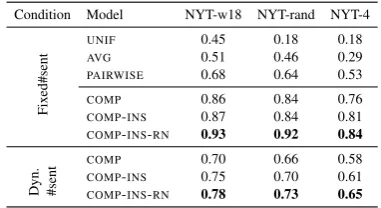
Table 3: Intrinsic evaluation: F1 scores (testing) for models trained on different NYT mixtures in fixed and dynamic #sentences conditions. In the dynamic #sen-tences condition, the baselines no longer apply because they do not model a stopping condition.
cluster for each query to the gold cluster. For sorting-clustering correlation, Spearman’s Rho (ρ); and for sorting per se, Kendall’s Tau (τ).11
5.1 Constructing Effective Training Mixtures
Which method for synthetic mixture creation leads to the best results on Human100? We first run our models in the three mixing conditions – scenario distractor only, random sentence distractor only, and both distractors (see Section 3.2), then eval-uate both intrinsically and on the human-curated Human100. Here we only use our domain-proxy NYT-* datasets.
COMP-INS-RN NYT-w18 NYT-rand NYT-4 Fixed #sent 0.65 0.60 0.70 Dyn. #sent 0.60 0.56 0.62
Human benchmark 0.82
Table 4: Which scenario mixture method is the best? F1 scores on the Human100 data of theCOMP-INS-RN model trained in different mixing conditions. The most complex condition (NYT-4) gives the best results.
Examining the results in Table3,12 we observe the hybrid mixtures with both types of distrac-tors are the most difficult, with substantially lower performance. But how does this translate into human evaluation? In Table 4, we evaluate the best-performing model (COMP-INS-RN, trained on
NYT-* sets) on Human100. We find that harder training conditions (i.e., the hybrid mixing) give stronger results on Human100. Our initial conclu-sion is: the more challenging hybrid mixing serves
11More discussion on theρ-τmix is at the end of sec 5.2. 12
[image:7.595.336.499.441.487.2]better as a training proxy to the realistic data. We also see in both Tables 3 and4that the dynamic #sent setting, where the model needs to decide when to stop adding events, is considerably more difficult throughout.
5.2 Do Our Modules All Contribute?
We additionally evaluate our proposed modules – insertion-sort based selection and relation nets – to see which contributes substantially in the intrin-sic evaluation (Table 3). The COMP-INSmodule achieves a gain of 3 points of F1 on average over
COMP, andCOMP-INS-RNimproves 4.5 F1 on av-erage overCOMP-INS. In addition we see a clear and large margin of the models over the baselines. To evaluate the modules on Human100, we use the models trained on the best hybrid mixtures (Sec-tion 5.1). The results are summarized in Table5.
COMP COMP-INS COMP-INS-RN
Fixed #sent 0.62 0.68 0.70 Dyn. #sent 0.53 0.61 0.62
Human benchmark 0.82
Table 5: How do modeling modules contribute? F1 scores on Human 100 of different models with the best hybrid training mixtures (NYT-4).
Similar to the intrinsic evaluation, both mod-ules improve performance across fixed and dy-namic conditions. While in intrinsic evaluation, relation nets are the stronger contributor, insertion-sort based selection leads to a higher performance gain on Human100.
COMP-INS sorting corr. clustering Fixed #sent 0.31 0.38 Dyn. #sent 0.30 0.40
Table 6: Sorting performance (τ) and its correlation with clustering accuracy (ρ)
While sorting performance in itself is not very high, it has a reasonable correlation with cluster-ing performance (Table 6): following Cui et al.
(2018), we use Kendall’sτ to compute sorting per-formance (as correlation of predicted and gold or-dering). We then calculate the correlation between sorting performance and model performance, us-ing Spearman’sρas the most widely used correla-tion measure in NLP.13
13Sorting and clustering performance are calculated one
pair per instance. In computingτ we drop incorrectly ex-tracted candidates as they do not have gold ordering with tar-get sentences.
5.3 Do We Learn Compatibility that Generalizes?
As argued previously (Section 3.1), NYT contains plenty of shallow textual cues, meaning an expres-sive model can do well at the task doing bag-of-words clustering of the data rather than more so-phisticated event compatibility inference.
COMP-INS-RN ROC-w18 ROC-rand ROC-4 Train-on-ROC (in-domain) 0.95 0.95 0.90 Train-on-NYT (out-domain) 0.85 0.87 0.81
Table 7: Generalization out-of-domain text: train on NYT-*/ROC-* and evaluate on ROC-* (fixed #sents).
The first question is: do the models generalize out-of-domain, particularly when textual cues are much fewer? We train our strongest COMP-INS
-RN on NYT-* and evaluate on the corresponding
ROC-* datasets (Table7): in in-domain evaluation (i.e., train and test on ROC) our model produces excellent performance, and in out-of-domain eval-uation (i.e., train on NYT test on ROC) it manages to keep up with fairly strong results. This indi-cates our model captures information beyond sur-face cues.
5.4 Final Model
From the domain-generalization test in Table 7, we see there is likely NYT-* sets do not subsume all the information in ROC-* sets. Exploiting all the data we have available, we combine ROC and NYT in a domain-joint training. The results in Table 8 show that in both fixed and dynamic #sent conditions, the model improves on the per-formance with single-domain training (Table4,5).
6 Analyzing Human-curated Data
To set up a human-level performance benchmark, we asked two additional annotators (they did not participate in the collection of Human100) to man-ually perform the same task as the models in fixed #sentences condition on a sample of 30 with ran-domly chosen query and target scenario. On av-erage the F1 is 0.82 (one worker 0.81, the other 0.83). While even our best model (COMP-INS
-RN) is inferior to the human-level performance, it
draws quite close.
This however does not tell the whole story: qualitatively comparing the scenarios built by
COMP-INS-RN R&N-w18 R&N-rand R&N-4 rand-scenario Fixed #sents 0.70 0.61 0.74 0.90 Dynamic #sents 0.65 0.59 0.67 0.79
UNIF 0.50 0.50 0.50 0.42
AVG 0.49 0.50 0.51 0.50
PAIRWISE 0.56 0.60 0.56 0.64
Human benchmark 0.82 0.97
Table 8: Left table: F1 scores for Human100 evalua-tion with the best model (COMP-INS-RN) in fixed and dynamic #sentences conditions. The model is trained with three domain-joint training datasets. The model clears a sizable margin over the baselines, but falls short from human-level. Right table: F1 for COMP -INS-RN with modified Human100, i.e. the distractor scenario is now a random sample from NYT rather than one collected by an annotator. Human100 has a topic similarity of over 0.8 but the modified version only 0.45. This demonstrateshightopic similarity is a strong contributor to the difficulty of Human100, which is true for both models and humans.
Target scenario:Trump says Russia is the sole party to be blamed.
(1) Trump says that Russia is the sole party to be blamed. (2) White House issued a statement which says Moscow is violating the Reagan-era agreement. (3) Secretary of State Mike Pompeo announced the decision to suspend the accord, declaring that countries must be held scenarioable when they break the rules. (4) “We can no longer be restricted by the treaty while Russia shamelessly violates it,” Mr. Pompeo said.
Distractor scenario:Russians accused the wrong doing on the part of the Trump administration
(1) Russians accuse the wrong doing on the part of the Trump administration.
(2) This is the latest step in the Trump administrations pattern of abandoning the diplomatic tools that have prevented nuclear war for 70 years.(3) Russia has also complained about the alleged lack of U.S. diplomacy. (4) Russian foreign minister Sergei Lavrov accused the U.S. of being obstinate. U.S. representatives arrived with a prepared position that was based on an ultimatum and centered on a demand for us to destroy this rocket, its launchers and all related equipment under US supervision.
Table 9: Humans make more reasonable mistakes (the query is underscored): the annotator selectedsentence (2) as a part of the target scenario, which, while not part of the gold, does make a comperent scenario. The model however chosesentence (1), which is in direct contradiction with the target scenario.
are not from the gold scenario (Table9). This in-dicates that models for the task could benefit from textual inference capabilities (Cases et al.,2017), or from deeper meaning representations.
Discussion The results on Human100 are largely in line with those on synthetic datasets, which indicates that results on synthetic data gives a reasonable estimate of results on more realistic data. While the performance on Human100 is lower overall, the findings are encouraging. Further, realistic cases of scenario discovery have the property that different scenarios for the same topic have a high vocabulary overlap. This can
be seen in Human100. This property of the data penalizes shallow processing based models while encouraging learning deeper semantics.
One caveat about Human100 is that the dataset is still relatively small; a larger dataset would be useful to strengthen quantitative analysis. Also, variable-size scenarios would be more realistic for evaluating the more general case. Finally, we would like to improve the crowdsourcing tech-nique in future work: in phase 1, some collected scenarios are not entirely in conflict with each other, for example two talking points Trump made in his State of the Union Address. An extra step where additional crowdworkers rate the compati-bility of scenarios could be useful. In phase 2, we would like to have scenarios which exhibit more nuanced conflicting points that capture a wider range of cues that distinguish different scenarios.
7 Conclusion
Identifying an individual scenario in a blend of contradictory stories is a task that is targeted by the Active Interpretation of Disparate Alternatives (AIDA) program as well in a recent Text Analysis Conference (TAC). We address this task through query-based scenario construction, and find siz-able performance improvements both from taking sentence order into account (INS) and from en-coding connections between words (RN).
Evaluat-ing on a new human-curated dataset, we find that the synthetic training data serves as a reasonable proxy for the human-curated data.
Our current model sometimes gets misled by su-perficially similar sentences, and it will be an im-portant future direction to move towards deeper reasoning for the task. In addition, we plan to create larger human-curated datasets with variable size scenarios.
Acknowledgments
References
E. Afreen Banu and R. Karthikeyan. 2014. Text data linkage of different entities using OCCT one class clustering tree. InProceedings of IJCSIT.
Regina Barzilay and Mirella Lapata. 2008. Model-ing Local Coherence: An Entity-Based Approach.
Computational Linguistics, 34(1):1–34.
Tal Baumel, Matan Eyal, and Michael Elhadad. 2018. Query focused abstractive summarization: Incorpo-rating query relevance, multi-document coverage, and summary length constraints into seq2seq mod-els. InCoRR:1801.07704.
Ron Bekkerman and Koby Crammer. 2008. One-class Clustering in the Text Domain. InProceedings of EMNLP, pages 41–50.
Ignacio Cases, Minh-Thang Luong, and Christopher Potts. 2017. On the effective use of pretraining for natural language inference. InCoRR:1710.02076.
Nathanael Chambers and Daniel Jurafsky. 2008. Un-supervised Learning of Narrative Event Chains. In
Proceedings of ACL.
Nathanael Chambers and Daniel Jurafsky. 2009. Unsu-pervised Learning of Narrative Schemas and Their Participants. InProceedings of ACL.
Zhiyong Cui, Ruimin Ke, and Yinhai Wang. 2018. Deep Stacked Bidirectional and Unidirectional LSTM Recurrent Neural Network for Network-wide Traffic Speed Prediction. InProceeings of IEEE.
Greg Durrett and Dan Klein. 2013. Easy Victories and Uphill Battles in Coreference Resolution . In Pro-ceedings of NAACL.
Micha Elsner and Eugene Charniak. 2008. You Talking to Me? A Corpus and Algorithm for Conversation Disentanglement. InProceedings of ACL.
Micha Elsner and Eugene Charniak. 2011. Disentan-gling chat with local coherence models. In Proceed-ings of ACL.
David Graff, Junbo Kong, Ke Chen, and Kazuaki Maeda. 2003. English Gigaword. Linguistic Data Consortium, Philadelphia, 4:1.
Karl Moritz Hermann, Tomas Kocisky, Edward Grefenstette, Lasse Espeholt, Will Kay, Mustafa Su-leyman, and Phil Blunsom. 2015. Teaching Ma-chines to Read and Comprehend. In Proceedings of NeurIPS.
Jyun-Yu Jiang, Francine Chen, Yang-Ying Chen, and Wei Wang. 2018. Learning to Disentangle Inter-leaved Conversational Threads with a Siamese Hi-erarchical Network and Similarity Ranking. In Pro-ceedings of NAACL.
Kate Keahey, Pierre Riteau, Dan Stanzione, Tim Cock-erill, Joe Mambretti, Paul Rad, and Paul Ruth. 2019. Chameleon: a scalable production testbed for com-puter science research. In Jeffrey Vetter, editor,
Contemporary High Performance Computing: From Petascale toward Exascale, 1 edition, volume 3 of
Chapman Hall/CRC Computational Science, chap-ter 5, pages 123–148. CRC Press, Boca Raton, FL.
Diederik P. Kingma and Jimmy Ba. 2014. Adam: a Method for Stochastic Optimization. In Proceed-ings of ICLR.
Jonathan K. Kummerfeld, Sai R. Gouravajhala, Joseph J. Peper, Vignesh Athreya, Chulaka Gu-nasekara, Jatin Ganhotra, Siva Sankalp Patel, Lazaros C Polymenakos, and Walter Lasecki. 2019. A Large-Scale Corpus for Conversation Disentan-glement. InProceedings of ACL.
Kathleen R. McKeown, Regina Barzilay, David Evans, Vasileios Hatzivassiloglou, Judith L. Klavans, Ani Nenkova, Carl Sable, Barry Schiffman, and Sergey Sigelman. 2002. Tracking and Summarizing News on a Daily Basis with Columbias Newsblaster. In
Proceedings of NAACL.
Raymond J. Mooney and Gerald DeJong. 1985. Learn-ing Schemata for Natural Language ProcessLearn-ing. In
Proceedings of IJCAI.
Nasrin Mostafazadeh, Michael Roth, Annie Louis, Nathanael Chambers, and James F. Allen. 2017. LS-DSem 2017 Shared Task: The Story Cloze Test. In
LSDSem 2017 Shared Task.
Jahna Otterbacher, G¨unes Erkan, and Dragomir R. Radev. 2005. Using random walks for question-focused sentence retrieval. In Proceedings of EMNLP.
Adam Paszke, Sam Gross, Soumith Chintala, and Gre-gory Chanan. 2017. Pytorch: Tensors and dynamic neural networks in python with strong gpu accelera-tion.
Matthew E. Peters, Mark Neumann, Mohit Iyyer, Matt Gardner, Christopher Clark, Kenton Lee, and Luke Zettlemoyer. 2018. Deep Contextualized Word Rep-resentations. InProceedings of NAACL.
Karl Pichotta and Raymond Mooney. 2016. Using Sentence-Level LSTM Language Models for Script Inference. InProeedings of ACL.
Dragomir Radev, Jahna Otterbacher, Adam Winkel, and Sasha Blair-Goldensohn. 2005. NewsI-nEssence: Summarizing Online News Topics. In
Communications of the ACM.
Roger C. Schank and Robert P. Abelson. 1977. Scripts, Plans, Goals and Understanding. Lawrence Erl-baum.