Proceedings of the 2019 Conference on Empirical Methods in Natural Language Processing 3632
Small and Practical BERT Models for Sequence Labeling
Henry Tsai, Jason Riesa, Melvin Johnson, Naveen Arivazhagan, Xin Li and Amelia Archer
Google Research San Francisco, CA, USA
{henrytsai,riesa,melvinp,navari,xinl,ameliaarcher}@google.com
Abstract
We propose a practical scheme to train a sin-gle multilingual sequence labeling model that yields state of the art results and is small and fast enough to run on a single CPU. Starting from a public multilingual BERT checkpoint, our final model is 6x smaller and 27x faster, and has higher accuracy than a state-of-the-art multilingual baseline. We show that our model especially outperforms on low-resource languages, and works on codemixed input text without being explicitly trained on codemixed examples. We showcase the effectiveness of our method by reporting on part-of-speech tag-ging and morphological prediction on 70 tree-banks and 48 languages.
1 Introduction
There have been many recent modeling improve-ments (Smith et al.,2018;Bohnet et al.,2018) on morphosyntactic tagging tasks. However, these models have largely focused on building separate models for each language or for a small group of related languages. In this paper, we con-sider the implications of training, evaluating, and deploying a single multilingual model for a di-verse set of almost 50 languages, evaluating on both part-of-speech tagging and morphological at-tribute prediction data from the Universal Depen-dencies repository (Nivre et al.,2018).
There are several benefits of using one multilin-gual model over several language specific models.
• Parameter sharing among languages reduces model size and enables cross-lingual transfer learning. We show that this improves accu-racy, especially for low-resource languages. • No language identification model needed
to decide which language-specific model to query. Critically, this reduces system com-plexity and prevents prediction errors from
language identification from propagating into the downstream system.
• Multilingual models can be applied to multi-lingual or codemixed inputs without explic-itly being trained on codemixed labeled ex-amples. Otherwise, given, e.g. a mixed Hindi/English input, one must decide to query either the Hindi model or the English model, both of which are sub-optimal.
In this paper, we show that by finetuning a pretrained BERT (Devlin et al., 2019) model we can build a multilingual model that has compara-ble or better accuracy to state-of-the-art language-specific models, and outperforms the state-of-the-art on low-resource languages. Our model out-performs other multilingual model baselines by a large margin. We evaluate on both part-of-speech tagging and morphological attribute pre-diction tasks with data from the Universal Depen-dencies repository (Nivre et al.,2018). However, this model is slow, very large, and difficult to de-ploy in practice.
We describe our solution for making this model small and practical enough to use in practice on a single CPU, while preserving quality. The final model is 27x faster than a BERT-based baseline model and 7x faster than a state-of-the-art LSTM-based model on CPU. It is 6 times smaller than the BERT-based model. Furthermore, most of the quality gains are preserved in the small model.
2 Multilingual Models for Sequence Labeling
Model Multilingual? Part-of-Speech F1 Morphology F1
Meta-LSTM No 94.5 92.5
BERT No 95.1 93.0
Meta-LSTM Yes 91.1 82.9
[image:2.595.305.530.185.246.2]BERT Yes 94.5 91.0
Table 1: Macro-averaged F1 comparison of per-language models and multilingual models over 48 languages. For non-multilingual models, F1 is the average over each per-language model trained.
a multilingual BERT-based model (Devlin et al.,
2019).
2.1 Meta-LSTM
The Meta-LSTM is the best-performing model of the CoNLL 2018 Shared Task (Smith et al.,2018) for universal part-of-speech tagging and morpho-logical features. The model is composed of 3 LSTMs: a character-BiLSTM, a word-BiLSTM and a single joint BiLSTM which takes the out-put of the character and word-BiLSTMs as inout-put. The entire model structure is referred to as Meta-LSTM.
To set up multilingual Meta-LSTM training, we take the union of all the word embeddings from the Bojanowski et al. (2017) embeddings model on Wikipedia1 in all languages. For out-of-vocabulary words, a special unknown token is used in place of the word.
The model is then trained as usual with cross-entropy loss. The char-BiLSTM and word-biLSTM are first trained independently. And fi-nally we train the entire Meta-LSTM.
2.2 Multilingual BERT
BERT is a transformer-based model (Vaswani et al.,2017) pretrained with a masked-LM task on millions of words of text. In this paper our BERT-based experiments make use of the cased multilin-gual BERT model available on GitHub2 and pre-trained on 104 languages.
Models fine-tuned on top of BERT models achieve state-of-the-art results on a variety of benchmark and real-world tasks.
To train a multilingual BERT model for our se-quence prediction tasks, we add a softmax layer on top of the the first wordpiece (Schuster and Naka-jima, 2012) of each token3 and finetune on data
1
https://fasttext.cc/docs/en/pretrained-vectors.html
2
https://github.com/google-research/bert/blob/master/multilingual.md
3We experimented with wordpiece-pooling (Lee et al.,
2017) which we found to marginally improve accuracy but at a cost of increasing implementation complexity to maintain.
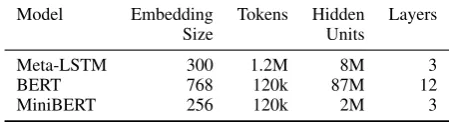
Model Embedding Tokens Hidden Layers
Size Units
Meta-LSTM 300 1.2M 8M 3
BERT 768 120k 87M 12
MiniBERT 256 120k 2M 3
Table 2: The number of parameters of each model. To-kensrefers to the number of tokens of the embedding rows. For the Meta-LSTM, a word-based model, this is the number of words in training. For BERT, this means the size of the Wordpiece vocabulary. And Hid-den Unitsrefers to all units that are not among the em-bedding layer or and output layer.
Input 32 words 128 words
Relative Speedup on GPU
Meta-LSTM 0.8x 0.2x
MiniBERT 4.3x 2.6x
Relative Speedup on CPU
Meta-LSTM 6.8x 2.3x
MiniBERT 27.7x 14.0x
Table 3: Relative inference speedup over BERT. We see MiniBERT is the fastest on both CPU and GPU. CPU is an Intel Xeon CPU E5-1650 v3 @3.50GHz. GPU is an Nvidia Titan V.
from all languages combined. During training, we concatenate examples from all treebanks and ran-domly shuffle the examples.
3 Small and Practical Models
The results in Table1make it clear that the BERT-based model for each task is a solid win over a Meta-LSTM model in both the per-language and multilingual settings. However, the number of pa-rameters of the BERT model is very large (179M parameters), making deploying memory intensive and inference slow: 230ms on an Intel Xeon CPU. Our goal is to produce a model fast enough to run on a single CPU while maintaining the modeling capability of the large model on our tasks.
Size and speed
Meta-LSTM and has fewer embedding parameters and hidden units than both models. Table2shows the parameters of each model. The Meta-LSTM has the largest number of parameters dominated by the large embeddings. BERT’s parameters are mostly in the hidden units. The MiniBERT has the fewest total parameters.
The inference-speed bottleneck for Meta-LSTM is the sequential character-LSTM-unrolling and for BERT is the large feedforward layers and attention computation that has time complexity quadratic to the sequence length. Table3compares the model speeds.
BERT is much slower than both MetaLSTM and MiniBERT on CPU. However, it is faster than Meta-LSTM on GPU due to the parallel computa-tion of the transformer. The MiniBERT is signif-icantly faster than the other models on both GPU and CPU.
Distillation
For model distillation (Hinton et al.,2015), we ex-tract sentences from Wikipedia in languages for which public multilingual is pretrained. For each sentence, we use the open-source BERT word-piece tokenizer (Schuster and Nakajima, 2012;
Devlin et al., 2019) and compute cross-entropy
loss for each wordpiece:
L(t,s) =H(σ(t/T), σ(s/T))
where H is the cross-entropy function, σ is the softmax function, t is the BERT model’s logit of the current wordpiece, s is the small BERT model’s logits andTis a temperature hyperparam-eter, explained in Section4.2.
To train the distilled multilingual model
mMiniBERT, we first use the distillation loss above to train the student from scratch using the teacher’s logits on unlabeled data. Afterwards, we finetune the student model on the labeled data the teacher is trained on.
4 Experiments
4.1 Data
We use universal part-of-speech tagging and mor-phology data from the The CoNLL 2018 Shared Task (Nivre et al.,2018;Zeman and Hajiˇc,2018). For comparison simplicity, we remove the lan-guages that the multilingual BERT public check-point is not pretrained on.
Model Part-of-Speech F1 Morphology F1
mMeta-LSTM 91.1 82.9
mMiniBERT 93.7 88.6
mBERT 94.5 91.0
Table 4: Macro-averaged F1 comparison of multilin-gual models. Multilinmultilin-gual models are prefixed with ‘m’.
For segmentation, we use a baseline segmenter (UDPipe v2.2)4provided by the shared task orga-nizer to segment raw text. We train and tune the models on gold-segmented data and apply the seg-menter on the raw test of test data before applying our models.
The part-of-speech tagging task has 17 labels for all languages. For morphology, we treat each morphological group as a class and union all classes as a output of 18334 labels.
4.2 Tuning
For Meta-LSTM, we use the public repository’s hyperparameters5.
FollowingDevlin et al.(2019), we use a smaller learning rate of 3e-5 for fine-tuning and a larger learning rate of 1e-4 when training from scratch and during distillation. Training batch size is set to 16 for finetuning and 256 for distillation.
For distillation, we try temperaturesT = 1,2,3
and use the teacher-student accuracy for evalua-tion. We observe BERT is very confident on its predictions, and using a large temperatureT = 3
to soften the distribution consistently yields the best result.
4.3 Multilingual Models
Multilingual Modeling Results We compare per-language models trained on single language treebanks with multilingual models in Table1and Table4. In the experimental results we use a pre-fix m to denote the model is a single multilin-gual model. We compare Meta-LSTM, BERT, and MiniBERT.
Multilingual Models Comparison mBERT performs the best among all multilingual models. The smallest and fastest model, mMiniBERT, performs comparably tomBERT, and outperforms
mMeta-LSTM, a state-of-the-art model for this task.
4
https://ufal.mff.cuni.cz/udpipe/models
POS Tagging Morphology
Languages kk hy lt be mr ta kk hy lt be mr ta
Train Size 31 50 153 260 373 400 31 50 153 260 373 400
Meta-LSTM 61.7 75.4 81.4 91.1 72.1 72.7 48.5 54.5 69.7 74.0 59.1 71.0
BERT 75.9 84.4 88.9 94.8 77.5 75.7 47.8 44.8 75.2 82.8 64.0 72.9 mBERT 81.4 86.6 90.0 95.0 75.9 74.3 64.6 51.1 73.6 87.5 64.2 73.8
[image:4.595.347.485.224.312.2]mMeta-LSTM 52.9 63.8 65.6 87.6 65.5 61.5 25.6 36.6 42.5 59.2 33.6 46.9 mMiniBERT 76.6 86.0 86.9 95.0 75.4 74.6 59.7 47.6 64.8 81.6 59.4 71.7
Table 5: POS tagging and Morphology F1 for all models on low-resource languages. Multilingual models are prefixed with ‘m’.
Multilingual Models vs Per-Language Models When comparing with per-language models, the multilingual models have lower F1. Kondratyuk
(2019) shows similar results. Meta-LSTM, when trained in a multilingual fashion, has bigger drops than BERT in general. Most of the Meta-LSTM drop is due to the character-LSTM, which drops by more than 4 points F1.
4.4 Low Resource Languages
We pick languages with fewer than 500 train-ing examples to investigate the performance of low-resource languages: Tamil (ta), Marathi (mr), Belarusian (be), Lithuanian (lt), Armenian (hy), Kazakh (kk)6. Table5shows the performance of the models.
BERT Cross-Lingual Transfer WhileWu and Dredze(2019) shows effective zero-shot crosslin-gual transfer from English to other high-resource languages, we show that cross-lingual transfer is even effective on low-resource languages when we train on all languages as mBERT is significantly better than BERT when we have fewer than 50 ex-amples. In these cases, themMiniBERT distilled from the multilingualmBERT yields results better than training individual BERT models. The gains becomes less significant when we have more train-ing data.
mMiniBERT Effectiveness The multilingual baselinemMeta-LSTM does not do well on low-resource languages. On the contrary,mMiniBERT performs well and outperforms the state-of-the-art Meta-LSTM on the POS tagging task and on four out of size languages of the Morphology task.
6The Universal Dependencies data does not have explicit
tuning data for hy and kk.
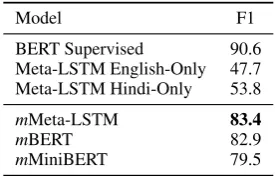
Model F1
BERT Supervised 90.6 Meta-LSTM English-Only 47.7 Meta-LSTM Hindi-Only 53.8
mMeta-LSTM 83.4
mBERT 82.9
mMiniBERT 79.5
Table 6: F1 score on Hindi-English codemixed POS tagging task. Each multilingual model is within 10 points of the supervised BERT model without having explicitly seen code-mixed data.
4.5 Codemixed Input
We use the Universal Dependencies’ Hindi-English codemixed data set (Bhat et al.,2017) to test the model’s ability to label code-mixed data. This dataset is based on code-switching tweets of Hindi and English multilingual speakers. We use the Devanagari script provided by the data set as input tokens.
In the Universal Dependency labeling guide-lines, code-switched or foreign-word tokens are labeled as X along with other tokens that cannot be labeled7. The trained model learns to partition the languages in a codemixed input by labeling to-kens in one language with X, and toto-kens in the other language with any of the other POS tags. It turns out that the 2nd-most likely label is usually the correct label in this case; we evaluate on this label when the 1-best is X.
Table6shows that all multilingual models han-dle codemixed data reasonably well without super-vised codemixed traininig data.
5 Conclusion
We have described the benefits of multilingual models over models trained on a single language for a single task, and have shown that it is possi-ble to resolve a major concern of deploying large
BERT-based models by distilling our multilingual model into one that maintains the quality wins with performance fast enough to run on a single CPU. Our distilled model outperforms a multilin-gual version of a very strong baseline model, and for most languages yields comparable or better performance to a large BERT model.
References
Irshad Bhat, Riyaz A Bhat, Manish Shrivastava, and Dipti Sharma. 2017. Joining hands: Exploiting monolingual treebanks for parsing of code-mixing data. InProceedings of the 15th Conference of the European Chapter of the Association for Compu-tational Linguistics: Volume 2, Short Papers, vol-ume 2, pages 324–330.
Bernd Bohnet, Ryan McDonald, Gonc¸alo Sim˜oes, Daniel Andor, Emily Pitler, and Joshua Maynez. 2018. Morphosyntactic tagging with a meta-BiLSTM model over context sensitive token encod-ings. InProceedings of the 56th Annual Meeting of the Association for Computational Linguistics (Vol-ume 1: Long Papers), pages 2642–2652, Melbourne, Australia. Association for Computational Linguis-tics.
Piotr Bojanowski, Edouard Grave, Armand Joulin, and Tomas Mikolov. 2017. Enriching word vectors with subword information. Transactions of the Associa-tion for ComputaAssocia-tional Linguistics, 5:135–146.
Jacob Devlin, Ming-Wei Chang, Kenton Lee, and Kristina Toutanova. 2019. Bert: Pre-training of deep bidirectional transformers for language understand-ing.
Geoffrey Hinton, Oriol Vinyals, and Jeff Dean. 2015. Distilling the knowledge in a neural network. arXiv preprint arXiv:1503.02531.
Daniel Kondratyuk. 2019. 75 languages, 1 model: Parsing universal dependencies universally. CoRR, abs/1904.02099.
Kenton Lee, Luheng He, Mike Lewis, and Luke Zettle-moyer. 2017. End-to-end neural coreference resolu-tion. InProceedings of the 2017 Conference on Em-pirical Methods in Natural Language Processing.
Joakim Nivre, Mitchell Abrams, ˇZeljko Agi´c, Lars Ahrenberg, and Lene Antonsen et al. 2018. Univer-sal dependencies 2.2. LINDAT/CLARIN digital li-brary at the Institute of Formal and Applied Linguis-tics ( ´UFAL), Faculty of Mathematics and Physics, Charles University.
Mike Schuster and Kaisuke Nakajima. 2012. Japanese and korean voice search. In 2012 IEEE Interna-tional Conference on Acoustics, Speech and Signal Processing (ICASSP), pages 5149–5152. IEEE.
Aaron Smith, Bernd Bohnet, Miryam de Lhoneux, Joakim Nivre, Yan Shao, and Sara Stymne. 2018.82 treebanks, 34 models: Universal dependency pars-ing with multi-treebank models. InProceedings of the CoNLL 2018 Shared Task: Multilingual Pars-ing from Raw Text to Universal Dependencies, pages 113–123, Brussels, Belgium. Association for Com-putational Linguistics.
Ashish Vaswani, Noam Shazeer, Niki Parmar, Jakob Uszkoreit, Llion Jones, Aidan N Gomez, Ł ukasz Kaiser, and Illia Polosukhin. 2017. Attention is all you need. In I. Guyon, U. V. Luxburg, S. Bengio, H. Wallach, R. Fergus, S. Vishwanathan, and R. Gar-nett, editors, Advances in Neural Information Pro-cessing Systems 30, pages 5998–6008. Curran As-sociates, Inc.
Shijie Wu and Mark Dredze. 2019.Beto, bentz, becas: The surprising cross-lingual effectiveness of BERT.
CoRR, abs/1904.09077.