Lattice-based System Combination for Statistical Machine Translation
Yang Feng, Yang Liu, Haitao Mi, Qun Liu, Yajuan L ¨u Key Laboratory of Intelligent Information Processing
Institute of Computing Technology Chinese Academy of Sciences P.O. Box 2704, Beijing 100190, China
{fengyang, yliu, htmi, liuqun, lvyajuan}@ict.ac.cn
Abstract
Current system combination methods usu-ally use confusion networks to find consensus translations among different systems. Requir-ing one-to-one mappRequir-ings between the words in candidate translations, confusion networks have difficulty in handling more general situa-tions in which several words are connected to another several words. Instead, we propose a lattice-based system combination model that allows for such phrase alignments and uses
lattices to encode all candidate translations.
Experiments show that our approach achieves significant improvements over the state-of-the-art baseline system on Chinese-to-English translation test sets.
1 Introduction
System combination aims to find consensus transla-tions among different machine translation systems. It has been proven that such consensus translations are usually better than the output of individual sys-tems (Frederking and Nirenburg, 1994).
In recent several years, the system combination methods based on confusion networks developed rapidly (Bangalore et al., 2001; Matusov et al., 2006; Sim et al., 2007; Rosti et al., 2007a; Rosti et al., 2007b; Rosti et al., 2008; He et al., 2008), which show state-of-the-art performance in benchmarks. A confusion network consists of a sequence of sets of candidate words. Each candidate word is associated with a score. The optimal consensus translation can be obtained by selecting one word from each set to maximizing the overall score.
To construct a confusion network, one first need to choose one of the hypotheses (i.e., candidate translations) as the backbone (also called “skeleton” in the literature) and then decide the word align-ments of other hypotheses to the backbone. Hy-pothesis alignment plays a crucial role in confusion-network-based system combination because it has a direct effect on selecting consensus translations.
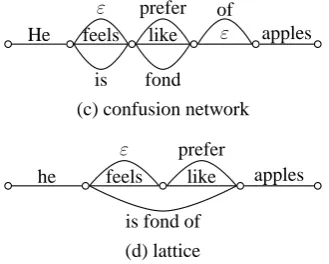
However, a confusion network is restricted in such a way that only 1-to-1 mappings are allowed in hypothesis alignment. This is not the fact even for word alignments between the same languages. It is more common that several words are connected to another several words. For example, “be capa-ble of” and “be acapa-ble to” have the same meaning. Although confusion-network-based approaches re-sort to inserting null words to alleviate this problem, they face the risk of producing degenerate transla-tions such as “be capable to” and “be able of”.
He feels like apples
He prefer apples
He feels like apples
He is fond of apples
(a) unidirectional alignments
He feels like apples
He prefer apples
He feels like apples
He is fond of apples
(b) bidirectional alignments
He feels like ε apples
ε prefer of
is fond
(c) confusion network
he feels like apples
ε prefer
is fond of
[image:2.595.89.254.176.308.2](d) lattice
Figure 1: Comparison of a confusion network and a lat-tice.
2 Background
2.1 Confusion Network and Lattice
We use an example shown in Figure 1 to illustrate our idea. Suppose that there are three hypotheses:
He feels like apples He prefer apples He is fond of apples
We choose the first sentence as the backbone. Then, we perform hypothesis alignment to build a confusion network, as shown in Figure 1(a). Note that although “feels like” has the same meaning with “is fond of”, a confusion network only allows for one-to-one mappings. In the confusion network shown in Figure 1(c), several null words ε are in-serted to ensure that each hypothesis has the same length. As each edge in the confusion network only has a single word, it is possible to produce inappro-priate translations such as “He is like of apples”.
In contrast, we allow many-to-many mappings in the hypothesis alignment shown in Figure 2(b). For example, “like” is aligned to three words: “is”, “fond”, and “of”. Then, we use a lattice shown in Figure 1(d) to represent all possible candidate
trans-lations. Note that the phrase “is fond of” is attached to an edge. Now, it is unlikely to obtain a translation like “He is like of apples”.
A lattice G= hV, Eiis a directed acyclic graph, formally a weighted finite state automation (FSA), whereV is the set of nodes andEis the set of edges. The nodes in a lattice are usually labeled according to an appropriate numbering to reflect how to pro-duce a translation. Each edge in a lattice is attached with a sequence of words as well as the associated probability.
As lattice is a more general form of confusion network (Dyer et al., 2008), we expect that replac-ing confusion networks with lattices will further im-prove system combination.
2.2 IHMM-based Alignment Method
Since the candidate hypotheses are aligned us-ing Indirect-HMM-based (IHMM-based) alignment method (He et al., 2008) in both direction, we briefly review the IHMM-based alignment method first. Take the direction that the hypothesis is aligned to the backbone as an example. The conditional prob-ability that the hypothesis is generated by the back-bone is given by
p(e′1J|eI1) =X
aJ
1 J
Y
j=1
[p(aj|aj−1, I)p(e′j|eaj)]l (1)
Where eI1 = (e1, ..., eI) is the backbone, e′J1 =
(e′1, ..., e′J)is a hypothesis aligned toeI
1, andaJ1 = (a1, .., aJ) is the alignment that specifies the posi-tion of backbone word that each hypothesis word is aligned to.
The translation probabilityp(e′j|ei)is a linear in-terpolation of semantic similarity psem(e′j|ei) and surface similarity psur(e′j|ei) and α is the interpo-lation factor:
p(e′
j|ei) =α·psem(e′j|ei)+(1−α)·psur(e′j|ei) (2)
sim-ilarity model is given by
psem(e′j|ei) = K
X
k=0
p(fk|ei)p(e′j|fk, ei)
≈XK
k=0
p(fk|ei)p(e′j|fk)
(3)
The surface similarity model is estimated by calcu-lating the literal matching rate:
psur(e′j|ei) = exp{ρ·[s(e′j, ei)−1]} (4)
wheres(e′j, ei)is given by
s(e′
j, ei) = M(e ′ j, ei)
max(|e′
j|,|ei|) (5)
whereM(e′j, ei)is the length of the longest matched prefix (LMP) andρis a smoothing factor that speci-fies the mapping.
The distortion probabilityp(aj =i|aj−1 = i′, I) is estimated by only considering the jump distance:
p(i|i′, I) = Pc(i−i′) I
i=1c(l−i′)
(6)
The distortion parameters c(d)are grouped into 11 buckets,c(≤ −4),c(−3), ...,c(0), ...,c(5),c(≥6). Since the alignments are in the same language, the distortion model favor monotonic alignments and penalize non-monotonic alignments. It is given in a intuitive way
c(d) = (1 +|d−1|)−K, d=−4, ...,6 (7)
whereKis tuned on held-out data.
Also the probabilityp0of jumping to anullword state is tuned on held-out data. So the overall distor-tion model becomes
p(i|i′, I) = (
p0 if i = null state (1−p0)·p(i|i′, I) otherwise
3 Lattice-based System Combination Model
Lattice-based system combination involves the fol-lowing steps:
(1) Collect the hypotheses from the candidate sys-tems.
(2) Choose the backbone from the hypotheses. This is performed using a sentence-level Minimum Bayes Risk (MBR) method. The hypothesis with the minimum cost of edits against all hypotheses is se-lected. The backbone is significant for it influences not only the word order, but also the following align-ments. The backbone is selected as follows:
EB = argmin
E′∈E
X
E∈E
T ER(E′, E) (8)
(3) Get the alignments of the backbone and hy-pothesis pairs. First, each pair is aligned in both di-rections using the IHMM-based alignment method. In the IHMM alignment model, bilingual dictionar-ies in both directions are indispensable. Then, we apply a grow-diag-final algorithm which is widely used in bilingual phrase extraction (Koehn et al., 2003) to monolingual alignments. The bidirec-tional alignments are combined to one resorting to the grow-diag-final algorithm, allowingn-to-n map-pings.
(4)Normalize the alignment pairs. The word or-der of the backbone determines the word oror-der of consensus outputs, so the word order of hypotheses must be consistent with that of the backbone. All words of a hypotheses are reordered according to the alignment to the backbone. For a word aligned tonull, an actualnull word may be inserted to the proper position. The alignment units are extracted first and then the hypothesis words in each unit are shifted as a whole.
(5) Construct the lattice in the light of phrase pairs extracted on the normalized alignment pairs. The expression ability of the lattice depends on the phrase pairs.
(6) Decode the lattice using a model similar to the log-linear model.
4 Lattice Construction
Unlike a confusion network that operates words only, a lattice allows for phrase pairs. So phrase pairs must be extracted before constructing a lat-tice. A major difficulty in extracting phrase pairs is that the word order of hypotheses is not consistent with that of the backbone. As a result, hypothesis words belonging to a phrase pair may be discon-tinuous. Before phrase pairs are extracted, the hy-pothesis words should be normalized to make sure the words in a phrase pair is continuous. We call a phrase pair before normalization a alignment unit.
The problem mentioned above is shown in Fig-ure 2. In FigFig-ure 2 (a), although (e′1e′3,e2) should be a phrase pair, but/e
′
10and/e
′
30are
discontin-uous, so the phrase pair can not be extracted. Only after the words of the hypothesis are reordered ac-cording to the corresponding words in the backbone as shown in Figure 2 (b), /e
′
10 and /e
′
30
be-come continuous and the phrase pair (e′1e′3,e2) can be extracted. The procedure of reordering is called
alignment normalization
Eh: e′1 e′2 e′3
EB: e1 e2 e3
(a)
Eh: e′2 e′1 e′3
EB: e1 e2 e3
[image:4.595.330.530.72.220.2](b)
Figure 2: An example of alignment units
4.1 Alignment Normalization
After the final alignments are generated in the grow-diag-final algorithm, minimum alignment units are extracted. The hypothesis words of an alignment unit are packed as a whole in shift operations.
See the example in Figure 2 (a) first. All mini-mum alignment units are as follows: (e′2,e1), (e′1e′3,
e2) and (ε,e3). (e′1e′2e′3,e1e2) is an alignment unit, but not a minimum alignment unit.
Let ¯ai = (¯e′i,e¯i) denote a minimum alignment unit, and assume that the word stringe¯′icovers words
e′
i1 ,..., e′im on the hypothesis side, and the word
stringe¯icovers the consecutive wordsei1 ,...,einon the backbone side. In an alignment unit, the word string on the hypothesis side can be discontinuous. The minimum unit ¯ai = (¯e′i,e¯i) must observe the following rules:
EB: e1 e2 e3
Eh : e′1 e′2 (a)
e1 e2 e3
e′
2 ε e′1
EB: e1 e2
Eh : e′1 e′2 e′3
e1 e2
e′ 1e′3
e′ 1e′2e′3
(b)
EB: e1 e2
Eh : e′1 e′2 e′3
e1 ε e2
e′
1 e′2 e′3
(c)
Figure 3: Different cases ofnullinsertion
• ∀e′
ik ∈¯e′i, ea′ik ∈e¯i
• ∀eik ∈¯ei, e′aik =null or e′aik ∈¯e′i
• ∄a¯j = (¯e′j,e¯j), ¯ej = ei1, ..., eik or e¯j =
eik, ..., ein, k∈[1, n]
Where a′ik denotes the position of the word in the backbone thate′ik is aligned to, andaik denotes the position of the word in the hypothesis that eik is aligned to.
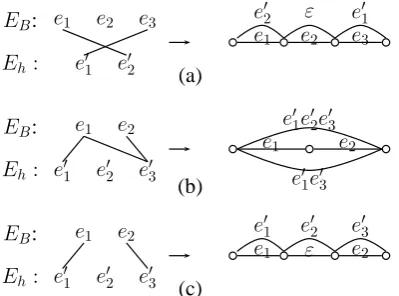
An actualnull word may be inserted to a proper position if a word, either from the hypothesis or from the backbone, is aligned to null. In this way, the minimum alignment set is extended to an alignment unit set, which includes not only minimum align-ment units but also alignalign-ment units which are gener-ated by adding null words to minimum alignment units. In general, the following three conditions should be taken into consideration:
• A backbone word is aligned tonull. A null word is inserted to the hypothesis as shown in Figure 3 (a).
• A hypothesis word is aligned tonull and it is between the span of a minimum alignment unit. A new alignment unit is generated by insert-ing the hypothesis word aligned to null to the minimum alignment unit. The new hypothesis string must remain the original word order of the hypothesis. It is illustrated in Figure 3 (b).
[image:4.595.89.276.388.446.2]e1 e2 ε e3
¯
e′
4 ¯e′5 e¯′6
(a)
e1 ε e2 e3
¯
e′
1 e¯′2 e¯′3
(b)
e1 ε e2 e3
¯
e′
1 ¯e′2 ¯e′3
¯
e′
4
(c)
e1 ε e2 ε e3
¯
e′
1 e¯′2 e¯
′
3
¯
e′
4 e¯′5
(d)
e1 ε e2 ε e3
¯
e′
1 e¯′2 e¯
′
3
¯
e′
4 e¯′5 ¯e′6
[image:5.595.79.515.70.230.2](e)
Figure 4: A toy instance of lattice construction
are inserted to the backbone. This is shown in Figure 3 (c).
4.2 Lattice Construction Algorithm
The lattice is constructed by adding the normalized alignment pairs incrementally. One backbone arc in a lattice can only span one backbone word. In con-trast, all hypothesis words in an alignment unit must be packed into one hypothesis arc. First the lattice is initialized with a normalized alignment pair. Then given all other alignment pairs one by one, the lat-tice is modified dynamically by adding the hypothe-sis words of an alignment pair in a left-to-right fash-ion.
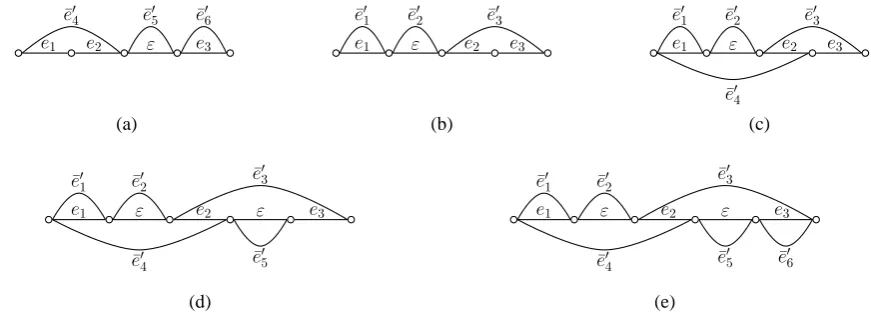
A toy instance is given in Figure 4 to illustrate the procedure of lattice construction. Assume the cur-rent inputs are: an alignment pair as in Figure 4 (a), and a lattice as in Figure 4 (b). The backbone words of the alignment pair are compared to the backbone words of the lattice one by one. The procedure is as follows:
• e1 is compared with e1. Since they are the
same, the hypothesis arce¯′4, which comes from the same node with e1 in the alignment pair, is compared with the hypothesis arc¯e′1, which comes from the same node with e1 in the lat-tice. The two hypothesis arcs are not the same, soe¯′4 is added to the lattice as shown in Figure 4(c). Both go to the next backbone words.
• e2is compared withε. The lattice remains the same. The lattice goes to the next backbone worde2.
• e2 is compared withe2. There is no hypothesis arc coming from the same node with the bone arc e2 in the alignment pair, so the lattice re-mains the same. Both go to the next backbone words.
• εis compared withe3. Anullbackbone arc is inserted into the lattice betweene2ande3. The hypothesis arce¯′5 is inserted to the lattice, too. The modified lattice is shown in Figure 4(d). The alignment pair goes to the next backbone worde3.
• e3 is compared withe3. For they are the same and there is no hypothesis arc¯e′6 in the lattice,
¯
e′
6is inserted to the lattice as in Figure 4(e). • Both arrive at the end and it is the turn of the
next alignment pair.
When comparing a backbone word of the given alignment pair with a backbone word of the lattice, the following three cases should be handled:
• The current backbone word of the given align-ment pair is anullword while the current back-bone word of the lattice is not. A null back-bone word is inserted to the lattice.
• The current backbone word of the lattice is a
Algorithm 1 Lattice construction algorithm.
1: Input: alignment pairs{pn}Nn=1 2: L←p1
3: Unique(L) 4: forn←2..Ndo 5: pnode=pn·first 6: lnode=L·first
7: whilepnode·barcnext6=NULLdo
8: if lnode·barcnext = NULL or pnode· bword=null and lnode·bword6=nullthen 9: INSERTBARC(lnode, null)
10: pnode=pnode·barcnext
11: else
12: ifpnode ·bword 6= null and lnode· bword=nullthen
13: lnode=lnode·barcnext
14: else
15: for eachharcofpnodedo
16: if NotExist(lnode, pnode·harc)
then
17: INSERTHARC(lnode, pnode·
harc)
18: pnode=pnode·barcnext 19: lnode=lnode·barcnext 20: Output: latticeL
• The current backbone words of the given align-ment pair and the lattice are the same. Let
{harcl} denotes the set of hypothesis arcs, which come from the same node with the cur-rent backbone arc in the lattice, andharch de-notes one of the corresponding hypothesis arcs in the given alignment pair. In the {harcl}, if there is no arc which is the same with the
harch, a hypothesis arc projecting toharch is added to the lattice.
The algorithm of constructing a lattice is illus-trated in Algorithm 1. The backbone words of the alignment pair and the lattice are processed one by one in a left-to-right manner. Line 2 initializes the lattice with the first alignment pair, and Line 3 re-moves the hypothesis arc which contains the same words with the backbone arc.barcdenotes the back-bone arc, storing one backback-bone word only, andharc denotes the hypothesis arc, storing the hypothesis words. For there may be many alignment units span the same backbone word range, there may be more than oneharccoming from one node. Line8−10 consider the condition1and function InsertBarc in
Line 9 inserts a null bone arc to the position right before the current node. Line12−13deal with con-dition2and jump to the next backbone word of the lattice. Line15−19handle condition3and function
InsertHarc inserts to the lattice aharcwith the same hypothesis words and the same backbone word span with the current hypothesis arc.
5 Decoding
In confusion network decoding, a translation is gen-erated by traveling all the nodes from left to right. So a translation path contains all the nodes. While in lattice decoding, a translation path may skip some nodes as some hypothesis arcs may cross more than one backbone arc.
Similar to the features in Rosti et al. (2007a), the features adopted by lattice-based model are arc pos-terior probability, language model probability, the number ofnullarcs, the number of hypothesis arcs possessing more than one non-null word and the number of all non-null words. The features are com-bined in a log-linear model with the arc posterior probabilities being processed specially as follows:
logp(e/f) =NXarc
i=1
log (XNs
s=1
λsps(arc))
+ζL(e) +αNnullarc(e)
+βNlongarc(e) +γNword(e)
(9)
where f denotes the source sentence, e denotes a translation generated by the lattice-based system,
Narc is the number of arcs the path of e covers,
Nsis the number of candidate systems andλsis the weight of systems.ζ is the language model weight andL(e)is the LM log-probability. Nnullarcs(e)is the number of the arcs which only contain a null word, and Nlongarc(e) is the number of the arcs which store more than one non-null word. The above two numbers are gotten by counting both backbone arcs and hypothesis arcs. αandβ are the corresponding weights of the numbers, respectively.
Nword(e) is the non-null word number andγ is its weight.
1/(k+ 1)if the hypothesis ranking k in the systems contains the arc (Rosti et al., 2007a; He et al., 2008). Cube pruning algorithm with beam search is em-ployed to search for the consensus output (Huang and Chiang, 2005). The nodes in the lattice are searched in a topological order and each node re-tains a list of N best candidate partial translations.
6 Experiments
The candidate systems participating in the system combination are as listed in Table 1: SystemA is a BTG-based system using a MaxEnt-based reorder-ing model; SystemB is a hierarchical phrase-based system; SystemC is the Moses decoder (Koehn et al., 2007); SystemDis a syntax-based system. 10-best hypotheses from each candidate system on the dev and test sets were collected as the input of the system combination.
In our experiments, the weights were all tuned on the NIST MT02 Chinese-to-English test set, includ-ing 878 sentences, and the test data was the NIST MT05 Chinese-to-English test set, including 1082 sentences, except the experiments in Table 2. A 5-gram language model was used which was trained on the XinHua portion of Gigaword corpus. The re-sults were all reported in case sensitive BLEU score and the weights were tuned in Powell’s method to maximum BLEU score. The IHMM-based align-ment module was implealign-mented according to He et al. (2008), He (2007) and Vogel et al. (1996). In all experiments, the parameters for IHMM-based align-ment module were set to: the smoothing factor for the surface similarity model,ρ = 3; the controlling factor for the distortion model,K = 2.
6.1 Comparison with
Confusion-network-based model
In order to compare the lattice-based system with the confusion-network-based system fairly, we used IHMM-based system combination model on behalf of the confusion-network-based model described in He et al. (2008). In both lattice-based and IHMM-based systems, the bilingual dictionaries were ex-tracted on the FBIS data set which included 289K sentence pairs. The interpolation factor of the simi-larity model was set toα= 0.1.
The results are shown in Table 1. IHMM stands for the IHMM-based model and Lattice stands for
the based model. On the dev set, the lattice-based system was 3.92 BLEU points higher than the best single system and 0.36 BLEU point higher than the IHMM-based system. On the test set, the lattice-based system got an absolute improvement by 3.73 BLEU points over the best single system and 1.23 BLEU points over the IHMM-based system.
System MT02 MT05
BLEU% BLEU%
[image:7.595.350.502.178.299.2]SystemA 31.93 30.68 SystemB 32.16 32.07 SystemC 32.09 31.64 SystemD 33.37 31.26 IHMM 36.93 34.57 Lattice 37.29 35.80
Table 1: Results on the MT02 and MT05 test sets
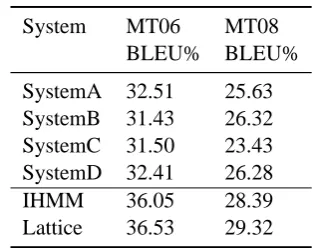
The results on another test sets are reported in Ta-ble 2. The parameters were tuned on the newswire part of NIST MT06 Chinese-to-English test set, in-cluding 616 sentences, and the test set was NIST MT08 Chinese-to-English test set, including 1357 sentences. The BLEU score of the lattice-based sys-tem is 0.93 BLEU point higher than the IHMM-based system and 3.0 BLEU points higher than the best single system.
System MT06 MT08
BLEU% BLEU%
SystemA 32.51 25.63 SystemB 31.43 26.32 SystemC 31.50 23.43 SystemD 32.41 26.28 IHMM 36.05 28.39 Lattice 36.53 29.32
Table 2: Results on the MT06 and MT08 test sets
[image:7.595.346.505.460.584.2]Source: ÛdIEhúiÛdIEdúi?1Ü¿
SystemA: Russia merger of state-owned oil company and the state-run gas company in Russia
SystemB: Russia ’s state-owned oil company is working with Russia ’s state-run gas company mergers SystemC: Russian state-run oil company is combined with the Russian state-run gas company
SystemD: Russia ’s state-owned oil companies are combined with Russia ’s state-run gas company
IHMM: Russian ’s state-owned oil company working with Russia ’s state-run gas company Lattice: Russia ’s state-owned oil company is combined with the Russian state-run gas company
Table 3: A real translation example
’s”. Instead, “Russia ’s” is together aligned to ”Rus-sian” in the lattice-based model. Also due to
1-to-1 mappings, null word aligned to “is” is inserted. As a result, “is” is missed in the output of IHMM-based model. In contrast, in the lattice-IHMM-based sys-tem, “is working with” are aligned to “is combined
with”, forming a phrase pair.
6.2 Effect of Dictionary Scale
The dictionary is important to the semantic similar-ity model in IHMM-based alignment method. We evaluated the effect of the dictionary scale by using dictionaries extracted on different data sets. The dic-tionaries were respectively extracted on similar data sets: 30K sentence pairs, 60K sentence pairs, 289K sentence pairs (FBIS corpus) and 2500K sentence pairs. The results are illustrated in Table 4. In or-der to demonstrate the effect of the dictionary size clearly, the interpolation factor of similarity model was all set toα= 0.1.
From Table 4, we can see that when the cor-pus size rise from 30k to 60k, the improvements were not obvious both on the dev set and on the test set. As the corpus was expanded to 289K, al-though on the dev set, the result was only 0.2 BLEU point higher, on the test set, it was 0.63 BLEU point higher. As the corpus size was up to 2500K, the BLEU scores both on the dev and test sets declined. The reason is that, on one hand, there are more noise on the 2500K sentence pairs; on the other hand, the 289K sentence pairs cover most of the words appear-ing on the test set. So we can conclude that in or-der to get better results, the dictionary scale must be up to some certain scale. If the dictionary is much smaller, the result will be impacted dramatically.
MT02 MT05
BLEU% BLEU%
30k 36.94 35.14 60k 37.09 35.17 289k 37.29 35.80 2500k 37.14 35.62
Table 4: Effect of dictionary scale
6.3 Effect of Semantic Alignments
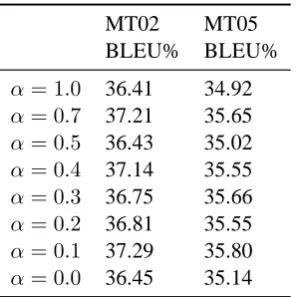
For the IHMM-based alignment method, the transla-tion probability of an English word pair is computed using a linear interpolation of the semantic similar-ity and the surface similarsimilar-ity. So the two similarsimilar-ity models decide the translation probability together and the proportion is controlled by the interpolation factor. We evaluated the effect of the two similarity models by varying the interpolation factorα.
We used the dictionaries extracted on the FBIS data set. The result is shown in Table 5. We got the best result with α = 0.1. When we excluded the semantic similarity model (α= 0.0) or excluded the surface similarity model (α= 1.0), the performance became worse.
7 Conclusion
MT02 MT05
BLEU% BLEU%
α= 1.0 36.41 34.92
α= 0.7 37.21 35.65
α= 0.5 36.43 35.02
α= 0.4 37.14 35.55
α= 0.3 36.75 35.66
α= 0.2 36.81 35.55
α= 0.1 37.29 35.80
[image:9.595.113.262.70.219.2]α= 0.0 36.45 35.14
Table 5: Effect of semantic alignments
a confusion-network-based model processes words only. As a result, phrase pairs must be extracted be-fore constructing a lattice.
On NIST MT05 test set, the lattice-based sys-tem gave better results with an absolute improve-ment of 1.23 BLEU points over the confusion-network-based system (He et al., 2008) and 3.73 BLEU points over the best single system. On NIST MT08 test set, the lattice-based system out-performed the confusion-network-based system by 0.93 BLEU point and outperformed the best single system by 3.0 BLEU points.
8 Acknowledgement
The authors were supported by National Natural Sci-ence Foundation of China Contract 60736014, Na-tional Natural Science Foundation of China Con-tract 60873167 and High Technology R&D Program Project No. 2006AA010108. Thank Wenbin Jiang, Tian Xia and Shu Cai for their help. We are also grateful to the anonymous reviewers for their valu-able comments.
References
Srinivas Bangalore, German Bordel, and Giuseppe Ric-cardi. 2001. Computing consensus translation from multiple machine translation systems. In Proc. of
IEEE ASRU, pages 351–354.
Christopher Dyer, Smaranda Muresan, and Philip Resnik. 2008. Generalizing word lattice translation. In
Pro-ceedings of ACL/HLT 2008, pages 1012–1020,
Colum-bus, Ohio, June.
Robert Frederking and Sergei Nirenburg. 1994. Three
heads are better than one. In Proc. of ANLP, pages 95–100.
Xiaodong He, Mei Yang, Jangfeng Gao, Patrick Nguyen, and Robert Moore. 2008. Indirect-hmm-based hy-pothesis alignment for computing outputs from ma-chine translation systems. In Proc. of EMNLP, pages 98–107.
Xiaodong He. 2007. Using word-dependent translation models in hmm based word alignment for statistical machine translation. In Proc. of COLING-ACL, pages 961–968.
Liang Huang and David Chiang. 2005. Better k-best parsing. In Proceedings of the Ninth International
Workshop on Parsing Technologies (IWPT), pages 53–
64.
Philipp Koehn, Franz J. Och, and Daniel Marcu. 2003. Statistical phrase-based translation. In Proc. of
HLT-NAACL, pages 127–133.
Philipp Koehn, Hieu Hoang, Alexandra Birch Mayne, Christopher Callison-Burch, Marcello Federico, Nicola Bertoldi, Brooke Cowan, Wade Shen, Chris-tine Moran, Richard Zens, Chris Dyer, Ondrej Bojar, Alexandra Constantin, and Evan Herbst. 2007. Moses: Open source toolkit for statistical machine translation. In Proc. of the 45th ACL, Demonstration
Session.
Evgeny Matusov, Nicola Ueffing, and Hermann Ney. 2006. Computing consensus translation from multiple machine translation systems using enhanced hypothe-ses alignment. In Proc. of IEEE EACL, pages 33–40. Antti-Veikko I. Rosti, Spyros Matsoukas, and Richard
Schwartz. 2007a. Improved word-level system com-bination for machine translation. In Proc. of ACL, pages 312–319.
Antti-Veikko I. Rosti, Bing Xiang, Spyros Matsoukas, Richard Schwartz, Necip Fazil Ayan, and Bonnie J. Dorr. 2007b. Combining outputs from multiple ma-chine translation systems. In Proc. of NAACL-HLT, pages 228–235.
Antti-Veikko I. Rosti, Bing Zhang, Spyros Matsoukas, and Richard Schwartz. 2008. Incremental hypothesis alignment for building confusion networks with appli-cation to machine translaiton system combination. In
Proc. of the Third ACL WorkShop on Statistical Ma-chine Translation, pages 183–186.
Khe Chai Sim, William J. Byrne, Mark J.F. Gales, Hichem Sahbi, and Phil C. Woodland. 2007. Con-sensus network decoding for statistical machine trans-lation system combination. In Proc. of ICASSP, pages 105–108.