Forest-based Translation Rule Extraction
Haitao Mi1
1Key Lab. of Intelligent Information Processing
Institute of Computing Technology Chinese Academy of Sciences P.O. Box 2704, Beijing 100190, China
Liang Huang2,1
2Dept. of Computer & Information Science
University of Pennsylvania 3330 Walnut St., Levine Hall Philadelphia, PA 19104, USA [email protected]
Abstract
Translation rule extraction is a fundamental problem in machine translation, especially for linguistically syntax-based systems that need parse trees from either or both sides of the bi-text. The current dominant practice only uses 1-best trees, which adversely affects the rule set quality due to parsing errors. So we pro-pose a novel approach which extracts rules from a packed forest that compactly encodes exponentially many parses. Experiments show that this method improves translation quality by over 1 BLEU point on a state-of-the-art tree-to-string system, and is 0.5 points better than (and twice as fast as) extracting on 30-best parses. When combined with our previous work on forest-based decoding, it achieves a 2.5 BLEU points improvement over the base-line, and even outperforms the hierarchical system of Hiero by 0.7 points.
1 Introduction
Automatic extraction of translation rules is a funda-mental problem in statistical machine translation, es-pecially for many syntax-based models where trans-lation rules directly encode linguistic knowledge. Typically, these models extract rules using parse trees from both or either side(s) of the bitext. The former case, with trees on both sides, is often called tree-to-tree models; while the latter case, with trees on either source or target side, include both tree-to-string and string-to-tree models (see Table 1). Leveraging from structural and linguistic informa-tion from parse trees, these models are believed to be better than their phrase-based counterparts in
source target examples (partial) tree-to-tree Ding and Palmer (2005)
tree-to-string Liu et al. (2006); Huang et al. (2006)
string-to-tree Galley et al. (2006)
string-to-string Chiang (2005)
Table 1: A classification of syntax-based MT. The first three use linguistic syntax, while the last one only formal syntax. Our experiments cover the second type using a packed forest in place of the tree for rule-extraction.
handling non-local reorderings, and have achieved promising translation results.1
However, these systems suffer from a major limi-tation, that the rule extractor only uses 1-best parse tree(s), which adversely affects the rule set quality due to parsing errors. To make things worse, mod-ern statistical parsers are often trained on domains quite different from those used in MT. By contrast, formally syntax-based models (Chiang, 2005) do not rely on parse trees, yet usually perform better than these linguistically sophisticated counterparts.
To alleviate this problem, an obvious idea is to extract rules fromk-best parses instead. However, a k-best list, with its limited scope, has too few vari-ations and too many redundancies (Huang, 2008). This situation worsens with longer sentences as the number of possible parses grows exponentially with the sentence length and ak-best list will only capture a tiny fraction of the whole space. In addition, many subtrees are repeated across different parses, so it is
1
For example, in recent NIST Evaluations, some of these models (Galley et al., 2006; Quirk et al., 2005; Liu et al., 2006) ranked among top 10. See http://www.nist.gov/speech/tests/mt/.
IP
NP
x1:NPB CC
yˇu
x2:NPB
x3:VPB
[image:2.612.313.533.55.431.2]→x1x3withx2
Figure 1: Example translation ruler1. The Chinese
con-junction yˇu “and” is translated into English prep. “with”.
also inefficient to extract rules separately from each of these very similar trees (or from the cross-product ofk2similar tree-pairs in tree-to-tree models).
We instead propose a novel approach that ex-tracts rules from packed forests (Section 3), which compactly encodes many more alternatives than k -best lists. Experiments (Section 5) show that forest-based extraction improves BLEU score by over 1 point on a state-of-the-art tree-to-string system (Liu et al., 2006; Mi et al., 2008), which is also 0.5 points better than (and twice as fast as) extracting on 30-best parses. When combined with our previ-ous orthogonal work on forest-based decoding (Mi et al., 2008), the forest-forest approach achieves a 2.5 BLEU points improvement over the baseline, and even outperforms the hierarchical system of Hi-ero, one of the best-performing systems to date.
Besides tree-to-string systems, our method is also applicable to other paradigms such as the string-to-tree models (Galley et al., 2006) where the rules are in the reverse order, and easily generalizable to pairs of forests in tree-to-tree models.
2 Tree-based Translation
We review in this section the tree-based approach to machine translation (Liu et al., 2006; Huang et al., 2006), and its rule extraction algorithm (Galley et al., 2004; Galley et al., 2006).
2.1 Tree-to-String System
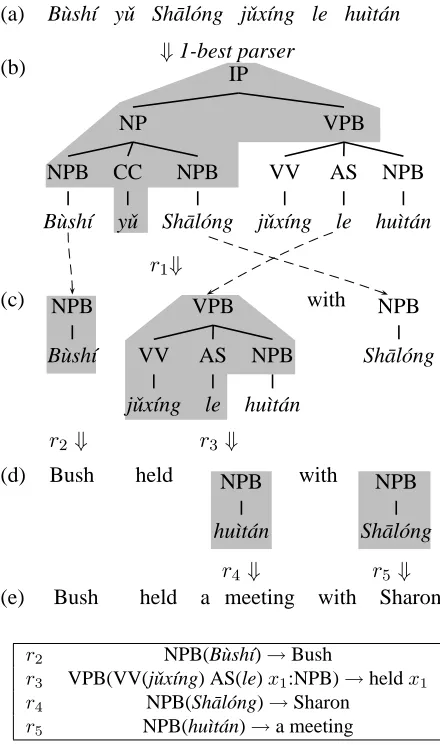
Current tree-based systems perform translation in two separate steps: parsing and decoding. The input string is first parsed by a parser into a 1-best tree, which will then be converted to a target language string by applying a set of tree-to-string transforma-tion rules. For example, consider the following ex-ample translating from Chinese to English:
(a) B`ush´ı yˇu Sh¯al´ong jˇux´ıng le hu`ıt´an
⇓1-best parser
(b) IP
NP
NPB
B`ush´ı CC
yˇu
NPB
Sh¯al´ong
VPB
VV
jˇux´ıng AS
le
NPB
hu`ıt´an
r1⇓
(c) NPB
B`ush´ı
VPB
VV
jˇux´ıng AS
le
NPB
hu`ıt´an
with NPB
Sh¯al´ong
r2⇓ r3 ⇓
(d) Bush held NPB
hu`ıt´an
with NPB
Sh¯al´ong
r4 ⇓ r5 ⇓
(e) Bush held a meeting with Sharon
r2 NPB(B`ush´ı)→Bush
r3 VPB(VV(jˇux´ıng) AS(le)x1:NPB)→heldx1
r4 NPB(Sh¯al´ong)→Sharon
r5 NPB(hu`ıt´an)→a meeting
Figure 2: Example derivation of tree-to-string translation, with rules used. Each shaded region denotes a tree frag-ment that is pattern-matched with the rule being applied.
(1) B`ush´ı Bush
yˇu and/with
Sh¯al´ong Sharon1
jˇux´ıng hold
le past.
hu`ıt´an meeting2
“Bush held a meeting2with Sharon1”
Figure 2 shows how this process works. The Chi-nese sentence (a) is first parsed into a parse tree (b), which will be converted into an English string in 5 steps. First, at the root node, we apply ruler1shown in Figure 1, which translates the Chinese coordina-tion construccoordina-tion (“... and ...”) into an English prepo-sitional phrase. Then, from step (c) we continue ap-plying rules to untranslated Chinese subtrees, until we get the complete English translation in (e).2
2
[image:2.612.72.292.62.137.2]IP “Bush .. Sharon”
NP “Bush⊔with Sharon”
NPB “Bush”
B`ush´ı
CC “with”
yˇu
NPB “Sharon”
Sh¯al´ong
VPB “held .. meeting”
VV “held”
jˇux´ıng
AS “held”
le
NPB “a meeting”
hu`ıt´an
(minimal) rules extracted
IP (NP(x1:NPBx2:CCx3:NPB)x4:VPB) →x1x4x2x3
CC (yˇu)→with
NPB (B`ush´ı)→Bush
NPB (Sh¯al´ong)→Sharon
VPB (VV(jˇux´ıng) AS(le)x1:NPB) →heldx1 NPB (hu`ıt´an)→a meeting
[image:3.612.79.530.61.224.2]Bush held a meeting with Sharon
Figure 3: Tree-based rule extraction (Galley et al., 2004). Each non-leaf node in the tree is annotated with its target span (below the node), where⊔denotes a gap, and non-faithful spans are crossed out. Shadowed nodes are admissible, with contiguous and faithful spans. The first two rules can be “composed” to form ruler1in Figure 1.
IP0,6 “Bush .. Sharon”
e2
NP0,3 “Bush⊔with Sharon”
e3
NPB0,1 “Bush”
B`ush´ı
CC1,2 “with”
yˇu
VP1,6 “held .. Sharon”
PP1,3 “with Sharon”
P1,2 “with”
NPB2,3 “Sharon”
Sh¯al´ong
VPB3,6 “held .. meeting”
VV3,4 “held”
jˇux´ıng
AS4,5 “held”
le
NPB5,6 “a meeting”
hu`ıt´an e1
extra (minimal) rules extracted
IP (x1:NPB x2:VP)→x1x2
VP (x1:PP x2:VPB)→x2x1
PP (x1:P x2:NPB)→x1x2
P (yˇu)→with
Bush held a meeting with Sharon
Figure 4: Forest-based rule extraction. Solid hyperedges correspond to the 1-best tree in Figure 3, while dashed hyper-edges denote the alternative parse interpreting yˇu as a preposition in Figure 5.
More formally, a (tree-to-string) translation rule (Galley et al., 2004; Huang et al., 2006) is a tuple
hlhs(r),rhs(r), φ(r)i, where lhs(r) is the source-side tree fragment, whose internal nodes are la-beled by nonterminal symbols (like NP and VP), and whose frontier nodes are labeled by source-language words (like “yˇu”) or variables from a set
X = {x1, x2, . . .}; rhs(r) is the target-side string expressed in target-language words (like “with”) and variables; andφ(r)is a mapping fromX to
nonter-minals. Each variablexi ∈ X occurs exactly once in
lhs(r)and exactly once inrhs(r). For example, for ruler1in Figure 1,
lhs(r1) = IP ( NP(x1CC(yˇu)x2) x3),
rhs(r1) = x1 x3 with x2,
φ(r1) = {x1: NPB, x2: NPB, x3: VPB}.
[image:3.612.78.532.283.520.2]2.2 Tree-to-String Rule Extraction
We now briefly explain the algorithm of Galley et al. (2004) that can extract these translation rules from a word-aligned bitext with source-side parses.
Consider the example in Figure 3. The basic idea is to decompose the source (Chinese) parse into a se-ries of tree fragments, each of which will form a rule with its corresponding English translation. However, not every fragmentation can be used for rule extrac-tion, since it may or may not respect the alignment and reordering between the two languages. So we say a fragmentation is well-formed with respect to an alignment if the root node of every tree fragment corresponds to a contiguous span on the target side; the intuition is that there is a “translational equiva-lence” between the subtree rooted at the node and the corresponding target span. For example, in Fig-ure 3, each node is annotated with its corresponding English span, where the NP node maps to a non-contiguous one “Bush⊔with Sharon”.
More formally, we need a precise formulation to handle the cases of one-to-many, many-to-one, and many-to-many alignment links. Given a source-target sentence pair(σ, τ)with alignmenta, the (tar-get) span of nodevis the set of target words aligned to leaf nodesyield(v)under nodev:
span(v) , {τi∈τ | ∃σj ∈yield(v),(σj, τi)∈a}. For example, in Figure 3, every node in the parse tree is annotated with its corresponding span below the node, where most nodes have contiguous spans ex-cept for the NP node which maps to a gapped phrase “Bush⊔ with Sharon”. But contiguity alone is not enough to ensure well-formedness, since there might be words within the span aligned to source words uncovered by the node. So we also define a span s to be faithful to nodev if every word in it is only aligned to nodes dominated byv, i.e.:
∀τi∈s,(σj, τi)∈a⇒σj ∈yield(v).
For example, sibling nodes VV and AS in the tree have non-faithful spans (crossed out in the Figure), because they both map to “held”, thus neither of them can be translated to “held” alone. In this case, a larger tree fragment rooted at VPB has to be extracted. Nodes with non-empty, contiguous, and faithful spans form the admissible set (shaded nodes
IP0,6 NPB0,1
B`ush´ı
VP1,6 PP1,3
P1,2
yˇu
NPB2,3
Sh¯al´ong
VPB3,6
[image:4.612.330.529.59.160.2]jˇux´ıng le hu`ıt´an
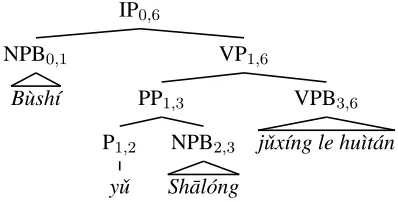
Figure 5: An alternative parse of the Chinese sentence, with yˇu as a preposition instead of a conjunction; com-mon parts shared with 1-best parse in Fig. 3 are elided.
in the figure), which serve as potential cut-points for rule extraction.3
With the admissible set computed, rule extraction is as simple as a depth-first traversal from the root: we “cut” the tree at all admissible nodes to form tree fragments and extract a rule for each fragment, with variables matching the admissible descendant nodes. For example, the tree in Figure 3 is cut into 6 pieces, each of which corresponds to a rule on the right.
These extracted rules are called minimal rules, which can be glued together to form composed rules with larger tree fragments (e.g.r1in Fig. 1) (Galley et al., 2006). Our experiments use composed rules.
3 Forest-based Rule Extraction
We now extend tree-based extraction algorithm from the previous section to work with a packed forest representing exponentially many parse trees.
3.1 Packed Forest
Informally, a packed parse forest, or forest in short, is a compact representation of all the deriva-tions (i.e., parse trees) for a given sentence under a context-free grammar (Earley, 1970; Billot and Lang, 1989). For example, consider again the Chi-nese sentence in Example (1) above, which has (at least) two readings depending on the part-of-speech of the word yˇu: it can be either a conjunction (CC “and”) as shown in Figure 3, or a preposition (P “with”) as shown in Figure 5, with only PP and VPB swapped from the English word order.
3Admissible set (Wang et al., 2007) is also known as
These two parse trees can be represented as a single forest by sharing common subtrees such as NPB0,1 and VPB3,6, as shown in Figure 4. Such a forest has a structure of a hypergraph (Huang and Chiang, 2005), where items like NP0,3 are called
nodes, whose indices denote the source span, and combinations like
e1 : IP0,6 →NPB0,3 VP3,6
we call hyperedges. We denotehead(e)andtails(e)
to be the consequent and antecedant items of hyper-edgee, respectively. For example,
head(e1) =IP0,6, tails(e1) ={NPB0,3,VP3,6}.
We also denoteBS(v)to be the set of incoming
hy-peredges of nodev, being different ways of deriving it. For example, in Figure 4,BS(IP0,6) ={e1, e2}.
3.2 Forest-based Rule Extraction Algorithm
Like in tree-based extraction, we extract rules from a packed forestF in two steps:
(1) admissible set computation (where to cut), and
(2) fragmentation (how to cut).
It turns out that the exact formulation developed for admissible set in the tree-based case can be ap-plied to a forest without any change. The fragmen-tation step, however, becomes much more involved since we now face a choice of multiple parse hyper-edges at each node. In other words, it becomes non-deterministic how to “cut” a forest into tree frag-ments, which is analogous to the non-deterministic pattern-match in forest-based decoding (Mi et al., 2008). For example there are two parse hyperedges e1ande2at the root node in Figure 4. When we fol-low one of them to grow a fragment, there again will be multiple choices at each of its tail nodes. Like in tree-based case, a fragment is said to be complete if all its leaf nodes are admissible. Otherwise, an in-complete fragment can grow at any non-admissible frontier nodev, where following each parse hyper-edge atvwill split off a new fragment. For example, followinge2at the root node will immediately lead us to two admissible nodes, NPB0,1 and VP1,6 (we will highlight admissible nodes by gray shades
Algorithm 1 Forest-based Rule Extraction.
Input: forestF, target sentenceτ, and alignmenta Output: minimal rule setR
1: admset ←ADMISSIBLE(F, τ, a) ⊲admissible set
2: for eachv∈admsetdo
3: open←∅ ⊲queue of active fragments
4: for eache∈BS(v)do ⊲incoming hyperedges
5: front ←tails(e)\admset ⊲initial frontier
6: open.append(h{e},fronti)
7: whileopen6=∅do
8: hfrag,fronti ←open.pop() ⊲active fragment
9: iffront =∅then
10: generate a rulerusing fragmentfrag
11: R.append(r)
12: else ⊲incomplete: further expand
13: u←front.pop() ⊲a frontier node
14: for eache∈BS(u)do
15: front′←front∪(tails(e)\admset)
16: open.append(hfrag∪ {e},front′i)
in this section like in Figures 3 and 4). So this frag-ment,frag1 = {e2}, is now complete and we can extract a rule,
IP (x1:NPB x2:VP)→x1x2.
However, following the other hyperedgee1
IP0,6 →NP0,3 VPB3,6
will leave the new fragment frag2 = {e1}
incom-plete with one non-admissible node NP0,3. We then growfrag2at this node by choosing hyperedgee3
NP0,3 → NPB0,1 CC1,2 NPB2,3 ,
and spin off a new fragmentfrag3={e1, e3}, which is now complete since all its four leaf nodes are ad-missible. We then extract a rule with four variables:
IP (NP(x1:NPBx2:CCx3:NPB)x4:VPB)
→ x1x4x2x3.
This procedure is formalized by a breadth-first search (BFS) in Pseudocode 1. The basic idea is to visit each frontier node v, and keep a queue open
front in the Pseudocode), being the subset of non-admissible leaf nodes (recall that expansion stops at admissible nodes). So each initial fragment along hyperedge e is associated with an initial frontier (line 5),front =tails(e)\admset.
A fragment is complete if its frontier is empty (line 9), otherwise we pop one frontier node u to expand, spin off new fragments by following hyper-edges ofu, and update the frontier (lines 14-16), un-til all active fragments are complete andopenqueue is empty (line 7).
A single parse tree can also be viewed as a triv-ial forest, where each node has only one incoming hyperedge. So the Galley et al. (2004) algorithm for tree-based rule extraction (Sec. 2.2) can be consid-ered a special case of our algorithm, where the queue
openalways contains one single active fragment.
3.3 Fractional Counts and Rule Probabilities
In tree-based extraction, for each sentence pair, each rule extracted naturally has a count of one, which will be used in maximum-likelihood estimation of rule probabilities. However, a forest is an implicit collection of many more trees, each of which, when enumerated, has its own probability accumulated from of the parse hyperedges involved. In other words, a forest can be viewed as a virtual weighted k-best list with a hugek. So a rule extracted from a non 1-best parse, i.e., using non 1-best hyperedges, should be penalized accordingly and should have a fractional count instead of a unit one, similar to the E-step in EM algorithms.
Inspired by the parsing literature on pruning (Charniak and Johnson, 2005; Huang, 2008) we pe-nalize a rulerby the posterior probability of its tree fragmentfrag = lhs(r). This posterior probability, notated αβ(frag), can be computed in an Inside-Outside fashion as the product of three parts: the out-side probability of its root node, the probabilities of parse hyperedges involved in the fragment, and the inside probabilities of its leaf nodes,
αβ(frag) =α(root(frag))
· Y
e∈frag P(e)
· Y
v∈yield(frag)
β(v)
(2)
where α(·) andβ(·) denote the outside and inside probabilities of tree nodes, respectively. For example in Figure 4,
αβ({e2, e3}) =α(IP0,6) · P(e2)·P(e3)
·β(NPB0,1)β(CC1,2)β(NPB2,3)β(VPB3,6). Now the fractional count of ruleris simply
c(r) = αβ(lhs(r))
αβ(TOP) (3)
where TOP denotes the root node of the forest. Like in the M-step in EM algorithm, we now extend the maximum likelihood estimation to frac-tional counts for three condifrac-tional probabilities re-garding a rule, which will be used in the experi-ments:
P(r |lhs(r)) = P c(r)
r′:lhs(r′)=lhs(r)c(r′)
, (4)
P(r|rhs(r)) = P c(r)
r′:rhs(r′)=rhs(r)c(r
′), (5)
P(r|root(lhs(r)))
= P c(r)
r′:root(lhs(r′))=root(lhs(r))c(r′)
. (6)
4 Related Work
The concept of packed forest has been previously used in translation rule extraction, for example in rule composition (Galley et al., 2006) and tree bina-rization (Wang et al., 2007). However, both of these efforts only use 1-best parses, with the second one packing different binarizations of the same tree in a forest. Nevertheless we suspect that their extraction algorithm is in principle similar to ours, although they do not provide details of forest-based fragmen-tation (Algorithm 1) which we think is non-trivial.
Our experiments will use both default 1-best decod-ing and forest-based decoddecod-ing. As we will see in the next section, the best result comes when we combine the merits of both, i.e., using forests in both rule ex-traction and decoding.
There is also a parallel work on extracting rules from k-best parses and k-best alignments (Venu-gopal et al., 2008), but both their experiments and our own below confirm that extraction on k-best parses is neither efficient nor effective.
5 Experiments
5.1 System
Our experiments are on Chinese-to-English trans-lation based on a tree-to-string system similar to (Huang et al., 2006; Liu et al., 2006). Given a 1-best treeT, the decoder searches for the best deriva-tiond∗among the set of all possible derivationsD:
d∗ = arg max
d∈D λ0log P(d|T) +λ1log Plm(τ(d))
+λ2|d|+λ3|τ(d)|
(7)
where the first two terms are translation and lan-guage model probabilities, τ(d) is the target string (English sentence) for derivationd, and the last two terms are derivation and translation length penalties, respectively. The conditional probability P(d | T)
decomposes into the product of rule probabilities:
P(d|T) =Y
r∈d
P(r). (8)
EachP(r)is in turn a product of five probabilities:
P(r) = P(r |lhs(r))λ4
·P(r|rhs(r))λ5 ·P(r|root(lhs(r)))λ6
·Plex(lhs(r)|rhs(r))λ7 ·Plex(rhs(r)|lhs(r))λ8
(9)
where the first three are conditional probabilities based on fractional counts of rules defined in Sec-tion 3.3, and the last two are lexical probabilities. These parameters λ1. . . λ8 are tuned by minimum error rate training (Och, 2003) on the dev sets. We refer readers to Mi et al. (2008) for details of the decoding algorithm.
0.240 0.242 0.244 0.246 0.248 0.250 0.252 0.254
0 1 2 3 4 5 6
BLEU score
average extracting time (secs/1000 sentences) 1-best
pe=2
pe=5
pe=8
k=30
forest extraction
k-best extraction
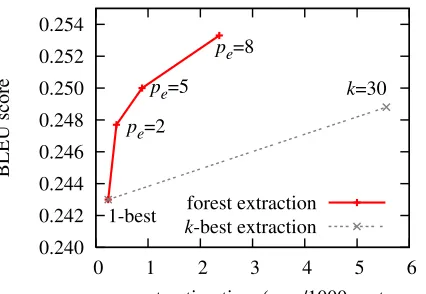
Figure 6: Comparison of extraction time and BLEU score: forest-based vs.1-best and 30-best.
rules from... extraction decoding BLEU 1-best trees 0.24 1.74 0.2430 30-best trees 5.56 3.31 0.2488 forest:pe=8 2.36 3.40 0.2533
[image:7.612.318.531.65.212.2]Pharaoh - - 0.2297
Table 2: Results with different rule extraction methods. Extraction and decoding columns are running times in secs per 1000 sentences and per sentence, respectively.
We use the Chinese parser of Xiong et al. (2005) to parse the source side of the bitext. Following Huang (2008), we also modify this parser to out-put a packed forest for each sentence, which can be pruned by the marginal probability-based inside-outside algorithm (Charniak and Johnson, 2005; Huang, 2008). We will first report results trained on a small-scaled dataset with detailed analysis, and then scale to a larger one, where we also combine the technique of forest-based decoding (Mi et al., 2008).
5.2 Results and Analysis on Small Data
To test the effect of forest-based rule extraction, we parse the training set into parse forests and use three levels of pruning thresholds:pe= 2,5,8.
rules from ... total # on dev new rules used
1-best trees 440k 90k
[image:8.612.73.301.56.115.2]-30-best trees 1.2M 130k 8.71% forest:pe=8 3.3M 188k 16.3%
Table 3: Statistics of rules extracted from small data. The last column shows the ratio of new rules introduced by non 1-best parses being used in 1-best derivations.
common subtrees. Forest extraction, by contrast, is much faster thanks to packing and produces consis-tently better BLEU scores. With pruning threshold pe = 8, forest-based extraction achieves a (case in-sensitive) BLEU score of 0.2533, which is an ab-solute improvement of 1.0% points over the 1-best baseline, and is statistically significant using the sign-test of Collins et al. (2005) (p < 0.01). This is also 0.5 points better than (and twice as fast as) extracting on 30-best parses. These BLEU score re-sults are summarized in Table 2, which also shows that decoding with forest-extracted rules is less than twice as slow as with 1-best rules, and only fraction-ally slower than with 30-best rules.
We also investigate the question of how often rules extracted from non 1-best parses are used by the decoder. Table 3 shows the numbers of rules extracted from 1-best, 30-best and forest-based ex-tractions, and the numbers that survive after filter-ing on the dev set. Basically in the forest-based case we can use about twice as many rules as in the 1-best case, or about 1.5 times of 30-1-best extraction. But the real question is, are these extra rules really useful in generating the final (1-best) translation? The last row shows that 16.3% of the rules used in 1-best derivations are indeed only extracted from non 1-best parses in the forests. Note that this is a stronger condition than changing the distribution of rules by considering more parses; here we introduce new rules never seen on any 1-best parses.
5.3 Final Results on Large Data
We also conduct experiments on a larger training dataset, FBIS, which contains 239K sentence pairs with about 6.9M/8.9M words in Chinese/English, respectively. We also use a bigger trigram model trained on the first 1/3 of the Xinhua portion of Gi-gaword corpus. To integrate with forest-based de-coding, we use both 1-best trees and packed forests
extract.\decoding 1-best tree forest:pd=10 1-best trees 0.2560 0.2674 30-best trees 0.2634 0.2767 forest:pe=5 0.2679 0.2816
[image:8.612.313.541.57.131.2]Hiero 0.2738
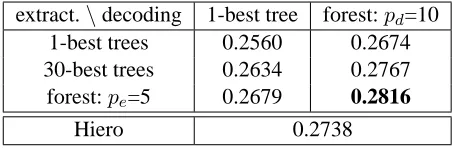
Table 4: BLEU score results trained on large data.
during both rule extraction and decoding phases. Since the data scale is larger than the small data, we are forced to use harsher pruning thresholds, with pe= 5for extraction andpd= 10for decoding.
The final BLEU score results are shown in Ta-ble 4. With both tree-based and forest-based decod-ing, rules extracted from forests significantly outper-form those extracted from 1-best trees (p < 0.01). The final result with both forest-based extraction and forest-based decoding reaches a BLEU score of 0.2816, outperforming that of Hiero (Chiang, 2005), one of the best performing systems to date. These re-sults confirm that our novel forest-based rule extrac-tion approach is a promising direcextrac-tion for syntax-based machine translation.
6 Conclusion and Future Work
In this paper, we have presented a novel approach that extracts translation rules from a packed forest encoding exponentially many trees, rather than from 1-best or k-best parses. Experiments on a state-of-the-art tree-to-string system show that this method improves BLEU score significantly, with reasonable extraction speed. When combined with our previ-ous work on forest-based decoding, the final result is even better than the hierarchical system Hiero. For future work we would like to apply this ap-proach to other types of syntax-based translation systems, namely the string-to-tree systems (Galley et al., 2006) and tree-to-tree systems.
Acknowledgement
References
Sylvie Billot and Bernard Lang. 1989. The structure of shared forests in ambiguous parsing. In Proceedings of ACL ’89, pages 143–151.
Eugene Charniak and Mark Johnson. 2005. Coarse-to-fine-grainedn-best parsing and discriminative rerank-ing. In Proceedings of the 43rd ACL, Ann Arbor, MI. David Chiang. 2005. A hierarchical phrase-based model
for statistical machine translation. In Proceedings of the 43rd ACL, Ann Arbor, MI.
Michael Collins, Philipp Koehn, and Ivona Kucerova. 2005. Clause restructuring for statistical machine translation. In Proceedings of ACL, pages 531–540, Ann Arbor, Michigan, June.
Yuan Ding and Martha Palmer. 2005. Machine trans-lation using probablisitic synchronous dependency in-sertion grammars. In Proceedings of the 43rd ACL, Ann Arbor, MI.
Jay Earley. 1970. An efficient context-free parsing algo-rithm. Communications of the ACM, 13(2):94–102. Michel Galley, Mark Hopkins, Kevin Knight, and Daniel
Marcu. 2004. What’s in a translation rule? In Pro-ceedings of HLT-NAACL, pages 273–280.
Michel Galley, Jonathan Graehl, Kevin Knight, Daniel Marcu, Steve DeNeefe, Wei Wang, and Ignacio Thayer. 2006. Scalable inference and training of context-rich syntactic translation models. In Proceed-ings of COLING-ACL.
Liang Huang and David Chiang. 2005. Better k-best Parsing. In Proceedings of the Ninth International Workshop on Parsing Technologies (IWPT-2005). Liang Huang and David Chiang. 2007. Forest
rescor-ing: Fast decoding with integrated language models. In Proceedings of ACL, Prague, Czech Rep., June. Liang Huang, Kevin Knight, and Aravind Joshi. 2006.
Statistical syntax-directed translation with extended domain of locality. In Proceedings of AMTA, Boston, MA, August.
Liang Huang. 2008. Forest reranking: Discriminative parsing with non-local features. In Proceedings of the ACL: HLT, Columbus, OH, June.
Yang Liu, Qun Liu, and Shouxun Lin. 2006. Tree-to-string alignment template for statistical machine trans-lation. In Proceedings of COLING-ACL, pages 609– 616.
Haitao Mi, Liang Huang, and Qun Liu. 2008. Forest-based translation. In Proceedings of ACL: HLT, Columbus, OH.
Franz Joseph Och. 2003. Minimum error rate training in statistical machine translation. In Proceedings of ACL, pages 160–167.
Chris Quirk, Arul Menezes, and Colin Cherry. 2005. Dependency treelet translation: Syntactically informed phrasal smt. In Proceedings of the 43rd ACL, Ann Ar-bor, MI.
Ashish Venugopal, Andreas Zollmann, Noah A. Smith, and Stephan Vogel. 2008. Wider pipelines: N-best alignments and parses in mt training. In Proceedings of AMTA, Honolulu, Hawaii.
Wei Wang, Kevin Knight, and Daniel Marcu. 2007. Binarizing syntax trees to improve syntax-based ma-chine translation accuracy. In Proceedings of EMNLP, Prague, Czech Rep., July.